Course : Engineering Metallurgy
Dr Vishvesh J Badhek,Prof & HoD,
Mechanical Enginereing Dept,
SoT,PDPU
Fabrication of Metals
Powder Metallurgy
Classification
Classification
Metal Fabrication Techniques
Forming Operation Casting Miscellaneous
Forging Rolling Extrusion Drawing
Sand Die Investment Continuous
Powder Metallurgy Welding
Powder metallurgy
• The compaction of powdered metal, followed
by a heat treatment to produce a more dense
piece. The process is appropriately called
powder metallurgy, frequently designated as
P/M.
• Powder metallurgy makes it possible to
produce a virtually nonporous piece having
properties almost equivalent to the fully
dense parent material.
• Diffusional processes during the heat
treatment are central to the development of
these properties
Suitability
• This method is especially suitable for metals
having low ductility's, since only small plastic
deformation of the powder particles need
occur.
• Metals having high melting temperatures are
difficult to melt and cast, and fabrication is
expedited using P/M.
Applications
• Furthermore, parts that require very close
dimensional tolerances (e.g., bushings and
gears) may be economically produced using
this technique
Process
Schematic of the P/M process.
• We start with the raw materials that need to be mixed to prepare them for the
next stage of the process - compaction.
• During compaction the powders are consolidated into a net shaped or a near net
shaped component. The as-pressed component is called a green compact.
• During the next stage of the P/M process the green compact is sintered in a
furnace that is filled with an inert or reducing gas atmosphere.
• In the first zone of the sintering furnace the lubricant that was added during the
initial mixing step is removed from the compact. The lubricant is needed to assist
the powder particle rearrangement that occurs during compaction and then to
help reduce frictional forces during ejection of the compacted part from the die
cavity.
• As the temperature is increased in subsequent zones of the sintering furnace, the
metal powder particles begin to bond to one another via a process called diffusion.
• Diffusion processes also permit admixed powders to alloy with the
base powder of the initial mixture to develop the desired alloy
composition.
• The extent of diffusion at the end of the high-heat zone of the
furnace determines the hardenability of the sintered material. This,
in turn, determines the microstructure that will be developed in the
sintered compact upon cooling to ambient temperature.
• Some P/M parts are ready to be used in the as-sintered condition.
• Others need to be sized to qualify their dimensions, some are
machined to add a feature not incorporated during compaction,
while some need to be heat treated.
The P/M Process
Raw
Materials
Compaction
Sintering
Secondary
Operations
Mixing
Elemental or
Alloy
Powders
+
Additives
Graphite
Lubricants
Controlled Atmosphere
Repressing; Heat Treatment; Machining; Welding
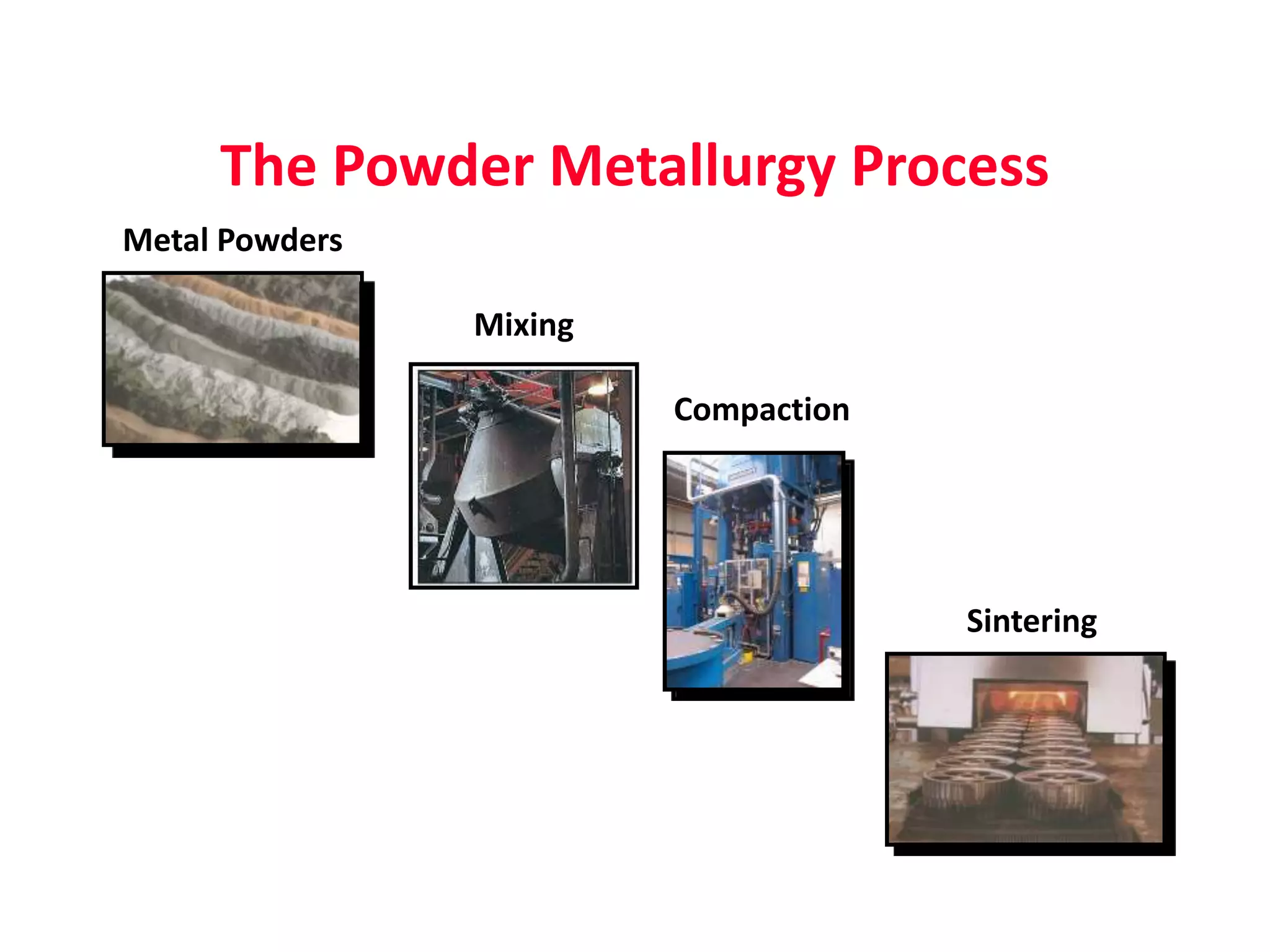
The Powder Metallurgy Process
Metal Powders
Mixing
Compaction
Sintering
Powder Metallurgy Applications
The first modern powder metallurgy product was the
tungsten filament of electric light bulbs developed in the
early 1900s.
Today the industry is truly international and growing in all
the major industrialized countries.
Companies range from those producing conventional
powdered metal parts using iron and copper-based
powders through to manufacturers of specialty products
including superalloys, porous products, friction materials,
magnetic powder cores and ferrites, tungsten carbide
cutting tools and wear parts.
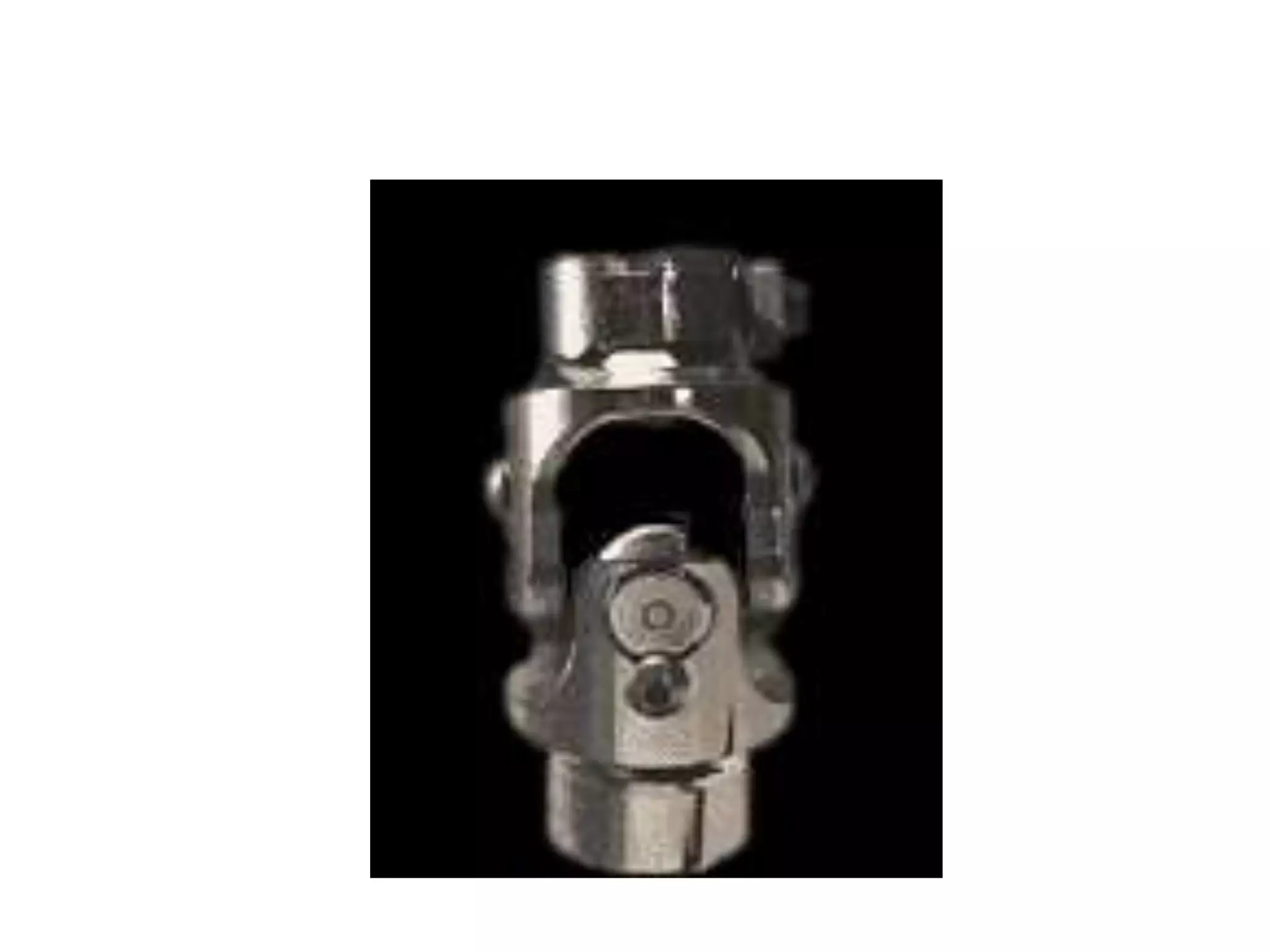
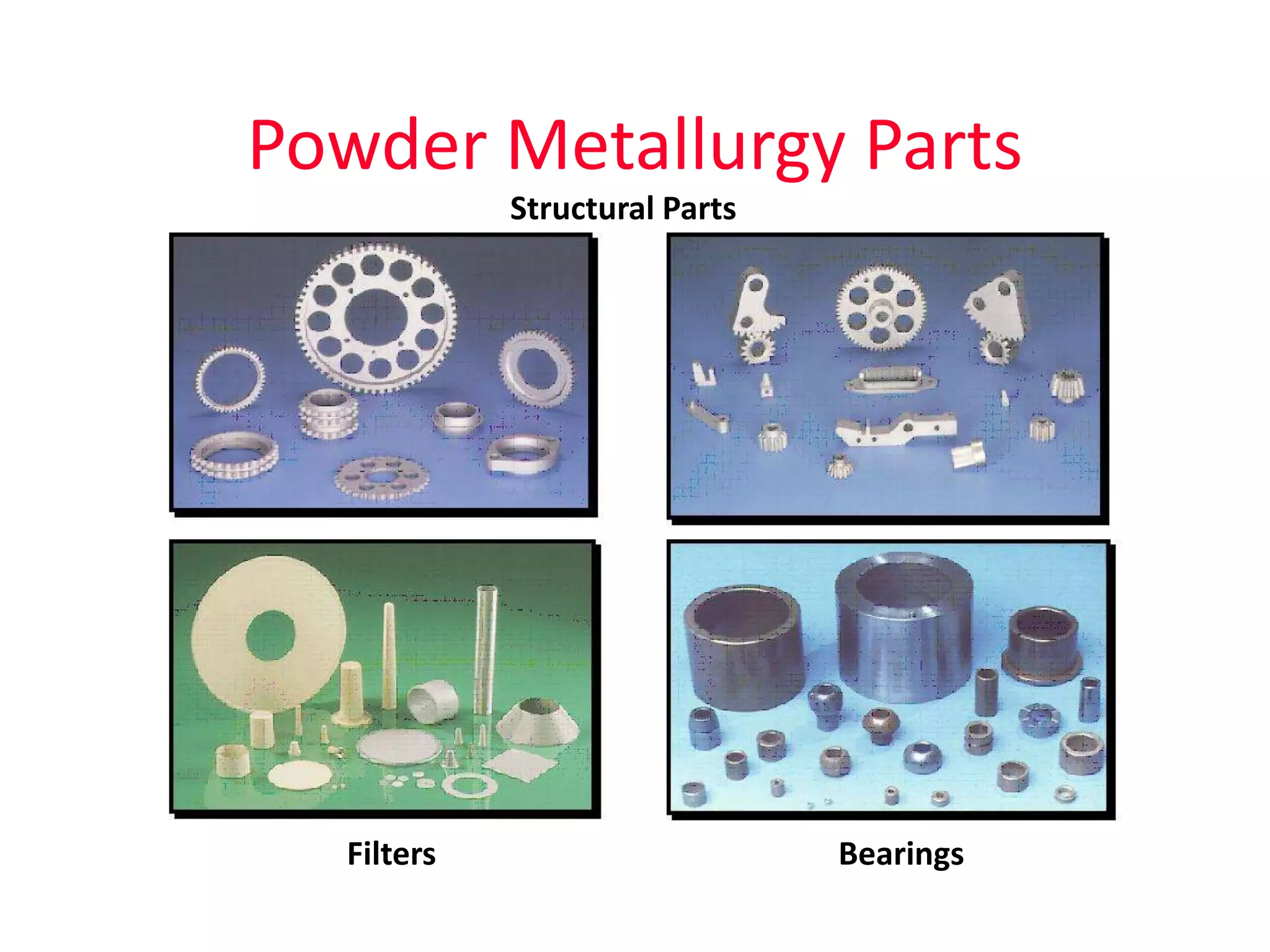
Powder Metallurgy Parts
Sintered Structural Components
Filters
Sintered Structural Components
Sintered Oil-Retaining Bearings
Filters
Structural Parts
Bearings
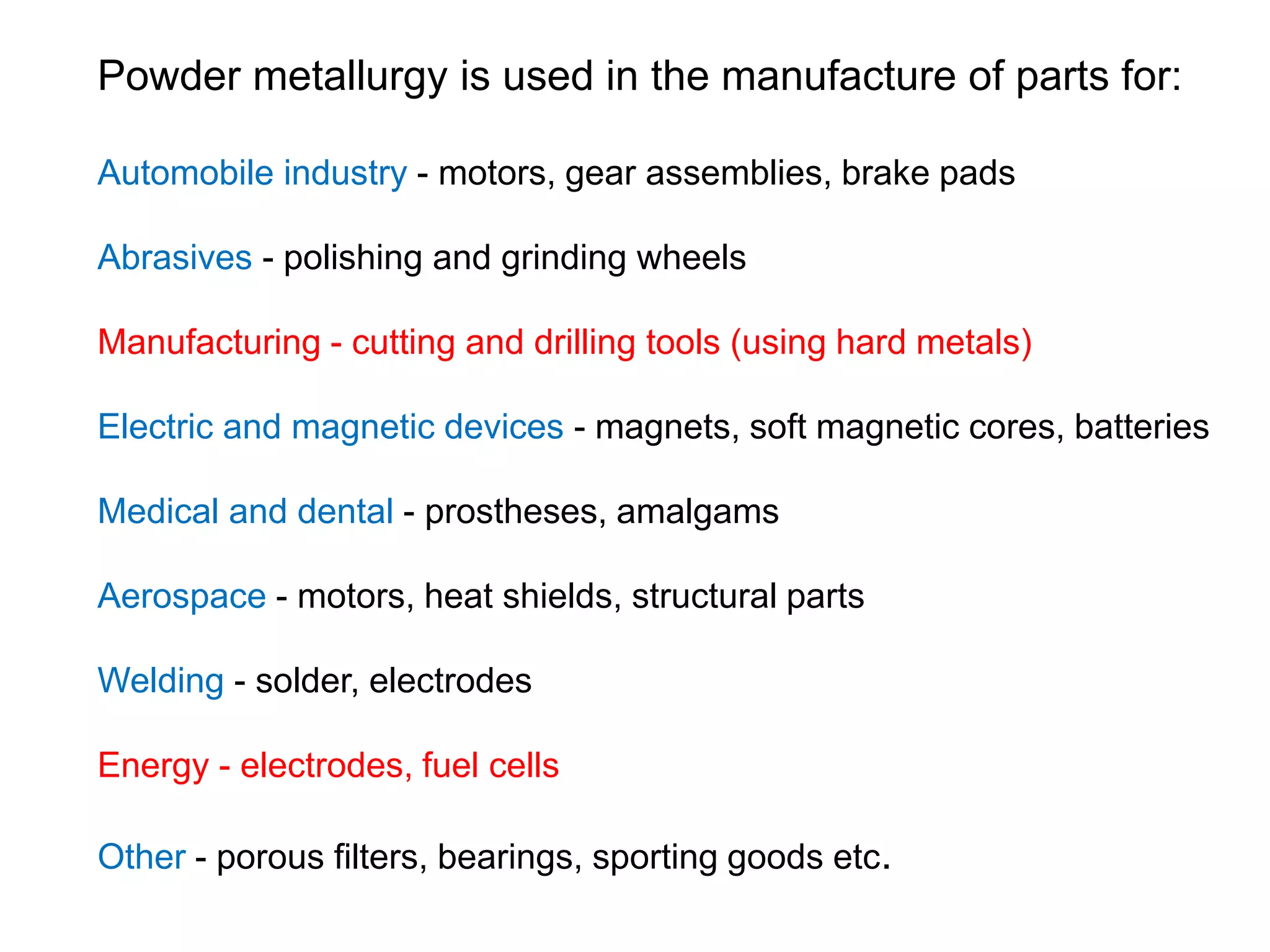
Powder metallurgy is used in the manufacture of parts for:
Automobile industry - motors, gear assemblies, brake pads
Abrasives - polishing and grinding wheels
Manufacturing - cutting and drilling tools (using hard metals)
Electric and magnetic devices - magnets, soft magnetic cores, batteries
Medical and dental - prostheses, amalgams
Aerospace - motors, heat shields, structural parts
Welding - solder, electrodes
Energy - electrodes, fuel cells
Other - porous filters, bearings, sporting goods etc.
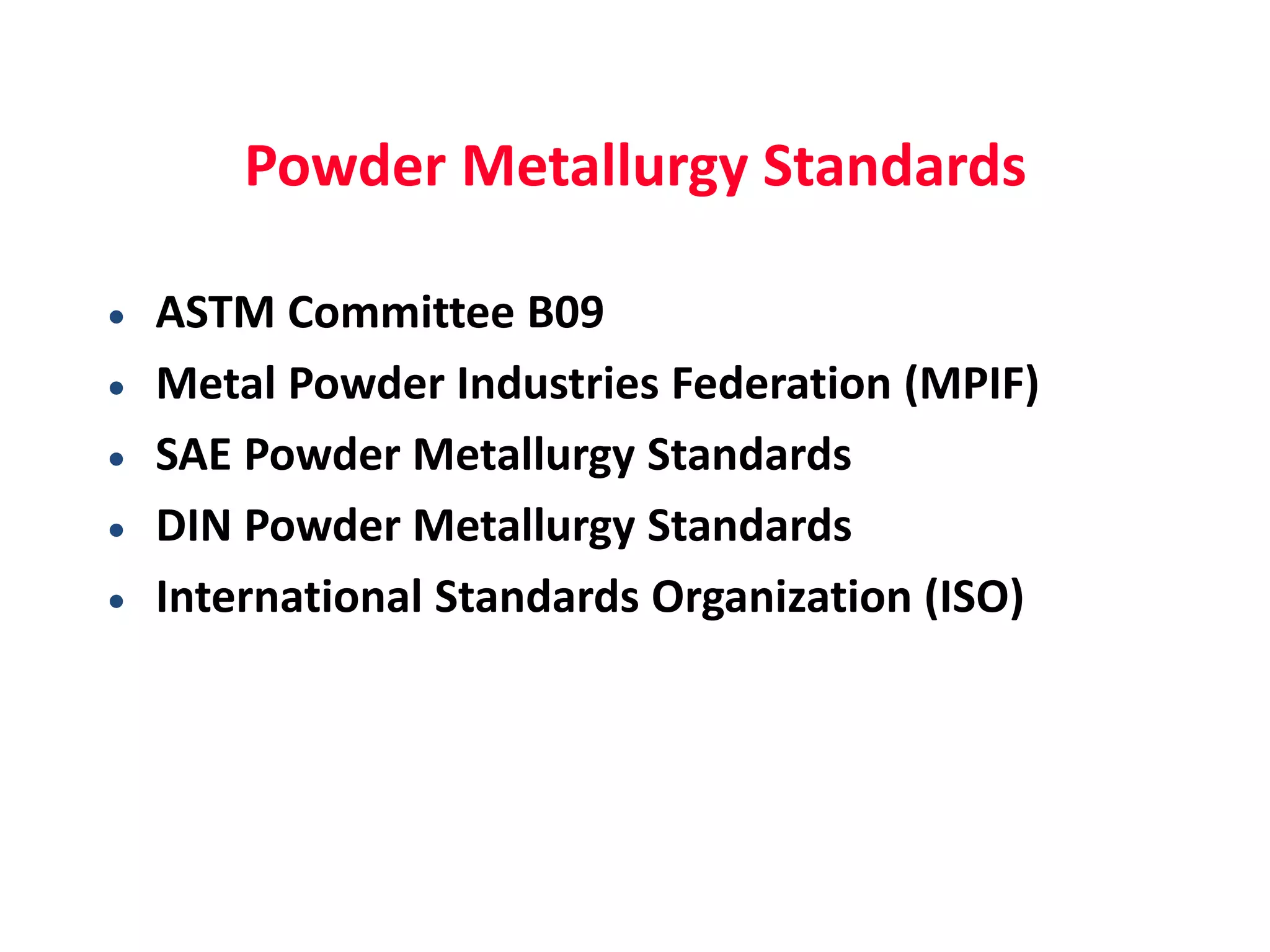
Powder Metallurgy Standards
 ASTM Committee B09
 Metal Powder Industries Federation (MPIF)
 SAE Powder Metallurgy Standards
 DIN Powder Metallurgy Standards
 International Standards Organization (ISO)
Thank You
Ref. : Materials Science and Engineering
An Introduction by William D. Callister, Jr.
Pl refer vidoe link shared for pratical understanding

Class 0 powder metallurgy

  • 1.
    Course : EngineeringMetallurgy Dr Vishvesh J Badhek,Prof & HoD, Mechanical Enginereing Dept, SoT,PDPU Fabrication of Metals Powder Metallurgy
  • 2.
  • 3.
    Classification Metal Fabrication Techniques FormingOperation Casting Miscellaneous Forging Rolling Extrusion Drawing Sand Die Investment Continuous Powder Metallurgy Welding
  • 12.
    Powder metallurgy • Thecompaction of powdered metal, followed by a heat treatment to produce a more dense piece. The process is appropriately called powder metallurgy, frequently designated as P/M.
  • 13.
    • Powder metallurgymakes it possible to produce a virtually nonporous piece having properties almost equivalent to the fully dense parent material. • Diffusional processes during the heat treatment are central to the development of these properties
  • 14.
    Suitability • This methodis especially suitable for metals having low ductility's, since only small plastic deformation of the powder particles need occur. • Metals having high melting temperatures are difficult to melt and cast, and fabrication is expedited using P/M.
  • 15.
    Applications • Furthermore, partsthat require very close dimensional tolerances (e.g., bushings and gears) may be economically produced using this technique
  • 16.
    Process Schematic of theP/M process. • We start with the raw materials that need to be mixed to prepare them for the next stage of the process - compaction. • During compaction the powders are consolidated into a net shaped or a near net shaped component. The as-pressed component is called a green compact. • During the next stage of the P/M process the green compact is sintered in a furnace that is filled with an inert or reducing gas atmosphere. • In the first zone of the sintering furnace the lubricant that was added during the initial mixing step is removed from the compact. The lubricant is needed to assist the powder particle rearrangement that occurs during compaction and then to help reduce frictional forces during ejection of the compacted part from the die cavity. • As the temperature is increased in subsequent zones of the sintering furnace, the metal powder particles begin to bond to one another via a process called diffusion.
  • 17.
    • Diffusion processesalso permit admixed powders to alloy with the base powder of the initial mixture to develop the desired alloy composition. • The extent of diffusion at the end of the high-heat zone of the furnace determines the hardenability of the sintered material. This, in turn, determines the microstructure that will be developed in the sintered compact upon cooling to ambient temperature. • Some P/M parts are ready to be used in the as-sintered condition. • Others need to be sized to qualify their dimensions, some are machined to add a feature not incorporated during compaction, while some need to be heat treated.
  • 18.
    The P/M Process Raw Materials Compaction Sintering Secondary Operations Mixing Elementalor Alloy Powders + Additives Graphite Lubricants Controlled Atmosphere Repressing; Heat Treatment; Machining; Welding
  • 19.
    The Powder MetallurgyProcess Metal Powders Mixing Compaction Sintering
  • 20.
  • 21.
    The first modernpowder metallurgy product was the tungsten filament of electric light bulbs developed in the early 1900s. Today the industry is truly international and growing in all the major industrialized countries. Companies range from those producing conventional powdered metal parts using iron and copper-based powders through to manufacturers of specialty products including superalloys, porous products, friction materials, magnetic powder cores and ferrites, tungsten carbide cutting tools and wear parts.
  • 22.
    Powder Metallurgy Parts SinteredStructural Components Filters Sintered Structural Components Sintered Oil-Retaining Bearings Filters Structural Parts Bearings
  • 23.
    Powder metallurgy isused in the manufacture of parts for: Automobile industry - motors, gear assemblies, brake pads Abrasives - polishing and grinding wheels Manufacturing - cutting and drilling tools (using hard metals) Electric and magnetic devices - magnets, soft magnetic cores, batteries Medical and dental - prostheses, amalgams Aerospace - motors, heat shields, structural parts Welding - solder, electrodes Energy - electrodes, fuel cells Other - porous filters, bearings, sporting goods etc.
  • 24.
    Powder Metallurgy Standards ASTM Committee B09  Metal Powder Industries Federation (MPIF)  SAE Powder Metallurgy Standards  DIN Powder Metallurgy Standards  International Standards Organization (ISO)
  • 25.
    Thank You Ref. :Materials Science and Engineering An Introduction by William D. Callister, Jr. Pl refer vidoe link shared for pratical understanding

Editor's Notes

  • #19 Here is a schematic of the P/M process. We start with the raw materials that need to be mixed to prepare them for the next stage of the process - compaction. During compaction the powders are consolidated into a net shaped or a near net shaped component. The as-pressed component is called a green compact. During the next stage of the P/M process the green compact is sintered in a furnace that is filled with an inert or reducing gas atmosphere. In the first zone of the sintering furnace the lubricant that was added during the initial mixing step is removed from the compact. The lubricant is needed to assist the powder particle rearrangement that occurs during compaction and then to help reduce frictional forces during ejection of the compacted part from the die cavity. As the temperature is increased in subsequent zones of the sintering furnace, the metal powder particles begin to bond to one another via a process called diffusion. Diffusion processes also permit admixed powders to alloy with the base powder of the initial mixture to develop the desired alloy composition. The extent of diffusion at the end of the high-heat zone of the furnace determines the hardenability of the sintered material. This, in turn, determines the microstructure that will be developed in the sintered compact upon cooling to ambient temperature. Some P/M parts are ready to be used in the as-sintered condition. Others need to be sized to qualify their dimensions, some are machined to add a feature not incorporated during compaction, while some need to be heat treated.
  • #20 The powder metallurgy process consists of taking metal powders and mixing them with graphite, lubricants, and alloy additions. The powder mixture is then transferred to a die cavity and compacted to the desired shape. Compacting pressures for ferrous powders range from 415 to 690 MPa (30 to 50 tsi). The as-compacted part is called a “green” compact. It is sintered in a controlled atmosphere furnace – typically at 1120 0C (2050 0F) – in order to metallurgically bond the metal particles to one another. Some parts are used directly in the as-sintered condition but many are subjected to secondary operations such as sizing (to qualify dimensions), tumbling (to remove burrs and sharp edges), heat treatment (to develop the desired microstructure), or machining.
  • #23 Here are some examples of P/M structural parts, some P/M filters, and some self-lubricating P/M bearings.
  • #25 The P/M industry has its associated standards. ASTM has Committee B09, that develops test methods and specifications related to metal powders and metal powder components. The Metal Powder Industries Federation has several associations who have their own individual standards groups. Although SAE has a P/M standard, its use has tended to be superceded by the ASTM and MPIF Standards in recent years. The German DIN Standards are still widely used throughout Europe, and, last but not least in a global economy is the International Standards Organization (ISO).