ME367 NON-DESTRUCTIVE TESTING
MODULE-1(AS PER APJ KTU SYLLABUS)
Sukesh O P, AP-ME , JECC10/16/2018
SUKESH O P/ APME/JECC 1
ME357 Non-Destructive Testing
10/16/2018SUKESH O P/ APME/JECC
2
Introduction to NDT- Visual Inspection- Liquid
Penetrant Inspection- Magnetic Particle
Inspection- Ultrasonic Testing- Radiography
Testing- Eddy Current Testing.
MODULE-1
10/16/2018SUKESH O P/ APME/JECC
3
Introduction to NDT, Comparison between destructive and
NDT, Importance of NDT, Scope of NDT, difficulties of
NDT, future progress in NDT, economics aspects of NDT.
Visual Inspection - tools, applications and limitations -
Fundamentals of visual testing: vision, lighting, material
attributes, environmental factors. visual perception, direct
and indirect methods mirrors, magnifiers, boroscopes, fibro
scopes, closed circuit television, light sources special
lighting, a systems, computer enhanced system.
Why are metals tested ?
 Ensure quality
 Test properties
 Prevent failure in use
 Make informed choices in using materials
Factor of Safety is the ratio comparing the actual
stress on a material and the safe useable stress.
Two forms of testing
 Mechanical tests – the material may be physically
tested to destruction. Will normally specify a value
for properties such as strength, hardness, toughness,
etc.
 Non-destructive tests (NDT) – samples or finished
articles are tested before being used.
DESTRUCTIVE TESTING
10/16/2018SUKESH O P/ APME/JECC
6
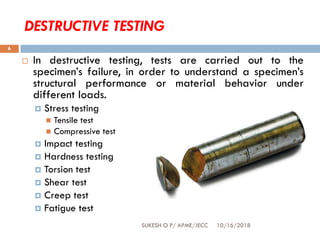
 In destructive testing, tests are carried out to the
specimen’s failure, in order to understand a specimen’s
structural performance or material behavior under
different loads.
 Stress testing
 Tensile test
 Compressive test
 Impact testing
 Hardness testing
 Torsion test
 Shear test
 Creep test
 Fatigue test
HARDNESS TESTING
Hardness is the ability to withstand indentation or
scratches
Types :-
 Brinell hardness test
 Vickers hardness test
 Rockwell hardness tests
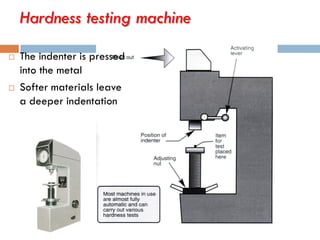
Hardness testing machine
 The indenter is pressed
into the metal
 Softer materials leave
a deeper indentation
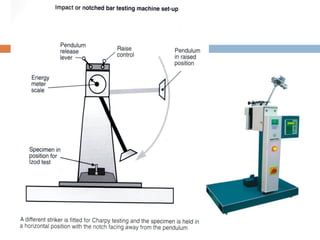
Impact Tests
 Toughness of metals is the ability to withstand
impact.
 Types :-
 Izod test
 Charpy impact test
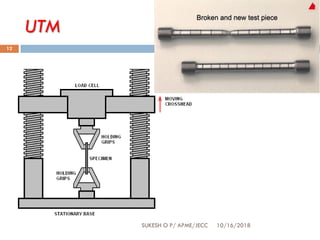
Tensile Testing
 Uses an extensometer to apply measured force to
an test specimen. The amount of extension can be
measured and graphed.
 Variables such as strain, stress, elasticity, tensile
strength, ductility and shear strength can be gauged.
 Test specimens can be round or flat.
UTM
10/16/2018SUKESH O P/ APME/JECC
12
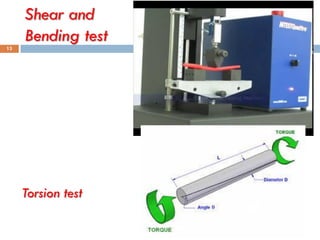
Shear and
Bending test
10/16/2018SUKESH O P/ APME/JECC
13
Torsion test
Non Destructive Testing
Nondestructive testing (NDT) has been defined as
comprising those test methods used to examine an
object, material or system without impairing its
future usefulness. The term is generally applied to
nonmedical investigations of material integrity .
NON-DESTRUCTIVE TESTING- Introduction
 Non destructive testing(NDT) is one of the important
methods used for evolution and quality control of
metal components
 During testing, the metal component does not get
damaged.
 NDT plays a crucial role in everyday life and is
necessary to assure safety and reliability.
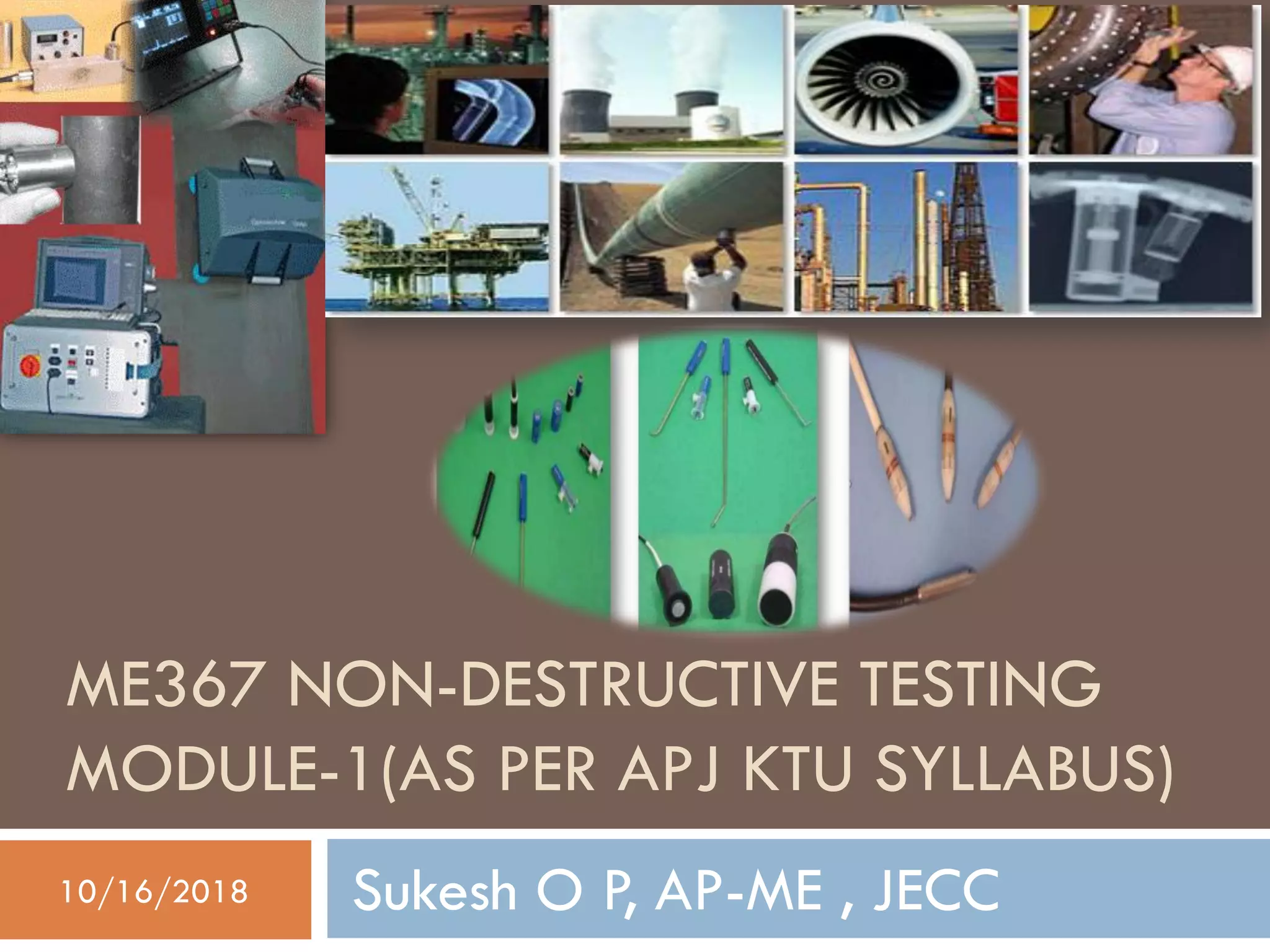
 Typical examples are found in aircraft, spacecraft
(shuttle), motor vehicles, pipelines, bridges, trains,
power stations, refineries, buildings and oil platforms
which are all inspected using NDT.
10/16/2018SUKESH O P/ APME/JECC
15
NON-DESTRUCTIVE TESTING- Introduction
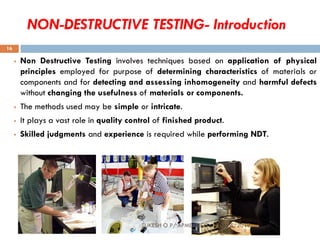
 Non Destructive Testing involves techniques based on application of physical
principles employed for purpose of determining characteristics of materials or
components and for detecting and assessing inhomogeneity and harmful defects
without changing the usefulness of materials or components.
 The methods used may be simple or intricate.
 It plays a vast role in quality control of finished product.
 Skilled judgments and experience is required while performing NDT.
SUKESH O P/ APME/JECC 10/16/2018
16
Characteristics of NDT
 Applied directly to the
product
 Tested parts are not
damaged
 Various tests can be
performed on the same
product
 Specimen preparation
not required
 Can be performed on
parts that are in service
 Low time consumption
 Low labour cost
Types of defects
1. Inherent defect: are formed during the initial
production of raw material. Ex: Porosity, cavity, voids etc
2. Processing defect: are formed during the processing
of component. Ex: surface and subsurface cracks developing due to
mechanical and thermal processing like grinding, heat treatment etc.,
3. Service defects : are formed during operating cycle
of component. Ex: surface and subsurface cracks due to fatigue, stress
corrosion, hydrogen embrittlement, pitting etc
NON-DESTRUCTIVE TESTING- Industrial Use
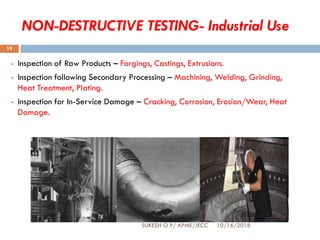
 Inspection of Raw Products – Forgings, Castings, Extrusions.
 Inspection following Secondary Processing – Machining, Welding, Grinding,
Heat Treatment, Plating.
 Inspection for In-Service Damage – Cracking, Corrosion, Erosion/Wear, Heat
Damage.
SUKESH O P/ APME/JECC 10/16/2018
19
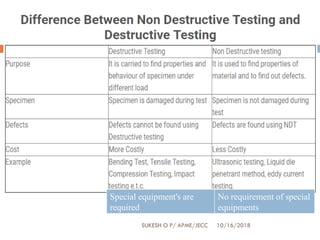
10/16/2018SUKESH O P/ APME/JECC
20
Special equipment's are
required
No requirement of special
equipments
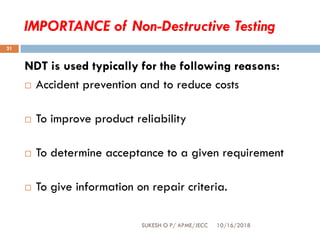
IMPORTANCE of Non-Destructive Testing
10/16/2018SUKESH O P/ APME/JECC
21
NDT is used typically for the following reasons:
 Accident prevention and to reduce costs
 To improve product reliability
 To determine acceptance to a given requirement
 To give information on repair criteria.
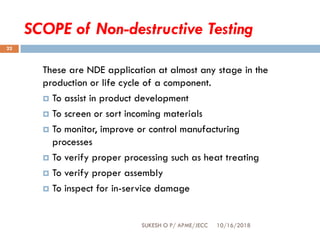
SCOPE of Non-destructive Testing
These are NDE application at almost any stage in the
production or life cycle of a component.
 To assist in product development
 To screen or sort incoming materials
 To monitor, improve or control manufacturing
processes
 To verify proper processing such as heat treating
 To verify proper assembly
 To inspect for in-service damage
10/16/2018SUKESH O P/ APME/JECC
22
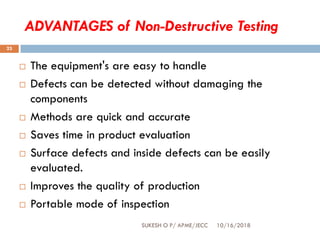
ADVANTAGES of Non-Destructive Testing
 The equipment's are easy to handle
 Defects can be detected without damaging the
components
 Methods are quick and accurate
 Saves time in product evaluation
 Surface defects and inside defects can be easily
evaluated.
 Improves the quality of production
 Portable mode of inspection
10/16/2018SUKESH O P/ APME/JECC
23
DIFFICULTIES of Non-Destructive Testing
10/16/2018SUKESH O P/ APME/JECC
24
 Lack of skilled operators.
 Radiation hazards.
 Power source required.
 High cost of equipment.
 Surface must be clean and smooth.
 Demagnetization may be needed.
FUTURE PROGRESS in Non-Destructive Testing
10/16/2018SUKESH O P/ APME/JECC
25
 There are two general trends within the NDT community that are influencing
development and both centre around the operator. On the one hand,
instrumentation is being developed to reduce the operator's involvement as much as
possible through automating functions and computerizing results. On the other side
there are significant efforts to quantify or standardize the human element through
training and qualification.
 Second in importance is an increasing demand from users for more precision, more
reliability and more speed. As users become more dependent on NDT results, to
support extended component life and lower factors of safety, this pressure will
increase. Finally the need for specialist technicians as well as applications specialists
will grow to cope with the many opportunities being presented.
 There is a new factor coming into NDT, which seems likely to bring major
modifications to most NDT methods. This is the use of computer techniques, using
small computers. Apart from the obvious, rather trivial uses to simplify calculations, it
is now possible to collect, store and process vast quantities of digital data at very
high speeds.
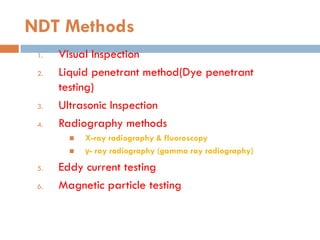
Types of Non-Destructive Testing
Visual
Examination
Liquid Penetrant
Testing
Magnetic Particle
Testing
Eddy Current
Testing Radiography Ultrasonic
Testing
SUKESH O P/ APME/JECC 10/16/2018
26
NDT Methods
1. Visual Inspection
2. Liquid penetrant method(Dye penetrant
testing)
3. Ultrasonic Inspection
4. Radiography methods
 X-ray radiography & fluoroscopy
 γ- ray radiography (gamma ray radiography)
5. Eddy current testing
6. Magnetic particle testing
APPLICATIONS of NDT
Power Plant Inspection
Wire Rope Inspection
Storage Tank Inspection
Aircraft Inspection
Jet Engine Inspection
Rail Line Inspection
Bridge Inspection
Pipe Line Inspection
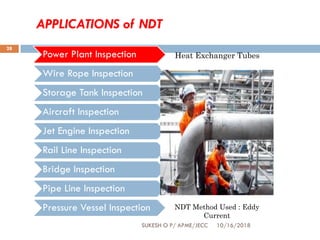
Pressure Vessel Inspection NDT Method Used : Eddy
Current
Heat Exchanger Tubes
SUKESH O P/ APME/JECC 10/16/2018
28
APPLICATIONS of NDT
Power Plant Inspection
Wire Rope Inspection
Storage Tank Inspection
Aircraft Inspection
Jet Engine Inspection
Rail Line Inspection
Bridge Inspection
Pipe Line Inspection
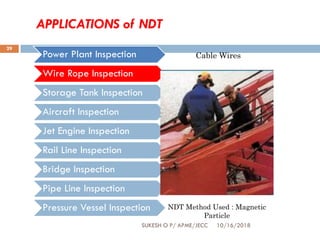
Pressure Vessel Inspection NDT Method Used : Magnetic
Particle
Cable Wires
SUKESH O P/ APME/JECC 10/16/2018
29
APPLICATIONS of NDT
Power Plant Inspection
Wire Rope Inspection
Storage Tank Inspection
Aircraft Inspection
Jet Engine Inspection
Rail Line Inspection
Bridge Inspection
Pipe Line Inspection
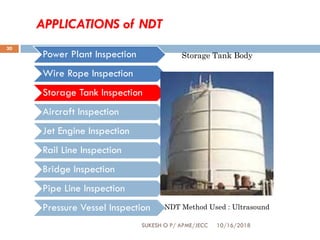
Pressure Vessel Inspection NDT Method Used : Ultrasound
Storage Tank Body
SUKESH O P/ APME/JECC 10/16/2018
30
APPLICATIONS of NDT
Power Plant Inspection
Wire Rope Inspection
Storage Tank Inspection
Aircraft Inspection
Jet Engine Inspection
Rail Line Inspection
Bridge Inspection
Pipe Line Inspection
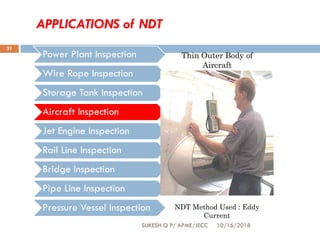
Pressure Vessel Inspection NDT Method Used : Eddy
Current
Thin Outer Body of
Aircraft
SUKESH O P/ APME/JECC 10/16/2018
31
APPLICATIONS of NDT
Power Plant Inspection
Wire Rope Inspection
Storage Tank Inspection
Aircraft Inspection
Jet Engine Inspection
Rail Line Inspection
Bridge Inspection
Pipe Line Inspection
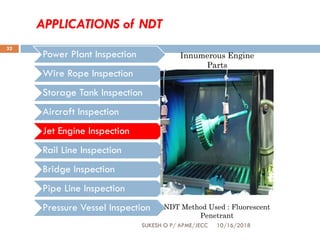
Pressure Vessel Inspection NDT Method Used : Fluorescent
Penetrant
Innumerous Engine
Parts
SUKESH O P/ APME/JECC 10/16/2018
32
APPLICATIONS of NDT
Power Plant Inspection
Wire Rope Inspection
Storage Tank Inspection
Aircraft Inspection
Jet Engine Inspection
Rail Line Inspection
Bridge Inspection
Pipe Line Inspection
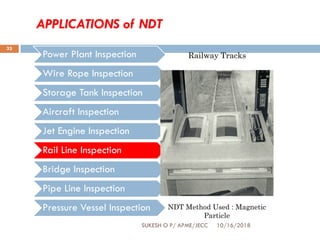
Pressure Vessel Inspection NDT Method Used : Magnetic
Particle
Railway Tracks
SUKESH O P/ APME/JECC 10/16/2018
33
APPLICATIONS of NDT
Power Plant Inspection
Wire Rope Inspection
Storage Tank Inspection
Aircraft Inspection
Jet Engine Inspection
Rail Line Inspection
Bridge Inspection
Pipe Line Inspection
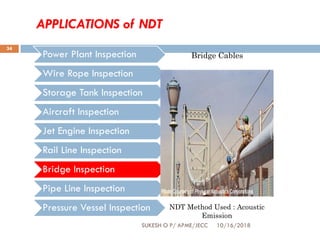
Pressure Vessel Inspection NDT Method Used : Acoustic
Emission
Bridge Cables
SUKESH O P/ APME/JECC 10/16/2018
34
APPLICATIONS of NDT
Power Plant Inspection
Wire Rope Inspection
Storage Tank Inspection
Aircraft Inspection
Jet Engine Inspection
Rail Line Inspection
Bridge Inspection
Pipe Line Inspection
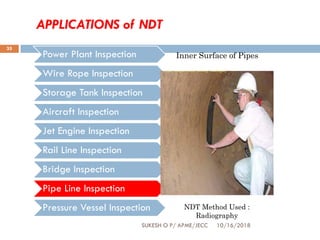
Pressure Vessel Inspection NDT Method Used :
Radiography
Inner Surface of Pipes
SUKESH O P/ APME/JECC 10/16/2018
35
APPLICATIONS of NDT
Power Plant Inspection
Wire Rope Inspection
Storage Tank Inspection
Aircraft Inspection
Jet Engine Inspection
Rail Line Inspection
Bridge Inspection
Pipe Line Inspection
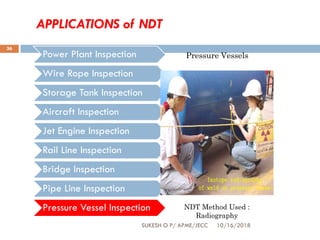
Pressure Vessel Inspection NDT Method Used :
Radiography
Pressure Vessels
SUKESH O P/ APME/JECC 10/16/2018
36
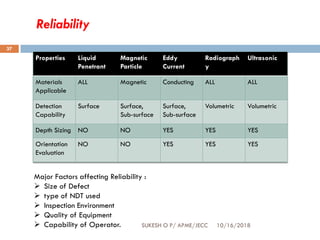
Reliability
Properties Liquid
Penetrant
Magnetic
Particle
Eddy
Current
Radiograph
y
Ultrasonic
Materials
Applicable
ALL Magnetic Conducting ALL ALL
Detection
Capability
Surface Surface,
Sub-surface
Surface,
Sub-surface
Volumetric Volumetric
Depth Sizing NO NO YES YES YES
Orientation
Evaluation
NO NO YES YES YES
Major Factors affecting Reliability :
 Size of Defect
 type of NDT used
 Inspection Environment
 Quality of Equipment
 Capability of Operator. SUKESH O P/ APME/JECC 10/16/2018
37
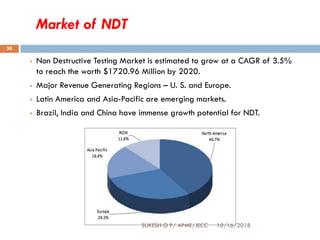
Market of NDT
 Non Destructive Testing Market is estimated to grow at a CAGR of 3.5%
to reach the worth $1720.96 Million by 2020.
 Major Revenue Generating Regions – U. S. and Europe.
 Latin America and Asia-Pacific are emerging markets.
 Brazil, India and China have immense growth potential for NDT.
SUKESH O P/ APME/JECC 10/16/2018
38
THANK YOU
SUKESH O P/ APME/JECC 10/16/2018
39
10/16/2018SUKESH O P/ APME/JECC
40

Non Destructive Testing

  • 1.
    ME367 NON-DESTRUCTIVE TESTING MODULE-1(ASPER APJ KTU SYLLABUS) Sukesh O P, AP-ME , JECC10/16/2018 SUKESH O P/ APME/JECC 1
  • 2.
    ME357 Non-Destructive Testing 10/16/2018SUKESHO P/ APME/JECC 2 Introduction to NDT- Visual Inspection- Liquid Penetrant Inspection- Magnetic Particle Inspection- Ultrasonic Testing- Radiography Testing- Eddy Current Testing.
  • 3.
    MODULE-1 10/16/2018SUKESH O P/APME/JECC 3 Introduction to NDT, Comparison between destructive and NDT, Importance of NDT, Scope of NDT, difficulties of NDT, future progress in NDT, economics aspects of NDT. Visual Inspection - tools, applications and limitations - Fundamentals of visual testing: vision, lighting, material attributes, environmental factors. visual perception, direct and indirect methods mirrors, magnifiers, boroscopes, fibro scopes, closed circuit television, light sources special lighting, a systems, computer enhanced system.
  • 4.
    Why are metalstested ?  Ensure quality  Test properties  Prevent failure in use  Make informed choices in using materials Factor of Safety is the ratio comparing the actual stress on a material and the safe useable stress.
  • 5.
    Two forms oftesting  Mechanical tests – the material may be physically tested to destruction. Will normally specify a value for properties such as strength, hardness, toughness, etc.  Non-destructive tests (NDT) – samples or finished articles are tested before being used.
  • 6.
    DESTRUCTIVE TESTING 10/16/2018SUKESH OP/ APME/JECC 6  In destructive testing, tests are carried out to the specimen’s failure, in order to understand a specimen’s structural performance or material behavior under different loads.  Stress testing  Tensile test  Compressive test  Impact testing  Hardness testing  Torsion test  Shear test  Creep test  Fatigue test
  • 7.
    HARDNESS TESTING Hardness isthe ability to withstand indentation or scratches Types :-  Brinell hardness test  Vickers hardness test  Rockwell hardness tests
  • 8.
    Hardness testing machine The indenter is pressed into the metal  Softer materials leave a deeper indentation
  • 9.
    Impact Tests  Toughnessof metals is the ability to withstand impact.  Types :-  Izod test  Charpy impact test
  • 11.
    Tensile Testing  Usesan extensometer to apply measured force to an test specimen. The amount of extension can be measured and graphed.  Variables such as strain, stress, elasticity, tensile strength, ductility and shear strength can be gauged.  Test specimens can be round or flat.
  • 12.
  • 13.
    Shear and Bending test 10/16/2018SUKESHO P/ APME/JECC 13 Torsion test
  • 14.
    Non Destructive Testing Nondestructivetesting (NDT) has been defined as comprising those test methods used to examine an object, material or system without impairing its future usefulness. The term is generally applied to nonmedical investigations of material integrity .
  • 15.
    NON-DESTRUCTIVE TESTING- Introduction Non destructive testing(NDT) is one of the important methods used for evolution and quality control of metal components  During testing, the metal component does not get damaged.  NDT plays a crucial role in everyday life and is necessary to assure safety and reliability.  Typical examples are found in aircraft, spacecraft (shuttle), motor vehicles, pipelines, bridges, trains, power stations, refineries, buildings and oil platforms which are all inspected using NDT. 10/16/2018SUKESH O P/ APME/JECC 15
  • 16.
    NON-DESTRUCTIVE TESTING- Introduction Non Destructive Testing involves techniques based on application of physical principles employed for purpose of determining characteristics of materials or components and for detecting and assessing inhomogeneity and harmful defects without changing the usefulness of materials or components.  The methods used may be simple or intricate.  It plays a vast role in quality control of finished product.  Skilled judgments and experience is required while performing NDT. SUKESH O P/ APME/JECC 10/16/2018 16
  • 17.
    Characteristics of NDT Applied directly to the product  Tested parts are not damaged  Various tests can be performed on the same product  Specimen preparation not required  Can be performed on parts that are in service  Low time consumption  Low labour cost
  • 18.
    Types of defects 1.Inherent defect: are formed during the initial production of raw material. Ex: Porosity, cavity, voids etc 2. Processing defect: are formed during the processing of component. Ex: surface and subsurface cracks developing due to mechanical and thermal processing like grinding, heat treatment etc., 3. Service defects : are formed during operating cycle of component. Ex: surface and subsurface cracks due to fatigue, stress corrosion, hydrogen embrittlement, pitting etc
  • 19.
    NON-DESTRUCTIVE TESTING- IndustrialUse  Inspection of Raw Products – Forgings, Castings, Extrusions.  Inspection following Secondary Processing – Machining, Welding, Grinding, Heat Treatment, Plating.  Inspection for In-Service Damage – Cracking, Corrosion, Erosion/Wear, Heat Damage. SUKESH O P/ APME/JECC 10/16/2018 19
  • 20.
    10/16/2018SUKESH O P/APME/JECC 20 Special equipment's are required No requirement of special equipments
  • 21.
    IMPORTANCE of Non-DestructiveTesting 10/16/2018SUKESH O P/ APME/JECC 21 NDT is used typically for the following reasons:  Accident prevention and to reduce costs  To improve product reliability  To determine acceptance to a given requirement  To give information on repair criteria.
  • 22.
    SCOPE of Non-destructiveTesting These are NDE application at almost any stage in the production or life cycle of a component.  To assist in product development  To screen or sort incoming materials  To monitor, improve or control manufacturing processes  To verify proper processing such as heat treating  To verify proper assembly  To inspect for in-service damage 10/16/2018SUKESH O P/ APME/JECC 22
  • 23.
    ADVANTAGES of Non-DestructiveTesting  The equipment's are easy to handle  Defects can be detected without damaging the components  Methods are quick and accurate  Saves time in product evaluation  Surface defects and inside defects can be easily evaluated.  Improves the quality of production  Portable mode of inspection 10/16/2018SUKESH O P/ APME/JECC 23
  • 24.
    DIFFICULTIES of Non-DestructiveTesting 10/16/2018SUKESH O P/ APME/JECC 24  Lack of skilled operators.  Radiation hazards.  Power source required.  High cost of equipment.  Surface must be clean and smooth.  Demagnetization may be needed.
  • 25.
    FUTURE PROGRESS inNon-Destructive Testing 10/16/2018SUKESH O P/ APME/JECC 25  There are two general trends within the NDT community that are influencing development and both centre around the operator. On the one hand, instrumentation is being developed to reduce the operator's involvement as much as possible through automating functions and computerizing results. On the other side there are significant efforts to quantify or standardize the human element through training and qualification.  Second in importance is an increasing demand from users for more precision, more reliability and more speed. As users become more dependent on NDT results, to support extended component life and lower factors of safety, this pressure will increase. Finally the need for specialist technicians as well as applications specialists will grow to cope with the many opportunities being presented.  There is a new factor coming into NDT, which seems likely to bring major modifications to most NDT methods. This is the use of computer techniques, using small computers. Apart from the obvious, rather trivial uses to simplify calculations, it is now possible to collect, store and process vast quantities of digital data at very high speeds.
  • 26.
    Types of Non-DestructiveTesting Visual Examination Liquid Penetrant Testing Magnetic Particle Testing Eddy Current Testing Radiography Ultrasonic Testing SUKESH O P/ APME/JECC 10/16/2018 26
  • 27.
    NDT Methods 1. VisualInspection 2. Liquid penetrant method(Dye penetrant testing) 3. Ultrasonic Inspection 4. Radiography methods  X-ray radiography & fluoroscopy  γ- ray radiography (gamma ray radiography) 5. Eddy current testing 6. Magnetic particle testing
  • 28.
    APPLICATIONS of NDT PowerPlant Inspection Wire Rope Inspection Storage Tank Inspection Aircraft Inspection Jet Engine Inspection Rail Line Inspection Bridge Inspection Pipe Line Inspection Pressure Vessel Inspection NDT Method Used : Eddy Current Heat Exchanger Tubes SUKESH O P/ APME/JECC 10/16/2018 28
  • 29.
    APPLICATIONS of NDT PowerPlant Inspection Wire Rope Inspection Storage Tank Inspection Aircraft Inspection Jet Engine Inspection Rail Line Inspection Bridge Inspection Pipe Line Inspection Pressure Vessel Inspection NDT Method Used : Magnetic Particle Cable Wires SUKESH O P/ APME/JECC 10/16/2018 29
  • 30.
    APPLICATIONS of NDT PowerPlant Inspection Wire Rope Inspection Storage Tank Inspection Aircraft Inspection Jet Engine Inspection Rail Line Inspection Bridge Inspection Pipe Line Inspection Pressure Vessel Inspection NDT Method Used : Ultrasound Storage Tank Body SUKESH O P/ APME/JECC 10/16/2018 30
  • 31.
    APPLICATIONS of NDT PowerPlant Inspection Wire Rope Inspection Storage Tank Inspection Aircraft Inspection Jet Engine Inspection Rail Line Inspection Bridge Inspection Pipe Line Inspection Pressure Vessel Inspection NDT Method Used : Eddy Current Thin Outer Body of Aircraft SUKESH O P/ APME/JECC 10/16/2018 31
  • 32.
    APPLICATIONS of NDT PowerPlant Inspection Wire Rope Inspection Storage Tank Inspection Aircraft Inspection Jet Engine Inspection Rail Line Inspection Bridge Inspection Pipe Line Inspection Pressure Vessel Inspection NDT Method Used : Fluorescent Penetrant Innumerous Engine Parts SUKESH O P/ APME/JECC 10/16/2018 32
  • 33.
    APPLICATIONS of NDT PowerPlant Inspection Wire Rope Inspection Storage Tank Inspection Aircraft Inspection Jet Engine Inspection Rail Line Inspection Bridge Inspection Pipe Line Inspection Pressure Vessel Inspection NDT Method Used : Magnetic Particle Railway Tracks SUKESH O P/ APME/JECC 10/16/2018 33
  • 34.
    APPLICATIONS of NDT PowerPlant Inspection Wire Rope Inspection Storage Tank Inspection Aircraft Inspection Jet Engine Inspection Rail Line Inspection Bridge Inspection Pipe Line Inspection Pressure Vessel Inspection NDT Method Used : Acoustic Emission Bridge Cables SUKESH O P/ APME/JECC 10/16/2018 34
  • 35.
    APPLICATIONS of NDT PowerPlant Inspection Wire Rope Inspection Storage Tank Inspection Aircraft Inspection Jet Engine Inspection Rail Line Inspection Bridge Inspection Pipe Line Inspection Pressure Vessel Inspection NDT Method Used : Radiography Inner Surface of Pipes SUKESH O P/ APME/JECC 10/16/2018 35
  • 36.
    APPLICATIONS of NDT PowerPlant Inspection Wire Rope Inspection Storage Tank Inspection Aircraft Inspection Jet Engine Inspection Rail Line Inspection Bridge Inspection Pipe Line Inspection Pressure Vessel Inspection NDT Method Used : Radiography Pressure Vessels SUKESH O P/ APME/JECC 10/16/2018 36
  • 37.
    Reliability Properties Liquid Penetrant Magnetic Particle Eddy Current Radiograph y Ultrasonic Materials Applicable ALL MagneticConducting ALL ALL Detection Capability Surface Surface, Sub-surface Surface, Sub-surface Volumetric Volumetric Depth Sizing NO NO YES YES YES Orientation Evaluation NO NO YES YES YES Major Factors affecting Reliability :  Size of Defect  type of NDT used  Inspection Environment  Quality of Equipment  Capability of Operator. SUKESH O P/ APME/JECC 10/16/2018 37
  • 38.
    Market of NDT Non Destructive Testing Market is estimated to grow at a CAGR of 3.5% to reach the worth $1720.96 Million by 2020.  Major Revenue Generating Regions – U. S. and Europe.  Latin America and Asia-Pacific are emerging markets.  Brazil, India and China have immense growth potential for NDT. SUKESH O P/ APME/JECC 10/16/2018 38
  • 39.
    THANK YOU SUKESH OP/ APME/JECC 10/16/2018 39
  • 40.