Titanium and Its Alloys
Medium density 4.54 Mg/m3 (steel 7.9 Mg/m3)
 High melting point (1668°C) But relatively strong. σYS ≈
800 MPa (max ≈ 1100 MPa)
 Stiffer than Aluminium; 107 - 116 GPa vs 70 GPa but not
as stiff as steel(207 GPa).
 Highly ductile
Good corrosion resistance
 Good strength to weight ratio
 Expensive production due to reactivity at high
temperature.
 Titanium and Its Alloys
 Almost all Ti alloys contain aluminum
-Al increases ductility, and
-Reduces density
MATERIAL OF THE FUTURE
TITANIUM AND ITS ALLOYS
 Titanium and its alloys are relatively new engineering materials that
possess an extraordinary combination of properties.
 The pure metal has a relatively low density (4.5 g/cm3), a high melting
point [1668C], and an elastic modulus of 107 GPa ( psi).
 Titanium alloys are extremely strong; room temperature
tensile strengths as high as 1400 MPa (200,000 psi) are attainable,
yielding remarkable specific strengths.
 Furthermore, the alloys are highly ductile and easily forged
and machined.
 The major limitation of titanium is its chemical reactivity with other
materials at elevated temperatures.
 This property has necessitated the development of nonconventional
refining, melting, and casting techniques; consequently, titanium
alloys are quite expensive.
 In spite of this high temperature reactivity, the corrosion resistance
of titanium alloys at normal temperatures is unusually high; they
are virtually immune to air, marine, and a variety of industrial
environments
Ti
 Atomic symbol : Ti
 Atomic weight : 47.90
 Electron configuration : [Ar] 4s
 Atomic radius : 144.5
 Melting point : 1668 C
 Boiling point : 3287 C
 Oxidation state : 4,3,2
Sources of Ti
 Meteorites and sun
 Igneous rocks and their
sediments
 Minerals like
rutile,ilmenite,and sphene
 Titanates and iron ore
 Commercially produced by
reducing titanium tetra
chloride (TiCl4)with
magnesium(Mg)
Rutile
Ilmenite
Physical properties of Ti
 Non ferrous metal
 Light weight and corrosion resistance
 Lustrous gray-white metal
 Low density
 Resistant to dil. Sulphuric acid and hydrochloric acid
and most of the organic acids,chlorine gases and
chlorine solutions
 Has high refractive index and optical dispersion
higher than diamond
 Malleable and ductile
Alloys Of Titanium
 Alpha alloy
Alpha alloys are those alloys that typically
contain aluminium(Al),tin (Sn)
They also contain Zr,N,Va,and Si
They do not respond to heat treatment but
they are weldable and are used for cryogenic
application,airplane parts,chemical
equipments
Alloys Of Titanium
 Alpha-Beta Alloys
They can be strengthened by heat
treatment and aging
Used in aircraft and aircraft turbine
parts ,chemical processing equipment,
marine hardware and prosthetic devices
Alloys Of Titanium
 Beta alloy
They have good hardenability,cold formability
when they are aged
They are slightly more denser then other Ti
alloys
They are the least creep resistant alloys ,they
are weldable
They are used for heavier duty purpose
on aircraft
Uses of Ti
for some watch cases and bracelets
in aircraft and space craft
in surgery
in sports equipment, automotive parts
in clubhead and shaft design
to make the outer case of the pacemaker
in some jewellery
APPLICATION OF Ti ALLOYS
Medical Application
Light, strong and totally bio-compatible, titanium is one of few
materials that naturally match the requirements for implantation
in the human body.
Medical grade titanium alloys(Ti-6Al-7Nb,Ti-5Al-2.5Fe,Ti-13Nb-
13Zr ,etc) have a significantly higher strength to weight ratio
than competing stainless steels.
The natural selection of titanium for implantation is determined
by a combination of most favourable characteristics including
immunity to corrosion, bio-compatibility, strength, low modulus
and density and the capacity for joining with bone and other
tissue – osseointegration.
The lower modulus of titanium alloys compared to steel is a
positive factor in reducing bone resorbtion.
.
APPLICATION OF Ti ALLOYS
Medical Application
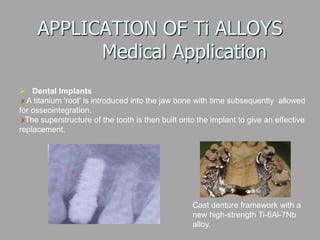
 Dental Implants
A titanium 'root' is introduced into the jaw bone with time subsequently allowed
for osseointegration.
The superstructure of the tooth is then built onto the implant to give an effective
replacement.
Cast denture framework with a
new high-strength Ti-6Al-7Nb
alloy.
APPLICATION OF Ti ALLOYS
Medical Application
 Bone and Joint Replacement
Internal and external bone-fracture fixation provides a
further major application for titanium as spinal fusion
devices, pins, bone-plates, screws, intramedullary nails,
and external fixators
 Cardiovascular devices
Titanium is regularly used for pacemaker cases and
defibrillators, as the carrier structure for replacement
heart valves, and for intra-vascular stents
 External Prostheses
Titanium is suitable for both temporary and long term
external fixations and devices as well as for orthotic
calipers and artificial limbs, both of which use titanium
extensively for its light weight, toughness and corrosion
resistance
.
Biological Ti
Implants
Pacemaker
APPLICATION OF Ti ALLOYS
Medical Application
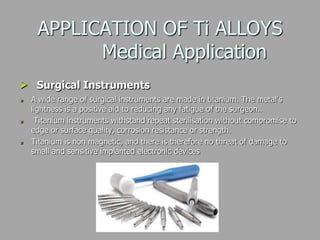
 Surgical Instruments
A wide range of surgical instruments are made in titanium. The metal's
lightness is a positive aid to reducing any fatigue of the surgeon..
Titanium instruments withstand repeat sterilisation without compromise to
edge or surface quality, corrosion resistance or strength.
Titanium is non magnetic, and there is therefore no threat of damage to
small and sensitive implanted electronic devices
APPLICATION OF Ti ALLOYS
Aerospace Application
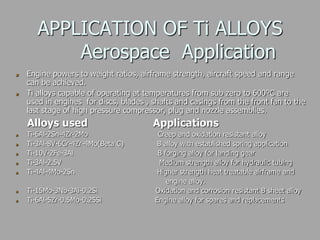
Engine powers to weight ratios, airframe strength, aircraft speed and range
can be achieved.
Ti alloys capable of operating at temperatures from sub zero to 600ºC are
used in engines for discs, blades , shafts and casings from the front fan to the
last stage of high pressure compressor, plug and nozzle assemblies.
Alloys used Applications
Ti-6Al-2Sn-4Zr-2Mo Creep and oxidation resistant alloy
Ti-3Al-8V-6Cr-4Zr-4Mo(Beta C) B alloy with established spring application
Ti-10V-2Fe-3Al B forging alloy for landing gear
Ti-3Al-2.5V Medium strength alloy for hydraulic tubing
Ti-4Al-4Mo-2Sn Higher strength heat treatable airframe and
engine alloy.
Ti-15Mo-3Nb-3Ai-0.2Si Oxidation and corrosion resistant B sheet alloy
Ti-6Al-5Zr-0.5Mo-0.25Si Engine alloy for spares and replacements
APPLICATION OF Ti ALLOYS
Aerospace Application
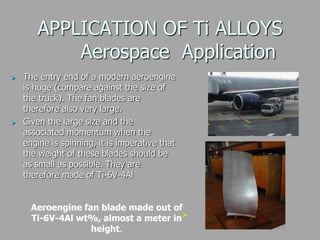
 The entry end of a modern aeroengine
is huge (compare against the size of
the truck). The fan blades are
therefore also very large.
 Given the large size and the
associated momentum when the
engine is spinning, it is imperative that
the weight of these blades should be
as small as possible. They are
therefore made of Ti-6V-4Al
Aeroengine fan blade made out of
Ti-6V-4Al wt%, almost a meter in
height.

APPLICATION OF Ti ALLOYS
Automotive Application
Automotive applications of titanium follow logically from the high strength,
low density and, in select applications, low modulus of titanium alloys, and
their excellent resistance to corrosion and oxidation.
Suspension spring, steering gears, connecting rods
Wheels, drive shafts, bumper supports.
Beta alloys such as Beta-CTM, LCB® (Low Cost Beta), as a class offer
designers many options to select a final combination of properties for
specific application e.g. as valve or suspension springs.
Ti springs Ti fasteners
APPLICATION OF Ti ALLOYS
Other Application
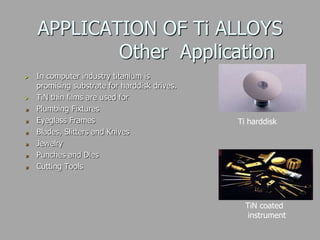
 In computer industry titanium is
promising substrate for harddisk drives.
 TiN thin films are used for
Plumbing Fixtures
Eyeglass Frames
Blades, Slitters and Knives
Jewelry
Punches and Dies
Cutting Tools
Ti harddisk
TiN coated
instrument
Nickel Alloys
Nickel: FCC (tough and ductile)
 Good high and low temperature strength,
high oxidation resistance
 Highly resistant to corrosion especially
alkaline.
 Highly desirable material, but extremely
expensive
Nickel alloys
 Nickel is often coated or plated on some metals
that are susceptible to corrosion as a protective
measure.
 Monel, (65 wt% Ni - 28 wt% Cu & Fe-
balance), has very high strength and is
extremely corrosion resistant; it is used in
pumps, valves, and other components that are
in contact with some acid and petroleum
solutions.
 Chromium improves corrosion resistance and
mechanical properties at elevated temperature
Inconel series (Ni-Cr alloys)
Super alloys
High temperature performance (strength) are used for
• Gas turbines, steam turbines, reciprocating engines
• Hot working and casting tools and dies
• Aircraft & space vehicles
• Nuclear and chemical industries
There are
 Iron based alloys:
- 32% to 67% Fe, 15% to 22% Cr and 9% to 38% Ni.
- common alloys: Incoloy series
 Cobalt based alloys:
- 30% to 65% Co, 19% to 30% Cr and up to 35% Ni.
- they retain their strength at high temp. but not as strong as Ni-
base superalloys
 Nickel based alloys:
- 38% to 76% Ni, up to 27% Cr and 20% Co.
- are the most common superalloys
- common alloys: Hastelloy, Inconel, Nimonic,
 The super alloys have superlative combinations of properties. Most
are used in aircraft turbine components, which must withstand
exposure to severely oxidizing environments and high temperatures
for reasonable time periods.
 Mechanical integrity under these conditions is critical; in this regard,
density is an important consideration because centrifugal stresses
are diminished in rotating members when the density
is reduced.
 These materials are classified according to the predominant metal
in the alloy, which may be cobalt, nickel, or iron. Other alloying
elements include the refractory metals (Nb, Mo,W, Ta), chromium,
and titanium.
 In addition to turbine applications, these alloys are utilized in nuclear
reactors and petrochemical equipment.

Non ferrous ti ni

  • 1.
    Titanium and ItsAlloys Medium density 4.54 Mg/m3 (steel 7.9 Mg/m3)  High melting point (1668°C) But relatively strong. σYS ≈ 800 MPa (max ≈ 1100 MPa)  Stiffer than Aluminium; 107 - 116 GPa vs 70 GPa but not as stiff as steel(207 GPa).  Highly ductile Good corrosion resistance  Good strength to weight ratio  Expensive production due to reactivity at high temperature.  Titanium and Its Alloys  Almost all Ti alloys contain aluminum -Al increases ductility, and -Reduces density
  • 2.
    MATERIAL OF THEFUTURE TITANIUM AND ITS ALLOYS
  • 3.
     Titanium andits alloys are relatively new engineering materials that possess an extraordinary combination of properties.  The pure metal has a relatively low density (4.5 g/cm3), a high melting point [1668C], and an elastic modulus of 107 GPa ( psi).  Titanium alloys are extremely strong; room temperature tensile strengths as high as 1400 MPa (200,000 psi) are attainable, yielding remarkable specific strengths.  Furthermore, the alloys are highly ductile and easily forged and machined.
  • 4.
     The majorlimitation of titanium is its chemical reactivity with other materials at elevated temperatures.  This property has necessitated the development of nonconventional refining, melting, and casting techniques; consequently, titanium alloys are quite expensive.  In spite of this high temperature reactivity, the corrosion resistance of titanium alloys at normal temperatures is unusually high; they are virtually immune to air, marine, and a variety of industrial environments
  • 5.
    Ti  Atomic symbol: Ti  Atomic weight : 47.90  Electron configuration : [Ar] 4s  Atomic radius : 144.5  Melting point : 1668 C  Boiling point : 3287 C  Oxidation state : 4,3,2
  • 6.
    Sources of Ti Meteorites and sun  Igneous rocks and their sediments  Minerals like rutile,ilmenite,and sphene  Titanates and iron ore  Commercially produced by reducing titanium tetra chloride (TiCl4)with magnesium(Mg) Rutile Ilmenite
  • 7.
    Physical properties ofTi  Non ferrous metal  Light weight and corrosion resistance  Lustrous gray-white metal  Low density  Resistant to dil. Sulphuric acid and hydrochloric acid and most of the organic acids,chlorine gases and chlorine solutions  Has high refractive index and optical dispersion higher than diamond  Malleable and ductile
  • 8.
    Alloys Of Titanium Alpha alloy Alpha alloys are those alloys that typically contain aluminium(Al),tin (Sn) They also contain Zr,N,Va,and Si They do not respond to heat treatment but they are weldable and are used for cryogenic application,airplane parts,chemical equipments
  • 9.
    Alloys Of Titanium Alpha-Beta Alloys They can be strengthened by heat treatment and aging Used in aircraft and aircraft turbine parts ,chemical processing equipment, marine hardware and prosthetic devices
  • 10.
    Alloys Of Titanium Beta alloy They have good hardenability,cold formability when they are aged They are slightly more denser then other Ti alloys They are the least creep resistant alloys ,they are weldable They are used for heavier duty purpose on aircraft
  • 11.
    Uses of Ti forsome watch cases and bracelets in aircraft and space craft in surgery in sports equipment, automotive parts in clubhead and shaft design to make the outer case of the pacemaker in some jewellery
  • 12.
    APPLICATION OF TiALLOYS Medical Application Light, strong and totally bio-compatible, titanium is one of few materials that naturally match the requirements for implantation in the human body. Medical grade titanium alloys(Ti-6Al-7Nb,Ti-5Al-2.5Fe,Ti-13Nb- 13Zr ,etc) have a significantly higher strength to weight ratio than competing stainless steels. The natural selection of titanium for implantation is determined by a combination of most favourable characteristics including immunity to corrosion, bio-compatibility, strength, low modulus and density and the capacity for joining with bone and other tissue – osseointegration. The lower modulus of titanium alloys compared to steel is a positive factor in reducing bone resorbtion. .
  • 13.
    APPLICATION OF TiALLOYS Medical Application  Dental Implants A titanium 'root' is introduced into the jaw bone with time subsequently allowed for osseointegration. The superstructure of the tooth is then built onto the implant to give an effective replacement. Cast denture framework with a new high-strength Ti-6Al-7Nb alloy.
  • 14.
    APPLICATION OF TiALLOYS Medical Application  Bone and Joint Replacement Internal and external bone-fracture fixation provides a further major application for titanium as spinal fusion devices, pins, bone-plates, screws, intramedullary nails, and external fixators  Cardiovascular devices Titanium is regularly used for pacemaker cases and defibrillators, as the carrier structure for replacement heart valves, and for intra-vascular stents  External Prostheses Titanium is suitable for both temporary and long term external fixations and devices as well as for orthotic calipers and artificial limbs, both of which use titanium extensively for its light weight, toughness and corrosion resistance . Biological Ti Implants Pacemaker
  • 15.
    APPLICATION OF TiALLOYS Medical Application  Surgical Instruments A wide range of surgical instruments are made in titanium. The metal's lightness is a positive aid to reducing any fatigue of the surgeon.. Titanium instruments withstand repeat sterilisation without compromise to edge or surface quality, corrosion resistance or strength. Titanium is non magnetic, and there is therefore no threat of damage to small and sensitive implanted electronic devices
  • 16.
    APPLICATION OF TiALLOYS Aerospace Application Engine powers to weight ratios, airframe strength, aircraft speed and range can be achieved. Ti alloys capable of operating at temperatures from sub zero to 600ºC are used in engines for discs, blades , shafts and casings from the front fan to the last stage of high pressure compressor, plug and nozzle assemblies. Alloys used Applications Ti-6Al-2Sn-4Zr-2Mo Creep and oxidation resistant alloy Ti-3Al-8V-6Cr-4Zr-4Mo(Beta C) B alloy with established spring application Ti-10V-2Fe-3Al B forging alloy for landing gear Ti-3Al-2.5V Medium strength alloy for hydraulic tubing Ti-4Al-4Mo-2Sn Higher strength heat treatable airframe and engine alloy. Ti-15Mo-3Nb-3Ai-0.2Si Oxidation and corrosion resistant B sheet alloy Ti-6Al-5Zr-0.5Mo-0.25Si Engine alloy for spares and replacements
  • 17.
    APPLICATION OF TiALLOYS Aerospace Application  The entry end of a modern aeroengine is huge (compare against the size of the truck). The fan blades are therefore also very large.  Given the large size and the associated momentum when the engine is spinning, it is imperative that the weight of these blades should be as small as possible. They are therefore made of Ti-6V-4Al Aeroengine fan blade made out of Ti-6V-4Al wt%, almost a meter in height. 
  • 18.
    APPLICATION OF TiALLOYS Automotive Application Automotive applications of titanium follow logically from the high strength, low density and, in select applications, low modulus of titanium alloys, and their excellent resistance to corrosion and oxidation. Suspension spring, steering gears, connecting rods Wheels, drive shafts, bumper supports. Beta alloys such as Beta-CTM, LCB® (Low Cost Beta), as a class offer designers many options to select a final combination of properties for specific application e.g. as valve or suspension springs. Ti springs Ti fasteners
  • 19.
    APPLICATION OF TiALLOYS Other Application  In computer industry titanium is promising substrate for harddisk drives.  TiN thin films are used for Plumbing Fixtures Eyeglass Frames Blades, Slitters and Knives Jewelry Punches and Dies Cutting Tools Ti harddisk TiN coated instrument
  • 20.
    Nickel Alloys Nickel: FCC(tough and ductile)  Good high and low temperature strength, high oxidation resistance  Highly resistant to corrosion especially alkaline.  Highly desirable material, but extremely expensive
  • 21.
    Nickel alloys  Nickelis often coated or plated on some metals that are susceptible to corrosion as a protective measure.  Monel, (65 wt% Ni - 28 wt% Cu & Fe- balance), has very high strength and is extremely corrosion resistant; it is used in pumps, valves, and other components that are in contact with some acid and petroleum solutions.  Chromium improves corrosion resistance and mechanical properties at elevated temperature Inconel series (Ni-Cr alloys)
  • 22.
    Super alloys High temperatureperformance (strength) are used for • Gas turbines, steam turbines, reciprocating engines • Hot working and casting tools and dies • Aircraft & space vehicles • Nuclear and chemical industries There are  Iron based alloys: - 32% to 67% Fe, 15% to 22% Cr and 9% to 38% Ni. - common alloys: Incoloy series  Cobalt based alloys: - 30% to 65% Co, 19% to 30% Cr and up to 35% Ni. - they retain their strength at high temp. but not as strong as Ni- base superalloys  Nickel based alloys: - 38% to 76% Ni, up to 27% Cr and 20% Co. - are the most common superalloys - common alloys: Hastelloy, Inconel, Nimonic,
  • 23.
     The superalloys have superlative combinations of properties. Most are used in aircraft turbine components, which must withstand exposure to severely oxidizing environments and high temperatures for reasonable time periods.  Mechanical integrity under these conditions is critical; in this regard, density is an important consideration because centrifugal stresses are diminished in rotating members when the density is reduced.  These materials are classified according to the predominant metal in the alloy, which may be cobalt, nickel, or iron. Other alloying elements include the refractory metals (Nb, Mo,W, Ta), chromium, and titanium.  In addition to turbine applications, these alloys are utilized in nuclear reactors and petrochemical equipment.