

Tips and Tricks of Semirigid
Ureteroscopy
Semirigid URS
• most commonly used type of scope for access
to the upper urinary tract.
Krambeck AE, Murat FJ, Gettman MT, et al. The evolutionof ureteroscopy: a
modern single-institution series. Mayo Clin Proc 2006;81(4):468–73
• Despite the versatility of modern URS,
definitive treatment of urinary stones remains
the most common indication for performing
ureteroscopic techniques
Harmon WJ, Sershon PD, Blute ML, Patterson DE, Segura JW. Ureteroscopy: current
practice and long-term complications. J Urol 1997;157:28–32 (R)
Learning Of Semirigid URS
Tips and Tricks
• Preoperative Preparation
• Patients positioning
• Operative Tricks and trouble shooting
Tips and Tricks
Preoperative Preparation
• Review patients radiology and radiologic
abnormalities
Stone : size location density
Urinary tract: hydroureteronephrosis
• Plan your procedure
Tips and Tricks
Preoperative Preparation
• Stop anticoagulants
• Any urinary tract infection (UTI) should be
treated
• Consider presenting and staged procedures
Tips and Tricks
Preoperative Preparation
• Check the Instruments
• Lithotripsy
• C arm , technician and contrast material
• Wires and graspers
Tips and Tricks
• Preoperative Preparation
• Patients positioning
• Operative Tricks and trouble shooting
Tips and Tricks
Patient Positioning
• Maintenance of mobility
• Fluoroscopic Imaging
• Access to instrumentation
• Visualization
Tips and Tricks
• Preoperative Preparation
• Patients positioning
• Operative Tricks and trouble shooting
• The most critical step in uneventful
completion of the procedure is the
cannulation of the ureteric orifice.
• Care must be taken to ensure a very gentle
and atraumatic entry.
• standard cystourethroscopy is performed and
the anatomic landmarks delineated.
STEPS
• Negotiation of the orifice ± dilatation
• Advancing the scope
• Stone manipulation and fragmentation
• Termination and stenting
PROBLEMS OF UO ACCESS
Ureteric Orifice Problems of Access
• Pinpoint
• Trabeculated Bladder
• UV Junction calculus
• Large median lobe
• Ectopic orifice
• Duplex system
• Ureterocoele
• Diverticulum
Negotiation of the orifice ± dilatation
Cant find the ureteric orifice
Negotiation of the orifice ± dilatation
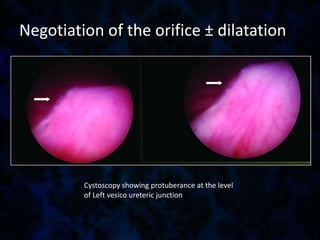
Cystoscopy showing protuberance at the level
of Left vesico ureteric junction
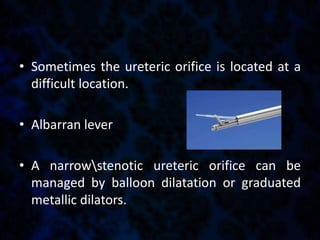
• Sometimes the ureteric orifice is located at a
difficult location.
• Albarran lever
• A narrowstenotic ureteric orifice can be
managed by balloon dilatation or graduated
metallic dilators.
Negotiation of the orifice ± dilatation
Alternatives for facilitating the insertion of the
guidewire in difficult cases. Directing it through
a ureteral catheter (a), under direct
ureteroscopic control (b).
Negotiation of the orifice ± dilatation
View from a ureteroscope as it is being
inserted into the left ureteric orifice between
two guidewires (railroading)
Negotiation of the orifice ± dilatation
Passing the ureteral orifice with two guidewires.
Negotiation of the orifice ± dilatation
Stone At the UO
Negotiation of the orifice ± dilatation
Incision of the stenosed ureteral
orifice using a Collins loop
URETERAL DILATATION
Non guided systems
•Hydrodilation (ureteromat or use of high pressure
bag)
Guided systems
•Graduated ureteral dilators
•Flexible, coaxial, sequential dilators
•Dilating balloon catheters
•Ureteral access sheath
Negotiation of the orifice ± dilatation
Dilation of the ureteral orifice
using a cone ureteral catheter.
Dilatation of the ureteric orifice
Ureteral orifice passively dilated with a JJ stent.
Problems which can occur due to the
use of dilators
• Failure of dilatation
• Perforation
• Submucosal tunneling
Negotiation of the orifice ± dilatation
When a guidewire or stent cannot
get pass a Steinstrasse or stone
impacted in the distal ureter, a
ureteroscope can be used to
fragment or dis-impact the stone,
or flush it with saline (introduced
through its irrigation channel). The
guidewire can then be passed
between the stone and the mucosa
under vision
STEPS
• Negotiation of the orifice ± dilatation
• Advancing the scope
• Stone manipulation and fragmentation
• Termination and stenting
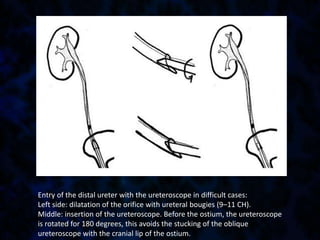
Entry of the distal ureter with the ureteroscope in difficult cases:
Left side: dilatation of the orifice with ureteral bougies (9–11 CH).
Middle: insertion of the ureteroscope. Before the ostium, the ureteroscope
is rotated for 180 degrees, this avoids the stucking of the oblique
ureteroscope with the cranial lip of the ostium.
Advancing the scope
Advancing the ureteroscope into the ureter.
Advancing the scope
Advancing the scope
Advancing the scope
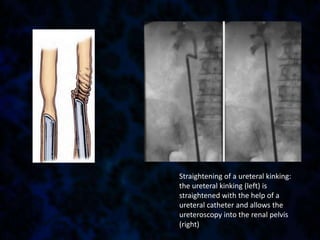
Negotiating the ureteral kinks with the Semirigid ureteroscope.
Straightening of a ureteral kinking:
the ureteral kinking (left) is
straightened with the help of a
ureteral catheter and allows the
ureteroscopy into the renal pelvis
(right)
• Mertz maneuver is a useful trick that involves
pushing the kidney upwards and medially,
using a closed fist on the flank beneath the
costal margin, to straighten the ureter.
Schwalb DM, Eshghi M. Techniques to negotiate the tortuous ureter.
J Urol. 1994;151(4):939–42.
URETERAL SPASM
• In an acute ureteric colic, severe spasm can make even
passing a preliminary guidewire difficult. The following
options can help relieve ureteral spasm.
• Local instillation
• Lidocaine Jelly (2 ml)
• Aminophylline 0.5% (3 ml)
• Intravenuous Buscopan
• Indwelling Stent
• Negotiation of the orifice ± dilatation
• Advancing the scope
• Stone manipulation and fragmentation
• Termination and stenting
Stone Manipulation
The extraction of small ureteral calculi with a forceps.
Stone Manipulation
extracted
with a
basket
catheter
under
direct
visual
control
Stone Manipulation
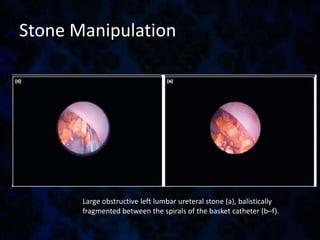
Large obstructive left lumbar ureteral stone (a), balistically
fragmented between the spirals of the basket catheter (b–f).
Stone Manipulation
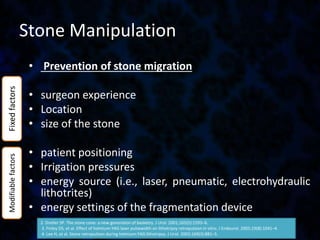
• Prevention of stone migration
• surgeon experience
• Location
• size of the stone
• patient positioning
• Irrigation pressures
• energy source (i.e., laser, pneumatic, electrohydraulic
lithotrites)
• energy settings of the fragmentation device
FixedfactorsModifiablefactors
2. Dretler SP. The stone cone: a new generation of basketry. J Urol. 2001;165(5):1593–6.
3. Finley DS, et al. Effect of holmium:YAG laser pulsewidth on lithotripsy retropulsion in vitro. J Endourol. 2005;19(8):1041–4.
4. Lee H, et al. Stone retropulsion during holmium:YAG lithotripsy. J Urol. 2003;169(3):881–5.
Stone Manipulation
• Prevention of stone migration
lithotripsy
Which Technique is Best?
• active extraction or dusting
• study by the Endourology Disease Group for
Excellence (EDGE)
comparing dusting to active extraction
• Cant find the stone
• If a false passage is created, a retrograde study
[instilling contrast under continuous
fluoroscopy]
• if resistance is encountered and only
extravasation of contrast is seen, then it is
best not to pursue any further.
• If the guidewire gets arrested in a false
passage, a smaller caliber ureteroscope can be
introduced as far as easily possible; while
withdrawing the scope, use irrigation under
pressure and have the guidewire ready,
positioned in the channel.
• On withdrawing the scope, sometimes
ureteral limen is seen and quickly cannulate it.
Basket problem
• Perforation
• Stuck basket
• Breakage
• Stone impacted within the basket
STEPS
• Negotiation of the orifice ± dilatation
• Advancing the scope
• Stone manipulation and fragmentation
• Termination and stenting
• If the stent is not sliding over the guidewire,
the beak of the cystoscope should be kept
close to ureteric orifices
• If it is still not sliding into the ureter, then use
a smaller caliber stent.
• The guidewire should be held tight by the
assistant to avoid looping in the bladder, and
the bladder should not be overdistended
THE TEN COMMANDMENTS
1. Safety use of visors, glasses, endovision camera, water
proof gown, gum boots.
2. Use of Image Intensifier. And do retrograde urography
3. Make sure accessories are available.
4. call for help
5.Regular use of glidewire
6. Dilatation of orifice helpful
7. Take measures to improve vision
8. Be ready to stage procedure - DJ Stenting
9. Picking up fragments not important
10. Recognize and correct complication early
Tips and tricks semirigid urs final

Tips and tricks semirigid urs final

  • 1.
    Tips and Tricksof Semirigid Ureteroscopy
  • 2.
    Semirigid URS • mostcommonly used type of scope for access to the upper urinary tract. Krambeck AE, Murat FJ, Gettman MT, et al. The evolutionof ureteroscopy: a modern single-institution series. Mayo Clin Proc 2006;81(4):468–73
  • 3.
    • Despite theversatility of modern URS, definitive treatment of urinary stones remains the most common indication for performing ureteroscopic techniques Harmon WJ, Sershon PD, Blute ML, Patterson DE, Segura JW. Ureteroscopy: current practice and long-term complications. J Urol 1997;157:28–32 (R)
  • 4.
  • 7.
    Tips and Tricks •Preoperative Preparation • Patients positioning • Operative Tricks and trouble shooting
  • 8.
    Tips and Tricks PreoperativePreparation • Review patients radiology and radiologic abnormalities Stone : size location density Urinary tract: hydroureteronephrosis • Plan your procedure
  • 9.
    Tips and Tricks PreoperativePreparation • Stop anticoagulants • Any urinary tract infection (UTI) should be treated • Consider presenting and staged procedures
  • 10.
    Tips and Tricks PreoperativePreparation • Check the Instruments • Lithotripsy • C arm , technician and contrast material • Wires and graspers
  • 11.
    Tips and Tricks •Preoperative Preparation • Patients positioning • Operative Tricks and trouble shooting
  • 12.
    Tips and Tricks PatientPositioning • Maintenance of mobility • Fluoroscopic Imaging • Access to instrumentation • Visualization
  • 16.
    Tips and Tricks •Preoperative Preparation • Patients positioning • Operative Tricks and trouble shooting
  • 17.
    • The mostcritical step in uneventful completion of the procedure is the cannulation of the ureteric orifice. • Care must be taken to ensure a very gentle and atraumatic entry.
  • 18.
    • standard cystourethroscopyis performed and the anatomic landmarks delineated.
  • 19.
    STEPS • Negotiation ofthe orifice ± dilatation • Advancing the scope • Stone manipulation and fragmentation • Termination and stenting
  • 20.
    PROBLEMS OF UOACCESS Ureteric Orifice Problems of Access • Pinpoint • Trabeculated Bladder • UV Junction calculus • Large median lobe • Ectopic orifice • Duplex system • Ureterocoele • Diverticulum
  • 21.
    Negotiation of theorifice ± dilatation
  • 22.
    Negotiation of theorifice ± dilatation
  • 24.
    Negotiation of theorifice ± dilatation Cant find the ureteric orifice
  • 25.
    Negotiation of theorifice ± dilatation Cystoscopy showing protuberance at the level of Left vesico ureteric junction
  • 27.
    • Sometimes theureteric orifice is located at a difficult location. • Albarran lever • A narrowstenotic ureteric orifice can be managed by balloon dilatation or graduated metallic dilators.
  • 30.
    Negotiation of theorifice ± dilatation
  • 31.
    Alternatives for facilitatingthe insertion of the guidewire in difficult cases. Directing it through a ureteral catheter (a), under direct ureteroscopic control (b). Negotiation of the orifice ± dilatation
  • 32.
    View from aureteroscope as it is being inserted into the left ureteric orifice between two guidewires (railroading) Negotiation of the orifice ± dilatation
  • 33.
    Negotiation of theorifice ± dilatation Passing the ureteral orifice with two guidewires.
  • 35.
    Negotiation of theorifice ± dilatation
  • 36.
  • 37.
    Negotiation of theorifice ± dilatation Incision of the stenosed ureteral orifice using a Collins loop
  • 40.
    URETERAL DILATATION Non guidedsystems •Hydrodilation (ureteromat or use of high pressure bag) Guided systems •Graduated ureteral dilators •Flexible, coaxial, sequential dilators •Dilating balloon catheters •Ureteral access sheath
  • 41.
    Negotiation of theorifice ± dilatation Dilation of the ureteral orifice using a cone ureteral catheter.
  • 42.
    Dilatation of theureteric orifice
  • 43.
    Ureteral orifice passivelydilated with a JJ stent.
  • 44.
    Problems which canoccur due to the use of dilators • Failure of dilatation • Perforation • Submucosal tunneling
  • 45.
    Negotiation of theorifice ± dilatation
  • 47.
    When a guidewireor stent cannot get pass a Steinstrasse or stone impacted in the distal ureter, a ureteroscope can be used to fragment or dis-impact the stone, or flush it with saline (introduced through its irrigation channel). The guidewire can then be passed between the stone and the mucosa under vision
  • 48.
    STEPS • Negotiation ofthe orifice ± dilatation • Advancing the scope • Stone manipulation and fragmentation • Termination and stenting
  • 49.
    Entry of thedistal ureter with the ureteroscope in difficult cases: Left side: dilatation of the orifice with ureteral bougies (9–11 CH). Middle: insertion of the ureteroscope. Before the ostium, the ureteroscope is rotated for 180 degrees, this avoids the stucking of the oblique ureteroscope with the cranial lip of the ostium.
  • 50.
    Advancing the scope Advancingthe ureteroscope into the ureter.
  • 51.
  • 53.
  • 54.
    Advancing the scope Negotiatingthe ureteral kinks with the Semirigid ureteroscope.
  • 55.
    Straightening of aureteral kinking: the ureteral kinking (left) is straightened with the help of a ureteral catheter and allows the ureteroscopy into the renal pelvis (right)
  • 56.
    • Mertz maneuveris a useful trick that involves pushing the kidney upwards and medially, using a closed fist on the flank beneath the costal margin, to straighten the ureter. Schwalb DM, Eshghi M. Techniques to negotiate the tortuous ureter. J Urol. 1994;151(4):939–42.
  • 58.
    URETERAL SPASM • Inan acute ureteric colic, severe spasm can make even passing a preliminary guidewire difficult. The following options can help relieve ureteral spasm. • Local instillation • Lidocaine Jelly (2 ml) • Aminophylline 0.5% (3 ml) • Intravenuous Buscopan • Indwelling Stent
  • 59.
    • Negotiation ofthe orifice ± dilatation • Advancing the scope • Stone manipulation and fragmentation • Termination and stenting
  • 60.
    Stone Manipulation The extractionof small ureteral calculi with a forceps.
  • 61.
  • 62.
    Stone Manipulation Large obstructiveleft lumbar ureteral stone (a), balistically fragmented between the spirals of the basket catheter (b–f).
  • 65.
    Stone Manipulation • Preventionof stone migration • surgeon experience • Location • size of the stone • patient positioning • Irrigation pressures • energy source (i.e., laser, pneumatic, electrohydraulic lithotrites) • energy settings of the fragmentation device FixedfactorsModifiablefactors 2. Dretler SP. The stone cone: a new generation of basketry. J Urol. 2001;165(5):1593–6. 3. Finley DS, et al. Effect of holmium:YAG laser pulsewidth on lithotripsy retropulsion in vitro. J Endourol. 2005;19(8):1041–4. 4. Lee H, et al. Stone retropulsion during holmium:YAG lithotripsy. J Urol. 2003;169(3):881–5.
  • 66.
  • 67.
  • 68.
    Which Technique isBest? • active extraction or dusting • study by the Endourology Disease Group for Excellence (EDGE) comparing dusting to active extraction
  • 71.
    • Cant findthe stone
  • 75.
    • If afalse passage is created, a retrograde study [instilling contrast under continuous fluoroscopy] • if resistance is encountered and only extravasation of contrast is seen, then it is best not to pursue any further.
  • 76.
    • If theguidewire gets arrested in a false passage, a smaller caliber ureteroscope can be introduced as far as easily possible; while withdrawing the scope, use irrigation under pressure and have the guidewire ready, positioned in the channel. • On withdrawing the scope, sometimes ureteral limen is seen and quickly cannulate it.
  • 79.
    Basket problem • Perforation •Stuck basket • Breakage • Stone impacted within the basket
  • 81.
    STEPS • Negotiation ofthe orifice ± dilatation • Advancing the scope • Stone manipulation and fragmentation • Termination and stenting
  • 82.
    • If thestent is not sliding over the guidewire, the beak of the cystoscope should be kept close to ureteric orifices
  • 83.
    • If itis still not sliding into the ureter, then use a smaller caliber stent. • The guidewire should be held tight by the assistant to avoid looping in the bladder, and the bladder should not be overdistended
  • 85.
    THE TEN COMMANDMENTS 1.Safety use of visors, glasses, endovision camera, water proof gown, gum boots. 2. Use of Image Intensifier. And do retrograde urography 3. Make sure accessories are available. 4. call for help 5.Regular use of glidewire 6. Dilatation of orifice helpful 7. Take measures to improve vision 8. Be ready to stage procedure - DJ Stenting 9. Picking up fragments not important 10. Recognize and correct complication early

Editor's Notes

  • #6 Harmon WJ, Sershon PD, Blute ML, Patterson DE, Segura JW.Ureteroscopy: current practice and long-termcomplications. J Urol 1997;157 :28–32 (R) Weinberg JJ, Ansong K, Smith AD. Complications of ureteroscopy in relation to experience: report of survey and author experience.J Urol1987;137: 384–5: (4/C) Blute ML, Segura JW, Patterson DE.Ureteroscopy. J Urol 1988; 139: 510–2 (4/C) Leijte JA, Oddens JR, Lock TM. Holmium laser lithotripsy for ureteric calculi: predictive factors for complications and success.J Endourol2008;22: 257–60 (4/ Abdelrahim AF, Abdelmaguid A, Abuzeid H, Amin M, Mousa E, Abdelrahim F. Rigid ureteroscopy for ureteral stones: factors associated with intraoperative adverse events. J Endourol 2008; 22: 277–80 (4/C) El-Nahas A, El-Tabey N, Eraky I et al .Semirigid ureteroscopy for ureteral stones: a multivariate analysis of unfavorable results. J Urol 2009; 181: 1158–62 (4/C)
  • #13 Especially during rigid ureteroscopy or proximal ureteroscopy, the surgeon’s ability to manipulate the endoscope extracorporeally is paramount to a swift and successful outcome.
  • #14 When appropriately positioned, the hip and knee joints are fl exed approximately 90 ° and the great toe and ipsilateral knee are aligned with the contralateral shoulder. The lower legs are well padded and secured snugly
  • #15 In the extended leg dorsolithotomy position, the leg ipsilateral to the stone is straightened and slightly abducted compared to the contralateral leg. This puts the ipsilateral psoas on stretch and improves access to the mid and proximal ureter by a rigid ureteroscope
  • #57 Another useful trick is to pass a guidewire halfway up to the kink; then advance an open-ended ureteric catheter over it and pull both as a unit in order to straighten it by traction. Keeping the open-ended catheter at this position, now the guidewire is pushed in. This traction maneuver can perhaps be done better with the help of a balloon catheter inflated and pulled just below the kink. • Passing a slippery hydrophilic (glide) wire that glides through the kink can also be used. • The ureteroscope can be used to bypass the kink under direct vision and maneuver the guidewire through its working channel. If available, a specialized (angled) ureteric catheter—e.g., Cobra catheter—can be used in combination with hydrophilic guidewire under fluoroscopic guidance. • A conventional guidewire can cause trauma to the mucosa and is more likely to kink or bend rather than curl against the obstruction [5]. Issa described a glide wire loop technique by using a hydrophilic-coated floppy-tipped guidewire that binds water to create a well-lubricated coating, which diminishes friction [6]. This is passed under fluoroscopic control to form a wedge between the stone and the wall of the ureter. It is further manipulated to form a curl that then forces the walls of the ureter to stretch at the site of impaction, resulting in the entry of this loop into the renal pelvis. The ureteric catheter is then passed over the guidewire into the pelvis. The wire is pulled back and redirected to curl in the renal pelvis, over which the stent can be advanced.