EE 230 MOSFETs – 1
Metal oxide semiconductor field effect transistors (MOSFETs)
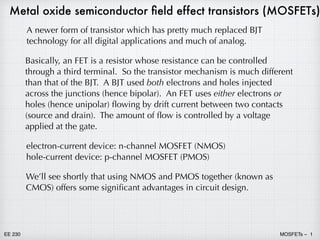
A newer form of transistor which has pretty much replaced BJT
technology for all digital applications and much of analog.
Basically, an FET is a resistor whose resistance can be controlled
through a third terminal. So the transistor mechanism is much different
than that of the BJT. A BJT used both electrons and holes injected
across the junctions (hence bipolar). An FET uses either electrons or
holes (hence unipolar) flowing by drift current between two contacts
(source and drain). The amount of flow is controlled by a voltage
applied at the gate.
electron-current device: n-channel MOSFET (NMOS)
hole-current device: p-channel MOSFET (PMOS)
We’ll see shortly that using NMOS and PMOS together (known as
CMOS) offers some significant advantages in circuit design.
EE 230 MOSFETs – 2
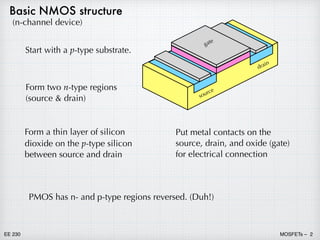
PMOS has n- and p-type regions reversed. (Duh!)
Start with a p-type substrate.
Form two n-type regions
(source & drain)
Form a thin layer of silicon
dioxide on the p-type silicon
between source and drain
Put metal contacts on the
source, drain, and oxide (gate)
for electrical connection
Basic NMOS structure
(n-channel device)
source
drain
oxide
gate
EE 230 MOSFETs –
source
drain
oxide
gate
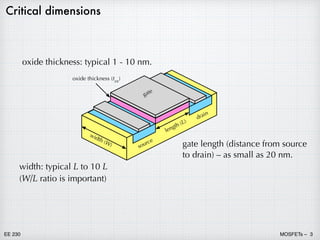
gate length (distance from source
to drain) – as small as 20 nm.
3
Critical dimensions
width: typical L to 10 L
(W/L ratio is important)
oxide thickness: typical 1 - 10 nm.
length (L)
width (W)
oxide thickness (tox
)
EE 230 MOSFETs – 4
Will current flow?
Apply a voltage between drain and source (VDS
).
If VDS > 0, the diode at the drain end will be reverse-biased, preventing
current flow.
Reversing the polarity doesn’t help, because then the other junction
will be reverse biased.
drain
source
gate
p
n n
+
–
VDS
EE 230 MOSFETs – 5
The MOS capacitor
The secret to MOSFET operation lies in the MOS capacitor (the central
part of the FET).
The structure is essentially a little parallel-plate capacitor formed by the
gate metal and the semiconductor with the oxide as the dielectric.
Define oxide
capacitance
&JDWH =
պR[$
WR[
&R[ =
պR[
WR[
gate
body
substrate (body)
units: F/m2 (or F/µm2)
εox = 3.9εo = 3.9(8.85x10⁻¹² F/m)
for tox = 10 nm (10–8 m)
Cox = 0.00345 F/m2
= 3.45x10⁻¹⁵ F/µm2
EE 230 MOSFETs – 6
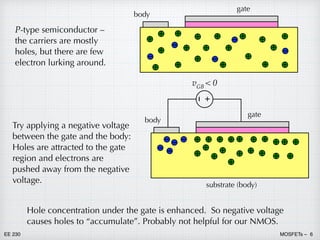
P-type semiconductor –
the carriers are mostly
holes, but there are few
electron lurking around.
Try applying a negative voltage
between the gate and the body:
Holes are attracted to the gate
region and electrons are
pushed away from the negative
voltage.
Hole concentration under the gate is enhanced. So negative voltage
causes holes to “accumulate”. Probably not helpful for our NMOS.
+
gate
body
+
+ +
+
+ +
+
+
+
+
+
+ +
+
+
+
+
+
+
–
–
–
–
–
+
gate
+
–
vGB
< 0
body
substrate (body)
+
+
+
+
+ +
+
+
+
+
+
+ +
+
+
+
+
+
+
–
– –
–
–
EE 230 MOSFETs – 7
So try applying a positive
voltage to the gate. Now
the holes are pushed away
and the electrons are
attracted.
The region under the gate becomes “depleted” of holes. So this is
probably not helpful either, but the movement of the electrons towards
the gate looks promising.
+
gate
+
–
vGB
> 0
body
substrate (body)
+
+
+
+
+
+
+ +
+ +
+
+
+
+
+
+
+
+
+ – – –
–
–
EE 230 MOSFETs – 8
So try increasing the gate
voltage further. Holes are
pushed away further and
electrons are attracted more
strongly.
At a sufficiently high voltage, enough electrons will gather together to
make the region under the gate “invert” and behave like it was n-
type!
The gate voltage required create the electron “inversion layer” is called
the threshold voltage, VT
. If the voltage is increase beyond VT
, even
more electrons are gathered together under the gate.
+
gate
+
–
vGB > VT
body
substrate (body)
+
+
+
+
+
+
+ +
+ +
+
+
+
+
+
+
+
+
+ – – – – – – – – – – – –
– – – – – – – – – – – –
EE 230 MOSFETs – 9
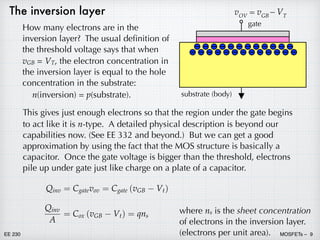
The inversion layer
How many electrons are in the
inversion layer? The usual definition of
the threshold voltage says that when
vGB = VT, the electron concentration in
the inversion layer is equal to the hole
concentration in the substrate:
n(inversion) = p(substrate).
This gives just enough electrons so that the region under the gate begins
to act like it is n-type. A detailed physical description is beyond our
capabilities now. (See EE 332 and beyond.) But we can get a good
approximation by using the fact that the MOS structure is basically a
capacitor. Once the gate voltage is bigger than the threshold, electrons
pile up under gate just like charge on a plate of a capacitor.
where ns is the sheet concentration
of electrons in the inversion layer.
(electrons per unit area).
gate
substrate (body)
– – – – – – – – – – – –
– – – – – – – – – – – –
vOV
= vGB
– VT
–
Qinv = Cgatevov = Cgate (vGB Vt)
Qinv
A
= Cox (vGB Vt) = qns
EE 230 MOSFETs – 10
The threshold voltage gate
substrate (body)
– – – – – – – – – – – –
– – – – – – – – – – – –
vOV
= vGB
– VT
–
The threshold voltage for a MOSFET
depends primarily on two things. The
doping level of the substrate and the
thickness of the insulating gate oxide
layer.
The definition of threshold is that the electron concentration under the
gate is equal to the hole concentration in the rest of the substrate. If the
hole concentration in the substrate is higher (due to higher doping)
more voltage is required to induce the higher number of electrons
needed for inversion. Increased doping means higher threshold.
It is actually the electric field in the gate that controls what is
happening in the inversion layer. Since E = vGB/tox , making the oxide
thicker requires more voltage in order to create the same electric field.
So a thicker oxide also leads to higher a threshold voltage.
Integrated circuit fabrication engineers work very hard to control the
threshold voltages of the MOSFETs. Not easy when there are millions
(or billions) of transistors in a chip!
EE 230 MOSFETs – 11
vGB
< 0 hole accumulation
0 < vGB
< VT carrier depletion
vGB
> VGB
inversion –
electron layer forms,
qns = Cox(vGB – VT)
So through the application of the gate voltage, we can control what is
happening with carriers under the gate.
Summary of MOS capacitor operation
EE 230 MOSFETs – 12
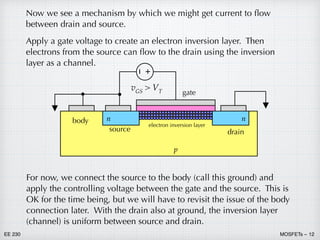
Now we see a mechanism by which we might get current to flow
between drain and source.
Apply a gate voltage to create an electron inversion layer. Then
electrons from the source can flow to the drain using the inversion
layer as a channel.
drain
source
gate
p
n n
vGS
> VT
electron inversion layer
+
–
body
For now, we connect the source to the body (call this ground) and
apply the controlling voltage between the gate and the source. This is
OK for the time being, but we will have to revisit the issue of the body
connection later. With the drain also at ground, the inversion layer
(channel) is uniform between source and drain.
EE 230 MOSFETs – 13
drain
source
gate
p
n n
vGS
> VT
electron inversion layer
+
–
+
–
vDS
> 0
iD
electrons
body
Drain current
With the inversion layer in place, we can apply a positive voltage
between the drain and source. This creates an electric field that will
push electrons from the source through the inversion layer channel to
the drain. The moving electrons represent a drain current flowing from
drain to source.
EE 230 MOSFETs – 14
At first inspection, the current flow
appears to be “ohmic”. The current is
entirely due to electrons and the
electrons move due to an applied
voltage. Basically, it looks like a resistor.
The total resistance is the sum the resistances of the three regions: RDS
= Rsource + Rinversion + Rdrain. Usually, the source and drain are very
heavily doped (lots of electrons) and so the resistances there are small.
Most of the resistance is associated with the inversion layer: RDS ≈
Rinversion.
drain
source
gate
p
n n
vGS
> VT
electron inversion layer
+
–
+
–
vDS
> 0
iD
electrons
body
EE 230 MOSFETs – 15
Using the basic definition for a resistor:
where ninv is the electron concentration (m–3) in the inversion layer, tinv
is the “thickness” of the inversion layer, µn is the electron mobility, q is
the charge on one electron and L and W are the gate length and width.
The electron concentration and inversion layer thickness are difficult to
quantify because of the sheet-like nature of the inversion layer.
However, the product ninv· tinv can be re-expressed more easily – it
represents the “sheet concentration” (m–2) of electrons in the inversion
layer, which we denote as ns.
We saw earlier that TQV = &R[ (Y*6 97)
5'6 = քLQY
/
:WLQY
=

T‫ܟ‬QQLQY
/
:WLQY
L' =
Y'6
5'6
= T‫ܟ‬QQLQYWLQY
:
/
Y'6
EE 230 MOSFETs – 16
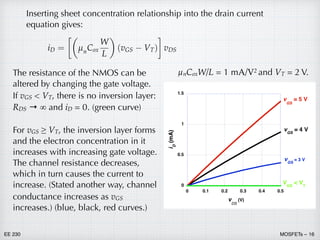
The resistance of the NMOS can be
altered by changing the gate voltage.
If vGS  VT, there is no inversion layer:
RDS → ∞ and iD = 0. (green curve)
For vGS ≥ VT, the inversion layer forms
and the electron concentration in it
increases with increasing gate voltage.
The channel resistance decreases,
which in turn causes the current to
increase. (Stated another way, channel
conductance increases as vGS
increases.) (blue, black, red curves.)
Inserting sheet concentration relationship into the drain current
equation gives:
L' = ‫ܟ‬QR[
:
/
(Y*6 97) Y'6
µnCoxW/L = 1 mA/V2 and VT = 2 V.
EE 230 MOSFETs – 17
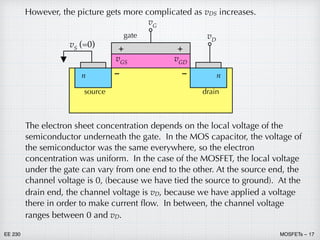
However, the picture gets more complicated as vDS increases.
The electron sheet concentration depends on the local voltage of the
semiconductor underneath the gate. In the MOS capacitor, the voltage of
the semiconductor was the same everywhere, so the electron
concentration was uniform. In the case of the MOSFET, the local voltage
under the gate can vary from one end to the other. At the source end, the
channel voltage is 0, (because we have tied the source to ground). At the
drain end, the channel voltage is vD, because we have applied a voltage
there in order to make current flow. In between, the channel voltage
ranges between 0 and vD.
drain
source
gate
n n
+
–
vGS
+
–
vGD
vG
vD
vS
(=0)
EE 230 MOSFETs – 18
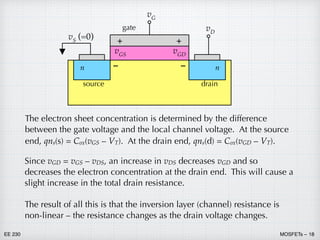
Since vGD = vGS – vDS, an increase in vDS decreases vGD and so
decreases the electron concentration at the drain end. This will cause a
slight increase in the total drain resistance.
The electron sheet concentration is determined by the difference
between the gate voltage and the local channel voltage. At the source
end, qns(s) = Cox(vGS – VT). At the drain end, qns(d) = Cox(vGD – VT).
drain
source
gate
n n
+
–
vGS
+
–
vGD
vG
vD
vS
(=0)
The result of all this is that the inversion layer (channel) resistance is
non-linear – the resistance changes as the drain voltage changes.
EE 230 MOSFETs – 19
The non-uniform electron concentration
along the channel implies that the channel
resistance is not uniform — it is greater at the
drain end, where there are fewer electrons.
So, as the drain voltage increases, the channel resistance increases.
The effect is that the I-V curve bends over at higher voltage.
VDS
ID
drain
source
gate
n n
VDS  0
VGS  VT
electron concentration decreases
at drain end
VGD
VGS
EE 230 MOSFETs – 20
So a more correct analysis of the current flow shows that the iD-vDS
relationship is not linear, but parabolic. (See EE 332.)
Study exercise: Show that this reduces to the linear equation for small
values of vDS.
L' =


‫ܟ‬QR[
:
/
 (Y*6 97) Y'6 Y
'6
. =


‫ܟ‬QR[
:
/
Notation: To save on ink and time, define the constant in front as:
The units of this “MOS current parameter” are A/V2. Or more typically
mA/V2. (Check it.)
Note: This use of K is not standard. Different textbooks will handle the
current parameter differently.
EE 230 MOSFETs – 21
Now take the final step: If
vDS is increased sufficiently,
we reach a point where vGD
 VT. The electron
concentration should
disappear at the drain end!
drain
source
gate
n n
VDS  0
VGS  VT
electron layer is pinched down
VGS VGD  VT
current saturation
The usual terminology is to say that the channel is “pinched off” at the
drain end, but this is slightly misleading. If the channel were truly
pinched off, then the electron concentration would go to zero there
and the current would necessarily have to go to zero, also.
Instead, it might be better to say that the channel is “pinched down”.
The electron concentration goes to some minimum value, but never
really shuts off. In effect, the flowing current works to hold the
channel open, even though the drain voltage seems high enough to
truly pinch off the channel.
EE 230 MOSFETs – 22
The mathematical analysis of what happens in a FET at pinch-off is a
fairly complicated problem in electromagnetics – definitely beyond
our current capabilities. (Again, see EE 332.)
However, the end result on the device behavior is easy to grasp – the
current saturates at the pinch down value. For higher values of vDS, the
current stays constant at a constant value.
The condition for the NMOS going reaching the “pinch-down”
condition is vGD ≤ VT. This can be re-expressed in terms of vDS and vGS.
To determine the saturation current, we can insert the pinch-down
condition given above into the iD-vDS equation from the ohmic region
of operation. Then the saturated current is
Y'6 Y*6 97
L' (VDW) =


‫ܟ‬QR[
:
/
[Y*6 97]

= . [Y*6 97]

(Work out these details for yourself.)
EE 230 MOSFETs – 23
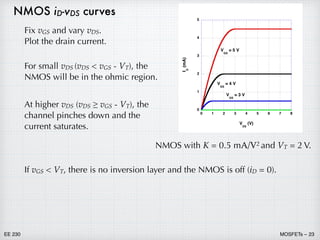
Fix vGS and vary vDS.
Plot the drain current.
NMOS with K = 0.5 mA/V2 and VT = 2 V.
NMOS iD-vDS curves
0
1
2
3
4
5
0 1 2 3 4 5 6 7 8
I
D
(mA)
V
DS
(V)
For small vDS (vDS  vGS - VT), the
NMOS will be in the ohmic region.
0
1
2
3
4
5
0 1 2 3 4 5 6 7 8
I
D
(mA)
V
DS
(V)
V
GS
= 4 V
At higher vDS (vDS ≥ vGS - VT), the
channel pinches down and the
current saturates.
0
1
2
3
4
5
0 1 2 3 4 5 6 7 8
I
D
(mA)
V
DS
(V)
V
GS
= 4 V
0
1
2
3
4
5
0 1 2 3 4 5 6 7 8
I
D
(mA)
V
DS
(V)
V
GS
= 4 V
V
GS
= 5 V
0
1
2
3
4
5
0 1 2 3 4 5 6 7 8
I
D
(mA)
V
DS
(V)
V
GS
= 4 V
V
GS
= 5 V
V
GS
= 3 V
If vGS  VT, there is no inversion layer and the NMOS is off (iD = 0).
0
1
2
3
4
5
0 1 2 3 4 5 6 7 8
I
D
(mA)
V
DS
(V)
V
GS
= 4 V
V
GS
= 5 V
V
GS
= 3 V
EE 230 MOSFETs – 24
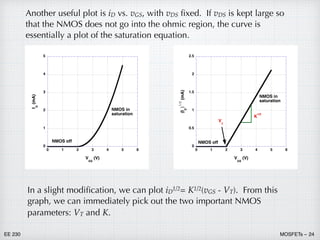
In a slight modification, we can plot iD
1/2= K1/2(vGS - VT). From this
graph, we can immediately pick out the two important NMOS
parameters: VT and K.
0
1
2
3
4
5
0 1 2 3 4 5 6
I
D
(mA)
V
GS
(V)
NMOS off
NMOS in
saturation
0
0.5
1
1.5
2
2.5
0 1 2 3 4 5 6
(I
D
)
1/2
(mA)
V
GS
(V)
NMOS off
NMOS in
saturation
K
1/2
V
T
Another useful plot is iD vs. vGS, with vDS fixed. If vDS is kept large so
that the NMOS does not go into the ohmic region, the curve is
essentially a plot of the saturation equation.
EE 230 MOSFETs – 25
iD = 0
Summary of NMOS equations
The equations are exact (within the limits of the simplest MOSFET
model). The quadratic dependence of current on voltage means that
the circuit analysis will be non-linear and we will have frequent need
for the quadratic equation.
off
vGS  VT
vGS ≥ VT on vDS  vGS – VT ohmic or linear
vDS ≥ vGS – VT saturation
L' =


‫ܟ‬QR[
:
/
 (Y*6 97) Y'6 Y
'6
. =


‫ܟ‬QR[
:
/
VT,
L' = . [Y*6 97]

iG = 0 !! (at least at DC)

nmos .pdf

  • 1.
    EE 230 MOSFETs– 1 Metal oxide semiconductor field effect transistors (MOSFETs) A newer form of transistor which has pretty much replaced BJT technology for all digital applications and much of analog. Basically, an FET is a resistor whose resistance can be controlled through a third terminal. So the transistor mechanism is much different than that of the BJT. A BJT used both electrons and holes injected across the junctions (hence bipolar). An FET uses either electrons or holes (hence unipolar) flowing by drift current between two contacts (source and drain). The amount of flow is controlled by a voltage applied at the gate. electron-current device: n-channel MOSFET (NMOS) hole-current device: p-channel MOSFET (PMOS) We’ll see shortly that using NMOS and PMOS together (known as CMOS) offers some significant advantages in circuit design.
  • 2.
    EE 230 MOSFETs– 2 PMOS has n- and p-type regions reversed. (Duh!) Start with a p-type substrate. Form two n-type regions (source & drain) Form a thin layer of silicon dioxide on the p-type silicon between source and drain Put metal contacts on the source, drain, and oxide (gate) for electrical connection Basic NMOS structure (n-channel device) source drain oxide gate
  • 3.
    EE 230 MOSFETs– source drain oxide gate gate length (distance from source to drain) – as small as 20 nm. 3 Critical dimensions width: typical L to 10 L (W/L ratio is important) oxide thickness: typical 1 - 10 nm. length (L) width (W) oxide thickness (tox )
  • 4.
    EE 230 MOSFETs– 4 Will current flow? Apply a voltage between drain and source (VDS ). If VDS > 0, the diode at the drain end will be reverse-biased, preventing current flow. Reversing the polarity doesn’t help, because then the other junction will be reverse biased. drain source gate p n n + – VDS
  • 5.
    EE 230 MOSFETs– 5 The MOS capacitor The secret to MOSFET operation lies in the MOS capacitor (the central part of the FET). The structure is essentially a little parallel-plate capacitor formed by the gate metal and the semiconductor with the oxide as the dielectric. Define oxide capacitance &JDWH = պR[$ WR[ &R[ = պR[ WR[ gate body substrate (body) units: F/m2 (or F/µm2) εox = 3.9εo = 3.9(8.85x10⁻¹² F/m) for tox = 10 nm (10–8 m) Cox = 0.00345 F/m2 = 3.45x10⁻¹⁵ F/µm2
  • 6.
    EE 230 MOSFETs– 6 P-type semiconductor – the carriers are mostly holes, but there are few electron lurking around. Try applying a negative voltage between the gate and the body: Holes are attracted to the gate region and electrons are pushed away from the negative voltage. Hole concentration under the gate is enhanced. So negative voltage causes holes to “accumulate”. Probably not helpful for our NMOS. + gate body + + + + + + + + + + + + + + + + + + + – – – – – + gate + – vGB < 0 body substrate (body) + + + + + + + + + + + + + + + + + + + – – – – –
  • 7.
    EE 230 MOSFETs– 7 So try applying a positive voltage to the gate. Now the holes are pushed away and the electrons are attracted. The region under the gate becomes “depleted” of holes. So this is probably not helpful either, but the movement of the electrons towards the gate looks promising. + gate + – vGB > 0 body substrate (body) + + + + + + + + + + + + + + + + + + + – – – – –
  • 8.
    EE 230 MOSFETs– 8 So try increasing the gate voltage further. Holes are pushed away further and electrons are attracted more strongly. At a sufficiently high voltage, enough electrons will gather together to make the region under the gate “invert” and behave like it was n- type! The gate voltage required create the electron “inversion layer” is called the threshold voltage, VT . If the voltage is increase beyond VT , even more electrons are gathered together under the gate. + gate + – vGB > VT body substrate (body) + + + + + + + + + + + + + + + + + + + – – – – – – – – – – – – – – – – – – – – – – – –
  • 9.
    EE 230 MOSFETs– 9 The inversion layer How many electrons are in the inversion layer? The usual definition of the threshold voltage says that when vGB = VT, the electron concentration in the inversion layer is equal to the hole concentration in the substrate: n(inversion) = p(substrate). This gives just enough electrons so that the region under the gate begins to act like it is n-type. A detailed physical description is beyond our capabilities now. (See EE 332 and beyond.) But we can get a good approximation by using the fact that the MOS structure is basically a capacitor. Once the gate voltage is bigger than the threshold, electrons pile up under gate just like charge on a plate of a capacitor. where ns is the sheet concentration of electrons in the inversion layer. (electrons per unit area). gate substrate (body) – – – – – – – – – – – – – – – – – – – – – – – – vOV = vGB – VT – Qinv = Cgatevov = Cgate (vGB Vt) Qinv A = Cox (vGB Vt) = qns
  • 10.
    EE 230 MOSFETs– 10 The threshold voltage gate substrate (body) – – – – – – – – – – – – – – – – – – – – – – – – vOV = vGB – VT – The threshold voltage for a MOSFET depends primarily on two things. The doping level of the substrate and the thickness of the insulating gate oxide layer. The definition of threshold is that the electron concentration under the gate is equal to the hole concentration in the rest of the substrate. If the hole concentration in the substrate is higher (due to higher doping) more voltage is required to induce the higher number of electrons needed for inversion. Increased doping means higher threshold. It is actually the electric field in the gate that controls what is happening in the inversion layer. Since E = vGB/tox , making the oxide thicker requires more voltage in order to create the same electric field. So a thicker oxide also leads to higher a threshold voltage. Integrated circuit fabrication engineers work very hard to control the threshold voltages of the MOSFETs. Not easy when there are millions (or billions) of transistors in a chip!
  • 11.
    EE 230 MOSFETs– 11 vGB < 0 hole accumulation 0 < vGB < VT carrier depletion vGB > VGB inversion – electron layer forms, qns = Cox(vGB – VT) So through the application of the gate voltage, we can control what is happening with carriers under the gate. Summary of MOS capacitor operation
  • 12.
    EE 230 MOSFETs– 12 Now we see a mechanism by which we might get current to flow between drain and source. Apply a gate voltage to create an electron inversion layer. Then electrons from the source can flow to the drain using the inversion layer as a channel. drain source gate p n n vGS > VT electron inversion layer + – body For now, we connect the source to the body (call this ground) and apply the controlling voltage between the gate and the source. This is OK for the time being, but we will have to revisit the issue of the body connection later. With the drain also at ground, the inversion layer (channel) is uniform between source and drain.
  • 13.
    EE 230 MOSFETs– 13 drain source gate p n n vGS > VT electron inversion layer + – + – vDS > 0 iD electrons body Drain current With the inversion layer in place, we can apply a positive voltage between the drain and source. This creates an electric field that will push electrons from the source through the inversion layer channel to the drain. The moving electrons represent a drain current flowing from drain to source.
  • 14.
    EE 230 MOSFETs– 14 At first inspection, the current flow appears to be “ohmic”. The current is entirely due to electrons and the electrons move due to an applied voltage. Basically, it looks like a resistor. The total resistance is the sum the resistances of the three regions: RDS = Rsource + Rinversion + Rdrain. Usually, the source and drain are very heavily doped (lots of electrons) and so the resistances there are small. Most of the resistance is associated with the inversion layer: RDS ≈ Rinversion. drain source gate p n n vGS > VT electron inversion layer + – + – vDS > 0 iD electrons body
  • 15.
    EE 230 MOSFETs– 15 Using the basic definition for a resistor: where ninv is the electron concentration (m–3) in the inversion layer, tinv is the “thickness” of the inversion layer, µn is the electron mobility, q is the charge on one electron and L and W are the gate length and width. The electron concentration and inversion layer thickness are difficult to quantify because of the sheet-like nature of the inversion layer. However, the product ninv· tinv can be re-expressed more easily – it represents the “sheet concentration” (m–2) of electrons in the inversion layer, which we denote as ns. We saw earlier that TQV = &R[ (Y*6 97) 5'6 = քLQY / :WLQY = T‫ܟ‬QQLQY / :WLQY L' = Y'6 5'6 = T‫ܟ‬QQLQYWLQY : / Y'6
  • 16.
    EE 230 MOSFETs– 16 The resistance of the NMOS can be altered by changing the gate voltage. If vGS VT, there is no inversion layer: RDS → ∞ and iD = 0. (green curve) For vGS ≥ VT, the inversion layer forms and the electron concentration in it increases with increasing gate voltage. The channel resistance decreases, which in turn causes the current to increase. (Stated another way, channel conductance increases as vGS increases.) (blue, black, red curves.) Inserting sheet concentration relationship into the drain current equation gives: L' = ‫ܟ‬QR[ : / (Y*6 97) Y'6 µnCoxW/L = 1 mA/V2 and VT = 2 V.
  • 17.
    EE 230 MOSFETs– 17 However, the picture gets more complicated as vDS increases. The electron sheet concentration depends on the local voltage of the semiconductor underneath the gate. In the MOS capacitor, the voltage of the semiconductor was the same everywhere, so the electron concentration was uniform. In the case of the MOSFET, the local voltage under the gate can vary from one end to the other. At the source end, the channel voltage is 0, (because we have tied the source to ground). At the drain end, the channel voltage is vD, because we have applied a voltage there in order to make current flow. In between, the channel voltage ranges between 0 and vD. drain source gate n n + – vGS + – vGD vG vD vS (=0)
  • 18.
    EE 230 MOSFETs– 18 Since vGD = vGS – vDS, an increase in vDS decreases vGD and so decreases the electron concentration at the drain end. This will cause a slight increase in the total drain resistance. The electron sheet concentration is determined by the difference between the gate voltage and the local channel voltage. At the source end, qns(s) = Cox(vGS – VT). At the drain end, qns(d) = Cox(vGD – VT). drain source gate n n + – vGS + – vGD vG vD vS (=0) The result of all this is that the inversion layer (channel) resistance is non-linear – the resistance changes as the drain voltage changes.
  • 19.
    EE 230 MOSFETs– 19 The non-uniform electron concentration along the channel implies that the channel resistance is not uniform — it is greater at the drain end, where there are fewer electrons. So, as the drain voltage increases, the channel resistance increases. The effect is that the I-V curve bends over at higher voltage. VDS ID drain source gate n n VDS 0 VGS VT electron concentration decreases at drain end VGD VGS
  • 20.
    EE 230 MOSFETs– 20 So a more correct analysis of the current flow shows that the iD-vDS relationship is not linear, but parabolic. (See EE 332.) Study exercise: Show that this reduces to the linear equation for small values of vDS. L' = ‫ܟ‬QR[ : / (Y*6 97) Y'6 Y '6 . = ‫ܟ‬QR[ : / Notation: To save on ink and time, define the constant in front as: The units of this “MOS current parameter” are A/V2. Or more typically mA/V2. (Check it.) Note: This use of K is not standard. Different textbooks will handle the current parameter differently.
  • 21.
    EE 230 MOSFETs– 21 Now take the final step: If vDS is increased sufficiently, we reach a point where vGD VT. The electron concentration should disappear at the drain end! drain source gate n n VDS 0 VGS VT electron layer is pinched down VGS VGD VT current saturation The usual terminology is to say that the channel is “pinched off” at the drain end, but this is slightly misleading. If the channel were truly pinched off, then the electron concentration would go to zero there and the current would necessarily have to go to zero, also. Instead, it might be better to say that the channel is “pinched down”. The electron concentration goes to some minimum value, but never really shuts off. In effect, the flowing current works to hold the channel open, even though the drain voltage seems high enough to truly pinch off the channel.
  • 22.
    EE 230 MOSFETs– 22 The mathematical analysis of what happens in a FET at pinch-off is a fairly complicated problem in electromagnetics – definitely beyond our current capabilities. (Again, see EE 332.) However, the end result on the device behavior is easy to grasp – the current saturates at the pinch down value. For higher values of vDS, the current stays constant at a constant value. The condition for the NMOS going reaching the “pinch-down” condition is vGD ≤ VT. This can be re-expressed in terms of vDS and vGS. To determine the saturation current, we can insert the pinch-down condition given above into the iD-vDS equation from the ohmic region of operation. Then the saturated current is Y'6 Y*6 97 L' (VDW) = ‫ܟ‬QR[ : / [Y*6 97] = . [Y*6 97] (Work out these details for yourself.)
  • 23.
    EE 230 MOSFETs– 23 Fix vGS and vary vDS. Plot the drain current. NMOS with K = 0.5 mA/V2 and VT = 2 V. NMOS iD-vDS curves 0 1 2 3 4 5 0 1 2 3 4 5 6 7 8 I D (mA) V DS (V) For small vDS (vDS vGS - VT), the NMOS will be in the ohmic region. 0 1 2 3 4 5 0 1 2 3 4 5 6 7 8 I D (mA) V DS (V) V GS = 4 V At higher vDS (vDS ≥ vGS - VT), the channel pinches down and the current saturates. 0 1 2 3 4 5 0 1 2 3 4 5 6 7 8 I D (mA) V DS (V) V GS = 4 V 0 1 2 3 4 5 0 1 2 3 4 5 6 7 8 I D (mA) V DS (V) V GS = 4 V V GS = 5 V 0 1 2 3 4 5 0 1 2 3 4 5 6 7 8 I D (mA) V DS (V) V GS = 4 V V GS = 5 V V GS = 3 V If vGS VT, there is no inversion layer and the NMOS is off (iD = 0). 0 1 2 3 4 5 0 1 2 3 4 5 6 7 8 I D (mA) V DS (V) V GS = 4 V V GS = 5 V V GS = 3 V
  • 24.
    EE 230 MOSFETs– 24 In a slight modification, we can plot iD 1/2= K1/2(vGS - VT). From this graph, we can immediately pick out the two important NMOS parameters: VT and K. 0 1 2 3 4 5 0 1 2 3 4 5 6 I D (mA) V GS (V) NMOS off NMOS in saturation 0 0.5 1 1.5 2 2.5 0 1 2 3 4 5 6 (I D ) 1/2 (mA) V GS (V) NMOS off NMOS in saturation K 1/2 V T Another useful plot is iD vs. vGS, with vDS fixed. If vDS is kept large so that the NMOS does not go into the ohmic region, the curve is essentially a plot of the saturation equation.
  • 25.
    EE 230 MOSFETs– 25 iD = 0 Summary of NMOS equations The equations are exact (within the limits of the simplest MOSFET model). The quadratic dependence of current on voltage means that the circuit analysis will be non-linear and we will have frequent need for the quadratic equation. off vGS VT vGS ≥ VT on vDS vGS – VT ohmic or linear vDS ≥ vGS – VT saturation L' = ‫ܟ‬QR[ : / (Y*6 97) Y'6 Y '6 . = ‫ܟ‬QR[ : / VT, L' = . [Y*6 97] iG = 0 !! (at least at DC)