PRESENTATION
ON
Scaling Of MOS
Submitted by :
Raviraj Kour
Contents
Moore’s Law
Why Scaling?
Types of Scaling
Short channel Effects
Narrow Width Effects
Queries
Thapar University , PatialaSunday, March 12, 2017 2
Thapar University , PatialaSunday, March 12, 2017 3
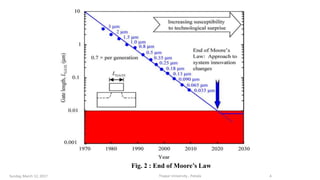
Moore’s Law[1]
 No. of transistors on a chip doubled every 18 to 24 months.
Semiconductor technology will double its effectiveness every 18 months.
Fig. 1 : No. of transistors with years
Fig. 2 : End of Moore’s Law
Thapar University , PatialaSunday, March 12, 2017 4
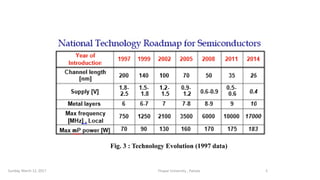
Fig. 3 : Technology Evolution (1997 data)
Thapar University , PatialaSunday, March 12, 2017 5
Why Scaling?[2]
Thapar University , PatialaSunday, March 12, 2017 6
 Design of high density chips in MOS VLSI technology requires:
 High packing density of MOSFETS
 Small transistor size
 This reduction of size is k/a Scaling.
 S>1 has been introduced leading to reduction of area by a factor S².
Disadvantage : Electric fields within the Gate Oxide grow larger.
Statistics[3]
Thapar University , PatialaSunday, March 12, 2017 7
Fig. 4 : Data showing no. of transistors on processors of Intel Corporation
with Years
Let’s Start
Thapar University , PatialaSunday, March 12, 2017 8
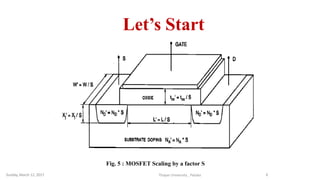
Fig. 5 : MOSFET Scaling by a factor S
Types of Scaling
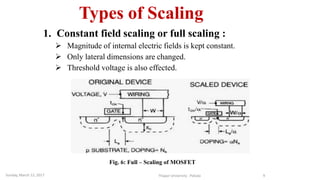
1. Constant field scaling or full scaling :
 Magnitude of internal electric fields is kept constant.
 Only lateral dimensions are changed.
 Threshold voltage is also effected.
Thapar University , PatialaSunday, March 12, 2017 9
Fig. 6: Full – Scaling of MOSFET
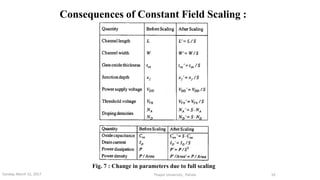
Consequences of Constant Field Scaling :
Thapar University , PatialaSunday, March 12, 2017 10
Fig. 7 : Change in parameters due to full scaling
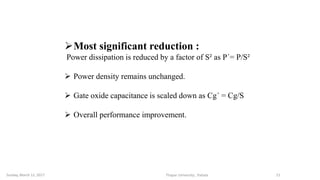
Most significant reduction :
Power dissipation is reduced by a factor of S² as P´= P/S²
 Power density remains unchanged.
 Gate oxide capacitance is scaled down as Cg´ = Cg/S
 Overall performance improvement.
Thapar University , PatialaSunday, March 12, 2017 11
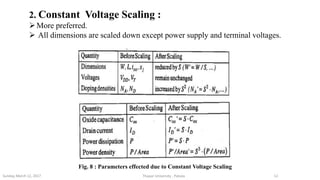
2. Constant Voltage Scaling :
More preferred.
 All dimensions are scaled down except power supply and terminal voltages.
Fig. 8 : Parameters effected due to Constant Voltage Scaling
Thapar University , PatialaSunday, March 12, 2017 12
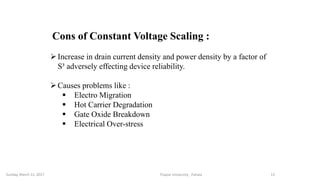
Cons of Constant Voltage Scaling :
Increase in drain current density and power density by a factor of
S³ adversely effecting device reliability.
Causes problems like :
 Electro Migration
 Hot Carrier Degradation
 Gate Oxide Breakdown
 Electrical Over-stress
Thapar University , PatialaSunday, March 12, 2017 13
Thapar University , PatialaSunday, March 12, 2017 14
 When channel length Leff approx. equals source and junction depth xj.
 Why Short Channel MOS , even if it has degraded performance ?
 Threshold voltage is less. Why ?
Effects :
 Drain- Induced Barrier Lowering
 Surface Scattering
 Velocity Saturation
 Impact Ionization
 Hot Carrier Effect
Short Channel Effects[4]
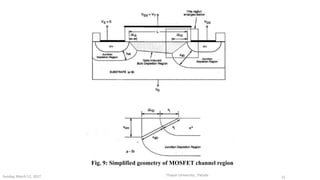
Fig. 9: Simplified geometry of MOSFET channel region
Thapar University , PatialaSunday, March 12, 2017 15
 Potential barrier is controlled by both VGS and VDS.
 If drain voltage increases , barrier in the channel decreases , leading to DIBL.
 Allows electron flow between S and D even at VGS < VTO .
A. Drain- Induced Barrier Lowering (DIBL)[5]
Fig. 10 : As channel length decreases, the barrier φB to be surmounted by an electron,
from the source on its way to the drain reduces.
Thapar University , PatialaSunday, March 12, 2017 16
Thapar University , PatialaSunday, March 12, 2017 17
B. Surface Scattering
 Due to SCE , electric field increases and mobility becomes field dependent.
 Surface scattering occurs.
Average surface mobility decreases.
Fig. 11: Pictorial representation of Surface Scattering[6]
Thapar University , PatialaSunday, March 12, 2017 18
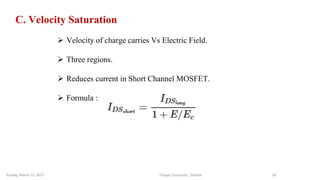
C. Velocity Saturation
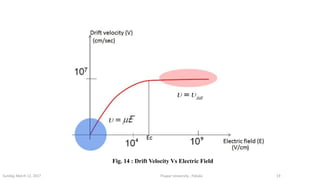
 Velocity of charge carries Vs Electric Field.
 Three regions.
 Reduces current in Short Channel MOSFET.
 Formula :
Fig. 14 : Drift Velocity Vs Electric Field
Thapar University , PatialaSunday, March 12, 2017 19
Thapar University , PatialaSunday, March 12, 2017 20
D. Impact Ionisation[7]
 Due to high electric field which causes high velocity of electrons.
 Generates Electron - Hole pairs.
Fig. 15 : Impact Ionization
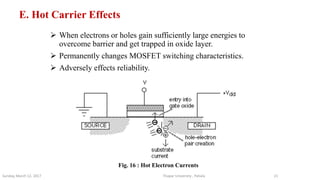
E. Hot Carrier Effects
 When electrons or holes gain sufficiently large energies to
overcome barrier and get trapped in oxide layer.
 Permanently changes MOSFET switching characteristics.
 Adversely effects reliability.
Thapar University , PatialaSunday, March 12, 2017 21
Fig. 16 : Hot Electron Currents
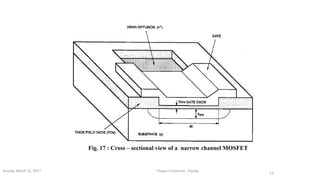
Narrow Channel Effects[8]
 MOS having channel widths (W) approx. equals depletion region
thickness (xdm) is known as Narrow – Channel MOS.
 Here , Vto (narrow channel) = Vto + ΔVto (most significant)
 Overlapping of Gate Oxide and FOX.
Thapar University , PatialaSunday, March 12, 2017
22
Thapar University , PatialaSunday, March 12, 2017
23
Fig. 17 : Cross – sectional view of a narrow channel MOSFET
Thapar University , PatialaSunday, March 12, 2017
24
References
[1] lect15-scaling.ppt
[2] Cmos Digital Integrated Circuits - Sung-Mo Kang and Yusuf Leblebici.pdf , pg. no. 115 ,
TATA MCGRAW – HILL EDITION
[3] www.intel.com/research/silicon/mooreslaw.htm
[4] Cmos Digital Integrated Circuits - Sung-Mo Kang and Yusuf Leblebici.pdf , pg. no. 119 ,
TATA MCGRAW – HILL EDITION
[5] Cmos Digital Integrated Circuits - Sung-Mo Kang and Yusuf Leblebici.pdf , pg. no. 127 ,
TATA MCGRAW – HILL EDITION
[6] EE327 Lec 30a - Surface scattering
[7] Introduction to VLSI design (EECS 467) Project Short-Channel Effects in MOSFETs
December 11th, 2000 Fabio D’Agostino Daniele Quercia pdf , pg. no. 3.
[8] Cmos Digital Integrated Circuits - Sung-Mo Kang and Yusuf Leblebici.pdf , page no. 125 ,
TATA MCGRAW – HILL EDITION
Sunday, March 12, 2017 Thapar University , Patiala 25

Presentation on Scaling

  • 1.
  • 2.
    Contents Moore’s Law Why Scaling? Typesof Scaling Short channel Effects Narrow Width Effects Queries Thapar University , PatialaSunday, March 12, 2017 2
  • 3.
    Thapar University ,PatialaSunday, March 12, 2017 3 Moore’s Law[1]  No. of transistors on a chip doubled every 18 to 24 months. Semiconductor technology will double its effectiveness every 18 months. Fig. 1 : No. of transistors with years
  • 4.
    Fig. 2 :End of Moore’s Law Thapar University , PatialaSunday, March 12, 2017 4
  • 5.
    Fig. 3 :Technology Evolution (1997 data) Thapar University , PatialaSunday, March 12, 2017 5
  • 6.
    Why Scaling?[2] Thapar University, PatialaSunday, March 12, 2017 6  Design of high density chips in MOS VLSI technology requires:  High packing density of MOSFETS  Small transistor size  This reduction of size is k/a Scaling.  S>1 has been introduced leading to reduction of area by a factor S². Disadvantage : Electric fields within the Gate Oxide grow larger.
  • 7.
    Statistics[3] Thapar University ,PatialaSunday, March 12, 2017 7 Fig. 4 : Data showing no. of transistors on processors of Intel Corporation with Years
  • 8.
    Let’s Start Thapar University, PatialaSunday, March 12, 2017 8 Fig. 5 : MOSFET Scaling by a factor S
  • 9.
    Types of Scaling 1.Constant field scaling or full scaling :  Magnitude of internal electric fields is kept constant.  Only lateral dimensions are changed.  Threshold voltage is also effected. Thapar University , PatialaSunday, March 12, 2017 9 Fig. 6: Full – Scaling of MOSFET
  • 10.
    Consequences of ConstantField Scaling : Thapar University , PatialaSunday, March 12, 2017 10 Fig. 7 : Change in parameters due to full scaling
  • 11.
    Most significant reduction: Power dissipation is reduced by a factor of S² as P´= P/S²  Power density remains unchanged.  Gate oxide capacitance is scaled down as Cg´ = Cg/S  Overall performance improvement. Thapar University , PatialaSunday, March 12, 2017 11
  • 12.
    2. Constant VoltageScaling : More preferred.  All dimensions are scaled down except power supply and terminal voltages. Fig. 8 : Parameters effected due to Constant Voltage Scaling Thapar University , PatialaSunday, March 12, 2017 12
  • 13.
    Cons of ConstantVoltage Scaling : Increase in drain current density and power density by a factor of S³ adversely effecting device reliability. Causes problems like :  Electro Migration  Hot Carrier Degradation  Gate Oxide Breakdown  Electrical Over-stress Thapar University , PatialaSunday, March 12, 2017 13
  • 14.
    Thapar University ,PatialaSunday, March 12, 2017 14  When channel length Leff approx. equals source and junction depth xj.  Why Short Channel MOS , even if it has degraded performance ?  Threshold voltage is less. Why ? Effects :  Drain- Induced Barrier Lowering  Surface Scattering  Velocity Saturation  Impact Ionization  Hot Carrier Effect Short Channel Effects[4]
  • 15.
    Fig. 9: Simplifiedgeometry of MOSFET channel region Thapar University , PatialaSunday, March 12, 2017 15
  • 16.
     Potential barrieris controlled by both VGS and VDS.  If drain voltage increases , barrier in the channel decreases , leading to DIBL.  Allows electron flow between S and D even at VGS < VTO . A. Drain- Induced Barrier Lowering (DIBL)[5] Fig. 10 : As channel length decreases, the barrier φB to be surmounted by an electron, from the source on its way to the drain reduces. Thapar University , PatialaSunday, March 12, 2017 16
  • 17.
    Thapar University ,PatialaSunday, March 12, 2017 17 B. Surface Scattering  Due to SCE , electric field increases and mobility becomes field dependent.  Surface scattering occurs. Average surface mobility decreases. Fig. 11: Pictorial representation of Surface Scattering[6]
  • 18.
    Thapar University ,PatialaSunday, March 12, 2017 18 C. Velocity Saturation  Velocity of charge carries Vs Electric Field.  Three regions.  Reduces current in Short Channel MOSFET.  Formula :
  • 19.
    Fig. 14 :Drift Velocity Vs Electric Field Thapar University , PatialaSunday, March 12, 2017 19
  • 20.
    Thapar University ,PatialaSunday, March 12, 2017 20 D. Impact Ionisation[7]  Due to high electric field which causes high velocity of electrons.  Generates Electron - Hole pairs. Fig. 15 : Impact Ionization
  • 21.
    E. Hot CarrierEffects  When electrons or holes gain sufficiently large energies to overcome barrier and get trapped in oxide layer.  Permanently changes MOSFET switching characteristics.  Adversely effects reliability. Thapar University , PatialaSunday, March 12, 2017 21 Fig. 16 : Hot Electron Currents
  • 22.
    Narrow Channel Effects[8] MOS having channel widths (W) approx. equals depletion region thickness (xdm) is known as Narrow – Channel MOS.  Here , Vto (narrow channel) = Vto + ΔVto (most significant)  Overlapping of Gate Oxide and FOX. Thapar University , PatialaSunday, March 12, 2017 22
  • 23.
    Thapar University ,PatialaSunday, March 12, 2017 23 Fig. 17 : Cross – sectional view of a narrow channel MOSFET
  • 24.
    Thapar University ,PatialaSunday, March 12, 2017 24
  • 25.
    References [1] lect15-scaling.ppt [2] CmosDigital Integrated Circuits - Sung-Mo Kang and Yusuf Leblebici.pdf , pg. no. 115 , TATA MCGRAW – HILL EDITION [3] www.intel.com/research/silicon/mooreslaw.htm [4] Cmos Digital Integrated Circuits - Sung-Mo Kang and Yusuf Leblebici.pdf , pg. no. 119 , TATA MCGRAW – HILL EDITION [5] Cmos Digital Integrated Circuits - Sung-Mo Kang and Yusuf Leblebici.pdf , pg. no. 127 , TATA MCGRAW – HILL EDITION [6] EE327 Lec 30a - Surface scattering [7] Introduction to VLSI design (EECS 467) Project Short-Channel Effects in MOSFETs December 11th, 2000 Fabio D’Agostino Daniele Quercia pdf , pg. no. 3. [8] Cmos Digital Integrated Circuits - Sung-Mo Kang and Yusuf Leblebici.pdf , page no. 125 , TATA MCGRAW – HILL EDITION Sunday, March 12, 2017 Thapar University , Patiala 25