
NLP in Team Coaching
Balaji Sathram, CSP, PMI-ACP.
Scrum master, Sabre.
Agenda
• History
• NLP: What, Why, Where?
• NLP Communication Model
• NLP Frames: Blame frame & Outcome frame
• State
• Meta Model
• Perceptual Positions
• Disney’s Creative Strategy
• TOTE Model
• FeedForward
History
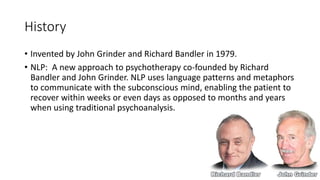
• Invented by John Grinder and Richard Bandler in 1979.
• NLP: A new approach to psychotherapy co-founded by Richard
Bandler and John Grinder. NLP uses language patterns and metaphors
to communicate with the subconscious mind, enabling the patient to
recover within weeks or even days as opposed to months and years
when using traditional psychoanalysis.
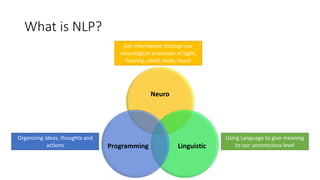
Neuro
LinguisticProgramming
Get information through our
neurological processes of sight,
hearing, smell, taste, touch
Using Language to give meaning
to our unconscious level
Organizing ideas, thoughts and
actions
What is NLP?
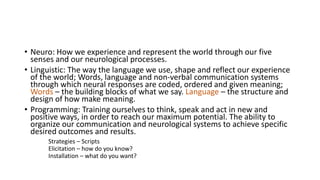
• Neuro: How we experience and represent the world through our five
senses and our neurological processes.
• Linguistic: The way the language we use, shape and reflect our experience
of the world; Words, language and non-verbal communication systems
through which neural responses are coded, ordered and given meaning;
Words – the building blocks of what we say. Language – the structure and
design of how make meaning.
• Programming: Training ourselves to think, speak and act in new and
positive ways, in order to reach our maximum potential. The ability to
organize our communication and neurological systems to achieve specific
desired outcomes and results.
Strategies – Scripts
Elicitation – how do you know?
Installation – what do you want?
Why NLP???
NLP is all about you.
• Your responsibilities
• Utilizing your resourcefulness
• Model excellence in any context
• Decide what really you want
• Workout a compelling strategies
• Your behaviors
Where NLP can be used?
• Business: Sales negotiations, meetings, presentation
• Education: Effective study methods, More Strength and Endurance
• Sports: outstanding performance, image training, mental support
• Communication: Self expression, Love, Problem solving, Attaining
goals and coaching
• Medical: Counselling, Psychotherapy and Hypnotherapy
• Health: Weight loss, Smoking and Phobia cure
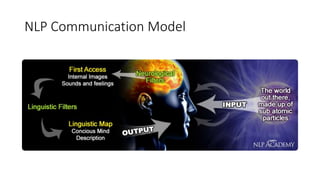
NLP Communication Model
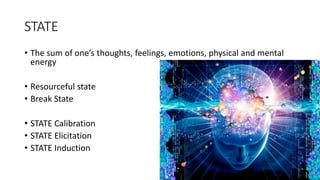
STATE
• The sum of one’s thoughts, feelings, emotions, physical and mental
energy
• Resourceful state
• Break State
• STATE Calibration
• STATE Elicitation
• STATE Induction
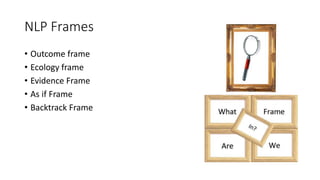
NLP Frames
• Outcome frame
• Ecology frame
• Evidence Frame
• As if Frame
• Backtrack Frame
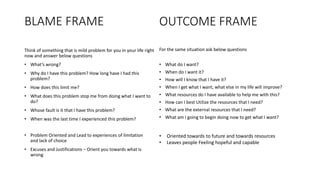
BLAME FRAME
Think of something that is mild problem for you in your life right
now and answer below questions
• What’s wrong?
• Why do I have this problem? How long have I had this
problem?
• How does this limit me?
• What does this problem stop me from doing what I want to
do?
• Whose fault is it that I have this problem?
• When was the last time I experienced this problem?
For the same situation ask below questions
• What do I want?
• When do I want it?
• How will I know that I have it?
• When I get what I want, what else in my life will improve?
• What resources do I have available to help me with this?
• How can I best Utilize the resources that I need?
• What are the external resources that I need?
• What am I going to begin doing now to get what I want?
OUTCOME FRAME
• Problem Oriented and Lead to experiences of limitation
and lack of choice
• Excuses and Justifications – Orient you towards what is
wrong
• Oriented towards to future and towards resources
• Leaves people Feeling hopeful and capable
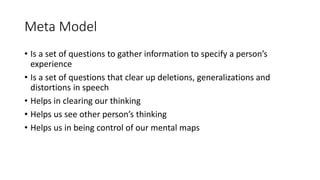
Meta Model
• Is a set of questions to gather information to specify a person’s
experience
• Is a set of questions that clear up deletions, generalizations and
distortions in speech
• Helps in clearing our thinking
• Helps us see other person’s thinking
• Helps us in being control of our mental maps
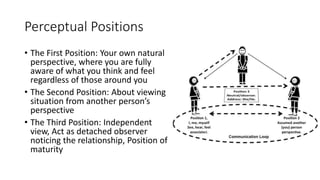
Perceptual Positions
• The First Position: Your own natural
perspective, where you are fully
aware of what you think and feel
regardless of those around you
• The Second Position: About viewing
situation from another person’s
perspective
• The Third Position: Independent
view, Act as detached observer
noticing the relationship, Position of
maturity
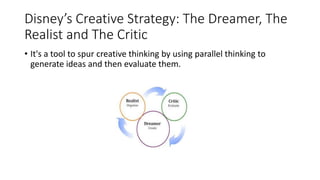
Disney’s Creative Strategy: The Dreamer, The
Realist and The Critic
• It's a tool to spur creative thinking by using parallel thinking to
generate ideas and then evaluate them.
TOTE Model
• Test, Operate, Test, Exit (TOTE)
• You test your strategy in order to assess whether you have reached
your goal
• Have a goal in mind, Purpose of Behavior is to get close to your goal
• If your goal is reached, you stop the behavior and exit the strategy
• If the goal is not reached, you modify the behavior and repeat it by
incorporating simple feedback and response loop
FeedForward
• Fundamental problem with all types of feedback: it focuses on the
past, on what has already occurred—not on the infinite variety of
opportunities that can happen in the future. As such, feedback can be
limited and static, as opposed to expansive and dynamic.
• Feedforward —that is, to give someone else suggestions for the
future and help as much as they can.
• Pick any behavior you would like to change, describe it to randomly selected
fellow participants
• Participants are only allowed to give ideas for the future
• Thank the participants for their ideas
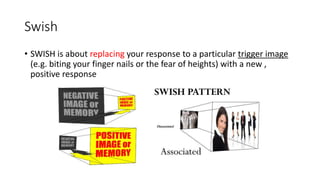
Swish
• SWISH is about replacing your response to a particular trigger image
(e.g. biting your finger nails or the fear of heights) with a new ,
positive response
NLP in Team Coaching

NLP in Team Coaching

  • 1.
    NLP in TeamCoaching Balaji Sathram, CSP, PMI-ACP. Scrum master, Sabre.
  • 2.
    Agenda • History • NLP:What, Why, Where? • NLP Communication Model • NLP Frames: Blame frame & Outcome frame • State • Meta Model • Perceptual Positions • Disney’s Creative Strategy • TOTE Model • FeedForward
  • 3.
    History • Invented byJohn Grinder and Richard Bandler in 1979. • NLP: A new approach to psychotherapy co-founded by Richard Bandler and John Grinder. NLP uses language patterns and metaphors to communicate with the subconscious mind, enabling the patient to recover within weeks or even days as opposed to months and years when using traditional psychoanalysis.
  • 4.
    Neuro LinguisticProgramming Get information throughour neurological processes of sight, hearing, smell, taste, touch Using Language to give meaning to our unconscious level Organizing ideas, thoughts and actions What is NLP?
  • 5.
    • Neuro: Howwe experience and represent the world through our five senses and our neurological processes. • Linguistic: The way the language we use, shape and reflect our experience of the world; Words, language and non-verbal communication systems through which neural responses are coded, ordered and given meaning; Words – the building blocks of what we say. Language – the structure and design of how make meaning. • Programming: Training ourselves to think, speak and act in new and positive ways, in order to reach our maximum potential. The ability to organize our communication and neurological systems to achieve specific desired outcomes and results. Strategies – Scripts Elicitation – how do you know? Installation – what do you want?
  • 6.
    Why NLP??? NLP isall about you. • Your responsibilities • Utilizing your resourcefulness • Model excellence in any context • Decide what really you want • Workout a compelling strategies • Your behaviors
  • 7.
    Where NLP canbe used? • Business: Sales negotiations, meetings, presentation • Education: Effective study methods, More Strength and Endurance • Sports: outstanding performance, image training, mental support • Communication: Self expression, Love, Problem solving, Attaining goals and coaching • Medical: Counselling, Psychotherapy and Hypnotherapy • Health: Weight loss, Smoking and Phobia cure
  • 8.
  • 9.
    STATE • The sumof one’s thoughts, feelings, emotions, physical and mental energy • Resourceful state • Break State • STATE Calibration • STATE Elicitation • STATE Induction
  • 10.
    NLP Frames • Outcomeframe • Ecology frame • Evidence Frame • As if Frame • Backtrack Frame
  • 11.
    BLAME FRAME Think ofsomething that is mild problem for you in your life right now and answer below questions • What’s wrong? • Why do I have this problem? How long have I had this problem? • How does this limit me? • What does this problem stop me from doing what I want to do? • Whose fault is it that I have this problem? • When was the last time I experienced this problem? For the same situation ask below questions • What do I want? • When do I want it? • How will I know that I have it? • When I get what I want, what else in my life will improve? • What resources do I have available to help me with this? • How can I best Utilize the resources that I need? • What are the external resources that I need? • What am I going to begin doing now to get what I want? OUTCOME FRAME • Problem Oriented and Lead to experiences of limitation and lack of choice • Excuses and Justifications – Orient you towards what is wrong • Oriented towards to future and towards resources • Leaves people Feeling hopeful and capable
  • 12.
    Meta Model • Isa set of questions to gather information to specify a person’s experience • Is a set of questions that clear up deletions, generalizations and distortions in speech • Helps in clearing our thinking • Helps us see other person’s thinking • Helps us in being control of our mental maps
  • 13.
    Perceptual Positions • TheFirst Position: Your own natural perspective, where you are fully aware of what you think and feel regardless of those around you • The Second Position: About viewing situation from another person’s perspective • The Third Position: Independent view, Act as detached observer noticing the relationship, Position of maturity
  • 14.
    Disney’s Creative Strategy:The Dreamer, The Realist and The Critic • It's a tool to spur creative thinking by using parallel thinking to generate ideas and then evaluate them.
  • 15.
    TOTE Model • Test,Operate, Test, Exit (TOTE) • You test your strategy in order to assess whether you have reached your goal • Have a goal in mind, Purpose of Behavior is to get close to your goal • If your goal is reached, you stop the behavior and exit the strategy • If the goal is not reached, you modify the behavior and repeat it by incorporating simple feedback and response loop
  • 16.
    FeedForward • Fundamental problemwith all types of feedback: it focuses on the past, on what has already occurred—not on the infinite variety of opportunities that can happen in the future. As such, feedback can be limited and static, as opposed to expansive and dynamic. • Feedforward —that is, to give someone else suggestions for the future and help as much as they can. • Pick any behavior you would like to change, describe it to randomly selected fellow participants • Participants are only allowed to give ideas for the future • Thank the participants for their ideas
  • 17.
    Swish • SWISH isabout replacing your response to a particular trigger image (e.g. biting your finger nails or the fear of heights) with a new , positive response