Neuro-linguistic
Programming (NLP)
History & Development
















Original work in the 1970’s by Richard Bandler, Computer Scientist and
Gestalt therapist and Dr. John Grinder, linguist and therapist.
Grinder and Bandler fell out(1980’s) , countersued each other amid
controversy over intellectual property rights of NLP.
Others used NLP to their own end including Anthony Robbins (Neuro
Associative Conditioning) and Michael Hall( Meta-states) - stepping back
and viewing the self from a larger perspective using self-reflexive
consciousness.
Abundance of developers and trainers created no definitive system of NLP
Research reviewers in experimental counseling psychology and the National
Research council gave NLP an overall negative assessment ( mid -late
80’s)
In 2000, Grinder & Bandler settled dispute and became offical co-founders
of NLP
Since then, many types of training certificates exist originally intended for
therapists. Certificate programs can be from 20 days to a 9 month program
for a professional level competence.
Exists as a set of techniques, methods, concepts, and labels
NLP is still an open field of training.

QuickTime™ and a
TIFFneeded to see thisdec
are (Uncompressed) pic
What is NLP?
Richard Bandler ‘s definition:

"The Study of the Structure of Subjective Experience and what can be calculated
from it.”
Others definition of NLP

An approach to discovering and modifying patterns of human thought and
behavior.


NLP is a universal model for communication and change. It is also an attitude and a
set of techniques to influence ourselves and others with precision, elegance and
integrity.



NLP describes the fundamental dynamics between mind (neuro) and language
(linguistic) and how their interaction effects our body and behavior
(programming).



NLP is about the study of patterns in human behavior that usually are outside of
conscious awareness.



NLP is is a tool for generating change for changes sake.



NLP is the Art and Science of Personal Excellence
Applications of NLP

QuickTime™
a
TIFFneeded to see and decompressor
are (Uncompressed) picture.
this



Companies,
organizations, and
individuals use NLP
as a communication
and self-improvement
tool.













QuickTime™ and a
TIFFneeded to see thisdecompressor
are (Uncompressed) picture.

QuickTime™ and a
TIFF needed to see thisdecomp
are (Uncompressed) picture

Directors and executives
Managers at all levels
Sales people
Administrators
Engineering and technical staff
Customer care operatives
Receptionists and secretaries
Trainers
Human Resource personnel
Therapists
Actors

QuickTime™ and a
TIFF (Uncompressed) decompre
are needed to see this picture.
Core Research
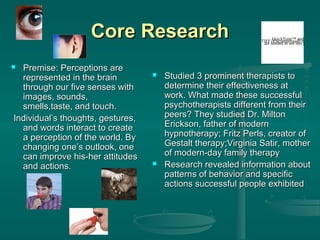
Premise: Perceptions are
represented in the brain
through our five senses with
images, sounds,
smells,taste, and touch.
Individual’s thoughts, gestures,
and words interact to create
a perception of the world. By
changing one’s outlook, one
can improve his-her attitudes
and actions.

QuickTime™ and a
TIFF needed to see thisdecompres
are (Uncompressed) picture.







Studied 3 prominent therapists to
determine their effectiveness at
work. What made these successful
psychotherapists different from their
peers? They studied Dr. Milton
Erickson, father of modern
hypnotherapy; Fritz Perls, creator of
Gestalt therapy;Virginia Satir, mother
of modern-day family therapy
Research revealed information about
patterns of behavior and specific
actions successful people exhibited
and a
TIFFQuickTime™ thisdecompressor
(Uncompressed) picture.
are needed to see



Modeling

Process of adopting
the behaviors,
language, strategies,
and beliefs of another
person

QuickTime™ and a
TIFF needed to see thisdecompressor
are (Uncompressed) picture.





Grinder and Bandler modeled
the three therapists and
developed special “patterns” for
general communication, rapportbuilding, and self-improvement.
NLP could be developed as a
tool for modeling excellence

QuickTime™ and a
TIFF needed to see thisdecompressor
are (Uncompressed) picture.

QuickTime™ and a
TIFF (Uncompressed) decompress
are needed to see this picture.
Representational systems
Grinder and Bandler focused on three major
representational modalities to use in their
research.




Visual (V)
Auditory (A)
Kinesthetic (K)

Each modality is broken down into smaller
structural divisions called Submodalities
NLP Submodalities
Submodality is a distinction of form or structure (rather
than content). A submodality describes the modality with
certain attributes and more precision.
For example,
Visual(modality) images can have many attributes. Some
common visual attributes(Submodalities) could be clear,
fuzzy, bright or dark.
Some Submodalities of the Kinesthetic system could be
soft, warm or cold.
QuickTime™ and a
TIFF (Uncompressed) decompressor
are needed to see this picture.

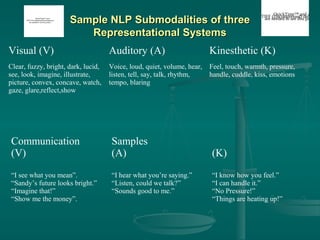
Sample NLP Submodalities of three
Representational Systems

QuickTime™ and a
TIFF needed to see thisdecompre
are (Uncompressed) picture.

Visual (V)

Auditory (A)

Kinesthetic (K)

Clear, fuzzy, bright, dark, lucid,
see, look, imagine, illustrate,
picture, convex, concave, watch,
gaze, glare,reflect,show

Voice, loud, quiet, volume, hear,
listen, tell, say, talk, rhythm,
tempo, blaring

Feel, touch, warmth, pressure,
handle, cuddle, kiss, emotions

Communication
(V)

Samples
(A)

“I see what you mean”.
“Sandy’s future looks bright.”
“Imagine that!”
“Show me the money”.

“I hear what you’re saying.”
“Listen, could we talk?”
“Sounds good to me.”

(K)
“I know how you feel.”
“I can handle it.”
“No Pressure!”
“Things are heating up!”
NLP Representational Systems
(Modalities)
VAK Preference Learning styles
Visual (V)

Auditory (A)

Kinesthetic (K)

Someone with a Visual learning
style has a preference for seen or
observed things including
pictures, movies, diagrams,
displays, demonstrations

Someone with an Auditory
learning style has a preference
for the transfer of information
through listening; to the spoken
word, of self or others, of sounds
and noises.

Someone with a Kinesthetic
learning style has a preference
for physical experience touching, feeling, holding,
doing, practical “hands-on”
experiences.
Limitations and Difficulties
using NLP








Lacks a specific definition without a
large body of empirical support.
Requires skill. Many use NLP
without much preparation or
practice, creates potential misuse.
Missing code of ethics
Difficult to measure scientifically
making it difficult to determine
effectiveness and “best use”
strategy
Ambiguous nature of NLP creates
openings for misinterpreting it
meaning
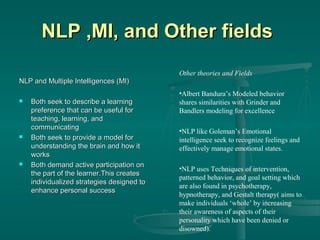
NLP ,MI, and Other fields
Other theories and Fields
NLP and Multiple Intelligences (MI)






Both seek to describe a learning
preference that can be useful for
teaching, learning, and
communicating
Both seek to provide a model for
understanding the brain and how it
works
Both demand active participation on
the part of the learner.This creates
individualized strategies designed to
enhance personal success

•Albert Bandura’s Modeled behavior
shares similarities with Grinder and
Bandlers modeling for excellence
•NLP like Goleman’s Emotional
intelligence seek to recognize feelings and
effectively manage emotional states.
•NLP uses Techniques of intervention,
patterned behavior, and goal setting which
are also found in psychotherapy,
hypnotherapy, and Gestalt therapy( aims to
make individuals ‘whole’ by increasing
their awareness of aspects of their
personality which have been denied or
disowned).
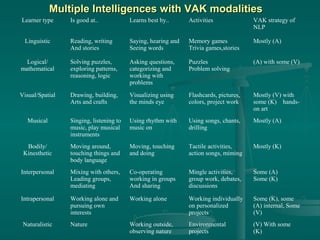
Multiple Intelligences with VAK modalities
Learner type

Is good at..

Learns best by..

Activities

VAK strategy of
NLP

Reading, writing
And stories

Saying, hearing and
Seeing words

Memory games
Trivia games,stories

Mostly (A)

Logical/
mathematical

Solving puzzles,
exploring patterns,
reasoning, logic

Asking questions,
categorizing and
working with
problems

Puzzles
Problem solving

(A) with some (V)

Visual/Spatial

Drawing, building,
Arts and crafts

Visualizing using
the minds eye

Flashcards, pictures,
colors, project work

Mostly (V) with
some (K) handson art

Musical

Singing, listening to
music, play musical
instruments

Using rhythm with
music on

Using songs, chants,
drilling

Mostly (A)

Bodily/
Kinesthetic

Moving around,
touching things and
body language

Moving, touching
and doing

Tactile activities,
action songs, miming

Mostly (K)

Interpersonal

Mixing with others,
Leading groups,
mediating

Co-operating
working in groups
And sharing

Mingle activities,
group work, debates,
discussions

Some (A)
Some (K)

Intrapersonal

Working alone and
pursuing own
interests

Working alone

Working individually
on personalized
projects

Some (K), some
(A) internal, Some
(V)

Nature

Working outside,
observing nature

Environmental
projects

(V) With some
(K)

Linguistic

Naturalistic
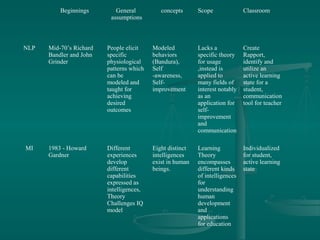
Beginnings

NLP

MI

General
assumptions

concepts

Scope

Classroom

Mid-70’s Richard
Bandler and John
Grinder

People elicit
specific
physiological
patterns which
can be
modeled and
taught for
achieving
desired
outcomes

Modeled
behaviors
(Bandura),
Self
-awareness,
Selfimprovement

Lacks a
specific theory
for usage
,instead is
applied to
many fields of
interest notably
as an
application for
selfimprovement
and
communication

Create
Rapport,
identify and
utilize an
active learning
state for a
student,
communication
tool for teacher

1983 - Howard
Gardner

Different
experiences
develop
different
capabilities
expressed as
intelligences,
Theory
Challenges IQ
model

Eight distinct
intelligences
exist in human
beings.

Learning
Theory
encompasses
different kinds
of intelligences
for
understanding
human
development
and
applications
for education

Individualized
for student,
active learning
state

NLP Overview

  • 1.
  • 2.
    History & Development          Originalwork in the 1970’s by Richard Bandler, Computer Scientist and Gestalt therapist and Dr. John Grinder, linguist and therapist. Grinder and Bandler fell out(1980’s) , countersued each other amid controversy over intellectual property rights of NLP. Others used NLP to their own end including Anthony Robbins (Neuro Associative Conditioning) and Michael Hall( Meta-states) - stepping back and viewing the self from a larger perspective using self-reflexive consciousness. Abundance of developers and trainers created no definitive system of NLP Research reviewers in experimental counseling psychology and the National Research council gave NLP an overall negative assessment ( mid -late 80’s) In 2000, Grinder & Bandler settled dispute and became offical co-founders of NLP Since then, many types of training certificates exist originally intended for therapists. Certificate programs can be from 20 days to a 9 month program for a professional level competence. Exists as a set of techniques, methods, concepts, and labels NLP is still an open field of training. QuickTime™ and a TIFFneeded to see thisdec are (Uncompressed) pic
  • 3.
    What is NLP? Richard Bandler ‘sdefinition:  "The Study of the Structure of Subjective Experience and what can be calculated from it.” Others definition of NLP  An approach to discovering and modifying patterns of human thought and behavior.  NLP is a universal model for communication and change. It is also an attitude and a set of techniques to influence ourselves and others with precision, elegance and integrity.  NLP describes the fundamental dynamics between mind (neuro) and language (linguistic) and how their interaction effects our body and behavior (programming).  NLP is about the study of patterns in human behavior that usually are outside of conscious awareness.  NLP is is a tool for generating change for changes sake.  NLP is the Art and Science of Personal Excellence
  • 4.
    Applications of NLP QuickTime™ a TIFFneededto see and decompressor are (Uncompressed) picture. this  Companies, organizations, and individuals use NLP as a communication and self-improvement tool.            QuickTime™ and a TIFFneeded to see thisdecompressor are (Uncompressed) picture. QuickTime™ and a TIFF needed to see thisdecomp are (Uncompressed) picture Directors and executives Managers at all levels Sales people Administrators Engineering and technical staff Customer care operatives Receptionists and secretaries Trainers Human Resource personnel Therapists Actors QuickTime™ and a TIFF (Uncompressed) decompre are needed to see this picture.
  • 5.
    Core Research Premise: Perceptionsare represented in the brain through our five senses with images, sounds, smells,taste, and touch. Individual’s thoughts, gestures, and words interact to create a perception of the world. By changing one’s outlook, one can improve his-her attitudes and actions. QuickTime™ and a TIFF needed to see thisdecompres are (Uncompressed) picture.    Studied 3 prominent therapists to determine their effectiveness at work. What made these successful psychotherapists different from their peers? They studied Dr. Milton Erickson, father of modern hypnotherapy; Fritz Perls, creator of Gestalt therapy;Virginia Satir, mother of modern-day family therapy Research revealed information about patterns of behavior and specific actions successful people exhibited
  • 6.
    and a TIFFQuickTime™ thisdecompressor (Uncompressed)picture. are needed to see  Modeling Process of adopting the behaviors, language, strategies, and beliefs of another person QuickTime™ and a TIFF needed to see thisdecompressor are (Uncompressed) picture.   Grinder and Bandler modeled the three therapists and developed special “patterns” for general communication, rapportbuilding, and self-improvement. NLP could be developed as a tool for modeling excellence QuickTime™ and a TIFF needed to see thisdecompressor are (Uncompressed) picture. QuickTime™ and a TIFF (Uncompressed) decompress are needed to see this picture.
  • 7.
    Representational systems Grinder andBandler focused on three major representational modalities to use in their research.    Visual (V) Auditory (A) Kinesthetic (K) Each modality is broken down into smaller structural divisions called Submodalities
  • 8.
    NLP Submodalities Submodality isa distinction of form or structure (rather than content). A submodality describes the modality with certain attributes and more precision. For example, Visual(modality) images can have many attributes. Some common visual attributes(Submodalities) could be clear, fuzzy, bright or dark. Some Submodalities of the Kinesthetic system could be soft, warm or cold.
  • 9.
    QuickTime™ and a TIFF(Uncompressed) decompressor are needed to see this picture. Sample NLP Submodalities of three Representational Systems QuickTime™ and a TIFF needed to see thisdecompre are (Uncompressed) picture. Visual (V) Auditory (A) Kinesthetic (K) Clear, fuzzy, bright, dark, lucid, see, look, imagine, illustrate, picture, convex, concave, watch, gaze, glare,reflect,show Voice, loud, quiet, volume, hear, listen, tell, say, talk, rhythm, tempo, blaring Feel, touch, warmth, pressure, handle, cuddle, kiss, emotions Communication (V) Samples (A) “I see what you mean”. “Sandy’s future looks bright.” “Imagine that!” “Show me the money”. “I hear what you’re saying.” “Listen, could we talk?” “Sounds good to me.” (K) “I know how you feel.” “I can handle it.” “No Pressure!” “Things are heating up!”
  • 10.
    NLP Representational Systems (Modalities) VAKPreference Learning styles Visual (V) Auditory (A) Kinesthetic (K) Someone with a Visual learning style has a preference for seen or observed things including pictures, movies, diagrams, displays, demonstrations Someone with an Auditory learning style has a preference for the transfer of information through listening; to the spoken word, of self or others, of sounds and noises. Someone with a Kinesthetic learning style has a preference for physical experience touching, feeling, holding, doing, practical “hands-on” experiences.
  • 11.
    Limitations and Difficulties usingNLP     Lacks a specific definition without a large body of empirical support. Requires skill. Many use NLP without much preparation or practice, creates potential misuse. Missing code of ethics Difficult to measure scientifically making it difficult to determine effectiveness and “best use” strategy Ambiguous nature of NLP creates openings for misinterpreting it meaning
  • 12.
    NLP ,MI, andOther fields Other theories and Fields NLP and Multiple Intelligences (MI)    Both seek to describe a learning preference that can be useful for teaching, learning, and communicating Both seek to provide a model for understanding the brain and how it works Both demand active participation on the part of the learner.This creates individualized strategies designed to enhance personal success •Albert Bandura’s Modeled behavior shares similarities with Grinder and Bandlers modeling for excellence •NLP like Goleman’s Emotional intelligence seek to recognize feelings and effectively manage emotional states. •NLP uses Techniques of intervention, patterned behavior, and goal setting which are also found in psychotherapy, hypnotherapy, and Gestalt therapy( aims to make individuals ‘whole’ by increasing their awareness of aspects of their personality which have been denied or disowned).
  • 13.
    Multiple Intelligences withVAK modalities Learner type Is good at.. Learns best by.. Activities VAK strategy of NLP Reading, writing And stories Saying, hearing and Seeing words Memory games Trivia games,stories Mostly (A) Logical/ mathematical Solving puzzles, exploring patterns, reasoning, logic Asking questions, categorizing and working with problems Puzzles Problem solving (A) with some (V) Visual/Spatial Drawing, building, Arts and crafts Visualizing using the minds eye Flashcards, pictures, colors, project work Mostly (V) with some (K) handson art Musical Singing, listening to music, play musical instruments Using rhythm with music on Using songs, chants, drilling Mostly (A) Bodily/ Kinesthetic Moving around, touching things and body language Moving, touching and doing Tactile activities, action songs, miming Mostly (K) Interpersonal Mixing with others, Leading groups, mediating Co-operating working in groups And sharing Mingle activities, group work, debates, discussions Some (A) Some (K) Intrapersonal Working alone and pursuing own interests Working alone Working individually on personalized projects Some (K), some (A) internal, Some (V) Nature Working outside, observing nature Environmental projects (V) With some (K) Linguistic Naturalistic
  • 14.
    Beginnings NLP MI General assumptions concepts Scope Classroom Mid-70’s Richard Bandler andJohn Grinder People elicit specific physiological patterns which can be modeled and taught for achieving desired outcomes Modeled behaviors (Bandura), Self -awareness, Selfimprovement Lacks a specific theory for usage ,instead is applied to many fields of interest notably as an application for selfimprovement and communication Create Rapport, identify and utilize an active learning state for a student, communication tool for teacher 1983 - Howard Gardner Different experiences develop different capabilities expressed as intelligences, Theory Challenges IQ model Eight distinct intelligences exist in human beings. Learning Theory encompasses different kinds of intelligences for understanding human development and applications for education Individualized for student, active learning state