
FACILITATION(BASICS)
Balaji Sathram, Agile Coach,
IBM CIO Agile Academy.
Group sharing
Safety
Confidential
§ Take a sticky note
§ Write your input for social contract and Paste it under
“Social Contract”
§ Yes: I actively support this decision
§ Veto: I understand the proposal, but I do not support it. I can
explain my concerns. (The group can’t decide)
§ I need more discussion before I can support this decision
To help you become a
significantly better facilitator in
the work you do
§ What is Facilitation?
§ Facilitator
§ Why Facilitation?
§ How is facilitation done?
§ Facilitation skills
§ Facilitation Techniques
§ Summary: Self-Reflection
§ Let’s Play Facilitation
§ Rigid/Inflexible
§ Forcing or manipulating
§ Talking more than 20% of the time
§ Taking sides or deciding who is right
§ Only engaging those who think/act
like you or talks the loudest
§ Controlling the conversation topics
§ One big group conversation
§ Without form
Facilitation is a fluid process using a variety of tools,
techniques, and activities to….
Empower participants, Create clarity, invite
collaboration and ….
Increase commitment to the solutions created
by the group in order to ….
Maximize Productivity.
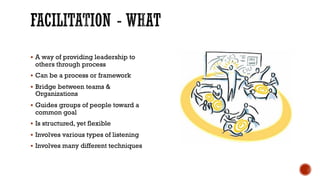
§ A way of providing leadership to
others through process
§ Can be a process or framework
§ Bridge between teams &
Organizations
§ Guides groups of people toward a
common goal
§ Is structured, yet flexible
§ Involves various types of listening
§ Involves many different techniques
Deals Throughout with Dysfunction
§ Think about all those dysfunctional things that make you NUTS in sessions you
facilitate
§ Behaviors that limit productivity
§ Attitudes that affect the team
§ Personalities that are hard to deal with
§ Things that disrupt your meetings
“What are those dysfunctions you want to know how to deal with ? “
§ Good listening and communication skills
§ Understands the aim of the meeting and long term
goals of the group
§ Confidence that the group can find a solution
§ Neutrality
§ Respect for all
§ Knows when to intervene and provide guidance
§ Clear thinking and observation
§ Ability to ask powerful questions
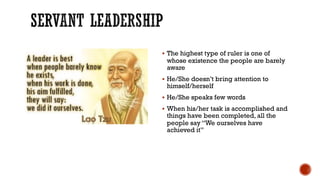
§ The highest type of ruler is one of
whose existence the people are barely
aware
§ He/She doesn’t bring attention to
himself/herself
§ He/She speaks few words
§ When his/her task is accomplished and
things have been completed, all the
people say “We ourselves have
achieved it”
SOURCE: https://www.slideshare.net/SvetlanaMukhinaICAgi/webinar1-online-icagileagileteamsfacilitation
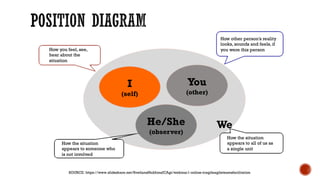
How you feel, see,
hear about the
situation
I
(self)
You
(other)
He/She
(observer)
We
How other person’s reality
looks, sounds and feels, if
you were this person
How the situation
appears to someone who
is not involved
How the situation
appears to all of us as
a single unit
SOURCE: https://www.slideshare.net/SvetlanaMukhinaICAgi/webinar1-online-icagileagileteamsfacilitation
Teaching
how to fish
OVER giving
fish every time
Staying
curious and
seeing the
best in people
OVER judging
or
manipulating
Focusing on
the leverage
in the present
moment
OVER
speculating
on past or
future
Responding
to change
OVER
following
a
facilitation
plan
§ Which is Harder for you to do?
§ Why is it Harder?
§ How to Overcome these difficulties?
§ Concentrates on value-driven
results over following a plan
§ Embodies the Agile values
Encourages organization wide
collaboration
§ Encourages teams to be self-
managing and empowered
§ Facilitates Agile practices
§ Focuses on the entire team or
organization, not just a few people
§ Guardian of the Agile process,
principles, and practices
§ Active Engagement
§ Attainable results reached by consensus
§ Clarity on the objectives and goals
§ Empowerment of teams/people
§ Enthusiastic participants
§ Open Collaboration
§ Participant buy-in
§ Before the session
§ Pre-meeting (preparation questions)
§ Pre-meeting Logistics
§ Use separate techniques for F2F and Virtual sessions
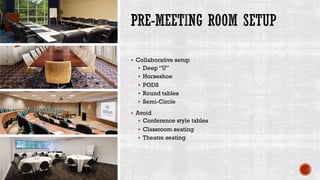
§ Pre-meeting room setup
§ Session Design
§ Opening the Session
§ During the Session
§ Closing the Session
§ Collaborative setup
§ Deep “U”
§ Horseshoe
§ PODS
§ Round tables
§ Semi-Circle
§ Avoid
§ Conference style tables
§ Classroom seating
§ Theatre seating
What tools could you use for
Remote/Virtual sessions?
§ Purpose
§ Outcomes and Deliverables
§ Wii-FM (What’s in it for me)
§ Inspire
§ Excite
§ Motivate
§ Engage participants
§ Roles and Responsibilities
§ What are they empowered to do?
§ Container
§ Tools for Success
§ Mood Wall
§ Parking Lot
§ Issues
§ Social Contracts
DURING THE
SESSION
§ Flipcharts can be labeled and positioned
ahead of time. Information should include
§ Session objectives
§ Action Items
§ Decisions
§ Parking Lots
§ Social Contract
§ Listing
§ Brainstorming
§ Grouping
§ Prioritization
§ Probe for Clarifications:
§ Powerful Questions
§ What...?
§ How…?
§ CanYou…?
§ Tell me more
Powerful Questions is a
technique that is commonly
used in Professional Coaching.
§ Get Untapped Ideas:
§ What else?
§ If you couldn’t fail,What would you do?
§ Have you thought of…?
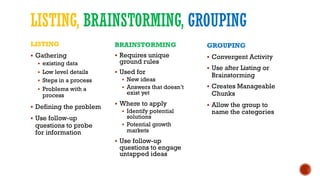
LISTING, BRAINSTORMING, GROUPING
LISTING
§ Gathering
§ existing data
§ Low level details
§ Steps in a process
§ Problems with a
process
§ Defining the problem
§ Use follow-up
questions to probe
for information
BRAINSTORMING
§ Requires unique
ground rules
§ Used for
§ New ideas
§ Answers that doesn’t
exist yet
§ Where to apply
§ Identify potential
solutions
§ Potential growth
markets
§ Use follow-up
questions to engage
untapped ideas
GROUPING
§ Convergent Activity
§ Use after Listing or
Brainstorming
§ Creates Manageable
Chunks
§ Allow the group to
name the categories
§ MoSCoW
§ Must have
§ Should have
§ Could have
§ Won’t have this time
§ Ranking
§ Voting
§ Impact analysis
§ Sticky DotVoting:
Used to prioritize from high to low
based on individual preference
§ Each person gets “dots” equal to 20-
25% of the number of Ideas (i.e. 20
Ideas = 4-5 dots)
§ Decision making is the
process of examining your
possibilities, options,
comparing them, and
choosing a right course of
action
§ Fist of Five for Building consensus
§ Review the work done, session objectives, outstanding issues
§ Conduct a retrospective
§ Recognize everyone’s hard work
§ Each person talks about what was gained from this session
§ Celebrate your achievements
End of the meeting Evaluations:
What to Evaluate?
• Results
• Techniques
• Communication
• Responsiveness
Evaluation Techniques:
• Plus/Minus (+/-)
• Start-Stop-Continue
• Exit Survey
• ROTI –Return on time invested
§ Action Items
As a Squad
§ Identify session activities
§ Open
§ During
§ Closing
§ At least 2 activities for each of the
above sections
§ Final words (from the host/executive sponsor)
§ Next session information
§ Document and Debrief
§ Document
§ Action items
§ Key work completed
§ Who to debrief
§ Session sponsor
§ Consult/inform people not in the
session (As needed)
§ Anyone affected by the session
outcomes
§ Monitor Action Items
§ Prepare agenda for next session
Take 5 minutes and summarize what you have learnt for past 80 minutes
Who wants to be a great
facilitator?
§ Facilitating with ease by Ingrid Bens
§ http://www.facilitationtutor.com/facilitation-resources/
§ Workshop conducted by Steven Crago and Matt
§ Workshop conducted by Lyssa Adkins
Team Facilitator

Team Facilitator

  • 1.
    FACILITATION(BASICS) Balaji Sathram, AgileCoach, IBM CIO Agile Academy.
  • 2.
  • 3.
    § Take asticky note § Write your input for social contract and Paste it under “Social Contract”
  • 5.
    § Yes: Iactively support this decision § Veto: I understand the proposal, but I do not support it. I can explain my concerns. (The group can’t decide) § I need more discussion before I can support this decision
  • 6.
    To help youbecome a significantly better facilitator in the work you do
  • 7.
    § What isFacilitation? § Facilitator § Why Facilitation? § How is facilitation done? § Facilitation skills § Facilitation Techniques § Summary: Self-Reflection § Let’s Play Facilitation
  • 8.
    § Rigid/Inflexible § Forcingor manipulating § Talking more than 20% of the time § Taking sides or deciding who is right § Only engaging those who think/act like you or talks the loudest § Controlling the conversation topics § One big group conversation § Without form
  • 9.
    Facilitation is afluid process using a variety of tools, techniques, and activities to…. Empower participants, Create clarity, invite collaboration and …. Increase commitment to the solutions created by the group in order to …. Maximize Productivity.
  • 10.
    § A wayof providing leadership to others through process § Can be a process or framework § Bridge between teams & Organizations § Guides groups of people toward a common goal § Is structured, yet flexible § Involves various types of listening § Involves many different techniques
  • 11.
    Deals Throughout withDysfunction § Think about all those dysfunctional things that make you NUTS in sessions you facilitate § Behaviors that limit productivity § Attitudes that affect the team § Personalities that are hard to deal with § Things that disrupt your meetings “What are those dysfunctions you want to know how to deal with ? “
  • 12.
    § Good listeningand communication skills § Understands the aim of the meeting and long term goals of the group § Confidence that the group can find a solution § Neutrality § Respect for all § Knows when to intervene and provide guidance § Clear thinking and observation § Ability to ask powerful questions
  • 13.
    § The highesttype of ruler is one of whose existence the people are barely aware § He/She doesn’t bring attention to himself/herself § He/She speaks few words § When his/her task is accomplished and things have been completed, all the people say “We ourselves have achieved it”
  • 14.
    SOURCE: https://www.slideshare.net/SvetlanaMukhinaICAgi/webinar1-online-icagileagileteamsfacilitation How youfeel, see, hear about the situation I (self) You (other) He/She (observer) We How other person’s reality looks, sounds and feels, if you were this person How the situation appears to someone who is not involved How the situation appears to all of us as a single unit
  • 15.
    SOURCE: https://www.slideshare.net/SvetlanaMukhinaICAgi/webinar1-online-icagileagileteamsfacilitation Teaching how tofish OVER giving fish every time Staying curious and seeing the best in people OVER judging or manipulating Focusing on the leverage in the present moment OVER speculating on past or future Responding to change OVER following a facilitation plan
  • 16.
    § Which isHarder for you to do? § Why is it Harder? § How to Overcome these difficulties?
  • 17.
    § Concentrates onvalue-driven results over following a plan § Embodies the Agile values Encourages organization wide collaboration § Encourages teams to be self- managing and empowered § Facilitates Agile practices § Focuses on the entire team or organization, not just a few people § Guardian of the Agile process, principles, and practices
  • 18.
    § Active Engagement §Attainable results reached by consensus § Clarity on the objectives and goals § Empowerment of teams/people § Enthusiastic participants § Open Collaboration § Participant buy-in
  • 19.
    § Before thesession § Pre-meeting (preparation questions) § Pre-meeting Logistics § Use separate techniques for F2F and Virtual sessions § Pre-meeting room setup § Session Design § Opening the Session § During the Session § Closing the Session
  • 20.
    § Collaborative setup §Deep “U” § Horseshoe § PODS § Round tables § Semi-Circle § Avoid § Conference style tables § Classroom seating § Theatre seating
  • 21.
    What tools couldyou use for Remote/Virtual sessions?
  • 22.
    § Purpose § Outcomesand Deliverables § Wii-FM (What’s in it for me) § Inspire § Excite § Motivate § Engage participants § Roles and Responsibilities § What are they empowered to do?
  • 23.
    § Container § Toolsfor Success § Mood Wall § Parking Lot § Issues § Social Contracts
  • 24.
  • 25.
    § Flipcharts canbe labeled and positioned ahead of time. Information should include § Session objectives § Action Items § Decisions § Parking Lots § Social Contract
  • 26.
    § Listing § Brainstorming §Grouping § Prioritization
  • 27.
    § Probe forClarifications: § Powerful Questions § What...? § How…? § CanYou…? § Tell me more Powerful Questions is a technique that is commonly used in Professional Coaching. § Get Untapped Ideas: § What else? § If you couldn’t fail,What would you do? § Have you thought of…?
  • 28.
    LISTING, BRAINSTORMING, GROUPING LISTING §Gathering § existing data § Low level details § Steps in a process § Problems with a process § Defining the problem § Use follow-up questions to probe for information BRAINSTORMING § Requires unique ground rules § Used for § New ideas § Answers that doesn’t exist yet § Where to apply § Identify potential solutions § Potential growth markets § Use follow-up questions to engage untapped ideas GROUPING § Convergent Activity § Use after Listing or Brainstorming § Creates Manageable Chunks § Allow the group to name the categories
  • 29.
    § MoSCoW § Musthave § Should have § Could have § Won’t have this time § Ranking § Voting § Impact analysis
  • 30.
    § Sticky DotVoting: Usedto prioritize from high to low based on individual preference § Each person gets “dots” equal to 20- 25% of the number of Ideas (i.e. 20 Ideas = 4-5 dots)
  • 31.
    § Decision makingis the process of examining your possibilities, options, comparing them, and choosing a right course of action
  • 32.
    § Fist ofFive for Building consensus
  • 33.
    § Review thework done, session objectives, outstanding issues § Conduct a retrospective § Recognize everyone’s hard work § Each person talks about what was gained from this session § Celebrate your achievements End of the meeting Evaluations: What to Evaluate? • Results • Techniques • Communication • Responsiveness Evaluation Techniques: • Plus/Minus (+/-) • Start-Stop-Continue • Exit Survey • ROTI –Return on time invested
  • 34.
  • 35.
    As a Squad §Identify session activities § Open § During § Closing § At least 2 activities for each of the above sections
  • 36.
    § Final words(from the host/executive sponsor) § Next session information
  • 37.
    § Document andDebrief § Document § Action items § Key work completed § Who to debrief § Session sponsor § Consult/inform people not in the session (As needed) § Anyone affected by the session outcomes § Monitor Action Items § Prepare agenda for next session
  • 38.
    Take 5 minutesand summarize what you have learnt for past 80 minutes
  • 39.
    Who wants tobe a great facilitator?
  • 41.
    § Facilitating withease by Ingrid Bens § http://www.facilitationtutor.com/facilitation-resources/ § Workshop conducted by Steven Crago and Matt § Workshop conducted by Lyssa Adkins