Using  Neuro-Linguistic Programming in the Workplace (NLP) Mark Hodder Master Practitioner & Trainer of Neuro Linguistic Programming (NLP)
Describe…. In a few words or a sentence describe… The best team you have worked in… How you make decisions… How you know you have done a good job…
In this Session What is NLP? Rapport – Body, Mind & Language  Increasing flexibility in your communication  The Principles of NLP
Definition of NLP? N - Neurology:  The study of the mind and nervous system; how we think L - Linguistics: The study of language and how we use it. P - Programming: The sequence of our actions; how we motivate ourselves to achieve our goals
What NLP really is A users guide to the brain Psychology of Excellence Modelling Excellence Art and Science of Peak Performance The principles of communication Influencing with Integrity Awaken the Giant Within
Five Principles for Success Know Your Outcome Take Action Have Sensory Acuity  (notice what you notice) Have Behavioural Flexibility Physiology and Psychology of Excellence
Calibration Vs Mind Reading
Calibration Vs Mind Reading Posture Breathing Lips Eyes Skin tone Skin colour
Time for a Test
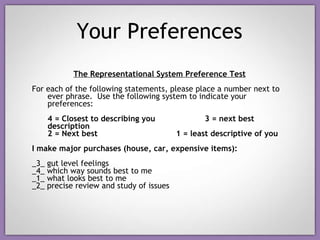
Your Preferences The Representational System Preference Test For each of the following statements, please place a number next to ever phrase.  Use the following system to indicate your preferences: 4 = Closest to describing you 3 = next best description 2 = Next best 1 = least descriptive of you I make major purchases (house, car, expensive items): _3_ gut level feelings _4_ which way sounds best to me _1_ what looks best to me _2_ precise review and study of issues
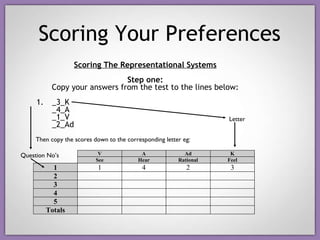
Scoring Your Preferences Scoring The Representational Systems Step one: Copy your answers from the test to the lines below: 1. _3_K _4_A _1_V  _2_Ad   Then copy the scores down to the corresponding letter eg: Question No’s Letter
The 5 Senses How we re-present the world to ourselves: See Hear Feel Smell Taste
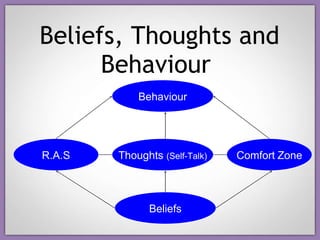
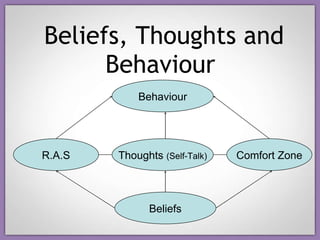
Beliefs, Thoughts and Behaviour  Beliefs Thoughts  (Self-Talk) Behaviour Comfort   Zone R.A.S
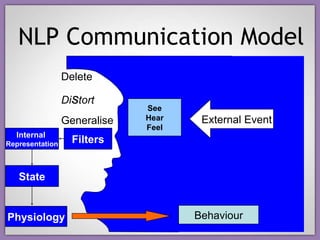
NLP Communication Model Delete  Di s tort Generalise Filters Internal  Representation State Physiology External Event Behaviour See Hear Feel
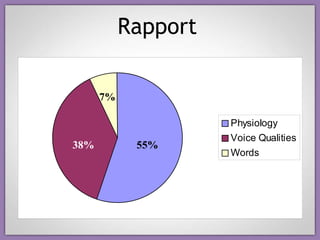
Rapport 55% 7% 38%
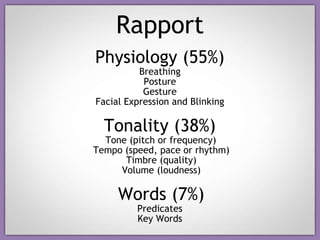
Rapport Physiology (55%) Breathing Posture Gesture Facial Expression and Blinking Tonality (38%) Tone (pitch or frequency) Tempo (speed, pace or rhythm) Timbre (quality) Volume (loudness) Words (7%) Predicates Key Words
Rapport Match Mirror Pace Lead
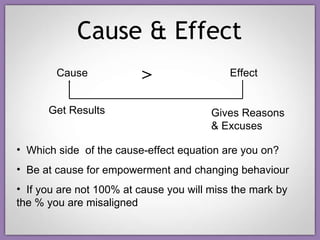
Cause & Effect Cause Effect Get Results Gives Reasons & Excuses > Which side  of the cause-effect equation are you on? Be at cause for empowerment and changing behaviour If you are not 100% at cause you will miss the mark by the % you are misaligned
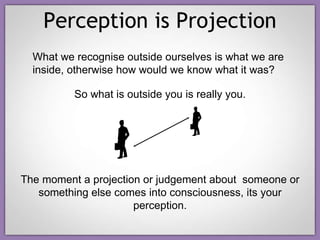
Perception is Projection What we recognise outside ourselves is what we are inside, otherwise how would we know what it was? So what is outside you is really you. The moment a projection or judgement about  someone or something else comes into consciousness, its your perception.
Communication The meaning of communication is the response you get, regardless of what you intended by that communication If what you are doing is not getting the outcome you want then do something different! Or If you always do what you’ve always done, you’ll always get what you always got!
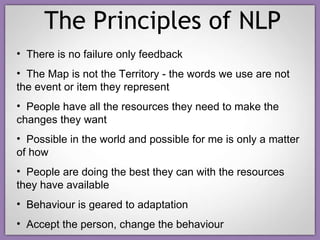
The Principles of NLP There is no failure only feedback The Map is not the Territory - the words we use are not the event or item they represent People have all the resources they need to make the changes they want Possible in the world and possible for me is only a matter of how People are doing the best they can with the resources they have available Behaviour is geared to adaptation Accept the person, change the behaviour
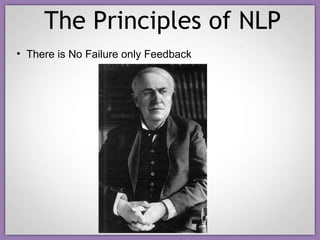
The Principles of NLP There is No Failure only Feedback
The Principles of NLP The Map is not the Territory - the words we use are not the event or item they represent
The Principles of NLP People have all the resources they need to make the changes they want
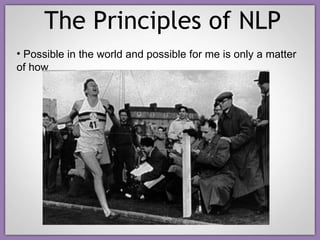
The Principles of NLP Possible in the world and possible for me is only a matter of how
The Principles of NLP People are doing the best they can with the resources they have available Behaviour is geared to adaptation Accept the person, change the behaviour
Beliefs, Thoughts and Behaviour  Beliefs Thoughts  (Self-Talk) Behaviour Comfort Zone R.A.S
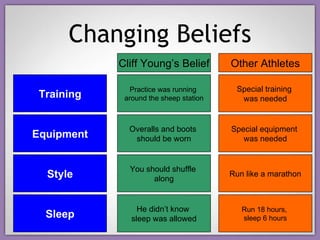
Changing Beliefs Training Cliff Young’s Belief Other Athletes Equipment Style Sleep Practice was running  around the sheep station Special training  was needed Overalls and boots  should be worn Special equipment  was needed You should shuffle  along He didn’t know  sleep was allowed Run like a marathon Run 18 hours,  sleep 6 hours
Cliff Young
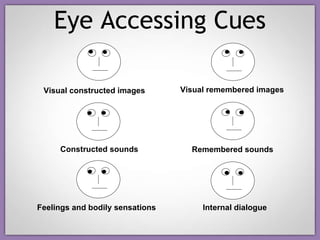
Eye Accessing Cues Feelings and bodily sensations Visual constructed images Visual remembered images Constructed sounds Remembered sounds Internal dialogue
Taking NLP Further Reading NLP Courses Practitioner and Master Practitioner Language Patterns and Reframing

Intorduction to Neuro Linguistic Programming (NLP)

  • 1.
    Using Neuro-LinguisticProgramming in the Workplace (NLP) Mark Hodder Master Practitioner & Trainer of Neuro Linguistic Programming (NLP)
  • 2.
    Describe…. In afew words or a sentence describe… The best team you have worked in… How you make decisions… How you know you have done a good job…
  • 3.
    In this SessionWhat is NLP? Rapport – Body, Mind & Language Increasing flexibility in your communication The Principles of NLP
  • 4.
    Definition of NLP?N - Neurology: The study of the mind and nervous system; how we think L - Linguistics: The study of language and how we use it. P - Programming: The sequence of our actions; how we motivate ourselves to achieve our goals
  • 5.
    What NLP reallyis A users guide to the brain Psychology of Excellence Modelling Excellence Art and Science of Peak Performance The principles of communication Influencing with Integrity Awaken the Giant Within
  • 6.
    Five Principles forSuccess Know Your Outcome Take Action Have Sensory Acuity (notice what you notice) Have Behavioural Flexibility Physiology and Psychology of Excellence
  • 7.
  • 8.
    Calibration Vs MindReading Posture Breathing Lips Eyes Skin tone Skin colour
  • 9.
  • 10.
    Your Preferences TheRepresentational System Preference Test For each of the following statements, please place a number next to ever phrase. Use the following system to indicate your preferences: 4 = Closest to describing you 3 = next best description 2 = Next best 1 = least descriptive of you I make major purchases (house, car, expensive items): _3_ gut level feelings _4_ which way sounds best to me _1_ what looks best to me _2_ precise review and study of issues
  • 11.
    Scoring Your PreferencesScoring The Representational Systems Step one: Copy your answers from the test to the lines below: 1. _3_K _4_A _1_V _2_Ad Then copy the scores down to the corresponding letter eg: Question No’s Letter
  • 12.
    The 5 SensesHow we re-present the world to ourselves: See Hear Feel Smell Taste
  • 13.
    Beliefs, Thoughts andBehaviour Beliefs Thoughts (Self-Talk) Behaviour Comfort Zone R.A.S
  • 14.
    NLP Communication ModelDelete Di s tort Generalise Filters Internal Representation State Physiology External Event Behaviour See Hear Feel
  • 15.
  • 16.
    Rapport Physiology (55%)Breathing Posture Gesture Facial Expression and Blinking Tonality (38%) Tone (pitch or frequency) Tempo (speed, pace or rhythm) Timbre (quality) Volume (loudness) Words (7%) Predicates Key Words
  • 17.
  • 18.
    Cause & EffectCause Effect Get Results Gives Reasons & Excuses > Which side of the cause-effect equation are you on? Be at cause for empowerment and changing behaviour If you are not 100% at cause you will miss the mark by the % you are misaligned
  • 19.
    Perception is ProjectionWhat we recognise outside ourselves is what we are inside, otherwise how would we know what it was? So what is outside you is really you. The moment a projection or judgement about someone or something else comes into consciousness, its your perception.
  • 20.
    Communication The meaningof communication is the response you get, regardless of what you intended by that communication If what you are doing is not getting the outcome you want then do something different! Or If you always do what you’ve always done, you’ll always get what you always got!
  • 21.
    The Principles ofNLP There is no failure only feedback The Map is not the Territory - the words we use are not the event or item they represent People have all the resources they need to make the changes they want Possible in the world and possible for me is only a matter of how People are doing the best they can with the resources they have available Behaviour is geared to adaptation Accept the person, change the behaviour
  • 22.
    The Principles ofNLP There is No Failure only Feedback
  • 23.
    The Principles ofNLP The Map is not the Territory - the words we use are not the event or item they represent
  • 24.
    The Principles ofNLP People have all the resources they need to make the changes they want
  • 25.
    The Principles ofNLP Possible in the world and possible for me is only a matter of how
  • 26.
    The Principles ofNLP People are doing the best they can with the resources they have available Behaviour is geared to adaptation Accept the person, change the behaviour
  • 27.
    Beliefs, Thoughts andBehaviour Beliefs Thoughts (Self-Talk) Behaviour Comfort Zone R.A.S
  • 28.
    Changing Beliefs TrainingCliff Young’s Belief Other Athletes Equipment Style Sleep Practice was running around the sheep station Special training was needed Overalls and boots should be worn Special equipment was needed You should shuffle along He didn’t know sleep was allowed Run like a marathon Run 18 hours, sleep 6 hours
  • 29.
  • 30.
    Eye Accessing CuesFeelings and bodily sensations Visual constructed images Visual remembered images Constructed sounds Remembered sounds Internal dialogue
  • 31.
    Taking NLP FurtherReading NLP Courses Practitioner and Master Practitioner Language Patterns and Reframing