Disaster Management:
Principles & Preparedness
Updated on 3 rd May 2019
Dr Venugopalan P P
DA,DNB,MNAMS, MEM-GW
Director , Emergency Medicine ,Aster DM Healthcare ,India -Lead
Founder & Executive Director , Active Network Group of Emergency Life Savers
(ANGELS)
Expert committee Member : Kerala Road Safety Authority ( Govt.of Kerala)
What is a DISASTER?
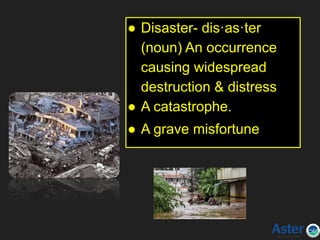
● Disaster- dis·as·ter
(noun) An occurrence
causing widespread
destruction & distress
● A catastrophe.
● A grave misfortune
Hazard
A phenomenon that has
the potential to cause
disruption or damage to
people and their
environment
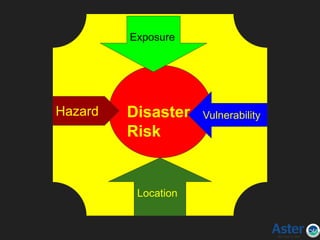
Disaster
Risk
Hazard
Location
Vulnerability
Exposure
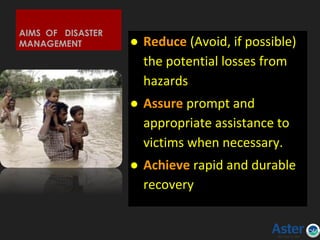
AIMS OF DISASTER
MANAGEMENT ● Reduce (Avoid, if possible)
the potential losses from
hazards
● Assure prompt and
appropriate assistance to
victims when necessary.
● Achieve rapid and durable
recovery
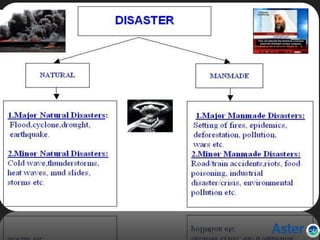
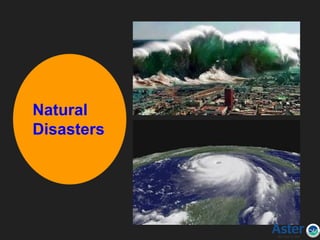
Natural
Disasters
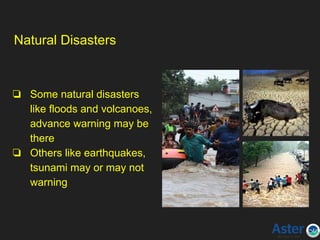
Natural Disasters
❏ Some natural disasters
like floods and volcanoes,
advance warning may be
there
❏ Others like earthquakes,
tsunami may or may not
warning
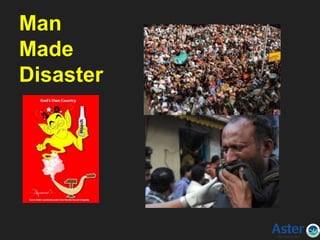
Man
Made
Disaster
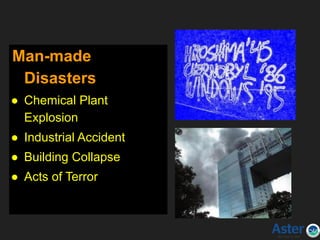
Man-made Disasters
Man-made
Disasters
● Chemical Plant
Explosion
● Industrial Accident
● Building Collapse
● Acts of Terror
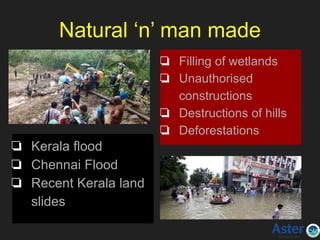
Natural ‘n’ man made
❏ Kerala flood
❏ Chennai Flood
❏ Recent Kerala land
slides
❏ Filling of wetlands
❏ Unauthorised
constructions
❏ Destructions of hills
❏ Deforestations
What is it?
Disaster scenarios once seemed merely
theoretical have become a disturbing reality
●
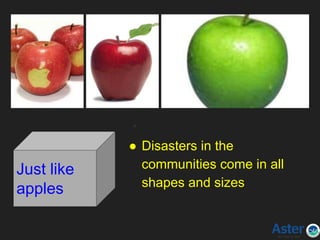
● Disasters in the
communities come in all
shapes and sizes
Just like
apples
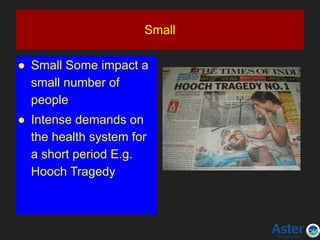
Small
● Small Some impact a
small number of
people
● Intense demands on
the health system for
a short period E.g.
Hooch Tragedy
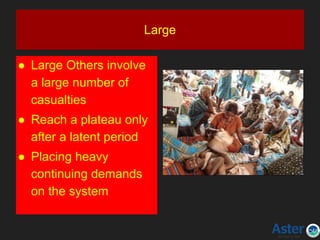
Large
● Large Others involve
a large number of
casualties
● Reach a plateau only
after a latent period
● Placing heavy
continuing demands
on the system
Why important?
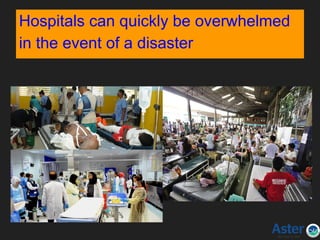
Hospitals can quickly be overwhelmed
in the event of a disaster
Developed or not
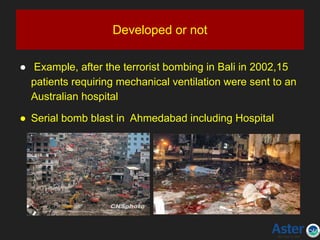
● Example, after the terrorist bombing in Bali in 2002,15
patients requiring mechanical ventilation were sent to an
Australian hospital
● Serial bomb blast in Ahmedabad including Hospital
Why we are not prepared?
❏ Traditional approach fail
❏ Need equipment
❏ Need training
❏ Needs Rs Rs Rs Rs Rs
❏ Fear of the unknown “It can’t
happen here” “Not interested”
❏ Inherent lethargy
So what?
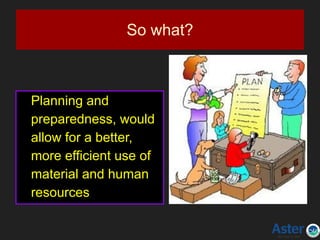
Planning and
preparedness, would
allow for a better,
more efficient use of
material and human
resources
Preparedness helped a lot in
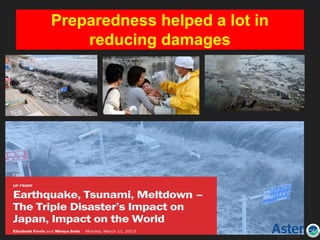
reducing damages
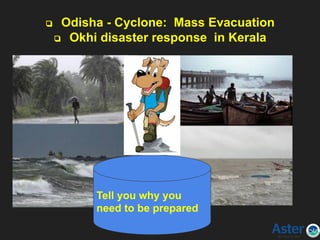
❏ Odisha - Cyclone: Mass Evacuation
❏ Okhi disaster response in Kerala
Tell you why you
need to be prepared
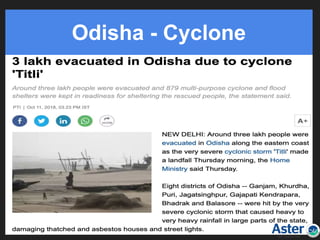
Odisha - Cyclone
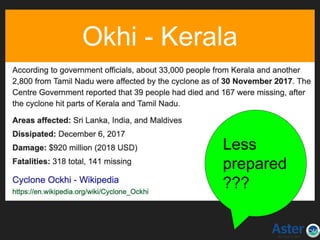
Okhi - Kerala
Less
prepared
???
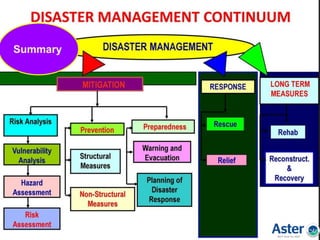
Key Points:
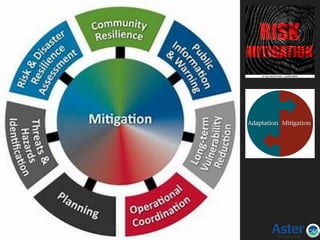
Mitigation( Prevention) involves
Structural and Non-structural
measures taken to limit the
impact of disasters
Achieved through risk analysis, which
results in information that provides a
foundation for mitigation activities that
reduce risk, and insurance that protects
financial investment
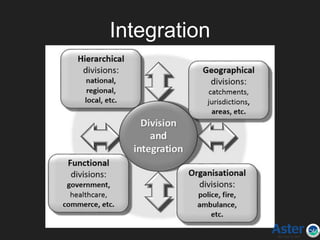
Integration
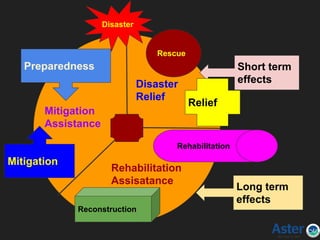
Disaster
Relief
Rehabilitation
Assisatance
Mitigation
Assistance
Short term
effects
Long term
effects
Rescue
Relief
Rehabilitation
Reconstruction
Mitigation
Preparedness
Disaster
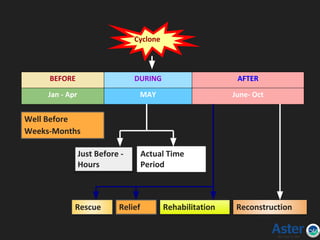
Stages of Disaster
Cyclone
Well Before
Weeks-Months
Just Before -
Hours
Actual Time
Period
Rescue RehabilitationRelief Reconstruction
BEFORE AFTERDURING
Jan - Apr MAY June- Oct
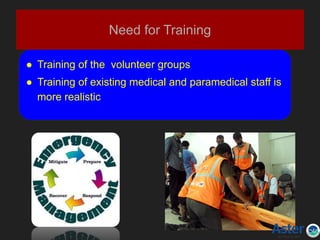
Need for Training
● Training of the volunteer groups
● Training of existing medical and paramedical staff is
more realistic
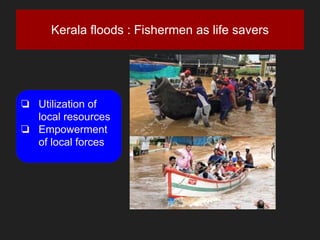
Kerala floods : Fishermen as life savers
❏ Utilization of
local resources
❏ Empowerment
of local forces
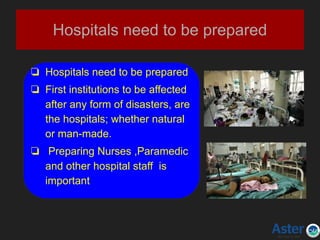
Hospitals need to be prepared
❏ Hospitals need to be prepared
❏ First institutions to be affected
after any form of disasters, are
the hospitals; whether natural
or man-made.
❏ Preparing Nurses ,Paramedic
and other hospital staff is
important
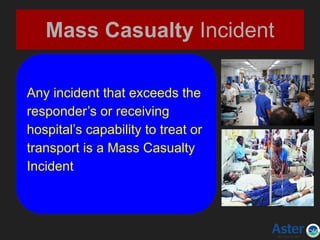
Mass Casualty Incident
Any incident that exceeds the
responder’s or receiving
hospital’s capability to treat or
transport is a Mass Casualty
Incident
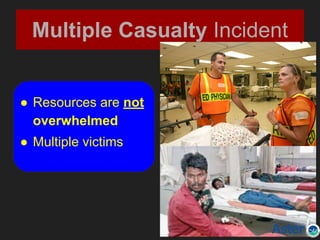
Multiple Casualty Incident
● Resources are not
overwhelmed
● Multiple victims
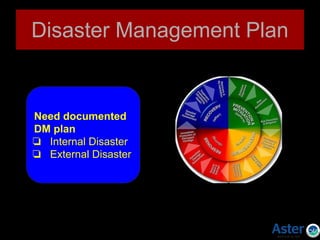
Disaster Management Plan
Need documented
DM plan
❏ Internal Disaster
❏ External Disaster
Systematic Approach
1. Command and Control
2. Safety - Self / Scene/
Survivor
3. Communication -
METHANE
4. Assessment
5. Triage , Treatment,
Transport
DM Plan -
Components
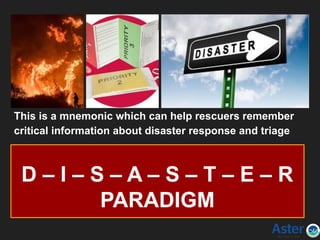
D – I – S – A – S – T – E – R
PARADIGM
This is a mnemonic which can help rescuers remember
critical information about disaster response and triage
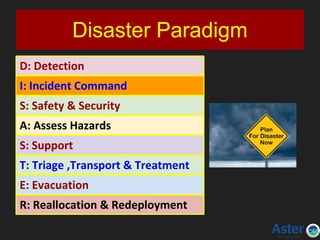
Disaster Paradigm
D: Detection
I: Incident Command
S: Safety & Security
A: Assess Hazards
S: Support
T: Triage ,Transport & Treatment
E: Evacuation
R: Reallocation & Redeployment
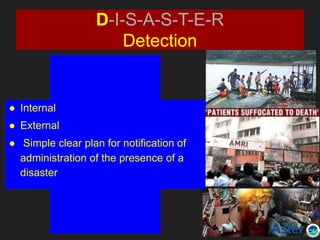
D-I-S-A-S-T-E-R
Detection
● Internal
● External
● Simple clear plan for notification of
administration of the presence of a
disaster
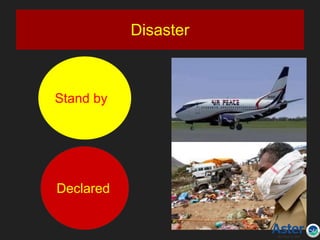
Disaster
Stand by
Declared
In
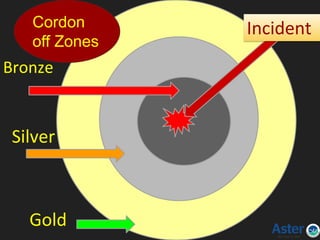
Gold
Silver
Bronze
IncidentCordon
off Zones
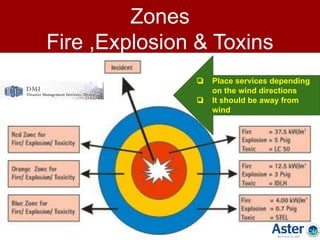
Zones
Fire ,Explosion & Toxins
exposures❏ Place services depending
on the wind directions
❏ It should be away from
wind
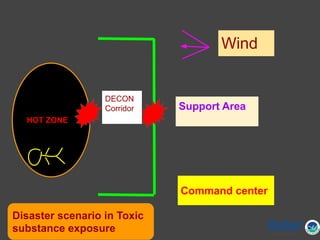
HOT ZONE
Command center
DECON
Corridor Support Area
Wind
Disaster scenario in Toxic
substance exposure
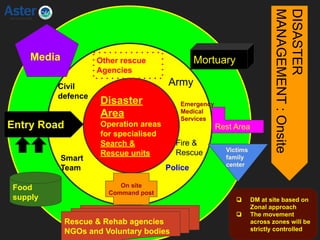
Disaster
Area
Operation areas
for specialised
Search &
Rescue units
Entry Road
Other rescue
Agencies
Civil
defence
Army
Emergency
Medical
Services
Fire &
Rescue
Police
On site
Command post
Smart
Team
Media Mortuary
Rest Area
Victims
family
center
Rescue & Rehab agencies
NGOs and Voluntary bodies
Food
supply ❏ DM at site based on
Zonal approach
❏ The movement
across zones will be
strictly controlled
DISASTER
MANAGEMENT:Onsite
D-I-S-A-S-T-E-R
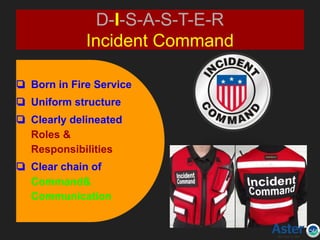
Incident Command
❏ Born in Fire Service
❏ Uniform structure
❏ Clearly delineated
Roles &
Responsibilities
❏ Clear chain of
Command&
Communication
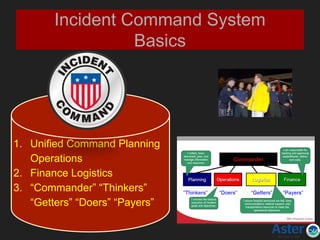
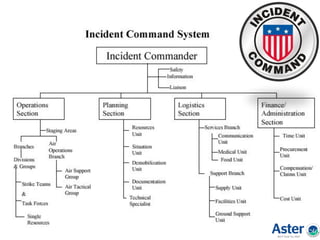
Incident Command System
Basics
1. Unified Command Planning
Operations
2. Finance Logistics
3. “Commander” “Thinkers”
“Getters” “Doers” “Payers”
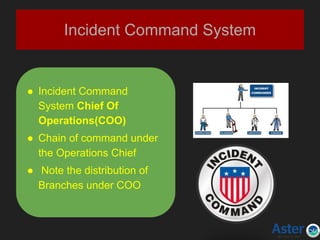
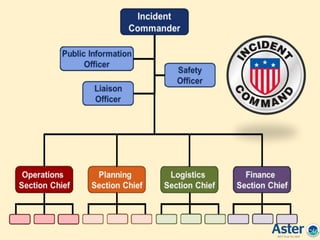
Incident Command System
● Incident Command
System Chief Of
Operations(COO)
● Chain of command under
the Operations Chief
● Note the distribution of
Branches under COO
D-I-S-A-S-T-E-R
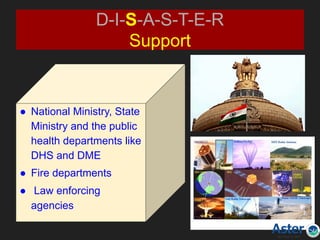
Support
● National Ministry, State
Ministry and the public
health departments like
DHS and DME
● Fire departments
● Law enforcing
agencies
D-I-S-A-S-T-E-R
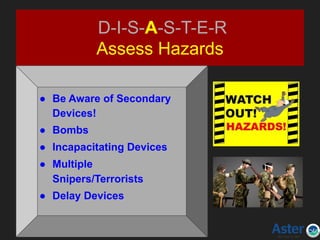
Assess Hazards
● Be Aware of Secondary
Devices!
● Bombs
● Incapacitating Devices
● Multiple
Snipers/Terrorists
● Delay Devices
D-I-S-A-S-T-E-R
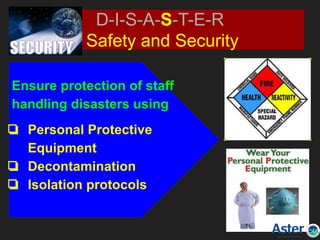
Safety and Security
Ensure protection of staff
handling disasters using
❏ Personal Protective
Equipment
❏ Decontamination
❏ Isolation protocols
D-I-S-A-S-T-E-R
Triage
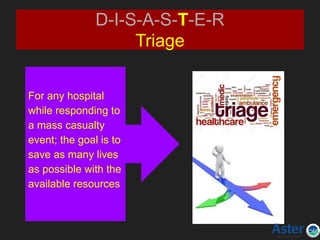
For any hospital
while responding to
a mass casualty
event; the goal is to
save as many lives
as possible with the
available resources
D-I-S-A-S-T-E-R
Triage
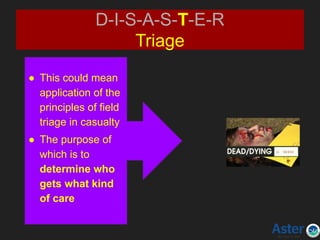
● This could mean
application of the
principles of field
triage in casualty
● The purpose of
which is to
determine who
gets what kind
of care
D-I-S-A-S-T-E-R
Triage
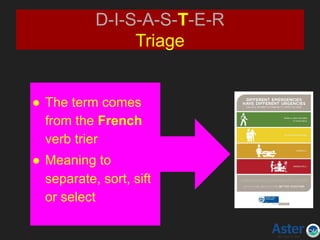
● The term comes
from the French
verb trier
● Meaning to
separate, sort, sift
or select
D-I-S-A-S-T-E-R
Triage
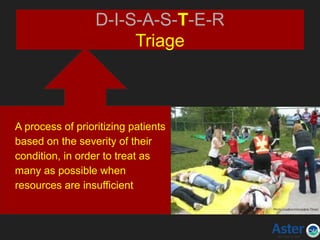
A process of prioritizing patients
based on the severity of their
condition, in order to treat as
many as possible when
resources are insufficient
D-I-S-A-S-T-E-R
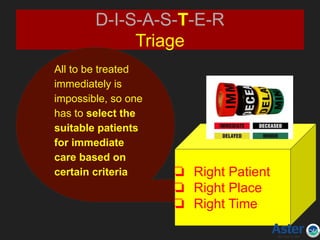
Triage
All to be treated
immediately is
impossible, so one
has to select the
suitable patients
for immediate
care based on
certain criteria ❏ Right Patient
❏ Right Place
❏ Right Time
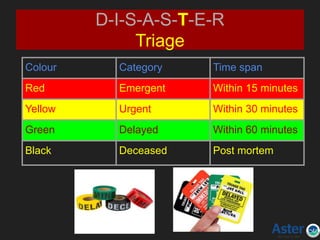
Colour Category Time span
Red Emergent Within 15 minutes
Yellow Urgent Within 30 minutes
Green Delayed Within 60 minutes
Black Deceased Post mortem
D-I-S-A-S-T-E-R
Triage
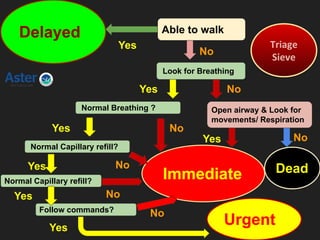
Able to walkDelayed
Yes
Look for Breathing
Open airway & Look for
movements/ Respiration
No
No
No
DeadImmediate
Yes
Yes
Normal Breathing ?
NoYes
Normal Capillary refill?
NoYes
Normal Capillary refill?
No
Follow commands?
No
Yes
Yes
Urgent
Triage
Sieve
D-I-S-A-S-T-E-R
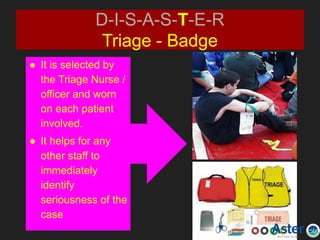
Triage - Badge
● It is selected by
the Triage Nurse /
officer and worn
on each patient
involved.
● It helps for any
other staff to
immediately
identify
seriousness of the
case
D-I-S-A-S-T-E-R
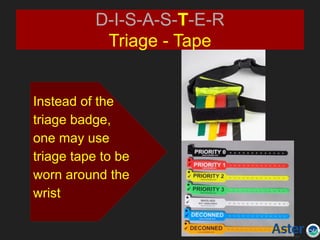
Triage - Tape
Instead of the
triage badge,
one may use
triage tape to be
worn around the
wrist
D-I-S-A-S-T-E-R
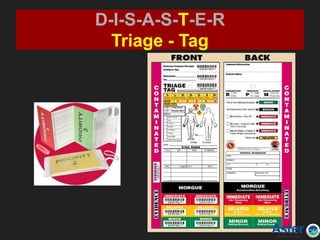
Triage - Tag
D-I-S-A-S-T-E-R
Triage - Nurse
❏ The triage nurse
should be in view of
the waiting area of
the casualty at all
times
❏ Prioritize the waiting
patients periodically
D-I-S-A-S-T-E-R
Triage - Nurse
● Greeting patients and families
in a warm, empathetic manner
● Performing brief visual
assessments
● Documenting the
assessments triaging patients
into priority groups using
appropriate guidelines
D-I-S-A-S-T-E-R
Triage - Nurse
● Ensuring necessary treatment to
deserving patients, returning to
the triage area
● Transporting patients to treatment
areas
● Giving reports to the emergency
physician, who is treating the
patient
D-I-S-A-S-T-E-R
Treatment
● Measuring the relevant vital
signs for appropriate
determination of triage level
● Reassessment of patients
remaining in the waiting room
D-I-S-A-S-T-E-R
Treatment
● Notifying patients and
their families of any
unavoidable delays
instructing patients and
families
● Triage up in any change
in their condition
D-I-S-A-S-T-E-R
Treatment
● Medications
● Antidotes
● Antibiotics
● Immunizations
● Prophylaxis
● Chelation
D-I-S-A-S-T-E-R
Evacuation
❏ A hospital might need to
be evacuated either
partially or wholly to
accommodate casualties
❏ Quarantine or divert
incoming patients
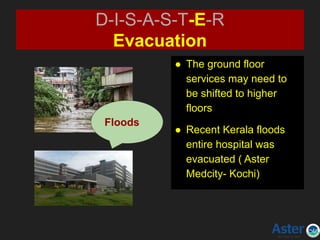
● The ground floor
services may need to
be shifted to higher
floors
● Recent Kerala floods
entire hospital was
evacuated ( Aster
Medcity- Kochi)
D-I-S-A-S-T-E-R
Evacuation
Floods
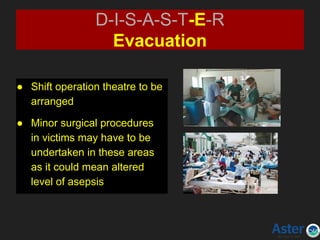
● Shift operation theatre to be
arranged
● Minor surgical procedures
in victims may have to be
undertaken in these areas
as it could mean altered
level of asepsis
D-I-S-A-S-T-E-R
Evacuation
D-I-S-A-S-T-E-R
Evacuation
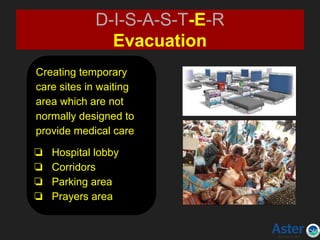
Creating temporary
care sites in waiting
area which are not
normally designed to
provide medical care
❏ Hospital lobby
❏ Corridors
❏ Parking area
❏ Prayers area
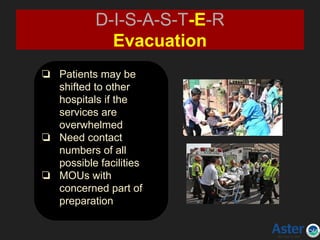
❏ Patients may be
shifted to other
hospitals if the
services are
overwhelmed
❏ Need contact
numbers of all
possible facilities
❏ MOUs with
concerned part of
preparation
D-I-S-A-S-T-E-R
Evacuation
D-I-S-A-S-T-E-R
Evacuation
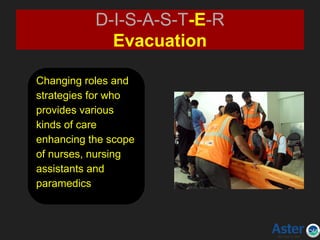
Changing roles and
strategies for who
provides various
kinds of care
enhancing the scope
of nurses, nursing
assistants and
paramedics
D-I-S-A-S-T-E-R
Evacuation
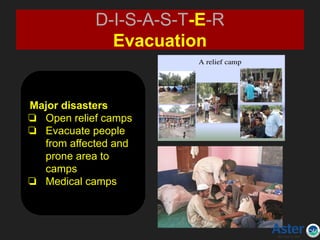
Major disasters
❏ Open relief camps
❏ Evacuate people
from affected and
prone area to
camps
❏ Medical camps
D-I-S-A-S-T-E-R
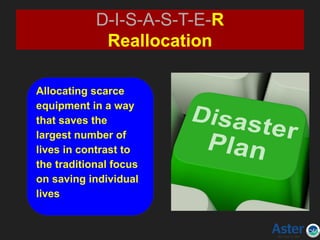
Reallocation
Allocating scarce
equipment in a way
that saves the
largest number of
lives in contrast to
the traditional focus
on saving individual
lives
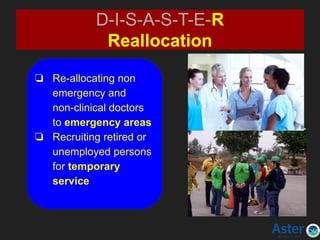
❏ Re-allocating non
emergency and
non-clinical doctors
to emergency areas
❏ Recruiting retired or
unemployed persons
for temporary
service
D-I-S-A-S-T-E-R
Reallocation
D-I-S-A-S-T-E-R
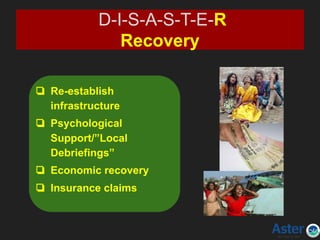
Recovery
❏ Re-establish
infrastructure
❏ Psychological
Support/”Local
Debriefings”
❏ Economic recovery
❏ Insurance claims
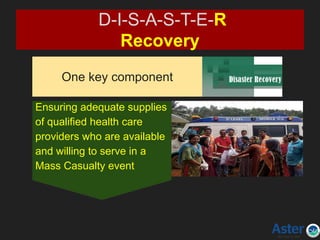
One key component
D-I-S-A-S-T-E-R
Recovery
Ensuring adequate supplies
of qualified health care
providers who are available
and willing to serve in a
Mass Casualty event
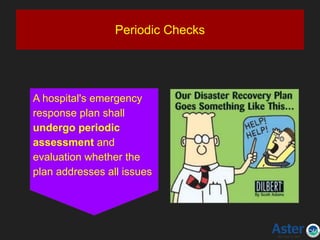
Periodic Checks
A hospital's emergency
response plan shall
undergo periodic
assessment and
evaluation whether the
plan addresses all issues
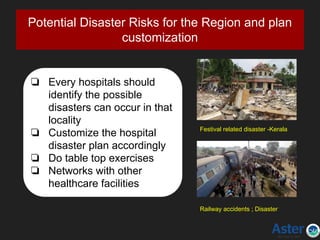
Potential Disaster Risks for the Region and plan
customization
❏ Every hospitals should
identify the possible
disasters can occur in that
locality
❏ Customize the hospital
disaster plan accordingly
❏ Do table top exercises
❏ Networks with other
healthcare facilities
Festival related disaster -Kerala
Railway accidents ; Disaster
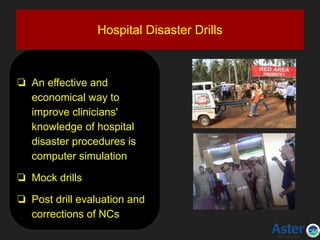
Hospital Disaster Drills
❏ An effective and
economical way to
improve clinicians'
knowledge of hospital
disaster procedures is
computer simulation
❏ Mock drills
❏ Post drill evaluation and
corrections of NCs
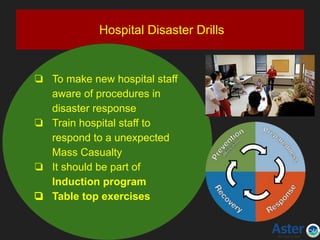
Hospital Disaster Drills
❏ To make new hospital staff
aware of procedures in
disaster response
❏ Train hospital staff to
respond to a unexpected
Mass Casualty
❏ It should be part of
Induction program
❏ Table top exercises
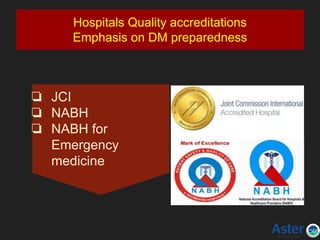
Hospitals Quality accreditations
Emphasis on DM preparedness
❏ JCI
❏ NABH
❏ NABH for
Emergency
medicine
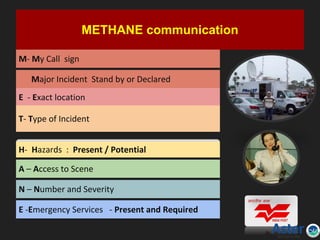
METHANE communication
M- My Call sign
Major Incident Stand by or Declared
E - Exact location
T- Type of Incident
H- Hazards : Present / Potential
A – Access to Scene
N – Number and Severity
E -Emergency Services - Present and Required
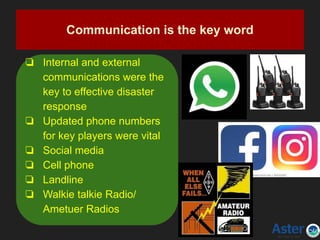
Communication is the key word
❏ Internal and external
communications were the
key to effective disaster
response
❏ Updated phone numbers
for key players were vital
❏ Social media
❏ Cell phone
❏ Landline
❏ Walkie talkie Radio/
Ametuer Radios
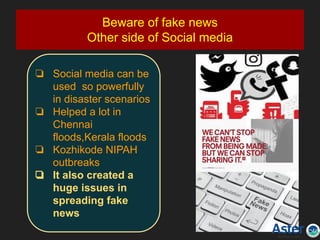
Beware of fake news
Other side of Social media
❏ Social media can be
used so powerfully
in disaster scenarios
❏ Helped a lot in
Chennai
floods,Kerala floods
❏ Kozhikode NIPAH
outbreaks
❏ It also created a
huge issues in
spreading fake
news
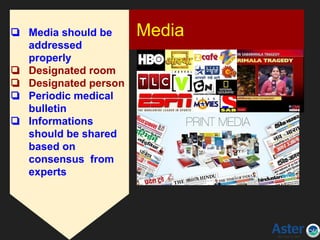
Media❏ Media should be
addressed
properly
❏ Designated room
❏ Designated person
❏ Periodic medical
bulletin
❏ Informations
should be shared
based on
consensus from
experts
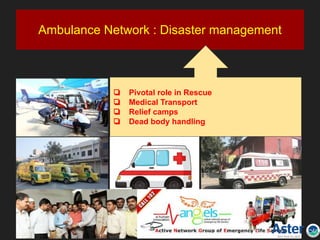
Ambulance Network : Disaster management
❏ Pivotal role in Rescue
❏ Medical Transport
❏ Relief camps
❏ Dead body handling
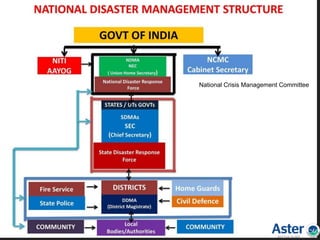
In India
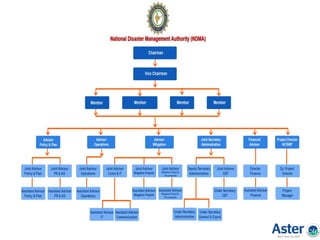
India : Statutory body to manage disasters
National Crisis Management Committee
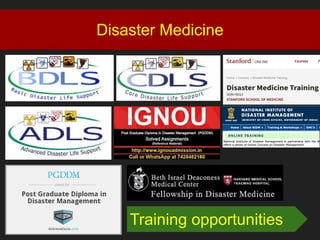
Disaster Medicine
Training opportunities
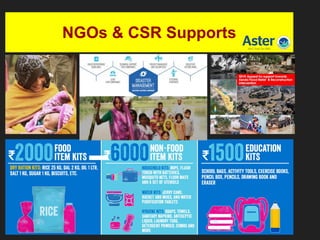
NGOs & CSR Supports
1349 × 465
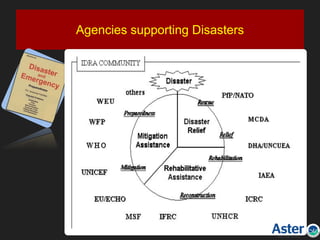
Agencies supporting Disasters
Summary
Thank You for the Patient Listening
drvenugopalpp@gmail.com
9847054747, 9544054747
www.emergencymedicinemims.com
www.angelsindia.org
www.drvenu.me

Disaster management principle and preparedness-2019