

Poly Trauma Airway
management : An area
which always forgets to
look into!
Dr.Venugopalan .P P
HOD & Sr.Consultant
Emergency Medicine
Aster MMS -Calicut
NEMCON
2023
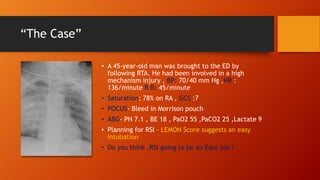
“The Case”
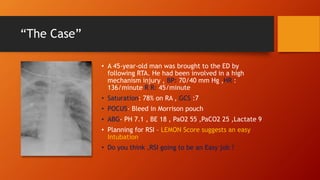
• A 45-year-old man was brought to the ED by
following RTA. He had been involved in a high
mechanism injury , BP: 70/40 mm Hg ,HR :
136/minute R R: 45/minute
• Saturation: 78% on RA , GCS :7
• POCUS- Bleed in Morrison pouch
• ABG- PH 7.1 , BE 18 , PaO2 55 ,PaCO2 25 ,Lactate 9
• Planning for RSI – LEMON Score suggests an easy
Intubation
• Do you think ,RSI going to be an Easy job ?
Background
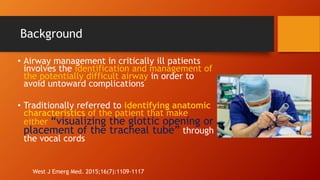
• Airway management in critically ill patients
involves the identification and management of
the potentially difficult airway in order to
avoid untoward complications
• Traditionally referred to identifying anatomic
characteristics of the patient that make
either “visualizing the glottic opening or
placement of the tracheal tube” through
the vocal cords
West J Emerg Med. 2015;16(7):1109-1117
Evidence based facts…
1.Heffner AC, Swords DS, Neale MN, et al. Incidence and factors associated with cardiac arrest complicating emergency airway management. Resuscitation. 2013;84(11):1500-1504.
2.Reynolds SF, Heffner J. Airway management of the critically ill patient: rapid-sequence intubation. Chest. 2005;127(4):1397-1412.
3.Mort TC. Emergency tracheal intubation: complications associated with repeated laryngoscopic attempts. Anesth Analg. 2004;99(2):607-613.
4.Bodily JB, Webb HR, Weiss SJ, et al. Incidence and duration of continuously measured oxygen desaturation during emergency department intubation. Ann Emerg Med. 2016;67(3):389-
• Surgical airway in ED
following anatomically
difficult Airway -0.5 %
• Incidence of hypoxaemia
19.2 %
• Hypotension – 25%
• Cardiac arrest - 4 to 11 %
• Success with first attempt intubation
reduces complication dramatically
• 20 % associated with physiological
derangements which is amenable for
optimization
• Potential to deteriorate in the presence
of altered physiological parameters
• This brings the concept of
“Physiologically Difficult Airway”
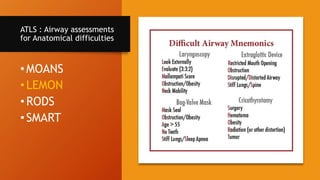
ATLS : Airway assessments
for Anatomical difficulties
•MOANS
•LEMON
•RODS
•SMART
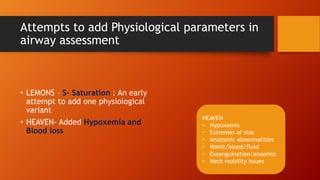
Attempts to add Physiological parameters in
airway assessment
• LEMONS – S- Saturation : An early
attempt to add one physiological
variant
• HEAVEN- Added Hypoxemia and
Blood loss
HEAVEN
• Hypoxemia
• Extremes of size
• Anatomic abnormalities
• Vomit/blood/fluid
• Exsanguination/anaemia
• Neck mobility issues
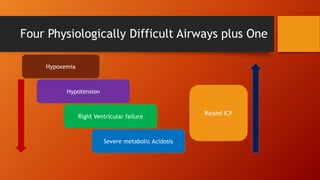
Four Physiologically Difficult Airways plus One
Hypoxemia
Severe metabolic Acidosis
Hypotension
Right Ventricular failure
Raised ICP
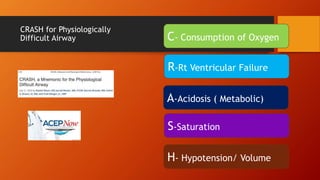
CRASH for Physiologically
Difficult Airway C- Consumption of Oxygen
R-Rt Ventricular Failure
A-Acidosis ( Metabolic)
S-Saturation
H- Hypotension/ Volume
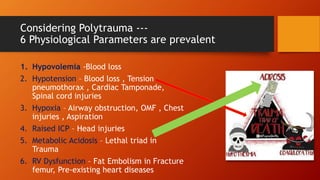
Considering Polytrauma ---
6 Physiological Parameters are prevalent
1. Hypovolemia -Blood loss
2. Hypotension – Blood loss , Tension
pneumothorax , Cardiac Tamponade,
Spinal cord injuries
3. Hypoxia – Airway obstruction, OMF , Chest
injuries , Aspiration
4. Raised ICP – Head injuries
5. Metabolic Acidosis – Lethal triad in
Trauma
6. RV Dysfunction – Fat Embolism in Fracture
femur, Pre-existing heart diseases
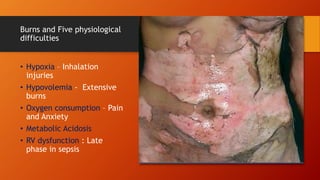
Burns and Five physiological
difficulties
• Hypoxia – Inhalation
injuries
• Hypovolemia - Extensive
burns
• Oxygen consumption – Pain
and Anxiety
• Metabolic Acidosis
• RV dysfunction : Late
phase in sepsis
CRASH - Consumption
• Paediatrics & Pregnancy
• Excitation / Delirium / Agitation
• Convulsion
• Malignant Hyperthermia
• Sepsis ( Late presentation)
• Acute respiratory distress
syndrome
• Thyrotoxicosis( Co-Existing )
1. Meticulous
preoxygenation
2. Improving low cardiac
output
3. Correcting anaemia
(Preserve adequate
oxygen delivery)
CRASH- Right Ventricular
Failure
• Right ventricle (RV) has limited
ability to increase contractility and
output in response to increased
demand
• RV dilation and tricuspid
regurgitation occur quickly when RV
afterload is increased
• Worsened by fluids administered in
an attempt to increase the preload
1. R S I & Paralysis may lead to
Hypercapnia, Atelectasis, and
Hypoxemia
2. All the 3 independently increase
pulmonary vascular resistance and
right ventricular afterload—often
leads to cardiovascular collapse
CRASH: Acidosis- Metabolic
• Major trauma
• Diabetic ketoacidosis
• Severe sepsis
• CKD
• Salicylate poisoning
Increased risk for life-threatening
acidosis
1. Interruption of ventilation
2. Inability to match the necessary
compensatory minute ventilation
A recent study showed that, with
60 seconds of apnoea, pH drops 0.15 and
PaCO2 increases by 12.5 mmHg,
which can be devastating to fragile patients
West JR, Scoccimarro A, Kramer C, et al. The effect of the apneic period on the respiratory physiology of
patients undergoing intubation in the ED. Am J Emerg Med. 2017;35(9):1320-1323.
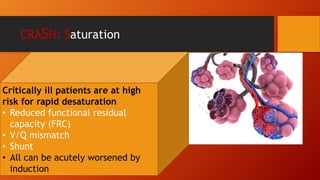
CRASH: Saturation
Failure to maintain adequate arterial
oxygenation
• Shunt
• Ventilation/perfusion (V/Q)
mismatch
Critically ill patients are at high
risk for rapid desaturation
• Reduced functional residual
capacity (FRC)
• V/Q mismatch
• Shunt
• All can be acutely worsened by
induction
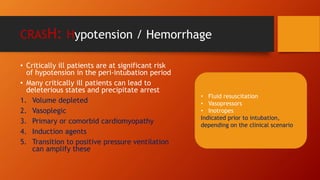
CRASH: Hypotension / Hemorrhage
• Critically ill patients are at significant risk
of hypotension in the peri-intubation period
• Many critically ill patients can lead to
deleterious states and precipitate arrest
1. Volume depleted
2. Vasoplegic
3. Primary or comorbid cardiomyopathy
4. Induction agents
5. Transition to positive pressure ventilation
can amplify these
• Fluid resuscitation
• Vasopressors
• Inotropes
Indicated prior to intubation,
depending on the clinical scenario
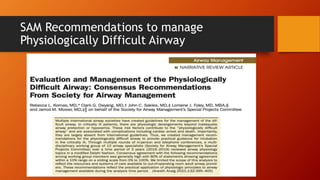
SAM Recommendations to manage
Physiologically Difficult Airway
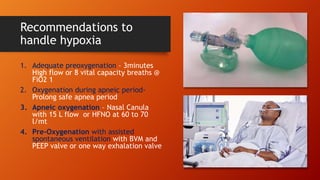
Recommendations to
handle hypoxia
1. Adequate preoxygenation – 3minutes
High flow or 8 vital capacity breaths @
FiO2 1
2. Oxygenation during apneic period-
Prolong safe apnea period
3. Apneic oxygenation – Nasal Canula
with 15 L flow or HFNO at 60 to 70
l/mt
4. Pre-Oxygenation with assisted
spontaneous ventilation with BVM and
PEEP valve or one way exhalation valve
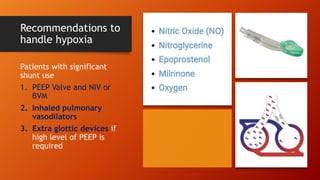
Recommendations to
handle hypoxia
Patients with significant
shunt use
1. PEEP Valve and NIV or
BVM
2. Inhaled pulmonary
vasodilators
3. Extra glottic devices if
high level of PEEP is
required
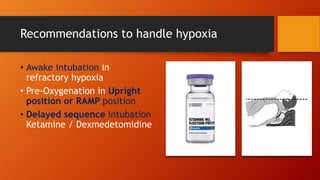
Recommendations to handle hypoxia
• Awake intubation in
refractory hypoxia
• Pre-Oxygenation in Upright
position or RAMP position
• Delayed sequence intubation
Ketamine / Dexmedetomidine
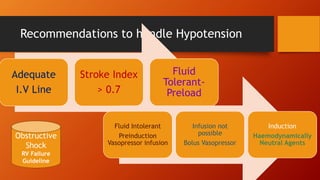
Recommendations to handle Hypotension
Adequate
I.V Line
Stroke Index
> 0.7
Fluid
Tolerant-
Preload
Fluid Intolerant
Preinduction
Vasopressor infusion
Infusion not
possible
Bolus Vasopressor
Induction
Haemodynamically
Neutral Agents
Obstructive
Shock
RV Failure
Guideline
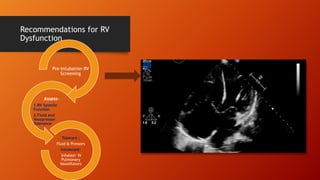
Recommendations for RV
Dysfunction
Pre-Intubation RV
Screening
Assess-
1.RV Systolic
Function
2.Fluid and
Vasopressor
Tolerance
Tolerant :
Fluid & Pressors
Intolerant:
Inhaled/ IV
Pulmonary
Vasodilators
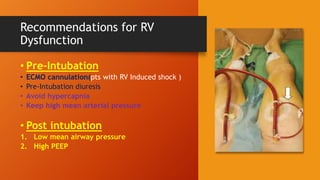
Recommendations for RV
Dysfunction
• Pre-Intubation
• ECMO cannulation(pts with RV Induced shock )
• Pre-Intubation diuresis
• Avoid hypercapnia
• Keep high mean arterial pressure
• Post intubation
1. Low mean airway pressure
2. High PEEP
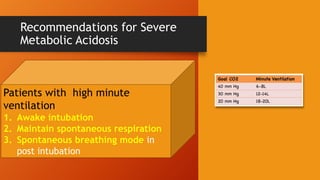
Recommendations for Severe
Metabolic Acidosis
High risk for post intubation
decompensation due to
1. Volume depletion
2. Inadequate alveolar ventilation
Patients with high minute
ventilation
1. Awake intubation
2. Maintain spontaneous respiration
3. Spontaneous breathing mode in
post intubation
Recommendations for Neurologically
injured patients –Raised ICP
1. Normocapnia
2. Neutral induction agents
3. Position 30 degree upright
4. Post intubation – limited PEEP
5. Avoid 3 Bs : Bucking , Blocking
& Biting
6. Avoid tube tie
7. Adequately Sedate and Paralyze
8. Avoid Mosquito Doses
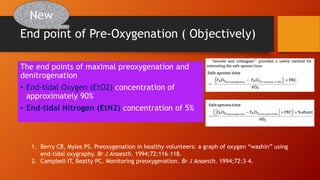
End point of Pre-Oxygenation ( Objectively)
The end points of maximal preoxygenation and
denitrogenation
• End-tidal Oxygen (EtO2) concentration of
approximately 90%
• End-tidal Nitrogen (EtN2) concentration of 5%
1. Berry CB, Myles PS. Preoxygenation in healthy volunteers: a graph of oxygen “washin” using
end-tidal oxygraphy. Br J Anaesth. 1994;72:116–118.
2. Campbell IT, Beatty PC. Monitoring preoxygenation. Br J Anaesth. 1994;72:3–4.
New
“The Case”
• A 45-year-old man was brought to the ED by
following RTA. He had been involved in a high
mechanism injury , BP: 70/40 mm Hg ,HR :
136/minute R R: 45/minute
• Saturation: 78% on RA , GCS :7
• POCUS- Bleed in Morrison pouch
• ABG- PH 7.1 , BE 18 , PaO2 55 ,PaCO2 25 ,Lactate 9
• Planning for RSI – LEMON Score suggests an easy
Intubation
• Do you think ,RSI going to be an Easy job ?
Take home
points
Physiologically difficult airway is rather
neglected or not considered seriously in
trauma airway management
Physiologically challenged airway
contributes significant morbidity and
mortality
Majority are preventable crashes on
preparation and pre optimization
When considering “7 Ps of RSI”- Add
Physiological Preparation and Pre-
Intubation optimization as “Eighth P"
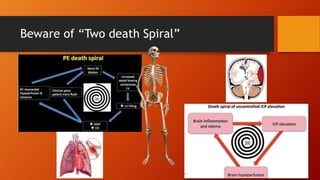
Beware of “Two death Spiral”
Further reading
• https://www.acepnow.com/article/crash-a-
mnemonic-for-the-physiological-difficult-
airway/?singlepage=1&theme=print-friendly
• https://journals.lww.com/anesthesia-
analgesia/Fulltext/2021/10000/Difficult_Airway_Ma
nagement_in_Adult_Coronavirus.10.aspx
• https://journals.lww.com/anesthesia-
analgesia/Fulltext/2021/02000/Evaluation_and_Man
agement_of_the_Physiologically.16.aspx
Thank you So much …
• drvenugopalpp@gmail.com
• 9847054747
• www.drvenu.blogspot.com
• www.drvenu.net

Difficult Airway in Polytrauma.pptx

  • 1.
    Poly Trauma Airway management: An area which always forgets to look into! Dr.Venugopalan .P P HOD & Sr.Consultant Emergency Medicine Aster MMS -Calicut NEMCON 2023
  • 2.
    “The Case” • A45-year-old man was brought to the ED by following RTA. He had been involved in a high mechanism injury , BP: 70/40 mm Hg ,HR : 136/minute R R: 45/minute • Saturation: 78% on RA , GCS :7 • POCUS- Bleed in Morrison pouch • ABG- PH 7.1 , BE 18 , PaO2 55 ,PaCO2 25 ,Lactate 9 • Planning for RSI – LEMON Score suggests an easy Intubation • Do you think ,RSI going to be an Easy job ?
  • 3.
    Background • Airway managementin critically ill patients involves the identification and management of the potentially difficult airway in order to avoid untoward complications • Traditionally referred to identifying anatomic characteristics of the patient that make either “visualizing the glottic opening or placement of the tracheal tube” through the vocal cords West J Emerg Med. 2015;16(7):1109-1117
  • 4.
    Evidence based facts… 1.HeffnerAC, Swords DS, Neale MN, et al. Incidence and factors associated with cardiac arrest complicating emergency airway management. Resuscitation. 2013;84(11):1500-1504. 2.Reynolds SF, Heffner J. Airway management of the critically ill patient: rapid-sequence intubation. Chest. 2005;127(4):1397-1412. 3.Mort TC. Emergency tracheal intubation: complications associated with repeated laryngoscopic attempts. Anesth Analg. 2004;99(2):607-613. 4.Bodily JB, Webb HR, Weiss SJ, et al. Incidence and duration of continuously measured oxygen desaturation during emergency department intubation. Ann Emerg Med. 2016;67(3):389- • Surgical airway in ED following anatomically difficult Airway -0.5 % • Incidence of hypoxaemia 19.2 % • Hypotension – 25% • Cardiac arrest - 4 to 11 % • Success with first attempt intubation reduces complication dramatically • 20 % associated with physiological derangements which is amenable for optimization • Potential to deteriorate in the presence of altered physiological parameters • This brings the concept of “Physiologically Difficult Airway”
  • 5.
    ATLS : Airwayassessments for Anatomical difficulties •MOANS •LEMON •RODS •SMART
  • 6.
    Attempts to addPhysiological parameters in airway assessment • LEMONS – S- Saturation : An early attempt to add one physiological variant • HEAVEN- Added Hypoxemia and Blood loss HEAVEN • Hypoxemia • Extremes of size • Anatomic abnormalities • Vomit/blood/fluid • Exsanguination/anaemia • Neck mobility issues
  • 7.
    Four Physiologically DifficultAirways plus One Hypoxemia Severe metabolic Acidosis Hypotension Right Ventricular failure Raised ICP
  • 8.
    CRASH for Physiologically DifficultAirway C- Consumption of Oxygen R-Rt Ventricular Failure A-Acidosis ( Metabolic) S-Saturation H- Hypotension/ Volume
  • 9.
    Considering Polytrauma --- 6Physiological Parameters are prevalent 1. Hypovolemia -Blood loss 2. Hypotension – Blood loss , Tension pneumothorax , Cardiac Tamponade, Spinal cord injuries 3. Hypoxia – Airway obstruction, OMF , Chest injuries , Aspiration 4. Raised ICP – Head injuries 5. Metabolic Acidosis – Lethal triad in Trauma 6. RV Dysfunction – Fat Embolism in Fracture femur, Pre-existing heart diseases
  • 10.
    Burns and Fivephysiological difficulties • Hypoxia – Inhalation injuries • Hypovolemia - Extensive burns • Oxygen consumption – Pain and Anxiety • Metabolic Acidosis • RV dysfunction : Late phase in sepsis
  • 11.
    CRASH - Consumption •Paediatrics & Pregnancy • Excitation / Delirium / Agitation • Convulsion • Malignant Hyperthermia • Sepsis ( Late presentation) • Acute respiratory distress syndrome • Thyrotoxicosis( Co-Existing ) 1. Meticulous preoxygenation 2. Improving low cardiac output 3. Correcting anaemia (Preserve adequate oxygen delivery)
  • 12.
    CRASH- Right Ventricular Failure •Right ventricle (RV) has limited ability to increase contractility and output in response to increased demand • RV dilation and tricuspid regurgitation occur quickly when RV afterload is increased • Worsened by fluids administered in an attempt to increase the preload 1. R S I & Paralysis may lead to Hypercapnia, Atelectasis, and Hypoxemia 2. All the 3 independently increase pulmonary vascular resistance and right ventricular afterload—often leads to cardiovascular collapse
  • 13.
    CRASH: Acidosis- Metabolic •Major trauma • Diabetic ketoacidosis • Severe sepsis • CKD • Salicylate poisoning Increased risk for life-threatening acidosis 1. Interruption of ventilation 2. Inability to match the necessary compensatory minute ventilation A recent study showed that, with 60 seconds of apnoea, pH drops 0.15 and PaCO2 increases by 12.5 mmHg, which can be devastating to fragile patients West JR, Scoccimarro A, Kramer C, et al. The effect of the apneic period on the respiratory physiology of patients undergoing intubation in the ED. Am J Emerg Med. 2017;35(9):1320-1323.
  • 14.
    CRASH: Saturation Failure tomaintain adequate arterial oxygenation • Shunt • Ventilation/perfusion (V/Q) mismatch Critically ill patients are at high risk for rapid desaturation • Reduced functional residual capacity (FRC) • V/Q mismatch • Shunt • All can be acutely worsened by induction
  • 15.
    CRASH: Hypotension /Hemorrhage • Critically ill patients are at significant risk of hypotension in the peri-intubation period • Many critically ill patients can lead to deleterious states and precipitate arrest 1. Volume depleted 2. Vasoplegic 3. Primary or comorbid cardiomyopathy 4. Induction agents 5. Transition to positive pressure ventilation can amplify these • Fluid resuscitation • Vasopressors • Inotropes Indicated prior to intubation, depending on the clinical scenario
  • 16.
    SAM Recommendations tomanage Physiologically Difficult Airway
  • 17.
    Recommendations to handle hypoxia 1.Adequate preoxygenation – 3minutes High flow or 8 vital capacity breaths @ FiO2 1 2. Oxygenation during apneic period- Prolong safe apnea period 3. Apneic oxygenation – Nasal Canula with 15 L flow or HFNO at 60 to 70 l/mt 4. Pre-Oxygenation with assisted spontaneous ventilation with BVM and PEEP valve or one way exhalation valve
  • 18.
    Recommendations to handle hypoxia Patientswith significant shunt use 1. PEEP Valve and NIV or BVM 2. Inhaled pulmonary vasodilators 3. Extra glottic devices if high level of PEEP is required
  • 19.
    Recommendations to handlehypoxia • Awake intubation in refractory hypoxia • Pre-Oxygenation in Upright position or RAMP position • Delayed sequence intubation Ketamine / Dexmedetomidine
  • 20.
    Recommendations to handleHypotension Adequate I.V Line Stroke Index > 0.7 Fluid Tolerant- Preload Fluid Intolerant Preinduction Vasopressor infusion Infusion not possible Bolus Vasopressor Induction Haemodynamically Neutral Agents Obstructive Shock RV Failure Guideline
  • 21.
    Recommendations for RV Dysfunction Pre-IntubationRV Screening Assess- 1.RV Systolic Function 2.Fluid and Vasopressor Tolerance Tolerant : Fluid & Pressors Intolerant: Inhaled/ IV Pulmonary Vasodilators
  • 22.
    Recommendations for RV Dysfunction •Pre-Intubation • ECMO cannulation(pts with RV Induced shock ) • Pre-Intubation diuresis • Avoid hypercapnia • Keep high mean arterial pressure • Post intubation 1. Low mean airway pressure 2. High PEEP
  • 23.
    Recommendations for Severe MetabolicAcidosis High risk for post intubation decompensation due to 1. Volume depletion 2. Inadequate alveolar ventilation Patients with high minute ventilation 1. Awake intubation 2. Maintain spontaneous respiration 3. Spontaneous breathing mode in post intubation
  • 24.
    Recommendations for Neurologically injuredpatients –Raised ICP 1. Normocapnia 2. Neutral induction agents 3. Position 30 degree upright 4. Post intubation – limited PEEP 5. Avoid 3 Bs : Bucking , Blocking & Biting 6. Avoid tube tie 7. Adequately Sedate and Paralyze 8. Avoid Mosquito Doses
  • 25.
    End point ofPre-Oxygenation ( Objectively) The end points of maximal preoxygenation and denitrogenation • End-tidal Oxygen (EtO2) concentration of approximately 90% • End-tidal Nitrogen (EtN2) concentration of 5% 1. Berry CB, Myles PS. Preoxygenation in healthy volunteers: a graph of oxygen “washin” using end-tidal oxygraphy. Br J Anaesth. 1994;72:116–118. 2. Campbell IT, Beatty PC. Monitoring preoxygenation. Br J Anaesth. 1994;72:3–4. New
  • 26.
    “The Case” • A45-year-old man was brought to the ED by following RTA. He had been involved in a high mechanism injury , BP: 70/40 mm Hg ,HR : 136/minute R R: 45/minute • Saturation: 78% on RA , GCS :7 • POCUS- Bleed in Morrison pouch • ABG- PH 7.1 , BE 18 , PaO2 55 ,PaCO2 25 ,Lactate 9 • Planning for RSI – LEMON Score suggests an easy Intubation • Do you think ,RSI going to be an Easy job ?
  • 27.
    Take home points Physiologically difficultairway is rather neglected or not considered seriously in trauma airway management Physiologically challenged airway contributes significant morbidity and mortality Majority are preventable crashes on preparation and pre optimization When considering “7 Ps of RSI”- Add Physiological Preparation and Pre- Intubation optimization as “Eighth P"
  • 28.
    Beware of “Twodeath Spiral”
  • 29.
    Further reading • https://www.acepnow.com/article/crash-a- mnemonic-for-the-physiological-difficult- airway/?singlepage=1&theme=print-friendly •https://journals.lww.com/anesthesia- analgesia/Fulltext/2021/10000/Difficult_Airway_Ma nagement_in_Adult_Coronavirus.10.aspx • https://journals.lww.com/anesthesia- analgesia/Fulltext/2021/02000/Evaluation_and_Man agement_of_the_Physiologically.16.aspx
  • 30.
    Thank you Somuch … • drvenugopalpp@gmail.com • 9847054747 • www.drvenu.blogspot.com • www.drvenu.net