Downloaded 12 times



![ANATOMY AND PHYSIOLOGY
Water comprises 60% of the total body weight of an adult, and is divided
functionally into the extracellular (extracellular fluid [ECF] = 20% of body weight)
and the intracellular fluid spaces (ICF = 40% of body weight).
It is separated by the cell membrane with its active sodium pump, which ensures that
sodium remains mainly in the ECF. The cell contains large anions such as protein
and glycogen, which cannot exit and therefore draw in K+ ions to maintain electrical
neutrality(Gibbs–Donnan equilibrium). These mechanisms ensure that Na+ and its
anions Cl− and HCO−3, are the mainstay of the ECF osmolality, and K+ has the
corresponding function in the ICF.
6](https://image.slidesharecdn.com/roseconcept-220513142946-8f05a4fa/85/ROSE-CONCEPT-pptx-6-320.jpg)

![FLUID MOVEMENTS BETWEEN VASCULATURE AND TISSUES
Ernest Starling described the forces that determine the movement of water between vasculature and
tissues, which was formalised subsequently into Starling’s equation, as follows:
Qf = Kf S ([Pc − Pt] – δ[πc − πt])
Where Qf: net amount of fluid that moves between the capillaries and the surrounding extracellular space
Kf: filtration coefficient for the membrane
S: the surface area of the membrane
Pc: hydrostatic pressure in the capillary membrane
Pt: hydrostatic pressure of the surrounding tissue
δ : coefficient of reflection which can vary from 1 = no movement to 0 = free diffusion of the solute across the
membrane
πc: oncotic pressure of the plasma and πt: oncotic pressure of the fluid in the extracellular space. 8](https://image.slidesharecdn.com/roseconcept-220513142946-8f05a4fa/85/ROSE-CONCEPT-pptx-8-320.jpg)


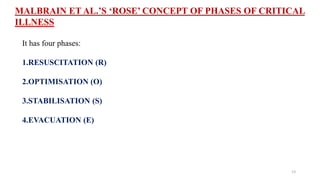


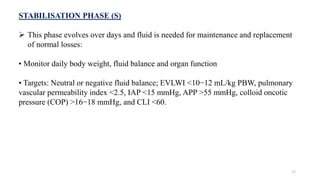
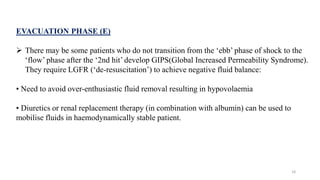

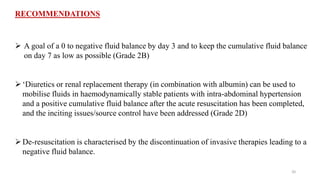


This article discusses the 'ROSE concept' of fluid management proposed by Malbrain et al. and its relevance for neuroanaesthesia and neurocritical care. The ROSE concept has four phases - resuscitation, optimisation, stabilisation, and evacuation. During the resuscitation phase, fluids are given aggressively to restore circulation. The optimisation phase aims for a neutral fluid balance to ensure tissue perfusion. Stabilisation focuses on maintaining neutral or negative balance. Finally, evacuation uses diuretics and albumin to achieve negative balance and 'de-resuscitation' in stable patients with fluid overload. The article concludes that while restriction of fluids is important to prevent increased intracranial pressure, neurosurgical


