NIOSOMES
SURAJ MANDAL
M.Pharma
 Niosomes are a novel drug delivery system,
in which the medication is encapsulated in a
vesicle. The vesicle is composed of a bilayer
of non-ionic surface active agents and hence
the name niosomes.
Nios = non ionic surfactant
somes = vesicles
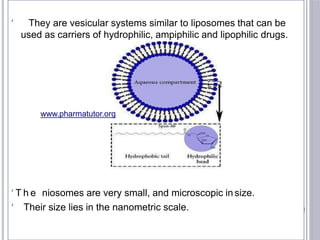
 They are vesicular systems similar to liposomes that can be
used as carriers of hydrophilic, ampiphilic and lipophilic drugs.
www.pharmatutor.org
 T h e niosomes are very small, and microscopic insize.
 Their size lies in the nanometric scale.
Most surface active agents when immersed in water yield
micellar structures, however some surfactants can yield
bilayer vesicles which are niosomes.
Niosomes may be-
unilamellar
 multilamellar
Small
Unilamellar
Vesicle
(SUV)
Large
Unilamellar
Vesicle
(LUV)
Multilamellar
Vesicle
(MLV)
Typical Size Ranges: SLV: 20-50 nm – MLV:100-1000 nm
MECHANISMS OF NIOSOMAL SKIN DELIVERY
Niosomes diffuse from the stratum corneum layer of skin
as a whole
New smaller vesicles are formed in skin
Noisomes interact with stratum corneum with aggregation, fusion
and adhesion to the cell surface which causes a high
thermodynamic activity gradient of the drug at the vesicle-stratum
corneum surface, which is the driving force for the penetration of
lipophilic drugs across the stratum corneum
lec
.Niosomes do not have any ofthese
problems:
Niosomes are made of uncharged single-chain surfactantmo
Structure of niosomes is diferent from that of liposomes
Liposomesface problems suchas:
expensive
chemically unstable
N/LIPOSOMES
ADVANTAGES OF NIOSOMES
Osmotically active
Increase the stability of the entrapped drug
Handling and storage of surfactants do not require
any special conditions.
Can increase the oral bioavailability of drugs
Can enhance the skin penetration of drugs
can be used for oral, parenteral as well topical use.
The surfactants are biodegradable,
biocompatible, and non-immunogenic .
Improve the therapeutic performance of the drug
by protecting it from the biological environment and
restricting effects to target cells
CONCLUSION
Niosomes are thoughts to be better candidates drug
delivery as compared to liposomes due to various
factors like cost, stability etc.
Various type of drug deliveries can be possible using
niosomes like targeting, ophthalmic, topical,
parentral etc.
file:///E:/M.PHARM%202SEM/Niosomes/niosomess/Niosome.htm
Book- Controlled and Novel Drug Dilevery by N.K. JAIN
Malhotra, M. & Jain, N.K., (1994). Niosomes as drug carriers.
Ind Drugs, Vol. 31
Azeem, A.; Anwer, M.K. & Talegaonkar, S., (2009).
Niosomes in sustained and targeted drug delivery: some
recent advances. J Drug Target, Vol. 17
NIOSOME: A PROMISING PHARMACEUTICAL DRUG
DELIVERY(http://www.ijpda.com/admin/uploads/AzYyEr.pdf)
Thank You

NIOSOMES

  • 1.
  • 2.
     Niosomes area novel drug delivery system, in which the medication is encapsulated in a vesicle. The vesicle is composed of a bilayer of non-ionic surface active agents and hence the name niosomes. Nios = non ionic surfactant somes = vesicles
  • 3.
     They arevesicular systems similar to liposomes that can be used as carriers of hydrophilic, ampiphilic and lipophilic drugs. www.pharmatutor.org  T h e niosomes are very small, and microscopic insize.  Their size lies in the nanometric scale.
  • 4.
    Most surface activeagents when immersed in water yield micellar structures, however some surfactants can yield bilayer vesicles which are niosomes. Niosomes may be- unilamellar  multilamellar
  • 5.
  • 7.
    MECHANISMS OF NIOSOMALSKIN DELIVERY Niosomes diffuse from the stratum corneum layer of skin as a whole New smaller vesicles are formed in skin Noisomes interact with stratum corneum with aggregation, fusion and adhesion to the cell surface which causes a high thermodynamic activity gradient of the drug at the vesicle-stratum corneum surface, which is the driving force for the penetration of lipophilic drugs across the stratum corneum
  • 8.
    lec .Niosomes do nothave any ofthese problems: Niosomes are made of uncharged single-chain surfactantmo Structure of niosomes is diferent from that of liposomes Liposomesface problems suchas: expensive chemically unstable N/LIPOSOMES
  • 9.
    ADVANTAGES OF NIOSOMES Osmoticallyactive Increase the stability of the entrapped drug Handling and storage of surfactants do not require any special conditions. Can increase the oral bioavailability of drugs Can enhance the skin penetration of drugs can be used for oral, parenteral as well topical use. The surfactants are biodegradable, biocompatible, and non-immunogenic . Improve the therapeutic performance of the drug by protecting it from the biological environment and restricting effects to target cells
  • 10.
    CONCLUSION Niosomes are thoughtsto be better candidates drug delivery as compared to liposomes due to various factors like cost, stability etc. Various type of drug deliveries can be possible using niosomes like targeting, ophthalmic, topical, parentral etc.
  • 11.
    file:///E:/M.PHARM%202SEM/Niosomes/niosomess/Niosome.htm Book- Controlled andNovel Drug Dilevery by N.K. JAIN Malhotra, M. & Jain, N.K., (1994). Niosomes as drug carriers. Ind Drugs, Vol. 31 Azeem, A.; Anwer, M.K. & Talegaonkar, S., (2009). Niosomes in sustained and targeted drug delivery: some recent advances. J Drug Target, Vol. 17 NIOSOME: A PROMISING PHARMACEUTICAL DRUG DELIVERY(http://www.ijpda.com/admin/uploads/AzYyEr.pdf)
  • 12.