Phytosomes : Preparation & Application
 PRESENTED BY: SURAJ MANDAL
 M. PHARM ( IInd SEM )
 ROLL NO : 1820156510
Contents..
• Definition
• Method of Preparation
• Difference Between Liposome and Phytosome
• Advantages of Phytosomes
• Properties of Phytosomes
• Applications of Phytosomes
Phytosome
• The term “phyto” means plant while “some” means cell-
like. Phytosomes are little cell like structure. This is
advanced forms of herbal formulations which contains the
bioactive phytoconsituents of herb extract surrounds and
bound by a lipid. Most of the bioactive constituents of
phytomedicines are water-soluble compounds like
flavonoids, glycosides.
• Because of water soluble herbal extract and lipophilic outer
layer phytosomes shows better absorption and as a result
produce better bioavailability and actions than the
conventional herbal extracts containing dosage form.
Preparation of Phytosome
 Phytosomes are prepared by reacting 3-2 moles or preferably 1 mole of
phosphatidylcholine with 1 mole of active phytoconstituents mostly the
flavonoids and the terpenoids in an aprotic solvent such as dioxane or
acetone from which complex can be isolated by precipitation with non
solvent such as aliphatic hydrocarbons or by lyophilization or by spray
drying. In the phyto-phospholipid complex formation the ratio
between these two components is in the range of 0.5-2 moles. The most
preferable ratio of phospholipid to phytoconstituents is 1:1.
 Spectroscopic techniques reveal’s that the molecules of the
phytoconstituents are bonded to phospholipid moiety by means of a
chemical bond.
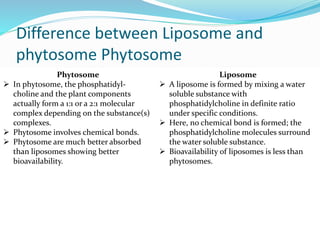
Difference between Liposome and
phytosome Phytosome
Phytosome
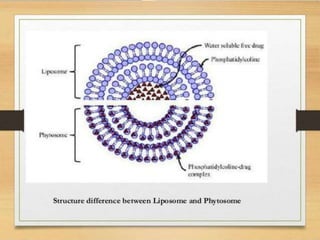
 In phytosome, the phosphatidyl-
choline and the plant components
actually form a 1:1 or a 2:1 molecular
complex depending on the substance(s)
complexes.
 Phytosome involves chemical bonds.
 Phytosome are much better absorbed
than liposomes showing better
bioavailability.
Liposome
 A liposome is formed by mixing a water
soluble substance with
phosphatidylcholine in definite ratio
under specific conditions.
 Here, no chemical bond is formed; the
phosphatidylcholine molecules surround
the water soluble substance.
 Bioavailability of liposomes is less than
phytosomes.
Advantages of Phytosomes
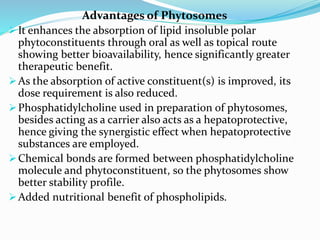
It enhances the absorption of lipid insoluble polar
phytoconstituents through oral as well as topical route
showing better bioavailability, hence significantly greater
therapeutic benefit.
As the absorption of active constituent(s) is improved, its
dose requirement is also reduced.
Phosphatidylcholine used in preparation of phytosomes,
besides acting as a carrier also acts as a hepatoprotective,
hence giving the synergistic effect when hepatoprotective
substances are employed.
Chemical bonds are formed between phosphatidylcholine
molecule and phytoconstituent, so the phytosomes show
better stability profile.
Added nutritional benefit of phospholipids.
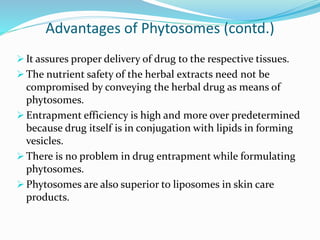
 It assures proper delivery of drug to the respective tissues.
 The nutrient safety of the herbal extracts need not be
compromised by conveying the herbal drug as means of
phytosomes.
 Entrapment efficiency is high and more over predetermined
because drug itself is in conjugation with lipids in forming
vesicles.
 There is no problem in drug entrapment while formulating
phytosomes.
 Phytosomes are also superior to liposomes in skin care
products.
Advantages of Phytosomes (contd.)
Properties of Phytosomes
Chemical Properties
 Phytosomes is a complex between a natural product and natural
phospholipids.
 The phytosome complex is obtained by reaction of suitable
amounts of phospholipid and the substrate in an appropriate
solvent such as glycerol.
 The main phospholipid-substrate interaction is due to the
formation of hydrogen bonds between the polar head of
phospholipids (i.e. phosphate and ammonium groups) and the
polar functionalities of the substrate.
 When treated with water, phytosomes assumes a micellar shape
forming liposomial-like structures.
Biological Properties
 Phytosome are advanced forms of herbal products that are
better absorbed, utilized and as a result produce better
results than conventional herbal extracts.
 Phytosomes are lipophilic substances with definite melting
point, freely soluble in non-polar solvents, and moderately
soluble in fats.
 Phytosomes can accommodate the active principle that is
anchored to the polar head of the phospholipids, which
finally becomes an integral part of the membrane.
 The increased bioavailability of the phytosome over the
non complexed botanical derivatives has been
demonstrated by pharmacokinetics studies or by
pharmacodynamic tests in experimental animals and in
human subjects.
Application of Phytosomes
Silymarin Phytosome
 Most of the phytosomes are focused to Silybum marianum
which contains premier liver-protectant flavonoids.
 The fruit of the milk thistle plant (S. marianum, Family
Steraceae) contains flavonoids known for hepato-protective
effects.
 Silymarin has been shown to have positive effects in treating
liver diseases of various kinds, including hepatitis, cirrhosis,
fatty infiltration of the liver (chemical and alcohol induced fatty
liver) and inflammation of the bile duct. Silymarin Phytosome
Phytosomes of grape seed •
 Grape seed phytosome is composed of oligomeric polyphenols
of varying molecular size complexed with phospholipids.
 The main properties of procyanidin flavonoids of grape seed are
an increase in total antioxidant capacity and stimulation of
physiological defenses of plasma.
Application of Phytosomes (contd.)
Phytosome of green tea
 Green tea leaves (Theasinensis) is characterized by presence of a
polyphenolic compound epigallocatechin 3-O-gallate as the key
component.
 These compounds are potent modulators of several biochemical process
linked to the breakdown of homeostasis in major chronic-degenerative
diseases such as cancer and atherosclerosis.
 Green tea also furnishes us with a number of beneficial activities such as
antioxidant, anticarcinogenic, antimutagenic, hypocholesterolemic,
cardioprotective effects.
Phytosomes of curcumin
 Maiti et al. developed the phytosomes of curcumin (flavonoid from
turmeric, Curcuma longa linn) and naringenin (flavonoid from grape,
Vitis vinifera).
 Phytosome of naringenin produced better antioxidant activity than the
free compound with a prolonged duration of action
References
1. INTERNATIONAL JOURNAL OF RESEARCH IN
PHARMACY AND CHEMISTRY (www.ijrpc.com)
2. International Journal of Pharmaceutical Sciences and
Drug Research (www.ijpsdr.com)
Phytosomes : Preparation & Application

Phytosomes : Preparation & Application

  • 1.
    Phytosomes : Preparation& Application  PRESENTED BY: SURAJ MANDAL  M. PHARM ( IInd SEM )  ROLL NO : 1820156510
  • 2.
    Contents.. • Definition • Methodof Preparation • Difference Between Liposome and Phytosome • Advantages of Phytosomes • Properties of Phytosomes • Applications of Phytosomes
  • 3.
    Phytosome • The term“phyto” means plant while “some” means cell- like. Phytosomes are little cell like structure. This is advanced forms of herbal formulations which contains the bioactive phytoconsituents of herb extract surrounds and bound by a lipid. Most of the bioactive constituents of phytomedicines are water-soluble compounds like flavonoids, glycosides. • Because of water soluble herbal extract and lipophilic outer layer phytosomes shows better absorption and as a result produce better bioavailability and actions than the conventional herbal extracts containing dosage form.
  • 4.
    Preparation of Phytosome Phytosomes are prepared by reacting 3-2 moles or preferably 1 mole of phosphatidylcholine with 1 mole of active phytoconstituents mostly the flavonoids and the terpenoids in an aprotic solvent such as dioxane or acetone from which complex can be isolated by precipitation with non solvent such as aliphatic hydrocarbons or by lyophilization or by spray drying. In the phyto-phospholipid complex formation the ratio between these two components is in the range of 0.5-2 moles. The most preferable ratio of phospholipid to phytoconstituents is 1:1.  Spectroscopic techniques reveal’s that the molecules of the phytoconstituents are bonded to phospholipid moiety by means of a chemical bond.
  • 5.
    Difference between Liposomeand phytosome Phytosome Phytosome  In phytosome, the phosphatidyl- choline and the plant components actually form a 1:1 or a 2:1 molecular complex depending on the substance(s) complexes.  Phytosome involves chemical bonds.  Phytosome are much better absorbed than liposomes showing better bioavailability. Liposome  A liposome is formed by mixing a water soluble substance with phosphatidylcholine in definite ratio under specific conditions.  Here, no chemical bond is formed; the phosphatidylcholine molecules surround the water soluble substance.  Bioavailability of liposomes is less than phytosomes.
  • 7.
    Advantages of Phytosomes Itenhances the absorption of lipid insoluble polar phytoconstituents through oral as well as topical route showing better bioavailability, hence significantly greater therapeutic benefit. As the absorption of active constituent(s) is improved, its dose requirement is also reduced. Phosphatidylcholine used in preparation of phytosomes, besides acting as a carrier also acts as a hepatoprotective, hence giving the synergistic effect when hepatoprotective substances are employed. Chemical bonds are formed between phosphatidylcholine molecule and phytoconstituent, so the phytosomes show better stability profile. Added nutritional benefit of phospholipids.
  • 8.
     It assuresproper delivery of drug to the respective tissues.  The nutrient safety of the herbal extracts need not be compromised by conveying the herbal drug as means of phytosomes.  Entrapment efficiency is high and more over predetermined because drug itself is in conjugation with lipids in forming vesicles.  There is no problem in drug entrapment while formulating phytosomes.  Phytosomes are also superior to liposomes in skin care products. Advantages of Phytosomes (contd.)
  • 9.
    Properties of Phytosomes ChemicalProperties  Phytosomes is a complex between a natural product and natural phospholipids.  The phytosome complex is obtained by reaction of suitable amounts of phospholipid and the substrate in an appropriate solvent such as glycerol.  The main phospholipid-substrate interaction is due to the formation of hydrogen bonds between the polar head of phospholipids (i.e. phosphate and ammonium groups) and the polar functionalities of the substrate.  When treated with water, phytosomes assumes a micellar shape forming liposomial-like structures.
  • 10.
    Biological Properties  Phytosomeare advanced forms of herbal products that are better absorbed, utilized and as a result produce better results than conventional herbal extracts.  Phytosomes are lipophilic substances with definite melting point, freely soluble in non-polar solvents, and moderately soluble in fats.  Phytosomes can accommodate the active principle that is anchored to the polar head of the phospholipids, which finally becomes an integral part of the membrane.  The increased bioavailability of the phytosome over the non complexed botanical derivatives has been demonstrated by pharmacokinetics studies or by pharmacodynamic tests in experimental animals and in human subjects.
  • 11.
    Application of Phytosomes SilymarinPhytosome  Most of the phytosomes are focused to Silybum marianum which contains premier liver-protectant flavonoids.  The fruit of the milk thistle plant (S. marianum, Family Steraceae) contains flavonoids known for hepato-protective effects.  Silymarin has been shown to have positive effects in treating liver diseases of various kinds, including hepatitis, cirrhosis, fatty infiltration of the liver (chemical and alcohol induced fatty liver) and inflammation of the bile duct. Silymarin Phytosome Phytosomes of grape seed •  Grape seed phytosome is composed of oligomeric polyphenols of varying molecular size complexed with phospholipids.  The main properties of procyanidin flavonoids of grape seed are an increase in total antioxidant capacity and stimulation of physiological defenses of plasma.
  • 12.
    Application of Phytosomes(contd.) Phytosome of green tea  Green tea leaves (Theasinensis) is characterized by presence of a polyphenolic compound epigallocatechin 3-O-gallate as the key component.  These compounds are potent modulators of several biochemical process linked to the breakdown of homeostasis in major chronic-degenerative diseases such as cancer and atherosclerosis.  Green tea also furnishes us with a number of beneficial activities such as antioxidant, anticarcinogenic, antimutagenic, hypocholesterolemic, cardioprotective effects. Phytosomes of curcumin  Maiti et al. developed the phytosomes of curcumin (flavonoid from turmeric, Curcuma longa linn) and naringenin (flavonoid from grape, Vitis vinifera).  Phytosome of naringenin produced better antioxidant activity than the free compound with a prolonged duration of action
  • 13.
    References 1. INTERNATIONAL JOURNALOF RESEARCH IN PHARMACY AND CHEMISTRY (www.ijrpc.com) 2. International Journal of Pharmaceutical Sciences and Drug Research (www.ijpsdr.com)