POWDER
Mr. Suraj Mandal
M.Pharm
Pharmaceutics
Introduction
POWDER
- Powders are the mixture of finely divided drug or
chemicals in dryform.
- They are used for internally &externally.
- Theyareavailable in crystallineoramorphous form.
- There is a relationship between particle size of powder &
dissolution, absorption & therapeutic effectof drug.
Advantages of Powders
ď‚— Powders are more stable than liquid dosageform.
ď‚— The chance of incompatibility are less as compared to liquid
dosage form.
ď‚— The onset of action of powdered drug is rapid as compared to
other solid dosage form e.g. tablet, capsules. Due to smaller
particlesizeof powder, itget dissolved easily in body fluids.

ď‚— Larger quty. of powdered drugs can be administered to the
patient orally by dissolving or mixing the powder in the
suitable liquid.
ď‚— Small children or elderly patient can easily take the powdered
drug as such ordispersed in wateroranyother liquid.
ď‚— Powders are more economical as compared with other dosage
form because not required any special machinery or
technique.
ď‚— Powders are more easy tocarry than the liquid dosage form.
Disadvantages of Powders
ď‚— Drugs having bitter, nauseous & unpleasant taste cannot
be dispensed in powderedform.
ď‚— Deliquescent & hygroscopic drugs cannot be dispensed in
powder form.
ď‚— Drugs which get affected by atmospheric conditions are
notsuitable fordispensing in powder forms.
ď‚— The dispensing of powder is a timeconsuming.
Classification of Powders
1. Bulk powder for internaluse.
2. Bulk powder for externaluse.
3. Simple & Compound powder for internaluse.
4. Powders enclosed in cachets &capsules.
5. Compressed powders (Tablets)
Bulk Powder for Internal Use
ď‚— When accuracy of dosage form is not required or is not
important at that time powders are dispensed in bulk
form.
ď‚— Bulk powdercontains several dosesof powder.
ď‚— They are supplied in wide-mouthed containers that
permitseasy removal of a spoonful powder.
ď‚— The non potent substances which are supplied in bulk are
antacid & laxativeetc.
ď‚— E.g. rhubarb powder
Bulk Powder for External Use
ď‚— Bulk powder forexternal useare non potentsubstance.
ď‚— These powders are supplied in cardboard, glass or plastic
containers, which are often designed for the specific
method of application.
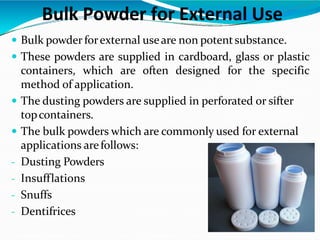
ď‚— The dusting powders are supplied in perforated or sifter
topcontainers.
ď‚— The bulk powders which are commonly used for external
applications arefollows:
- Dusting Powders
- Insufflations
- Snuffs
- Dentifrices
ď‚— Dusting Powders:
- These are used for external application on the skin &
generallyapplied in very fine state toavoid local irritation.
- Therefore, dusting powder should be passed through sieve
no. 80 or 120 toenhance theireffectiveness.
- Dusting powders are 2 types: i. Medical ii.Surgical
- Medical & surgical dusting powders are free from
pathogenic microorganism.
- Medical & Surgical dusting powders before use must be
sterilised by dry heat method at 1600 C for 2hrs.
- Surgical dusting powders are used in body cavities & also
used on burn case & umbilical cord ofinfants.
- Whereas, medical dusting powders are generally use on
superficial skincondition.
Bulk Powder for External Use
ď‚— Cont..
- In the preparation of dusting powder the talc or kaolin,
starch are used commonly because these are chemically
inert.
- But, such ingredients are readily contaminated with
pathogenic bacteria so, these must be sterilised before their
use by dry heat sterilisationmethod.
- The dusting powders are dispensed in sifter or aerosol
containers.
- Dusting powders are generally non- toxic but inhalation of its
fine powdered ingredients by infants may lead to pulmonary
inflammation. So proper care should be taken while
handling.
- Use : Antiseptic, Astringent, Absorbent,Antiperspirant
Bulk Powder for External Use
ď‚— E.g of Dusting powder
Rx,
Purified talc, sterilised 50 gm
Starch powder 25 gm
Zinc oxide powder 20 gm
Salicylic acid powder 5gm
Procedure: weigh accurately all the powders & mix them
ascending order of their weight. Pass the mixed powder
through sieve no 85 or 120. after sieving mix them lightly &
Transfer into sifter top container & protect it from
atmosphericcontamination.
Direction: Applied on the affected part two or three times a
day.
Use: Zinc oxide use for astringent & antiseptic & salicylic acid
used for antiseptic &fungicidal.
Bulk Powder for External Use
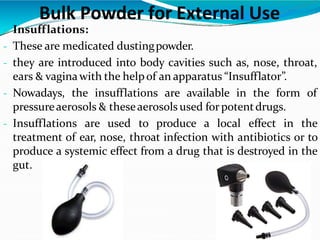
ď‚— Insufflations:
- These are medicated dustingpowder.
- they are introduced into body cavities such as, nose, throat,
ears & vagina with the helpof an apparatus “Insufflator”.
- Nowadays, the insufflations are available in the form of
pressureaerosols & theseaerosols used forpotentdrugs.
- Insufflations are used to produce a local effect in the
treatment of ear, nose, throat infection with antibiotics or to
produce a systemic effect from a drug that is destroyed in the
gut.
Bulk Powder for External Use
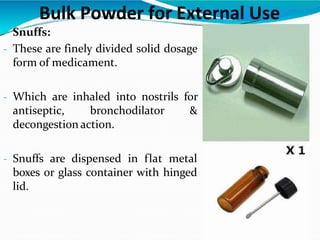
ď‚— Snuffs:
- These are finely divided solid dosage
form of medicament.
- Which are inhaled into nostrils for
antiseptic, bronchodilator &
decongestion action.
- Snuffs are dispensed in flat metal
boxes or glass container with hinged
lid.
Bulk Powder for External Use
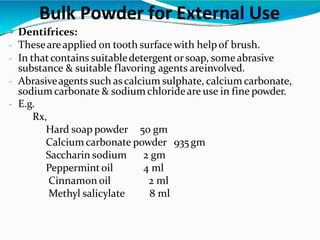
ď‚— Dentifrices:
- Theseareapplied on tooth surface with helpof brush.
- In thatcontains suitabledetergentor soap, some abrasive
substance & suitable flavoring agents areinvolved.
- Abrasiveagents such ascalcium sulphate, calciumcarbonate,
sodium carbonate & sodium chlorideare use in fine powder.
- E.g.
Rx,
Hard soap powder 50 gm
Calcium carbonate powder 935 gm
Saccharin sodium 2 gm
Peppermintoil 4 ml
Cinnamon oil 2 ml
Methyl salicylate 8 ml
Bulk Powder for External Use
Simple & Compound Powders for Internal
Use
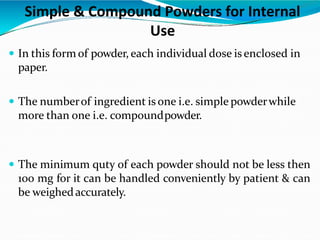
ď‚— In this form of powder, each individual dose is enclosed in
paper.
ď‚— The numberof ingredient is one i.e. simple powderwhile
more than one i.e. compoundpowder.
ď‚— The minimum quty of each powder should not be less then
100 mg for it can be handled conveniently by patient & can
be weighedaccurately.
Simple & Compound Powders for Internal Use
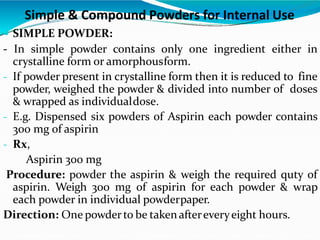
ď‚— SIMPLE POWDER:
- In simple powder contains only one ingredient either in
crystalline form or amorphousform.
- If powder present in crystalline form then it is reduced to fine
powder, weighed the powder & divided into number of doses
& wrapped as individualdose.
- E.g. Dispensed six powders of Aspirin each powder contains
300 mg of aspirin
- Rx,
Aspirin 300 mg
Procedure: powder the aspirin & weigh the required quty of
aspirin. Weigh 300 mg of aspirin for each powder & wrap
each powder in individual powderpaper.
Direction: One powderto be takenaftereveryeight hours.
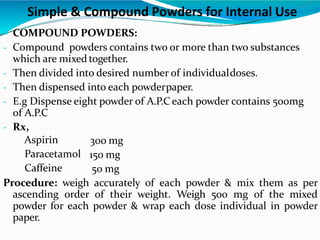
ď‚— COMPOUND POWDERS:
- Compound powders contains two or more than two substances
which are mixed together.
- Then divided into desired number of individualdoses.
- Then dispensed into each powderpaper.
- E.g Dispense eight powder of A.P.C each powder contains 500mg
of A.P.C
- Rx,
Aspirin
Paracetamol
Caffeine
300 mg
150 mg
50 mg
Procedure: weigh accurately of each powder & mix them as per
ascending order of their weight. Weigh 500 mg of the mixed
powder for each powder & wrap each dose individual in powder
paper.
Simple & Compound Powders for Internal Use
Powders enclosed in cachets &
capsules
ď‚— Cachets are solid dosage form of drug & cachets are also
called as wafercapsules.
ď‚— These are molded from riceflour.
ď‚— Rice paper prepared from mixture of rice f lour with water
enclosed in between two hot, polished,cylinders.
ď‚— Then waterwasevaporates & wafer is formed.
ď‚— In the cachets 0.2 to 1.5 gm nauseous or disagreeable drugs in
powder form areenclosed.
ď‚— Cachets are quite hard so, before swallowing they dipped in
water for seconds & then placed on the tongue & swallowed
with draught ofwater.
ď‚— After swallowing the cachets gets disintegrate & drug is
released.
ď‚— ADVANTAGES OF CACHETS:
- Madeeasily..
- Disintegrate quickly instomach
- Drug can be easilydispensed
- Large doseof drug can be swallowed by using cachets.
Powders enclosed in cachets &
capsules
ď‚— DISADVANTAGES OF CACHETS:
- Required soften before use orswallowing.
- Easilydamaged.
- Cannot be protect the enclosed drug from light& moisture.
- Shell of cachets are fragile so, drug contents cannot be
compressed.
- Theyare not suitable for filling thedrug in large scale.
- They occurs more space compae with tablets & capsules solid
dosage form.
Powders enclosed in cachets & capsules
ď‚— Cachets are twotypes:
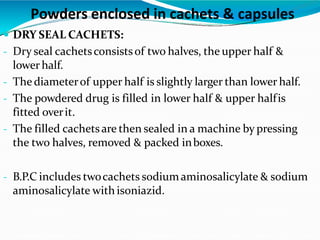
- Wet seal cachets
- Dry sealcachets
- WET SEAL CACHETS:
- A wet seal cachets is made up of two similar convex halves
having flat edges.
- The weighed of powder drug is placed in one half, the edge of
other half are moistened with water & placed exactly over the
first half containing thedrug.
- The flat edges of both the halves are pressed together in
order to seal itperfectly.
Powders enclosed in cachets & capsules
ď‚— DRY SEAL CACHETS:
- Dry seal cachetsconsistsof two halves, the upper half &
lower half.
- The diameterof upper half is slightly larger than lower half.
- The powdered drug is filled in lower half & upper halfis
fitted overit.
- The filled cachetsare then sealed in a machine by pressing
the two halves, removed & packed inboxes.
- B.P.C includes twocachets sodiumaminosalicylate & sodium
aminosalicylate with isoniazid.
Powders enclosed in cachets & capsules
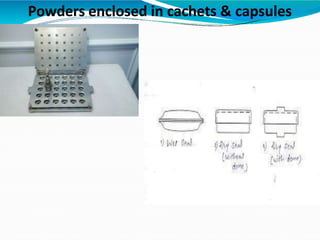
ď‚— In that powders moulded intotablets.
ď‚— Theyare flat, circulardisc & usuallycontains potentdrug.
ď‚— In that potentdrugsare mixed with lactose, dextroseorsome
otherdiluents.
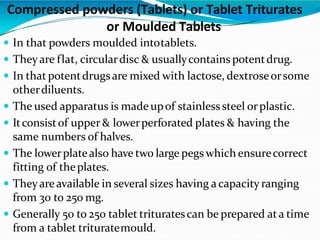
ď‚— The used apparatus is made upof stainlesssteel orplastic.
ď‚— Itconsistof upper & lowerperforated plates & having the
same numbers of halves.
ď‚— The lowerplatealso have two large pegs which ensurecorrect
fitting of theplates.
ď‚— Theyareavailable in several sizes having a capacity ranging
from 30 to 250 mg.
ď‚— Generally 50 to 250 tablet trituratescan be prepared ata time
from a tablet trituratemould.
Compressed powders (Tablets) or Tablet Triturates
or Moulded Tablets
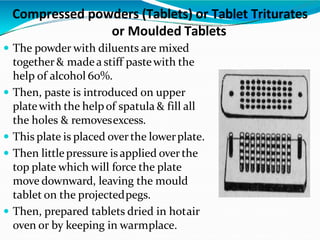
ď‚— The powder with diluents are mixed
together & madea stiff pastewith the
help of alcohol 60%.
ď‚— Then, paste is introduced on upper
platewith the helpof spatula & fill all
the holes & removesexcess.
ď‚— This plate is placed overthe lowerplate.
ď‚— Then littlepressure is applied overthe
top plate which will force the plate
move downward, leaving the mould
tablet on the projectedpegs.
ď‚— Then, prepared tablets dried in hotair
oven or by keeping in warmplace.
Compressed powders (Tablets) or Tablet Triturates
or Moulded Tablets
Dispensing of Powders Involving Special
Problems
ď‚— Volatile Substances:
- Certainvegetablepowdercontainsvolatileoil.
- Toprevent the loss of volatileoils, thesevegetabledrugs must
be powdered lightly in amortar.
- Also, menthol, camphor & essential oils takes place
incorporation in powder.
- Final productpack with doublewrapping.
ď‚— Hygroscopic & deliquescentpowders:
- Absorb the moisture from atmosphere are called hygroscopic
powders.
- Absorb the moisture from atmosphere & convert into solution are
called deliquescent powders.
- E.g. ammonium chloride, ammonium citrate, pepsin,
phenobarbitone, sodium iodideetc.
- Such substance are usually provide in granular form in order to
exposé less surface area to atmosphere & avoid convert into fine
powder.
- Such powder should be doublewrapped.
Dispensing of Powders Involving Special
Problems
ď‚— Efflorescent powders:
- Some crystalline substance liberates water of crystallisation
whollyorpartlyon exposure to humid atmosphere.
- e.g. citricacid, caffeine, ferrous sulphateetc.
- So, this problem overcome by mixing or incorporate with
inert substanceorusing anhydrous slat.
Dispensing of Powders Involving Special
Problems
ď‚— Eutectic mixture:
ď‚— Liquids:
- In some prescription the liquid medicaments are also
incorporated with powders.
- In that case, if liquid quty is small, it may be triturated with
equal amount of powder, then the reset of the ingredients are
incorporated in small proportions with continuousstirring.
Dispensing of Powders Involving Special
Problems
ď‚— Potentdrugs:
- The substance having a max. dose of less than 60 mg & poisonous
substances are called potentdrugs.
- Itshould be difficult toweigh on dispensing balance.
- For that, firstly potent drugs incorporated with diluents such as
lactose beforeweigh.
- e.g. Dispense following powder in 5 powderpackets
- Rx,
Codeine phosphate 10 mg
In that case, weigh 100 mg of codeine phosphate & 900 mg oflactose
mixed with ascending orderwith helpof spatula.
Out of 1 gm of triturate, weigh 100 mg of each powder contains 10
mg of codeine phosphate & pack in powder paper.
Dispensing of Powders Involving Special
Problems
ď‚— Granularpowders:
- Some solid medicaments required to administered in orally in
large dose & its not possible to convert into tablet or capsule bec. a
large numberof themwill be required to takesingledose.
- And these medicaments are difficult to dispense in powder form
bec. Its bitter, nauseous & unpleasanttaste.
- In this case, solid medicaments mix with sweetening, flavoring &
coloring agent with suitable granulating agent to moisten the
powder to make coherentmass.
- Then, pass through sieve no. 10 to make granules & dry in hot air
oven at 600C & after drying pass through sieve no. 20 & pack into
wide mouthcontainers.
- E.g. Nowadays, antibiotics like erythromycin, ampicillin etc are
available in granularpowder bec. Theyare unstable in liquid form.
Dispensing of Powders Involving Special
Problems
ď‚— Effervescentgranules:
- These type of medicament granules are prepared for internal
use.
- In that, medicaments mixed with citric acid, tartaric acid &
sodium bicarbonate with sweetening agents alsopresent.
- When contact with water they release of carbon dioxide to
mask the bitter & saline tasteof drug.
- Also, carbon dioxide stimulates the flow of gastric juice &
helps in the absorption ofmedicaments.
OF PREPARATION OF EFFERVESCENT- METHODS
GRANULES:
- Heat Method
- WetMethod
Heat Method:
- Firstly, porcelain dish make hot on water bath before transferring
the powder.
- Then, transfer the medicament with citric acid & other
ingredients.
- In that stagecitricacid liberates thewater & producedump mass.
- Heating stage takes 1 to 5mint.
- Then damp mass pass through sieve & dry in hot airoven at 600 C.
- Then finally packed in air tightcontainer.
Wet Method
- In this method, the ingredients are mixed with alcohol to
produce coherentmass.
- Produced mass pass through sieve no 10 or 8 & dry in hot air
oven at 600 C.
- Then dried granules are again passed through sieve to break
the lumpswhich may be formed during drying.
- Finally, the prepared granules are packed in air tight
containers.
MIXING OF POWDERS
ď‚— Spatulation
ď‚— Trituration
ď‚— Geometricdilution
ď‚— Sifting
ď‚— Tumbling
Cont..
ď‚— Spatulation: mixing the powders with help of spatula on a
paper orsheet.
ď‚— Trituration: it is used for reduce of size & for mixing of
powders.
ď‚— Geometric dilution: for potentdrugs..
ď‚— Sifting: the powdersare mixed by passing through sifters.
ď‚— Tumbling: tumbling is the process of mixing powders in a
large container rotated by an electric motor. These type of
blenders are widely used in industry as large volume of
powder mixers.
Packing of Powder
ď‚— Doublewrapping:
- In that, wrap the powders by using twodifferent types
of paper.
- Outerpaper is plain paperwhile innerwrapping is of
gelatin paper.
Powders

Powders

  • 1.
  • 2.
    Introduction POWDER - Powders arethe mixture of finely divided drug or chemicals in dryform. - They are used for internally &externally. - Theyareavailable in crystallineoramorphous form. - There is a relationship between particle size of powder & dissolution, absorption & therapeutic effectof drug.
  • 3.
    Advantages of Powders ď‚—Powders are more stable than liquid dosageform. ď‚— The chance of incompatibility are less as compared to liquid dosage form. ď‚— The onset of action of powdered drug is rapid as compared to other solid dosage form e.g. tablet, capsules. Due to smaller particlesizeof powder, itget dissolved easily in body fluids. ď‚— Larger quty. of powdered drugs can be administered to the patient orally by dissolving or mixing the powder in the suitable liquid. ď‚— Small children or elderly patient can easily take the powdered drug as such ordispersed in wateroranyother liquid. ď‚— Powders are more economical as compared with other dosage form because not required any special machinery or technique. ď‚— Powders are more easy tocarry than the liquid dosage form.
  • 4.
    Disadvantages of Powders ď‚—Drugs having bitter, nauseous & unpleasant taste cannot be dispensed in powderedform. ď‚— Deliquescent & hygroscopic drugs cannot be dispensed in powder form. ď‚— Drugs which get affected by atmospheric conditions are notsuitable fordispensing in powder forms. ď‚— The dispensing of powder is a timeconsuming.
  • 5.
    Classification of Powders 1.Bulk powder for internaluse. 2. Bulk powder for externaluse. 3. Simple & Compound powder for internaluse. 4. Powders enclosed in cachets &capsules. 5. Compressed powders (Tablets)
  • 6.
    Bulk Powder forInternal Use ď‚— When accuracy of dosage form is not required or is not important at that time powders are dispensed in bulk form. ď‚— Bulk powdercontains several dosesof powder. ď‚— They are supplied in wide-mouthed containers that permitseasy removal of a spoonful powder. ď‚— The non potent substances which are supplied in bulk are antacid & laxativeetc. ď‚— E.g. rhubarb powder
  • 7.
    Bulk Powder forExternal Use ď‚— Bulk powder forexternal useare non potentsubstance. ď‚— These powders are supplied in cardboard, glass or plastic containers, which are often designed for the specific method of application. ď‚— The dusting powders are supplied in perforated or sifter topcontainers. ď‚— The bulk powders which are commonly used for external applications arefollows: - Dusting Powders - Insufflations - Snuffs - Dentifrices
  • 8.
    ď‚— Dusting Powders: -These are used for external application on the skin & generallyapplied in very fine state toavoid local irritation. - Therefore, dusting powder should be passed through sieve no. 80 or 120 toenhance theireffectiveness. - Dusting powders are 2 types: i. Medical ii.Surgical - Medical & surgical dusting powders are free from pathogenic microorganism. - Medical & Surgical dusting powders before use must be sterilised by dry heat method at 1600 C for 2hrs. - Surgical dusting powders are used in body cavities & also used on burn case & umbilical cord ofinfants. - Whereas, medical dusting powders are generally use on superficial skincondition. Bulk Powder for External Use
  • 9.
    ď‚— Cont.. - Inthe preparation of dusting powder the talc or kaolin, starch are used commonly because these are chemically inert. - But, such ingredients are readily contaminated with pathogenic bacteria so, these must be sterilised before their use by dry heat sterilisationmethod. - The dusting powders are dispensed in sifter or aerosol containers. - Dusting powders are generally non- toxic but inhalation of its fine powdered ingredients by infants may lead to pulmonary inflammation. So proper care should be taken while handling. - Use : Antiseptic, Astringent, Absorbent,Antiperspirant Bulk Powder for External Use
  • 10.
    ď‚— E.g ofDusting powder Rx, Purified talc, sterilised 50 gm Starch powder 25 gm Zinc oxide powder 20 gm Salicylic acid powder 5gm Procedure: weigh accurately all the powders & mix them ascending order of their weight. Pass the mixed powder through sieve no 85 or 120. after sieving mix them lightly & Transfer into sifter top container & protect it from atmosphericcontamination. Direction: Applied on the affected part two or three times a day. Use: Zinc oxide use for astringent & antiseptic & salicylic acid used for antiseptic &fungicidal. Bulk Powder for External Use
  • 11.
     Insufflations: - Theseare medicated dustingpowder. - they are introduced into body cavities such as, nose, throat, ears & vagina with the helpof an apparatus “Insufflator”. - Nowadays, the insufflations are available in the form of pressureaerosols & theseaerosols used forpotentdrugs. - Insufflations are used to produce a local effect in the treatment of ear, nose, throat infection with antibiotics or to produce a systemic effect from a drug that is destroyed in the gut. Bulk Powder for External Use
  • 12.
    ď‚— Snuffs: - Theseare finely divided solid dosage form of medicament. - Which are inhaled into nostrils for antiseptic, bronchodilator & decongestion action. - Snuffs are dispensed in flat metal boxes or glass container with hinged lid. Bulk Powder for External Use
  • 13.
    ď‚— Dentifrices: - Theseareappliedon tooth surface with helpof brush. - In thatcontains suitabledetergentor soap, some abrasive substance & suitable flavoring agents areinvolved. - Abrasiveagents such ascalcium sulphate, calciumcarbonate, sodium carbonate & sodium chlorideare use in fine powder. - E.g. Rx, Hard soap powder 50 gm Calcium carbonate powder 935 gm Saccharin sodium 2 gm Peppermintoil 4 ml Cinnamon oil 2 ml Methyl salicylate 8 ml Bulk Powder for External Use
  • 14.
    Simple & CompoundPowders for Internal Use ď‚— In this form of powder, each individual dose is enclosed in paper. ď‚— The numberof ingredient is one i.e. simple powderwhile more than one i.e. compoundpowder. ď‚— The minimum quty of each powder should not be less then 100 mg for it can be handled conveniently by patient & can be weighedaccurately.
  • 15.
    Simple & CompoundPowders for Internal Use ď‚— SIMPLE POWDER: - In simple powder contains only one ingredient either in crystalline form or amorphousform. - If powder present in crystalline form then it is reduced to fine powder, weighed the powder & divided into number of doses & wrapped as individualdose. - E.g. Dispensed six powders of Aspirin each powder contains 300 mg of aspirin - Rx, Aspirin 300 mg Procedure: powder the aspirin & weigh the required quty of aspirin. Weigh 300 mg of aspirin for each powder & wrap each powder in individual powderpaper. Direction: One powderto be takenaftereveryeight hours.
  • 16.
    ď‚— COMPOUND POWDERS: -Compound powders contains two or more than two substances which are mixed together. - Then divided into desired number of individualdoses. - Then dispensed into each powderpaper. - E.g Dispense eight powder of A.P.C each powder contains 500mg of A.P.C - Rx, Aspirin Paracetamol Caffeine 300 mg 150 mg 50 mg Procedure: weigh accurately of each powder & mix them as per ascending order of their weight. Weigh 500 mg of the mixed powder for each powder & wrap each dose individual in powder paper. Simple & Compound Powders for Internal Use
  • 17.
    Powders enclosed incachets & capsules ď‚— Cachets are solid dosage form of drug & cachets are also called as wafercapsules. ď‚— These are molded from riceflour. ď‚— Rice paper prepared from mixture of rice f lour with water enclosed in between two hot, polished,cylinders. ď‚— Then waterwasevaporates & wafer is formed. ď‚— In the cachets 0.2 to 1.5 gm nauseous or disagreeable drugs in powder form areenclosed.
  • 18.
    ď‚— Cachets arequite hard so, before swallowing they dipped in water for seconds & then placed on the tongue & swallowed with draught ofwater. ď‚— After swallowing the cachets gets disintegrate & drug is released. ď‚— ADVANTAGES OF CACHETS: - Madeeasily.. - Disintegrate quickly instomach - Drug can be easilydispensed - Large doseof drug can be swallowed by using cachets. Powders enclosed in cachets & capsules
  • 19.
    ď‚— DISADVANTAGES OFCACHETS: - Required soften before use orswallowing. - Easilydamaged. - Cannot be protect the enclosed drug from light& moisture. - Shell of cachets are fragile so, drug contents cannot be compressed. - Theyare not suitable for filling thedrug in large scale. - They occurs more space compae with tablets & capsules solid dosage form. Powders enclosed in cachets & capsules
  • 20.
    ď‚— Cachets aretwotypes: - Wet seal cachets - Dry sealcachets - WET SEAL CACHETS: - A wet seal cachets is made up of two similar convex halves having flat edges. - The weighed of powder drug is placed in one half, the edge of other half are moistened with water & placed exactly over the first half containing thedrug. - The flat edges of both the halves are pressed together in order to seal itperfectly. Powders enclosed in cachets & capsules
  • 21.
    Powders enclosed incachets & capsules
  • 22.
    ď‚— DRY SEALCACHETS: - Dry seal cachetsconsistsof two halves, the upper half & lower half. - The diameterof upper half is slightly larger than lower half. - The powdered drug is filled in lower half & upper halfis fitted overit. - The filled cachetsare then sealed in a machine by pressing the two halves, removed & packed inboxes. - B.P.C includes twocachets sodiumaminosalicylate & sodium aminosalicylate with isoniazid. Powders enclosed in cachets & capsules
  • 23.
    ď‚— In thatpowders moulded intotablets. ď‚— Theyare flat, circulardisc & usuallycontains potentdrug. ď‚— In that potentdrugsare mixed with lactose, dextroseorsome otherdiluents. ď‚— The used apparatus is made upof stainlesssteel orplastic. ď‚— Itconsistof upper & lowerperforated plates & having the same numbers of halves. ď‚— The lowerplatealso have two large pegs which ensurecorrect fitting of theplates. ď‚— Theyareavailable in several sizes having a capacity ranging from 30 to 250 mg. ď‚— Generally 50 to 250 tablet trituratescan be prepared ata time from a tablet trituratemould. Compressed powders (Tablets) or Tablet Triturates or Moulded Tablets
  • 24.
    ď‚— The powderwith diluents are mixed together & madea stiff pastewith the help of alcohol 60%. ď‚— Then, paste is introduced on upper platewith the helpof spatula & fill all the holes & removesexcess. ď‚— This plate is placed overthe lowerplate. ď‚— Then littlepressure is applied overthe top plate which will force the plate move downward, leaving the mould tablet on the projectedpegs. ď‚— Then, prepared tablets dried in hotair oven or by keeping in warmplace. Compressed powders (Tablets) or Tablet Triturates or Moulded Tablets
  • 25.
    Dispensing of PowdersInvolving Special Problems ď‚— Volatile Substances: - Certainvegetablepowdercontainsvolatileoil. - Toprevent the loss of volatileoils, thesevegetabledrugs must be powdered lightly in amortar. - Also, menthol, camphor & essential oils takes place incorporation in powder. - Final productpack with doublewrapping.
  • 26.
     Hygroscopic &deliquescentpowders: - Absorb the moisture from atmosphere are called hygroscopic powders. - Absorb the moisture from atmosphere & convert into solution are called deliquescent powders. - E.g. ammonium chloride, ammonium citrate, pepsin, phenobarbitone, sodium iodideetc. - Such substance are usually provide in granular form in order to exposé less surface area to atmosphere & avoid convert into fine powder. - Such powder should be doublewrapped. Dispensing of Powders Involving Special Problems
  • 27.
    ď‚— Efflorescent powders: -Some crystalline substance liberates water of crystallisation whollyorpartlyon exposure to humid atmosphere. - e.g. citricacid, caffeine, ferrous sulphateetc. - So, this problem overcome by mixing or incorporate with inert substanceorusing anhydrous slat. Dispensing of Powders Involving Special Problems
  • 28.
    ď‚— Eutectic mixture: ď‚—Liquids: - In some prescription the liquid medicaments are also incorporated with powders. - In that case, if liquid quty is small, it may be triturated with equal amount of powder, then the reset of the ingredients are incorporated in small proportions with continuousstirring. Dispensing of Powders Involving Special Problems
  • 29.
    ď‚— Potentdrugs: - Thesubstance having a max. dose of less than 60 mg & poisonous substances are called potentdrugs. - Itshould be difficult toweigh on dispensing balance. - For that, firstly potent drugs incorporated with diluents such as lactose beforeweigh. - e.g. Dispense following powder in 5 powderpackets - Rx, Codeine phosphate 10 mg In that case, weigh 100 mg of codeine phosphate & 900 mg oflactose mixed with ascending orderwith helpof spatula. Out of 1 gm of triturate, weigh 100 mg of each powder contains 10 mg of codeine phosphate & pack in powder paper. Dispensing of Powders Involving Special Problems
  • 30.
    ď‚— Granularpowders: - Somesolid medicaments required to administered in orally in large dose & its not possible to convert into tablet or capsule bec. a large numberof themwill be required to takesingledose. - And these medicaments are difficult to dispense in powder form bec. Its bitter, nauseous & unpleasanttaste. - In this case, solid medicaments mix with sweetening, flavoring & coloring agent with suitable granulating agent to moisten the powder to make coherentmass. - Then, pass through sieve no. 10 to make granules & dry in hot air oven at 600C & after drying pass through sieve no. 20 & pack into wide mouthcontainers. - E.g. Nowadays, antibiotics like erythromycin, ampicillin etc are available in granularpowder bec. Theyare unstable in liquid form. Dispensing of Powders Involving Special Problems
  • 31.
    ď‚— Effervescentgranules: - Thesetype of medicament granules are prepared for internal use. - In that, medicaments mixed with citric acid, tartaric acid & sodium bicarbonate with sweetening agents alsopresent. - When contact with water they release of carbon dioxide to mask the bitter & saline tasteof drug. - Also, carbon dioxide stimulates the flow of gastric juice & helps in the absorption ofmedicaments. OF PREPARATION OF EFFERVESCENT- METHODS GRANULES: - Heat Method - WetMethod
  • 32.
    Heat Method: - Firstly,porcelain dish make hot on water bath before transferring the powder. - Then, transfer the medicament with citric acid & other ingredients. - In that stagecitricacid liberates thewater & producedump mass. - Heating stage takes 1 to 5mint. - Then damp mass pass through sieve & dry in hot airoven at 600 C. - Then finally packed in air tightcontainer.
  • 33.
    Wet Method - Inthis method, the ingredients are mixed with alcohol to produce coherentmass. - Produced mass pass through sieve no 10 or 8 & dry in hot air oven at 600 C. - Then dried granules are again passed through sieve to break the lumpswhich may be formed during drying. - Finally, the prepared granules are packed in air tight containers.
  • 34.
    MIXING OF POWDERS ď‚—Spatulation ď‚— Trituration ď‚— Geometricdilution ď‚— Sifting ď‚— Tumbling
  • 35.
    Cont.. ď‚— Spatulation: mixingthe powders with help of spatula on a paper orsheet. ď‚— Trituration: it is used for reduce of size & for mixing of powders. ď‚— Geometric dilution: for potentdrugs.. ď‚— Sifting: the powdersare mixed by passing through sifters. ď‚— Tumbling: tumbling is the process of mixing powders in a large container rotated by an electric motor. These type of blenders are widely used in industry as large volume of powder mixers.
  • 36.
    Packing of Powder ď‚—Doublewrapping: - In that, wrap the powders by using twodifferent types of paper. - Outerpaper is plain paperwhile innerwrapping is of gelatin paper.