The Fundamentals
of Pneumatic
Control Technology
Birth of automation
The Industrial Revolution . . . .
• Began in France in the 1700s.
• Sowed the seeds of industry as we know today.
• Industry was born because of the limitations of
humans as the source of power.
• Humans tend to get tired, bored, distracted, sick.
• Human output lacks consistency, accuracy and precision.
• Machines have a long service life, tremendous strength,
work 24 hours a day and do not suffer from any of the
shortcomings seen in humans.
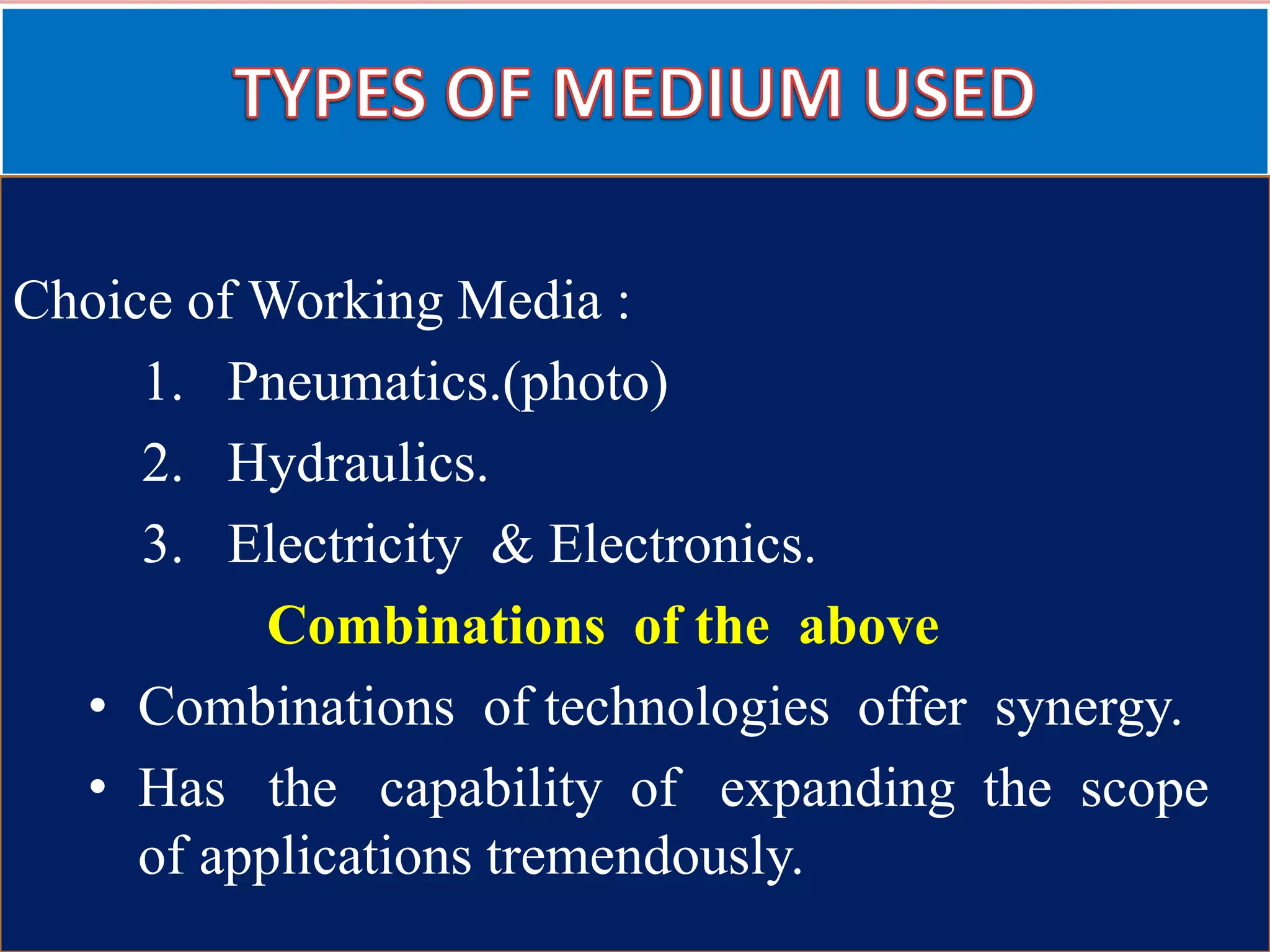
Choice of Working Media :
1. Pneumatics.(photo)
2. Hydraulics.
3. Electricity & Electronics.
Combinations of the above
• Combinations of technologies offer synergy.
• Has the capability of expanding the scope
of applications tremendously.
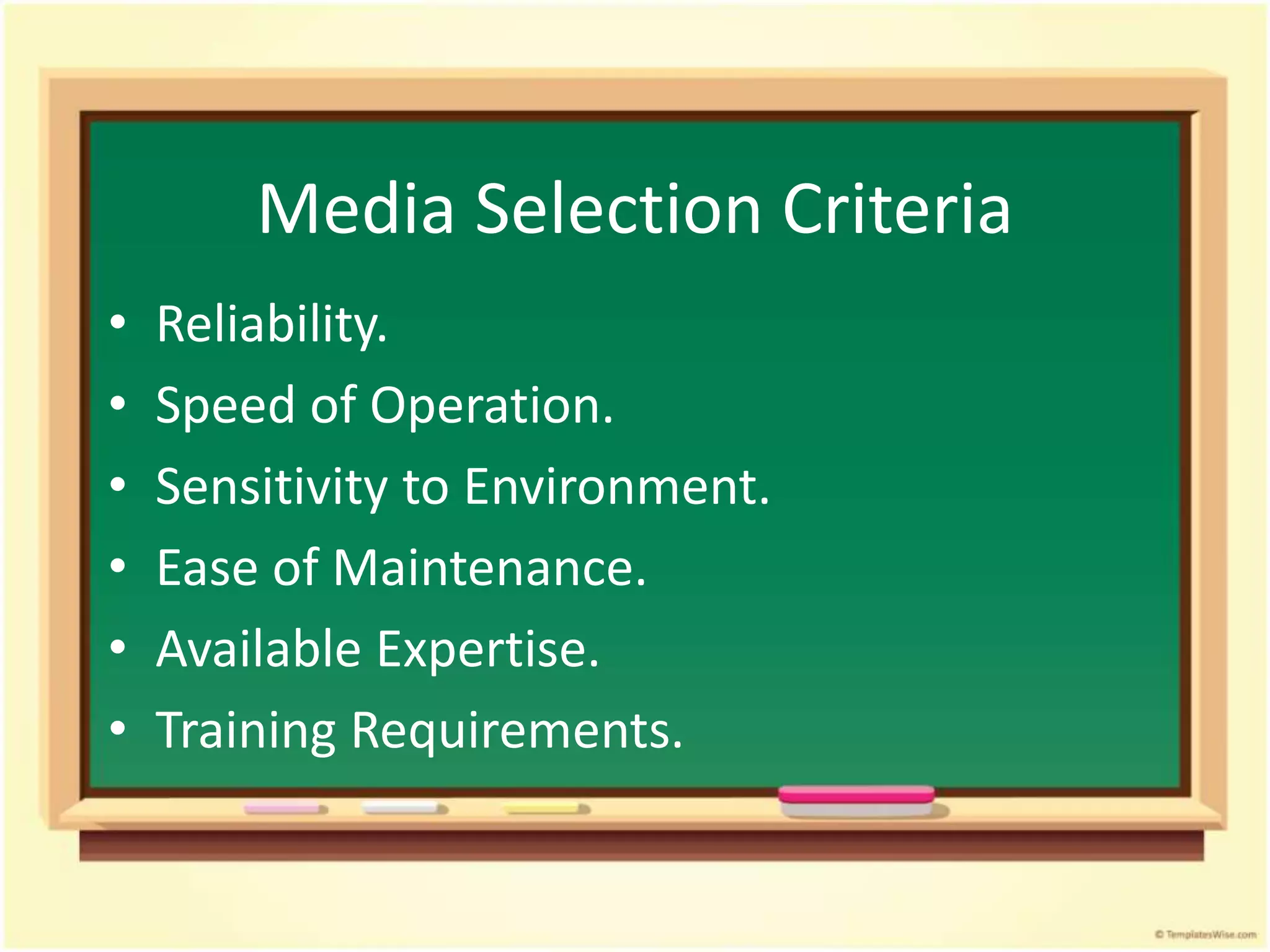
Media Selection Criteria
• Reliability.
• Speed of Operation.
• Sensitivity to Environment.
• Ease of Maintenance.
• Available Expertise.
• Training Requirements.
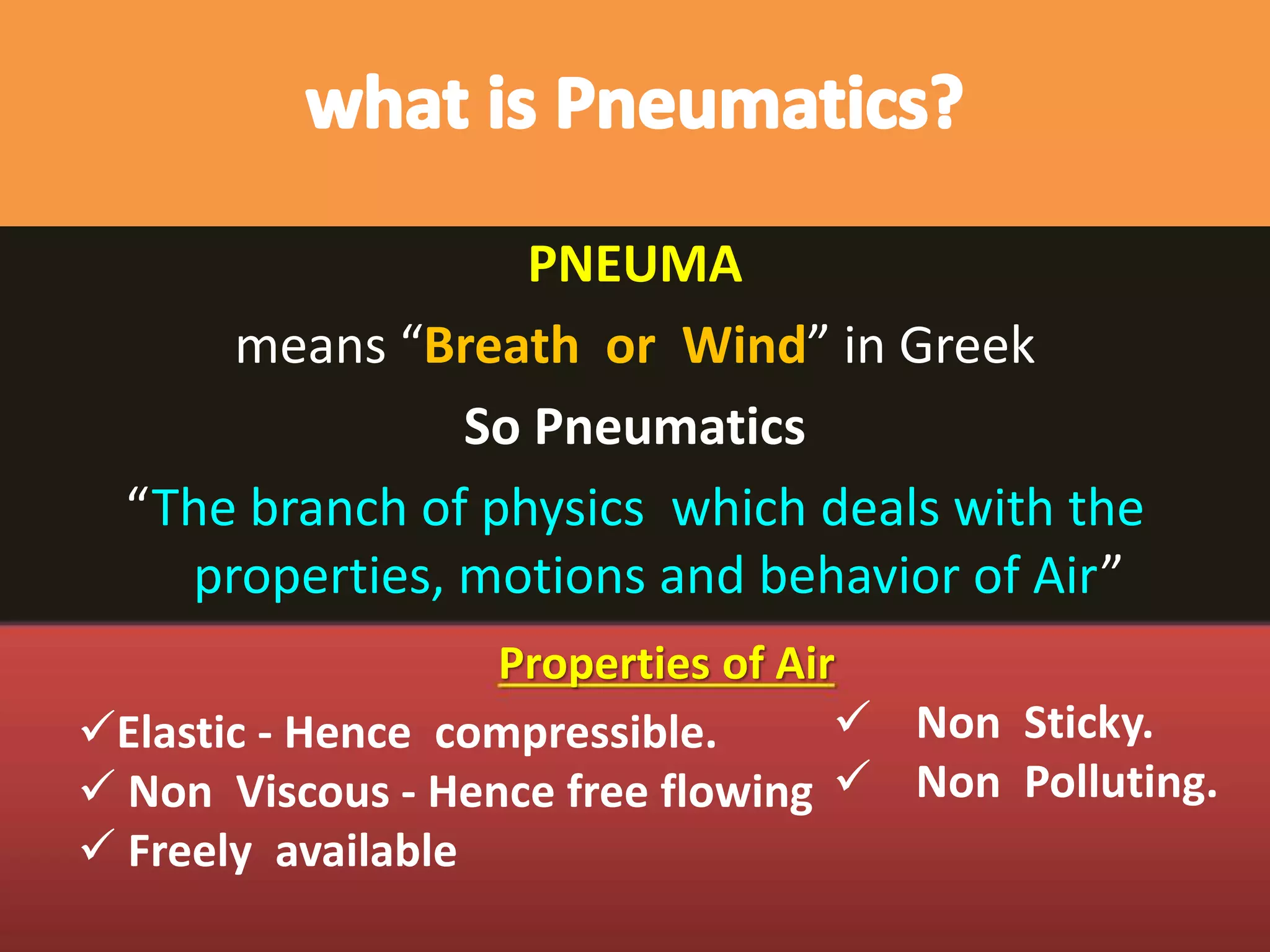
PNEUMA
means “Breath or Wind” in Greek
So Pneumatics
“The branch of physics which deals with the
properties, motions and behavior of Air”
Properties of Air
 Non Sticky.
 Non Polluting.
Elastic - Hence compressible.
 Non Viscous - Hence free flowing
 Freely available
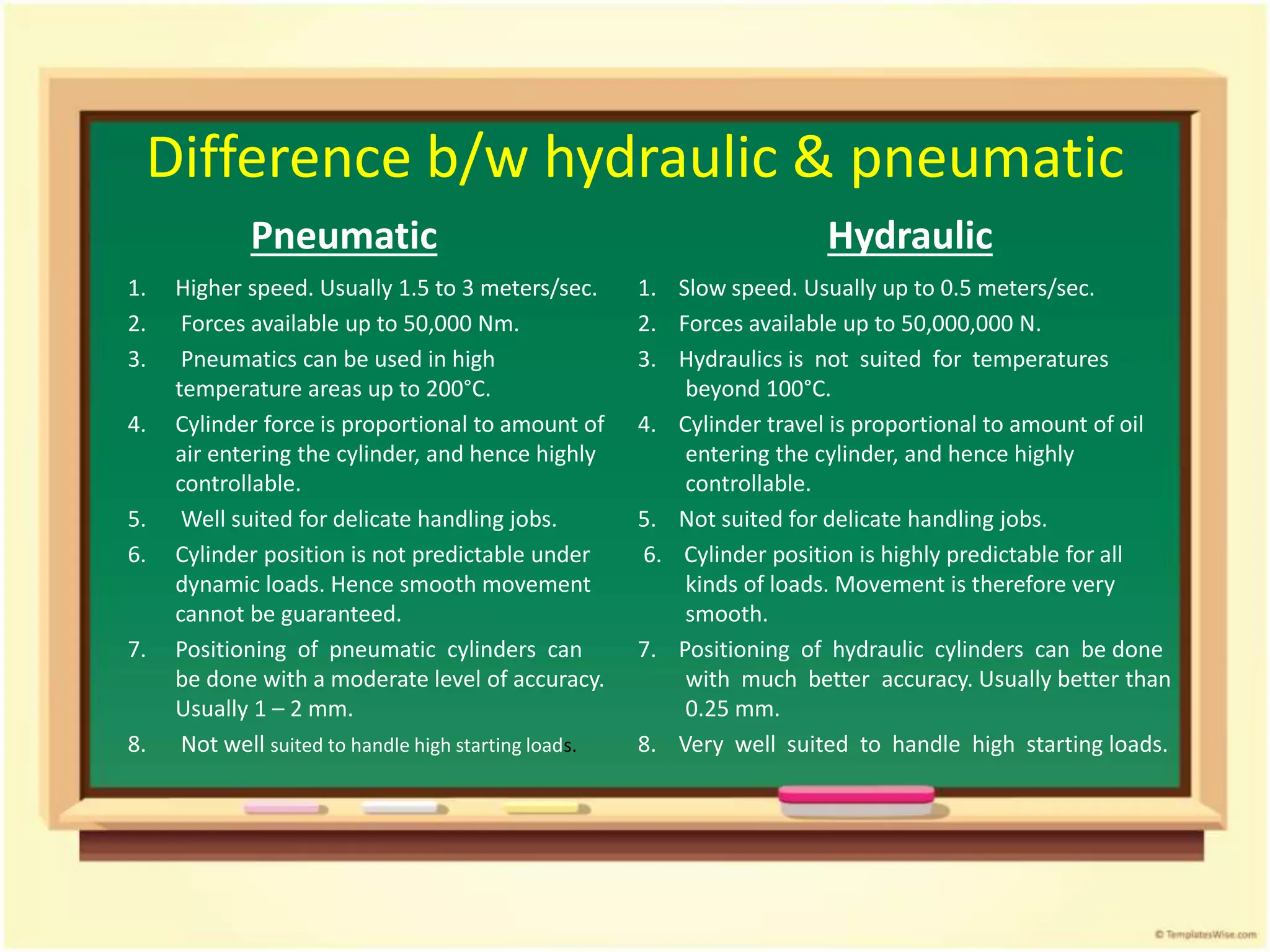
Difference b/w hydraulic & pneumatic
Pneumatic
1. Higher speed. Usually 1.5 to 3 meters/sec.
2. Forces available up to 50,000 Nm.
3. Pneumatics can be used in high
temperature areas up to 200°C.
4. Cylinder force is proportional to amount of
air entering the cylinder, and hence highly
controllable.
5. Well suited for delicate handling jobs.
6. Cylinder position is not predictable under
dynamic loads. Hence smooth movement
cannot be guaranteed.
7. Positioning of pneumatic cylinders can
be done with a moderate level of accuracy.
Usually 1 – 2 mm.
8. Not well suited to handle high starting loads.
Hydraulic
1. Slow speed. Usually up to 0.5 meters/sec.
2. Forces available up to 50,000,000 N.
3. Hydraulics is not suited for temperatures
beyond 100°C.
4. Cylinder travel is proportional to amount of oil
entering the cylinder, and hence highly
controllable.
5. Not suited for delicate handling jobs.
6. Cylinder position is highly predictable for all
kinds of loads. Movement is therefore very
smooth.
7. Positioning of hydraulic cylinders can be done
with much better accuracy. Usually better than
0.25 mm.
8. Very well suited to handle high starting loads.
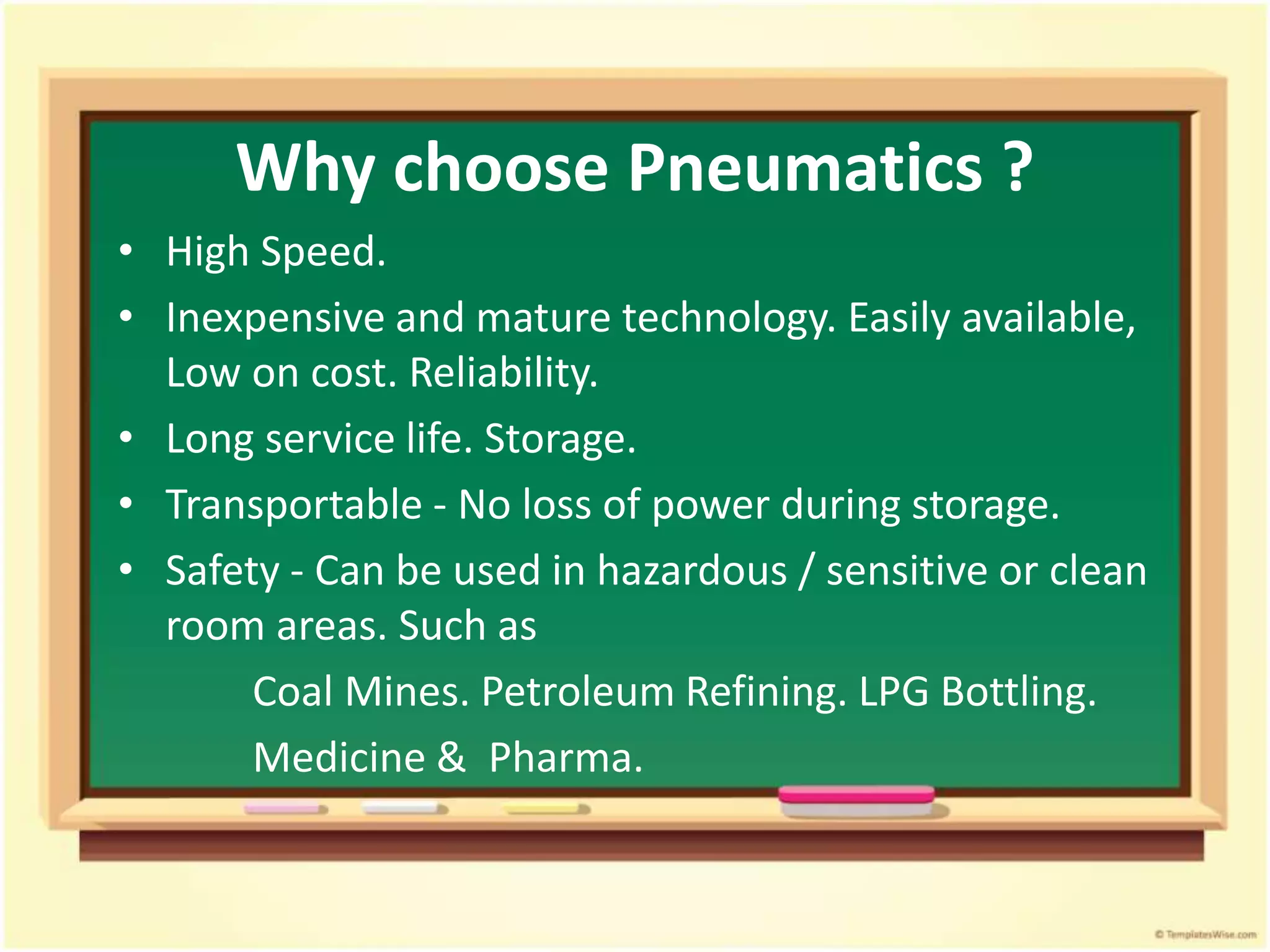
Why choose Pneumatics ?
• High Speed.
• Inexpensive and mature technology. Easily available,
Low on cost. Reliability.
• Long service life. Storage.
• Transportable - No loss of power during storage.
• Safety - Can be used in hazardous / sensitive or clean
room areas. Such as
Coal Mines. Petroleum Refining. LPG Bottling.
Medicine & Pharma.
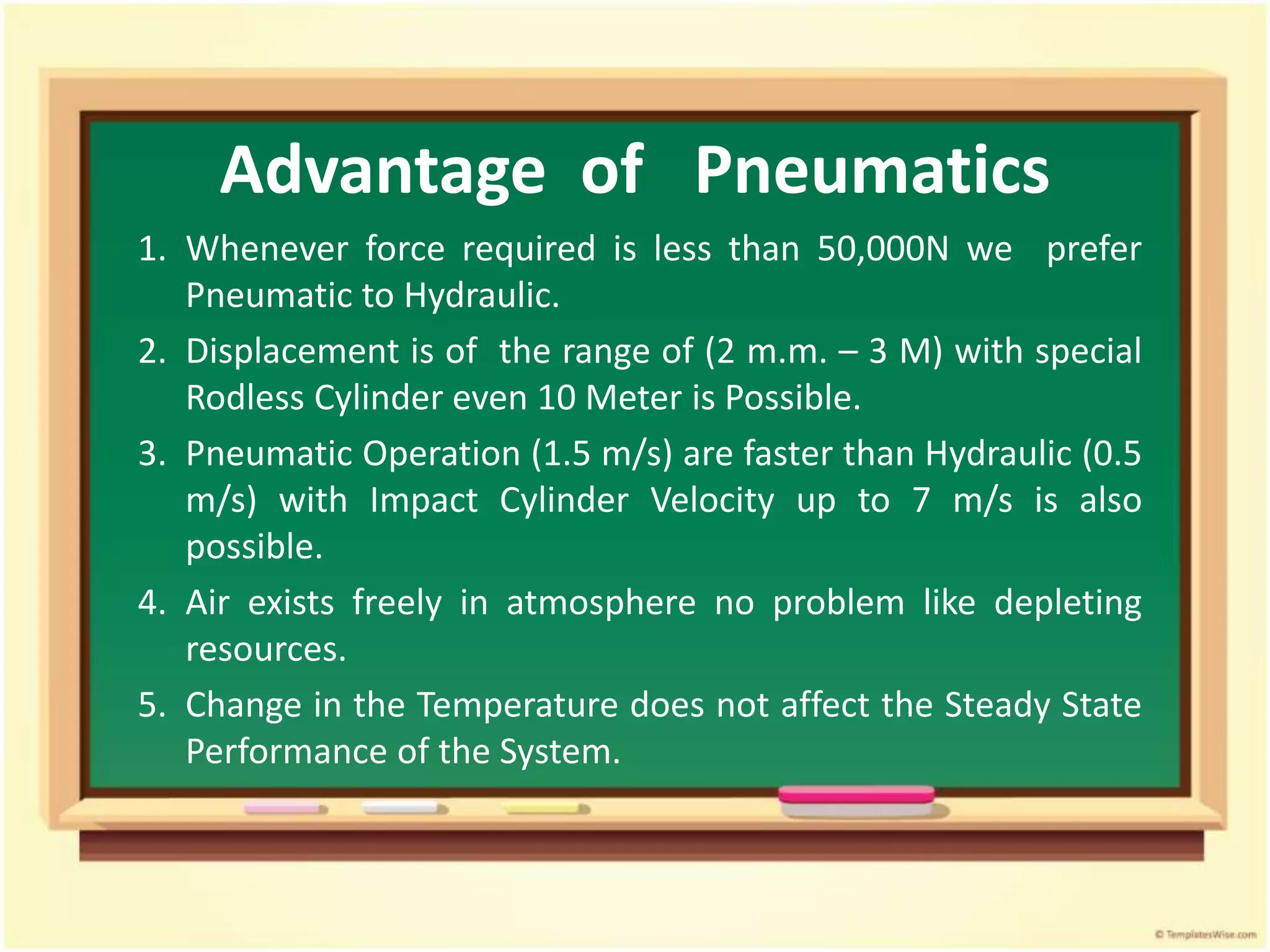
Advantage of Pneumatics
1. Whenever force required is less than 50,000N we prefer
Pneumatic to Hydraulic.
2. Displacement is of the range of (2 m.m. – 3 M) with special
Rodless Cylinder even 10 Meter is Possible.
3. Pneumatic Operation (1.5 m/s) are faster than Hydraulic (0.5
m/s) with Impact Cylinder Velocity up to 7 m/s is also
possible.
4. Air exists freely in atmosphere no problem like depleting
resources.
5. Change in the Temperature does not affect the Steady State
Performance of the System.
Advantage of Pneumatics(contd.)
1. Cleaning – Leaking Pipes does not Contaminate. It is used in
Food & Pharma, Chemical, Textile, Printing Inks, etc.
2. Air will not burn also working pressure is around 6 Bar. So it is
safe. Hence, explosion proof.
3. Initial cost is high but maintenance cost is low. Total cost is
minimum so it is economical
4. In Air drop in pressure is not large. In Hydraulics, Return lines are
required. It can be transported over a large distance up to 1000
meter. You cannot take oil in hydraulics for 100 meter.
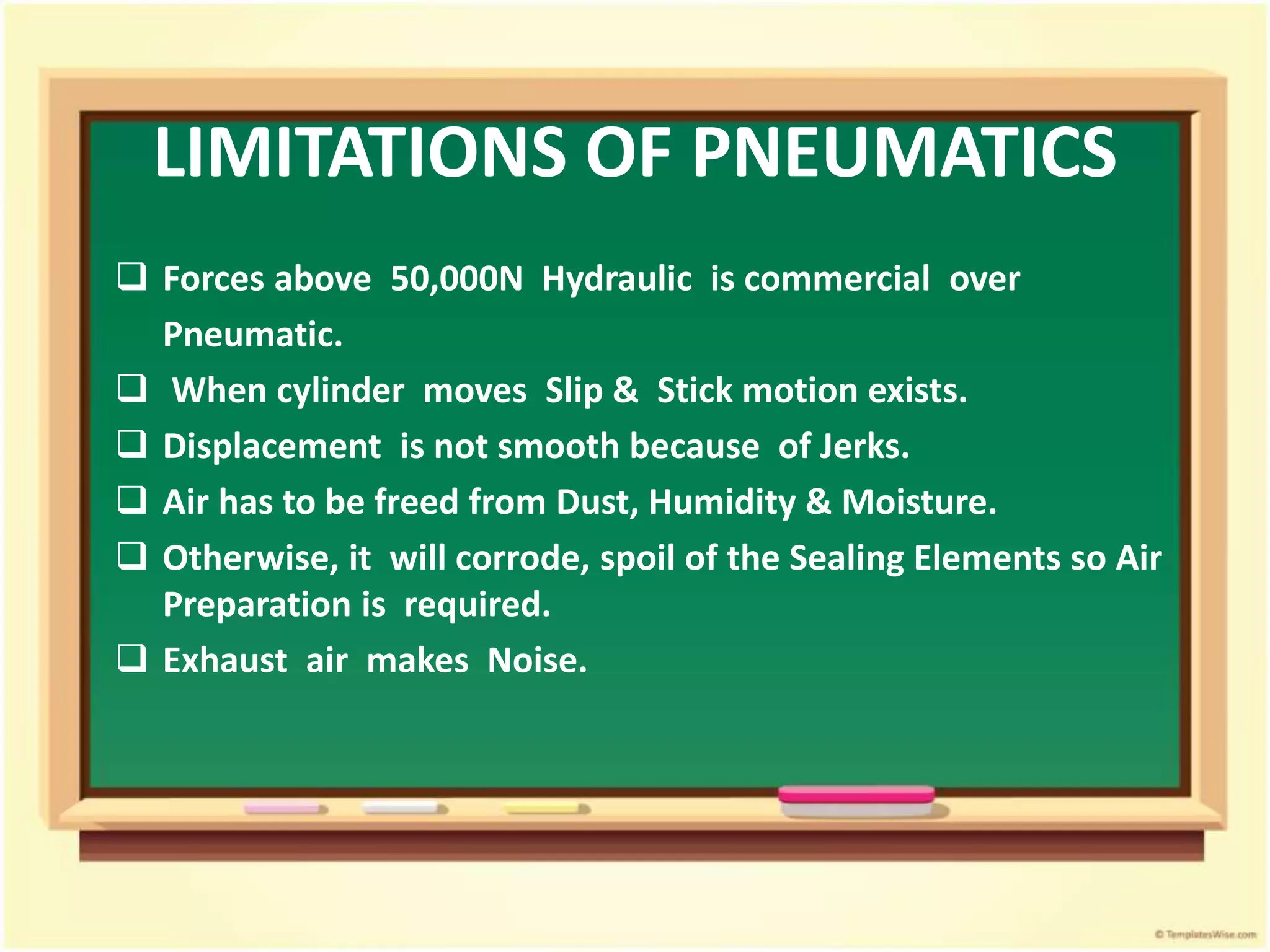
LIMITATIONS OF PNEUMATICS
 Forces above 50,000N Hydraulic is commercial over
Pneumatic.
 When cylinder moves Slip & Stick motion exists.
 Displacement is not smooth because of Jerks.
 Air has to be freed from Dust, Humidity & Moisture.
 Otherwise, it will corrode, spoil of the Sealing Elements so Air
Preparation is required.
 Exhaust air makes Noise.
Principal of Pneumatics
Boyle - Mariotte’s Law.
 The product of Pressure and Volume of a given amount of gas is a constant,
provided the temperature remains constant
Charles’s & Gay - Lussac’s Law.
 The volume of a gas is proportional to its absolute temperature, provided the
pressure remains constant.
 -273 °C is the lowest possible temperature in the universe and is known as
absolute zero [0 °Kelvin].
 Absolute temperature is measured in º Kelvin. A change of 1 °C results in a
change of 1 °K.
 0 °C = 273 °K and 1 °C = 274 °K
(P1 x V1 = P2 x V2).
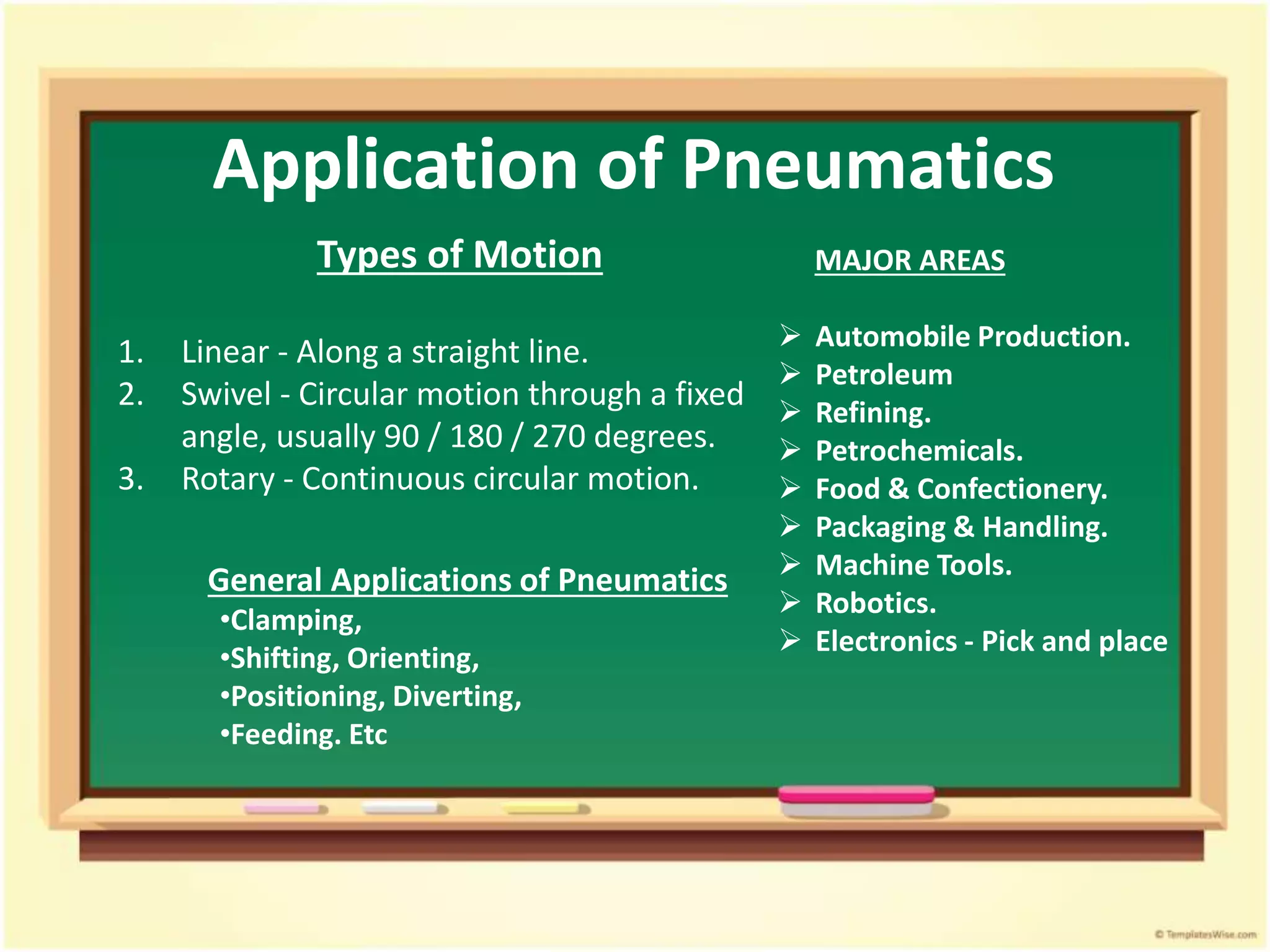
Application of Pneumatics
General Applications of Pneumatics
•Clamping,
•Shifting, Orienting,
•Positioning, Diverting,
•Feeding. Etc
MAJOR AREAS
 Automobile Production.
 Petroleum
 Refining.
 Petrochemicals.
 Food & Confectionery.
 Packaging & Handling.
 Machine Tools.
 Robotics.
 Electronics - Pick and place
Types of Motion
1. Linear - Along a straight line.
2. Swivel - Circular motion through a fixed
angle, usually 90 / 180 / 270 degrees.
3. Rotary - Continuous circular motion.

fundamentals & basics of pneumatic system

  • 1.
  • 2.
    Birth of automation TheIndustrial Revolution . . . . • Began in France in the 1700s. • Sowed the seeds of industry as we know today. • Industry was born because of the limitations of humans as the source of power. • Humans tend to get tired, bored, distracted, sick. • Human output lacks consistency, accuracy and precision. • Machines have a long service life, tremendous strength, work 24 hours a day and do not suffer from any of the shortcomings seen in humans.
  • 3.
    Choice of WorkingMedia : 1. Pneumatics.(photo) 2. Hydraulics. 3. Electricity & Electronics. Combinations of the above • Combinations of technologies offer synergy. • Has the capability of expanding the scope of applications tremendously.
  • 4.
    Media Selection Criteria •Reliability. • Speed of Operation. • Sensitivity to Environment. • Ease of Maintenance. • Available Expertise. • Training Requirements.
  • 5.
    PNEUMA means “Breath orWind” in Greek So Pneumatics “The branch of physics which deals with the properties, motions and behavior of Air” Properties of Air  Non Sticky.  Non Polluting. Elastic - Hence compressible.  Non Viscous - Hence free flowing  Freely available
  • 6.
    Difference b/w hydraulic& pneumatic Pneumatic 1. Higher speed. Usually 1.5 to 3 meters/sec. 2. Forces available up to 50,000 Nm. 3. Pneumatics can be used in high temperature areas up to 200°C. 4. Cylinder force is proportional to amount of air entering the cylinder, and hence highly controllable. 5. Well suited for delicate handling jobs. 6. Cylinder position is not predictable under dynamic loads. Hence smooth movement cannot be guaranteed. 7. Positioning of pneumatic cylinders can be done with a moderate level of accuracy. Usually 1 – 2 mm. 8. Not well suited to handle high starting loads. Hydraulic 1. Slow speed. Usually up to 0.5 meters/sec. 2. Forces available up to 50,000,000 N. 3. Hydraulics is not suited for temperatures beyond 100°C. 4. Cylinder travel is proportional to amount of oil entering the cylinder, and hence highly controllable. 5. Not suited for delicate handling jobs. 6. Cylinder position is highly predictable for all kinds of loads. Movement is therefore very smooth. 7. Positioning of hydraulic cylinders can be done with much better accuracy. Usually better than 0.25 mm. 8. Very well suited to handle high starting loads.
  • 7.
    Why choose Pneumatics? • High Speed. • Inexpensive and mature technology. Easily available, Low on cost. Reliability. • Long service life. Storage. • Transportable - No loss of power during storage. • Safety - Can be used in hazardous / sensitive or clean room areas. Such as Coal Mines. Petroleum Refining. LPG Bottling. Medicine & Pharma.
  • 8.
    Advantage of Pneumatics 1.Whenever force required is less than 50,000N we prefer Pneumatic to Hydraulic. 2. Displacement is of the range of (2 m.m. – 3 M) with special Rodless Cylinder even 10 Meter is Possible. 3. Pneumatic Operation (1.5 m/s) are faster than Hydraulic (0.5 m/s) with Impact Cylinder Velocity up to 7 m/s is also possible. 4. Air exists freely in atmosphere no problem like depleting resources. 5. Change in the Temperature does not affect the Steady State Performance of the System.
  • 9.
    Advantage of Pneumatics(contd.) 1.Cleaning – Leaking Pipes does not Contaminate. It is used in Food & Pharma, Chemical, Textile, Printing Inks, etc. 2. Air will not burn also working pressure is around 6 Bar. So it is safe. Hence, explosion proof. 3. Initial cost is high but maintenance cost is low. Total cost is minimum so it is economical 4. In Air drop in pressure is not large. In Hydraulics, Return lines are required. It can be transported over a large distance up to 1000 meter. You cannot take oil in hydraulics for 100 meter.
  • 10.
    LIMITATIONS OF PNEUMATICS Forces above 50,000N Hydraulic is commercial over Pneumatic.  When cylinder moves Slip & Stick motion exists.  Displacement is not smooth because of Jerks.  Air has to be freed from Dust, Humidity & Moisture.  Otherwise, it will corrode, spoil of the Sealing Elements so Air Preparation is required.  Exhaust air makes Noise.
  • 11.
    Principal of Pneumatics Boyle- Mariotte’s Law.  The product of Pressure and Volume of a given amount of gas is a constant, provided the temperature remains constant Charles’s & Gay - Lussac’s Law.  The volume of a gas is proportional to its absolute temperature, provided the pressure remains constant.  -273 °C is the lowest possible temperature in the universe and is known as absolute zero [0 °Kelvin].  Absolute temperature is measured in º Kelvin. A change of 1 °C results in a change of 1 °K.  0 °C = 273 °K and 1 °C = 274 °K (P1 x V1 = P2 x V2).
  • 12.
    Application of Pneumatics GeneralApplications of Pneumatics •Clamping, •Shifting, Orienting, •Positioning, Diverting, •Feeding. Etc MAJOR AREAS  Automobile Production.  Petroleum  Refining.  Petrochemicals.  Food & Confectionery.  Packaging & Handling.  Machine Tools.  Robotics.  Electronics - Pick and place Types of Motion 1. Linear - Along a straight line. 2. Swivel - Circular motion through a fixed angle, usually 90 / 180 / 270 degrees. 3. Rotary - Continuous circular motion.