NEWTON
RAPHSON
METHOD
Introduction
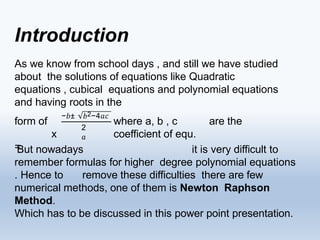
As we know from school days , and still we have studied
about the solutions of equations like Quadratic
equations , cubical equations and polynomial equations
and having roots in the
form of
x
=
−𝑏± 𝑏2−4𝑎𝑐
2
𝑎
where a, b , c are the
coefficient of equ.
But nowadays it is very difficult to
remember formulas for higher degree polynomial equations
. Hence to remove these difficulties there are few
numerical methods, one of them is Newton Raphson
Method.
Which has to be discussed in this power point presentation.
Newton Raphson
Method :
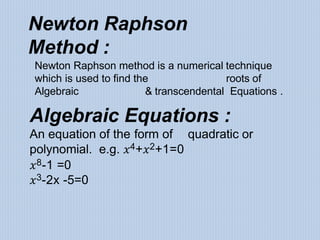
Newton Raphson method is a numerical technique
which is used to find the roots of
Algebraic & transcendental Equations .
Algebraic Equations :
An equation of the form of quadratic or
polynomial. e.g. 𝑥4+𝑥2+1=0
𝑥8-1 =0
𝑥3-2x -5=0
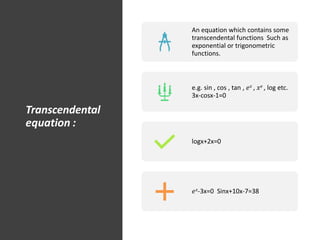
Transcendental
equation :
An equation which contains some
transcendental functions Such as
exponential or trigonometric
functions.
e.g. sin , cos , tan , 𝑒𝑥 , 𝑥𝑒 , log etc.
3x-cosx-1=0
logx+2x=0
𝑒𝑥-3x=0 Sinx+10x-7=38
Newton Raphson
Method :
Let us consider an equation f(x)=0 having graphical representation as
• f(x) =0 ,is an given equation
• Starting from an initial point 𝑥0
• Determine the slope of f(x) at x=𝑥0 .Call it f’(
𝑥0).
𝑖
𝑓(𝑥𝑖)−0
Slope =tanѲ= = 𝑓′ 𝑥 .
𝑥𝑖−𝑥𝑖+1
From here we get
𝑖
• f’(𝑥 ) =
𝑓(𝑥𝑖)
𝑥𝑖−𝑥𝑖+1
.
Hence
;
• 𝐱𝐢+𝟏 = 𝐱𝐢− 𝐢
𝐟(𝐱 )
𝐟′(𝐱𝐢)
• Newton Raphson
formula
Algorithm for f(x)=0
0
• Calculate f’(x) symbolically.
• Choose an initial guess 𝑥0as given below
let [a,b] be any interval such that f(a)<0 and f(b)>0 ,
then
𝑥 =𝑎+𝑏
.
2
• then 𝑥1 = 𝑥0
− 𝑓 𝑥0
𝑓′ 𝑥0
.
• Similarly 𝑥2 =𝑥1
− 𝑓 𝑥1
𝑓′(𝑥1)
.
• Then by repetition of this process we can find 𝑥3 ,𝑥4 ,𝑥5
……
• At last we reach at a stage where we find 𝒙𝒊+𝟏 = 𝒙𝒊.
• Then we willstop.
• Hence 𝒙𝒊 will be the required root of given equation.
NRM by Taylor
series :
if we have given an equation f(x)=0.
𝑥0 be the approximated root of given equation.
• Let (𝑥0 +h) be the actual root where ‘h’ is very small such
that
• f(𝑥0 + ℎ)=0
From Taylor series expansion on expanding to f(𝑥0 + ℎ)
ℎ2 ℎ3
f(𝑥0 + ℎ)=f(𝑥0) + hf’(𝑥0)+ 2!
f’’(𝑥0) + 3!
f’’’(𝑥0) +…….
Now on neglecting higher powers of h
• f(𝑥0) + hf’(𝑥0) =0
𝑓(𝑥0)
From above h= -
𝑓′(𝑥0)
Cont.
.
Hence first approximation 𝑥1=(𝑥0 +
ℎ);
𝑥1=𝑥0- 0
𝑓(𝑥 )
𝑓′(𝑥0)
Second approximation ;
2
𝑥 =𝑥
-
1
𝑓(𝑥 )
1 𝑓′(𝑥1)
On repeating this
process We get
𝒙𝒏+𝟏=𝒙𝒏 − 𝒇(𝒙𝒏)
𝒇′(𝒙𝒏)
This is the required newton Raphson
method.
How to solve an example :
F(x)= 𝑥3- 2x – 5
F’(x) = 3𝑥2-2
Now checking for initial point
F(1) =-6
F(2)= -1
F(3) =16
Hence root lies between (2,3)
Initial point (𝑥0) =
2+3
2
=2.5
From NRM formula
𝑛 +1
𝑛
𝑓′(𝑥𝑛)
𝑥 =𝑥 − 𝑓(𝑥𝑛)
putting all these above values in this
formula
𝑛 +1 𝑛
𝑥 = 𝑥 −
On putting initial value 𝑥0 = 2.5
We get first approximate root;
𝑥1=2.164179104
Similarly:
𝑥2=2.097135356
𝑥3=2.094555232
𝑥4=2.094551482
𝑥5=2.094551482
Hence 𝐱𝟒=𝐱𝟓
Hence 2.094551482 is the required root of given equation.
n
n n
3 x 2
 2
 2 x  5
x 3
Application of NRM
To find the square root of any no.
To find the inverse
To find inverse square root.
Root of any given equation.
Limitations
of NRM
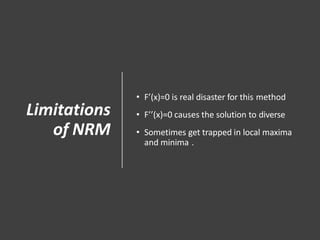
• F’(x)=0 is real disaster for this method
• F’’(x)=0 causes the solution to diverse
• Sometimes get trapped in local maxima
and minima .
THANK YOU..!!!!!!

Newton Raphson pptx

  • 1.
  • 2.
    Introduction As we knowfrom school days , and still we have studied about the solutions of equations like Quadratic equations , cubical equations and polynomial equations and having roots in the form of x = −𝑏± 𝑏2−4𝑎𝑐 2 𝑎 where a, b , c are the coefficient of equ. But nowadays it is very difficult to remember formulas for higher degree polynomial equations . Hence to remove these difficulties there are few numerical methods, one of them is Newton Raphson Method. Which has to be discussed in this power point presentation.
  • 3.
    Newton Raphson Method : NewtonRaphson method is a numerical technique which is used to find the roots of Algebraic & transcendental Equations . Algebraic Equations : An equation of the form of quadratic or polynomial. e.g. 𝑥4+𝑥2+1=0 𝑥8-1 =0 𝑥3-2x -5=0
  • 4.
    Transcendental equation : An equationwhich contains some transcendental functions Such as exponential or trigonometric functions. e.g. sin , cos , tan , 𝑒𝑥 , 𝑥𝑒 , log etc. 3x-cosx-1=0 logx+2x=0 𝑒𝑥-3x=0 Sinx+10x-7=38
  • 5.
    Newton Raphson Method : Letus consider an equation f(x)=0 having graphical representation as
  • 6.
    • f(x) =0,is an given equation • Starting from an initial point 𝑥0 • Determine the slope of f(x) at x=𝑥0 .Call it f’( 𝑥0). 𝑖 𝑓(𝑥𝑖)−0 Slope =tanѲ= = 𝑓′ 𝑥 . 𝑥𝑖−𝑥𝑖+1 From here we get 𝑖 • f’(𝑥 ) = 𝑓(𝑥𝑖) 𝑥𝑖−𝑥𝑖+1 . Hence ; • 𝐱𝐢+𝟏 = 𝐱𝐢− 𝐢 𝐟(𝐱 ) 𝐟′(𝐱𝐢) • Newton Raphson formula
  • 7.
    Algorithm for f(x)=0 0 •Calculate f’(x) symbolically. • Choose an initial guess 𝑥0as given below let [a,b] be any interval such that f(a)<0 and f(b)>0 , then 𝑥 =𝑎+𝑏 . 2 • then 𝑥1 = 𝑥0 − 𝑓 𝑥0 𝑓′ 𝑥0 . • Similarly 𝑥2 =𝑥1 − 𝑓 𝑥1 𝑓′(𝑥1) . • Then by repetition of this process we can find 𝑥3 ,𝑥4 ,𝑥5 …… • At last we reach at a stage where we find 𝒙𝒊+𝟏 = 𝒙𝒊. • Then we willstop. • Hence 𝒙𝒊 will be the required root of given equation.
  • 8.
    NRM by Taylor series: if we have given an equation f(x)=0. 𝑥0 be the approximated root of given equation. • Let (𝑥0 +h) be the actual root where ‘h’ is very small such that • f(𝑥0 + ℎ)=0 From Taylor series expansion on expanding to f(𝑥0 + ℎ) ℎ2 ℎ3 f(𝑥0 + ℎ)=f(𝑥0) + hf’(𝑥0)+ 2! f’’(𝑥0) + 3! f’’’(𝑥0) +……. Now on neglecting higher powers of h • f(𝑥0) + hf’(𝑥0) =0 𝑓(𝑥0) From above h= - 𝑓′(𝑥0) Cont. .
  • 9.
    Hence first approximation𝑥1=(𝑥0 + ℎ); 𝑥1=𝑥0- 0 𝑓(𝑥 ) 𝑓′(𝑥0) Second approximation ; 2 𝑥 =𝑥 - 1 𝑓(𝑥 ) 1 𝑓′(𝑥1) On repeating this process We get 𝒙𝒏+𝟏=𝒙𝒏 − 𝒇(𝒙𝒏) 𝒇′(𝒙𝒏) This is the required newton Raphson method.
  • 10.
    How to solvean example : F(x)= 𝑥3- 2x – 5 F’(x) = 3𝑥2-2 Now checking for initial point F(1) =-6 F(2)= -1 F(3) =16 Hence root lies between (2,3) Initial point (𝑥0) = 2+3 2 =2.5 From NRM formula 𝑛 +1 𝑛 𝑓′(𝑥𝑛) 𝑥 =𝑥 − 𝑓(𝑥𝑛) putting all these above values in this formula
  • 11.
    𝑛 +1 𝑛 𝑥= 𝑥 − On putting initial value 𝑥0 = 2.5 We get first approximate root; 𝑥1=2.164179104 Similarly: 𝑥2=2.097135356 𝑥3=2.094555232 𝑥4=2.094551482 𝑥5=2.094551482 Hence 𝐱𝟒=𝐱𝟓 Hence 2.094551482 is the required root of given equation. n n n 3 x 2  2  2 x  5 x 3
  • 12.
    Application of NRM Tofind the square root of any no. To find the inverse To find inverse square root. Root of any given equation.
  • 13.
    Limitations of NRM • F’(x)=0is real disaster for this method • F’’(x)=0 causes the solution to diverse • Sometimes get trapped in local maxima and minima .
  • 14.