Prevalence and Etiology:
• Urinary tract infections (UTIs) occur in 1-3% of
girls and 1% of boys.
• In girls, the first UTI usually occurs by the age
of 5 yr, with peaks during infancy and toilet
training.
• In boys, most UTIs occur during the 1st yr of
life; UTIs are much more common in
uncircumcised boys, especially in the 1st year
of life.
Prevalence by Age
• The prevalence of UTIs varies with age.
• During the 1st yr of life, the male : female
ratio is 2.8-5.4 : 1.
• Beyond 1-2 yr, there is a female
preponderance, with a male : female ratio of
1 : 10.
Etiology
• UTIs are caused mainly by colonic bacteria.
• In girls, 75-90% of all infections are caused by
Escherichia coli, followed by Klebsiella spp and Proteus
spp.
• Some series report that in boys >1 yr of age, Proteus is
as common a cause as E. coli; others report a
preponderance of gram-positive organisms in boys.
• Staphylococcus saprophyticus and enterococcus are
pathogens in both sexes.
Clinical Manifestations and
Classification:
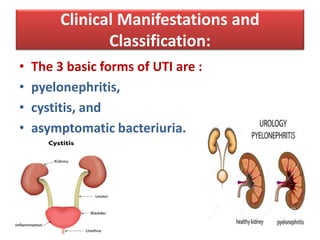
• The 3 basic forms of UTI are :
• pyelonephritis,
• cystitis, and
• asymptomatic bacteriuria.
Clinical Pyelonephritis:
• Clinical pyelonephritis is characterized by any
or all of the following:
• abdominal, back, or flank pain; fever; malaise;
nausea; vomiting; and, occasionally, diarrhea.
Fever may be the only manifestation.
• Newborns can show nonspecific symptoms
such as poor feeding, irritability, jaundice, and
weight loss.
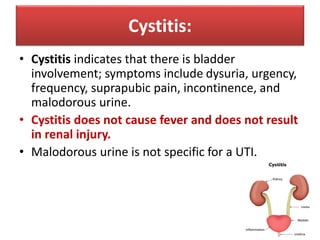
• Pyelonephritis is the most common serious
bacterial infection in infants <24 mo of age who
have fever without an obvious focus.
• These symptoms are an indication that there is
bacterial involvement of the upper urinary tract.
• Involvement of the renal parenchyma is termed
acute pyelonephritis, whereas if there is no
parenchymal involvement, the condition may be
termed pyelitis.
• Acute pyelonephritis can result in renal injury,
termed pyelonephritic scarring.
Clinical Pyelonephritis:
Cystitis:
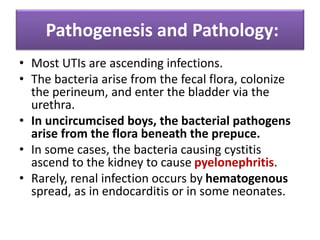
• Cystitis indicates that there is bladder
involvement; symptoms include dysuria, urgency,
frequency, suprapubic pain, incontinence, and
malodorous urine.
• Cystitis does not cause fever and does not result
in renal injury.
• Malodorous urine is not specific for a UTI.
Pathogenesis and Pathology:
• Most UTIs are ascending infections.
• The bacteria arise from the fecal flora, colonize
the perineum, and enter the bladder via the
urethra.
• In uncircumcised boys, the bacterial pathogens
arise from the flora beneath the prepuce.
• In some cases, the bacteria causing cystitis
ascend to the kidney to cause pyelonephritis.
• Rarely, renal infection occurs by hematogenous
spread, as in endocarditis or in some neonates.
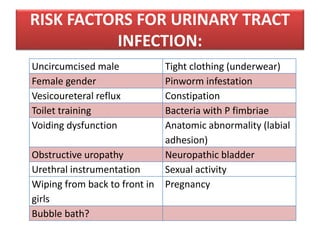
RISK FACTORS FOR URINARY TRACT
INFECTION:
Uncircumcised male Tight clothing (underwear)
Female gender Pinworm infestation
Vesicoureteral reflux Constipation
Toilet training Bacteria with P fimbriae
Voiding dysfunction Anatomic abnormality (labial
adhesion)
Obstructive uropathy Neuropathic bladder
Urethral instrumentation Sexual activity
Wiping from back to front in
girls
Pregnancy
Bubble bath?
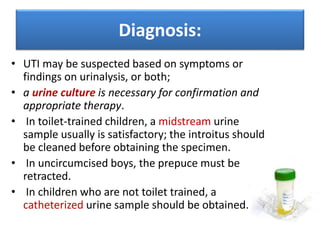
Diagnosis:
• UTI may be suspected based on symptoms or
findings on urinalysis, or both;
• a urine culture is necessary for confirmation and
appropriate therapy.
• In toilet-trained children, a midstream urine
sample usually is satisfactory; the introitus should
be cleaned before obtaining the specimen.
• In uncircumcised boys, the prepuce must be
retracted.
• In children who are not toilet trained, a
catheterized urine sample should be obtained.
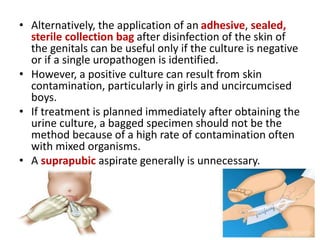
• Alternatively, the application of an adhesive, sealed,
sterile collection bag after disinfection of the skin of
the genitals can be useful only if the culture is negative
or if a single uropathogen is identified.
• However, a positive culture can result from skin
contamination, particularly in girls and uncircumcised
boys.
• If treatment is planned immediately after obtaining the
urine culture, a bagged specimen should not be the
method because of a high rate of contamination often
with mixed organisms.
• A suprapubic aspirate generally is unnecessary.
• Pyuria (leukocytes in the urine) suggests
infection, but infection can occur in the absence
of pyuria; this finding is more confirmatory than
diagnostic. Conversely, pyuria can be present
without UTI.
• Sterile pyuria (positive leukocytes, negative
culture) occurs in partially treated bacterial UTIs,
viral infections, renal tuberculosis, renal abscess,
UTI in the presence of urinary obstruction,
urethritis due to a sexually transmitted infection
(STI) , inflammation near the ureter or bladder
(appendicitis, Crohn disease), and interstitial
nephritis (eosinophils).
Diagnosis
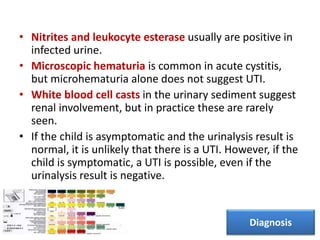
• Nitrites and leukocyte esterase usually are positive in
infected urine.
• Microscopic hematuria is common in acute cystitis,
but microhematuria alone does not suggest UTI.
• White blood cell casts in the urinary sediment suggest
renal involvement, but in practice these are rarely
seen.
• If the child is asymptomatic and the urinalysis result is
normal, it is unlikely that there is a UTI. However, if the
child is symptomatic, a UTI is possible, even if the
urinalysis result is negative.
Diagnosis
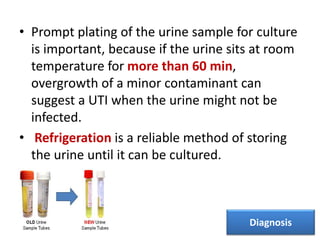
• Prompt plating of the urine sample for culture
is important, because if the urine sits at room
temperature for more than 60 min,
overgrowth of a minor contaminant can
suggest a UTI when the urine might not be
infected.
• Refrigeration is a reliable method of storing
the urine until it can be cultured.
Diagnosis
• If the culture shows >100,000 colonies of a single
pathogen, or if there are 10,000 colonies and the child
is symptomatic, the child is considered to have a UTI.
• In a bag sample, if the urinalysis result is positive, the
patient is symptomatic, and there is a single organism
cultured with a colony count >100,000, there is a
presumed UTI.
• If any of these criteria are not met, confirmation of
infection with a catheterized sample is recommended.
• With acute renal infection, leukocytosis, neutrophilia,
and elevated serum erythrocyte sedimentation rate
and C-reactive protein are common.
Diagnosis
Treatment:
• Acute cystitis should be treated promptly to prevent
possible progression to pyelonephritis.
• treatment is started pending results of the culture.
• If treatment is initiated before the results of a culture
and sensitivities are available, a 3- to 5-day course of
therapy with trimethoprim-sulfamethoxazole (TMP-
SMX) or trimethoprim is effective against most strains
of E. coli.
• Nitrofurantoin (5-7 mg/kg/24 hr in 3-4 divided doses)
also is effective and has the advantage of being active
against Klebsiella and Enterobacter organisms.
• Amoxicillin (50 mg/kg/24 hr) also is effective as initial
treatment but has no clear advantages over
sulfonamides or nitrofurantoin.
• In acute febrile infections suggesting pyelonephritis, a
10- to 14-day course of broad-spectrum antibiotics
capable of reaching significant tissue levels is
preferable.
• Children who are dehydrated, are vomiting, are unable
to drink fluids, are ≤1mo of age, or in whom urosepsis
is a possibility should be admitted to the hospital for
IV rehydration and IV antibiotic therapy.
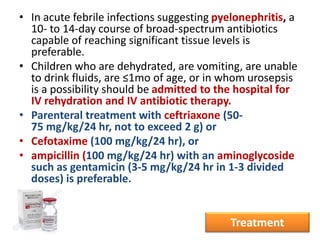
• Parenteral treatment with ceftriaxone (50-
75 mg/kg/24 hr, not to exceed 2 g) or
• Cefotaxime (100 mg/kg/24 hr), or
• ampicillin (100 mg/kg/24 hr) with an aminoglycoside
such as gentamicin (3-5 mg/kg/24 hr in 1-3 divided
doses) is preferable.
Treatment
• Treatment with aminoglycosides is particularly
effective against Pseudomonas spp, and
alkalinization of urine with sodium bicarbonate
increases its effectiveness in the urinary tract.
• Oral 3rd-generation cephalosporins such as
cefixime are as effective as parenteral ceftriaxone
against a variety of gram-negative organisms
other than Pseudomonas, and these medications
are considered by some authorities to be the
treatment of choice for oral outpatient therapy.
Treatment
• The oral fluoroquinolone ciprofloxacin is an
alternative agent for resistant microorganisms,
particularly Pseudomonas, in patients >17 yr.
• It also has been used on occasion for short-
course therapy in younger children with
Pseudomonas UTI.
• However, the clinical use of fluoroquinolones
in children should be restricted because of
potential cartilage damage.
Treatment
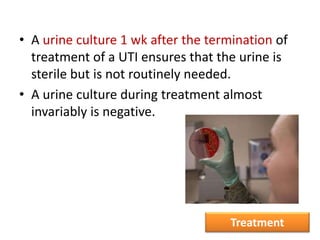
• A urine culture 1 wk after the termination of
treatment of a UTI ensures that the urine is
sterile but is not routinely needed.
• A urine culture during treatment almost
invariably is negative.
Treatment
• There is interest in probiotic therapy, which
replaces pathologic urogenital flora, and
• Cranberry juice, which prevents bacterial
adhesion and biofilm formation, but these
agents have not proved beneficial in
preventing UTI in children.
Treatment
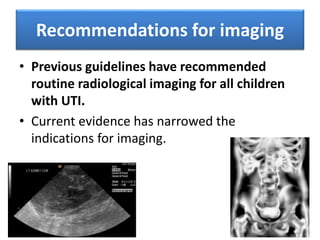
Recommendations for imaging
• Previous guidelines have recommended
routine radiological imaging for all children
with UTI.
• Current evidence has narrowed the
indications for imaging.
Imaging Studies:
• The goal of imaging studies in children with a
UTI is to:
identify anatomic abnormalities that
predispose to infection,
determine whether there is active renal
involvement, and
to assess whether renal function is normal or
at risk.
Imaging Studies: lower urinary tract
• In children with ≄1 infection of the lower urinary
tract (dysuria, urgency, frequency, suprapubic
pain), imaging is usually unnecessary.
• Instead, assessment and treatment of bladder
and bowel dysfunction is important.
• If there are numerous lower urinary tract
infections, then a renal sonogram is appropriate,
but a VCUG rarely adds useful information.
Sonogram
Nelson Textbook
• In children with their 1st
episode of clinical
pyelonephritis—
• those with febrile UTI,
• in infants,
• those with systemic
illness—and a positive urine
culture, irrespective of
temperature, a sonogram of
kidneys and bladder should
be performed
Malaysian Guideline
• All children less than 3 years
of age
• Children above 3 years of age
with:
• poor urinary stream,
• seriously ill with UTI,
• palpable abdominal masses,
• raised serum creatinine,
• non E coli UTI,
• febrile after 48 hours of
antibiotic treatment, or
• recurrent UTI.
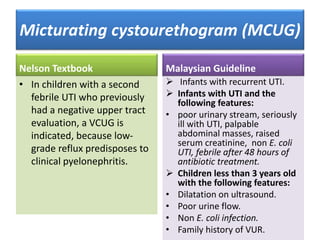
Micturating cystourethogram (MCUG)
Nelson Textbook
• In children with a second
febrile UTI who previously
had a negative upper tract
evaluation, a VCUG is
indicated, because low-
grade reflux predisposes to
clinical pyelonephritis.
Malaysian Guideline
 Infants with recurrent UTI.
 Infants with UTI and the
following features:
• poor urinary stream, seriously
ill with UTI, palpable
abdominal masses, raised
serum creatinine, non E. coli
UTI, febrile after 48 hours of
antibiotic treatment.
 Children less than 3 years old
with the following features:
• Dilatation on ultrasound.
• Poor urine flow.
• Non E. coli infection.
• Family history of VUR.
Thank You

Urinary Tract Infections in children

  • 2.
    Prevalence and Etiology: •Urinary tract infections (UTIs) occur in 1-3% of girls and 1% of boys. • In girls, the first UTI usually occurs by the age of 5 yr, with peaks during infancy and toilet training. • In boys, most UTIs occur during the 1st yr of life; UTIs are much more common in uncircumcised boys, especially in the 1st year of life.
  • 3.
    Prevalence by Age •The prevalence of UTIs varies with age. • During the 1st yr of life, the male : female ratio is 2.8-5.4 : 1. • Beyond 1-2 yr, there is a female preponderance, with a male : female ratio of 1 : 10.
  • 4.
    Etiology • UTIs arecaused mainly by colonic bacteria. • In girls, 75-90% of all infections are caused by Escherichia coli, followed by Klebsiella spp and Proteus spp. • Some series report that in boys >1 yr of age, Proteus is as common a cause as E. coli; others report a preponderance of gram-positive organisms in boys. • Staphylococcus saprophyticus and enterococcus are pathogens in both sexes.
  • 5.
    Clinical Manifestations and Classification: •The 3 basic forms of UTI are : • pyelonephritis, • cystitis, and • asymptomatic bacteriuria.
  • 6.
    Clinical Pyelonephritis: • Clinicalpyelonephritis is characterized by any or all of the following: • abdominal, back, or flank pain; fever; malaise; nausea; vomiting; and, occasionally, diarrhea. Fever may be the only manifestation. • Newborns can show nonspecific symptoms such as poor feeding, irritability, jaundice, and weight loss.
  • 7.
    • Pyelonephritis isthe most common serious bacterial infection in infants <24 mo of age who have fever without an obvious focus. • These symptoms are an indication that there is bacterial involvement of the upper urinary tract. • Involvement of the renal parenchyma is termed acute pyelonephritis, whereas if there is no parenchymal involvement, the condition may be termed pyelitis. • Acute pyelonephritis can result in renal injury, termed pyelonephritic scarring. Clinical Pyelonephritis:
  • 8.
    Cystitis: • Cystitis indicatesthat there is bladder involvement; symptoms include dysuria, urgency, frequency, suprapubic pain, incontinence, and malodorous urine. • Cystitis does not cause fever and does not result in renal injury. • Malodorous urine is not specific for a UTI.
  • 9.
    Pathogenesis and Pathology: •Most UTIs are ascending infections. • The bacteria arise from the fecal flora, colonize the perineum, and enter the bladder via the urethra. • In uncircumcised boys, the bacterial pathogens arise from the flora beneath the prepuce. • In some cases, the bacteria causing cystitis ascend to the kidney to cause pyelonephritis. • Rarely, renal infection occurs by hematogenous spread, as in endocarditis or in some neonates.
  • 10.
    RISK FACTORS FORURINARY TRACT INFECTION: Uncircumcised male Tight clothing (underwear) Female gender Pinworm infestation Vesicoureteral reflux Constipation Toilet training Bacteria with P fimbriae Voiding dysfunction Anatomic abnormality (labial adhesion) Obstructive uropathy Neuropathic bladder Urethral instrumentation Sexual activity Wiping from back to front in girls Pregnancy Bubble bath?
  • 11.
    Diagnosis: • UTI maybe suspected based on symptoms or findings on urinalysis, or both; • a urine culture is necessary for confirmation and appropriate therapy. • In toilet-trained children, a midstream urine sample usually is satisfactory; the introitus should be cleaned before obtaining the specimen. • In uncircumcised boys, the prepuce must be retracted. • In children who are not toilet trained, a catheterized urine sample should be obtained.
  • 12.
    • Alternatively, theapplication of an adhesive, sealed, sterile collection bag after disinfection of the skin of the genitals can be useful only if the culture is negative or if a single uropathogen is identified. • However, a positive culture can result from skin contamination, particularly in girls and uncircumcised boys. • If treatment is planned immediately after obtaining the urine culture, a bagged specimen should not be the method because of a high rate of contamination often with mixed organisms. • A suprapubic aspirate generally is unnecessary.
  • 13.
    • Pyuria (leukocytesin the urine) suggests infection, but infection can occur in the absence of pyuria; this finding is more confirmatory than diagnostic. Conversely, pyuria can be present without UTI. • Sterile pyuria (positive leukocytes, negative culture) occurs in partially treated bacterial UTIs, viral infections, renal tuberculosis, renal abscess, UTI in the presence of urinary obstruction, urethritis due to a sexually transmitted infection (STI) , inflammation near the ureter or bladder (appendicitis, Crohn disease), and interstitial nephritis (eosinophils). Diagnosis
  • 14.
    • Nitrites andleukocyte esterase usually are positive in infected urine. • Microscopic hematuria is common in acute cystitis, but microhematuria alone does not suggest UTI. • White blood cell casts in the urinary sediment suggest renal involvement, but in practice these are rarely seen. • If the child is asymptomatic and the urinalysis result is normal, it is unlikely that there is a UTI. However, if the child is symptomatic, a UTI is possible, even if the urinalysis result is negative. Diagnosis
  • 15.
    • Prompt platingof the urine sample for culture is important, because if the urine sits at room temperature for more than 60 min, overgrowth of a minor contaminant can suggest a UTI when the urine might not be infected. • Refrigeration is a reliable method of storing the urine until it can be cultured. Diagnosis
  • 16.
    • If theculture shows >100,000 colonies of a single pathogen, or if there are 10,000 colonies and the child is symptomatic, the child is considered to have a UTI. • In a bag sample, if the urinalysis result is positive, the patient is symptomatic, and there is a single organism cultured with a colony count >100,000, there is a presumed UTI. • If any of these criteria are not met, confirmation of infection with a catheterized sample is recommended. • With acute renal infection, leukocytosis, neutrophilia, and elevated serum erythrocyte sedimentation rate and C-reactive protein are common. Diagnosis
  • 17.
    Treatment: • Acute cystitisshould be treated promptly to prevent possible progression to pyelonephritis. • treatment is started pending results of the culture. • If treatment is initiated before the results of a culture and sensitivities are available, a 3- to 5-day course of therapy with trimethoprim-sulfamethoxazole (TMP- SMX) or trimethoprim is effective against most strains of E. coli. • Nitrofurantoin (5-7 mg/kg/24 hr in 3-4 divided doses) also is effective and has the advantage of being active against Klebsiella and Enterobacter organisms. • Amoxicillin (50 mg/kg/24 hr) also is effective as initial treatment but has no clear advantages over sulfonamides or nitrofurantoin.
  • 18.
    • In acutefebrile infections suggesting pyelonephritis, a 10- to 14-day course of broad-spectrum antibiotics capable of reaching significant tissue levels is preferable. • Children who are dehydrated, are vomiting, are unable to drink fluids, are ≤1mo of age, or in whom urosepsis is a possibility should be admitted to the hospital for IV rehydration and IV antibiotic therapy. • Parenteral treatment with ceftriaxone (50- 75 mg/kg/24 hr, not to exceed 2 g) or • Cefotaxime (100 mg/kg/24 hr), or • ampicillin (100 mg/kg/24 hr) with an aminoglycoside such as gentamicin (3-5 mg/kg/24 hr in 1-3 divided doses) is preferable. Treatment
  • 19.
    • Treatment withaminoglycosides is particularly effective against Pseudomonas spp, and alkalinization of urine with sodium bicarbonate increases its effectiveness in the urinary tract. • Oral 3rd-generation cephalosporins such as cefixime are as effective as parenteral ceftriaxone against a variety of gram-negative organisms other than Pseudomonas, and these medications are considered by some authorities to be the treatment of choice for oral outpatient therapy. Treatment
  • 20.
    • The oralfluoroquinolone ciprofloxacin is an alternative agent for resistant microorganisms, particularly Pseudomonas, in patients >17 yr. • It also has been used on occasion for short- course therapy in younger children with Pseudomonas UTI. • However, the clinical use of fluoroquinolones in children should be restricted because of potential cartilage damage. Treatment
  • 21.
    • A urineculture 1 wk after the termination of treatment of a UTI ensures that the urine is sterile but is not routinely needed. • A urine culture during treatment almost invariably is negative. Treatment
  • 22.
    • There isinterest in probiotic therapy, which replaces pathologic urogenital flora, and • Cranberry juice, which prevents bacterial adhesion and biofilm formation, but these agents have not proved beneficial in preventing UTI in children. Treatment
  • 23.
    Recommendations for imaging •Previous guidelines have recommended routine radiological imaging for all children with UTI. • Current evidence has narrowed the indications for imaging.
  • 24.
    Imaging Studies: • Thegoal of imaging studies in children with a UTI is to: identify anatomic abnormalities that predispose to infection, determine whether there is active renal involvement, and to assess whether renal function is normal or at risk.
  • 25.
    Imaging Studies: lowerurinary tract • In children with ≄1 infection of the lower urinary tract (dysuria, urgency, frequency, suprapubic pain), imaging is usually unnecessary. • Instead, assessment and treatment of bladder and bowel dysfunction is important. • If there are numerous lower urinary tract infections, then a renal sonogram is appropriate, but a VCUG rarely adds useful information.
  • 26.
    Sonogram Nelson Textbook • Inchildren with their 1st episode of clinical pyelonephritis— • those with febrile UTI, • in infants, • those with systemic illness—and a positive urine culture, irrespective of temperature, a sonogram of kidneys and bladder should be performed Malaysian Guideline • All children less than 3 years of age • Children above 3 years of age with: • poor urinary stream, • seriously ill with UTI, • palpable abdominal masses, • raised serum creatinine, • non E coli UTI, • febrile after 48 hours of antibiotic treatment, or • recurrent UTI.
  • 27.
    Micturating cystourethogram (MCUG) NelsonTextbook • In children with a second febrile UTI who previously had a negative upper tract evaluation, a VCUG is indicated, because low- grade reflux predisposes to clinical pyelonephritis. Malaysian Guideline  Infants with recurrent UTI.  Infants with UTI and the following features: • poor urinary stream, seriously ill with UTI, palpable abdominal masses, raised serum creatinine, non E. coli UTI, febrile after 48 hours of antibiotic treatment.  Children less than 3 years old with the following features: • Dilatation on ultrasound. • Poor urine flow. • Non E. coli infection. • Family history of VUR.
  • 28.