Neuromuscular Diseases
    Roy Maynard, M.D.
    September 23, 2010
Objectives

• Identify clinical signs of impending
  respiratory failure
• List 3 lung function tests used to
  monitor patients with neuromuscular
  disease for respiratory failure
• Define Non-Invasive Ventilation


                                         2 of 56
Classification

•   Muscular Dystrophies
•   Congenital and Metabolic Myopathies
•   Anterior Horn Cell Disorders
•   Neuromuscular Junction Diseases


                                          3 of 56
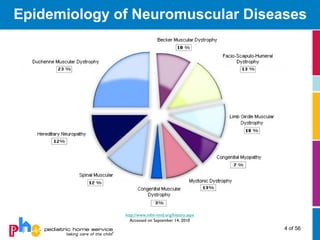
Epidemiology of Neuromuscular Diseases


              http://www.mfm-nmd.org/history.aspx
                Accessed on September 14, 2010
                                                    4 of 56
Clinical Signs of Neuromuscular Disease

•   Weakness, poor cough, retained airway secretions
•   Inability to lift extremities against gravity
•   Muscle wasting
•   Low muscle tone (hypotonia)
•   Poor feeding, swallowing dysfunction
•   Failure to thrive
•   Increased respiratory rate
•   Use of accessory muscles of respiration
•   Recurrent infections
•   Night sweats


                                                  5 of 56
Work-Up Hypotonia and Weakness

 •   CK       - creatinine kinase
 •   EMG - electromyogram
 •   NCS - nerve conduction study
 •   ECG - cardiac muscle involvement
 •   Muscle Biopsy - electron microscopy
 •   Nerve Biopsy
 •   Gene testing
 •   Others


                                           6 of 56
Clinical Symptoms of
        Impending Respiratory Failure

• Infants
  –   Paradoxical breathing
  –   Tachypnea
  –   Head bobbing
  –   Poor feeding
  –   Increasing muscle weakness and hypotonia


                                                 7 of 56
Clinical Symptoms of
      Impending Respiratory Failure

• Older children
  – Sleep disordered breathing (SDB)
    • Daytime behavioral and neurocognitive
      problems
    • Hyperactivity
    • Tiredness
    • Morning headaches
    • Nocturnal arousals
    • Daytime sleepiness
    • Anorexia

                                              8 of 56
Classification: Muscular Dystrophies


    –   Duchenne muscular dystrophy
    –   Becker muscular dystrophy
    –   Myotonic muscular dystrophy
    –   Congenital muscular dystrophy (8)
    –   Distal muscular dystrophy (8)
    –   Others


                                            9 of 56
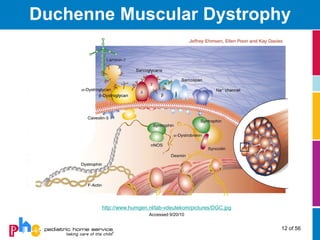
Duchenne Muscular Dystrophy
• Genetics
  – X-linked recessive (males)
  – Chromosome X, DMD gene
• Cause
  – Dystrophin protein needed for muscle cell interaction
• Onset
  – 2-6 years of age degenerative disease
• Symptoms
  – Proximal muscle weakness, affects respiratory and
    cardiac muscle


                                                        10 of 56
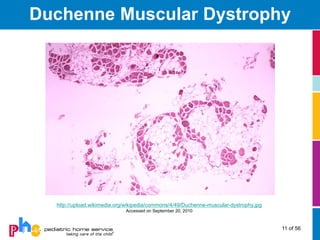
Duchenne Muscular Dystrophy


  http://upload.wikimedia.org/wikipedia/commons/4/49/Duchenne-muscular-dystrophy.jpg
                             Accessed on September 20, 2010


                                                                                       11 of 56
Duchenne Muscular Dystrophy


       http://www.humgen.nl/lab-vdeutekom/pictures/DGC.jpg
                         Accessed 9/20/10


                                                             12 of 56
Classification: Congenital Myopathies

  •   Nemaline myopathy
  •   Myotubular/Centronuclear myopathy
  •   Central core disease
  •   Multiminicore disease
  •   Congenital fiber-type disproportion
      myopathy


                                        13 of 56
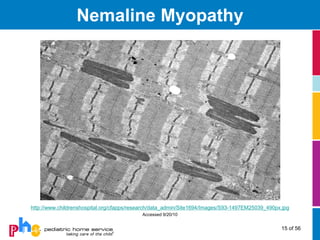
Nemaline Myopathy
• Genetics
  –   Autosomal recessive and dominant forms
  –   First discovered in 1956 by Dr. Reyes
  –   1/50,000 births
  –   6 different mutations identified
• Onset
  – Infancy and early childhood
• Clinical presentation
  – Face, neck and proximal muscle weakness
  – Absent deep tendon reflexes (DTR), normal creatinine
    kinase

                                                    14 of 56
Nemaline Myopathy


http://www.childrenshospital.org/cfapps/research/data_admin/Site1694/Images/S93-1497EM25039_490px.jpg
                                           Accessed 9/20/10


                                                                                                 15 of 56
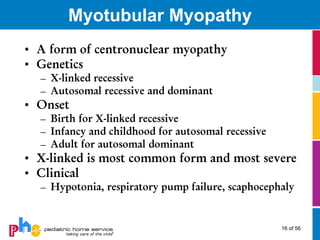
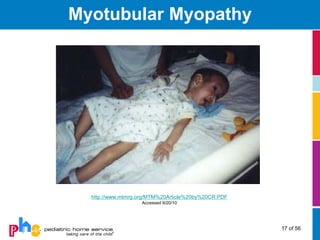
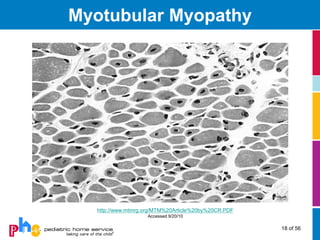
Myotubular Myopathy
• A form of centronuclear myopathy
• Genetics
  – X-linked recessive
  – Autosomal recessive and dominant
• Onset
  – Birth for X-linked recessive
  – Infancy and childhood for autosomal recessive
  – Adult for autosomal dominant
• X-linked is most common form and most severe
• Clinical
  – Hypotonia, respiratory pump failure, scaphocephaly


                                                    16 of 56
Myotubular Myopathy


  http://www.mtmrg.org/MTM%20Article%20by%20CR.PDF
                   Accessed 9/20/10


                                                     17 of 56
Myotubular Myopathy


  http://www.mtmrg.org/MTM%20Article%20by%20CR.PDF
                   Accessed 9/20/10

                                                     18 of 56
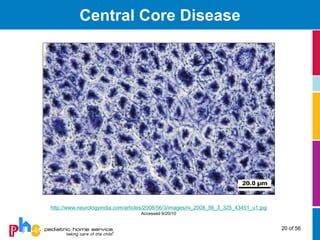
Central Core Disease

•   Proximal skeletal muscles
•   Variable clinical picture
•   Malignant hyperthermia
•   Rare
•   Mutations RYR1 gene
•   Genetics autosomal dominant (some
    autosomal recessive)


                                        19 of 56
Central Core Disease


http://www.neurologyindia.com/articles/2008/56/3/images/ni_2008_56_3_325_43451_u1.jpg
                                   Accessed 9/20/10


                                                                                        20 of 56
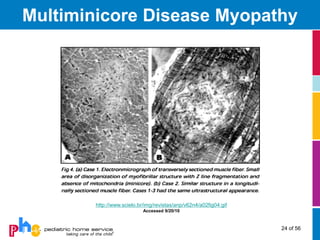
Multiminicore Disease

• Genetics autosomal recessive
  – SEPPN1 mutation
  – Rare disease
• Clinical
  – 4 types
     •   Rigid spine (classic)
     •   Progressive with hand involvement
     •   Arthrogryposis multiplex
     •   opththalmoplegic


                                             21 of 56
Multiminicore Disease
• Symptoms
  –   Muscle weakness and wasting
  –   Scoliosis
  –   Impaired respiratory function
  –   Delayed motor development
  –   Feeding problems in infants
  –   Contractures
  –   Weak eye movements
  –   Low set ears
• Management
  – Supportive

                                      22 of 56
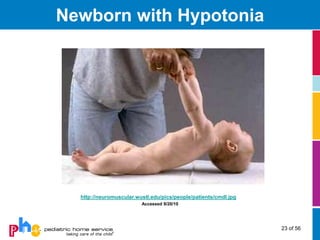
Newborn with Hypotonia


  http://neuromuscular.wustl.edu/pics/people/patients/cmdl.jpg
                         Accessed 9/20/10


                                                                 23 of 56
Multiminicore Disease Myopathy


        http://www.scielo.br/img/revistas/anp/v62n4/a02fig04.gif
                            Accessed 9/20/10


                                                                   24 of 56
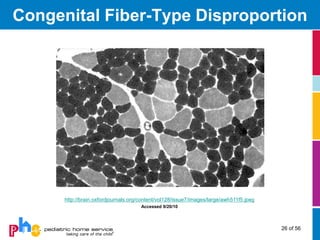
Congenital Fiber-Type Disproportion
• Genetics
  – 3 different mutations, usually present first year of
    life
• Clinical
  – Hypotonia, weakness, delayed motor development
    first year of life
  – 90% static or slow improvement over time
  – Contractures at birth
  – Scoliosis
  – Dislocated hips

                                                    25 of 56
Congenital Fiber-Type Disproportion


      http://brain.oxfordjournals.org/content/vol128/issue7/images/large/awh511f5.jpeg
                                      Accessed 9/20/10


                                                                                         26 of 56
Metabolic Myopathies

•   Pompe disease
•   Phosphorylase deficiency
•   Phosphofructokinase deficiency
•   Debrancher enzyme deficiency
•   Mitochondrial myopathy
•   Carnitine deficiency
•   Carnitine palmityl transferase deficiency
•   Lactate dehydrogenase deficiency
•   Others


                                                27 of 56
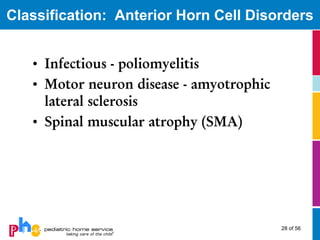
Classification: Anterior Horn Cell Disorders


   • Infectious - poliomyelitis
   • Motor neuron disease - amyotrophic
     lateral sclerosis
   • Spinal muscular atrophy (SMA)


                                          28 of 56
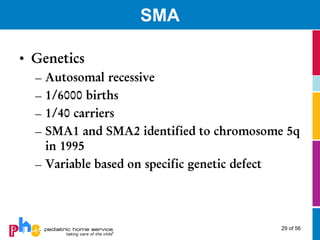
SMA

• Genetics
  – Autosomal recessive
  – 1/6000 births
  – 1/40 carriers
  – SMA1 and SMA2 identified to chromosome 5q
    in 1995
  – Variable based on specific genetic defect


                                          29 of 56
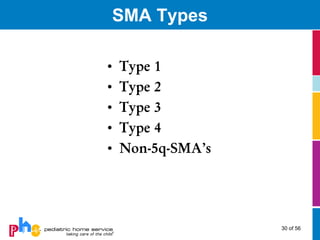
SMA Types

•   Type 1
•   Type 2
•   Type 3
•   Type 4
•   Non-5q-SMA’s


                   30 of 56
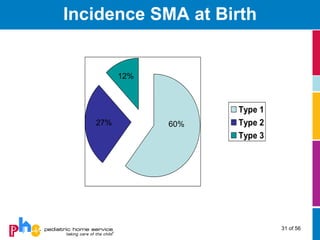
Incidence SMA at Birth


         12%


                     Type 1
   27%         60%   Type 2
                     Type 3


                              31 of 56
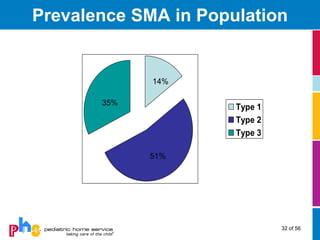
Prevalence SMA in Population


             14%

       35%
                      Type 1
                      Type 2
                      Type 3

             51%


                               32 of 56
SMA Type 1

• Werdnig-Hoffman Disease
• Severe
• Age of onset 0-6 months
• Never sits, flaccid paralysis, absent deep
  tendon reflexes, tongue fasiculations
• Life expectancy < 2 years


                                           33 of 56
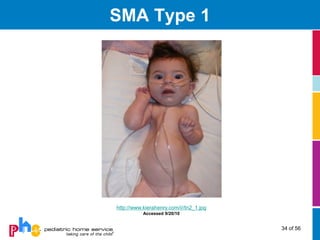
SMA Type 1


http://www.kierahenry.com/i//tn2_1.jpg
           Accessed 9/20/10


                                         34 of 56
SMA Type 2

•   Intermediate severity
•   Age of onset 7-18 months
•   Sits but never stands
•   Life expectancy > 2 years


                                35 of 56
SMA Types 3 and 4

• SMA 3
  –   Kugelberg-Welander Disease
  –   Mild severity
  –   Age of onset > 18 months
  –   Function stands and walks
  –   Life expectancy - adult
• SMA 4 (adult form – rare)
  – Very mild severity
  – Presents 2nd and 3rd decade
  – Ambulatory

                                   36 of 56
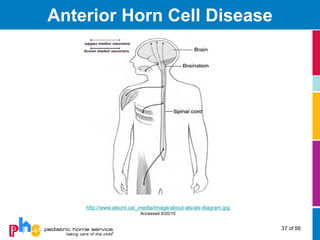
Anterior Horn Cell Disease


    http://www.alsont.ca/_media/Image/about-als/als-diagram.jpg
                          Accessed 9/20/10


                                                                  37 of 56
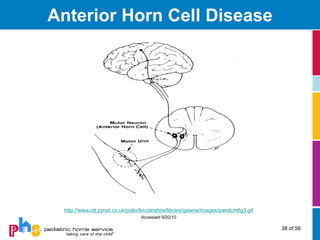
Anterior Horn Cell Disease


 http://www.ott.zynet.co.uk/polio/lincolnshire/library/gawne/images/pandcmfig3.gif
                                 Accessed 9/20/10

                                                                                     38 of 56
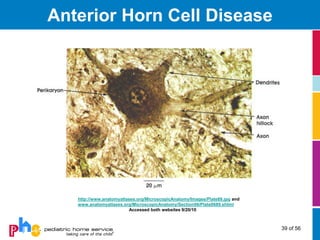
Anterior Horn Cell Disease


   http://www.anatomyatlases.org/MicroscopicAnatomy/Images/Plate89.jpg and
   www.anatomyatlases.org/MicroscopicAnatomy/Section06/Plate0689.shtml
                         Accessed both websites 9/20/10


                                                                             39 of 56
Classification:
Diseases of the Neuromuscular Junction


  • Congenital myasthenic syndromes
  • Myasthenia gravis
    – Acetylcholine junction


                                      40 of 56
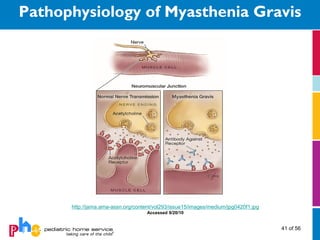
Pathophysiology of Myasthenia Gravis


      http://jama.ama-assn.org/content/vol293/issue15/images/medium/jpg0420f1.jpg
                                    Accessed 9/20/10


                                                                                    41 of 56
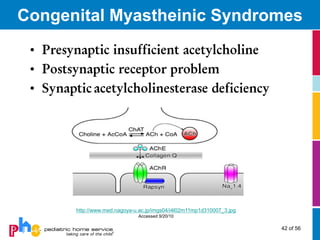
Congenital Myastheinic Syndromes
 • Presynaptic insufficient acetylcholine
 • Postsynaptic receptor problem
 • Synaptic acetylcholinesterase deficiency


         http://www.med.nagoya-u.ac.jp/imgs04/i4l02m11mp1d310007_3.jpg
                                Accessed 9/20/10

                                                                         42 of 56
Complications of Neuromuscular Disease

• Scoliosis
• Bulbar Dysfunction
  – Swallowing dysfunction, speech
• Osteoporosis
• Respiratory Failure
• Cardiomyopathy/Congestive Heart
  Failure
• Early Death

                                     43 of 56
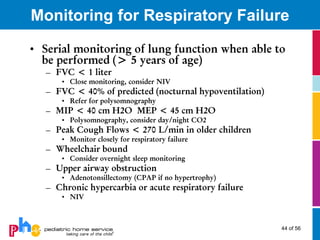
Monitoring for Respiratory Failure
• Serial monitoring of lung function when able to
  be performed (> 5 years of age)
   – FVC < 1 liter
       • Close monitoring, consider NIV
   – FVC < 40% of predicted (nocturnal hypoventilation)
       • Refer for polysomnography
   – MIP < 40 cm H2O MEP < 45 cm H2O
       • Polysomnography, consider day/night CO2
   – Peak Cough Flows < 270 L/min in older children
       • Monitor closely for respiratory failure
   – Wheelchair bound
       • Consider overnight sleep monitoring
   – Upper airway obstruction
       • Adenotonsillectomy (CPAP if no hypertrophy)
   – Chronic hypercarbia or acute respiratory failure
       • NIV


                                                          44 of 56
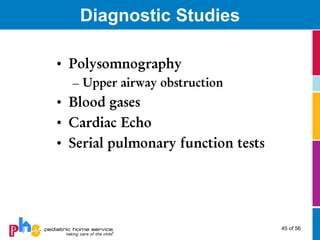
Diagnostic Studies

• Polysomnography
  – Upper airway obstruction
• Blood gases
• Cardiac Echo
• Serial pulmonary function tests


                                    45 of 56
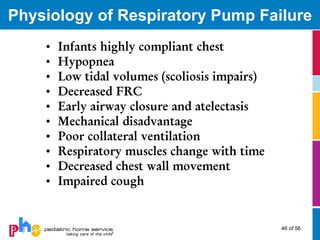
Physiology of Respiratory Pump Failure
    •   Infants highly compliant chest
    •   Hypopnea
    •   Low tidal volumes (scoliosis impairs)
    •   Decreased FRC
    •   Early airway closure and atelectasis
    •   Mechanical disadvantage
    •   Poor collateral ventilation
    •   Respiratory muscles change with time
    •   Decreased chest wall movement
    •   Impaired cough


                                                46 of 56
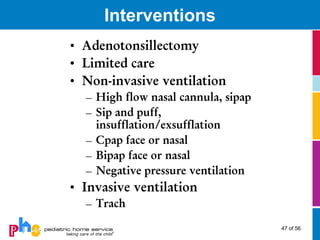
Interventions
• Adenotonsillectomy
• Limited care
• Non-invasive ventilation
  – High flow nasal cannula, sipap
  – Sip and puff,
    insufflation/exsufflation
  – Cpap face or nasal
  – Bipap face or nasal
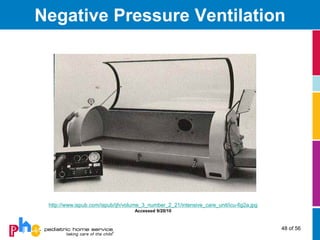
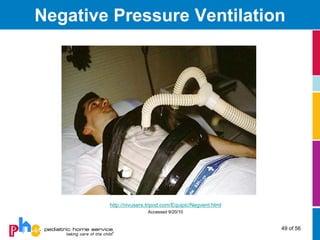
  – Negative pressure ventilation
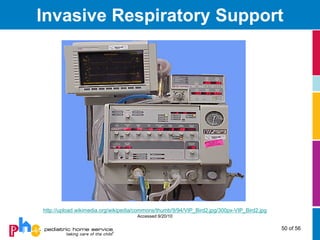
• Invasive ventilation
  – Trach
                                     47 of 56
Negative Pressure Ventilation


 http://www.ispub.com/ispub/ijh/volume_3_number_2_21/intensive_care_unit/icu-fig2a.jpg
                                    Accessed 9/20/10


                                                                                         48 of 56
Negative Pressure Ventilation


        http://nivusers.tripod.com/Equipic/Negvent.html
                        Accessed 9/20/10


                                                          49 of 56
Invasive Respiratory Support


http://upload.wikimedia.org/wikipedia/commons/thumb/9/94/VIP_Bird2.jpg/300px-VIP_Bird2.jpg
                                     Accessed 9/20/10

                                                                                             50 of 56
NIV and Airway Clearance
• First used in the 1960’s
• First suggested for use in 1980’s for NMD
• May reduce incidence of respiratory
  infections
• Techniques to improve pulmonary toilet –
  breath stacking, cough assist devices
• Possible benefit of high-frequency chest
  wall oscillation and intrapulmonary
  percussive ventilation


                                         51 of 56
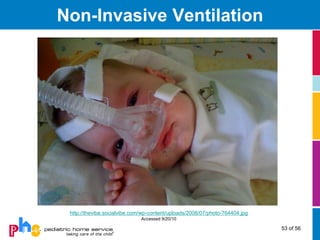
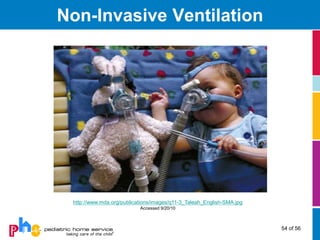
Non-Invasive Ventilation

• According to international consensus,
  NIV is defined as any form of
  ventilatory support applied without
  endotracheal intubation and includes
  bipap, cpap and other modes


                                      52 of 56
Non-Invasive Ventilation


 http://thevibe.socialvibe.com/wp-content/uploads/2008/07/photo-764404.jpg
                              Accessed 9/20/10

                                                                             53 of 56
Non-Invasive Ventilation


 http://www.mda.org/publications/images/q11-3_Taleah_English-SMA.jpg
                           Accessed 9/20/10


                                                                       54 of 56
Conclusions

• Marked improvement in management of
  respiratory complications of neuromuscular
  disease in past 15 years
• Serial monitoring for progressive respiratory
  pump failure necessary to minimize pulmonary
  complications
• Early implementation of therapies to treat
  hypoventilation and promote airway clearance
  may augment quality and quantity of life


                                            55 of 56
Q&A


Thank you for attending!


                           56 of 56

Neuromuscular Diseases

  • 1.
    Neuromuscular Diseases Roy Maynard, M.D. September 23, 2010
  • 2.
    Objectives • Identify clinicalsigns of impending respiratory failure • List 3 lung function tests used to monitor patients with neuromuscular disease for respiratory failure • Define Non-Invasive Ventilation 2 of 56
  • 3.
    Classification • Muscular Dystrophies • Congenital and Metabolic Myopathies • Anterior Horn Cell Disorders • Neuromuscular Junction Diseases 3 of 56
  • 4.
    Epidemiology of NeuromuscularDiseases http://www.mfm-nmd.org/history.aspx Accessed on September 14, 2010 4 of 56
  • 5.
    Clinical Signs ofNeuromuscular Disease • Weakness, poor cough, retained airway secretions • Inability to lift extremities against gravity • Muscle wasting • Low muscle tone (hypotonia) • Poor feeding, swallowing dysfunction • Failure to thrive • Increased respiratory rate • Use of accessory muscles of respiration • Recurrent infections • Night sweats 5 of 56
  • 6.
    Work-Up Hypotonia andWeakness • CK - creatinine kinase • EMG - electromyogram • NCS - nerve conduction study • ECG - cardiac muscle involvement • Muscle Biopsy - electron microscopy • Nerve Biopsy • Gene testing • Others 6 of 56
  • 7.
    Clinical Symptoms of Impending Respiratory Failure • Infants – Paradoxical breathing – Tachypnea – Head bobbing – Poor feeding – Increasing muscle weakness and hypotonia 7 of 56
  • 8.
    Clinical Symptoms of Impending Respiratory Failure • Older children – Sleep disordered breathing (SDB) • Daytime behavioral and neurocognitive problems • Hyperactivity • Tiredness • Morning headaches • Nocturnal arousals • Daytime sleepiness • Anorexia 8 of 56
  • 9.
    Classification: Muscular Dystrophies – Duchenne muscular dystrophy – Becker muscular dystrophy – Myotonic muscular dystrophy – Congenital muscular dystrophy (8) – Distal muscular dystrophy (8) – Others 9 of 56
  • 10.
    Duchenne Muscular Dystrophy •Genetics – X-linked recessive (males) – Chromosome X, DMD gene • Cause – Dystrophin protein needed for muscle cell interaction • Onset – 2-6 years of age degenerative disease • Symptoms – Proximal muscle weakness, affects respiratory and cardiac muscle 10 of 56
  • 11.
    Duchenne Muscular Dystrophy http://upload.wikimedia.org/wikipedia/commons/4/49/Duchenne-muscular-dystrophy.jpg Accessed on September 20, 2010 11 of 56
  • 12.
    Duchenne Muscular Dystrophy http://www.humgen.nl/lab-vdeutekom/pictures/DGC.jpg Accessed 9/20/10 12 of 56
  • 13.
    Classification: Congenital Myopathies • Nemaline myopathy • Myotubular/Centronuclear myopathy • Central core disease • Multiminicore disease • Congenital fiber-type disproportion myopathy 13 of 56
  • 14.
    Nemaline Myopathy • Genetics – Autosomal recessive and dominant forms – First discovered in 1956 by Dr. Reyes – 1/50,000 births – 6 different mutations identified • Onset – Infancy and early childhood • Clinical presentation – Face, neck and proximal muscle weakness – Absent deep tendon reflexes (DTR), normal creatinine kinase 14 of 56
  • 15.
  • 16.
    Myotubular Myopathy • Aform of centronuclear myopathy • Genetics – X-linked recessive – Autosomal recessive and dominant • Onset – Birth for X-linked recessive – Infancy and childhood for autosomal recessive – Adult for autosomal dominant • X-linked is most common form and most severe • Clinical – Hypotonia, respiratory pump failure, scaphocephaly 16 of 56
  • 17.
    Myotubular Myopathy http://www.mtmrg.org/MTM%20Article%20by%20CR.PDF Accessed 9/20/10 17 of 56
  • 18.
    Myotubular Myopathy http://www.mtmrg.org/MTM%20Article%20by%20CR.PDF Accessed 9/20/10 18 of 56
  • 19.
    Central Core Disease • Proximal skeletal muscles • Variable clinical picture • Malignant hyperthermia • Rare • Mutations RYR1 gene • Genetics autosomal dominant (some autosomal recessive) 19 of 56
  • 20.
  • 21.
    Multiminicore Disease • Geneticsautosomal recessive – SEPPN1 mutation – Rare disease • Clinical – 4 types • Rigid spine (classic) • Progressive with hand involvement • Arthrogryposis multiplex • opththalmoplegic 21 of 56
  • 22.
    Multiminicore Disease • Symptoms – Muscle weakness and wasting – Scoliosis – Impaired respiratory function – Delayed motor development – Feeding problems in infants – Contractures – Weak eye movements – Low set ears • Management – Supportive 22 of 56
  • 23.
    Newborn with Hypotonia http://neuromuscular.wustl.edu/pics/people/patients/cmdl.jpg Accessed 9/20/10 23 of 56
  • 24.
    Multiminicore Disease Myopathy http://www.scielo.br/img/revistas/anp/v62n4/a02fig04.gif Accessed 9/20/10 24 of 56
  • 25.
    Congenital Fiber-Type Disproportion •Genetics – 3 different mutations, usually present first year of life • Clinical – Hypotonia, weakness, delayed motor development first year of life – 90% static or slow improvement over time – Contractures at birth – Scoliosis – Dislocated hips 25 of 56
  • 26.
    Congenital Fiber-Type Disproportion http://brain.oxfordjournals.org/content/vol128/issue7/images/large/awh511f5.jpeg Accessed 9/20/10 26 of 56
  • 27.
    Metabolic Myopathies • Pompe disease • Phosphorylase deficiency • Phosphofructokinase deficiency • Debrancher enzyme deficiency • Mitochondrial myopathy • Carnitine deficiency • Carnitine palmityl transferase deficiency • Lactate dehydrogenase deficiency • Others 27 of 56
  • 28.
    Classification: Anterior HornCell Disorders • Infectious - poliomyelitis • Motor neuron disease - amyotrophic lateral sclerosis • Spinal muscular atrophy (SMA) 28 of 56
  • 29.
    SMA • Genetics – Autosomal recessive – 1/6000 births – 1/40 carriers – SMA1 and SMA2 identified to chromosome 5q in 1995 – Variable based on specific genetic defect 29 of 56
  • 30.
    SMA Types • Type 1 • Type 2 • Type 3 • Type 4 • Non-5q-SMA’s 30 of 56
  • 31.
    Incidence SMA atBirth 12% Type 1 27% 60% Type 2 Type 3 31 of 56
  • 32.
    Prevalence SMA inPopulation 14% 35% Type 1 Type 2 Type 3 51% 32 of 56
  • 33.
    SMA Type 1 •Werdnig-Hoffman Disease • Severe • Age of onset 0-6 months • Never sits, flaccid paralysis, absent deep tendon reflexes, tongue fasiculations • Life expectancy < 2 years 33 of 56
  • 34.
  • 35.
    SMA Type 2 • Intermediate severity • Age of onset 7-18 months • Sits but never stands • Life expectancy > 2 years 35 of 56
  • 36.
    SMA Types 3and 4 • SMA 3 – Kugelberg-Welander Disease – Mild severity – Age of onset > 18 months – Function stands and walks – Life expectancy - adult • SMA 4 (adult form – rare) – Very mild severity – Presents 2nd and 3rd decade – Ambulatory 36 of 56
  • 37.
    Anterior Horn CellDisease http://www.alsont.ca/_media/Image/about-als/als-diagram.jpg Accessed 9/20/10 37 of 56
  • 38.
    Anterior Horn CellDisease http://www.ott.zynet.co.uk/polio/lincolnshire/library/gawne/images/pandcmfig3.gif Accessed 9/20/10 38 of 56
  • 39.
    Anterior Horn CellDisease http://www.anatomyatlases.org/MicroscopicAnatomy/Images/Plate89.jpg and www.anatomyatlases.org/MicroscopicAnatomy/Section06/Plate0689.shtml Accessed both websites 9/20/10 39 of 56
  • 40.
    Classification: Diseases of theNeuromuscular Junction • Congenital myasthenic syndromes • Myasthenia gravis – Acetylcholine junction 40 of 56
  • 41.
    Pathophysiology of MyastheniaGravis http://jama.ama-assn.org/content/vol293/issue15/images/medium/jpg0420f1.jpg Accessed 9/20/10 41 of 56
  • 42.
    Congenital Myastheinic Syndromes • Presynaptic insufficient acetylcholine • Postsynaptic receptor problem • Synaptic acetylcholinesterase deficiency http://www.med.nagoya-u.ac.jp/imgs04/i4l02m11mp1d310007_3.jpg Accessed 9/20/10 42 of 56
  • 43.
    Complications of NeuromuscularDisease • Scoliosis • Bulbar Dysfunction – Swallowing dysfunction, speech • Osteoporosis • Respiratory Failure • Cardiomyopathy/Congestive Heart Failure • Early Death 43 of 56
  • 44.
    Monitoring for RespiratoryFailure • Serial monitoring of lung function when able to be performed (> 5 years of age) – FVC < 1 liter • Close monitoring, consider NIV – FVC < 40% of predicted (nocturnal hypoventilation) • Refer for polysomnography – MIP < 40 cm H2O MEP < 45 cm H2O • Polysomnography, consider day/night CO2 – Peak Cough Flows < 270 L/min in older children • Monitor closely for respiratory failure – Wheelchair bound • Consider overnight sleep monitoring – Upper airway obstruction • Adenotonsillectomy (CPAP if no hypertrophy) – Chronic hypercarbia or acute respiratory failure • NIV 44 of 56
  • 45.
    Diagnostic Studies • Polysomnography – Upper airway obstruction • Blood gases • Cardiac Echo • Serial pulmonary function tests 45 of 56
  • 46.
    Physiology of RespiratoryPump Failure • Infants highly compliant chest • Hypopnea • Low tidal volumes (scoliosis impairs) • Decreased FRC • Early airway closure and atelectasis • Mechanical disadvantage • Poor collateral ventilation • Respiratory muscles change with time • Decreased chest wall movement • Impaired cough 46 of 56
  • 47.
    Interventions • Adenotonsillectomy • Limitedcare • Non-invasive ventilation – High flow nasal cannula, sipap – Sip and puff, insufflation/exsufflation – Cpap face or nasal – Bipap face or nasal – Negative pressure ventilation • Invasive ventilation – Trach 47 of 56
  • 48.
    Negative Pressure Ventilation http://www.ispub.com/ispub/ijh/volume_3_number_2_21/intensive_care_unit/icu-fig2a.jpg Accessed 9/20/10 48 of 56
  • 49.
    Negative Pressure Ventilation http://nivusers.tripod.com/Equipic/Negvent.html Accessed 9/20/10 49 of 56
  • 50.
  • 51.
    NIV and AirwayClearance • First used in the 1960’s • First suggested for use in 1980’s for NMD • May reduce incidence of respiratory infections • Techniques to improve pulmonary toilet – breath stacking, cough assist devices • Possible benefit of high-frequency chest wall oscillation and intrapulmonary percussive ventilation 51 of 56
  • 52.
    Non-Invasive Ventilation • Accordingto international consensus, NIV is defined as any form of ventilatory support applied without endotracheal intubation and includes bipap, cpap and other modes 52 of 56
  • 53.
  • 54.
  • 55.
    Conclusions • Marked improvementin management of respiratory complications of neuromuscular disease in past 15 years • Serial monitoring for progressive respiratory pump failure necessary to minimize pulmonary complications • Early implementation of therapies to treat hypoventilation and promote airway clearance may augment quality and quantity of life 55 of 56
  • 56.
    Q&A Thank you forattending! 56 of 56