NEUROMUSCULAR
        DISORDERS

           P R E PA R E D A N D P R E S E N T E D B Y


• IBRAHIM H. TAWHARI.
• MOHAMMED I. ALHEFZI.
                                 • ABDULLAH H. AL-ASMRI.
                                 • YAHYA M. ABUTALIB.
                                                           S
S ID / CC:


                                                     SCENARIO - HISTORY
  S A 4-months-old infant.
  S Presenting with weak arms & limbs.


S HPI:
  S A 4-months infant has been brought by his
    mother.
  S The mother states that she noted a
    generalized weakness of her baby.
  S She states that her baby has is unable to lift
    his head off the pillow.
  S When picked up, his head falls back as his
    neck is weak.
  S He feeds from a bottle and takes a long time.
    His sucking is weak and slow.
S HPI CONTD.:


                                                     SCENARIO - HISTORY
  S He has weakness in his limbs.
  S On further questioning, the mother states that
    he was always alert with good eye contact.
  S He began smiling by 6 weeks of age
    recognized his parents.
  S He turns her head and eyes toward sounds
    and begun to coo a little.

S DEVELOPMENTAL HX.:
  S As above.

S PAST HX.:
  S As above.
  S He got chest infection last month.
SCENARIO - HISTORY
S DRUG HX.:
  S NAD.

S FAMILY HX.:
  S He is the the 2nd child.
  S He has only one older sister and she is
     healthy.

S PREGNANCY HX.:
  S The mother was healthy during pregnancy
    and had no complications.
  S She was not using any drugs and didn’t
    expose to radiation.
  S This was her 2nd pregnancy and she noted
    that fetal movement was less than her first
    pregnancy.
SCENARIO - HISTORY
S NEONATAL HX.:
  S GA: full term.
  S Birth weight: 2.7 Kg.
  S Weak crying.
  S No admission.


S IMMUNIZATION HX.:
  S He received all vaccines up to date as
     scheduled.
S GENERAL & VITAL SIGNS:
  S No facial dysmorfic.
  S Afebrile.


                                               SCENARIO - PE
  S Tachycardia & tachypnea.
  S Subcostal retraction.
  S Lung: Clear.
  S Abdomen: normal.


S CNS:
  S Mental status:
  S Alert, smiles and interacts with mother.

S CRANIAL NERVES:
  S Normal.
S MOTOR:
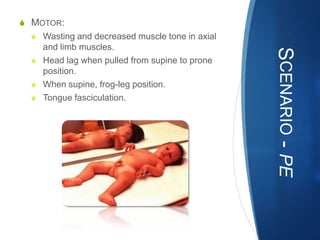
  S Wasting and decreased muscle tone in axial
    and limb muscles.


                                                 SCENARIO - PE
  S Head lag when pulled from supine to prone
    position.
  S When supine, frog-leg position.
  S Tongue fasciculation.
S LAB WORK;


                                      SCENARIO – LAB INV.
S CBC:
  S   Normal.

S ELECTROLYTES:
  S   Normal.

S CPK:
  S   250 IU/mL. “mild elevation”.


S MUSCLE BX;

S Confirmed.
  S   Spinal Muscular Atrophy.
  S   “Werding Hoffmann’s Disease”.
NEUROMUSCULAR
    DISORDERS
          Definition


                       S
DEFINITION


S Defines as disorders of the motor unit.

S excludes influences of muscle functions from the brain such
  as spasticity.
NEUROMUSCULAR
    DISORDERS
         Classification


                          S
CLASSIFICATION


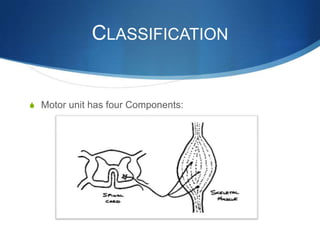
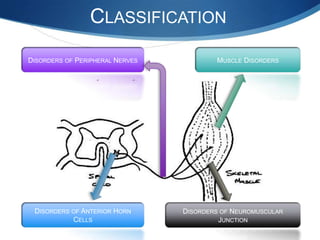
S Motor unit has four Components:
CLASSIFICATION
DISORDERS OF PERIPHERAL NERVES           MUSCLE DISORDERS


 DISORDERS OF ANTERIOR HORN      DISORDERS OF NEUROMUSCULAR
           CELLS                          JUNCTION
CLASSIFICATION
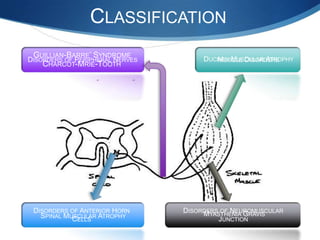
 GUILLIAN-BARRE’ SYNDROME             DUCHEN MUSCULAR ATROPHY
DISORDERS OF PERIPHERAL NERVES           MUSCLE DISORDERS
   CHARCOT-MRIE-TOOTH


 DISORDERS OF ANTERIOR HORN      DISORDERS OF NEUROMUSCULAR
                                      MYASTHENIA GRAVIS
   SPINAL MUSCULAR ATROPHY
            CELLS                         JUNCTION
SPINAL MUSCULAR
        ATROPHY
      Ant. Horn Cells Disorders


                                  S
SPINAL MUSCULAR ATROPHY
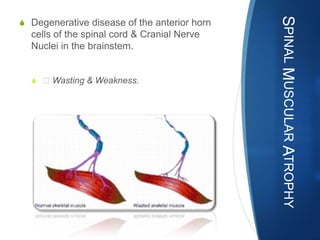
S Degenerative disease of the anterior horn
  cells of the spinal cord & Cranial Nerve
  Nuclei in the brainstem.


  S Wasting & Weakness.
SPINAL MUSCULAR ATROPHY
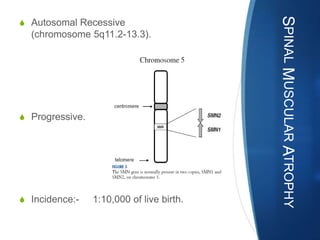
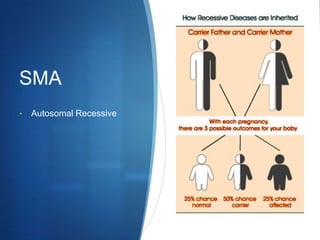
S Autosomal Recessive
  (chromosome 5q11.2-13.3).


S Progressive.


S Incidence:-    1:10,000 of live birth.
SMA
•   Autosomal Recessive
SPINAL MUSCULAR ATROPHY
S CLINICAL PICTURE;
  S Generalized weakness.
  S Severe hypotonia.
  S Proximal & distal muscles of limbs.
  S Intercostal muscles..., & Chest deformity…
  S Bulbar muscles.
  S Absent deep tondon reflexes
  S Hx. of fetal movement in utero.
  S Breathing difficulty  Paradoxical
    Respiration.
  S Feeding difficulty.
  S Floppy infant.
  S Frequent severe respiratory tract infections.

S IQ??
  S Normal.
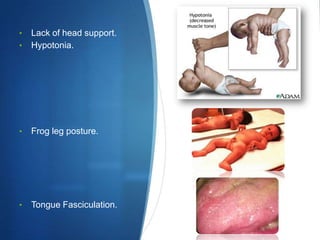
•   Lack of head support.
•   Hypotonia.


•   Frog leg posture.


•   Tongue Fasciculation.
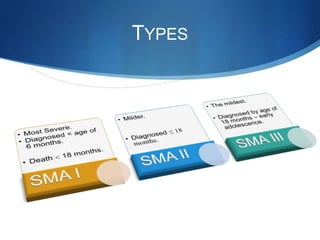
TYPES
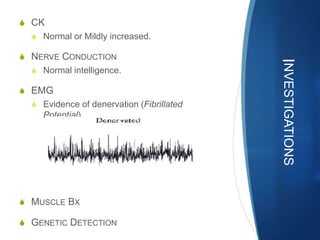
S CK
  S Normal or Mildly increased.

S NERVE CONDUCTION


                                           INVESTIGATIONS
  S Normal intelligence.

S EMG
  S Evidence of denervation (Fibrillated
    Potential).


S MUSCLE BX

S GENETIC DETECTION
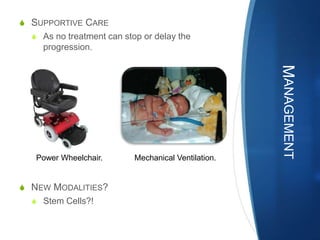
S SUPPORTIVE CARE
  S As no treatment can stop or delay the
    progression.


                                                     MANAGEMENT
   Power Wheelchair.       Mechanical Ventilation.


S NEW MODALITIES?
  S Stem Cells?!
PART II
Mohammed I. Alhefzi


                      S
GUILLIAN-BARRÈ
     SYNDROME
    Peripheral Nerves Disorders


                                  S
GUILLIAN-BARRÈ SYNDROME
S Inflammatory disorder of the peripheral nerves

S Weakness and tingling.
  S > +1 limb.
  S Symmetric.
  S Legs > Trunk > Arms > Neck > Face.

S Progressive.

S Severe (medical emergency requiring
  hospitalization)
S Preceded by infections.
  S URTI
  S GI
  S 1 - 3 wks.

S Incidence: 1-2 per 100,000.

S Males > Females (1.5:1).
GUILLIAN-BARRÈ SYNDROME
S CAUSES;


S Unknown.


S AI destruction of myelin and/or axons.


S Precedes by Infections.


S Affects signals;
  S Weakness.
  S Numbness.
  S Paralysis.
GUILLIAN-BARRÈ SYNDROME
S WHO IS AT RISK?


S Young/Older Adults.

S Triggers;
  S Campylobacter infection. "esp. poultry"
  S Mycoplasma pneumonia.
  S Surgery.
  S Epstein-Barr virus.
  S Influenza virus.
  S Hodgkin's disease.
  S Mononucleosis.
  S HIV.
GUILLIAN-BARRÈ SYNDROME
S CLINICAL PICTURE;

S   MOST SIGNIFICANTLY WITHIN 4 WEEKS.


S Muscle weakness. (Ascending).

S Aching pain.
    S Shoulders, thighs, lumbar region.

S Dysphagia, Dysarthria, Facial
    weakness, Ophthalmoplegia.

S MINIMAL loss of sensation (on exam).

S Decreased or absent tendon reflexes.
S COMPLICATIONS;


                                 GUILLIAN-BARRÈ SYNDROME
S Breathing.

S CVS.

S Pain.

S Bowel/Bladder Dysfunctions.

S Blood clots.

S Pressure sores.

S Relapse.
  S "10%"

S Death.
  S (RDS, Heart Block). [Rare]
GUILLIAN-BARRÈ SYNDROME
S INVESTIGATIONS;


S CSF (LP).
   S Elevated Protein, normal cell count. (1wk)

S EMG.
   S Demyelination? Axonal?

S Nerve Bx. (If other fails).
   S Sural Nerve.

S ECG.
   S Arrhythmias?

S Other Investigations according to the cause.
GUILLIAN-BARRÈ SYNDROME
S MANAGEMENT;


S I.V. Ig.

S Plasmapheresis.

S Paralyzed Patients.
   S Anticoagulants. (Prevent TE).

S Electively;
   S ET Intubation.
   S Tracehostomy.
   S Mechanical Ventilation.
   S Nutritional Support.
Charcot-Marie-Tooth
Hereditary Motor & Sensory Neuropathy (HMSN I)


                                                 S
S AD.


                                                   CHARCOT-MARIE-TOOTH
  S Both genders affected equally.
  S CMTX affects males.


S Prevalence: at least 1 in 2.500.


S Age of onset varies (first 2 decades of life).


S Caused by gene mutations.
  S Inherited (Familial).
  S Less commonly De Novo (Sporadic).
S CLINICAL PICTURE;


                                               CHARCOT-MARIE-TOOTH
S Weakness; legs, ankles and feet.

S Loss of muscle bulk.

S Hand weakness.

S Difficulty in running.

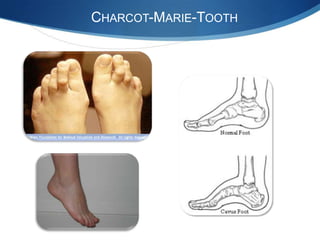
S Foot deformity (Pes Cavus).

S Hammertoes.

S Diminished or absent deep tendon reflexes.

S Steppage gait.

S Usually (+ve) Romberg's Test.

S Generally NO PAIN.
CHARCOT-MARIE-TOOTH
S INVESTIGATIONS;


                     CHARCOT-MARIE-TOOTH
S EMG.


S Genetic Testing.


S Nerve Bx.
S MANAGEMENT;


                                             CHARCOT-MARIE-TOOTH
S No Cure. (Supportive).

S Medications.
  S (If Pain) from muscle cramps.

S Therapy;
  S Physical therapy.
  S Occupational therapy.
  S Orthopedic devices. (leg/ankle braces)

S Surgery
  S Severe cases.
  S Not weakness/loss of sensations
PART III
Abdullah H. Al-Asmri


                       S
MYASTHENIA GRAVIS


                    S
MYASTHENIA GRAVIS
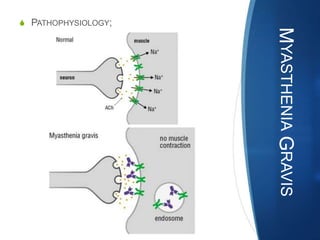
S An autoimmune of neuromuscular junction.


S Weakness of skeletal muscles.


S Fatigability on exertion.
S PATHOPHYSIOLOGY;


                     MYASTHENIA GRAVIS
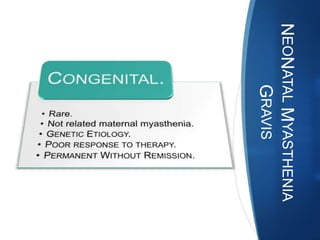
NEONATAL MYASTHENIA
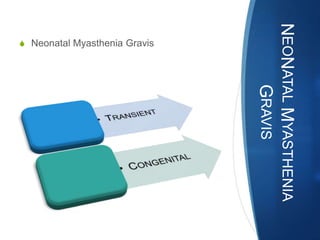
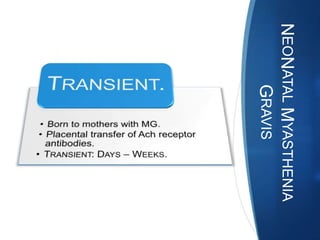
S Neonatal Myasthenia Gravis


                                     GRAVIS
NEONATAL MYASTHENIA
      GRAVIS
NEONATAL MYASTHENIA
      GRAVIS
MYASTHENIA GRAVIS
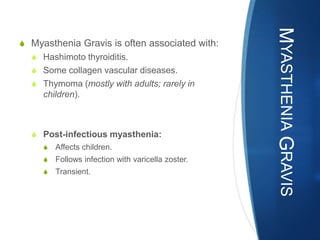
S Myasthenia Gravis is often associated with:
  S Hashimoto thyroiditis.
  S Some collagen vascular diseases.
  S Thymoma (mostly with adults; rarely in
     children).


  S Post-infectious myasthenia:
     S   Affects children.
     S   Follows infection with varicella zoster.
     S   Transient.
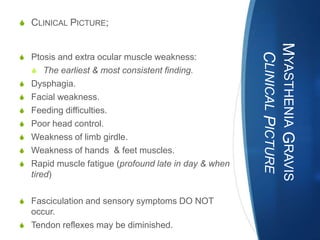
S CLINICAL PICTURE;


                                                      MYASTHENIA GRAVIS
                                                       CLINICAL PICTURE
S Ptosis and extra ocular muscle weakness:
   S The earliest & most consistent finding.
S Dysphagia.
S Facial weakness.
S Feeding difficulties.
S Poor head control.
S Weakness of limb girdle.
S Weakness of hands & feet muscles.
S Rapid muscle fatigue (profound late in day & when
   tired)

S Fasciculation and sensory symptoms DO NOT
  occur.
S Tendon reflexes may be diminished.
S DIAGNOSTIC STUDIES;
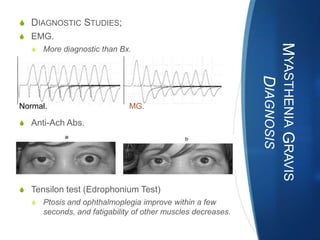
S EMG.


                                                              MYASTHENIA GRAVIS
   S More diagnostic than Bx.


                                                                 DIAGNOSIS
Normal.                       MG.

S Anti-Ach Abs.


S Tensilon test (Edrophonium Test)
   S Ptosis and ophthalmoplegia improve within a few
      seconds, and fatigability of other muscles decreases.
S TREATMENT;


                                  MYASTHENIA GRAVIS
S NO TREATMENT.
   S For Mild and transient MG.


                                     TREATMENT
S Cholinesterase inhibitors.
      S     Neostigmine.
      S     Physostigmine


S Steroids.


S I.V. Ig


S Plasmapheresis
S Thymectomy.


                                                    MYASTHENIA GRAVIS
     S   If high Ab titer.
     S   Duration of symptoms < 2 years.


                                                       TREATMENT
S Neonates with transient maternally transmitted
  MG require cholinesterase inhibitors for only a
  few days or occasionally for a few
  weeks, especially to allow feeding.
S AVOID:


                                   MYASTHENIA GRAVIS
S Neuromuscular blocking agents.


                                       CAUTIONS
S Aminoglycosides.
PART IV
Yahya M. AbuTalib


                    S
DUCHENN MUSCULAR
       DYSTROPHY
    “Pseudohypertrophic Muscle Dystrophy”


                                            S
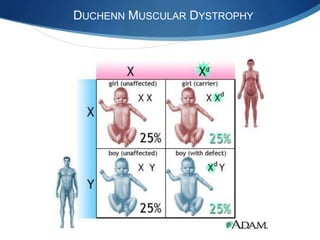
S An X-linked recessive (locus Xp2.1).


                                          DUCHENN MUSCULAR
                                             DYSTROPHY
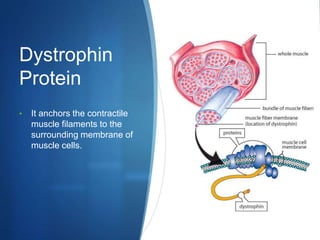
S Results from deficiency of dystrophin
  protein.


S Onset: 3-5 years of age.


S Incidence:-    1:3600 male.


S Males > Females.
DUCHENN MUSCULAR DYSTROPHY
Dystrophin
Protein
•   It anchors the contractile
    muscle filaments to the
    surrounding membrane of
    muscle cells.
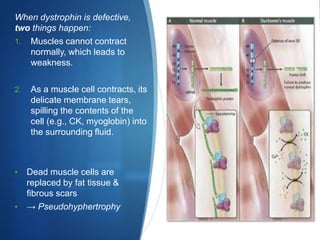
When dystrophin is defective,
two things happen:
1. Muscles cannot contract
   normally, which leads to
   weakness.

2.    As a muscle cell contracts, its
      delicate membrane tears,
      spilling the contents of the
      cell (e.g., CK, myoglobin) into
      the surrounding fluid.


•    Dead muscle cells are
     replaced by fat tissue &
     fibrous scars
•    → Pseudohyphertrophy
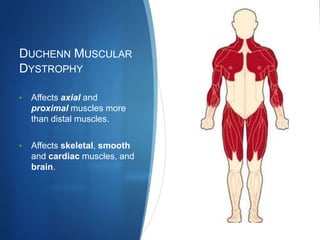
DUCHENN MUSCULAR
DYSTROPHY

•   Affects axial and
    proximal muscles more
    than distal muscles.

•   Affects skeletal, smooth
    and cardiac muscles, and
    brain.
S CLINICAL PICTURE;


                                        DUCHENN MUSCULAR DYSTROPHY
S Hypotonia.


                                              CLINICAL PICTURE
S Fatigability.

S Difficulty in standing & walking.

S Psedohypertrophy of calf & deltoid.

S Toe walking.

S Deformity of spine.

S Cardiomyopathy.

S Low IQ.
DUCHENN MUSCULAR DYSTROPHY
                     CLINICAL PICTURE


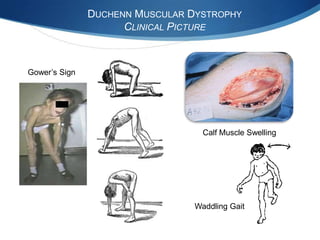
Gower’s Sign


                                   Calf Muscle Swelling


                                 Waddling Gait
DUCHENN MUSCULAR DYSTROPHY
S PROGRESSIVE COURSE;
   S Gower sign: 3years.
   S Arm weakness: 6years.


                                                            CLINICAL PICTURE
   S Wheelchair: 12 years.
   S Poor cough & respiratory difficulty: 16 years.


S Death is mainly due to respiratory failure.
DUCHENN MUSCULAR DYSTROPHY
S CK;
  S Greatly ↑↑↑


                                                   INVESTIGATIONS
S MUSCLE BX;
  S Necrosis, fat cells & fibrous tissue.


S CT BRAIN;
  S Brain atrophy.
DUCHENN MUSCULAR DYSTROPHY
        MANAGEMENT
     S SUPPORTIVE.
                     S No Cure.
BECKER MUSCULAR
      DYSTROPHY


                  S
S SIMILAR TO DUCHENN MUSCULAR DYSTROPY.


                                                BECKER MUSCULAR
S X-LINKED RECESSIVE.


                                                   DYSTROPHY
S SOME DYSTROPHIN IS PRESENT BUT IS ABNORMAL.


S MILDER.


S SLOWLY PROGRESSIVE.


S CALLED: BENIGN PSEUDOHYPERTROPHY.
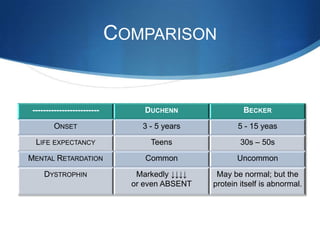
COMPARISON


 -------------------------        DUCHENN                BECKER

         ONSET                   3 - 5 years           5 - 15 yeas

  LIFE EXPECTANCY                  Teens                30s – 50s

MENTAL RETARDATION                Common               Uncommon

     DYSTROPHIN                 Markedly ↓↓↓↓    May be normal; but the
                               or even ABSENT   protein itself is abnormal.
PRESENTED AS FULFILLMENT OF PEDIA II COURSE.


WISH YOU ALL THE BEST; FROM: I. TAWHARI, M. ALHEFZI, A. AL-ASMRI, Y. ABUTALIB

Neuro Muscular Disorders

  • 1.
    NEUROMUSCULAR DISORDERS P R E PA R E D A N D P R E S E N T E D B Y • IBRAHIM H. TAWHARI. • MOHAMMED I. ALHEFZI. • ABDULLAH H. AL-ASMRI. • YAHYA M. ABUTALIB. S
  • 4.
    S ID /CC: SCENARIO - HISTORY S A 4-months-old infant. S Presenting with weak arms & limbs. S HPI: S A 4-months infant has been brought by his mother. S The mother states that she noted a generalized weakness of her baby. S She states that her baby has is unable to lift his head off the pillow. S When picked up, his head falls back as his neck is weak. S He feeds from a bottle and takes a long time. His sucking is weak and slow.
  • 5.
    S HPI CONTD.: SCENARIO - HISTORY S He has weakness in his limbs. S On further questioning, the mother states that he was always alert with good eye contact. S He began smiling by 6 weeks of age recognized his parents. S He turns her head and eyes toward sounds and begun to coo a little. S DEVELOPMENTAL HX.: S As above. S PAST HX.: S As above. S He got chest infection last month.
  • 6.
    SCENARIO - HISTORY SDRUG HX.: S NAD. S FAMILY HX.: S He is the the 2nd child. S He has only one older sister and she is healthy. S PREGNANCY HX.: S The mother was healthy during pregnancy and had no complications. S She was not using any drugs and didn’t expose to radiation. S This was her 2nd pregnancy and she noted that fetal movement was less than her first pregnancy.
  • 7.
    SCENARIO - HISTORY SNEONATAL HX.: S GA: full term. S Birth weight: 2.7 Kg. S Weak crying. S No admission. S IMMUNIZATION HX.: S He received all vaccines up to date as scheduled.
  • 8.
    S GENERAL &VITAL SIGNS: S No facial dysmorfic. S Afebrile. SCENARIO - PE S Tachycardia & tachypnea. S Subcostal retraction. S Lung: Clear. S Abdomen: normal. S CNS: S Mental status: S Alert, smiles and interacts with mother. S CRANIAL NERVES: S Normal.
  • 9.
    S MOTOR: S Wasting and decreased muscle tone in axial and limb muscles. SCENARIO - PE S Head lag when pulled from supine to prone position. S When supine, frog-leg position. S Tongue fasciculation.
  • 10.
    S LAB WORK; SCENARIO – LAB INV. S CBC: S Normal. S ELECTROLYTES: S Normal. S CPK: S 250 IU/mL. “mild elevation”. S MUSCLE BX; S Confirmed. S Spinal Muscular Atrophy. S “Werding Hoffmann’s Disease”.
  • 13.
    NEUROMUSCULAR DISORDERS Definition S
  • 14.
    DEFINITION S Defines asdisorders of the motor unit. S excludes influences of muscle functions from the brain such as spasticity.
  • 17.
    NEUROMUSCULAR DISORDERS Classification S
  • 18.
    CLASSIFICATION S Motor unithas four Components:
  • 19.
    CLASSIFICATION DISORDERS OF PERIPHERALNERVES MUSCLE DISORDERS DISORDERS OF ANTERIOR HORN DISORDERS OF NEUROMUSCULAR CELLS JUNCTION
  • 20.
    CLASSIFICATION GUILLIAN-BARRE’ SYNDROME DUCHEN MUSCULAR ATROPHY DISORDERS OF PERIPHERAL NERVES MUSCLE DISORDERS CHARCOT-MRIE-TOOTH DISORDERS OF ANTERIOR HORN DISORDERS OF NEUROMUSCULAR MYASTHENIA GRAVIS SPINAL MUSCULAR ATROPHY CELLS JUNCTION
  • 23.
    SPINAL MUSCULAR ATROPHY Ant. Horn Cells Disorders S
  • 24.
    SPINAL MUSCULAR ATROPHY SDegenerative disease of the anterior horn cells of the spinal cord & Cranial Nerve Nuclei in the brainstem. S Wasting & Weakness.
  • 25.
    SPINAL MUSCULAR ATROPHY SAutosomal Recessive (chromosome 5q11.2-13.3). S Progressive. S Incidence:- 1:10,000 of live birth.
  • 26.
    SMA • Autosomal Recessive
  • 27.
    SPINAL MUSCULAR ATROPHY SCLINICAL PICTURE; S Generalized weakness. S Severe hypotonia. S Proximal & distal muscles of limbs. S Intercostal muscles..., & Chest deformity… S Bulbar muscles. S Absent deep tondon reflexes S Hx. of fetal movement in utero. S Breathing difficulty  Paradoxical Respiration. S Feeding difficulty. S Floppy infant. S Frequent severe respiratory tract infections. S IQ?? S Normal.
  • 28.
    Lack of head support. • Hypotonia. • Frog leg posture. • Tongue Fasciculation.
  • 29.
  • 30.
    S CK S Normal or Mildly increased. S NERVE CONDUCTION INVESTIGATIONS S Normal intelligence. S EMG S Evidence of denervation (Fibrillated Potential). S MUSCLE BX S GENETIC DETECTION
  • 31.
    S SUPPORTIVE CARE S As no treatment can stop or delay the progression. MANAGEMENT Power Wheelchair. Mechanical Ventilation. S NEW MODALITIES? S Stem Cells?!
  • 32.
  • 35.
    GUILLIAN-BARRÈ SYNDROME Peripheral Nerves Disorders S
  • 36.
    GUILLIAN-BARRÈ SYNDROME S Inflammatorydisorder of the peripheral nerves S Weakness and tingling. S > +1 limb. S Symmetric. S Legs > Trunk > Arms > Neck > Face. S Progressive. S Severe (medical emergency requiring hospitalization) S Preceded by infections. S URTI S GI S 1 - 3 wks. S Incidence: 1-2 per 100,000. S Males > Females (1.5:1).
  • 37.
    GUILLIAN-BARRÈ SYNDROME S CAUSES; SUnknown. S AI destruction of myelin and/or axons. S Precedes by Infections. S Affects signals; S Weakness. S Numbness. S Paralysis.
  • 38.
    GUILLIAN-BARRÈ SYNDROME S WHOIS AT RISK? S Young/Older Adults. S Triggers; S Campylobacter infection. "esp. poultry" S Mycoplasma pneumonia. S Surgery. S Epstein-Barr virus. S Influenza virus. S Hodgkin's disease. S Mononucleosis. S HIV.
  • 39.
    GUILLIAN-BARRÈ SYNDROME S CLINICALPICTURE; S MOST SIGNIFICANTLY WITHIN 4 WEEKS. S Muscle weakness. (Ascending). S Aching pain. S Shoulders, thighs, lumbar region. S Dysphagia, Dysarthria, Facial weakness, Ophthalmoplegia. S MINIMAL loss of sensation (on exam). S Decreased or absent tendon reflexes.
  • 40.
    S COMPLICATIONS; GUILLIAN-BARRÈ SYNDROME S Breathing. S CVS. S Pain. S Bowel/Bladder Dysfunctions. S Blood clots. S Pressure sores. S Relapse. S "10%" S Death. S (RDS, Heart Block). [Rare]
  • 41.
    GUILLIAN-BARRÈ SYNDROME S INVESTIGATIONS; SCSF (LP). S Elevated Protein, normal cell count. (1wk) S EMG. S Demyelination? Axonal? S Nerve Bx. (If other fails). S Sural Nerve. S ECG. S Arrhythmias? S Other Investigations according to the cause.
  • 42.
    GUILLIAN-BARRÈ SYNDROME S MANAGEMENT; SI.V. Ig. S Plasmapheresis. S Paralyzed Patients. S Anticoagulants. (Prevent TE). S Electively; S ET Intubation. S Tracehostomy. S Mechanical Ventilation. S Nutritional Support.
  • 43.
    Charcot-Marie-Tooth Hereditary Motor &Sensory Neuropathy (HMSN I) S
  • 44.
    S AD. CHARCOT-MARIE-TOOTH S Both genders affected equally. S CMTX affects males. S Prevalence: at least 1 in 2.500. S Age of onset varies (first 2 decades of life). S Caused by gene mutations. S Inherited (Familial). S Less commonly De Novo (Sporadic).
  • 45.
    S CLINICAL PICTURE; CHARCOT-MARIE-TOOTH S Weakness; legs, ankles and feet. S Loss of muscle bulk. S Hand weakness. S Difficulty in running. S Foot deformity (Pes Cavus). S Hammertoes. S Diminished or absent deep tendon reflexes. S Steppage gait. S Usually (+ve) Romberg's Test. S Generally NO PAIN.
  • 46.
  • 47.
    S INVESTIGATIONS; CHARCOT-MARIE-TOOTH S EMG. S Genetic Testing. S Nerve Bx.
  • 48.
    S MANAGEMENT; CHARCOT-MARIE-TOOTH S No Cure. (Supportive). S Medications. S (If Pain) from muscle cramps. S Therapy; S Physical therapy. S Occupational therapy. S Orthopedic devices. (leg/ankle braces) S Surgery S Severe cases. S Not weakness/loss of sensations
  • 49.
  • 52.
  • 53.
    MYASTHENIA GRAVIS S Anautoimmune of neuromuscular junction. S Weakness of skeletal muscles. S Fatigability on exertion.
  • 54.
    S PATHOPHYSIOLOGY; MYASTHENIA GRAVIS
  • 55.
    NEONATAL MYASTHENIA S NeonatalMyasthenia Gravis GRAVIS
  • 56.
  • 57.
  • 58.
    MYASTHENIA GRAVIS S MyastheniaGravis is often associated with: S Hashimoto thyroiditis. S Some collagen vascular diseases. S Thymoma (mostly with adults; rarely in children). S Post-infectious myasthenia: S Affects children. S Follows infection with varicella zoster. S Transient.
  • 59.
    S CLINICAL PICTURE; MYASTHENIA GRAVIS CLINICAL PICTURE S Ptosis and extra ocular muscle weakness: S The earliest & most consistent finding. S Dysphagia. S Facial weakness. S Feeding difficulties. S Poor head control. S Weakness of limb girdle. S Weakness of hands & feet muscles. S Rapid muscle fatigue (profound late in day & when tired) S Fasciculation and sensory symptoms DO NOT occur. S Tendon reflexes may be diminished.
  • 60.
    S DIAGNOSTIC STUDIES; SEMG. MYASTHENIA GRAVIS S More diagnostic than Bx. DIAGNOSIS Normal. MG. S Anti-Ach Abs. S Tensilon test (Edrophonium Test) S Ptosis and ophthalmoplegia improve within a few seconds, and fatigability of other muscles decreases.
  • 61.
    S TREATMENT; MYASTHENIA GRAVIS S NO TREATMENT. S For Mild and transient MG. TREATMENT S Cholinesterase inhibitors. S Neostigmine. S Physostigmine S Steroids. S I.V. Ig S Plasmapheresis
  • 62.
    S Thymectomy. MYASTHENIA GRAVIS S If high Ab titer. S Duration of symptoms < 2 years. TREATMENT S Neonates with transient maternally transmitted MG require cholinesterase inhibitors for only a few days or occasionally for a few weeks, especially to allow feeding.
  • 63.
    S AVOID: MYASTHENIA GRAVIS S Neuromuscular blocking agents. CAUTIONS S Aminoglycosides.
  • 64.
    PART IV Yahya M.AbuTalib S
  • 67.
    DUCHENN MUSCULAR DYSTROPHY “Pseudohypertrophic Muscle Dystrophy” S
  • 68.
    S An X-linkedrecessive (locus Xp2.1). DUCHENN MUSCULAR DYSTROPHY S Results from deficiency of dystrophin protein. S Onset: 3-5 years of age. S Incidence:- 1:3600 male. S Males > Females.
  • 69.
  • 70.
    Dystrophin Protein • It anchors the contractile muscle filaments to the surrounding membrane of muscle cells.
  • 71.
    When dystrophin isdefective, two things happen: 1. Muscles cannot contract normally, which leads to weakness. 2. As a muscle cell contracts, its delicate membrane tears, spilling the contents of the cell (e.g., CK, myoglobin) into the surrounding fluid. • Dead muscle cells are replaced by fat tissue & fibrous scars • → Pseudohyphertrophy
  • 72.
    DUCHENN MUSCULAR DYSTROPHY • Affects axial and proximal muscles more than distal muscles. • Affects skeletal, smooth and cardiac muscles, and brain.
  • 73.
    S CLINICAL PICTURE; DUCHENN MUSCULAR DYSTROPHY S Hypotonia. CLINICAL PICTURE S Fatigability. S Difficulty in standing & walking. S Psedohypertrophy of calf & deltoid. S Toe walking. S Deformity of spine. S Cardiomyopathy. S Low IQ.
  • 74.
    DUCHENN MUSCULAR DYSTROPHY CLINICAL PICTURE Gower’s Sign Calf Muscle Swelling Waddling Gait
  • 75.
    DUCHENN MUSCULAR DYSTROPHY SPROGRESSIVE COURSE; S Gower sign: 3years. S Arm weakness: 6years. CLINICAL PICTURE S Wheelchair: 12 years. S Poor cough & respiratory difficulty: 16 years. S Death is mainly due to respiratory failure.
  • 76.
    DUCHENN MUSCULAR DYSTROPHY SCK; S Greatly ↑↑↑ INVESTIGATIONS S MUSCLE BX; S Necrosis, fat cells & fibrous tissue. S CT BRAIN; S Brain atrophy.
  • 77.
    DUCHENN MUSCULAR DYSTROPHY MANAGEMENT S SUPPORTIVE. S No Cure.
  • 78.
    BECKER MUSCULAR DYSTROPHY S
  • 79.
    S SIMILAR TODUCHENN MUSCULAR DYSTROPY. BECKER MUSCULAR S X-LINKED RECESSIVE. DYSTROPHY S SOME DYSTROPHIN IS PRESENT BUT IS ABNORMAL. S MILDER. S SLOWLY PROGRESSIVE. S CALLED: BENIGN PSEUDOHYPERTROPHY.
  • 80.
    COMPARISON ------------------------- DUCHENN BECKER ONSET 3 - 5 years 5 - 15 yeas LIFE EXPECTANCY Teens 30s – 50s MENTAL RETARDATION Common Uncommon DYSTROPHIN Markedly ↓↓↓↓ May be normal; but the or even ABSENT protein itself is abnormal.
  • 81.
    PRESENTED AS FULFILLMENTOF PEDIA II COURSE. WISH YOU ALL THE BEST; FROM: I. TAWHARI, M. ALHEFZI, A. AL-ASMRI, Y. ABUTALIB