1DISSOCIATIVE DISORDERS
2Somatoform DisordersThese a group of mental disorders characterized by physical symptomsThey do not have corresponding organic pathologyPatients truly believes that they have a physical problem
3Six major  DSM-IV classificationsSomatization disorderConversion disorderHypochondriasisBody dysmorphic disorderPain disorderUndifferentiated somatoform disorder (combo of other somatoform disorders)
4DDX:  Major differential diagnosis involves the possibility that the patient truly has a an unidentified underlying physical ailment CNS illnessMultiple sclerosisDementiaEpilepsyBrain tumorConnective tissue disorderLupusEndocrine disorderThyroid dysfunctionhypoglycemia
5Somatoform disorders are more common  in female except for Hypochondrasis, which is found equally in both50% of patients also have another mental disorder [depression and anxiety]Patient unconsciously expresses an unacceptable emotion as a physical symptom so he does not have to deal with the emotion [primary gain]Symptoms allows the patient to get attention from others or avoid responsibility [secondary gain]
6Treatment can control symptoms but they often returnUseful factors in treatmentFormation of a good doctor - patient relationship Individual and group psychotherapy, hypnosis and behavioral relaxation therapyIdentification and reduction of patient’s life that may exacerbate the symptomsReducing the secondary gain associated with the symptoms Medications are useful for treatment of comorbid psychiatric illness
7Somatization Disorder Multiple vague physical symptom NauseaDyspneaTirednessMenstrual irregularitiesOccurrenceOnset before 30 years of ageMore common in lower socioeconomic groups10% of patients of primary care practitionersCourse of disorder is chronic and lifelongSymptoms are increased by stressful life events
825 year-old woman has a history of unclear somatic complaints.  She tells you that she has consulted many doctors but that they are unable to help her
9Conversion DisorderAbrupt, dramatic loss of motor or sensory function or organ of special senseMotor PresentationParalysis [which shifts to different areas of the body]Seizures, which are often bizarreGlobus hystericus (lump in the throat)
10Sensory PresentationParesthesias (abnormal sensations)anesthesiasVisual problemsOccurrenceMore common in adolescents and young adultsPatients from rural areasPsychiatrically unsophisticated patients
11Course and PrognosisMost patients show Sx remission in less than 1 monthSometimes immediately after hypnosis Sx go away25% of patients have recurrent episodes [ when stressful life events occur
12HypochondriasisExaggerated concern with health and illnessMore common in middle and old ageEqual in both sexesEpisodic periods of SxEach lasting up to a few yearsInterspersed with periods when few Sx are present50% of patients improve over course of their lives
13Body Dysmorphic DisorderPatient is preoccupied with a defect in appearance [but has a normal appearance]If defect present it is usually very minorMost often complaint involves slight flaws of the face and headOnset usually in the late teensChronic course with variable levels of concern over time about the physical feature causing distressPlastic surgery or other medical treatment rarely alleviates Sx
14Pain DisorderPatient experiences intense, prolonged pain with no physical cause or not explained completely by physical cause or not explained completely by physical diseaseCan be acute (lasting less than 6 months)Chronic is lasting more than a6 monthsOften coexists with a general medical condition
15Usually onset is in the 30s and 40sDisorder can be disabling – addiction to pain medicationAnti-depressants (SSRIs) may be useful
16Factitious DisorderAlso called Munchausen SyndromeMental or physical illness or induced physical illness to gain attention from medical personnelPatient often have worked in the medical field and have specific knowledge of how to imitate medical illness effectively
17Common Sx:Abdominal painBlood in urineInduction of tachycardiaFeverSkin lesionsSeizures
18Factitious Disorder by proxyInduction of illness in another personUsually a child by parentSome patients report a history of childhood abuse or neglect
19MalingeringSimulation of physical or mental illness for financial or other gainPatient avoids medical treatment and “recovers” as soon as the gain is realized
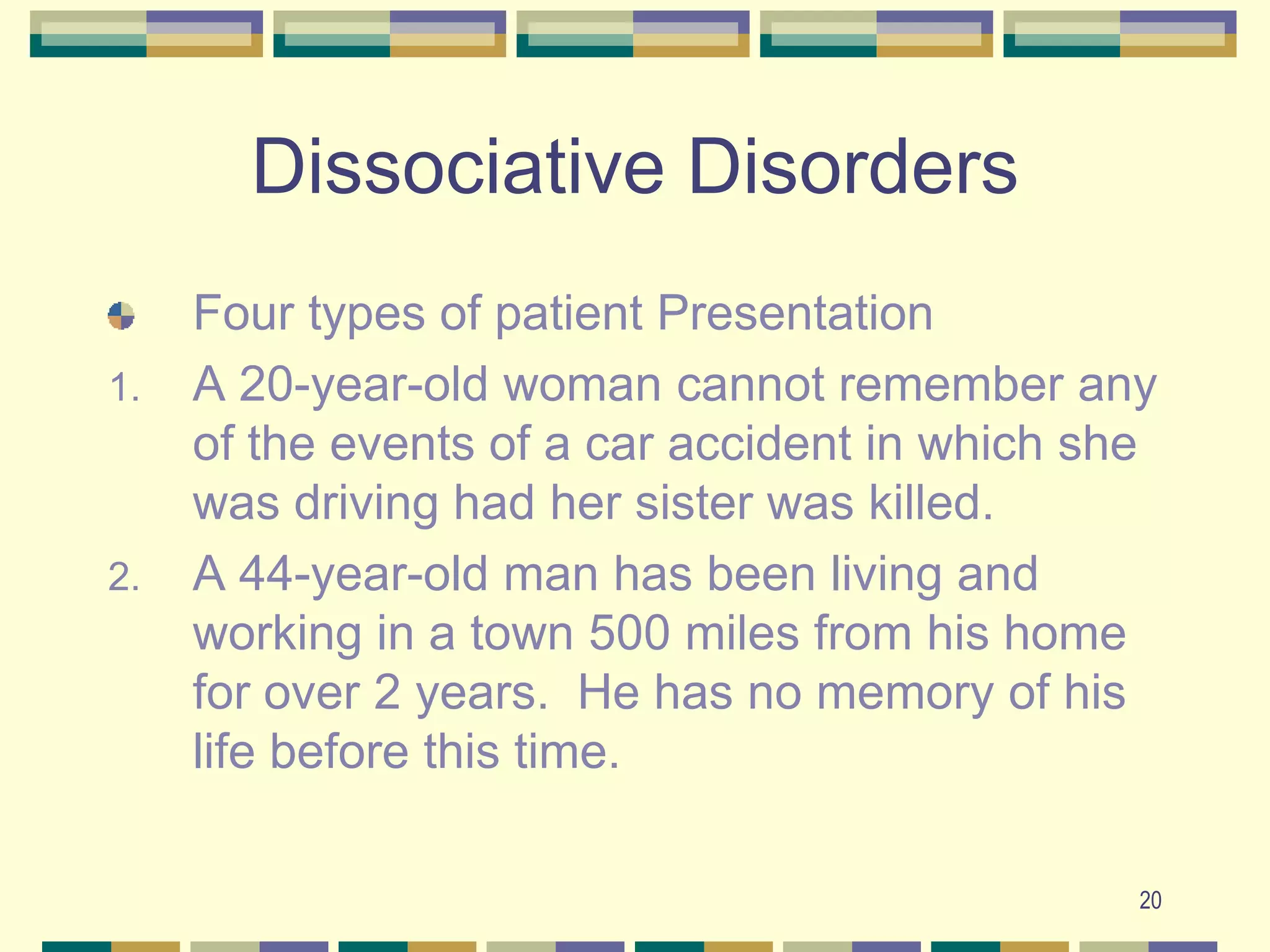
20Dissociative DisordersFour types of patient PresentationA 20-year-old woman cannot remember any of the events of a car accident in which she was driving had her sister was killed.A 44-year-old man has been living and working in a town 500 miles from his home for over 2 years.  He has no memory of his life before this time.
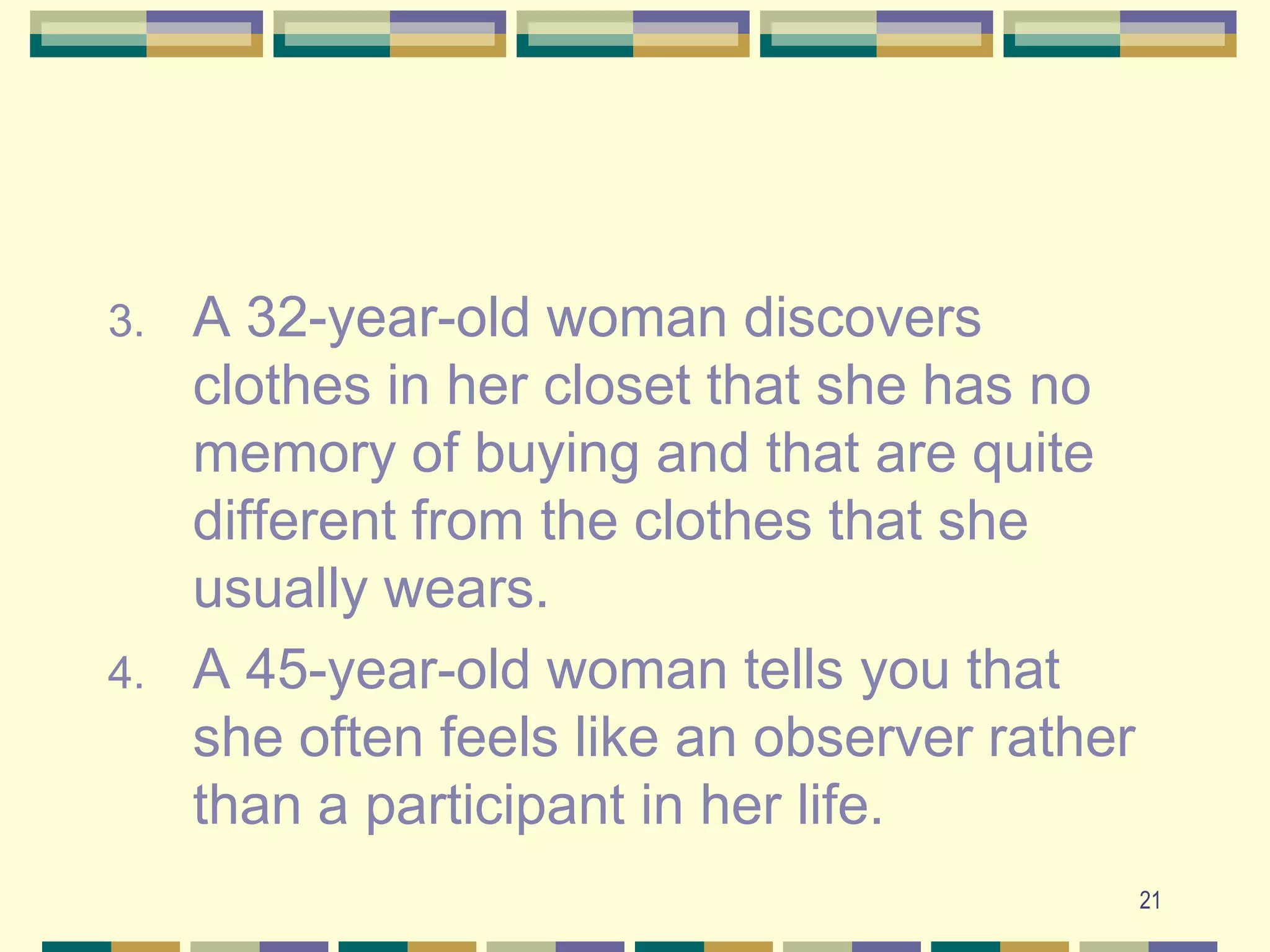
21A 32-year-old woman discovers clothes in her closet that she has no memory of buying and that are quite different from the clothes that she usually wears.A 45-year-old woman tells you that she often feels like an observer rather than a participant in her life.
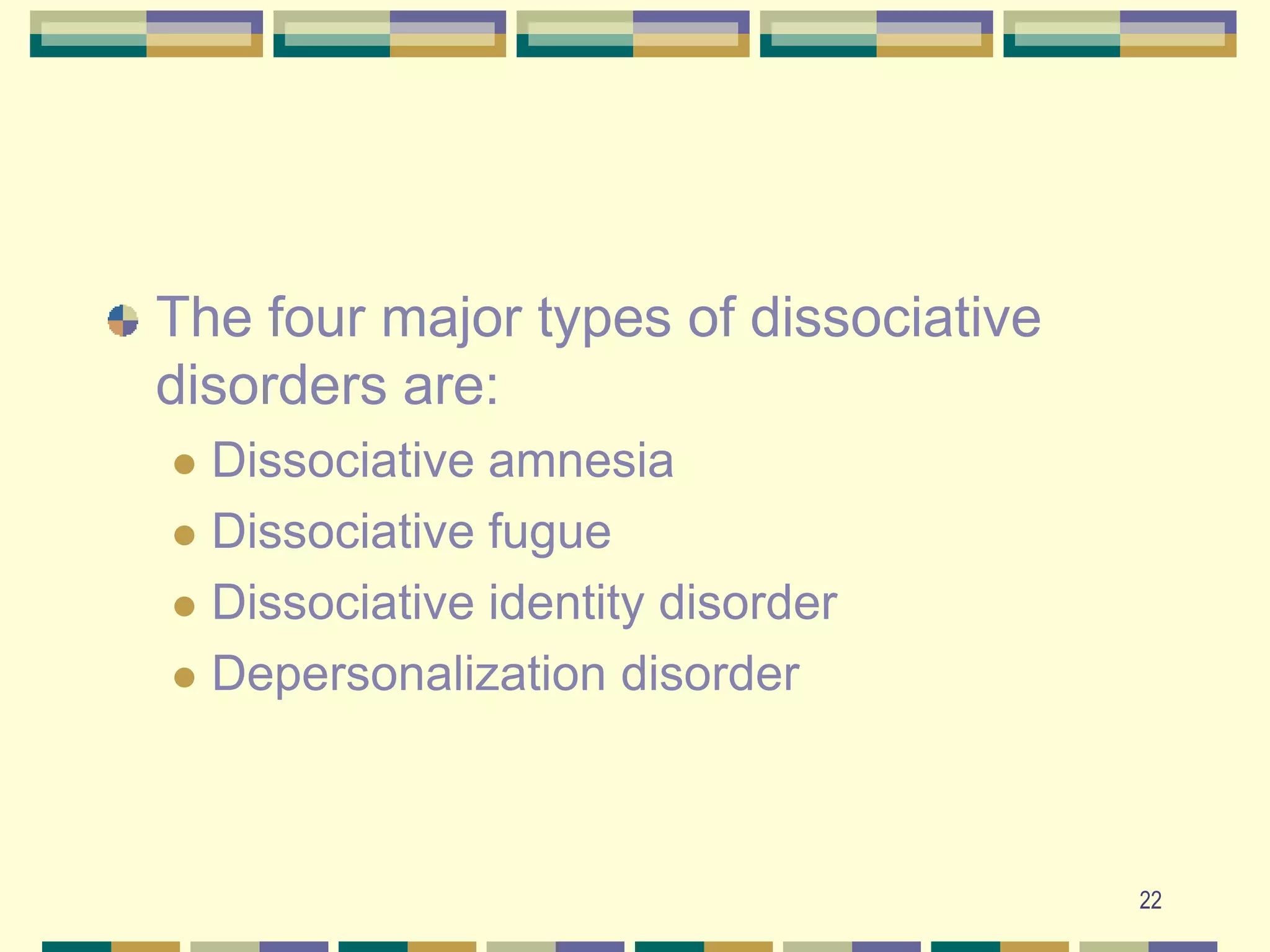
22The four major types of dissociative disorders are:Dissociative amnesiaDissociative fugueDissociative identity disorderDepersonalization disorder
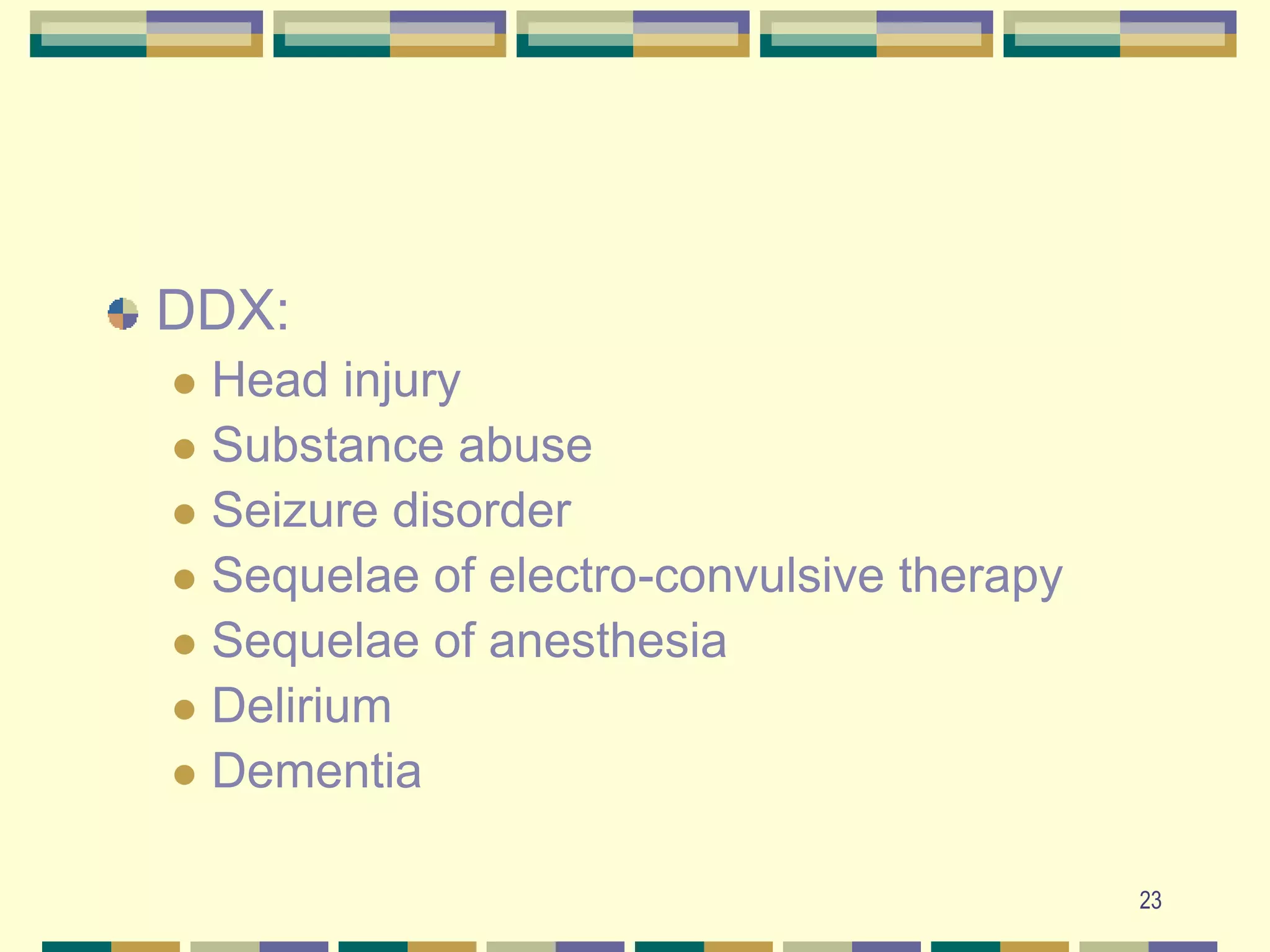
23DDX:Head injurySubstance abuseSeizure disorderSequelae of electro-convulsive therapySequelae of anesthesiaDeliriumDementia
24Post-traumatic stress disorder and malingering are the psychological differentials to think aboutSome cultures or religions have perception that altered states of identity, consciousness are seen in concert with certain experiences
25Dissociative AmnesiaPatient is not able to remember important information about oneselfIt is uncommon and occurs more often in young adults and in womenIt is used as defense mechanisms for denial and repression after an emotionally traumatic event
26Hypnosis and sodium amorbarbital interviews are to recover the lost traumatic memoriesLong-term psychotherapy to deal with the recovered materialAmnesia after acute stress may resolve in minutes or may last for years
27Dissociative FugueSudden inability to remember important information about oneself with leaving home and assuming a different identityPatient is usually not aware that he has done thisHas a rare occurrence and is associated with a history of excessive alcohol useWhile etiology  ?  Most have a traumatic event in recent past
28Hypnosis and sodium amobarbital interviews is usedUsually resolves within days --- occasionally last years
29Dissociative Identity DisorderAlso called Multiple Personality DisorderPatients have at least two separate personalitiesOne ‘alter’ usually dominates the othersMost commonly seen in womenNot uncommon in mild formRare in severe form
30Mild forms may resemble borderline personality disorder or schizophreniaMalingering must be ruled out[when the patient presents in a forensic (legal) context]Early traumatic experienceUsually abuse in childhood or adolescenceMost commonly associated with incest
31In some cases, integration of the personalities using insight-oriented psychotherapy with or without hypnosisAntidepressants, antianxiety and anticonvulsant agents may be helpfulOften chronic and associated with other psychiatric symptoms [depression and anxiety]
32Depersonalization DisorderRecurrent and persistent feeling of detachment from one’s own body or social situation [ if involves environment its called derealization disorder]Sx often present in psychiatric disorders such as schizophrenia, depression, anxiety and histrionic personality disorder
33In transient form, occurs in many peopleThere is no sex differenceTraumatic event in childhood or adolescence  may be the etiologyAnti-anxiety and SSRIs may be usefulPsychotherapy is rarely useful
34Starts most often between 15 and 30 years of ageOccurs episodically and commonly continues for many years
35What are the characteristics of Paraphilias?Preferential use of unusual objects of sexual desire or engagement in unusual sexual activityBehavior should occur over a period of at least 6 monthsBehavior causes impairment in occupational or social functioningPrimary disturbance in mood causing subjective distress and occupational or social problemsThese individuals act on their fantasies – if they don’t it is not Paraphilia
Paraphilias, Gender Identity Disorder, and Homosexuality36
37Types of ParaphiliasPedophiliaVoyeurismExhibitionismFetishismFrotteurismNecrophiliaSexual Sadism and MasochismTelephone ScatologiaZoophilia
38PedophiliaPreferred method of sexual gratification is to engage in sexual activity with children of the opposite or same sexUp to 20% of children have been sexually abused It is the most common ParaphiliaTypical patient:  A 45 y/o scoutmaster is arrested after an 11 y/o boy scout complains that the scoutmaster fondled him during a photography session.
39VoyeurismObtaining sexual satisfaction from secretly watching people undressing or engaging in sexual activityTypical patientA 28 y/o man is repeatedly arrested for using binoculars to spy on women in a neighboring apartment building
40Exhibitionism Exposing the genitals to unsuspecting people in a manner that shocks themA typical patient:34 Y/O MAN IS REPEATEDLY ARRESTED FOR UNZIPPING HIS TROUSERS AND BARING HIS PENIS TO WOMEN ON THE SUBWAY
41Fetishism Sexual preference for inanimate objects, such as women’s gloves, shoes, feet, etc.Typical patient:A 30 y/o man commonly masturbates while stroking a woman’s high-heeled shoesTransvestic fetishismSexual gratification obtained from wearing women’s clothing ….. Most common is lingerieA 23 y/o man reports that to become aroused he must wear a woman’s nightgown, when ever he has sex with his wife
42Frotteurism Sexual gratification is obtained from rubbing the penis against a non-consenting, unaware womanTypical patient 29 y/o man is arrested for masturbating by rubbing up against a woman in a crowded subway car.
43NecrophiliaSexual satisfaction is obtained from sexual activity with corpsesTypical patient32 y/o man is arrested for murder after he confesses to killing a young women to have sex with her
44Masochism and SadismObtaining sexual pleasure from receiving (masochism) or causing (sadism) physical suffering or humiliationTypical patient46 y/o stockbroker regularly pays a woman to beat and humiliate him
45Telephone ScatologiaDeriving sexual pleasure from calling unsuspected women and engaging them in sexually explicit conversationsTypical patient	32 y/o man makes anonymous telephone calls to teenager girls after school hours so that he can talk to them about sex
46ZoophiliaPreferred sexual activity is with animalsCan be dangerous because sexually aroused animals are often unpredictableTypical patientA  18 y/o man prefers to have sexual intercourse with his female dog
47TreatmentPsychoanalytically oriented psychotherapyAversive conditioning (electric shock)Anti-androgens and female sex hormones used for paraphilias characterized by hypersexualityFactors for best prognosis:Ability to have sexual intercourse in the absence of the paraphiliaPresence of guilt about the paraphiliaFactors for worse prognosis Referral by police rather than selfYounger age of activity onset
48Gender Identity DisorderPatient sense of being male or female Commonly called Trans-sexuality Expression of one’s gender identity in societyAge gender identity develops is between 2 and 3 years of ageMust R/O schizophrenia, serious distress homosexuality More common in manCan be diagnosis in childhoodMany patient obtain sex hormones to help with secondary characteristics
49Sex surgery is rarely performed now because in past the depression and psychological symptoms were not relieved following surgeryPrognosis Often chronic, lifelong distressDepression with risk of suicide
50Typical patient28y/o male patient tells you that ever since childhood he has felt like he was “a woman born into the body of a man”.  He hates his penis and feels like it does not belong to him. He is sexually attracted to heterosexual men, prefers to dress in women’s clothes, and would like to have a sex operation.
51Homosexuality 	Likes people of the same sex as a sexual and love objectMost have experienced heterosexual sex50 – 75% have childrenDSM IV see it as a normal variant of sexual expressionIs considered a dysfunction when the discomfort about sexual preference is pronounced (Sexual disorder NOS) These patients may become chronically depressed
52Indicators of a Genetic  EtiologyHigh concordance rate in monozygotic twins than dizygotic twinsMarkers on the X chromosome
53

Psych Lecture 7 Somatoform.1ppt

  • 1.
  • 2.
    2Somatoform DisordersThese agroup of mental disorders characterized by physical symptomsThey do not have corresponding organic pathologyPatients truly believes that they have a physical problem
  • 3.
    3Six major DSM-IV classificationsSomatization disorderConversion disorderHypochondriasisBody dysmorphic disorderPain disorderUndifferentiated somatoform disorder (combo of other somatoform disorders)
  • 4.
    4DDX: Majordifferential diagnosis involves the possibility that the patient truly has a an unidentified underlying physical ailment CNS illnessMultiple sclerosisDementiaEpilepsyBrain tumorConnective tissue disorderLupusEndocrine disorderThyroid dysfunctionhypoglycemia
  • 5.
    5Somatoform disorders aremore common in female except for Hypochondrasis, which is found equally in both50% of patients also have another mental disorder [depression and anxiety]Patient unconsciously expresses an unacceptable emotion as a physical symptom so he does not have to deal with the emotion [primary gain]Symptoms allows the patient to get attention from others or avoid responsibility [secondary gain]
  • 6.
    6Treatment can controlsymptoms but they often returnUseful factors in treatmentFormation of a good doctor - patient relationship Individual and group psychotherapy, hypnosis and behavioral relaxation therapyIdentification and reduction of patient’s life that may exacerbate the symptomsReducing the secondary gain associated with the symptoms Medications are useful for treatment of comorbid psychiatric illness
  • 7.
    7Somatization Disorder Multiplevague physical symptom NauseaDyspneaTirednessMenstrual irregularitiesOccurrenceOnset before 30 years of ageMore common in lower socioeconomic groups10% of patients of primary care practitionersCourse of disorder is chronic and lifelongSymptoms are increased by stressful life events
  • 8.
    825 year-old womanhas a history of unclear somatic complaints. She tells you that she has consulted many doctors but that they are unable to help her
  • 9.
    9Conversion DisorderAbrupt, dramaticloss of motor or sensory function or organ of special senseMotor PresentationParalysis [which shifts to different areas of the body]Seizures, which are often bizarreGlobus hystericus (lump in the throat)
  • 10.
    10Sensory PresentationParesthesias (abnormalsensations)anesthesiasVisual problemsOccurrenceMore common in adolescents and young adultsPatients from rural areasPsychiatrically unsophisticated patients
  • 11.
    11Course and PrognosisMostpatients show Sx remission in less than 1 monthSometimes immediately after hypnosis Sx go away25% of patients have recurrent episodes [ when stressful life events occur
  • 12.
    12HypochondriasisExaggerated concern withhealth and illnessMore common in middle and old ageEqual in both sexesEpisodic periods of SxEach lasting up to a few yearsInterspersed with periods when few Sx are present50% of patients improve over course of their lives
  • 13.
    13Body Dysmorphic DisorderPatientis preoccupied with a defect in appearance [but has a normal appearance]If defect present it is usually very minorMost often complaint involves slight flaws of the face and headOnset usually in the late teensChronic course with variable levels of concern over time about the physical feature causing distressPlastic surgery or other medical treatment rarely alleviates Sx
  • 14.
    14Pain DisorderPatient experiencesintense, prolonged pain with no physical cause or not explained completely by physical cause or not explained completely by physical diseaseCan be acute (lasting less than 6 months)Chronic is lasting more than a6 monthsOften coexists with a general medical condition
  • 15.
    15Usually onset isin the 30s and 40sDisorder can be disabling – addiction to pain medicationAnti-depressants (SSRIs) may be useful
  • 16.
    16Factitious DisorderAlso calledMunchausen SyndromeMental or physical illness or induced physical illness to gain attention from medical personnelPatient often have worked in the medical field and have specific knowledge of how to imitate medical illness effectively
  • 17.
    17Common Sx:Abdominal painBloodin urineInduction of tachycardiaFeverSkin lesionsSeizures
  • 18.
    18Factitious Disorder byproxyInduction of illness in another personUsually a child by parentSome patients report a history of childhood abuse or neglect
  • 19.
    19MalingeringSimulation of physicalor mental illness for financial or other gainPatient avoids medical treatment and “recovers” as soon as the gain is realized
  • 20.
    20Dissociative DisordersFour typesof patient PresentationA 20-year-old woman cannot remember any of the events of a car accident in which she was driving had her sister was killed.A 44-year-old man has been living and working in a town 500 miles from his home for over 2 years. He has no memory of his life before this time.
  • 21.
    21A 32-year-old womandiscovers clothes in her closet that she has no memory of buying and that are quite different from the clothes that she usually wears.A 45-year-old woman tells you that she often feels like an observer rather than a participant in her life.
  • 22.
    22The four majortypes of dissociative disorders are:Dissociative amnesiaDissociative fugueDissociative identity disorderDepersonalization disorder
  • 23.
    23DDX:Head injurySubstance abuseSeizuredisorderSequelae of electro-convulsive therapySequelae of anesthesiaDeliriumDementia
  • 24.
    24Post-traumatic stress disorderand malingering are the psychological differentials to think aboutSome cultures or religions have perception that altered states of identity, consciousness are seen in concert with certain experiences
  • 25.
    25Dissociative AmnesiaPatient isnot able to remember important information about oneselfIt is uncommon and occurs more often in young adults and in womenIt is used as defense mechanisms for denial and repression after an emotionally traumatic event
  • 26.
    26Hypnosis and sodiumamorbarbital interviews are to recover the lost traumatic memoriesLong-term psychotherapy to deal with the recovered materialAmnesia after acute stress may resolve in minutes or may last for years
  • 27.
    27Dissociative FugueSudden inabilityto remember important information about oneself with leaving home and assuming a different identityPatient is usually not aware that he has done thisHas a rare occurrence and is associated with a history of excessive alcohol useWhile etiology ? Most have a traumatic event in recent past
  • 28.
    28Hypnosis and sodiumamobarbital interviews is usedUsually resolves within days --- occasionally last years
  • 29.
    29Dissociative Identity DisorderAlsocalled Multiple Personality DisorderPatients have at least two separate personalitiesOne ‘alter’ usually dominates the othersMost commonly seen in womenNot uncommon in mild formRare in severe form
  • 30.
    30Mild forms mayresemble borderline personality disorder or schizophreniaMalingering must be ruled out[when the patient presents in a forensic (legal) context]Early traumatic experienceUsually abuse in childhood or adolescenceMost commonly associated with incest
  • 31.
    31In some cases,integration of the personalities using insight-oriented psychotherapy with or without hypnosisAntidepressants, antianxiety and anticonvulsant agents may be helpfulOften chronic and associated with other psychiatric symptoms [depression and anxiety]
  • 32.
    32Depersonalization DisorderRecurrent andpersistent feeling of detachment from one’s own body or social situation [ if involves environment its called derealization disorder]Sx often present in psychiatric disorders such as schizophrenia, depression, anxiety and histrionic personality disorder
  • 33.
    33In transient form,occurs in many peopleThere is no sex differenceTraumatic event in childhood or adolescence may be the etiologyAnti-anxiety and SSRIs may be usefulPsychotherapy is rarely useful
  • 34.
    34Starts most oftenbetween 15 and 30 years of ageOccurs episodically and commonly continues for many years
  • 35.
    35What are thecharacteristics of Paraphilias?Preferential use of unusual objects of sexual desire or engagement in unusual sexual activityBehavior should occur over a period of at least 6 monthsBehavior causes impairment in occupational or social functioningPrimary disturbance in mood causing subjective distress and occupational or social problemsThese individuals act on their fantasies – if they don’t it is not Paraphilia
  • 36.
    Paraphilias, Gender IdentityDisorder, and Homosexuality36
  • 37.
  • 38.
    38PedophiliaPreferred method ofsexual gratification is to engage in sexual activity with children of the opposite or same sexUp to 20% of children have been sexually abused It is the most common ParaphiliaTypical patient: A 45 y/o scoutmaster is arrested after an 11 y/o boy scout complains that the scoutmaster fondled him during a photography session.
  • 39.
    39VoyeurismObtaining sexual satisfactionfrom secretly watching people undressing or engaging in sexual activityTypical patientA 28 y/o man is repeatedly arrested for using binoculars to spy on women in a neighboring apartment building
  • 40.
    40Exhibitionism Exposing thegenitals to unsuspecting people in a manner that shocks themA typical patient:34 Y/O MAN IS REPEATEDLY ARRESTED FOR UNZIPPING HIS TROUSERS AND BARING HIS PENIS TO WOMEN ON THE SUBWAY
  • 41.
    41Fetishism Sexual preferencefor inanimate objects, such as women’s gloves, shoes, feet, etc.Typical patient:A 30 y/o man commonly masturbates while stroking a woman’s high-heeled shoesTransvestic fetishismSexual gratification obtained from wearing women’s clothing ….. Most common is lingerieA 23 y/o man reports that to become aroused he must wear a woman’s nightgown, when ever he has sex with his wife
  • 42.
    42Frotteurism Sexual gratificationis obtained from rubbing the penis against a non-consenting, unaware womanTypical patient 29 y/o man is arrested for masturbating by rubbing up against a woman in a crowded subway car.
  • 43.
    43NecrophiliaSexual satisfaction isobtained from sexual activity with corpsesTypical patient32 y/o man is arrested for murder after he confesses to killing a young women to have sex with her
  • 44.
    44Masochism and SadismObtainingsexual pleasure from receiving (masochism) or causing (sadism) physical suffering or humiliationTypical patient46 y/o stockbroker regularly pays a woman to beat and humiliate him
  • 45.
    45Telephone ScatologiaDeriving sexualpleasure from calling unsuspected women and engaging them in sexually explicit conversationsTypical patient 32 y/o man makes anonymous telephone calls to teenager girls after school hours so that he can talk to them about sex
  • 46.
    46ZoophiliaPreferred sexual activityis with animalsCan be dangerous because sexually aroused animals are often unpredictableTypical patientA 18 y/o man prefers to have sexual intercourse with his female dog
  • 47.
    47TreatmentPsychoanalytically oriented psychotherapyAversiveconditioning (electric shock)Anti-androgens and female sex hormones used for paraphilias characterized by hypersexualityFactors for best prognosis:Ability to have sexual intercourse in the absence of the paraphiliaPresence of guilt about the paraphiliaFactors for worse prognosis Referral by police rather than selfYounger age of activity onset
  • 48.
    48Gender Identity DisorderPatientsense of being male or female Commonly called Trans-sexuality Expression of one’s gender identity in societyAge gender identity develops is between 2 and 3 years of ageMust R/O schizophrenia, serious distress homosexuality More common in manCan be diagnosis in childhoodMany patient obtain sex hormones to help with secondary characteristics
  • 49.
    49Sex surgery israrely performed now because in past the depression and psychological symptoms were not relieved following surgeryPrognosis Often chronic, lifelong distressDepression with risk of suicide
  • 50.
    50Typical patient28y/o malepatient tells you that ever since childhood he has felt like he was “a woman born into the body of a man”. He hates his penis and feels like it does not belong to him. He is sexually attracted to heterosexual men, prefers to dress in women’s clothes, and would like to have a sex operation.
  • 51.
    51Homosexuality Likes peopleof the same sex as a sexual and love objectMost have experienced heterosexual sex50 – 75% have childrenDSM IV see it as a normal variant of sexual expressionIs considered a dysfunction when the discomfort about sexual preference is pronounced (Sexual disorder NOS) These patients may become chronically depressed
  • 52.
    52Indicators of aGenetic EtiologyHigh concordance rate in monozygotic twins than dizygotic twinsMarkers on the X chromosome
  • 53.