Myasthenia Gravis
Dr. Shardendu Kumar Mishra
PhD
Department of Pharmacology
Outline
 Background
 Anatomy
 Pathophysiology
 Epidemiology
 Clinical Presentation
 Work-up
 Treatment
 Rehabilitation
Background
 Acquired autoimmune disorder
 Clinically characterized by:
 Weakness of skeletal muscles
 Fatigability on exertion.
 First clinical description in 1672 by Thomas
Willis
Anatomy
 Neuromuscular Junction (NMJ)
 Components:
 Presynaptic membrane
 Postsynaptic membrane
 Synaptic cleft
 Presynaptic membrane contains vesicles with
Acetylcholine (ACh) which are released into

synaptic cleft in a calcium dependent manner
 ACh attaches to ACh receptors (AChR) on
postsynaptic membrane
Anatomy
 Neuromuscular Junction (NMJ)
 The Acetylcholine receptor (AChR) is a sodium
channel that opens when bound by ACh
 There is a partial depolarization of the postsynaptic
membrane and this causes an excitatory postsynaptic
potential (EPSP)
 If enough sodium channels open and a threshold
potential is reached, a muscle action potential is
generated in the postsynaptic membrane
Pathophysiology
 In MG, antibodies are directed toward the
acetylcholine receptor at the neuromuscular
junction of skeletal muscles
 Results in:
 Decreased number of nicotinic acetylcholine
receptors at the motor end-plate
 Reduced postsynaptic membrane folds
 Widened synaptic cleft
Pathophysiology
 Anti-AChR antibody is found in 80-
90% of patients with MG
 Proven with passive transfer
experiments
 MG may be considered a B cell-
mediated disease
 Antibodies
Pathophysiology
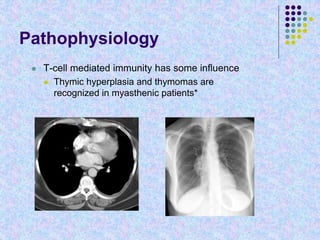
 T-cell mediated immunity has some influence
 Thymic hyperplasia and thymomas are
recognized in myasthenic patients*
Epidemiology
 Frequency
 Annual incidence in US- 2/1,000,000 (E)
 Worldwide prevalence 1/10,000 (D)
 Mortality/morbidity
 Recent decrease in mortality rate due to advances in treatment
 3-4% (as high as 30-40%)
 Risk factors
 Age > 40
 Short history of disease
 Thymoma
 Sex
 F-M (6:4)
 Mean age of onset (M-42, F-28)
 Incidence peaks- M- 6-7th decade F- 3rd decade
Clinical Presentation
 Fluctuating weakness increased by exertion
 Weakness increases during the day and improves
with rest
 Extraocular muscle weakness
 Ptosis is present initially in 50% of patients and
during the course of disease in 90% of patients
 Head extension and flexion weakness
 Weakness may be worse in proximal muscles
Clinical presentation
 Progression of disease
 Mild to more severe over weeks to months
 Usually spreads from ocular to facial to bulbar to truncal
and limb muscles
 Often, symptoms may remain limited to EOM and eyelid
muscles for years
 The disease remains ocular in 16% of patients
 Remissions
 Spontaneous remissions rare
 Most remissions with treatment occur within the first three
years
Clinical presentation
 Basic physical exam findings
 Muscle strength testing
 Recognize patients who may develop respiratory
failure (i.e. difficult breathing)
 Sensory examination and DTR’s are normal
Clinical presentation
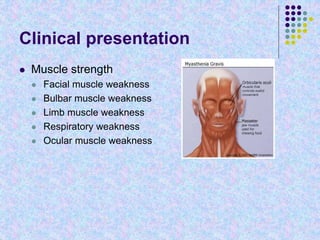
 Muscle strength
 Facial muscle weakness
 Bulbar muscle weakness
 Limb muscle weakness
 Respiratory weakness
 Ocular muscle weakness
Clinical presentation
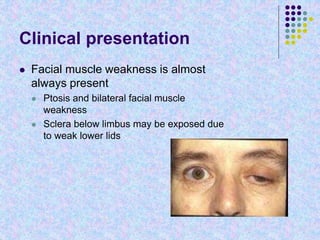
 Facial muscle weakness is almost
always present
 Ptosis and bilateral facial muscle
weakness
 Sclera below limbus may be exposed due
to weak lower lids
Clinical presentation
 Bulbar muscle weakness
 Palatal muscles
 “Nasal voice”, nasal regurgitation
 Chewing may become difficult
 Severe jaw weakness may cause jaw to hang open
 Swallowing may be difficult and aspiration may
occur with fluids—coughing and choking while
drinking
 Neck muscles
 Neck flexors affected more than extensors
Clinical presentation
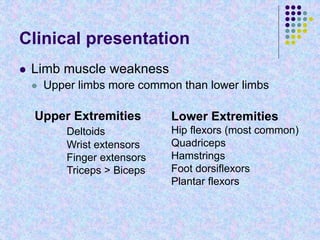
 Limb muscle weakness
 Upper limbs more common than lower limbs
Upper Extremities
Deltoids
Wrist extensors
Finger extensors
Triceps > Biceps
Lower Extremities
Hip flexors (most common)
Quadriceps
Hamstrings
Foot dorsiflexors
Plantar flexors
Clinical presentation
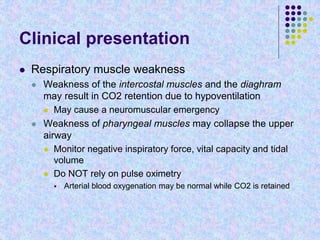
 Respiratory muscle weakness
 Weakness of the intercostal muscles and the diaghram
may result in CO2 retention due to hypoventilation
 May cause a neuromuscular emergency
 Weakness of pharyngeal muscles may collapse the upper
airway
 Monitor negative inspiratory force, vital capacity and tidal
volume
 Do NOT rely on pulse oximetry
 Arterial blood oxygenation may be normal while CO2 is retained
Clinical presentation
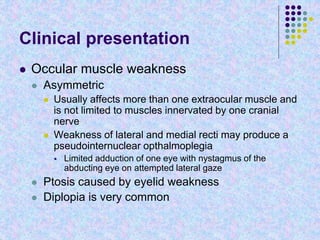
 Occular muscle weakness
 Asymmetric
 Usually affects more than one extraocular muscle and
is not limited to muscles innervated by one cranial
nerve
 Weakness of lateral and medial recti may produce a
pseudointernuclear opthalmoplegia
 Limited adduction of one eye with nystagmus of the
abducting eye on attempted lateral gaze
 Ptosis caused by eyelid weakness
 Diplopia is very common
Clinical presentation
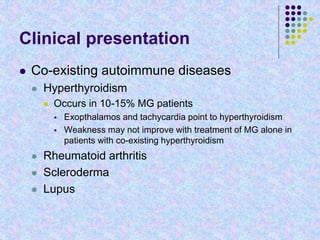
 Co-existing autoimmune diseases
 Hyperthyroidism
 Occurs in 10-15% MG patients
 Exopthalamos and tachycardia point to hyperthyroidism
 Weakness may not improve with treatment of MG alone in
patients with co-existing hyperthyroidism
 Rheumatoid arthritis
 Scleroderma
 Lupus
Clinical presentation
 Causes
 Idiopathic
 Penicillamine
 AChR antibodies are found in 90% of patients
developing MG secondary to penicillamine exposure
 Drugs
Clinical presentation
 Causes
 Drugs
 Antibiotics
(Aminoglycosides,
ciprofloxacin, ampicillin,
erythromycin)
 B-blocker (propranolol)
 Lithium
 Magnesium
 Procainamide
 Verapamil
 Quinidine
 Chloroquine
 Prednisone
 Timolol
 Anticholinergics
Differentials
 Amyotropic Lateral
Sclerosis
 Basilar Artery
Thrombosis
 Brainstem gliomas
 Cavernous sinus
syndromes
 Dermatomyositis
 Lambert-Eaton
Myasthenic Syndrome
 Multiple Sclerosis
 Sarcoidosis and
Neuropathy
 Thyroid disease
 Botulism
 Oculopharyngeal
muscular dystrophy
 Brainstem syndromes
 Lab studies
 Anti-acetylcholine receptor antibody
 Positive in 74%
 80% in generalized myasthenia
 50% of patients with pure ocular myasthenia
 Anti-striated muscle
 Present in 84% of patients with thymoma who are
younger than 40 years
 Imaging studies
 Chest x-ray
 Plain anteroposterior and lateral views may identify a
thymoma as an anterior mediastinal mass
 Chest CT scan is mandatory to identify thymoma
 MRI of the brain and orbits may help to rule out
other causes of cranial nerve deficits but should
not be used routinely
 Electrodiagnostic studies
 Repetitive nerve stimulation
 Single fiber electromyography
 SFEMG is more sensitive than RNS in MG
Pharmacological testing
 Edrophonium (Tensilon test)
 Patients with MG have low numbers of AChR at
the NMJ
 Ach released from the motor nerve terminal is
metabolized by Acetylcholine esterase
 Edrophonium is a short acting Acetylcholine
Esterase Inhibitor that improves muscle
weakness
 Evaluate weakness (i.e. ptosis and
opthalmoplegia) before and after administration
Pharmacological testing
 Edrophonium (Tensilon test)
 Steps
 0.1ml of a 10 mg/ml edrophonium solution is
administered as a test
 If no unwanted effects are noted (i.e. sinus
bradychardia), the remainder of the drug is injected
 Consider that Edrophonium can improve weakness in
diseases other than MG such as ALS, poliomyelitis,
and some peripheral neuropathies
Treatment
 AChE inhibitors
 Immunomodulating therapies
 Plasmapheresis
 Thymectomy
 Important in treatment, especially if thymoma is
present
Treatment
 AChE inhibitor
 Pyridostigmine bromide (Mestinon)
 Starts working in 30-60 minutes and lasts 3-6 hours
 Individualize dose
 Adult dose:
 60-960mg/d PO
 2mg IV/IM q2-3h
 Caution
 Check for cholinergic crisis
 Others: Neostigmine Bromide
Treatment
 Immunomodulating therapies
 Prednisone
 Most commonly used corticosteroid in US
 Significant improvement is often seen after a
decreased antibody titer which is usually 1-4 months
 No single dose regimen is accepted
 Some start low and go high
 Others start high dose to achieve a quicker response
 Clearance may be decreased by estrogens or digoxin
 Patients taking concurrent diuretics should be
monitored for hypokalemia
Treatment
 Diet
 Patients may experience difficulty chewing and
swallowing due to oropharyngeal weakness
 If dysphagia develops, liquids should be thickened
 Thickened liquids decrease risk for aspiration
 Activity
 Patients should be advised to be as active as
possible but should rest frequently and avoid
sustained activity
 Educate patients about fluctuating nature of
weakness and exercise induced fatigability
Complications of MG
 Respiratory failure
 Dysphagia
 Complications secondary to drug treatment
 Long term steroid use
 Osteoporosis, cataracts, hyperglycemia, HTN
 Gastritis, peptic ulcer disease
 Pneumocystis carinii
Prognosis
 Untreated MG carries a mortality rate of 25-
31%
 Treated MG has a 4% mortalitiy rate
 40% have ONLY occular symptoms
 Only 16% of those with occular symptoms at
onset remain exclusively occular at the end of 2
years
Rehabilitation
 Strategies emphasize
 Patient education
 Timing activity
 Providing adaptive equipment
 Providing assistive devices
 Exercise is not useful
References
1. Delisa, S. A., Goans, B., Rehabilitatoin Medicine Principles and
Practice, 1998, Lippencott-Raven
2. Kimura, J., Electrodiagnosis in Diseases of Nerve and Muscle,
F.A.Davis Company, Philadelphia
3. Rosenberg, R. N., Comprehensive Neurology, 1991, Raven
Press Ltd
4. O’sullivan, Schmidtz, Physical Medicine and Rehabilitation
Assessment and Treatment, pg. 151-152
5. Grabois, Garrison, Hart, Lehmke, Neuromuscular Diseases, pgs.
1653-1655
6. Shah, A. K., www.emedicine.com, Myasthenia Gravis, 2002,
Wayne State University
7. Tensilon test pictures
http://www.neuro.wustl.edu/neuromuscular/mtime/mgdx.html
Thank You!

Myasthenia gravis

  • 1.
    Myasthenia Gravis Dr. ShardenduKumar Mishra PhD Department of Pharmacology
  • 2.
    Outline  Background  Anatomy Pathophysiology  Epidemiology  Clinical Presentation  Work-up  Treatment  Rehabilitation
  • 3.
    Background  Acquired autoimmunedisorder  Clinically characterized by:  Weakness of skeletal muscles  Fatigability on exertion.  First clinical description in 1672 by Thomas Willis
  • 4.
    Anatomy  Neuromuscular Junction(NMJ)  Components:  Presynaptic membrane  Postsynaptic membrane  Synaptic cleft  Presynaptic membrane contains vesicles with Acetylcholine (ACh) which are released into synaptic cleft in a calcium dependent manner  ACh attaches to ACh receptors (AChR) on postsynaptic membrane
  • 5.
    Anatomy  Neuromuscular Junction(NMJ)  The Acetylcholine receptor (AChR) is a sodium channel that opens when bound by ACh  There is a partial depolarization of the postsynaptic membrane and this causes an excitatory postsynaptic potential (EPSP)  If enough sodium channels open and a threshold potential is reached, a muscle action potential is generated in the postsynaptic membrane
  • 6.
    Pathophysiology  In MG,antibodies are directed toward the acetylcholine receptor at the neuromuscular junction of skeletal muscles  Results in:  Decreased number of nicotinic acetylcholine receptors at the motor end-plate  Reduced postsynaptic membrane folds  Widened synaptic cleft
  • 7.
    Pathophysiology  Anti-AChR antibodyis found in 80- 90% of patients with MG  Proven with passive transfer experiments  MG may be considered a B cell- mediated disease  Antibodies
  • 8.
    Pathophysiology  T-cell mediatedimmunity has some influence  Thymic hyperplasia and thymomas are recognized in myasthenic patients*
  • 9.
    Epidemiology  Frequency  Annualincidence in US- 2/1,000,000 (E)  Worldwide prevalence 1/10,000 (D)  Mortality/morbidity  Recent decrease in mortality rate due to advances in treatment  3-4% (as high as 30-40%)  Risk factors  Age > 40  Short history of disease  Thymoma  Sex  F-M (6:4)  Mean age of onset (M-42, F-28)  Incidence peaks- M- 6-7th decade F- 3rd decade
  • 10.
    Clinical Presentation  Fluctuatingweakness increased by exertion  Weakness increases during the day and improves with rest  Extraocular muscle weakness  Ptosis is present initially in 50% of patients and during the course of disease in 90% of patients  Head extension and flexion weakness  Weakness may be worse in proximal muscles
  • 11.
    Clinical presentation  Progressionof disease  Mild to more severe over weeks to months  Usually spreads from ocular to facial to bulbar to truncal and limb muscles  Often, symptoms may remain limited to EOM and eyelid muscles for years  The disease remains ocular in 16% of patients  Remissions  Spontaneous remissions rare  Most remissions with treatment occur within the first three years
  • 12.
    Clinical presentation  Basicphysical exam findings  Muscle strength testing  Recognize patients who may develop respiratory failure (i.e. difficult breathing)  Sensory examination and DTR’s are normal
  • 13.
    Clinical presentation  Musclestrength  Facial muscle weakness  Bulbar muscle weakness  Limb muscle weakness  Respiratory weakness  Ocular muscle weakness
  • 14.
    Clinical presentation  Facialmuscle weakness is almost always present  Ptosis and bilateral facial muscle weakness  Sclera below limbus may be exposed due to weak lower lids
  • 15.
    Clinical presentation  Bulbarmuscle weakness  Palatal muscles  “Nasal voice”, nasal regurgitation  Chewing may become difficult  Severe jaw weakness may cause jaw to hang open  Swallowing may be difficult and aspiration may occur with fluids—coughing and choking while drinking  Neck muscles  Neck flexors affected more than extensors
  • 16.
    Clinical presentation  Limbmuscle weakness  Upper limbs more common than lower limbs Upper Extremities Deltoids Wrist extensors Finger extensors Triceps > Biceps Lower Extremities Hip flexors (most common) Quadriceps Hamstrings Foot dorsiflexors Plantar flexors
  • 17.
    Clinical presentation  Respiratorymuscle weakness  Weakness of the intercostal muscles and the diaghram may result in CO2 retention due to hypoventilation  May cause a neuromuscular emergency  Weakness of pharyngeal muscles may collapse the upper airway  Monitor negative inspiratory force, vital capacity and tidal volume  Do NOT rely on pulse oximetry  Arterial blood oxygenation may be normal while CO2 is retained
  • 18.
    Clinical presentation  Occularmuscle weakness  Asymmetric  Usually affects more than one extraocular muscle and is not limited to muscles innervated by one cranial nerve  Weakness of lateral and medial recti may produce a pseudointernuclear opthalmoplegia  Limited adduction of one eye with nystagmus of the abducting eye on attempted lateral gaze  Ptosis caused by eyelid weakness  Diplopia is very common
  • 19.
    Clinical presentation  Co-existingautoimmune diseases  Hyperthyroidism  Occurs in 10-15% MG patients  Exopthalamos and tachycardia point to hyperthyroidism  Weakness may not improve with treatment of MG alone in patients with co-existing hyperthyroidism  Rheumatoid arthritis  Scleroderma  Lupus
  • 20.
    Clinical presentation  Causes Idiopathic  Penicillamine  AChR antibodies are found in 90% of patients developing MG secondary to penicillamine exposure  Drugs
  • 21.
    Clinical presentation  Causes Drugs  Antibiotics (Aminoglycosides, ciprofloxacin, ampicillin, erythromycin)  B-blocker (propranolol)  Lithium  Magnesium  Procainamide  Verapamil  Quinidine  Chloroquine  Prednisone  Timolol  Anticholinergics
  • 22.
    Differentials  Amyotropic Lateral Sclerosis Basilar Artery Thrombosis  Brainstem gliomas  Cavernous sinus syndromes  Dermatomyositis  Lambert-Eaton Myasthenic Syndrome  Multiple Sclerosis  Sarcoidosis and Neuropathy  Thyroid disease  Botulism  Oculopharyngeal muscular dystrophy  Brainstem syndromes
  • 23.
     Lab studies Anti-acetylcholine receptor antibody  Positive in 74%  80% in generalized myasthenia  50% of patients with pure ocular myasthenia  Anti-striated muscle  Present in 84% of patients with thymoma who are younger than 40 years
  • 24.
     Imaging studies Chest x-ray  Plain anteroposterior and lateral views may identify a thymoma as an anterior mediastinal mass  Chest CT scan is mandatory to identify thymoma  MRI of the brain and orbits may help to rule out other causes of cranial nerve deficits but should not be used routinely
  • 25.
     Electrodiagnostic studies Repetitive nerve stimulation  Single fiber electromyography  SFEMG is more sensitive than RNS in MG
  • 26.
    Pharmacological testing  Edrophonium(Tensilon test)  Patients with MG have low numbers of AChR at the NMJ  Ach released from the motor nerve terminal is metabolized by Acetylcholine esterase  Edrophonium is a short acting Acetylcholine Esterase Inhibitor that improves muscle weakness  Evaluate weakness (i.e. ptosis and opthalmoplegia) before and after administration
  • 27.
    Pharmacological testing  Edrophonium(Tensilon test)  Steps  0.1ml of a 10 mg/ml edrophonium solution is administered as a test  If no unwanted effects are noted (i.e. sinus bradychardia), the remainder of the drug is injected  Consider that Edrophonium can improve weakness in diseases other than MG such as ALS, poliomyelitis, and some peripheral neuropathies
  • 28.
    Treatment  AChE inhibitors Immunomodulating therapies  Plasmapheresis  Thymectomy  Important in treatment, especially if thymoma is present
  • 29.
    Treatment  AChE inhibitor Pyridostigmine bromide (Mestinon)  Starts working in 30-60 minutes and lasts 3-6 hours  Individualize dose  Adult dose:  60-960mg/d PO  2mg IV/IM q2-3h  Caution  Check for cholinergic crisis  Others: Neostigmine Bromide
  • 30.
    Treatment  Immunomodulating therapies Prednisone  Most commonly used corticosteroid in US  Significant improvement is often seen after a decreased antibody titer which is usually 1-4 months  No single dose regimen is accepted  Some start low and go high  Others start high dose to achieve a quicker response  Clearance may be decreased by estrogens or digoxin  Patients taking concurrent diuretics should be monitored for hypokalemia
  • 31.
    Treatment  Diet  Patientsmay experience difficulty chewing and swallowing due to oropharyngeal weakness  If dysphagia develops, liquids should be thickened  Thickened liquids decrease risk for aspiration  Activity  Patients should be advised to be as active as possible but should rest frequently and avoid sustained activity  Educate patients about fluctuating nature of weakness and exercise induced fatigability
  • 32.
    Complications of MG Respiratory failure  Dysphagia  Complications secondary to drug treatment  Long term steroid use  Osteoporosis, cataracts, hyperglycemia, HTN  Gastritis, peptic ulcer disease  Pneumocystis carinii
  • 33.
    Prognosis  Untreated MGcarries a mortality rate of 25- 31%  Treated MG has a 4% mortalitiy rate  40% have ONLY occular symptoms  Only 16% of those with occular symptoms at onset remain exclusively occular at the end of 2 years
  • 34.
    Rehabilitation  Strategies emphasize Patient education  Timing activity  Providing adaptive equipment  Providing assistive devices  Exercise is not useful
  • 35.
    References 1. Delisa, S.A., Goans, B., Rehabilitatoin Medicine Principles and Practice, 1998, Lippencott-Raven 2. Kimura, J., Electrodiagnosis in Diseases of Nerve and Muscle, F.A.Davis Company, Philadelphia 3. Rosenberg, R. N., Comprehensive Neurology, 1991, Raven Press Ltd 4. O’sullivan, Schmidtz, Physical Medicine and Rehabilitation Assessment and Treatment, pg. 151-152 5. Grabois, Garrison, Hart, Lehmke, Neuromuscular Diseases, pgs. 1653-1655 6. Shah, A. K., www.emedicine.com, Myasthenia Gravis, 2002, Wayne State University 7. Tensilon test pictures http://www.neuro.wustl.edu/neuromuscular/mtime/mgdx.html
  • 36.