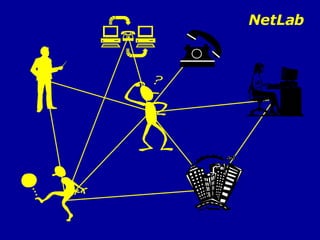
A Non-Technical Introduction to Social Network Analysis Barry Wellman Founder, International Network  For Social Network Analysis Centre for Urban & Community Studies  University of Toronto  Toronto, Canada M5S 1A1 [email_address] www.chass.utoronto.ca/~wellman Networks  For  Newbies
NetLab
Three Ways to Look at Reality Categories All Possess One or More Properties as an Aggregate of Individuals Examples:  Men, Developed Countries Groups (Almost) All Densely-Knit Within Tight Boundary Thought of as  a Solidary Unit  (Really a Special Network) Family, Workgroup, Community Networks Set of Connected Units: People, Organizations, Networks Can Belong to Multiple Networks Examples:  Friendship, Organizational, Inter-Organizational, World-System, Internet
Nodes, Relationships & Ties Nodes: A Unit That Possibly is Connected Individuals, Households, Workgroups,Organizations, States Relationships (A Specific Type of Connection) A “Role Relationship” Gives Emotional Support Sends Money To Attacks Ties  (One or More Relationships) Friendship (with possibly many relationships) Affiliations ( Person – Organization) Works for IBM; INSNA Member; Football Team One-Mode, Two-Mode Networks
A Network is More Than  The Sum of Its Ties A Network Consists of One or More  Nodes Could be Persons, Organizations, Groups, Nations Connected by One or More  Ties Could be One or More Relationships That Form Distinct, Analyzable  Patterns Can Study Patterns of  Relationships  OR  Ties Emergent Properties  (Simmel vs. Homans)
In a Sentence – “ To Discover How A, Who is in Touch with B and C,  Is Affected by the Relation Between B & C” John Barnes
2 Minute History of Sunbelt Conference Informal conferences in mid-late 1970s Toronto (1974); Hawaii Formalized as Sunbelt 1981 – annual Why “Sunbelt”? Normal Rotation: SE US, US West, Europe Slovenia (2004); Charleston (Feb 2005), Vancouver? Always Informal, But Serious Work
10 Minute History of INSNA Founded by Barry Wellman in 1976-1977 Sabbatical Travel Carried Tales Nick Mullins: Every “Theory Group” Has an Organizational Leader Owned by Wellman until 1988 as small business Subsequent Coordinators/Presidents Al Wolfe, Steve Borgatti, Martin Everett Steering Committee Non-Profit Constitution under Borgatti; Coordinator > President Bill Richards President, 2003- Scott Feld VP; Katie Faust Treasurer; Frans Stokman, Euro. Rep. Our First Real Election Grown from 175 to 400 Members Many More on Listserv (Not Limited to Members) Steve Borgatti maintains; unmoderated Website: www.insna.sfu.ca -- being upgraded
10 Minute Overview - Journals Wellman founded,edited,published  Connections,  1977 Informal journal: “Useful” articles, news, gossip, grants, abstracts, book summaries Bill Richards, Tom Valente edit now Lin Freeman founded, edits  Social Networks,  1978? Formal journal: Refereed articles Ronald Breiger now co-editor David Krackhardt founded, edits J of  Social Structure,  2000? Online, Refereed Lots of visuals Articles Appear Occasionally when their time has come
10 Minute Overview – Key Books Elizabeth Bott,  Family & Social Network,  1957 J. Clyde Mitchell,  Networks, Norms & Institutions,  1973 Holland & Leinhardt,  Perspectives on Social Network  Research, 1979s S. D. Berkowitz,  An Introduction to Structural Analysis,  1982 Knoke & Kuklinski,  Network Analysis,  1983, Sage, low-cost Charles Tilly,  Big Structures, Large Processes, Huge  Comparisons,  1984 Wellman & Berkowitz, eds.,  Social Structures , 1988 David Knoke,  Political Networks,  1990 John Scott,  Social Network Analysis,  1991 Ron Burt,  Structural Holes,  1992 Manuel Castells,  The Rise of Network Society,  1996, 2000 Wasserman & Faust,  Social Network Analysis, 1992 Nan Lin,  Social Capital  (monograph & reader), 2001
10 Minute Overview – Software UCINet – Whole Network Analysis Lin Freeman, Steve Borgatti, Martin Everett MultiNet – Whole Network Analysis  + Nodal Characteristics Structure – Ron Burt – Not Maintained P*Star – Dyadic Analysis – Stan Wasserman Krackplot – Network Visualization (Obsolete) David Krackhardt, Jim Blythe Pajek – Network Visualization – Supersedes Krackplot  Slovenia Personal Network Analysis SPSS/SAS – See Wellman, et al. “How To…” papers
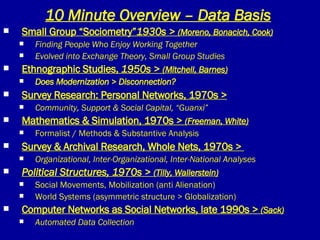
10 Minute Overview – Data Basis Small Group “Sociometry” 1930s >  (Moreno, Bonacich, Cook) Finding People Who Enjoy Working Together Evolved into Exchange Theory, Small Group Studies Ethnographic Studies,  1950s >  (Mitchell, Barnes) Does Modernization > Disconnection? Survey Research: Personal Networks, 1970s > Community, Support & Social Capital, “Guanxi” Mathematics & Simulation, 1970s >  (Freeman, White) Formalist / Methods & Substantive Analysis Survey & Archival Research, Whole Nets, 1970s >  Organizational, Inter-Organizational, Inter-National Analyses Political Structures, 1970s >  (Tilly, Wallerstein) Social Movements, Mobilization (anti Alienation) World Systems (asymmetric structure > Globalization) Computer Networks as Social Networks, late 1990s >  (Sack) Automated Data Collection
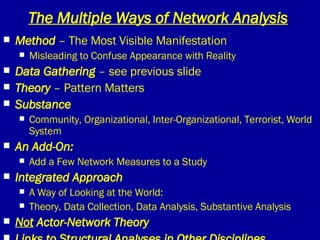
The Multiple Ways of Network Analysis Method  – The Most Visible Manifestation Misleading to Confuse Appearance with Reality Data Gathering  –  see previous slide Theory  – Pattern Matters Substance Community, Organizational, Inter-Organizational, Terrorist, World System An Add-On:  Add a Few Network Measures to a Study Integrated Approach A Way of Looking at the World:  Theory, Data Collection, Data Analysis, Substantive Analysis Not  Actor-Network Theory Links to Structural Analyses in Other Disciplines
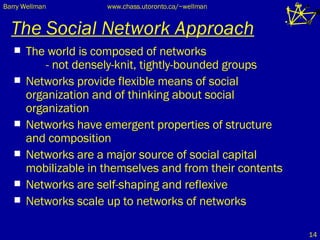
The Social Network Approach The world is composed of networks  - not densely-knit, tightly-bounded groups Networks provide flexible means of social organization and of thinking about social organization Networks have emergent properties of structure and composition  Networks are a major source of social capital mobilizable in themselves and from their contents Networks are self-shaping and reflexive Networks scale up to networks of networks
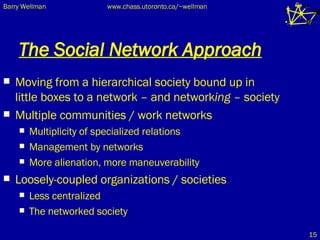
The Social Network Approach Moving from a hierarchical society bound up in  little boxes to a network – and network ing  – society Multiple communities / work networks Multiplicity of specialized relations Management by networks More alienation, more maneuverability Loosely-coupled organizations / societies Less centralized The networked society
Changing Connectivity: Groups to Networks Densely Knit > Sparsely-Knit Impermeable (Bounded) > Permeable Broadly-Based Solidarity >  Specialized Multiple Foci
Networked Individualism Moving from a society bound up in little boxes to a multiple network – and network ing  – society Networks are a flexible means of social organization Networks are a major source of social capital:  mobilizable in themselves & from their contents Networks link: Persons Within organizations Between organizations and institutions
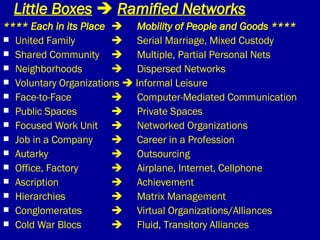
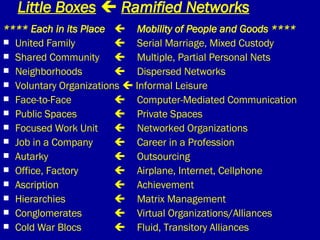
Little Boxes      Ramified Networks **** Each in its Place  Mobility of People and Goods **** United Family    Serial Marriage, Mixed Custody Shared Community     Multiple, Partial Personal Nets Neighborhoods     Dispersed Networks Voluntary Organizations    Informal Leisure Face-to-Face     Computer-Mediated Communication Public Spaces     Private Spaces Focused Work Unit   Networked Organizations Job in a Company   Career in a Profession Autarky   Outsourcing Office, Factory     Airplane, Internet, Cellphone Ascription     Achievement Hierarchies     Matrix Management Conglomerates     Virtual Organizations/Alliances Cold War Blocs     Fluid, Transitory Alliances
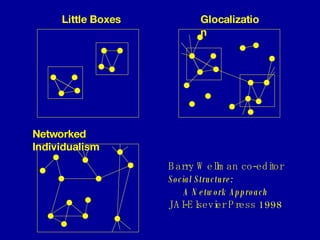
Barry Wellman co-editor  Social Structure:    A Network Approach JAI-Elsevier Press 1998 Little Boxes Glocalization Networked Individualism
Ways of Looking at Networks Whole Networks  & Personal Networks Focus on the System or on the Set of Individuals Graphs & Matrices We dream in graphs We analyze in matrices
Whole Social Networks Comprehensive Set of Role Relationships in an Entire Social System Analyze Each Role Relationship – Can Combine  Composition:  % Women; Heterogeneity; % Weak Ties Structure:  Pattern of Ties Village, Organization, Kinship, Enclaves,  World-System Copernican Airplane View Typical Methods:  Cliques, Blocks, Centrality, Flows Examples:  (1)   What is the Real Structure of an Organization? (2) How Does Information Flow Through a Village?
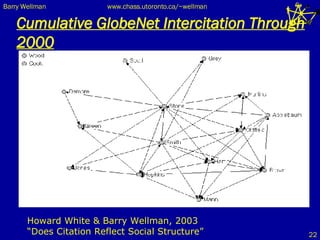
Cumulative GlobeNet Intercitation Through 2000 Howard White & Barry Wellman, 2003  “Does Citation Reflect Social Structure”
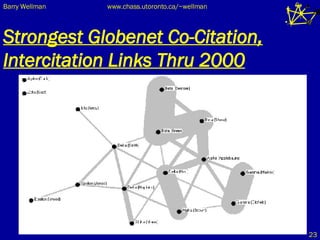
Strongest Globenet Co-Citation, Intercitation Links Thru 2000
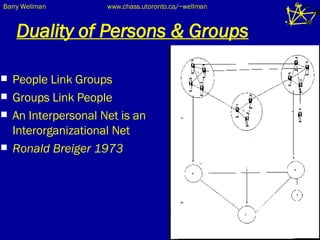
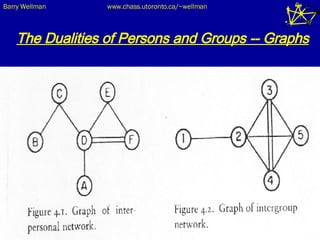
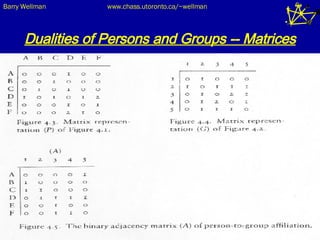
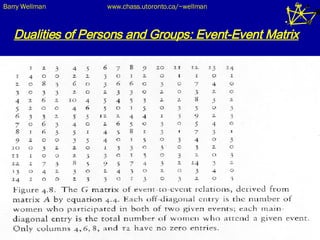
Duality of Persons & Groups People Link Groups Groups Link People An Interpersonal Net is an Interorganizational Net Ronald Breiger 1973
The Dualities of Persons and Groups -- Graphs
Dualities of Persons and Groups -- Matrices
Dualities of Persons and Groups: Event-Event Matrix
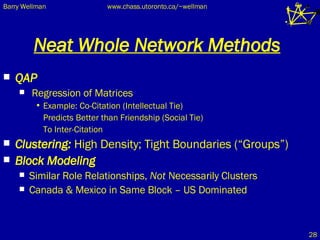
Neat Whole Network Methods QAP Regression of Matrices Example: Co-Citation (Intellectual Tie)  Predicts Better than Friendship (Social Tie) To Inter-Citation Clustering:  High Density; Tight Boundaries (“Groups”) Block Modeling Similar Role Relationships,  Not  Necessarily Clusters Canada & Mexico in Same Block – US Dominated
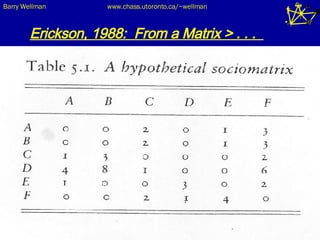
Erickson, 1988:  From a Matrix > . . .
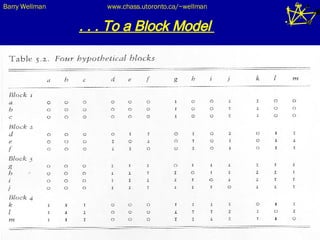
. . . To a Block Model
Costs of Whole Network Analysis Requires a Roster of Entire Population Requires (Imposition of) a Social Boundary This May Assume What You Want to Find Hard to Handle Missing Data Needs Special Analytic Packages Becoming Easier to Use
Personal Social Networks Ptolemaic Ego-Centered View Good for Unbounded Networks Often Uses Survey Research Example:  (1)   Do Densely-Knit Networks Provide More Support?  (structure) (2) Do More Central People Get More Support? (network) (2) Do Women Provide More Support?  (composition) (3) Do Face-to-Face Ties Provide More Support Than Internet Ties?  (relational) (4) Are People More Isolated Now?  (ego)
Costs of Personal Network Studies Concentrates on Strong Ties Collecting Proper Data in Survey Takes Much Time Ignores Ecological Juxtapositions Hard to Aggregate from Personal Network to Whole Network Easier to Decompose Whole Network (Haythornthwaite & Wellman) Often Relies on Respondents’ Reports
Social Network Analysis: More Flavors Diffusion of Information (& Viruses) Flows Through Systems Organizational Analyses “ Real” Organization” Knowledge Acquisition & Management Inter-Organizational Analysis Is There a Ruling Elite Strategies, Deals Networking: How People Network As a Strategy Unconscious Behavior Are There Networking Personality Types?
SNA: Branching Out Social Movements World-Systems Analyses Cognitive Networks Citation Networks Co-Citation Inter-Citation Applied Networks Terrorist Networks Corruption Networks
Multilevel Analysis: New Approach to an Old Problem Switching and Combining Levels Individual Agency, Dyadic Dancing,  Network Facilitation & Emergent Properties Consider Wider Range of Theories Disentangles  (& Avoids Nagging Confounding) Tie Effects Network  Effects Contingent (Cross-Level) Effects Interactions Addresses  Emergent Properties Fundamental Sociological Issue Simmel vs. Homans
Multilevel Analysis – Tie Effects Tie Strength:  Stronger is More Supportive Workmates:  Provide More Everyday Support (Multilevel Discovered This)
Multilevel Analysis– Network Effects Network Size  Not Only More Support from Entire Network More Probability of Support from Each Network Member Mutual Ties ( Reciprocity):  Those Who Have More Ties with Network Members Provide More Support Cross-Level Effect Stronger (and Attenuates) Dyadic (Tie-Level) Effect It’s Contribution to the Network, Not the Alter
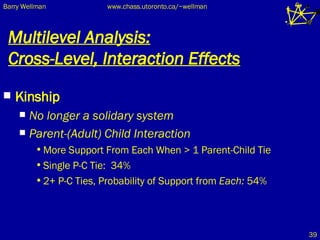
Multilevel Analysis: Cross-Level, Interaction Effects Kinship No longer a solidary system Parent-(Adult) Child Interaction More Support From Each When > 1 Parent-Child Tie Single P-C Tie:  34% 2+ P-C Ties, Probability of Support from  Each:  54%
Multilevel Interactions-- Accessibility  37% of Moderately Accessible  Ties  Provide Everyday Support But If Overall Network Is  Moderately Supportive, 54% of All Network Members  Provide Everyday Support Women More Supportive  In Nets with More Women
The Internet in Everyday Life Computer Networks as Social Networks  Key Questions Community On and Off line Networked Life before the Internet Netville: The Wired Suburb Large Web Surveys: National Geographic Work On and Off line Towards Networked Individualism,  or The Retreat to Little Boxes
Social Affordances of New Forms of Computer-Mediated Connectivity Bandwidth Ubiquity – Anywhere, Anytime Convergence – Any Media Accesses All Portability – Especially Wireless Globalized Connectivity Personalization
Research Questions Ties:  Does the Internet support  all types of ties ? Weak  and  Strong? Instrumental  and  Socio-Emotional? Online-Only or Using Internet & Other Media (F2F, Phone)? Social Capital:  Has the Internet  increased,   decreased,  or  multiplied   contact – at work, in society? Interpersonally – Locally Interpersonally – Long Distance Organizationally  GloCalization:   Has the map of the world dissolved so much that  distance  does not matter?   Has the Internet brought  spatial  and  social   peripheries   closer to the center?
Research Questions  (cont’d) Structure:  Does the Internet facilitate working in  loosely-coupled   networks  rather than  dense, tight groups ? Knowledge Management:  How do people find and acquire usable knowledge in networked and virtual organizations
Guiding Research Principles Substitute systematic data analysis for hype Do field studies, not lab experiments Combine statistical with observational info. Study the use of each media in larger context Work with other disciplines Analyze Existing Uses Develop New Uses
Studies of Community  On and Off-Line Pre-Internet Networked Communities “ Netville”: The Wired Suburb National Geographic Web Survey 1998, 2001 Other Internet Community Studies Barry Wellman,   “The Network Community”    Introduction to  Networks in the Global Village   Westview Press, 1999
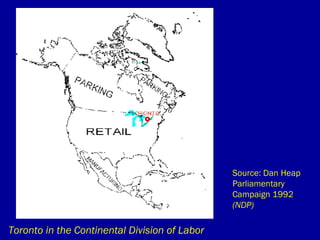
Source: Dan Heap Parliamentary Campaign 1992  (NDP) Toronto in the Continental Division of Labor
Physical Place and Cyber Place Door to Door, Place to Place,  Person to Person, Role to Role Barry Wellman, “Changing Connectivity: A Future History of Y2.03K.”  Sociological Research Online  4, 4, February 2000: http://www.socresonline.org.uk/4/wellman.html Barry Wellman, “Physical Place and Cyber Place: The Rise of Networked Individualism.”  International Journal of Urban and Regional Research  25   (2001): June.
Door To Door Old Workgroups/ Communities Based on  Propinquity, Kinship  Pre-Industrial Villages, Wandering Bands All Observe and Interact with All Deal with Only One Group Knowledge Comes Only From Within the Group – and Stays Within the Group
Place To Place (Phones, Networked PCs, Airplanes, Expressways, RR, Transit) Home, Office Important Contexts,  Not Intervening Space Ramified & Sparsely Knit: Not Local Solidarities Not neighborhood-based Not densely-knit with a group feeling Partial Membership in Multiple Workgroups/ Communities  Often Based on Shared Interest Connectivity Beyond Neighborhood, Work Site Household to Household / Work Group to Work Group Domestication, Feminization of Community Deal with Multiple Groups Knowledge Comes From Internal & External Sources “ Glocalization”: Globally Connected, Locally Invested
Person To Person (Cell Phones, Wireless Computing) Little Awareness of Context Individual, Not Household or Work Group Personalized Networking Tailored Media Interactions Private Desires Replace Public Civility Less Caring for Strangers, Fewer Weak Ties Online Interactions Linked with Offline Dissolution of the Internal: All Knowledge is External
Role To Role Tailored Communication Media Little Awareness of Whole Person Portfolios of Specialized Relationships Boutiques, not Variety Stores Cycling among Specialized  Communities / Work Groups Role-Based Media Interactions Management by Network
“ Netville”: The Wired Suburb Leading-Edge Development Exurban Toronto Mid-Priced, Detached Tract Homes Bell Canada, etc. Field Trial 10Mb/sec, ATM-Based, No-Cost Internet Services Ethnographic Fieldwork Hampton Lived There for 2 Years Survey Research Wants, Networks, Activities
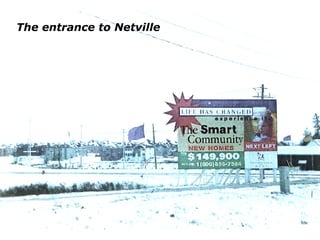
The entrance to Netville
View of   Netville
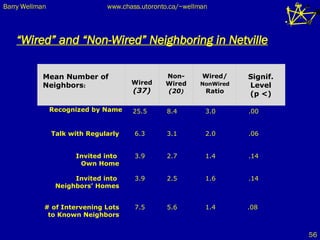
“ Wired” and “Non-Wired” Neighboring in Netville   Recognized by Name 25.5 8.4 3.0 .00 Talk with Regularly 6.3 3.1 2.0 .06 Invited into  Own Home 3.9 2.7 1.4 .14 Invited into  Neighbors’ Homes 3.9 2.5 1.6 .14 # of Intervening Lots to Known Neighbors 7.5 5.6 1.4 .08   Mean Number of Neighbors :     Wired (37)   Non-Wired (20 ) Wired/   NonWired  Ratio   Signif. Level (p <)
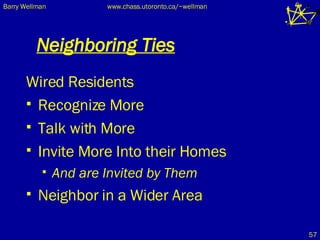
Neighboring Ties   Wired Residents Recognize More Talk with More Invite More Into their Homes  And are Invited by Them Neighbor in a Wider Area
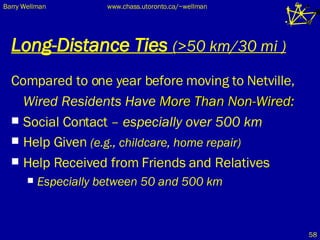
Long-Distance Ties   (>50 km/30 mi ) Compared to one year before moving to Netville, Wired Residents Have  More Than Non-Wired: Social Contact  – especially over 500 km Help Given  (e.g., childcare, home repair) Help Received from Friends and Relatives Especially between 50 and 500 km
Long-Distance Ties Wired Residents Say the Internet: Makes it Easier to Communicate Fosters Greater Volume of Communication Introduces New Modes of Communication Acquire More Diverse Knowledge
“ Netville”: The Wired Suburb With Keith Hampton (MIT) “ Netville Online and Offline: Observing and Surveying a Wired Suburb.”  American Behavioral Scientist  43, 3  (Nov 1999): 475-92.  “ Examining Community in the Digital Neighborhood” Pp. 475-92 in  Digital Cities: Technologies, Experiences and Future Perspectives , edited by Toru Ishida and Katherine Isbister. Berlin: Springer-Verlag, 2000.  “ Long Distance Community in the Network Society”  American Behavioral Scientist , 45 (Nov 2001): 477-97 “ How the Internet Builds Local Community”.  City and Community,  2001
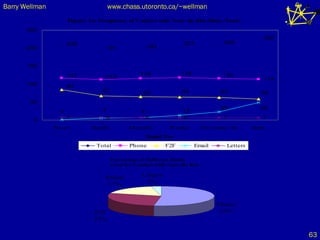
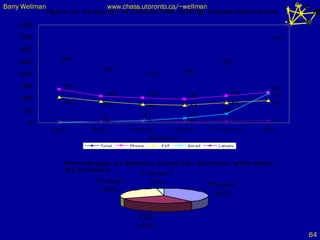
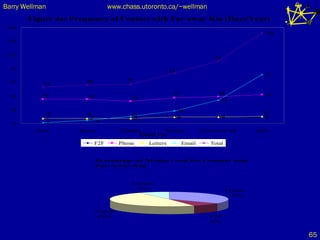
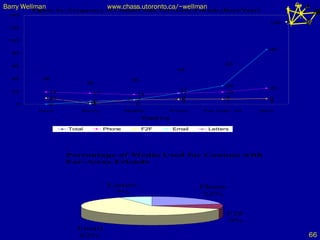
National Geographic  Survey 2000  and Survey 2001 “ Survey 2000” --   Fall 1998 35,000  Americans 5,000  Canadians 15,000  “Others”  “ Survey 2001” -- Fall  2001, N > 6,000
Survey 2000 Research Questions Are There Systematic Social Variations in  Who Uses the Internet – for What? Does the Internet Multiply, Add To, or Decrease  Interpersonal Ties ? Does the Internet Multiply, Add To, or Decrease  Organizational Involvement ? Does the Internet Increase, Decrease or Transform  Community Commitment? Does the Internet Increase Knowledge? Are There Variations by National Context?


Computer Supported Cooperative Work Fishbowls and Switchboards Media Use and Choice Cerise Indigo Networked Scholarly Organizations Technet Globenet Teleworking: The Home-Work Nexus
The “Fishbowl” Group Office:   Door-to-Door All Work Together in Same Room All Visible to Each Another All have Physical Access to Each Other All can see when a Person is Interruptible All can see when One Person is with Another No Real Secrets No Secret Meetings Anyone can Observe Conversations & Decide to Join Little Alert to Others Approaching
Neighbors have Hi Visual & Aural Awareness Limited Number of Participants Densely-Knit  (most directly connected) Tightly Bounded  (most interactions within group) Frequent Contact Recurrent Interactions Long-Duration Ties Cooperate for Clear, Collective purposes Sense of Group Solidarity  (name, collective identity) Social Control by Supervisor & Group
The “Switchboard” Network Office: Person-to-Person Each Works Separately Office Doors Closable for Privacy Glass in Doors Indicate Interruptibility If Doors Locked, Must Knock  If Doors Open, Request Admission Difficult to learn if Person is Dealing with Others Unless Door is Open Large Number of Potential Interactors Average Person knows  > 1,000 Strangers & Friends of Friends May also be Contacted
Sparsely-Knit  Most Don’t Know Each Other Or Not  Aware of Mutual Contact No Detailed Knowledge of Indirect Ties Loosely-Bounded Many Different People Contacted Many Different Workplaces Can Link with Outside Organizations Each Functions Individually Collective Activities Transient, Shifting Sets  Subgroups, Cleavages, Secrets Can Develop
“ Cerise” / “Indigo” CSCW Using Video/ Email at Work R&D Work:  Faculty, Students, Programmers, Admin. Caroline Haythornthwaite &  Laura Garton Collaborators Survey and Ethnography
CSCW Research Questions How do Work, Social Roles Affect Media Use? Is Email Used Only for Specialized Communication? Does Email Use:   Replace, Add To, or Increase F2F, Phone Contact? Does Email Move Spatial/Social Peripheries    Socially Closer? Does Email Foster Networked Organization?
Separate Information Exchange Roles   Derived from Factor Analysis of Specific Exchanges Work Giving Work Receiving Work Collaborative Writing Computer Programming Social Sociability Major Emotional Support
Communication Roles Scheduled Meetings  Classes, Research Meetings   Email Unscheduled Meetings  Less Frequent, More Wide-Ranging   Media that Afford Control of Interactions Media associated with Group Norms
Social Roles Sociability, major emotional support Media Use follows Pairs’ Interaction Patterns Unscheduled Meetings for Close Friends Unscheduled, Scheduled, Email for Work-Only Media that Affords Spontaneity Social Messages Tag on Work Messages Work-Only Pairs; Formal Work-Role Pairs
The Average Pair: Specialized :   Exchanges 3/6 Types of Information Via 1 or 2 Media Unscheduled F2F, Scheduled F2F Meetings, or Email Mean = 5.2 Information-Media Links / Pair
Conclusions: The Cerise Study Away from Individual Choice, Congruency Social Affordances Only Create Possibilities Email Used for All Roles: Work, Knowledge, Sociability and Support Email Lowers Status Distances Email Network  Not  a Unique Social Network Intermixed with Face-to-Face  (low use of phone, video, fax) Reduces Temporal as well as Spatial Distances
The More Email, the More F2F Contact The More Intense Work & Friendship Tie The More Frequent Email  Independent Predictors: Friendship a bit Stronger The More Intense Work & Friendship Tie The More Types of Media Used to Communicate Independent Predictors: Friendship Stronger F2F the Medium of choice in weaker ties.  In Stronger Ties, Email Supplements F2F
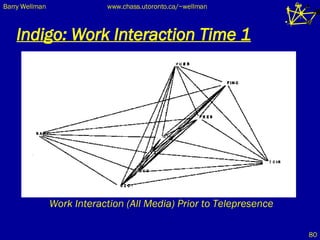
Indigo: Work Interaction Time 1 Work Interaction (All Media) Prior to Telepresence
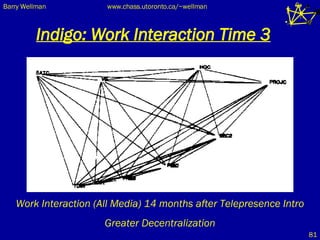
Indigo: Work Interaction Time 3 Work Interaction (All Media) 14 months after Telepresence Intro Greater Decentralization
“ Cerise” / “Indigo” Papers Caroline Haythornthwaite and Barry Wellman, “Work, Friendship and Media Use for Information Exchange in a Networked Organization.” Journal of the American Society for Information Science  49 (1998): 1101-14 Marilyn Mantei, Ronald Baecker, William Buxton, Thomas Milligan, Abigail Sellen and Barry Wellman. &quot;Experiences in the Use of a Media Space.&quot; 1992. Pp 372-78 in  Groupware,  edited by David Marca and Geoffrey Bock. Los Alamitos, CA: IEEE Computer Society Press, 1992.  Caroline Haythornthwaite, Barry Wellman & Marilyn Mantei “ Work Relationships and Media Use.”  Group Decision and Negotiation  4 (1995): 193-211.  Caroline Haythornthwaite, Barry Wellman & Laura Garton, “Work and Community Via Computer-Mediated Communication.” Pp. 199-226 in  Psychology and the Internet,  edited by Jayne Gackenbach. San Diego: Academic Press, 1998.
Netting Scholars:   Communities of Practice & Inquiry Emmanuel Koku, Nancy Nazer & Barry Wellman “ Netting Scholars: Online and Offline.”  American Behavioral Scientist , 44 ,10 (June, 2001): 1750-72 Emmanuel Koku & Barry Wellman “ Scholarly Networks as Learning Communities” In  Designing Virtual Communities in the Service of Learning,  Ed ited by Sasha Barab & Rob Kling.  Cambridge: Cambridge University Press, 2002
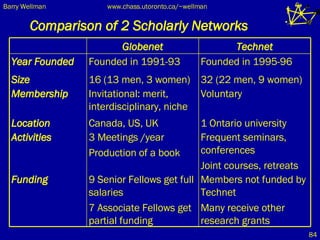
Comparison of 2 Scholarly Networks Members not funded by Technet Many receive other research grants 9 Senior Fellows get full salaries 7 Associate Fellows get partial funding Funding Frequent seminars, conferences Joint courses, retreats 3 Meetings /year Production of a book Activities 1 Ontario university Canada, US, UK Location Voluntary Invitational: merit, interdisciplinary, niche Membership 32 (22 men, 9 women) 16 (13 men, 3 women) Size Founded in 1995-96 Founded in 1991-93 Year Founded Technet Globenet
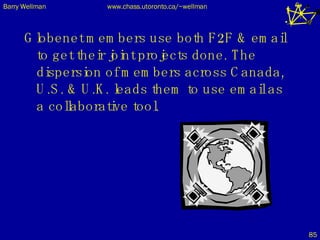
Globenet members use both F2F & email  to get their joint projects done. The dispersion of members across Canada, U.S. & U.K. leads them to use email as a collaborative tool.
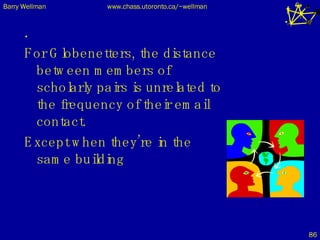
. For Globenetters, the distance between members of scholarly pairs is unrelated to the frequency of their email contact. Except when they’re in the same building
Friendship is the strongest predictor to face-to-face & email contact in Technet & Globenet
The scholarly relationship of collaborating on a project is the second strongest predictor of frequent F2F contact &  frequent email contact.  It & friendship are the only 2 significant predictors.
Congruent with the theories of media use: Tasks requiring complex negotiations preferably conducted via richer F2F contacts.  Technet members use F2F contact when possible. Email fills in temporal & informational gaps. Those Technet members who often read each other’s work, communicate more by email.
Where F2F contact is easily done, it is the preferred medium for collaborative work. However, colleagues easily share their ideas and their work – or announce its existence – by email and web postings. They do not have to walk over to each other’s offices to do this, although Canadian winters can inhibit in-person visits
Sources of Prominence in Globenet External Sources Important for Gaining Entrance Scholarly Status Niche Plus Perceived Internal Congeniality Internal Sources Important Within Network Knights of the Roundtable Formal Role Scholarly Communication within Network Number of Friendships
Summary: Ties Internet Supports  Strong & Weak Ties Evidence: Netville, Netting Scholars, Cerise, Telework Internet Supports Instrumental & Socioemotional Ties Evidence: Netville, National Geographic, Netting Scholars, Cerise, Telework Ties Rarely are Internet-Only Evidence: Netville, National Geographic, Netting Scholars, Cerise, Telework Internet Replaces Fax & May Reduce Phone –  Not F2F Evidence: Netville, Netting Scholars, Cerise
Summary: Local Social Capital Multiplied Number & Range of Neighbors Evidence: Netville Increased Contact with Existing Neighbors –  Email Adds On to Same Levels of F2F, Phone Evidence: National Geographic, Berkeley, Netville? Demand for Local Information Evidence: Netville, Berkeley, Small City Study
Summary: Long Distance Ties Increased Contact with Long Distance Ties –  Email Adds On to Same Levels of F2F, Phone 1.  Friends More than Kin 2.  Long-Distance Ties More than Local 3.  Post Used Only for Rituals  (Birthdays, Christmas) Evidence: National Geographic, Netville
Summary: Computer-Mediated Communication   Not only supports online “virtual” communities Supports and maintains existing ties: strong & weak Increases connectivity with weak ties Supports  both  local and non-local social ties In Neighborhood,  High-speed Network: Increases local network size Increases amount of local contact Long-Distance,  High-Speed Network Increases amount of contact Increases support exchanged Facilitates contact with geographical periphery
Summary:  The GloCalization Paradox Surf and Email Globally Stay Wired at Office/Home to be Online Desire for Local/Distant Services and Information  Internet Supplements/Augments F2F Doesn’t Replace It;  Rarely Used Exclusively Media Choice? By Any Means Available Many Emails are Local –    Within the Workgroup or Community Local Becomes Just Another Interest Evidence: Netville, National Geographic, Small Cities, Berkeley, Netting Scholars, Cerise, Indigo, Telework
Summary: Social Network Structure Internet Aids Both Direct & Indirect Connections Knowledge Acquisition & Management Accessing Friends of Friends Forwarding & Folding In: Making Indirect Ties Direct Ties Social and Spatial Peripheries Closer to the Center Shift from Spatial Propinquity to Shared Interests Shifting, Fluid Structures Networked, Long-Distance Coordination & “Reports”
Conclusions: Changing Connectivity By Any Means Available Door-to-Door  >  Place-to-Place    > Person-to-Person Connectivity Less Solidary Households Dual Careers Multiple Schedules Multiple Marriages New Forms of Community Partial Membership in Multiple Communities Networked & Virtual Work Relationships
Conclusions: Role-to-Role Relationships Partial Communities of:   Shared, Specialized Interest Importance of Informal Network Capital Production Reproduction Externalities Bridging and Bonding Ties
Conclusions: How a Network Society Looks Multiplicity of Specialized Relations Management by Networks More Uncertainty, More Maneuverability Boutiques, not General Stores Less Palpable than Traditional Solidarities Need Navigation Tools An Electronic Group is Virtually a Social Network.&quot; Pp. 179-205 in  Culture of the Internet,  edited by Sara Kiesler. Mahwah, NJ: Lawrence Erlbaum, 1997.
Conclusions: Shift to New Kinds  Of Community & Workgroups Partial Membership in Multiple Networks Multiple Reports Long-Distance Relationships Transitory Work Relationships Each Person Operates Own Network Online Interactions Linked with Offline Status, Power, Social Characteristics Important Sparsely-Knit: Fewer Direct Connections Than Door-To-Door --  Need for Institutional Memory & Knowledge Management IKNOW (Nosh Contractor) – Network Tracer ContactMap (Bonnie Nardi & Steve Whittaker) – Network Accumulator
Conclusions:  The Rise of Personalized Networking Individual Agency Constrained by Nets:  Personalization rather than Group Behavior Interpersonal Ties Dancing Dyadic Duets:  Bandwidth Sparsely-Knit, Physically-Dispersed Ties Social Networks Multiple, Ad Hoc Wireless Portability
Design Considerations for a Networked Society – Connecting Open List Indicate Presence, Awareness, Availability Prioritize from Deductive, Inductive &  Ad Hoc Data Prioritize by Locale Searchable and Sortable List By a Variety of Attributes
Design Considerations for a Networked Society – Autonomy Incorporate Third Parties Quickly Set Up & Dissolve Work Teams Privacy Protection Control Who is Aware of the Interaction Alert if Others Lurking File Access Cross-Platform Communication
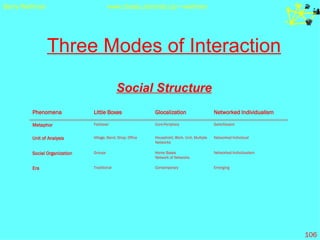
Three Modes of Interaction Social Structure Emerging Contemporary Traditional Era Networked Individualism Home Bases  Network of Networks Groups Social Organization Networked Individual Household, Work, Unit, Multiple Networks Village, Band, Shop, Office Unit of Analysis Switchboard Core-Periphery Fishbowl Metaphor Networked Individualism Glocalization Little Boxes Phenomena
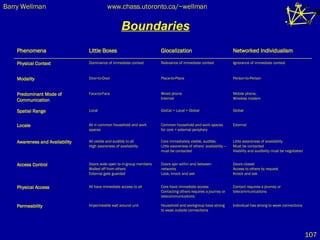
Boundaries Individual has strong to weak connections Household and workgroup have strong to weak outside connections Impermeable wall around unit Permeability Contact requires a journey or telecommunications Core have immediate access Contacting others requires a journey or telecommunications All have immediate access to all Physical Access Doors closed  Access to others by request Knock and ask Doors ajar within and between networks  Look, knock and ask Doors wide open to in-group members Walled off from others External gate guarded Access Control Little awareness of availability  Must be contacted  Visibility and audibility must be negotiated Core immediately visible, audible;  Little awareness of others’ availability -- must be contacted All visible and audible to all  High awareness of availability Awareness and Availability External Common household and work spaces for core + external periphery All in common household and work spaces Locale Global GloCal = Local + Global Local Spatial Range Mobile phone,  Wireless modem Wired phone Internet Face-to-Face Predominant Mode of Communication Person-to-Person Place-to-Place Door-to-Door Modality Ignorance of immediate context Relevance of immediate context Dominance of immediate context Physical Context Networked Individualism Glocalization Little Boxes Phenomena
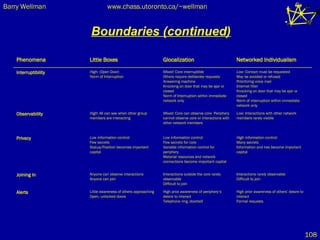
Boundaries (continued) Low : Contact must be requested  May be avoided or refused Prioritizing voice mail Internet filter Knocking on door that may be ajar or closed Norm of interruption within immediate network only Mixed : Core interruptible Others require deliberate requests Answering machine Knocking on door that may be ajar or closed Norm of Interruption within immediate network only High:  (Open Door)  Norm of Interruption Interruptibility Low : Interactions with other network members rarely visible Mixed : Core can observe core  Periphery cannot observe core or interactions with other network members High : All can see when other group members are interacting Observability High information control: Many secrets  Information and ties become important capital Low information control: Few secrets for core Variable information control for periphery Material resources and network connections become important capital Low information control:   Few secrets Status/Position becomes important capital Privacy High prior awareness of others’ desire to interact Formal requests High prior awareness of periphery’s desire to interact  Telephone ring, doorbell Little awareness of others approaching  Open, unlocked doors Alerts Interactions rarely observable  Difficult to join Interactions outside the core rarely observable  Difficult to join Anyone can observe interactions Anyone can join Joining In Networked Individualism Glocalization Little Boxes Phenomena
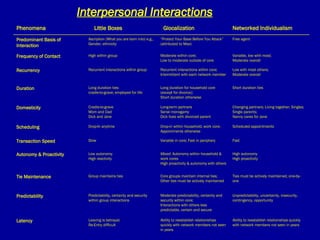
Interpersonal Interactions Ability to reestablish relationships quickly with network members not seen in years Ability to reestablish relationships quickly with network members not seen in years Leaving is betrayal;  Re-Entry difficult Latency Unpredictability, uncertainty, insecurity, contingency, opportunity Moderate predictability, certainty and security within core;  Interactions with others less predictable, certain and secure Predictability, certainty and security within group interactions Predictability Ties must be actively maintained, one-by-one Core groups maintain internal ties; Other ties must be actively maintained Group maintains ties Tie Maintenance High autonomy  High proactivity Mixed : Autonomy within household & work cores High proactivity & autonomy with others Low autonomy High reactivity Autonomy & Proactivity Fast Variable in core; Fast in periphery Slow Transaction Speed Scheduled appointments Drop-in within household, work core; Appointments otherwise Drop-In anytime Scheduling Changing partners; Living together; Singles; Single parents;  Nanny cares for Jane Long-term partners  Serial monogamy  Dick lives with divorced parent Cradle-to-grave Mom and Dad Dick and Jane Domesticity Short duration ties Long duration for household core (except for divorce);  Short duration otherwise Long duration ties: cradle-to-grave; employed for life Duration Low with most others;  Moderate overall Recurrent interactions within core; Intermittent with each network member Recurrent interactions within group Recurrency Variable, low with most;  Moderate overall Moderate within core;  Low to moderate outside of core High within group Frequency of Contact Free agent “ Protect Your Base Before You Attack” (attributed to Mao) Ascription (What you are born into) e.g., Gender, ethnicity Predominant Basis of Interaction Networked Individualism Glocalization Little Boxes Phenomena
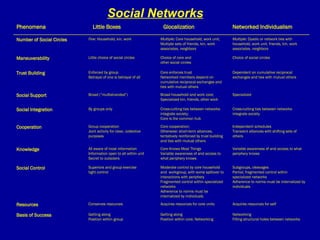
Social Networks Networking Filling structural holes between networks Getting along Position within core; Networking Getting along  Position within group Basis of Success Acquires resources for self Acquires resources for core units Conserves resources Resources Subgroups, cleavages  Partial, fragmented control within specialized networks Adherence to norms must be internalized by individuals Moderate control by core household and  workgroup, with some spillover to interactions with periphery  Fragmented control within specialized networks  Adherence to norms must be internalized by individuals Superiors and group exercise  tight control Social Control Variable awareness of and access to what periphery knows Core Knows Most Things  Variable awareness of and access to what periphery knows All aware of most information  Information open to all within unit  Secret to outsiders Knowledge Independent schedules  Transient alliances with shifting sets of others Core cooperation;  Otherwise: short-term alliances, tentatively reinforced by trust building and ties with mutual others Group cooperation Joint activity for clear, collective purposes Cooperation Cross-cutting ties between networks integrate society Cross-cutting ties between networks integrate society; Core is the common hub By groups only Social Integration Specialized Broad household and work core; Specialized kin, friends, other work Broad (“multistranded”) Social Support Dependent on cumulative reciprocal exchanges and ties with mutual others Core enforces trust  Networked members depend on cumulative reciprocal exchanges and ties with mutual others Enforced by group  Betrayal of one is betrayal of all Trust Building Choice of social circles Choice of core and  other social circles Little choice of social circles Maneuverability Multiple : Dyadic or network ties with household, work unit, friends, kin, work associates, neighbors Multiple : Core household, work unit; Multiple sets of friends, kin, work associates, neighbors Few : Household, kin, work Number of Social Circles Networked Individualism Glocalization Little Boxes Phenomena
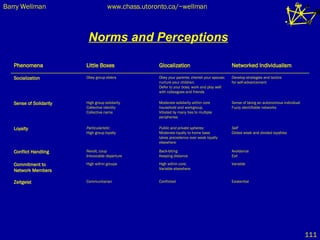
Norms and Perceptions Existential Conflicted  Communitarian Zeitgeist Variable High within core;  Variable elsewhere High within groups Commitment to  Network Members Avoidance Exit Back-biting Keeping distance Revolt, coup Irrevocable departure Conflict Handling Self Global weak and divided loyalties Public and private spheres:   Moderate loyalty to home base  takes precedence over weak loyalty elsewhere Particularistic :  High group loyalty Loyalty Sense of being an autonomous individual Fuzzy identifiable networks Moderate solidarity within core household and workgroup,  Vitiated by many ties to multiple peripheries High group solidarity Collective identity Collective name Sense of Solidarity Develop strategies and tactics  for self-advancement Obey your parents; cherish your spouse; nurture your children; Defer to your boss; work and play well with colleagues and friends Obey group elders Socialization Networked Individualism Glocalization Little Boxes Phenomena
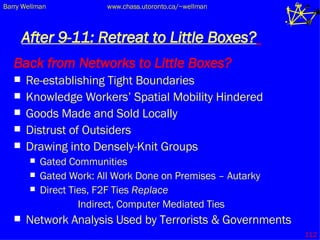
After 9-11: Retreat to Little Boxes?   Back from Networks to Little Boxes? Re-establishing Tight Boundaries Knowledge Workers’ Spatial Mobility Hindered Goods Made and Sold Locally Distrust of Outsiders Drawing into Densely-Knit Groups Gated Communities Gated Work: All Work Done on Premises – Autarky Direct Ties, F2F Ties  Replace  Indirect, Computer Mediated Ties Network Analysis Used by Terrorists & Governments
Little Boxes      Ramified Networks **** Each in its Place      Mobility of People and Goods **** United Family      Serial Marriage, Mixed Custody Shared Community       Multiple, Partial Personal Nets Neighborhoods       Dispersed Networks Voluntary Organizations    Informal Leisure Face-to-Face       Computer-Mediated Communication Public Spaces       Private Spaces Focused Work Unit       Networked Organizations Job in a Company       Career in a Profession Autarky       Outsourcing Office, Factory       Airplane, Internet, Cellphone Ascription      Achievement Hierarchies       Matrix Management Conglomerates       Virtual Organizations/Alliances Cold War Blocs       Fluid, Transitory Alliances
Edited Books The Internet in Everyday Life Caroline Haythornthwaite, co-editor Oxford: Blackwell Publishers 2002 Preliminary:  American Behavioral Scientist,  Nov 2001 Networks in the Global Village Boulder, CO: Westview Press 1999 Social Structures: A Network Approach S. D. Berkowitz, co-editor Cambridge University Press, 1988; Reprinted:  Elsevier-JAI Press, 1997 Reprinted:  CSPI Press, Toronto, 2003
Recent  Integrative Articles “ Computer Networks as Social Networks” Science  293 (Sept 14, 2001): 2031-34. “ Designing the Internet for a Networked Society.” Communications of the ACM,  April 2002: in press. Research Supported By: Institute of Knowledge Management , CITO, Mitel, National Science Foundation (US), Social Science & Humanities Research Council of Canada
Thank You -- Barry Wellman Director, NetLab Centre for Urban & Community Studies University of Toronto Toronto, Canada M5S 1A1 [email_address] www.chass.utoronto.ca/~wellman Networks For Ex-Newbies

networks4newbies

  • 1.
    A Non-Technical Introductionto Social Network Analysis Barry Wellman Founder, International Network For Social Network Analysis Centre for Urban & Community Studies University of Toronto Toronto, Canada M5S 1A1 [email_address] www.chass.utoronto.ca/~wellman Networks For Newbies
  • 2.
  • 3.
    Three Ways toLook at Reality Categories All Possess One or More Properties as an Aggregate of Individuals Examples: Men, Developed Countries Groups (Almost) All Densely-Knit Within Tight Boundary Thought of as a Solidary Unit (Really a Special Network) Family, Workgroup, Community Networks Set of Connected Units: People, Organizations, Networks Can Belong to Multiple Networks Examples: Friendship, Organizational, Inter-Organizational, World-System, Internet
  • 4.
    Nodes, Relationships &Ties Nodes: A Unit That Possibly is Connected Individuals, Households, Workgroups,Organizations, States Relationships (A Specific Type of Connection) A “Role Relationship” Gives Emotional Support Sends Money To Attacks Ties (One or More Relationships) Friendship (with possibly many relationships) Affiliations ( Person – Organization) Works for IBM; INSNA Member; Football Team One-Mode, Two-Mode Networks
  • 5.
    A Network isMore Than The Sum of Its Ties A Network Consists of One or More Nodes Could be Persons, Organizations, Groups, Nations Connected by One or More Ties Could be One or More Relationships That Form Distinct, Analyzable Patterns Can Study Patterns of Relationships OR Ties Emergent Properties (Simmel vs. Homans)
  • 6.
    In a Sentence– “ To Discover How A, Who is in Touch with B and C, Is Affected by the Relation Between B & C” John Barnes
  • 7.
    2 Minute Historyof Sunbelt Conference Informal conferences in mid-late 1970s Toronto (1974); Hawaii Formalized as Sunbelt 1981 – annual Why “Sunbelt”? Normal Rotation: SE US, US West, Europe Slovenia (2004); Charleston (Feb 2005), Vancouver? Always Informal, But Serious Work
  • 8.
    10 Minute Historyof INSNA Founded by Barry Wellman in 1976-1977 Sabbatical Travel Carried Tales Nick Mullins: Every “Theory Group” Has an Organizational Leader Owned by Wellman until 1988 as small business Subsequent Coordinators/Presidents Al Wolfe, Steve Borgatti, Martin Everett Steering Committee Non-Profit Constitution under Borgatti; Coordinator > President Bill Richards President, 2003- Scott Feld VP; Katie Faust Treasurer; Frans Stokman, Euro. Rep. Our First Real Election Grown from 175 to 400 Members Many More on Listserv (Not Limited to Members) Steve Borgatti maintains; unmoderated Website: www.insna.sfu.ca -- being upgraded
  • 9.
    10 Minute Overview- Journals Wellman founded,edited,published Connections, 1977 Informal journal: “Useful” articles, news, gossip, grants, abstracts, book summaries Bill Richards, Tom Valente edit now Lin Freeman founded, edits Social Networks, 1978? Formal journal: Refereed articles Ronald Breiger now co-editor David Krackhardt founded, edits J of Social Structure, 2000? Online, Refereed Lots of visuals Articles Appear Occasionally when their time has come
  • 10.
    10 Minute Overview– Key Books Elizabeth Bott, Family & Social Network, 1957 J. Clyde Mitchell, Networks, Norms & Institutions, 1973 Holland & Leinhardt, Perspectives on Social Network Research, 1979s S. D. Berkowitz, An Introduction to Structural Analysis, 1982 Knoke & Kuklinski, Network Analysis, 1983, Sage, low-cost Charles Tilly, Big Structures, Large Processes, Huge Comparisons, 1984 Wellman & Berkowitz, eds., Social Structures , 1988 David Knoke, Political Networks, 1990 John Scott, Social Network Analysis, 1991 Ron Burt, Structural Holes, 1992 Manuel Castells, The Rise of Network Society, 1996, 2000 Wasserman & Faust, Social Network Analysis, 1992 Nan Lin, Social Capital (monograph & reader), 2001
  • 11.
    10 Minute Overview– Software UCINet – Whole Network Analysis Lin Freeman, Steve Borgatti, Martin Everett MultiNet – Whole Network Analysis + Nodal Characteristics Structure – Ron Burt – Not Maintained P*Star – Dyadic Analysis – Stan Wasserman Krackplot – Network Visualization (Obsolete) David Krackhardt, Jim Blythe Pajek – Network Visualization – Supersedes Krackplot Slovenia Personal Network Analysis SPSS/SAS – See Wellman, et al. “How To…” papers
  • 12.
    10 Minute Overview– Data Basis Small Group “Sociometry” 1930s > (Moreno, Bonacich, Cook) Finding People Who Enjoy Working Together Evolved into Exchange Theory, Small Group Studies Ethnographic Studies, 1950s > (Mitchell, Barnes) Does Modernization > Disconnection? Survey Research: Personal Networks, 1970s > Community, Support & Social Capital, “Guanxi” Mathematics & Simulation, 1970s > (Freeman, White) Formalist / Methods & Substantive Analysis Survey & Archival Research, Whole Nets, 1970s > Organizational, Inter-Organizational, Inter-National Analyses Political Structures, 1970s > (Tilly, Wallerstein) Social Movements, Mobilization (anti Alienation) World Systems (asymmetric structure > Globalization) Computer Networks as Social Networks, late 1990s > (Sack) Automated Data Collection
  • 13.
    The Multiple Waysof Network Analysis Method – The Most Visible Manifestation Misleading to Confuse Appearance with Reality Data Gathering – see previous slide Theory – Pattern Matters Substance Community, Organizational, Inter-Organizational, Terrorist, World System An Add-On: Add a Few Network Measures to a Study Integrated Approach A Way of Looking at the World: Theory, Data Collection, Data Analysis, Substantive Analysis Not Actor-Network Theory Links to Structural Analyses in Other Disciplines
  • 14.
    The Social NetworkApproach The world is composed of networks - not densely-knit, tightly-bounded groups Networks provide flexible means of social organization and of thinking about social organization Networks have emergent properties of structure and composition Networks are a major source of social capital mobilizable in themselves and from their contents Networks are self-shaping and reflexive Networks scale up to networks of networks
  • 15.
    The Social NetworkApproach Moving from a hierarchical society bound up in little boxes to a network – and network ing – society Multiple communities / work networks Multiplicity of specialized relations Management by networks More alienation, more maneuverability Loosely-coupled organizations / societies Less centralized The networked society
  • 16.
    Changing Connectivity: Groupsto Networks Densely Knit > Sparsely-Knit Impermeable (Bounded) > Permeable Broadly-Based Solidarity > Specialized Multiple Foci
  • 17.
    Networked Individualism Movingfrom a society bound up in little boxes to a multiple network – and network ing – society Networks are a flexible means of social organization Networks are a major source of social capital: mobilizable in themselves & from their contents Networks link: Persons Within organizations Between organizations and institutions
  • 18.
    Little Boxes  Ramified Networks **** Each in its Place  Mobility of People and Goods **** United Family  Serial Marriage, Mixed Custody Shared Community  Multiple, Partial Personal Nets Neighborhoods  Dispersed Networks Voluntary Organizations  Informal Leisure Face-to-Face  Computer-Mediated Communication Public Spaces  Private Spaces Focused Work Unit  Networked Organizations Job in a Company  Career in a Profession Autarky  Outsourcing Office, Factory  Airplane, Internet, Cellphone Ascription  Achievement Hierarchies  Matrix Management Conglomerates  Virtual Organizations/Alliances Cold War Blocs  Fluid, Transitory Alliances
  • 19.
    Barry Wellman co-editor Social Structure: A Network Approach JAI-Elsevier Press 1998 Little Boxes Glocalization Networked Individualism
  • 20.
    Ways of Lookingat Networks Whole Networks & Personal Networks Focus on the System or on the Set of Individuals Graphs & Matrices We dream in graphs We analyze in matrices
  • 21.
    Whole Social NetworksComprehensive Set of Role Relationships in an Entire Social System Analyze Each Role Relationship – Can Combine Composition: % Women; Heterogeneity; % Weak Ties Structure: Pattern of Ties Village, Organization, Kinship, Enclaves, World-System Copernican Airplane View Typical Methods: Cliques, Blocks, Centrality, Flows Examples: (1) What is the Real Structure of an Organization? (2) How Does Information Flow Through a Village?
  • 22.
    Cumulative GlobeNet IntercitationThrough 2000 Howard White & Barry Wellman, 2003 “Does Citation Reflect Social Structure”
  • 23.
    Strongest Globenet Co-Citation,Intercitation Links Thru 2000
  • 24.
    Duality of Persons& Groups People Link Groups Groups Link People An Interpersonal Net is an Interorganizational Net Ronald Breiger 1973
  • 25.
    The Dualities ofPersons and Groups -- Graphs
  • 26.
    Dualities of Personsand Groups -- Matrices
  • 27.
    Dualities of Personsand Groups: Event-Event Matrix
  • 28.
    Neat Whole NetworkMethods QAP Regression of Matrices Example: Co-Citation (Intellectual Tie) Predicts Better than Friendship (Social Tie) To Inter-Citation Clustering: High Density; Tight Boundaries (“Groups”) Block Modeling Similar Role Relationships, Not Necessarily Clusters Canada & Mexico in Same Block – US Dominated
  • 29.
    Erickson, 1988: From a Matrix > . . .
  • 30.
    . . .To a Block Model
  • 31.
    Costs of WholeNetwork Analysis Requires a Roster of Entire Population Requires (Imposition of) a Social Boundary This May Assume What You Want to Find Hard to Handle Missing Data Needs Special Analytic Packages Becoming Easier to Use
  • 32.
    Personal Social NetworksPtolemaic Ego-Centered View Good for Unbounded Networks Often Uses Survey Research Example: (1) Do Densely-Knit Networks Provide More Support? (structure) (2) Do More Central People Get More Support? (network) (2) Do Women Provide More Support? (composition) (3) Do Face-to-Face Ties Provide More Support Than Internet Ties? (relational) (4) Are People More Isolated Now? (ego)
  • 33.
    Costs of PersonalNetwork Studies Concentrates on Strong Ties Collecting Proper Data in Survey Takes Much Time Ignores Ecological Juxtapositions Hard to Aggregate from Personal Network to Whole Network Easier to Decompose Whole Network (Haythornthwaite & Wellman) Often Relies on Respondents’ Reports
  • 34.
    Social Network Analysis:More Flavors Diffusion of Information (& Viruses) Flows Through Systems Organizational Analyses “ Real” Organization” Knowledge Acquisition & Management Inter-Organizational Analysis Is There a Ruling Elite Strategies, Deals Networking: How People Network As a Strategy Unconscious Behavior Are There Networking Personality Types?
  • 35.
    SNA: Branching OutSocial Movements World-Systems Analyses Cognitive Networks Citation Networks Co-Citation Inter-Citation Applied Networks Terrorist Networks Corruption Networks
  • 36.
    Multilevel Analysis: NewApproach to an Old Problem Switching and Combining Levels Individual Agency, Dyadic Dancing, Network Facilitation & Emergent Properties Consider Wider Range of Theories Disentangles (& Avoids Nagging Confounding) Tie Effects Network Effects Contingent (Cross-Level) Effects Interactions Addresses Emergent Properties Fundamental Sociological Issue Simmel vs. Homans
  • 37.
    Multilevel Analysis –Tie Effects Tie Strength: Stronger is More Supportive Workmates: Provide More Everyday Support (Multilevel Discovered This)
  • 38.
    Multilevel Analysis– NetworkEffects Network Size Not Only More Support from Entire Network More Probability of Support from Each Network Member Mutual Ties ( Reciprocity): Those Who Have More Ties with Network Members Provide More Support Cross-Level Effect Stronger (and Attenuates) Dyadic (Tie-Level) Effect It’s Contribution to the Network, Not the Alter
  • 39.
    Multilevel Analysis: Cross-Level,Interaction Effects Kinship No longer a solidary system Parent-(Adult) Child Interaction More Support From Each When > 1 Parent-Child Tie Single P-C Tie: 34% 2+ P-C Ties, Probability of Support from Each: 54%
  • 40.
    Multilevel Interactions-- Accessibility 37% of Moderately Accessible Ties Provide Everyday Support But If Overall Network Is Moderately Supportive, 54% of All Network Members Provide Everyday Support Women More Supportive In Nets with More Women
  • 41.
    The Internet inEveryday Life Computer Networks as Social Networks Key Questions Community On and Off line Networked Life before the Internet Netville: The Wired Suburb Large Web Surveys: National Geographic Work On and Off line Towards Networked Individualism, or The Retreat to Little Boxes
  • 42.
    Social Affordances ofNew Forms of Computer-Mediated Connectivity Bandwidth Ubiquity – Anywhere, Anytime Convergence – Any Media Accesses All Portability – Especially Wireless Globalized Connectivity Personalization
  • 43.
    Research Questions Ties: Does the Internet support all types of ties ? Weak and Strong? Instrumental and Socio-Emotional? Online-Only or Using Internet & Other Media (F2F, Phone)? Social Capital: Has the Internet increased, decreased, or multiplied contact – at work, in society? Interpersonally – Locally Interpersonally – Long Distance Organizationally GloCalization: Has the map of the world dissolved so much that distance does not matter? Has the Internet brought spatial and social peripheries closer to the center?
  • 44.
    Research Questions (cont’d) Structure: Does the Internet facilitate working in loosely-coupled networks rather than dense, tight groups ? Knowledge Management: How do people find and acquire usable knowledge in networked and virtual organizations
  • 45.
    Guiding Research PrinciplesSubstitute systematic data analysis for hype Do field studies, not lab experiments Combine statistical with observational info. Study the use of each media in larger context Work with other disciplines Analyze Existing Uses Develop New Uses
  • 46.
    Studies of Community On and Off-Line Pre-Internet Networked Communities “ Netville”: The Wired Suburb National Geographic Web Survey 1998, 2001 Other Internet Community Studies Barry Wellman, “The Network Community” Introduction to Networks in the Global Village Westview Press, 1999
  • 47.
    Source: Dan HeapParliamentary Campaign 1992 (NDP) Toronto in the Continental Division of Labor
  • 48.
    Physical Place andCyber Place Door to Door, Place to Place, Person to Person, Role to Role Barry Wellman, “Changing Connectivity: A Future History of Y2.03K.” Sociological Research Online 4, 4, February 2000: http://www.socresonline.org.uk/4/wellman.html Barry Wellman, “Physical Place and Cyber Place: The Rise of Networked Individualism.” International Journal of Urban and Regional Research 25 (2001): June.
  • 49.
    Door To DoorOld Workgroups/ Communities Based on Propinquity, Kinship Pre-Industrial Villages, Wandering Bands All Observe and Interact with All Deal with Only One Group Knowledge Comes Only From Within the Group – and Stays Within the Group
  • 50.
    Place To Place(Phones, Networked PCs, Airplanes, Expressways, RR, Transit) Home, Office Important Contexts, Not Intervening Space Ramified & Sparsely Knit: Not Local Solidarities Not neighborhood-based Not densely-knit with a group feeling Partial Membership in Multiple Workgroups/ Communities Often Based on Shared Interest Connectivity Beyond Neighborhood, Work Site Household to Household / Work Group to Work Group Domestication, Feminization of Community Deal with Multiple Groups Knowledge Comes From Internal & External Sources “ Glocalization”: Globally Connected, Locally Invested
  • 51.
    Person To Person(Cell Phones, Wireless Computing) Little Awareness of Context Individual, Not Household or Work Group Personalized Networking Tailored Media Interactions Private Desires Replace Public Civility Less Caring for Strangers, Fewer Weak Ties Online Interactions Linked with Offline Dissolution of the Internal: All Knowledge is External
  • 52.
    Role To RoleTailored Communication Media Little Awareness of Whole Person Portfolios of Specialized Relationships Boutiques, not Variety Stores Cycling among Specialized Communities / Work Groups Role-Based Media Interactions Management by Network
  • 53.
    “ Netville”: TheWired Suburb Leading-Edge Development Exurban Toronto Mid-Priced, Detached Tract Homes Bell Canada, etc. Field Trial 10Mb/sec, ATM-Based, No-Cost Internet Services Ethnographic Fieldwork Hampton Lived There for 2 Years Survey Research Wants, Networks, Activities
  • 54.
  • 55.
    View of Netville
  • 56.
    “ Wired” and“Non-Wired” Neighboring in Netville   Recognized by Name 25.5 8.4 3.0 .00 Talk with Regularly 6.3 3.1 2.0 .06 Invited into Own Home 3.9 2.7 1.4 .14 Invited into Neighbors’ Homes 3.9 2.5 1.6 .14 # of Intervening Lots to Known Neighbors 7.5 5.6 1.4 .08   Mean Number of Neighbors :     Wired (37)   Non-Wired (20 ) Wired/ NonWired Ratio   Signif. Level (p <)
  • 57.
    Neighboring Ties Wired Residents Recognize More Talk with More Invite More Into their Homes And are Invited by Them Neighbor in a Wider Area
  • 58.
    Long-Distance Ties (>50 km/30 mi ) Compared to one year before moving to Netville, Wired Residents Have More Than Non-Wired: Social Contact – especially over 500 km Help Given (e.g., childcare, home repair) Help Received from Friends and Relatives Especially between 50 and 500 km
  • 59.
    Long-Distance Ties WiredResidents Say the Internet: Makes it Easier to Communicate Fosters Greater Volume of Communication Introduces New Modes of Communication Acquire More Diverse Knowledge
  • 60.
    “ Netville”: TheWired Suburb With Keith Hampton (MIT) “ Netville Online and Offline: Observing and Surveying a Wired Suburb.” American Behavioral Scientist 43, 3 (Nov 1999): 475-92. “ Examining Community in the Digital Neighborhood” Pp. 475-92 in Digital Cities: Technologies, Experiences and Future Perspectives , edited by Toru Ishida and Katherine Isbister. Berlin: Springer-Verlag, 2000. “ Long Distance Community in the Network Society” American Behavioral Scientist , 45 (Nov 2001): 477-97 “ How the Internet Builds Local Community”. City and Community, 2001
  • 61.
    National Geographic Survey 2000 and Survey 2001 “ Survey 2000” -- Fall 1998 35,000 Americans 5,000 Canadians 15,000 “Others” “ Survey 2001” -- Fall 2001, N > 6,000
  • 62.
    Survey 2000 ResearchQuestions Are There Systematic Social Variations in Who Uses the Internet – for What? Does the Internet Multiply, Add To, or Decrease Interpersonal Ties ? Does the Internet Multiply, Add To, or Decrease Organizational Involvement ? Does the Internet Increase, Decrease or Transform Community Commitment? Does the Internet Increase Knowledge? Are There Variations by National Context?
  • 63.
  • 64.
  • 65.
  • 66.
  • 67.
    Computer Supported CooperativeWork Fishbowls and Switchboards Media Use and Choice Cerise Indigo Networked Scholarly Organizations Technet Globenet Teleworking: The Home-Work Nexus
  • 68.
    The “Fishbowl” GroupOffice: Door-to-Door All Work Together in Same Room All Visible to Each Another All have Physical Access to Each Other All can see when a Person is Interruptible All can see when One Person is with Another No Real Secrets No Secret Meetings Anyone can Observe Conversations & Decide to Join Little Alert to Others Approaching
  • 69.
    Neighbors have HiVisual & Aural Awareness Limited Number of Participants Densely-Knit (most directly connected) Tightly Bounded (most interactions within group) Frequent Contact Recurrent Interactions Long-Duration Ties Cooperate for Clear, Collective purposes Sense of Group Solidarity (name, collective identity) Social Control by Supervisor & Group
  • 70.
    The “Switchboard” NetworkOffice: Person-to-Person Each Works Separately Office Doors Closable for Privacy Glass in Doors Indicate Interruptibility If Doors Locked, Must Knock If Doors Open, Request Admission Difficult to learn if Person is Dealing with Others Unless Door is Open Large Number of Potential Interactors Average Person knows > 1,000 Strangers & Friends of Friends May also be Contacted
  • 71.
    Sparsely-Knit MostDon’t Know Each Other Or Not Aware of Mutual Contact No Detailed Knowledge of Indirect Ties Loosely-Bounded Many Different People Contacted Many Different Workplaces Can Link with Outside Organizations Each Functions Individually Collective Activities Transient, Shifting Sets Subgroups, Cleavages, Secrets Can Develop
  • 72.
    “ Cerise” /“Indigo” CSCW Using Video/ Email at Work R&D Work: Faculty, Students, Programmers, Admin. Caroline Haythornthwaite & Laura Garton Collaborators Survey and Ethnography
  • 73.
    CSCW Research QuestionsHow do Work, Social Roles Affect Media Use? Is Email Used Only for Specialized Communication? Does Email Use: Replace, Add To, or Increase F2F, Phone Contact? Does Email Move Spatial/Social Peripheries Socially Closer? Does Email Foster Networked Organization?
  • 74.
    Separate Information ExchangeRoles Derived from Factor Analysis of Specific Exchanges Work Giving Work Receiving Work Collaborative Writing Computer Programming Social Sociability Major Emotional Support
  • 75.
    Communication Roles ScheduledMeetings Classes, Research Meetings Email Unscheduled Meetings Less Frequent, More Wide-Ranging Media that Afford Control of Interactions Media associated with Group Norms
  • 76.
    Social Roles Sociability,major emotional support Media Use follows Pairs’ Interaction Patterns Unscheduled Meetings for Close Friends Unscheduled, Scheduled, Email for Work-Only Media that Affords Spontaneity Social Messages Tag on Work Messages Work-Only Pairs; Formal Work-Role Pairs
  • 77.
    The Average Pair:Specialized : Exchanges 3/6 Types of Information Via 1 or 2 Media Unscheduled F2F, Scheduled F2F Meetings, or Email Mean = 5.2 Information-Media Links / Pair
  • 78.
    Conclusions: The CeriseStudy Away from Individual Choice, Congruency Social Affordances Only Create Possibilities Email Used for All Roles: Work, Knowledge, Sociability and Support Email Lowers Status Distances Email Network Not a Unique Social Network Intermixed with Face-to-Face (low use of phone, video, fax) Reduces Temporal as well as Spatial Distances
  • 79.
    The More Email,the More F2F Contact The More Intense Work & Friendship Tie The More Frequent Email Independent Predictors: Friendship a bit Stronger The More Intense Work & Friendship Tie The More Types of Media Used to Communicate Independent Predictors: Friendship Stronger F2F the Medium of choice in weaker ties. In Stronger Ties, Email Supplements F2F
  • 80.
    Indigo: Work InteractionTime 1 Work Interaction (All Media) Prior to Telepresence
  • 81.
    Indigo: Work InteractionTime 3 Work Interaction (All Media) 14 months after Telepresence Intro Greater Decentralization
  • 82.
    “ Cerise” /“Indigo” Papers Caroline Haythornthwaite and Barry Wellman, “Work, Friendship and Media Use for Information Exchange in a Networked Organization.” Journal of the American Society for Information Science 49 (1998): 1101-14 Marilyn Mantei, Ronald Baecker, William Buxton, Thomas Milligan, Abigail Sellen and Barry Wellman. &quot;Experiences in the Use of a Media Space.&quot; 1992. Pp 372-78 in Groupware, edited by David Marca and Geoffrey Bock. Los Alamitos, CA: IEEE Computer Society Press, 1992. Caroline Haythornthwaite, Barry Wellman & Marilyn Mantei “ Work Relationships and Media Use.” Group Decision and Negotiation 4 (1995): 193-211. Caroline Haythornthwaite, Barry Wellman & Laura Garton, “Work and Community Via Computer-Mediated Communication.” Pp. 199-226 in Psychology and the Internet, edited by Jayne Gackenbach. San Diego: Academic Press, 1998.
  • 83.
    Netting Scholars: Communities of Practice & Inquiry Emmanuel Koku, Nancy Nazer & Barry Wellman “ Netting Scholars: Online and Offline.” American Behavioral Scientist , 44 ,10 (June, 2001): 1750-72 Emmanuel Koku & Barry Wellman “ Scholarly Networks as Learning Communities” In Designing Virtual Communities in the Service of Learning, Ed ited by Sasha Barab & Rob Kling. Cambridge: Cambridge University Press, 2002
  • 84.
    Comparison of 2Scholarly Networks Members not funded by Technet Many receive other research grants 9 Senior Fellows get full salaries 7 Associate Fellows get partial funding Funding Frequent seminars, conferences Joint courses, retreats 3 Meetings /year Production of a book Activities 1 Ontario university Canada, US, UK Location Voluntary Invitational: merit, interdisciplinary, niche Membership 32 (22 men, 9 women) 16 (13 men, 3 women) Size Founded in 1995-96 Founded in 1991-93 Year Founded Technet Globenet
  • 85.
    Globenet members useboth F2F & email to get their joint projects done. The dispersion of members across Canada, U.S. & U.K. leads them to use email as a collaborative tool.
  • 86.
    . For Globenetters,the distance between members of scholarly pairs is unrelated to the frequency of their email contact. Except when they’re in the same building
  • 87.
    Friendship is thestrongest predictor to face-to-face & email contact in Technet & Globenet
  • 88.
    The scholarly relationshipof collaborating on a project is the second strongest predictor of frequent F2F contact & frequent email contact. It & friendship are the only 2 significant predictors.
  • 89.
    Congruent with thetheories of media use: Tasks requiring complex negotiations preferably conducted via richer F2F contacts. Technet members use F2F contact when possible. Email fills in temporal & informational gaps. Those Technet members who often read each other’s work, communicate more by email.
  • 90.
    Where F2F contactis easily done, it is the preferred medium for collaborative work. However, colleagues easily share their ideas and their work – or announce its existence – by email and web postings. They do not have to walk over to each other’s offices to do this, although Canadian winters can inhibit in-person visits
  • 91.
    Sources of Prominencein Globenet External Sources Important for Gaining Entrance Scholarly Status Niche Plus Perceived Internal Congeniality Internal Sources Important Within Network Knights of the Roundtable Formal Role Scholarly Communication within Network Number of Friendships
  • 92.
    Summary: Ties InternetSupports Strong & Weak Ties Evidence: Netville, Netting Scholars, Cerise, Telework Internet Supports Instrumental & Socioemotional Ties Evidence: Netville, National Geographic, Netting Scholars, Cerise, Telework Ties Rarely are Internet-Only Evidence: Netville, National Geographic, Netting Scholars, Cerise, Telework Internet Replaces Fax & May Reduce Phone – Not F2F Evidence: Netville, Netting Scholars, Cerise
  • 93.
    Summary: Local SocialCapital Multiplied Number & Range of Neighbors Evidence: Netville Increased Contact with Existing Neighbors – Email Adds On to Same Levels of F2F, Phone Evidence: National Geographic, Berkeley, Netville? Demand for Local Information Evidence: Netville, Berkeley, Small City Study
  • 94.
    Summary: Long DistanceTies Increased Contact with Long Distance Ties – Email Adds On to Same Levels of F2F, Phone 1. Friends More than Kin 2. Long-Distance Ties More than Local 3. Post Used Only for Rituals (Birthdays, Christmas) Evidence: National Geographic, Netville
  • 95.
    Summary: Long DistanceTies Increased Contact with Long Distance Ties – Email Adds On to Same Levels of F2F, Phone 1. Friends More than Kin 2. Long-Distance Ties More than Local 3. Post Used Only for Rituals (Birthdays, Christmas) Evidence: National Geographic, Netville
  • 96.
    Summary: Computer-Mediated Communication Not only supports online “virtual” communities Supports and maintains existing ties: strong & weak Increases connectivity with weak ties Supports both local and non-local social ties In Neighborhood, High-speed Network: Increases local network size Increases amount of local contact Long-Distance, High-Speed Network Increases amount of contact Increases support exchanged Facilitates contact with geographical periphery
  • 97.
    Summary: TheGloCalization Paradox Surf and Email Globally Stay Wired at Office/Home to be Online Desire for Local/Distant Services and Information Internet Supplements/Augments F2F Doesn’t Replace It; Rarely Used Exclusively Media Choice? By Any Means Available Many Emails are Local – Within the Workgroup or Community Local Becomes Just Another Interest Evidence: Netville, National Geographic, Small Cities, Berkeley, Netting Scholars, Cerise, Indigo, Telework
  • 98.
    Summary: Social NetworkStructure Internet Aids Both Direct & Indirect Connections Knowledge Acquisition & Management Accessing Friends of Friends Forwarding & Folding In: Making Indirect Ties Direct Ties Social and Spatial Peripheries Closer to the Center Shift from Spatial Propinquity to Shared Interests Shifting, Fluid Structures Networked, Long-Distance Coordination & “Reports”
  • 99.
    Conclusions: Changing ConnectivityBy Any Means Available Door-to-Door > Place-to-Place > Person-to-Person Connectivity Less Solidary Households Dual Careers Multiple Schedules Multiple Marriages New Forms of Community Partial Membership in Multiple Communities Networked & Virtual Work Relationships
  • 100.
    Conclusions: Role-to-Role RelationshipsPartial Communities of: Shared, Specialized Interest Importance of Informal Network Capital Production Reproduction Externalities Bridging and Bonding Ties
  • 101.
    Conclusions: How aNetwork Society Looks Multiplicity of Specialized Relations Management by Networks More Uncertainty, More Maneuverability Boutiques, not General Stores Less Palpable than Traditional Solidarities Need Navigation Tools An Electronic Group is Virtually a Social Network.&quot; Pp. 179-205 in Culture of the Internet, edited by Sara Kiesler. Mahwah, NJ: Lawrence Erlbaum, 1997.
  • 102.
    Conclusions: Shift toNew Kinds Of Community & Workgroups Partial Membership in Multiple Networks Multiple Reports Long-Distance Relationships Transitory Work Relationships Each Person Operates Own Network Online Interactions Linked with Offline Status, Power, Social Characteristics Important Sparsely-Knit: Fewer Direct Connections Than Door-To-Door -- Need for Institutional Memory & Knowledge Management IKNOW (Nosh Contractor) – Network Tracer ContactMap (Bonnie Nardi & Steve Whittaker) – Network Accumulator
  • 103.
    Conclusions: TheRise of Personalized Networking Individual Agency Constrained by Nets: Personalization rather than Group Behavior Interpersonal Ties Dancing Dyadic Duets: Bandwidth Sparsely-Knit, Physically-Dispersed Ties Social Networks Multiple, Ad Hoc Wireless Portability
  • 104.
    Design Considerations fora Networked Society – Connecting Open List Indicate Presence, Awareness, Availability Prioritize from Deductive, Inductive & Ad Hoc Data Prioritize by Locale Searchable and Sortable List By a Variety of Attributes
  • 105.
    Design Considerations fora Networked Society – Autonomy Incorporate Third Parties Quickly Set Up & Dissolve Work Teams Privacy Protection Control Who is Aware of the Interaction Alert if Others Lurking File Access Cross-Platform Communication
  • 106.
    Three Modes ofInteraction Social Structure Emerging Contemporary Traditional Era Networked Individualism Home Bases Network of Networks Groups Social Organization Networked Individual Household, Work, Unit, Multiple Networks Village, Band, Shop, Office Unit of Analysis Switchboard Core-Periphery Fishbowl Metaphor Networked Individualism Glocalization Little Boxes Phenomena
  • 107.
    Boundaries Individual hasstrong to weak connections Household and workgroup have strong to weak outside connections Impermeable wall around unit Permeability Contact requires a journey or telecommunications Core have immediate access Contacting others requires a journey or telecommunications All have immediate access to all Physical Access Doors closed Access to others by request Knock and ask Doors ajar within and between networks Look, knock and ask Doors wide open to in-group members Walled off from others External gate guarded Access Control Little awareness of availability Must be contacted Visibility and audibility must be negotiated Core immediately visible, audible; Little awareness of others’ availability -- must be contacted All visible and audible to all High awareness of availability Awareness and Availability External Common household and work spaces for core + external periphery All in common household and work spaces Locale Global GloCal = Local + Global Local Spatial Range Mobile phone, Wireless modem Wired phone Internet Face-to-Face Predominant Mode of Communication Person-to-Person Place-to-Place Door-to-Door Modality Ignorance of immediate context Relevance of immediate context Dominance of immediate context Physical Context Networked Individualism Glocalization Little Boxes Phenomena
  • 108.
    Boundaries (continued) Low: Contact must be requested May be avoided or refused Prioritizing voice mail Internet filter Knocking on door that may be ajar or closed Norm of interruption within immediate network only Mixed : Core interruptible Others require deliberate requests Answering machine Knocking on door that may be ajar or closed Norm of Interruption within immediate network only High: (Open Door) Norm of Interruption Interruptibility Low : Interactions with other network members rarely visible Mixed : Core can observe core Periphery cannot observe core or interactions with other network members High : All can see when other group members are interacting Observability High information control: Many secrets Information and ties become important capital Low information control: Few secrets for core Variable information control for periphery Material resources and network connections become important capital Low information control: Few secrets Status/Position becomes important capital Privacy High prior awareness of others’ desire to interact Formal requests High prior awareness of periphery’s desire to interact Telephone ring, doorbell Little awareness of others approaching Open, unlocked doors Alerts Interactions rarely observable Difficult to join Interactions outside the core rarely observable Difficult to join Anyone can observe interactions Anyone can join Joining In Networked Individualism Glocalization Little Boxes Phenomena
  • 109.
    Interpersonal Interactions Abilityto reestablish relationships quickly with network members not seen in years Ability to reestablish relationships quickly with network members not seen in years Leaving is betrayal; Re-Entry difficult Latency Unpredictability, uncertainty, insecurity, contingency, opportunity Moderate predictability, certainty and security within core; Interactions with others less predictable, certain and secure Predictability, certainty and security within group interactions Predictability Ties must be actively maintained, one-by-one Core groups maintain internal ties; Other ties must be actively maintained Group maintains ties Tie Maintenance High autonomy High proactivity Mixed : Autonomy within household & work cores High proactivity & autonomy with others Low autonomy High reactivity Autonomy & Proactivity Fast Variable in core; Fast in periphery Slow Transaction Speed Scheduled appointments Drop-in within household, work core; Appointments otherwise Drop-In anytime Scheduling Changing partners; Living together; Singles; Single parents; Nanny cares for Jane Long-term partners Serial monogamy Dick lives with divorced parent Cradle-to-grave Mom and Dad Dick and Jane Domesticity Short duration ties Long duration for household core (except for divorce); Short duration otherwise Long duration ties: cradle-to-grave; employed for life Duration Low with most others; Moderate overall Recurrent interactions within core; Intermittent with each network member Recurrent interactions within group Recurrency Variable, low with most; Moderate overall Moderate within core; Low to moderate outside of core High within group Frequency of Contact Free agent “ Protect Your Base Before You Attack” (attributed to Mao) Ascription (What you are born into) e.g., Gender, ethnicity Predominant Basis of Interaction Networked Individualism Glocalization Little Boxes Phenomena
  • 110.
    Social Networks NetworkingFilling structural holes between networks Getting along Position within core; Networking Getting along Position within group Basis of Success Acquires resources for self Acquires resources for core units Conserves resources Resources Subgroups, cleavages Partial, fragmented control within specialized networks Adherence to norms must be internalized by individuals Moderate control by core household and workgroup, with some spillover to interactions with periphery Fragmented control within specialized networks Adherence to norms must be internalized by individuals Superiors and group exercise tight control Social Control Variable awareness of and access to what periphery knows Core Knows Most Things Variable awareness of and access to what periphery knows All aware of most information Information open to all within unit Secret to outsiders Knowledge Independent schedules Transient alliances with shifting sets of others Core cooperation; Otherwise: short-term alliances, tentatively reinforced by trust building and ties with mutual others Group cooperation Joint activity for clear, collective purposes Cooperation Cross-cutting ties between networks integrate society Cross-cutting ties between networks integrate society; Core is the common hub By groups only Social Integration Specialized Broad household and work core; Specialized kin, friends, other work Broad (“multistranded”) Social Support Dependent on cumulative reciprocal exchanges and ties with mutual others Core enforces trust Networked members depend on cumulative reciprocal exchanges and ties with mutual others Enforced by group Betrayal of one is betrayal of all Trust Building Choice of social circles Choice of core and other social circles Little choice of social circles Maneuverability Multiple : Dyadic or network ties with household, work unit, friends, kin, work associates, neighbors Multiple : Core household, work unit; Multiple sets of friends, kin, work associates, neighbors Few : Household, kin, work Number of Social Circles Networked Individualism Glocalization Little Boxes Phenomena
  • 111.
    Norms and PerceptionsExistential Conflicted Communitarian Zeitgeist Variable High within core; Variable elsewhere High within groups Commitment to Network Members Avoidance Exit Back-biting Keeping distance Revolt, coup Irrevocable departure Conflict Handling Self Global weak and divided loyalties Public and private spheres: Moderate loyalty to home base takes precedence over weak loyalty elsewhere Particularistic : High group loyalty Loyalty Sense of being an autonomous individual Fuzzy identifiable networks Moderate solidarity within core household and workgroup, Vitiated by many ties to multiple peripheries High group solidarity Collective identity Collective name Sense of Solidarity Develop strategies and tactics for self-advancement Obey your parents; cherish your spouse; nurture your children; Defer to your boss; work and play well with colleagues and friends Obey group elders Socialization Networked Individualism Glocalization Little Boxes Phenomena
  • 112.
    After 9-11: Retreatto Little Boxes? Back from Networks to Little Boxes? Re-establishing Tight Boundaries Knowledge Workers’ Spatial Mobility Hindered Goods Made and Sold Locally Distrust of Outsiders Drawing into Densely-Knit Groups Gated Communities Gated Work: All Work Done on Premises – Autarky Direct Ties, F2F Ties Replace Indirect, Computer Mediated Ties Network Analysis Used by Terrorists & Governments
  • 113.
    Little Boxes  Ramified Networks **** Each in its Place  Mobility of People and Goods **** United Family  Serial Marriage, Mixed Custody Shared Community  Multiple, Partial Personal Nets Neighborhoods  Dispersed Networks Voluntary Organizations  Informal Leisure Face-to-Face  Computer-Mediated Communication Public Spaces  Private Spaces Focused Work Unit  Networked Organizations Job in a Company  Career in a Profession Autarky  Outsourcing Office, Factory  Airplane, Internet, Cellphone Ascription  Achievement Hierarchies  Matrix Management Conglomerates  Virtual Organizations/Alliances Cold War Blocs  Fluid, Transitory Alliances
  • 114.
    Edited Books TheInternet in Everyday Life Caroline Haythornthwaite, co-editor Oxford: Blackwell Publishers 2002 Preliminary: American Behavioral Scientist, Nov 2001 Networks in the Global Village Boulder, CO: Westview Press 1999 Social Structures: A Network Approach S. D. Berkowitz, co-editor Cambridge University Press, 1988; Reprinted: Elsevier-JAI Press, 1997 Reprinted: CSPI Press, Toronto, 2003
  • 115.
    Recent IntegrativeArticles “ Computer Networks as Social Networks” Science 293 (Sept 14, 2001): 2031-34. “ Designing the Internet for a Networked Society.” Communications of the ACM, April 2002: in press. Research Supported By: Institute of Knowledge Management , CITO, Mitel, National Science Foundation (US), Social Science & Humanities Research Council of Canada
  • 116.
    Thank You --Barry Wellman Director, NetLab Centre for Urban & Community Studies University of Toronto Toronto, Canada M5S 1A1 [email_address] www.chass.utoronto.ca/~wellman Networks For Ex-Newbies