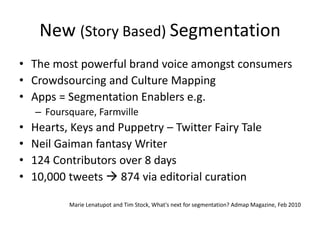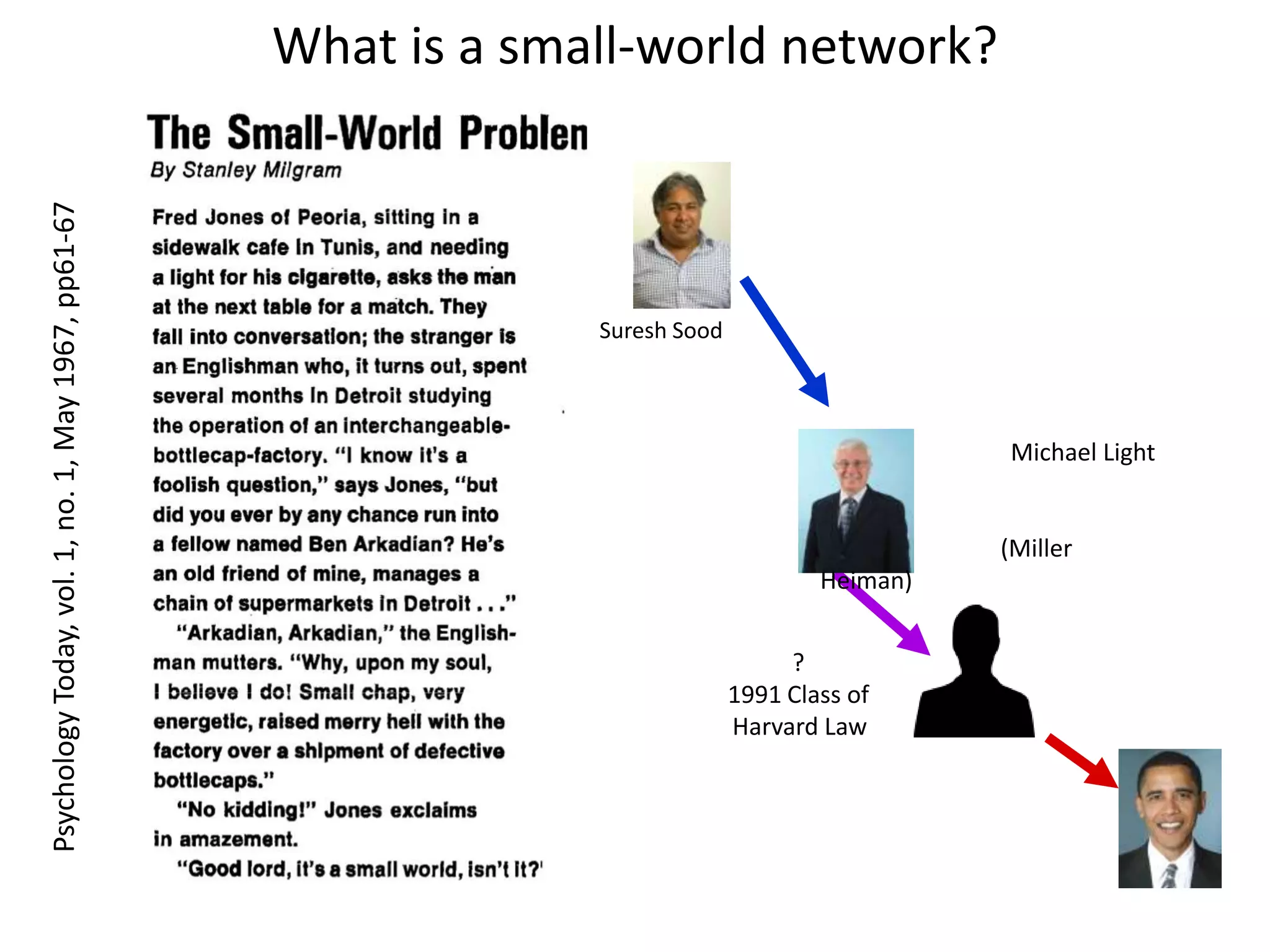
What is a small-world network?Suresh Sood				Michael Light												         (Miller Heiman)Psychology Today, vol. 1, no. 1, May 1967, pp61‐67?1991 Class of Harvard Law
GreatMystery14Suresh S.soodysoodywww.facebook.com/sureshsoodssoodHero5!twitter.com/soodywww.bravenewtalent.com/talent/suresh_soodwww.linkedin.com/in/sureshsoodGeektoidMangalascuzzy55suresh.sood@uts.edu.au
Giant Global Graph'll be thinking in the graph.My flights.My friends.Things in my life.My breakfast.What was that? Oh, yogourt, granola, nuts, and fresh fruit, since you ask.Submitted by timbl on Wed, 2007-11-21http://dig.csail.mit.edu/breadcrumbs/node/215
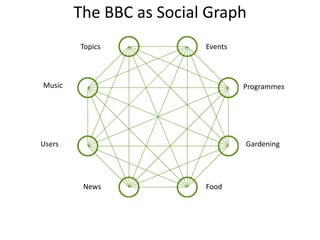
The BBC as Social GraphTopics	EventsMusicProgrammesUsersGardeningNewsFood
Zuckerberg: “We Are Building A Web Where The Default Is Social”(3rd F8 developer conference, San Francisco)Open (Interest)  Graph not only social connections between people, but connections people have with their interests—things, places, brands, and other sites. Yelp might create one around restaurants, Pandora might create one around music. Add some “like” buttons and anytime someone likes a restaurant or song anywhere on the Web with a Facebook like button, that information will flow back into the Open Graph. So that Yelp will know what restaurants you and your friends have liked elsewhere and take that into consideration when giving you recommendations, or Pandora with music, and so on. Facebook is taking some of the information that pops up in people’s realtime streams and baking it into the Web. “The stream is ephemeral,” says Zuckerberg. “It is there for a few hours and then it mostly floats away. Services don’t understand the semantic connections between you and that restaurant.” But now Facebook can. Instead of the Web being defined only by hyperlinks (to the benefit of search engines like Google), Facebook wants it to be defined by social connections, likes and dislikes, interests that are coded and machine-readable. “Our goal is to use the open graph so people can have instantly social experiences wherever they go,” he says.The Open Graph is hugely ambitious. Just wait until Facebook plugs in targeted advertising by: 	Location, Age, Sex, Keywords, Education, Workplace, Relationship Status, Relationship Interests & Languages.The Open Graph API will allow any page on the Web to have all the features of a Facebook Page. Once implemented, developers can include a number of Facebook Widgets, like the Fan Box, or enable the transformation of any Web page so it functions similar to a Facebook Page.
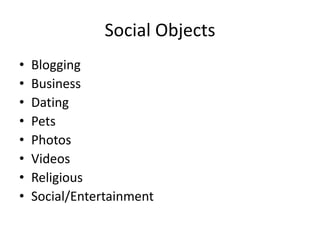
Social Objects BloggingBusinessDatingPetsPhotosVideosReligiousSocial/Entertainment
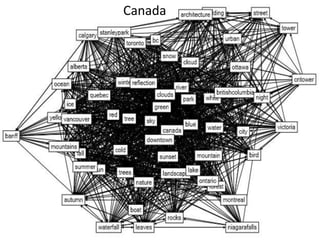
Canada
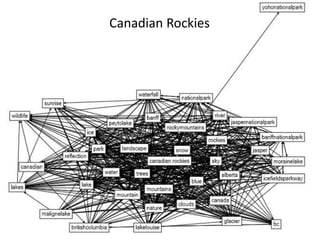
Canadian Rockies
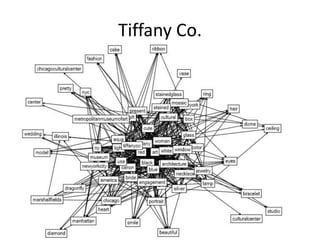
Tiffany Co.
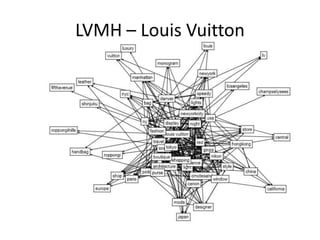
LVMH – Louis Vuitton
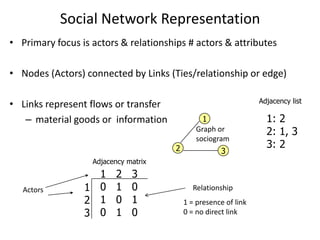
Social Network RepresentationPrimary focus is actors & relationships # actors & attributesNodes (Actors) connected by Links (Ties/relationship or edge)Links represent flows or transfermaterial goods or  information Adjacency list1: 22: 1, 33: 21Graph orsociogram23Adjacency matrix1   2   30   1   01   0   10   1   0123RelationshipActors1 = presence of link0 = no direct link
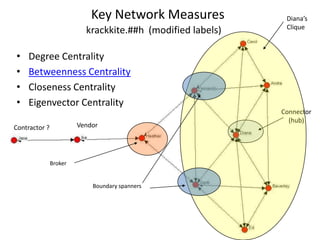
Key Network MeasuresDegree CentralityBetweenness CentralityCloseness CentralityEigenvector CentralityDiana’sCliquekrackkite.##h  (modified labels)Connector(hub)VendorContractor ?BrokerBoundary spanners
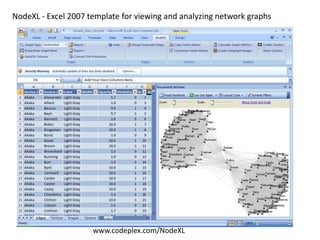
NodeXL - Excel 2007 template for viewing and analyzing network graphswww.codeplex.com/NodeXL
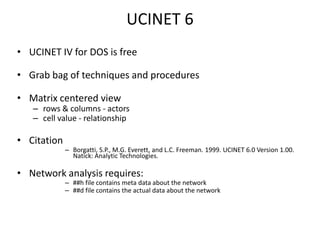
UCINET 6 UCINET IV for DOS is free Grab bag of techniques and proceduresMatrix centered view rows & columns - actorscell value - relationshipCitation Borgatti, S.P., M.G. Everett, and L.C. Freeman. 1999. UCINET 6.0 Version 1.00. Natick: Analytic Technologies.Network analysis requires:##h file contains meta data about the network ##d file contains the actual data about the network
Useful ReferencesUCINET user guideTutorial Prof HannemanNetwork Analysis in Marketing (Webster & Morrison 2004)www.insna.org(international network for social analysis)
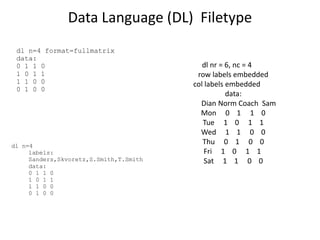
Data Language (DL)  Filetypedl nr = 6, nc = 4	row labels embedded col labels embedded	data:	      Dian Norm Coach  Sam	Mon     0    1     1    0	Tue     1    0     1    1	Wed     1    1     0    0	Thu     0    1     0    0	Fri     1    0     1    1 	Sat     1    1     0    0
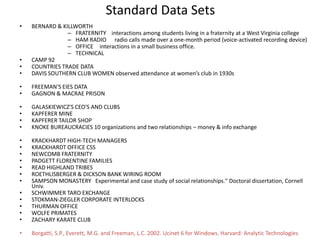
Standard Data SetsBERNARD & KILLWORTHFRATERNITY    interactions among students living in a fraternity at a West Virginia collegeHAM RADIO      radio calls made over a one-month period (voice-activated recording device)OFFICE  	interactions in a small business office. TECHNICALCAMP 92COUNTRIES TRADE DATADAVIS SOUTHERN CLUB WOMEN observed attendance at women’s club in 1930sFREEMAN'S EIES DATAGAGNON & MACRAE PRISONGALASKIEWICZ'S CEO'S AND CLUBSKAPFERER MINEKAPFERER TAILOR SHOPKNOKE BUREAUCRACIES 10 organizations and two relationships – money & info exchangeKRACKHARDT HIGH-TECH MANAGERSKRACKHARDT OFFICE CSSNEWCOMB FRATERNITYPADGETT FLORENTINE FAMILIESREAD HIGHLAND TRIBESROETHLISBERGER & DICKSON BANK WIRING ROOMSAMPSON MONASTERY   Experimental and case study of social relationships." Doctoral dissertation, Cornell Univ.SCHWIMMER TARO EXCHANGESTOKMAN-ZIEGLER CORPORATE INTERLOCKSTHURMAN OFFICEWOLFE PRIMATESZACHARY KARATE CLUBBorgatti, S.P., Everett, M.G. and Freeman, L.C. 2002. Ucinet 6 for Windows. Harvard: Analytic Technologies.
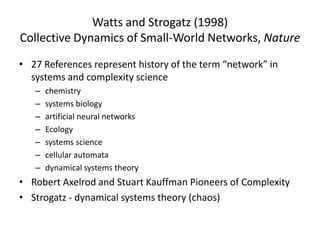
Watts and Strogatz (1998)Collective Dynamics of Small-World Networks, Nature27 References represent history of the term “network” in systems and complexity sciencechemistrysystems biologyartificial neural networks Ecology systems sciencecellular automata dynamical systems theoryRobert Axelrod and Stuart Kauffman Pioneers of ComplexityStrogatz - dynamical systems theory (chaos)
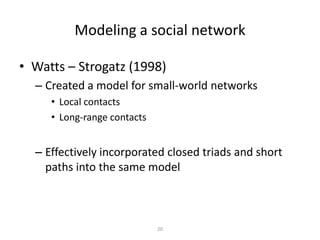
20Modeling a social networkWatts – Strogatz (1998)Created a model for small-world networksLocal contactsLong-range contactsEffectively incorporated closed triads and short paths into the same model
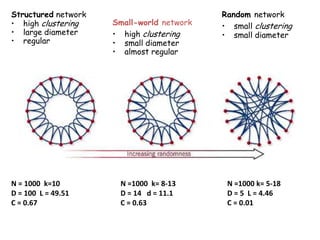
Structured networkhigh clustering
large diameter
regularRandom networksmall clustering
small diameterSmall-world networkhigh clustering
small diameter
almost regularN = 1000  k=10D = 100  L = 49.51C = 0.67N =1000  k= 8-13D = 14   d = 11.1C = 0.63N =1000 k= 5-18D = 5  L = 4.46C = 0.01
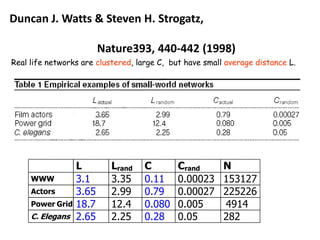
LLCCNrandrand3.13.350.110.00023153127WWW3.652.990.790.00027225226Actors18.712.40.0800.0054914Power Grid2.652.250.280.05282C. ElegansDuncan J. Watts & Steven H. Strogatz,Nature393, 440-442 (1998)Real life networks are clustered, large C,  but have small average distance L.
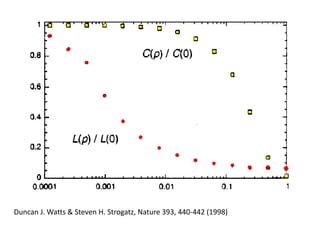
Duncan J. Watts & Steven H. Strogatz, Nature 393, 440-442 (1998)
Duncan Watts - The “New” Science of Networks : Annu. Rev. Sociol. 2004. 30:243–70Research cluster builds on“…a long tradition of network analysis in sociology and anthropology 	(Degenne and Forse 1994; Scott 2000; Wasserman and Faust 1994)”“…an even longer history of graph theory in discrete mathematics	 (Ahuja et al. 1993; Bollobas 1998; West 1996)...” “spurred by the rapidly growing availability of cheap yet powerful computers and large-scale electronic datasets...”scholars come from a variety of disciplines, including “the mathematical, biological, and social sciences...”Watts notes the label “new science of networks” may “strike many sociologists as misleading, given the familiarity (to social network analysts) of many of its central ideas’’ (p. 342). ‘‘Nevertheless,’’ he argues, ‘‘the label does capture the sense of excitement surrounding what is unquestionably a fast developing field----new papers are appearing almost daily----and also the un-precedented degree of synthesis that this excitement has generated across the many disciplines in which network-related problems arise’’ (p. 243).
Duncan Watts - The “New” Science of Networks Annu. Rev. Sociol. 2004. 30:243–70Goal to make “substantial progress on a number of previously intractable problems, reformulating old ideas, introducing new techniques, and uncovering connections between what had seemed to be quite different problems” [Examples of intractable problems - analysis of large-scale, complex networks, the study of the evolution and transformation of complex networks over time, the study of how information, innovations, disease, cultural fads flow/move through complex networks. Old ideas - affiliation networks, the small-world problem and community structure. New techniques - discrete mathematics, the power law, cellular automata and agent-based modelling. Cross-disciplinary connections - similarities in network structure at different levels of scale, from a protein to a human organization to an ecosystem. ]
Traditional Practioners & New Networkers AnthropologistsSociologistsSocial workPsychologistsOrganizational theoristsPhysicistsMathematicians/StatisticiansEconomistsComputer ScientistsBiologistsEcologistsCriminologistsHealth Professionals
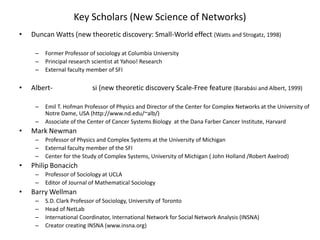
Key Scholars (New Science of Networks)Duncan Watts (new theoretic discovery: Small-World effect (Watts and Strogatz, 1998)Former Professor of sociology at Columbia University Principal research scientist at Yahoo! ResearchExternal faculty member of SFIAlbert-LászlóBarabási (new theoretic discovery Scale-Free feature (Barabási and Albert, 1999)Emil T. Hofman Professor of Physics and Director of the Center for Complex Networks at the University of Notre Dame, USA (http://www.nd.edu/~alb/)Associate of the Center of Cancer Systems Biology  at the Dana Farber Cancer Institute, HarvardMark NewmanProfessor of Physics and Complex Systems at the University of MichiganExternal faculty member of the SFICenter for the Study of Complex Systems, University of Michigan ( John Holland /Robert Axelrod)Philip BonacichProfessor of Sociology at UCLAEditor of Journal of Mathematical SociologyBarry Wellman S.D. Clark Professor of Sociology, University of TorontoHead of NetLabInternational Coordinator, International Network for Social Network Analysis (INSNA)Creator creating INSNA (www.insna.org)
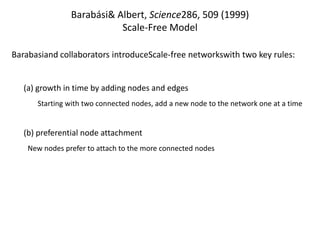
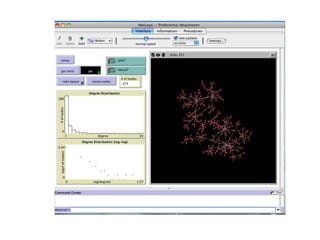
Barabási & Albert, Science286, 509 (1999)Scale-Free Model Barabasiand collaborators introduceScale-free networkswith two key rules:	(a) growth in time by adding nodes and edges	Starting with two connected nodes, add a new node to the network one at a time	(b) preferential node attachment New nodes prefer to attach to the more connected nodes
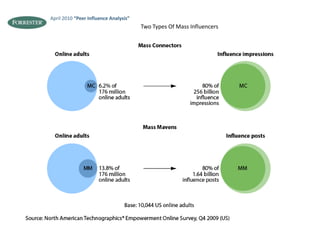
April 2010 “Peer Influence Analysis”Two Types Of Mass Influencers
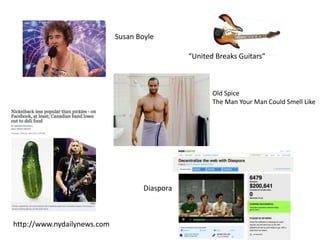
Susan Boyle“United Breaks Guitars”Old SpiceThe Man Your Man Could Smell Like Diasporahttp://www.nydailynews.com
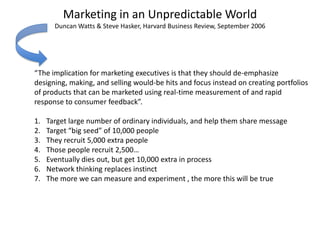
Marketing in an Unpredictable WorldDuncan Watts & Steve Hasker, Harvard Business Review, September 2006“The implication for marketing executives is that they should de-emphasize designing, making, and selling would-be hits and focus instead on creating portfolios of products that can be marketed using real-time measurement of and rapid response to consumer feedback”.Target large number of ordinary individuals, and help them share messageTarget “big seed” of 10,000 people They recruit 5,000 extra people Those people recruit 2,500… Eventually dies out, but get 10,000 extra in processNetwork thinking replaces instinct The more we can measure and experiment , the more this will be true
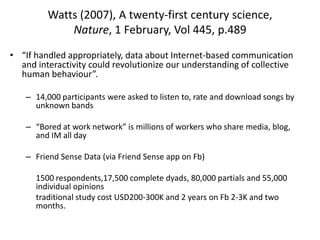
Watts (2007), A twenty-first century science, Nature, 1 February, Vol 445, p.489“If handled appropriately, data about Internet-based communication and interactivity could revolutionize our understanding of collective human behaviour”.14,000 participants were asked to listen to, rate and download songs by unknown bands“Bored at work network” is millions of workers who share media, blog, and IM all dayFriend Sense Data (via Friend Sense app on Fb)	1500 respondents,17,500 complete dyads, 80,000 partials and 55,000 individual opinions	traditional study cost USD200-300K and 2 years on Fb 2-3K and two months.
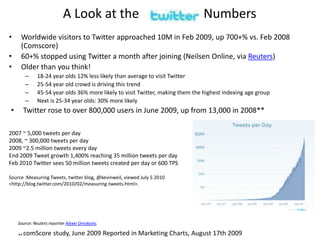
A Look at the                    NumbersWorldwide visitors to Twitter approached 10M in Feb 2009, up 700+% vs. Feb 2008 (Comscore)60+% stopped using Twitter a month after joining (Neilsen Online, via Reuters)Older than you think!18-24 year olds 12% less likely than average to visit Twitter25-54 year old crowd is driving this trend45-54 year olds 36% more likely to visit Twitter, making them the highest indexing age groupNext is 25-34 year olds: 30% more likelyTwitter rose to over 800,000 users in June 2009, up from 13,000 in 2008**2007 ~ 5,000 tweets per day2008, ~ 300,000 tweets per day2009 ~2.5 million tweets every dayEnd 2009 Tweet growth 1,400% reaching 35 million tweets per dayFeb 2010 Twitter sees 50 million tweets created per day or 600 TPSSource :Measuring Tweets, twitter blog, @kevinweil, viewed July 5 2010 <http://blog.twitter.com/2010/02/measuring-tweets.html>.Source: Reuters reporter Alexei Oreskovic.** comScore study, June 2009 Reported in Marketing Charts, August 17th 2009
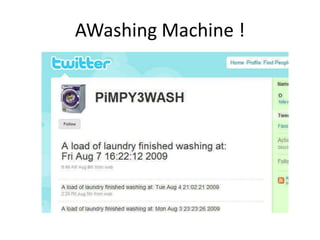
AWashing Machine !
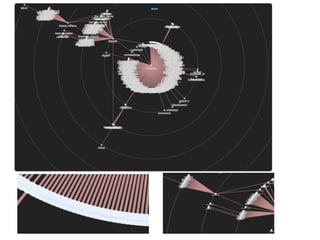
Week 2 statsTotal Researchers: 371 (+71 since last week)Total Active Data Collections: 262 (169 Streaming, 59 REST, 34 Curated Collections) (+37)Total finished Data Collections: 36 (+23)Total number of tweets in Database: ~33,234,149 (+15m)Total number of users in Database: ~14,437,195 (+7m)Number of tweets including the word “bieber”: too manyDatabase size: 28.7 GB (x2)Current rate of growth ~ 15 million tweets a week… or about 15 gigs a week.
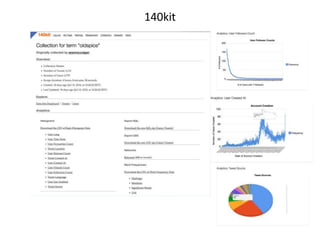
140kit
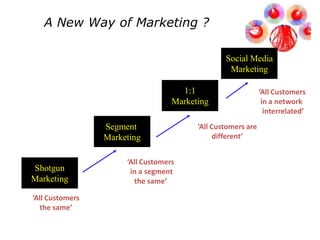
Social Media Marketing is not Conventional Marketing“a many-to-many mediated communications model in which consumers can interact with the medium, firms can provide content to the medium and, in the most radical departure from traditional marketing environments, consumers can provide commercially oriented content to the medium.”Hoffman & Novak, 1997
Digital Breadcrumbs
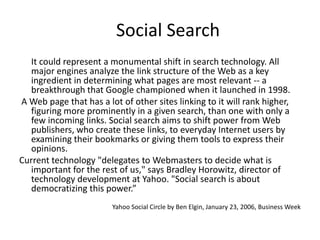
	Social Search	It could represent a monumental shift in search technology. All major engines analyze the link structure of the Web as a key ingredient in determining what pages are most relevant -- a breakthrough that Google championed when it launched in 1998. A Web page that has a lot of other sites linking to it will rank higher, figuring more prominently in a given search, than one with only a few incoming links. Social search aims to shift power from Web publishers, who create these links, to everyday Internet users by examining their bookmarks or giving them tools to express their opinions.Current technology "delegates to Webmasters to decide what is important for the rest of us," says Bradley Horowitz, director of technology development at Yahoo. "Social search is about democratizing this power.”Yahoo Social Circle by Ben Elgin, January 23, 2006, Business Week
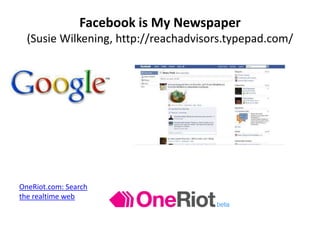
Facebook is My Newspaper(Susie Wilkening, http://reachadvisors.typepad.com/OneRiot.com: Search the realtime web
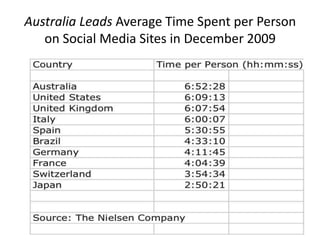
Australia Leads Average Time Spent per Person on Social Media Sites in December 2009
Referral & Destination Traffic for April 2010agl.com.auSites people visit before going to agl.com.aufacebook.com	(21.19%)google.com		(15.57%)google.com.au	( 2.68%)Sites people visit after leaving agl.com.aufacebook.com			(31.6%)energyaustralia.com.au (< 0.1%)google.com.au (<0.1%)
Wikipedia entries well placed on GoogleGenerate articles relating to your organisation,executives and newsMonitor articles on wikipedia for reputation managementReference with related entries
…Blogs are like conversations with friends. You share what you feel and what excites you about certain things. It's almost as good as being there. The fact that others can Google your topic and read is like tuning into a television station.			We all want to know what's out there. Who's doing what, shopping where and what products help others. Blogs are just another way to share all the great things, not so great things and just a part of who we are. An outlet if you will. The blogisphere community is all connect and we make contacts in many ways. Through posts, through twitter conversations, through smaller nit community's, live web casts, and through conferences that we met in person. We make many friends and help each other with lot of topics. Many of us are Mom bloggers who stay at home and have no way of making new friends or communicating with others until we found blogging. Blogging creates friendships and that's what makes us real and connected.40 year old Mom blogger “nightowlmama” (#260)
55Linguistic Inquiry & Word Count : “junk words” in content http://www.liwc.net/liwcresearch07.phpCognitive complexity = zexcl + ztentat + znegate + zdiscrepzinclDepression = zI + zphyscal + znegemo – zposemoLiar = – zself – zother – zexcl + znegemo or Honesty = zself + zother + zexcl - znegemo -  zmotionFemale = zself – zsixltr +z other + znegate – zarticle – zpreps + zcertain + zsocial + zpresent – zspace – zoccup + zhome – zmoneyAging = zposemo – zI + zsixltr + zcogmech + zexcl + zfuture – zpast – ztimePresidential = zsixltr – zwps – zunique – zpronoun – zself – zyou – zother – znegate + zarticle + zprepSlatcher, R.B., Chung, C.K., Pennebaker, J.W., & Stone, L.D. (2007), Winning words: Individual differences in linguistic style among U.S. presidential and vice presidential candidates, Journal of Research in Personality, 41, 63-75.
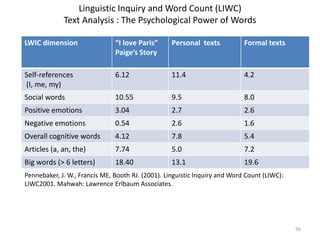
Linguistic Inquiry and Word Count (LIWC)Text Analysis : The Psychological Power of Words 56Pennebaker, J. W., Francis ME, Booth RJ. (2001). Linguistic Inquiry and Word Count (LIWC): LIWC2001. Mahwah: Lawrence Erlbaum Associates.
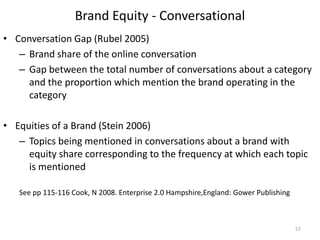
Brand Equity - Conversational Conversation Gap (Rubel 2005)Brand share of the online conversationGap between the total number of conversations about a category and the proportion which mention the brand operating in the categoryEquities of a Brand (Stein 2006)Topics being mentioned in conversations about a brand with equity share corresponding to the frequency at which each topic is mentionedSee pp 115-116 Cook, N 2008. Enterprise 2.0 Hampshire,England: Gower Publishing57
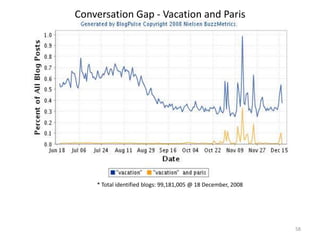
Conversation Gap - Vacation and Paris58* Total identified blogs: 99,181,005 @ 18 December, 2008
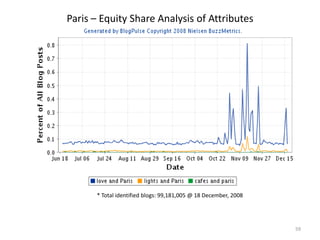
Paris – Equity Share Analysis of Attributes59* Total identified blogs: 99,181,005 @ 18 December, 2008
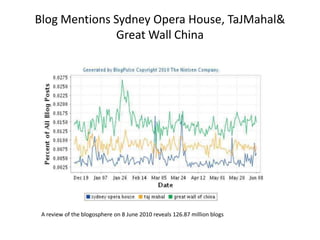
Blog Mentions Sydney Opera House, TaJMahal & Great Wall ChinaA review of the blogosphere on 8 June 2010 reveals 126.87 million blogs
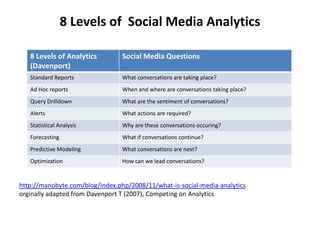
8 Levels of  Social Media Analyticshttp://manobyte.com/blog/index.php/2008/11/what-is-social-media-analytics orginally adapted from Davenport T (2007), Competing on Analytics

Small Worlds Social Graphs Social Media

  • 1.
    What is asmall-world network?Suresh Sood Michael Light (Miller Heiman)Psychology Today, vol. 1, no. 1, May 1967, pp61‐67?1991 Class of Harvard Law
  • 2.
  • 3.
    Giant Global Graph'llbe thinking in the graph.My flights.My friends.Things in my life.My breakfast.What was that? Oh, yogourt, granola, nuts, and fresh fruit, since you ask.Submitted by timbl on Wed, 2007-11-21http://dig.csail.mit.edu/breadcrumbs/node/215
  • 4.
    The BBC asSocial GraphTopics EventsMusicProgrammesUsersGardeningNewsFood
  • 5.
    Zuckerberg: “We AreBuilding A Web Where The Default Is Social”(3rd F8 developer conference, San Francisco)Open (Interest) Graph not only social connections between people, but connections people have with their interests—things, places, brands, and other sites. Yelp might create one around restaurants, Pandora might create one around music. Add some “like” buttons and anytime someone likes a restaurant or song anywhere on the Web with a Facebook like button, that information will flow back into the Open Graph. So that Yelp will know what restaurants you and your friends have liked elsewhere and take that into consideration when giving you recommendations, or Pandora with music, and so on. Facebook is taking some of the information that pops up in people’s realtime streams and baking it into the Web. “The stream is ephemeral,” says Zuckerberg. “It is there for a few hours and then it mostly floats away. Services don’t understand the semantic connections between you and that restaurant.” But now Facebook can. Instead of the Web being defined only by hyperlinks (to the benefit of search engines like Google), Facebook wants it to be defined by social connections, likes and dislikes, interests that are coded and machine-readable. “Our goal is to use the open graph so people can have instantly social experiences wherever they go,” he says.The Open Graph is hugely ambitious. Just wait until Facebook plugs in targeted advertising by: Location, Age, Sex, Keywords, Education, Workplace, Relationship Status, Relationship Interests & Languages.The Open Graph API will allow any page on the Web to have all the features of a Facebook Page. Once implemented, developers can include a number of Facebook Widgets, like the Fan Box, or enable the transformation of any Web page so it functions similar to a Facebook Page.
  • 7.
  • 8.
  • 9.
  • 10.
  • 11.
  • 12.
    Social Network RepresentationPrimaryfocus is actors & relationships # actors & attributesNodes (Actors) connected by Links (Ties/relationship or edge)Links represent flows or transfermaterial goods or information Adjacency list1: 22: 1, 33: 21Graph orsociogram23Adjacency matrix1 2 30 1 01 0 10 1 0123RelationshipActors1 = presence of link0 = no direct link
  • 13.
    Key Network MeasuresDegreeCentralityBetweenness CentralityCloseness CentralityEigenvector CentralityDiana’sCliquekrackkite.##h (modified labels)Connector(hub)VendorContractor ?BrokerBoundary spanners
  • 14.
    NodeXL - Excel2007 template for viewing and analyzing network graphswww.codeplex.com/NodeXL
  • 15.
    UCINET 6 UCINETIV for DOS is free Grab bag of techniques and proceduresMatrix centered view rows & columns - actorscell value - relationshipCitation Borgatti, S.P., M.G. Everett, and L.C. Freeman. 1999. UCINET 6.0 Version 1.00. Natick: Analytic Technologies.Network analysis requires:##h file contains meta data about the network ##d file contains the actual data about the network
  • 16.
    Useful ReferencesUCINET userguideTutorial Prof HannemanNetwork Analysis in Marketing (Webster & Morrison 2004)www.insna.org(international network for social analysis)
  • 17.
    Data Language (DL) Filetypedl nr = 6, nc = 4 row labels embedded col labels embedded data: Dian Norm Coach Sam Mon 0 1 1 0 Tue 1 0 1 1 Wed 1 1 0 0 Thu 0 1 0 0 Fri 1 0 1 1  Sat 1 1 0 0
  • 18.
    Standard Data SetsBERNARD& KILLWORTHFRATERNITY interactions among students living in a fraternity at a West Virginia collegeHAM RADIO radio calls made over a one-month period (voice-activated recording device)OFFICE interactions in a small business office. TECHNICALCAMP 92COUNTRIES TRADE DATADAVIS SOUTHERN CLUB WOMEN observed attendance at women’s club in 1930sFREEMAN'S EIES DATAGAGNON & MACRAE PRISONGALASKIEWICZ'S CEO'S AND CLUBSKAPFERER MINEKAPFERER TAILOR SHOPKNOKE BUREAUCRACIES 10 organizations and two relationships – money & info exchangeKRACKHARDT HIGH-TECH MANAGERSKRACKHARDT OFFICE CSSNEWCOMB FRATERNITYPADGETT FLORENTINE FAMILIESREAD HIGHLAND TRIBESROETHLISBERGER & DICKSON BANK WIRING ROOMSAMPSON MONASTERY Experimental and case study of social relationships." Doctoral dissertation, Cornell Univ.SCHWIMMER TARO EXCHANGESTOKMAN-ZIEGLER CORPORATE INTERLOCKSTHURMAN OFFICEWOLFE PRIMATESZACHARY KARATE CLUBBorgatti, S.P., Everett, M.G. and Freeman, L.C. 2002. Ucinet 6 for Windows. Harvard: Analytic Technologies.
  • 19.
    Watts and Strogatz(1998)Collective Dynamics of Small-World Networks, Nature27 References represent history of the term “network” in systems and complexity sciencechemistrysystems biologyartificial neural networks Ecology systems sciencecellular automata dynamical systems theoryRobert Axelrod and Stuart Kauffman Pioneers of ComplexityStrogatz - dynamical systems theory (chaos)
  • 20.
    20Modeling a socialnetworkWatts – Strogatz (1998)Created a model for small-world networksLocal contactsLong-range contactsEffectively incorporated closed triads and short paths into the same model
  • 21.
  • 22.
  • 23.
  • 24.
  • 25.
  • 26.
    almost regularN =1000 k=10D = 100 L = 49.51C = 0.67N =1000 k= 8-13D = 14 d = 11.1C = 0.63N =1000 k= 5-18D = 5 L = 4.46C = 0.01
  • 27.
    LLCCNrandrand3.13.350.110.00023153127WWW3.652.990.790.00027225226Actors18.712.40.0800.0054914Power Grid2.652.250.280.05282C. ElegansDuncanJ. Watts & Steven H. Strogatz,Nature393, 440-442 (1998)Real life networks are clustered, large C, but have small average distance L.
  • 28.
    Duncan J. Watts& Steven H. Strogatz, Nature 393, 440-442 (1998)
  • 30.
    Duncan Watts -The “New” Science of Networks : Annu. Rev. Sociol. 2004. 30:243–70Research cluster builds on“…a long tradition of network analysis in sociology and anthropology (Degenne and Forse 1994; Scott 2000; Wasserman and Faust 1994)”“…an even longer history of graph theory in discrete mathematics (Ahuja et al. 1993; Bollobas 1998; West 1996)...” “spurred by the rapidly growing availability of cheap yet powerful computers and large-scale electronic datasets...”scholars come from a variety of disciplines, including “the mathematical, biological, and social sciences...”Watts notes the label “new science of networks” may “strike many sociologists as misleading, given the familiarity (to social network analysts) of many of its central ideas’’ (p. 342). ‘‘Nevertheless,’’ he argues, ‘‘the label does capture the sense of excitement surrounding what is unquestionably a fast developing field----new papers are appearing almost daily----and also the un-precedented degree of synthesis that this excitement has generated across the many disciplines in which network-related problems arise’’ (p. 243).
  • 31.
    Duncan Watts -The “New” Science of Networks Annu. Rev. Sociol. 2004. 30:243–70Goal to make “substantial progress on a number of previously intractable problems, reformulating old ideas, introducing new techniques, and uncovering connections between what had seemed to be quite different problems” [Examples of intractable problems - analysis of large-scale, complex networks, the study of the evolution and transformation of complex networks over time, the study of how information, innovations, disease, cultural fads flow/move through complex networks. Old ideas - affiliation networks, the small-world problem and community structure. New techniques - discrete mathematics, the power law, cellular automata and agent-based modelling. Cross-disciplinary connections - similarities in network structure at different levels of scale, from a protein to a human organization to an ecosystem. ]
  • 32.
    Traditional Practioners &New Networkers AnthropologistsSociologistsSocial workPsychologistsOrganizational theoristsPhysicistsMathematicians/StatisticiansEconomistsComputer ScientistsBiologistsEcologistsCriminologistsHealth Professionals
  • 33.
    Key Scholars (NewScience of Networks)Duncan Watts (new theoretic discovery: Small-World effect (Watts and Strogatz, 1998)Former Professor of sociology at Columbia University Principal research scientist at Yahoo! ResearchExternal faculty member of SFIAlbert-LászlóBarabási (new theoretic discovery Scale-Free feature (Barabási and Albert, 1999)Emil T. Hofman Professor of Physics and Director of the Center for Complex Networks at the University of Notre Dame, USA (http://www.nd.edu/~alb/)Associate of the Center of Cancer Systems Biology at the Dana Farber Cancer Institute, HarvardMark NewmanProfessor of Physics and Complex Systems at the University of MichiganExternal faculty member of the SFICenter for the Study of Complex Systems, University of Michigan ( John Holland /Robert Axelrod)Philip BonacichProfessor of Sociology at UCLAEditor of Journal of Mathematical SociologyBarry Wellman S.D. Clark Professor of Sociology, University of TorontoHead of NetLabInternational Coordinator, International Network for Social Network Analysis (INSNA)Creator creating INSNA (www.insna.org)
  • 34.
    Barabási & Albert,Science286, 509 (1999)Scale-Free Model Barabasiand collaborators introduceScale-free networkswith two key rules: (a) growth in time by adding nodes and edges Starting with two connected nodes, add a new node to the network one at a time (b) preferential node attachment New nodes prefer to attach to the more connected nodes
  • 37.
    April 2010 “PeerInfluence Analysis”Two Types Of Mass Influencers
  • 40.
    Susan Boyle“United BreaksGuitars”Old SpiceThe Man Your Man Could Smell Like Diasporahttp://www.nydailynews.com
  • 41.
    Marketing in anUnpredictable WorldDuncan Watts & Steve Hasker, Harvard Business Review, September 2006“The implication for marketing executives is that they should de-emphasize designing, making, and selling would-be hits and focus instead on creating portfolios of products that can be marketed using real-time measurement of and rapid response to consumer feedback”.Target large number of ordinary individuals, and help them share messageTarget “big seed” of 10,000 people They recruit 5,000 extra people Those people recruit 2,500… Eventually dies out, but get 10,000 extra in processNetwork thinking replaces instinct The more we can measure and experiment , the more this will be true
  • 42.
    Watts (2007), Atwenty-first century science, Nature, 1 February, Vol 445, p.489“If handled appropriately, data about Internet-based communication and interactivity could revolutionize our understanding of collective human behaviour”.14,000 participants were asked to listen to, rate and download songs by unknown bands“Bored at work network” is millions of workers who share media, blog, and IM all dayFriend Sense Data (via Friend Sense app on Fb) 1500 respondents,17,500 complete dyads, 80,000 partials and 55,000 individual opinions traditional study cost USD200-300K and 2 years on Fb 2-3K and two months.
  • 43.
    A Look atthe NumbersWorldwide visitors to Twitter approached 10M in Feb 2009, up 700+% vs. Feb 2008 (Comscore)60+% stopped using Twitter a month after joining (Neilsen Online, via Reuters)Older than you think!18-24 year olds 12% less likely than average to visit Twitter25-54 year old crowd is driving this trend45-54 year olds 36% more likely to visit Twitter, making them the highest indexing age groupNext is 25-34 year olds: 30% more likelyTwitter rose to over 800,000 users in June 2009, up from 13,000 in 2008**2007 ~ 5,000 tweets per day2008, ~ 300,000 tweets per day2009 ~2.5 million tweets every dayEnd 2009 Tweet growth 1,400% reaching 35 million tweets per dayFeb 2010 Twitter sees 50 million tweets created per day or 600 TPSSource :Measuring Tweets, twitter blog, @kevinweil, viewed July 5 2010 <http://blog.twitter.com/2010/02/measuring-tweets.html>.Source: Reuters reporter Alexei Oreskovic.** comScore study, June 2009 Reported in Marketing Charts, August 17th 2009
  • 44.
  • 45.
    Week 2 statsTotalResearchers: 371 (+71 since last week)Total Active Data Collections: 262 (169 Streaming, 59 REST, 34 Curated Collections) (+37)Total finished Data Collections: 36 (+23)Total number of tweets in Database: ~33,234,149 (+15m)Total number of users in Database: ~14,437,195 (+7m)Number of tweets including the word “bieber”: too manyDatabase size: 28.7 GB (x2)Current rate of growth ~ 15 million tweets a week… or about 15 gigs a week.
  • 46.
  • 48.
    Social Media Marketingis not Conventional Marketing“a many-to-many mediated communications model in which consumers can interact with the medium, firms can provide content to the medium and, in the most radical departure from traditional marketing environments, consumers can provide commercially oriented content to the medium.”Hoffman & Novak, 1997
  • 50.
  • 53.
    Social Search It couldrepresent a monumental shift in search technology. All major engines analyze the link structure of the Web as a key ingredient in determining what pages are most relevant -- a breakthrough that Google championed when it launched in 1998. A Web page that has a lot of other sites linking to it will rank higher, figuring more prominently in a given search, than one with only a few incoming links. Social search aims to shift power from Web publishers, who create these links, to everyday Internet users by examining their bookmarks or giving them tools to express their opinions.Current technology "delegates to Webmasters to decide what is important for the rest of us," says Bradley Horowitz, director of technology development at Yahoo. "Social search is about democratizing this power.”Yahoo Social Circle by Ben Elgin, January 23, 2006, Business Week
  • 54.
    Facebook is MyNewspaper(Susie Wilkening, http://reachadvisors.typepad.com/OneRiot.com: Search the realtime web
  • 56.
    Australia Leads AverageTime Spent per Person on Social Media Sites in December 2009
  • 57.
    Referral & DestinationTraffic for April 2010agl.com.auSites people visit before going to agl.com.aufacebook.com (21.19%)google.com (15.57%)google.com.au ( 2.68%)Sites people visit after leaving agl.com.aufacebook.com (31.6%)energyaustralia.com.au (< 0.1%)google.com.au (<0.1%)
  • 58.
    Wikipedia entries wellplaced on GoogleGenerate articles relating to your organisation,executives and newsMonitor articles on wikipedia for reputation managementReference with related entries
  • 59.
    …Blogs are likeconversations with friends. You share what you feel and what excites you about certain things. It's almost as good as being there. The fact that others can Google your topic and read is like tuning into a television station. We all want to know what's out there. Who's doing what, shopping where and what products help others. Blogs are just another way to share all the great things, not so great things and just a part of who we are. An outlet if you will. The blogisphere community is all connect and we make contacts in many ways. Through posts, through twitter conversations, through smaller nit community's, live web casts, and through conferences that we met in person. We make many friends and help each other with lot of topics. Many of us are Mom bloggers who stay at home and have no way of making new friends or communicating with others until we found blogging. Blogging creates friendships and that's what makes us real and connected.40 year old Mom blogger “nightowlmama” (#260)
  • 60.
    55Linguistic Inquiry &Word Count : “junk words” in content http://www.liwc.net/liwcresearch07.phpCognitive complexity = zexcl + ztentat + znegate + zdiscrepzinclDepression = zI + zphyscal + znegemo – zposemoLiar = – zself – zother – zexcl + znegemo or Honesty = zself + zother + zexcl - znegemo - zmotionFemale = zself – zsixltr +z other + znegate – zarticle – zpreps + zcertain + zsocial + zpresent – zspace – zoccup + zhome – zmoneyAging = zposemo – zI + zsixltr + zcogmech + zexcl + zfuture – zpast – ztimePresidential = zsixltr – zwps – zunique – zpronoun – zself – zyou – zother – znegate + zarticle + zprepSlatcher, R.B., Chung, C.K., Pennebaker, J.W., & Stone, L.D. (2007), Winning words: Individual differences in linguistic style among U.S. presidential and vice presidential candidates, Journal of Research in Personality, 41, 63-75.
  • 61.
    Linguistic Inquiry andWord Count (LIWC)Text Analysis : The Psychological Power of Words 56Pennebaker, J. W., Francis ME, Booth RJ. (2001). Linguistic Inquiry and Word Count (LIWC): LIWC2001. Mahwah: Lawrence Erlbaum Associates.
  • 62.
    Brand Equity -Conversational Conversation Gap (Rubel 2005)Brand share of the online conversationGap between the total number of conversations about a category and the proportion which mention the brand operating in the categoryEquities of a Brand (Stein 2006)Topics being mentioned in conversations about a brand with equity share corresponding to the frequency at which each topic is mentionedSee pp 115-116 Cook, N 2008. Enterprise 2.0 Hampshire,England: Gower Publishing57
  • 63.
    Conversation Gap -Vacation and Paris58* Total identified blogs: 99,181,005 @ 18 December, 2008
  • 64.
    Paris – EquityShare Analysis of Attributes59* Total identified blogs: 99,181,005 @ 18 December, 2008
  • 65.
    Blog Mentions SydneyOpera House, TaJMahal & Great Wall ChinaA review of the blogosphere on 8 June 2010 reveals 126.87 million blogs
  • 66.
    8 Levels of Social Media Analyticshttp://manobyte.com/blog/index.php/2008/11/what-is-social-media-analytics orginally adapted from Davenport T (2007), Competing on Analytics

Editor's Notes

  • #14 Diana – max links (degree centrality) most connected – connector or hub – number of nodes connected – high influence of spreading info or virusHeather – best location powerful figure as broker to determine what flows and doesn’t –single point of failure – high betweeness = high influence – position of node as gatekeeper to exploit structural holes (gaps in network)Fernado &amp; Garth – shortest paths = closeness – the bigger the number the less centralEigenvector = importance of node in network ~ page rank google is similar measure
  • #49 The ability to disperse and share information through social platforms and do it using real-time tools is shifting the focus of content from “historical” news to real-time events.
  • #50 Also, think Mobile we will discuss UK stats shortly from December released over weekend. Social Media moving rapidly to be the gateway to web content Facebook has replaced her newspaper as the go-to place for relevant news in Susie’s life. It&apos;s not hard to imagine a near future where Facebook (and sites like it) also replace a lot of the ways we use atomized search.For people who are deeply immersed in social media, social networks are already a much heavier influence on personal choices--where to visit, what concert to attend--than traditional advertising. Which means that your organization&apos;s website--a brochure out in the wilderness of the Web--is only going to remain relevant and useful as a marketing piece if it is being referenced in the social context of your users&apos; lives. the next generation of Web users may find what they want by using their social network rather than a search algorithm. Social Media changes way we deal with web and in a sec we see mobile.
  • #54 http://wikifashion.com/wiki/Main_Page (see popular brands and new pages) – Brisbane based. &amp; wikiscannerHow Can You Use Wikipedia?•Create unbiased articles about your company, executives and important news stories&gt; Web site traffic increase•Cross-reference your articles with related articles &gt; New user discovery•Reputation managementSubscribe to updates to monitor changes Manage photos, links, content, etc.