











Social Media – The 5 SMs Patti Anklam May 7, 2010
Definitions
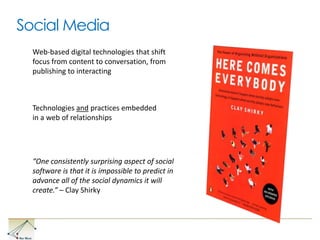
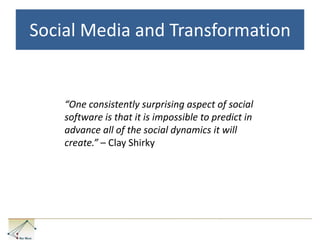
Social Media Web-based digital technologies that shift focus from content to conversation, from publishing to interactingTechnologies and practices embedded in a web of relationships“One consistently surprising aspect of social software is that it is impossible to predict in advance all of the social dynamics it will create.” – Clay Shirky
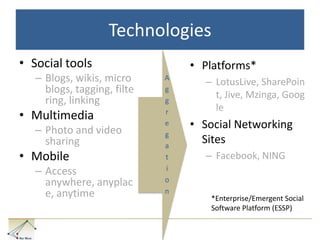
TechnologiesSocial toolsBlogs, wikis, microblogs, tagging, filtering, linkingMultimediaPhoto and video sharingMobileAccess anywhere, anyplace, anytimePlatforms*
LotusLive, SharePoint, Jive, Mzinga, Google
Social Networking Sites
Facebook, NINGAggregation*Enterprise/Emergent Social Software Platform (ESSP)
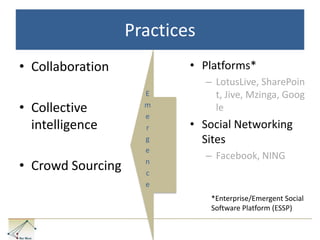
PracticesCollaborationCollective intelligenceCrowd SourcingPlatforms*
LotusLive, SharePoint, Jive, Mzinga, Google
Social Networking Sites
Facebook, NINGEmergence*Enterprise/Emergent Social Software Platform (ESSP)
Distinctions: 4  5 “SMs”
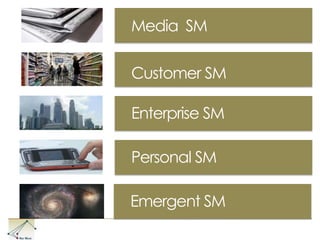
Media  SMCustomer SMEnterprise SMPersonal SMEmergent SM
Media  SM
Customer SM
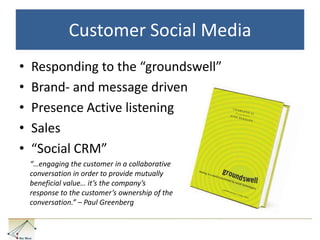
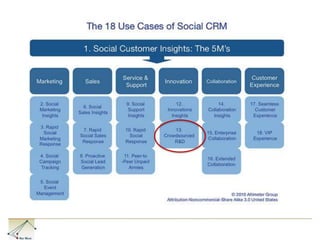
Customer Social MediaResponding to the “groundswell”Brand- and message drivenPresence Active listeningSales“Social CRM”“…engaging the customer in a collaborative conversation in order to provide mutually beneficial value… it’s the company’s response to the customer’s ownership of the conversation.” – Paul Greenberg
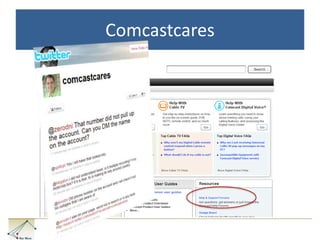
Comcastcares
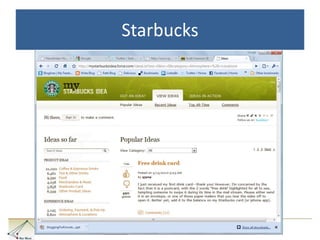
Starbucks
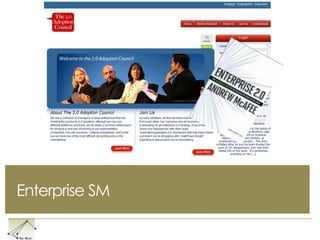
Enterprise SM
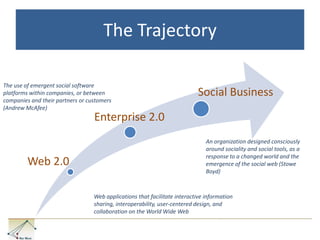
The TrajectoryThe use of emergent social software platforms within companies, or between companies and their partners or customers (Andrew McAfee)An organization designed consciously around sociality and social tools, as a response to a changed world and the emergence of the social web (Stowe Boyd)Web applications that facilitate interactive information sharing, interoperability, user-centered design, and collaboration on the World Wide Web
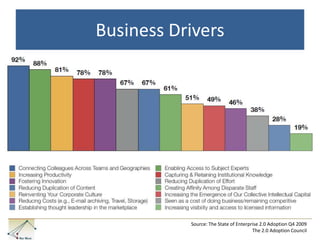
Business DriversSource: The State of Enterprise 2.0 Adoption Q4 2009The 2.0 Adoption Council
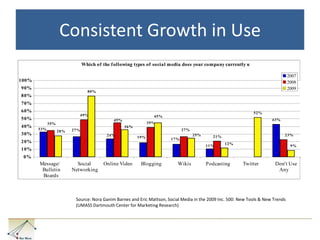
Consistent Growth in UseSource: Nora Ganim Barnes and Eric Mattson, Social Media in the 2009 Inc. 500: New Tools & New Trends(UMASS Dartmouth Center for Marketing Research)
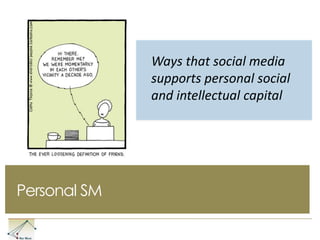
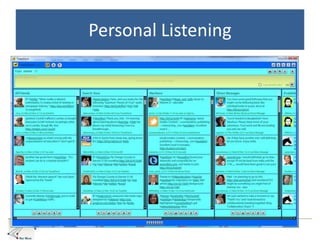
Ways that social media supports personal social and intellectual capitalPersonal SM
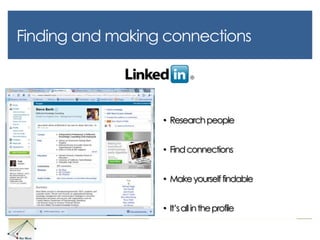
Finding and making connections  Research people
  Find connections
  Make yourself findable
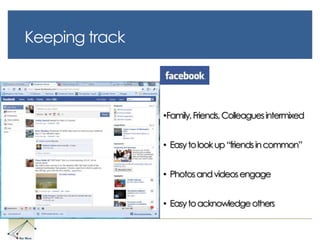
  It’s all in the profileKeeping trackFamily, Friends, Colleagues intermixed
  Easy to look up “friends in common”
  Photos and videos engage
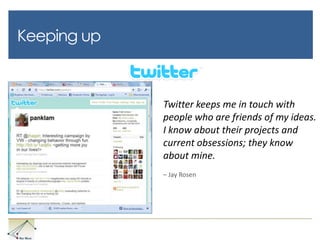
  Easy to acknowledge othersTwitter keeps me in touch with people who are friends of my ideas. I know about their projects and current obsessions; they know about mine.                                                                                                                     – Jay RosenKeeping up
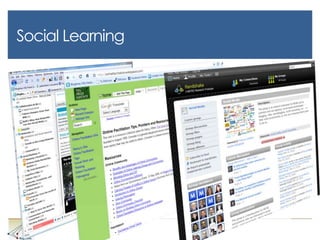
Social Learning
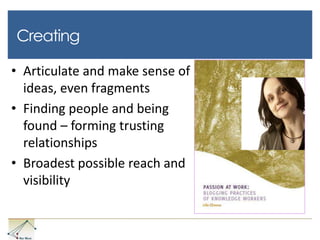
Articulate and make sense of ideas, even fragmentsFinding people and being found – forming trusting relationshipsBroadest possible reach and visibilityCreating
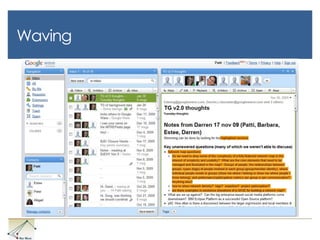
Waving
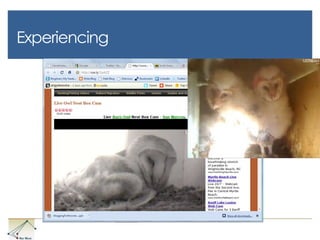
Experiencing
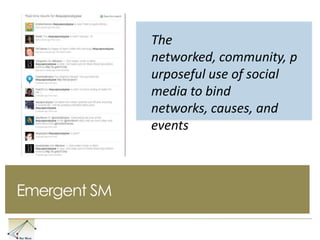
The networked, community, purposeful use of social media to bind networks, causes, and eventsEmergent SM
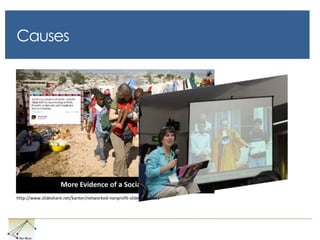
Causeshttp://www.slideshare.net/kanter/networked-nonprofit-slides-3671181
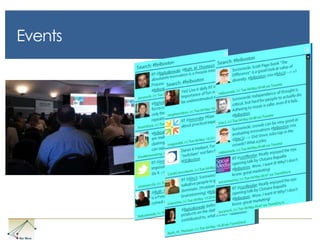
Events
Crowdshttp://www.youtube.com/watch?v=JuOMkj-oU94
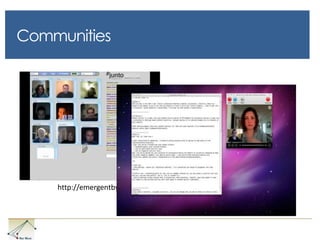
Communitieshttp://emergentbydesign.com
Common Practices and Issues
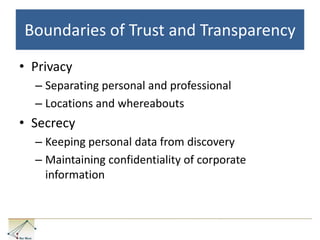
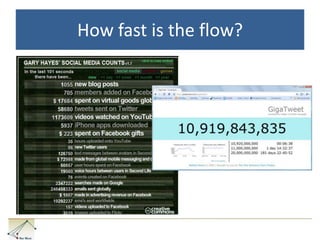
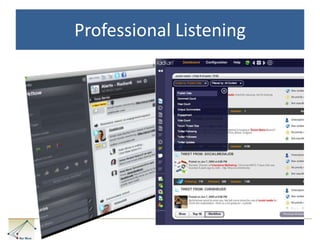
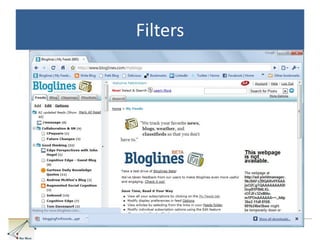
Community ManagementMeasurementPrivacyManaging the Flow
Community Management
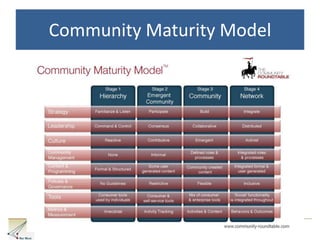
Community Maturity Model
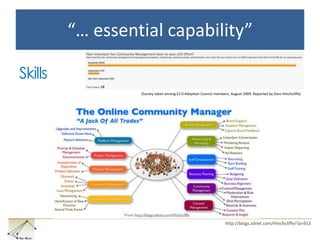
(Survey taken among E2.0 Adoption Council members, August 2009. Reported by Dion Hinchcliffe)“… essential capability”Skillshttp://blogs.zdnet.com/Hinchcliffe/?p=913
Measurement
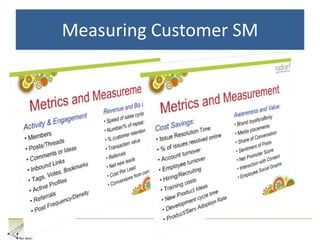
Measuring Customer SM
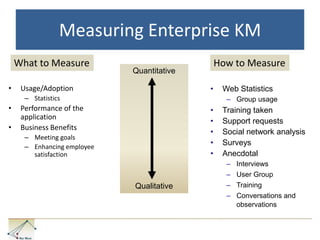
Measuring Enterprise KMQuantitativeQualitativeWhat to MeasureHow to MeasureWeb Statistics
Group usage
Training taken

The 5 social medias (5 SMs)

Editor's Notes

  • #2 Abstract as advertised:The locus of knowledge has shifted over the past 15 years of “KM” – from being in “stuff” (artifacts, content management systems), to being in people (communities of practice, collaboration systems), to being in the network (constantly alive and moving around us, available directly and peripherally from our friends, colleagues, co-workers, and those we following on Twitter).  How we maintain and grow our personal networks – our personal net work – is a critical part of “personal knowledge management.”  Patti will put personal networks in context and then review practical techniques for maintaining personal networks.
  • #3 Before talking about personal networks and knowledge management, I need to share my personal perspectives and on both of these so you can understand my language.
  • #7 Before talking about personal networks and knowledge management, I need to share my personal perspectives and on both of these so you can understand my language.
  • #19 In one sense I’ve been interested in and creating networks throughout my career, but it wasn’t’ until I was introduced to science of network in the fall of 2000 that may things started to click with me. The fact that there is a tool that lets us map the relationships among people is not novel, but the research that is coming forward that tells us how the structure of a network can predict outcomes and behaviors, that is what is revolutionary. That is what is changing our thinking.
  • #23 In one sense I’ve been interested in and creating networks throughout my career, but it wasn’t’ until I was introduced to science of network in the fall of 2000 that may things started to click with me. The fact that there is a tool that lets us map the relationships among people is not novel, but the research that is coming forward that tells us how the structure of a network can predict outcomes and behaviors, that is what is revolutionary. That is what is changing our thinking.