The Key Success Factor in
Knowledge Management…
What Else?
Change Management
Patti Anklam, Net Work
Ethel Salonen, MITRE Corporation
June 10, 2013
My Journey (1984 – 2013)
• Seat-of-the-pants
• Classic change management theory
– Introducing technology and process
changes in high-tech
– Organizational design / program management
• In knowledge management
– As Director of KM
– As a consultant
• In the nonprofit world
– Exposure to “Theory of Change”
– Looking at network building as a lever for
change
2
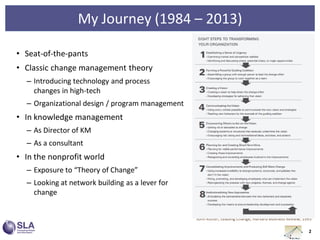
John Kotter, Leading Change, Harvard Business Review, 1995
The Network Perspective in KM
• “Knowledge flows along established pathways in organizations.
To change the flow of knowledge, you have to change the
pathways.”
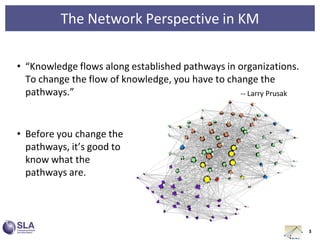
• Before you change the
pathways, it’s good to
know what the
pathways are.
3
-- Larry Prusak
Creating a Network Map
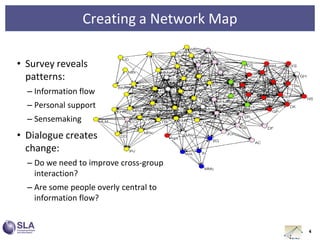
• Survey reveals
patterns:
– Information flow
– Personal support
– Sensemaking
4
• Dialogue creates
change:
– Do we need to improve cross-group
interaction?
– Are some people overly central to
information flow?
Networks, Complexity, and Change
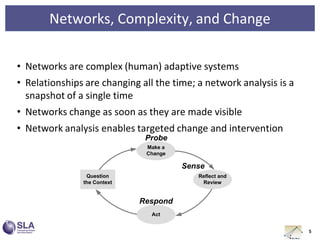
• Networks are complex (human) adaptive systems
• Relationships are changing all the time; a network analysis is a
snapshot of a single time
• Networks change as soon as they are made visible
• Network analysis enables targeted change and intervention
5
Making the Change
6
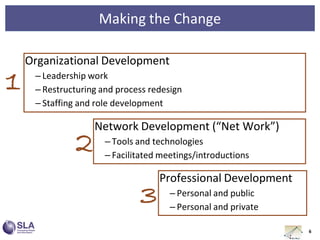
Organizational Development
– Leadership work
– Restructuring and process redesign
– Staffing and role development
1
Network Development (“Net Work”)
– Tools and technologies
– Facilitated meetings/introductions
2
Professional Development
– Personal and public
– Personal and private
3
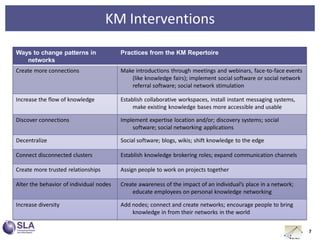
KM Interventions
Ways to change patterns in
networks
Practices from the KM Repertoire
Create more connections Make introductions through meetings and webinars, face-to-face events
(like knowledge fairs); implement social software or social network
referral software; social network stimulation
Increase the flow of knowledge Establish collaborative workspaces, install instant messaging systems,
make existing knowledge bases more accessible and usable
Discover connections Implement expertise location and/or; discovery systems; social
software; social networking applications
Decentralize Social software; blogs, wikis; shift knowledge to the edge
Connect disconnected clusters Establish knowledge brokering roles; expand communication channels
Create more trusted relationships Assign people to work on projects together
Alter the behavior of individual nodes Create awareness of the impact of an individual’s place in a network;
educate employees on personal knowledge networking
Increase diversity Add nodes; connect and create networks; encourage people to bring
knowledge in from their networks in the world
7
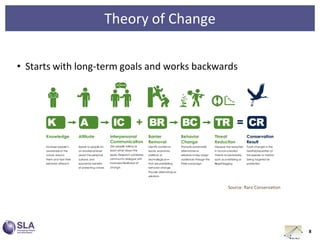
Theory of Change
• Starts with long-term goals and works backwards
8
Source: Rare Conservation
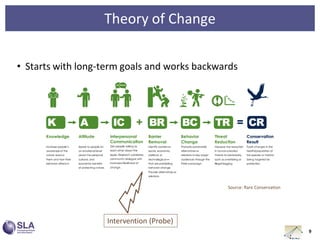
Theory of Change
• Starts with long-term goals and works backwards
9
Intervention (Probe)
Source: Rare Conservation
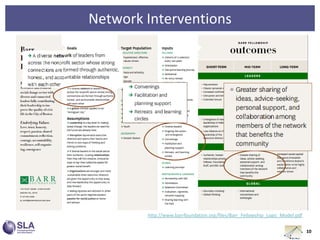
Network Interventions
• Designed as part of a theory of change or “logic model”
10
http://www.barrfoundation.org/files/Barr_Fellowship_Logic_Model.pdf
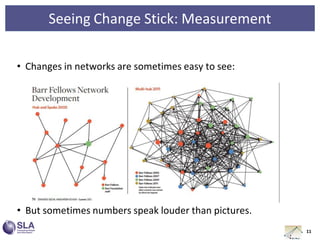
Seeing Change Stick: Measurement
• Changes in networks are sometimes easy to see:
11
• But sometimes numbers speak louder than pictures.
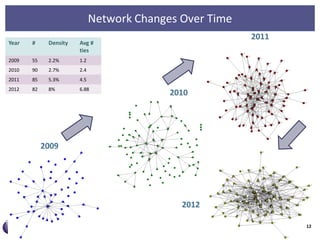
Network Changes Over Time
2010
2011
Year # Density Avg #
ties
2009 55 2.2% 1.2
2010 90 2.7% 2.4
2011 85 5.3% 4.5
2012 82 8% 6.88
2009
2012
12
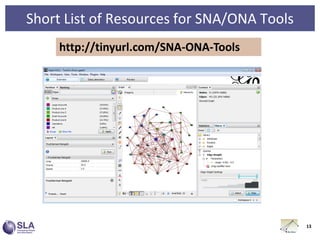
Short List of Resources for SNA/ONA Tools
13
http://tinyurl.com/SNA-ONA-Tools
Finding Models and Mentors
• Network analysis should be considered a
component of a change program
– It does help to identify influencers
– It can help target specific organizational
groups or connections for change
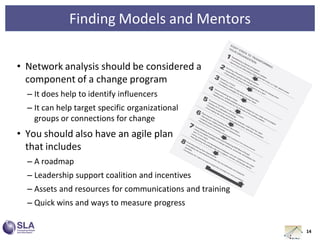
• You should also have an agile plan
that includes
– A roadmap
– Leadership support coalition and incentives
– Assets and resources for communications and training
– Quick wins and ways to measure progress
14
Plus Ça Change…
Question
• patti@pattianklam.com
•http://www.pattianklam.com
Thank you.
16

The Key Success Factor in Knowledge Management... What Else? Change Management

  • 1.
    The Key SuccessFactor in Knowledge Management… What Else? Change Management Patti Anklam, Net Work Ethel Salonen, MITRE Corporation June 10, 2013
  • 2.
    My Journey (1984– 2013) • Seat-of-the-pants • Classic change management theory – Introducing technology and process changes in high-tech – Organizational design / program management • In knowledge management – As Director of KM – As a consultant • In the nonprofit world – Exposure to “Theory of Change” – Looking at network building as a lever for change 2 John Kotter, Leading Change, Harvard Business Review, 1995
  • 3.
    The Network Perspectivein KM • “Knowledge flows along established pathways in organizations. To change the flow of knowledge, you have to change the pathways.” • Before you change the pathways, it’s good to know what the pathways are. 3 -- Larry Prusak
  • 4.
    Creating a NetworkMap • Survey reveals patterns: – Information flow – Personal support – Sensemaking 4 • Dialogue creates change: – Do we need to improve cross-group interaction? – Are some people overly central to information flow?
  • 5.
    Networks, Complexity, andChange • Networks are complex (human) adaptive systems • Relationships are changing all the time; a network analysis is a snapshot of a single time • Networks change as soon as they are made visible • Network analysis enables targeted change and intervention 5
  • 6.
    Making the Change 6 OrganizationalDevelopment – Leadership work – Restructuring and process redesign – Staffing and role development 1 Network Development (“Net Work”) – Tools and technologies – Facilitated meetings/introductions 2 Professional Development – Personal and public – Personal and private 3
  • 7.
    KM Interventions Ways tochange patterns in networks Practices from the KM Repertoire Create more connections Make introductions through meetings and webinars, face-to-face events (like knowledge fairs); implement social software or social network referral software; social network stimulation Increase the flow of knowledge Establish collaborative workspaces, install instant messaging systems, make existing knowledge bases more accessible and usable Discover connections Implement expertise location and/or; discovery systems; social software; social networking applications Decentralize Social software; blogs, wikis; shift knowledge to the edge Connect disconnected clusters Establish knowledge brokering roles; expand communication channels Create more trusted relationships Assign people to work on projects together Alter the behavior of individual nodes Create awareness of the impact of an individual’s place in a network; educate employees on personal knowledge networking Increase diversity Add nodes; connect and create networks; encourage people to bring knowledge in from their networks in the world 7
  • 8.
    Theory of Change •Starts with long-term goals and works backwards 8 Source: Rare Conservation
  • 9.
    Theory of Change •Starts with long-term goals and works backwards 9 Intervention (Probe) Source: Rare Conservation
  • 10.
    Network Interventions • Designedas part of a theory of change or “logic model” 10 http://www.barrfoundation.org/files/Barr_Fellowship_Logic_Model.pdf
  • 11.
    Seeing Change Stick:Measurement • Changes in networks are sometimes easy to see: 11 • But sometimes numbers speak louder than pictures.
  • 12.
    Network Changes OverTime 2010 2011 Year # Density Avg # ties 2009 55 2.2% 1.2 2010 90 2.7% 2.4 2011 85 5.3% 4.5 2012 82 8% 6.88 2009 2012 12
  • 13.
    Short List ofResources for SNA/ONA Tools 13 http://tinyurl.com/SNA-ONA-Tools
  • 14.
    Finding Models andMentors • Network analysis should be considered a component of a change program – It does help to identify influencers – It can help target specific organizational groups or connections for change • You should also have an agile plan that includes – A roadmap – Leadership support coalition and incentives – Assets and resources for communications and training – Quick wins and ways to measure progress 14
  • 15.
  • 16.