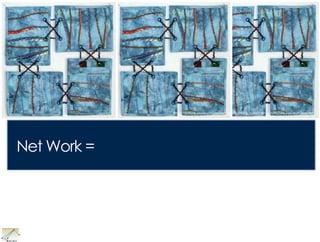
This is Net Work.Creating and Sustaining Successful NetworksPatti Anklam May 6, 2010
Themes from Net Work
Attributes of networks
Tools for net work
Networks and leadership
Networks and innovation
Social media
The changing landscape of connectedness
Innovation enginesAgendaPatti Anklam May 2010         2
Networks and Net Work
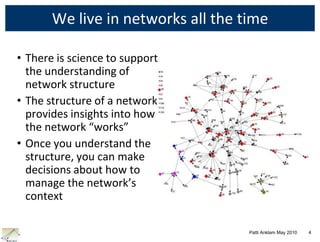
We live in networks all the timePatti Anklam May 2010         4There is science to support the understanding of network structure
The structure of a network provides insights into how the network “works”
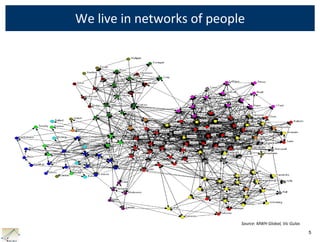
Once you understand the structure, you can make decisions about how to manage the network’s contextWe live in networks of people5Source: MWH Global, Vic Gulas
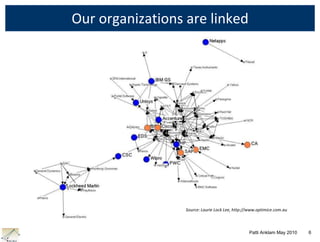
Our organizations are linkedPatti Anklam May 2010         6Source: Laurie Lock Lee, http://www.optimice.com.au
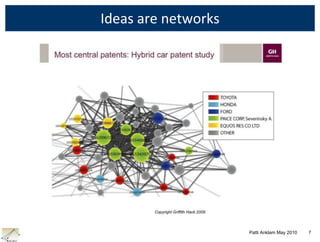
Ideas are networksPatti Anklam May 2010         7
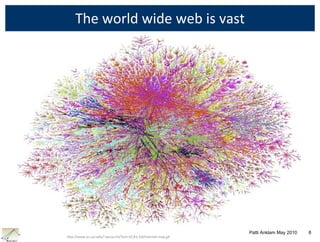
The world wide web is vastPatti Anklam May 2010         8http://www.ics.uci.edu/~wscacchi/Tech-EC/EC-EB/Internet-map.gif
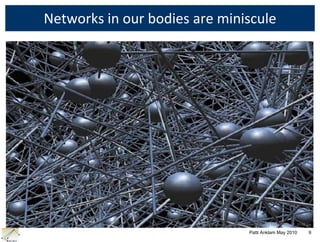
Networks in our bodies are minisculePatti Anklam May 2010         9http://images.iop.org/objects/phw/world/21/10/31/PWnow1_10-08.jpg
What do we notice about these networks?Patti Anklam May 2010         10Any set of relationships is a network
Person-person
Group-group
Cross-enterprise
Cross-business
Information artifacts
Web sites
Atoms and molecules
A network is a collection of entities linked by a type of relationship
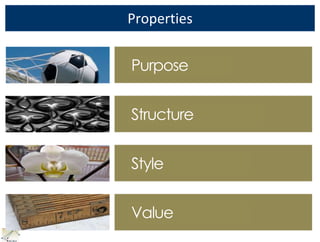
All networks have common properties and can be analyzedPurposeStructureStyleValueProperties
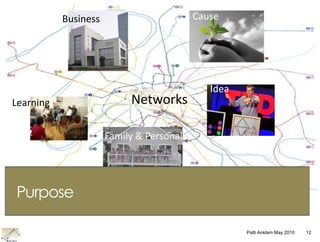
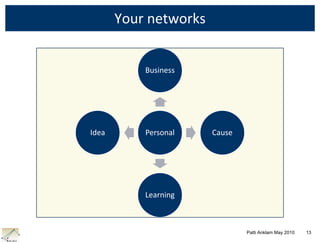
CauseBusinessIdeaNetworksLearningFamily & PersonalPurposePatti Anklam May 2010         12
Your networksPatti Anklam May 2010         13
Learning NetworksPatti Anklam May 2010         14  Global Professional Associations
  Face-to-Face Local Groups
  Mailing lists
  Online Communities
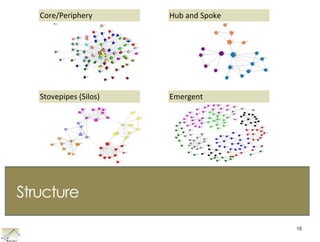
  ConferencesCore/PeripheryHub and SpokeStovepipes (Silos)EmergentStructure15
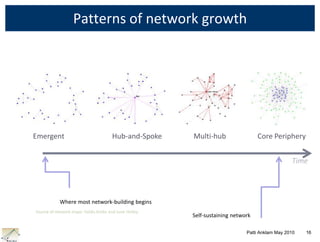
Patterns of network growthPatti Anklam May 2010         16EmergentHub-and-SpokeMulti-hubCore PeripheryTimeWhere most network-building beginsSource of network maps: Valdis Krebs and June HolleySelf-sustaining network
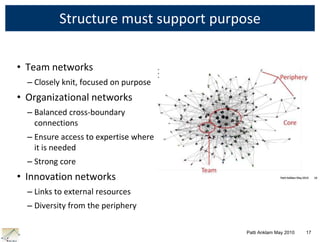
Team networks
Closely knit, focused on purpose
Organizational networks
Balanced cross-boundary connections
Ensure access to expertise where it is needed
Strong core
Innovation networks
Links to external resources
Diversity from the peripheryStructure must support purposePatti Anklam May 2010         17
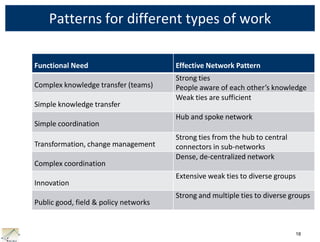
Patterns for different types of work18
Elements of StylePatti Anklam May 2010         19Place
  Space
  Pace
  Style of interactionValuePatti Anklam May 2010         20
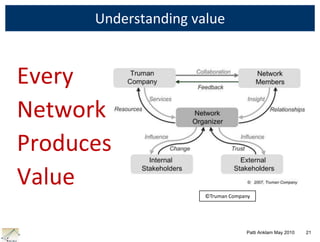
Understanding valueEveryNetworkProducesValuePatti Anklam May 2010         21©Truman Company
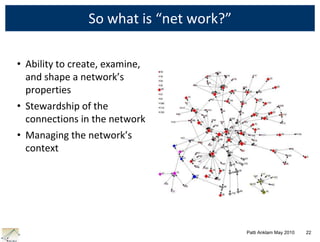
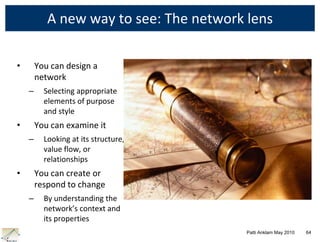
So what is “net work?”Patti Anklam May 2010         22Ability to create, examine, and shape a network’s properties
Stewardship of the connections in the network
Managing the network’s contextWhy is it important to understand networks?Patti Anklam May 2010         23
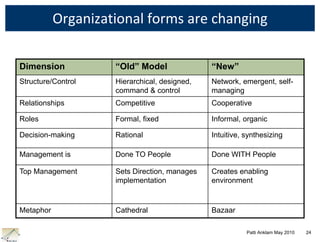
Organizational forms are changingPatti Anklam May 2010         24
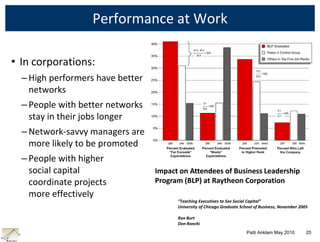
Performance at WorkPatti Anklam May 2010         25In corporations:High performers have better networksPeople with better networks stay in their jobs longerNetwork-savvy managers are more likely to be promotedPeople with higher social capital coordinate projectsmore effectivelyImpact on Attendees of Business Leadership Program (BLP) at Raytheon Corporation“Teaching Executives to See Social Capital”University of Chicago Graduate School of Business, November 2005Ron BurtDon Ronchi
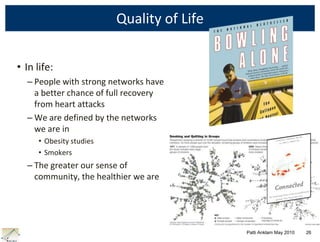
Quality of LifeIn life:People with strong networks have a better chance of full recovery from heart attacksWe are defined by the networks we are inObesity studiesSmokersThe greater our sense of community, the healthier we arePatti Anklam May 2010         26
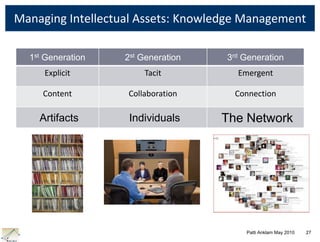
Managing Intellectual Assets: Knowledge ManagementPatti Anklam May 2010         27
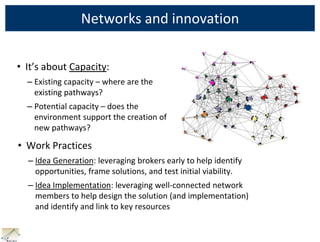
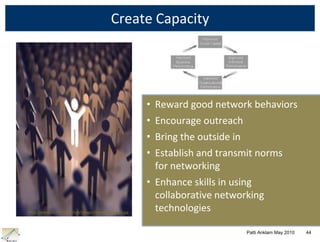
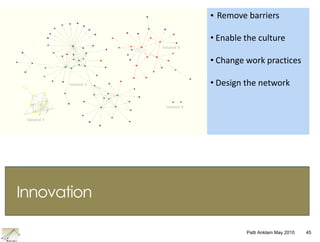
Networks and innovation It’s about Capacity:Existing capacity – where are the existing pathways?Potential capacity – does the environment support the creation of new pathways?Work Practices
Idea Generation: leveraging brokers early to help identify opportunities, frame solutions, and test initial viability.
Idea Implementation: leveraging well-connected network members to help design the solution (and implementation) and identify and link to key resourcesDesign
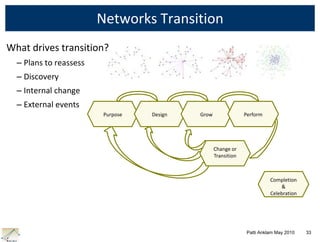
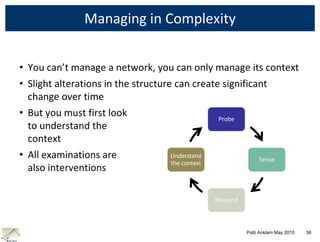
Transition
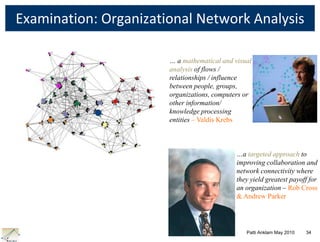
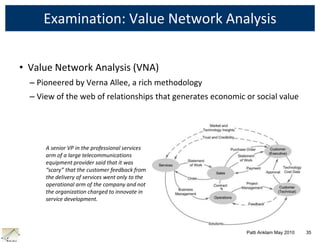
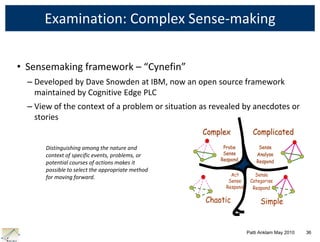
ExaminationTools for Net Work
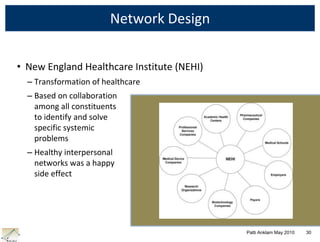
Network DesignPatti Anklam May 2010         30New England Healthcare Institute (NEHI)
Transformation of healthcare
Based on collaborationamong all constituentsto identify and solvespecific systemicproblems

Net work creating and sustaining successful networks

Editor's Notes

  • #2 Abstract as advertised:The locus of knowledge has shifted over the past 15 years of “KM” – from being in “stuff” (artifacts, content management systems), to being in people (communities of practice, collaboration systems), to being in the network (constantly alive and moving around us, available directly and peripherally from our friends, colleagues, co-workers, and those we following on Twitter).  How we maintain and grow our personal networks – our personal net work – is a critical part of “personal knowledge management.”  Patti will put personal networks in context and then review practical techniques for maintaining personal networks.
  • #4 Before talking about personal networks and knowledge management, I need to share my personal perspectives and on both of these so you can understand my language.
  • #12 In my book, Net Work, I describe a framework for thinking about and talking about networks.http://www.athenryac.com/time-set-goals
  • #16 In one sense I’ve been interested in and creating networks throughout my career, but it wasn’t’ until I was introduced to science of network in the fall of 2000 that may things started to click with me. The fact that there is a tool that lets us map the relationships among people is not novel, but the research that is coming forward that tells us how the structure of a network can predict outcomes and behaviors, that is what is revolutionary. That is what is changing our thinking.
  • #30 Before talking about personal networks and knowledge management, I need to share my personal perspectives and on both of these so you can understand my language.
  • #49 “Everything is fragmented” says Dave Weinberger, and right he is. I don’t know about you, but I leave pieces of myself and what I’m thinking about and collecting all over the place. What Dave, and others who are at the front wave of social media research, are onto is that in this new place, everything hinges on discoverability.If it’s out there, and those who created it made sufficient tracks to enable others to find it, we can find it and put it together in a way that makes sense for us.Meanwhile, it’s just way too much. So what do we do? We rely on our personal networks.
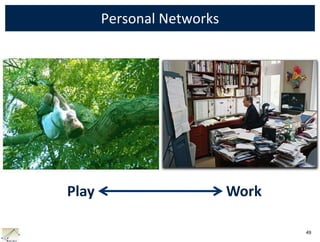
  • #50 http://www.freeplaynetwork.org.uk/playlink/exhibition/Earlier, I said that we can generally identify a network as having a particular core purpose. We participate in these as individuals, and people in these networks make up our personal network. When work is fun, some of those people whom we know from work become our closest personal friends. (I had lunch yesterday with 2 friends I worked with at Digital. We’ve been having lunch together for over 30 years. These are good friends, and we now we just play together.)Now I am going to launch into how we maintain our personal networks in the age of digital networks, but I don’t want to leave you thinking that what I am going to talk about applies only to work networks.