Stephen P. Borgatti, et al.
Science 323, 892 (2009));
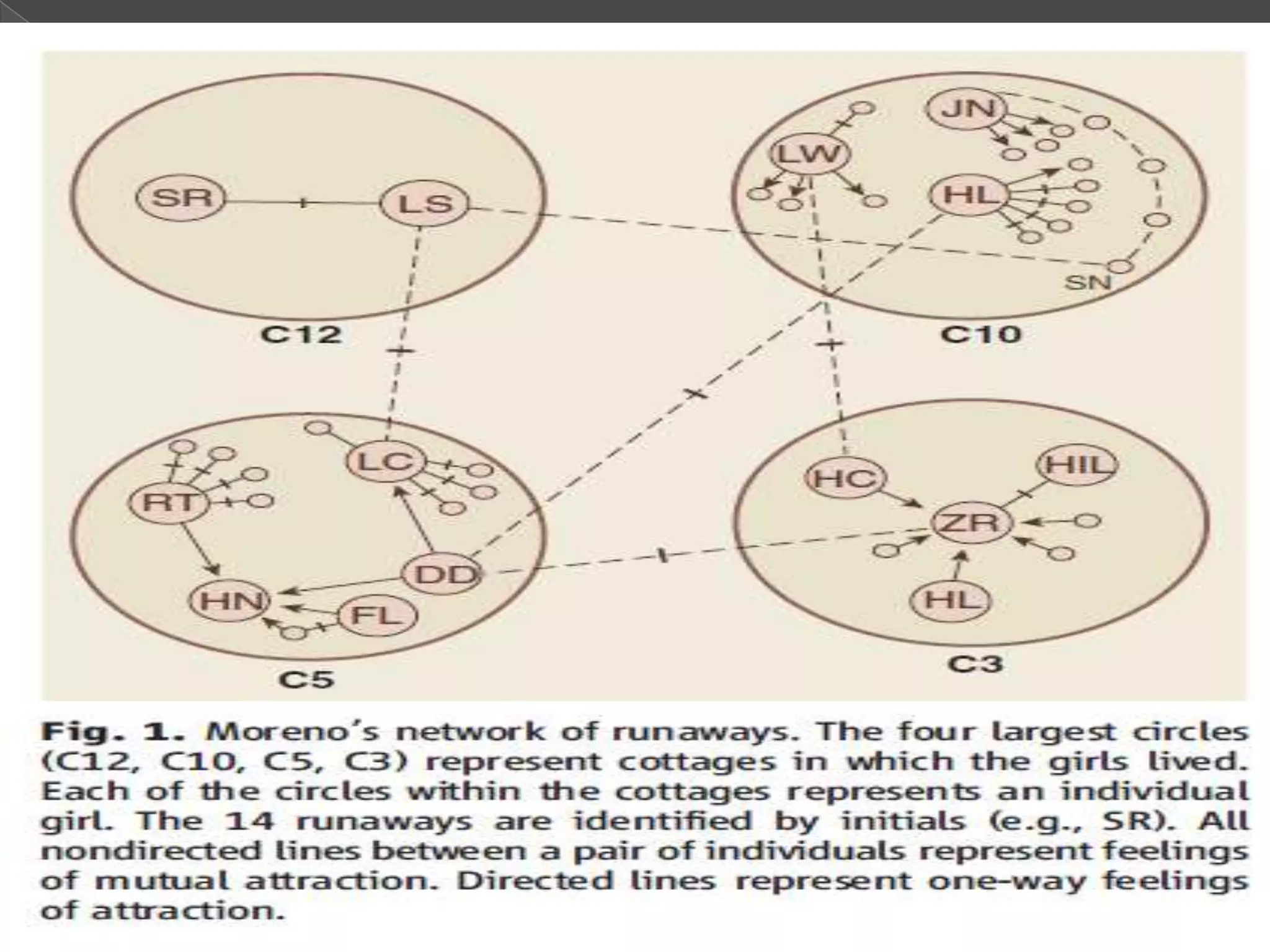
In the fall of 1932, there was an epidemic of
runaways at the Hudson School for Girls
Moreno's Sociometry
Network Analysis in the Social Sciences
The links in SN provided channels for the
flow of social influence among girls
Comte -The idea of social physics
Durheim -Societes like biological systems


Matrix algebra-Graph theory
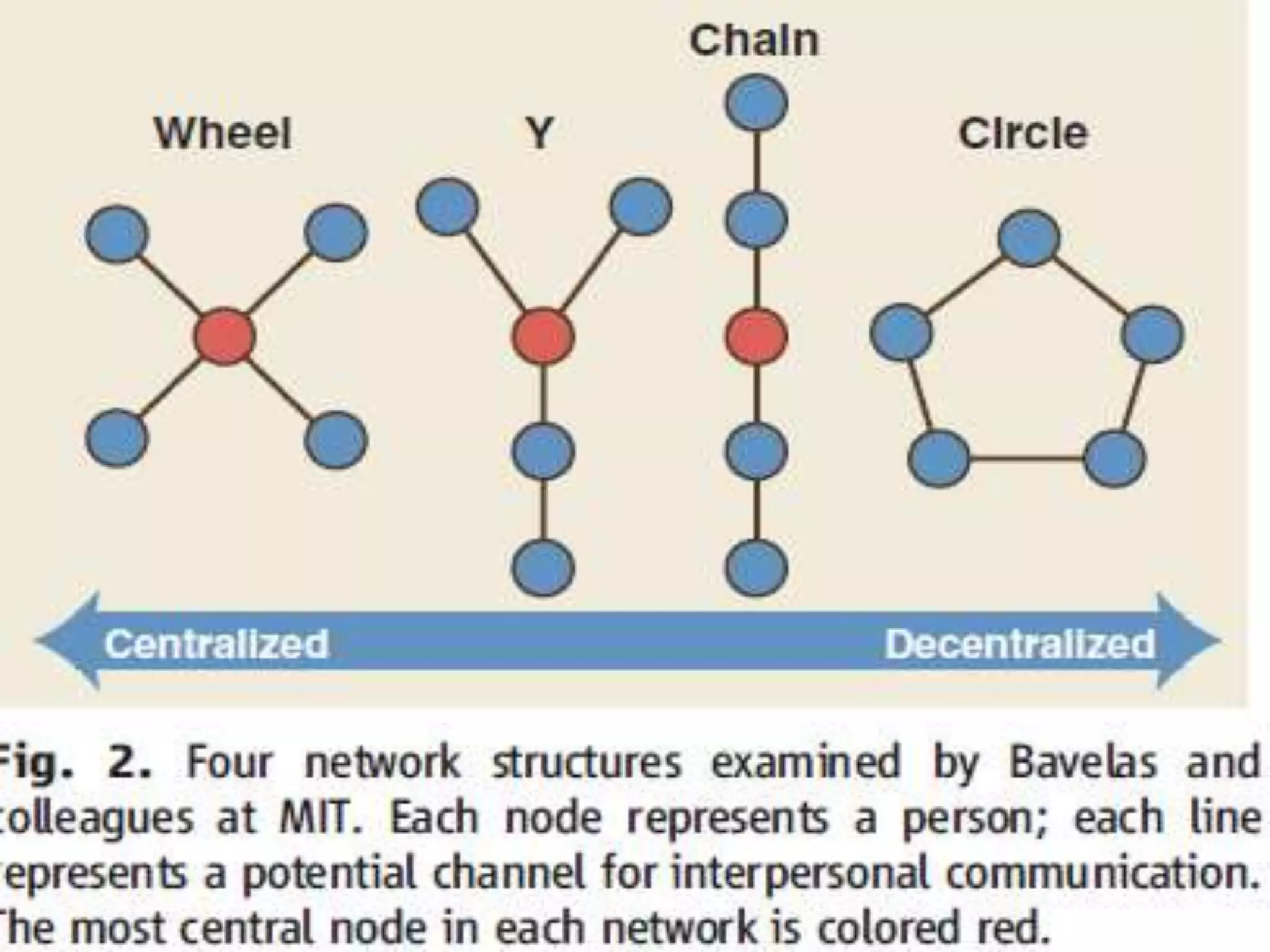
Group network lab (MIT)-Study of network
topology (stars vs circles)-Bavelas et al
Small world problem
Six degress of separation
Urbanization destroyed community
Network analysis to represent community
structure

S. F. Nadel began
to see societies not as monolithic
entities but rather as a “pattern or
network (or „system‟) of relationships
obtaining between actors in
their capacity of playing roles relative
to one another”

Levi-Strauss, scholars
began to represent kinship systems
as relational algebras that consisted
of a small set of generating relations

That gave hope to the idea that
deep lawlike regularities might underlie the apparent chaos
of human social systems

Bott (The study of 20 urban families)



Degree of segregation in the role relationship of
husband and wife
 The more connected the network, the
more likely the couple would maintain a traditional
segregation of husband and wife roles,
showing that the structure of the larger network
can affect relations and behaviors within the dyad.
(TOP-DOWN approach)
The

idea that whom a person is connected
to, and how these contacts are
connected to each other, enable people to
access resources that ultimately
lead them to such things as better jobs
and
faster promotions.
e.g LINKEDIN SOCIAL NETWORK


In the 1990s, network analysis radiated
into a great number of fields, including physics and

biology,management consulting
public health and crime/war fighting.

Knowledge management,
where the objective is to help organizations
better exploit the knowledge and capabilities distributed
across its members.

In public health, network
approaches have been important both in
stopping the spread of infectious diseases and in

providing better health care and social support.

Network approach in war and crimes


Perhaps the oldest criticism of social
network research is that the field lacks a
(native) theoretical understanding—it is
“merely descriptive”or “just
methodology.”

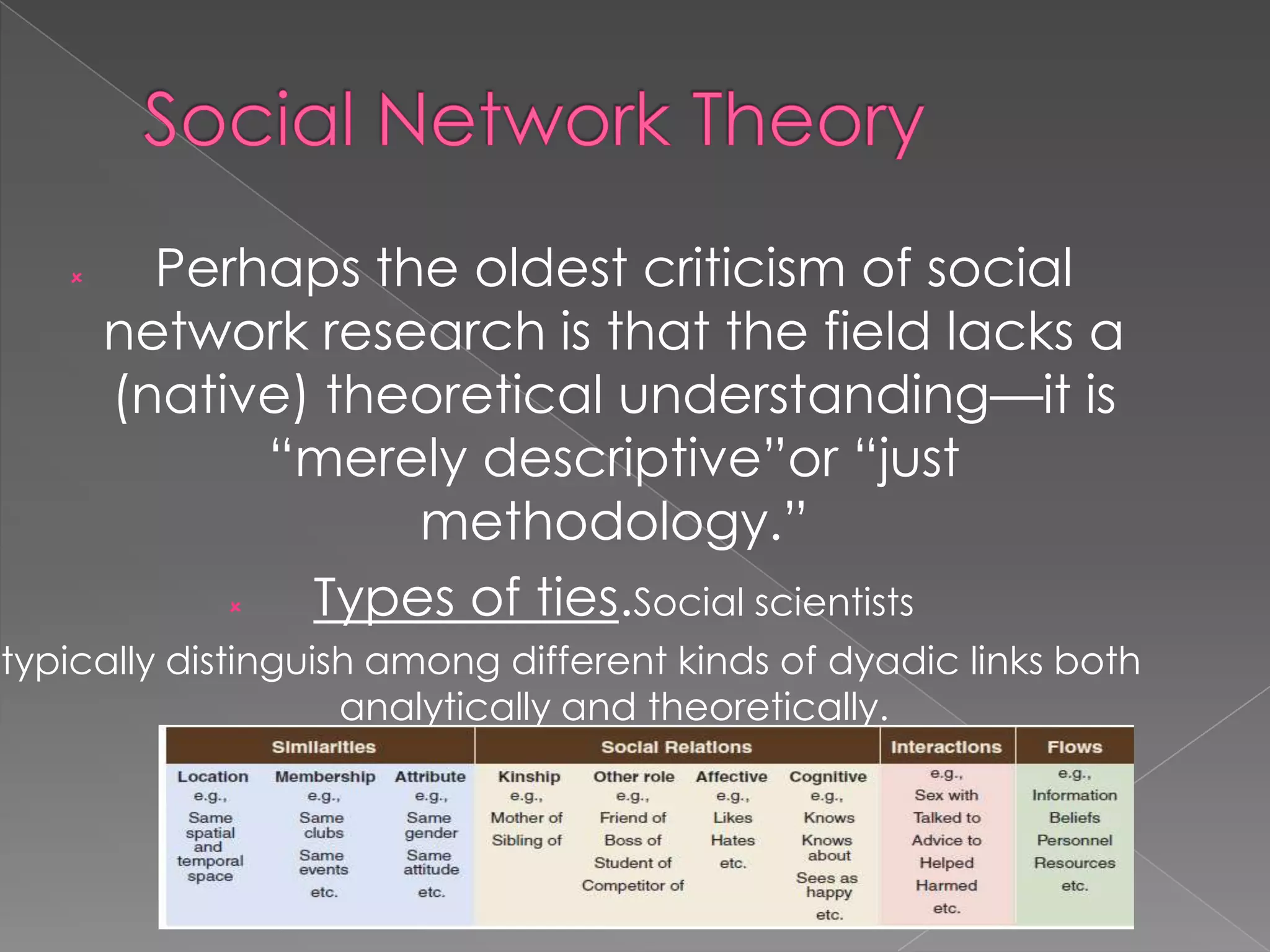
Types of ties.Social scientists

typically distinguish among different kinds of dyadic links both
analytically and theoretically.


Teams with the same composition of
member skills can perform very
differently depending on the patterns of
relationships among the members

A node‟s outcomes and future
characteristics depend in part on its
position in the network structure

Connections to powerfull others
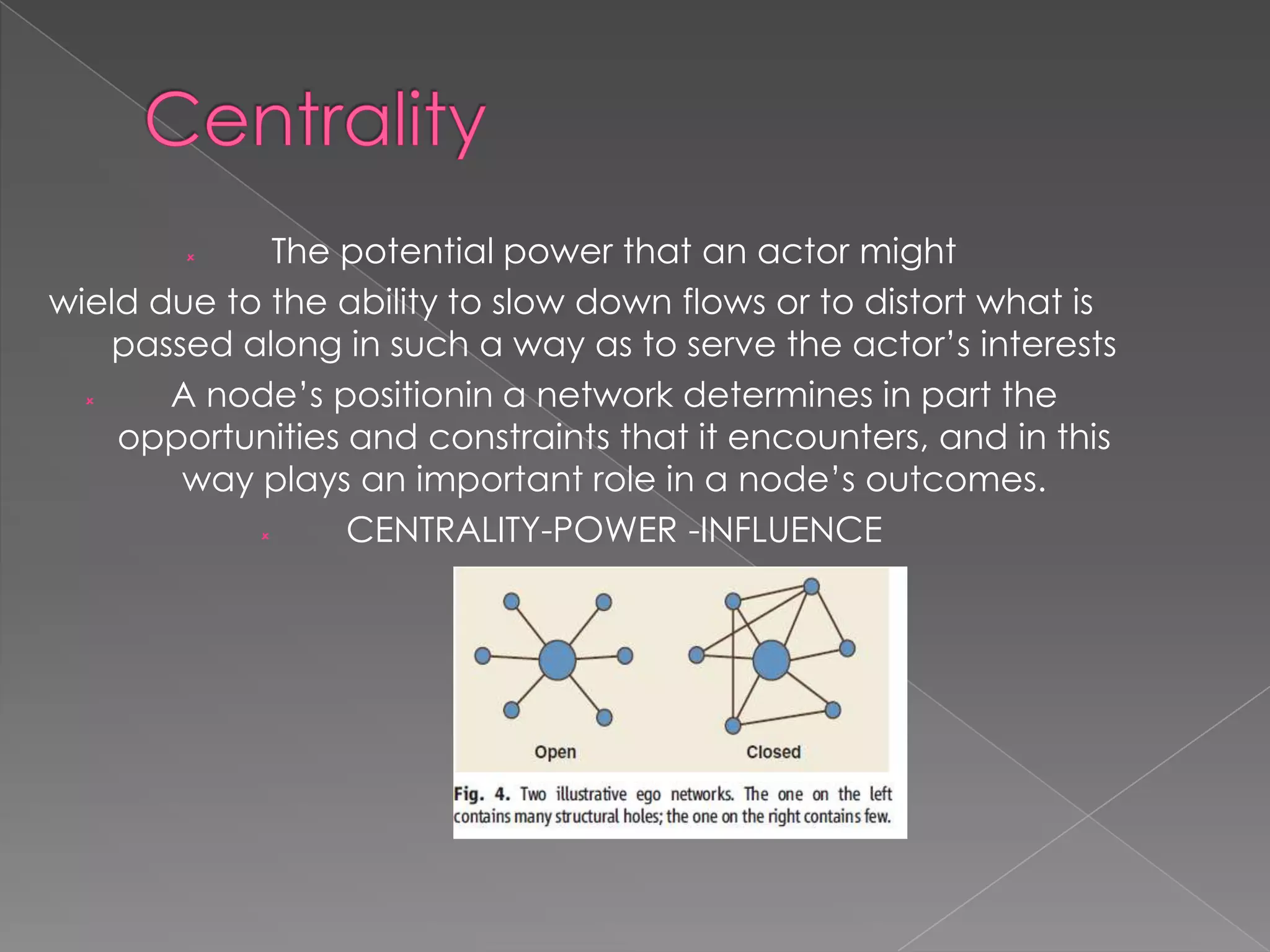
The potential power that an actor might
wield due to the ability to slow down flows or to distort what is
passed along in such a way as to serve the actor‟s interests

A node‟s positionin a network determines in part the
opportunities and constraints that it encounters, and in this
way plays an important role in a node‟s outcomes.

CENTRALITY-POWER -INFLUENCE

Something flows along a network path
from one node to the other

The adaptation mechanism states that
nodesbecome homogeneous as a result
of experiencing and adapting to similar
social environments

If two nodes have ties to the same (or
equivalent) others, they face the same
environmental forces and are likely to
adapt by becoming increasingly similar
•
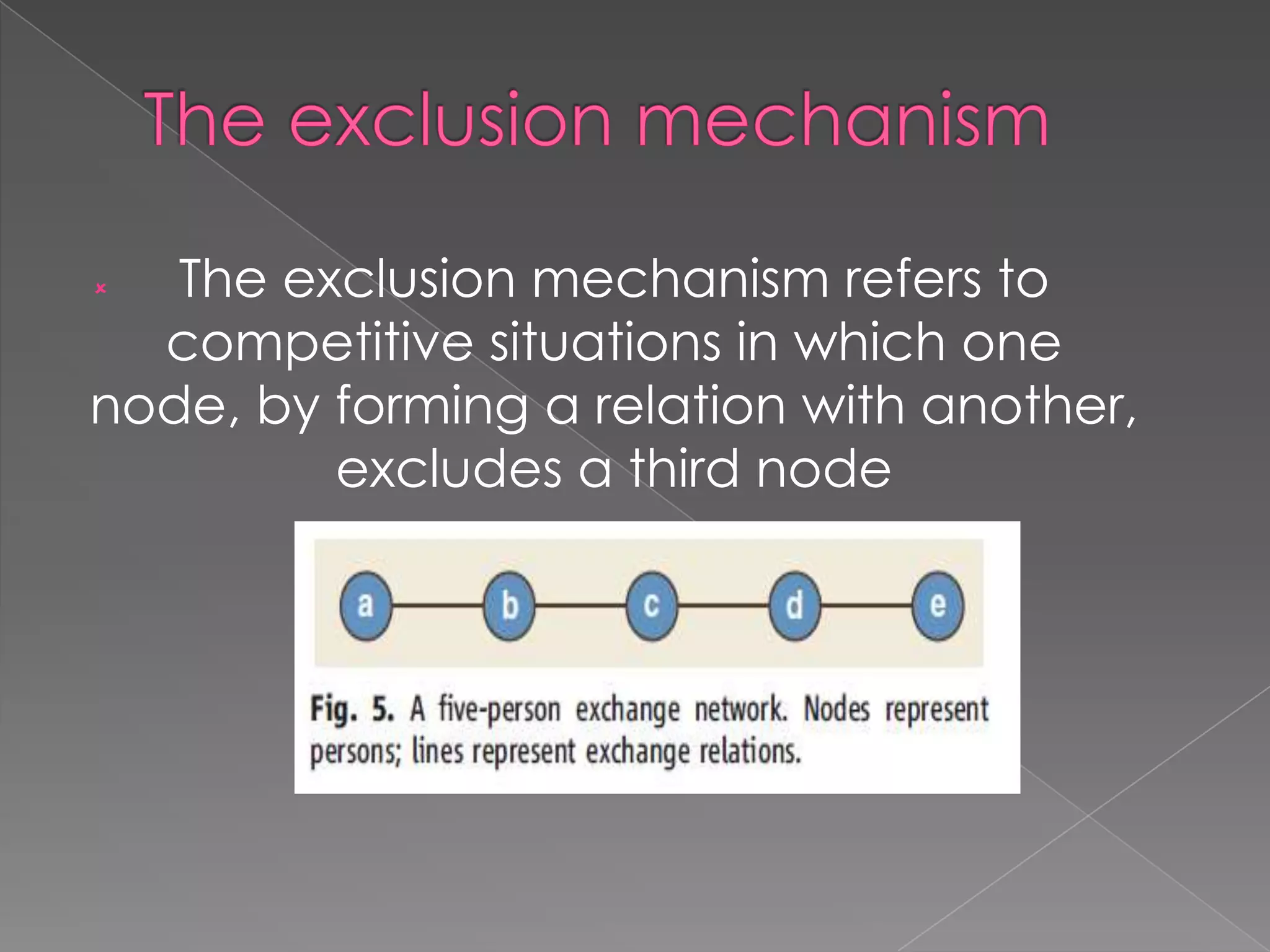
The exclusion mechanism refers to
competitive situations in which one
node, by forming a relation with another,
excludes a third node

A foreseeable challenge for network
research in the social sciences is
that its theories can diffuse through a
population,influencing the way people see
themselves and how they act, a
phenomenon that Giddens described
as the double-hermeneutic



Research examining economic networks
has been studied from two perspectives;
one view comes from economics and
sociology; the other originated in
research on complex systems in physics
and computer science

Micro-macro analysis
A

star-spoke network, like a very
centralized or-ganization, in which a central
“hub” channels all
communication among agents. In this
“micro” perspective we focus on the
individual system elements and their
detailed network of relations
The micro analysis of economic networks
relies on game theory, which
aims at identifying Nash equilibria (i.e.,
situations that are strategically stable in
the sense that no agent has an incentive
to deviate). It can also rely on operations
research, where algorithms for
searching and optimizing have been
developed. As the number of nodes
and possible links scales up, however,
such problems become very difficult
to solve, and classical approaches are
unsatisfactory.
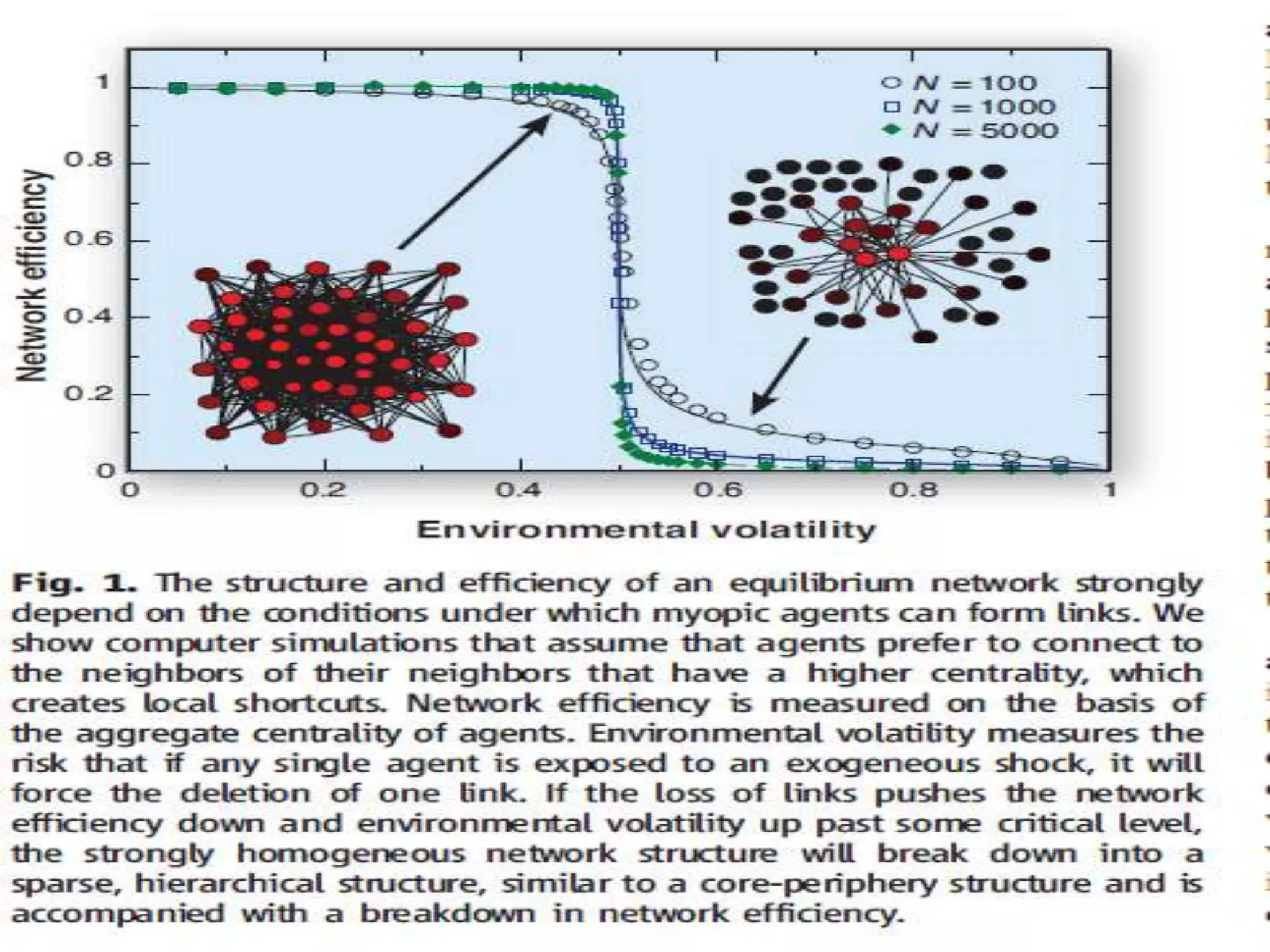
Small changes in environmental volatility can have drastic
consequences in the overall configuration
of the system
The inability of previous approaches to reproduce
statistical regularities that have been observed
empirically in network structures justifies
our pursuit of a complex-systems approach that
may provide predictions for large-scale networks.


Degree of connectivity (number
of links) or their centrality, as measured on
the basis of the importance of a node—
which, in turn, can be affected by its links
to other nodes

Thus, instead of focusing on understanding
the endogenous behavior of individual agents, the complexsystems approach centers on understanding how the
network-formation rules systematically
affect the emerging link structure

Networks generated with different stochastic
algorithms, such as random, scale-free or smallworld
networks, have been compared with real
complex networks

Comparing network structures across these different
disciplines suggests that economic networks
may also reflect a similar universality

In the complex-network context, “links” are not binary
(existing or not existing), but are weighted according to the
economic interaction.

Country centrality in the terms of
the likelihood that any given additional
dollar traded in the world reaches that
country by following existing links
with a probability proportional to its
weigh ,the relative changes in centrality
over time show trends for different
countries that predict divergence inregional integration within the
global economy
and do so better than traditional international trade
and macroeconomic statistics

Focus on centrality or other such
properties of networks can only provide a
firstorder classification that emphasizes the role
of fluctuations and randomness and cannot
predict the underlying dynamics of the agents,
whether
they are firms or countries
Massive data analysis
Time and space (going beyond snapshot
approach)
Structure identification
Beyond simplicity
Systemic feedback


Network Analysis in the Social Sciences

  • 1.
    Stephen P. Borgatti,et al. Science 323, 892 (2009));
  • 3.
    In the fallof 1932, there was an epidemic of runaways at the Hudson School for Girls Moreno's Sociometry Network Analysis in the Social Sciences The links in SN provided channels for the flow of social influence among girls Comte -The idea of social physics Durheim -Societes like biological systems 
  • 4.
    Matrix algebra-Graph theory Groupnetwork lab (MIT)-Study of network topology (stars vs circles)-Bavelas et al Small world problem Six degress of separation Urbanization destroyed community Network analysis to represent community structure 
  • 6.
    S. F. Nadelbegan to see societies not as monolithic entities but rather as a “pattern or network (or „system‟) of relationships obtaining between actors in their capacity of playing roles relative to one another”  Levi-Strauss, scholars began to represent kinship systems as relational algebras that consisted of a small set of generating relations  That gave hope to the idea that deep lawlike regularities might underlie the apparent chaos of human social systems 
  • 7.
    Bott (The studyof 20 urban families)  Degree of segregation in the role relationship of husband and wife  The more connected the network, the more likely the couple would maintain a traditional segregation of husband and wife roles, showing that the structure of the larger network can affect relations and behaviors within the dyad. (TOP-DOWN approach)
  • 8.
    The idea that whoma person is connected to, and how these contacts are connected to each other, enable people to access resources that ultimately lead them to such things as better jobs and faster promotions. e.g LINKEDIN SOCIAL NETWORK
  • 9.
     In the 1990s,network analysis radiated into a great number of fields, including physics and biology,management consulting public health and crime/war fighting.  Knowledge management, where the objective is to help organizations better exploit the knowledge and capabilities distributed across its members.  In public health, network approaches have been important both in stopping the spread of infectious diseases and in providing better health care and social support.  Network approach in war and crimes
  • 10.
     Perhaps the oldestcriticism of social network research is that the field lacks a (native) theoretical understanding—it is “merely descriptive”or “just methodology.”  Types of ties.Social scientists typically distinguish among different kinds of dyadic links both analytically and theoretically.
  • 11.
     Teams with thesame composition of member skills can perform very differently depending on the patterns of relationships among the members  A node‟s outcomes and future characteristics depend in part on its position in the network structure  Connections to powerfull others
  • 12.
    The potential powerthat an actor might wield due to the ability to slow down flows or to distort what is passed along in such a way as to serve the actor‟s interests  A node‟s positionin a network determines in part the opportunities and constraints that it encounters, and in this way plays an important role in a node‟s outcomes.  CENTRALITY-POWER -INFLUENCE 
  • 13.
    Something flows alonga network path from one node to the other  The adaptation mechanism states that nodesbecome homogeneous as a result of experiencing and adapting to similar social environments  If two nodes have ties to the same (or equivalent) others, they face the same environmental forces and are likely to adapt by becoming increasingly similar •
  • 14.
    The exclusion mechanismrefers to competitive situations in which one node, by forming a relation with another, excludes a third node 
  • 15.
    A foreseeable challengefor network research in the social sciences is that its theories can diffuse through a population,influencing the way people see themselves and how they act, a phenomenon that Giddens described as the double-hermeneutic 
  • 17.
     Research examining economicnetworks has been studied from two perspectives; one view comes from economics and sociology; the other originated in research on complex systems in physics and computer science  Micro-macro analysis
  • 18.
    A star-spoke network, likea very centralized or-ganization, in which a central “hub” channels all communication among agents. In this “micro” perspective we focus on the individual system elements and their detailed network of relations
  • 19.
    The micro analysisof economic networks relies on game theory, which aims at identifying Nash equilibria (i.e., situations that are strategically stable in the sense that no agent has an incentive to deviate). It can also rely on operations research, where algorithms for searching and optimizing have been developed. As the number of nodes and possible links scales up, however, such problems become very difficult to solve, and classical approaches are unsatisfactory.
  • 20.
    Small changes inenvironmental volatility can have drastic consequences in the overall configuration of the system The inability of previous approaches to reproduce statistical regularities that have been observed empirically in network structures justifies our pursuit of a complex-systems approach that may provide predictions for large-scale networks. 
  • 21.
    Degree of connectivity(number of links) or their centrality, as measured on the basis of the importance of a node— which, in turn, can be affected by its links to other nodes 
  • 23.
    Thus, instead offocusing on understanding the endogenous behavior of individual agents, the complexsystems approach centers on understanding how the network-formation rules systematically affect the emerging link structure  Networks generated with different stochastic algorithms, such as random, scale-free or smallworld networks, have been compared with real complex networks  Comparing network structures across these different disciplines suggests that economic networks may also reflect a similar universality 
  • 24.
    In the complex-networkcontext, “links” are not binary (existing or not existing), but are weighted according to the economic interaction.  Country centrality in the terms of the likelihood that any given additional dollar traded in the world reaches that country by following existing links with a probability proportional to its weigh ,the relative changes in centrality over time show trends for different countries that predict divergence inregional integration within the global economy and do so better than traditional international trade and macroeconomic statistics 
  • 26.
    Focus on centralityor other such properties of networks can only provide a firstorder classification that emphasizes the role of fluctuations and randomness and cannot predict the underlying dynamics of the agents, whether they are firms or countries Massive data analysis Time and space (going beyond snapshot approach) Structure identification Beyond simplicity Systemic feedback 