Social Networks for Managers
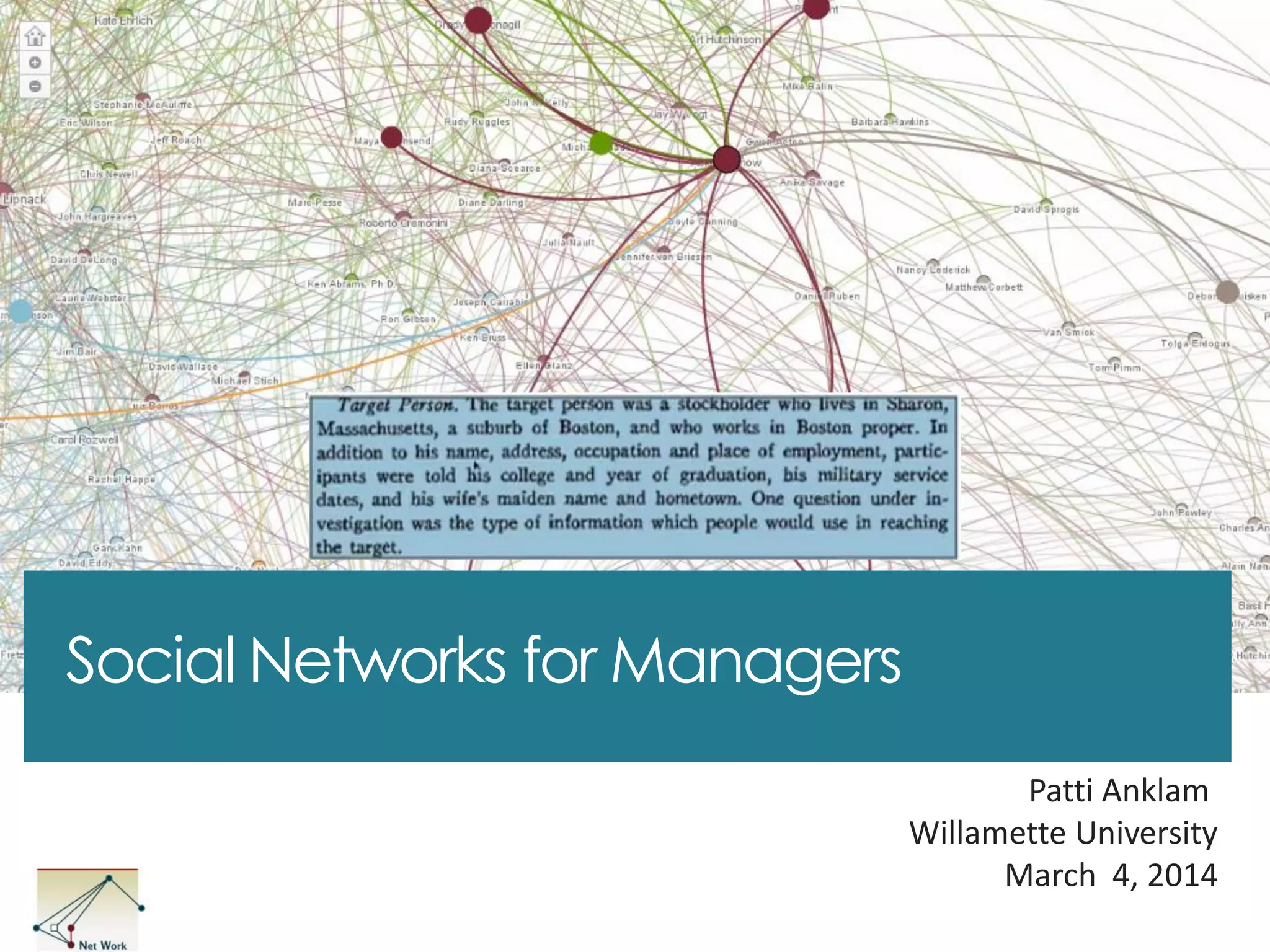
Patti Anklam
Willamette University
March 4, 2014
I’ve become convinced that understanding
how networks work is an essential 21st
century literacy.
Howard Rheingold
Agenda
Social Network Analysis
―The language of networks
―Networks in organizations

Overview of Tools and
Technologies

Social Networks for Managers

3
http://www.dftdigest.com/images/Spyglass.jpg

The New Language of Networks
Networks Matter
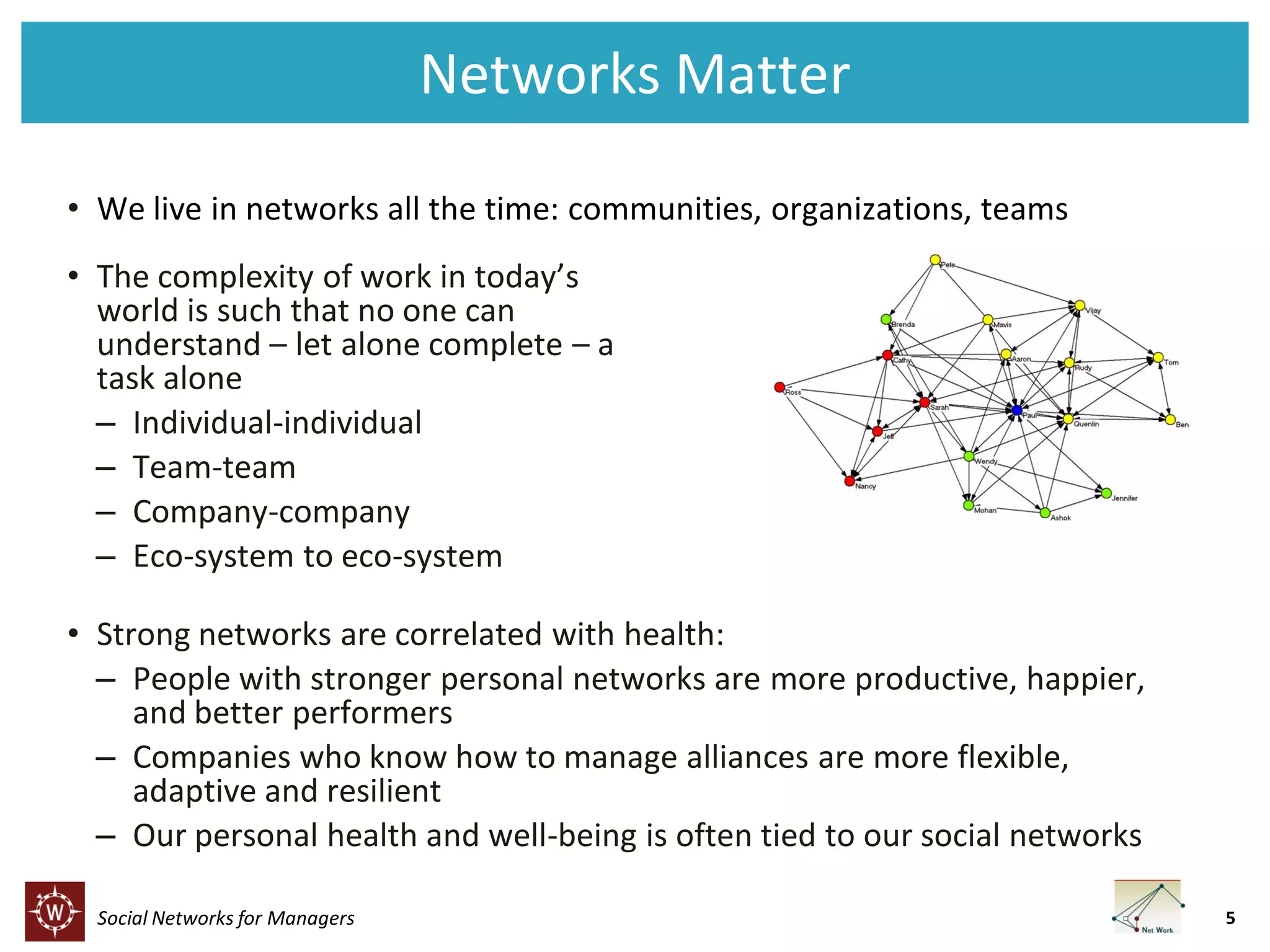
• We live in networks all the time: communities, organizations, teams
• The complexity of work in today’s
world is such that no one can
understand – let alone complete – a
task alone
– Individual-individual
– Team-team
– Company-company
– Eco-system to eco-system
• Strong networks are correlated with health:
– People with stronger personal networks are more productive, happier,
and better performers
– Companies who know how to manage alliances are more flexible,
adaptive and resilient
– Our personal health and well-being is often tied to our social networks
Social Networks for Managers

5
Structure Matters
• There is science to support the
understanding of network
structure
• The structure of a network
provides insights into how the
network “works”
• Once you understand the
structure, you can make
decisions about how to
manage the network’s context
• Network analysis tools help
you understand the structure

6

Social Networks for Managers
The Importance of Understanding Networks

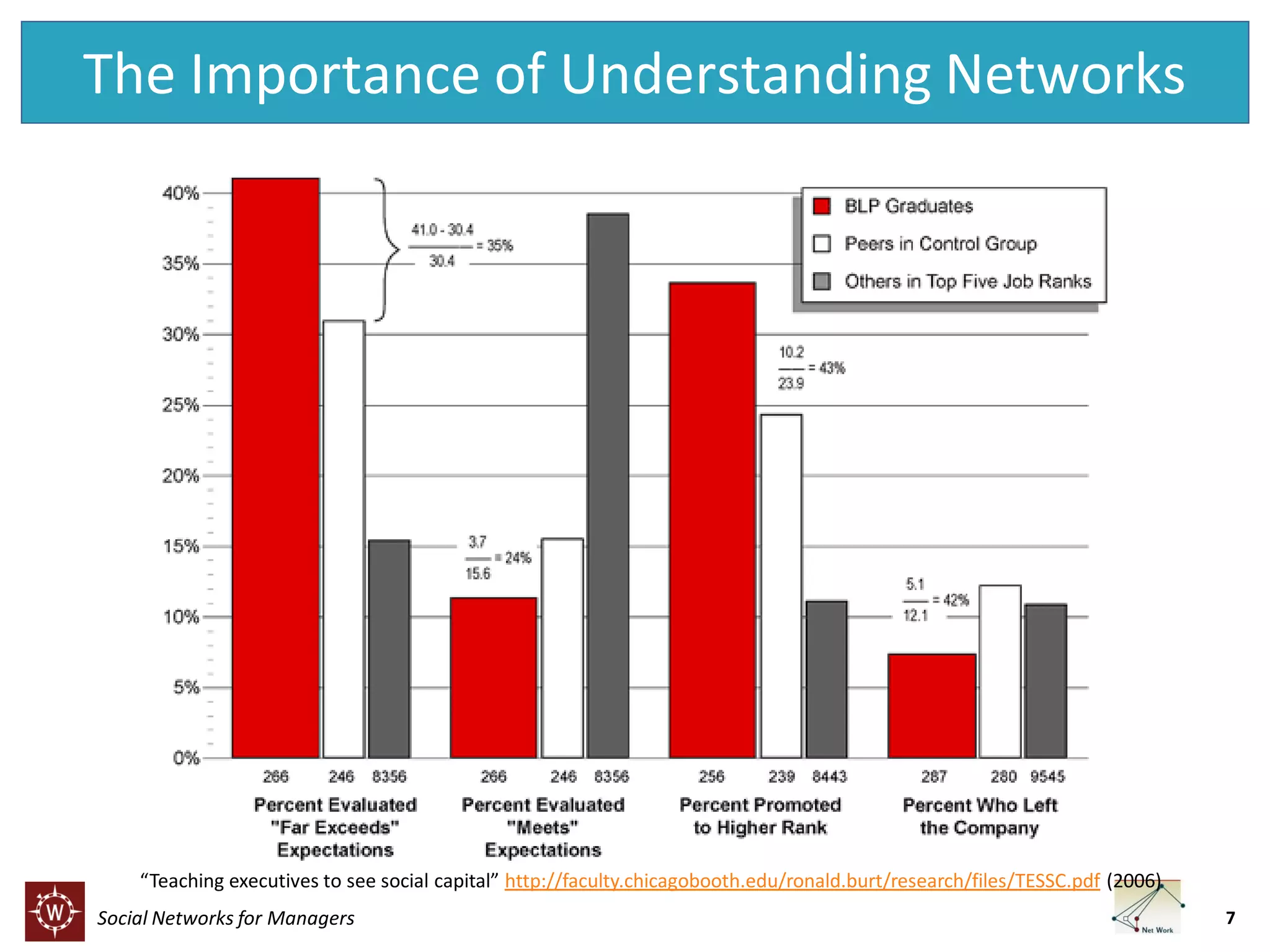
“Teaching executives to see social capital” http://faculty.chicagobooth.edu/ronald.burt/research/files/TESSC.pdf (2006)

Social Networks for Managers

7
The new science of networks
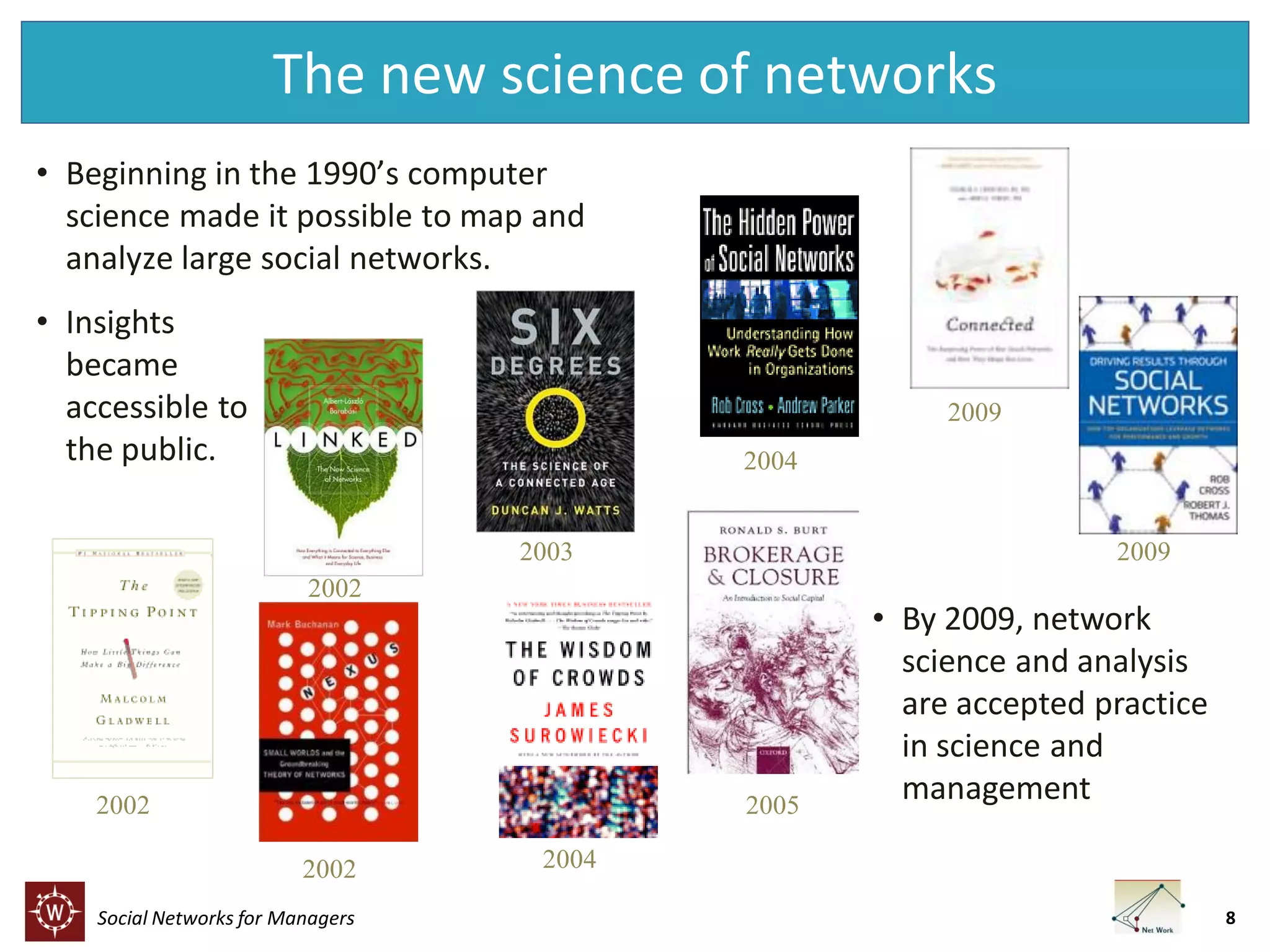
• Beginning in the 1990’s computer
science made it possible to map and
analyze large social networks.

• Insights
became
accessible to
the public.

2009
2004

2003

2009

2002

2002

2005
2002

Social Networks for Managers

• By 2009, network
science and analysis
are accepted practice
in science and
management

2004
8
Meanwhile…
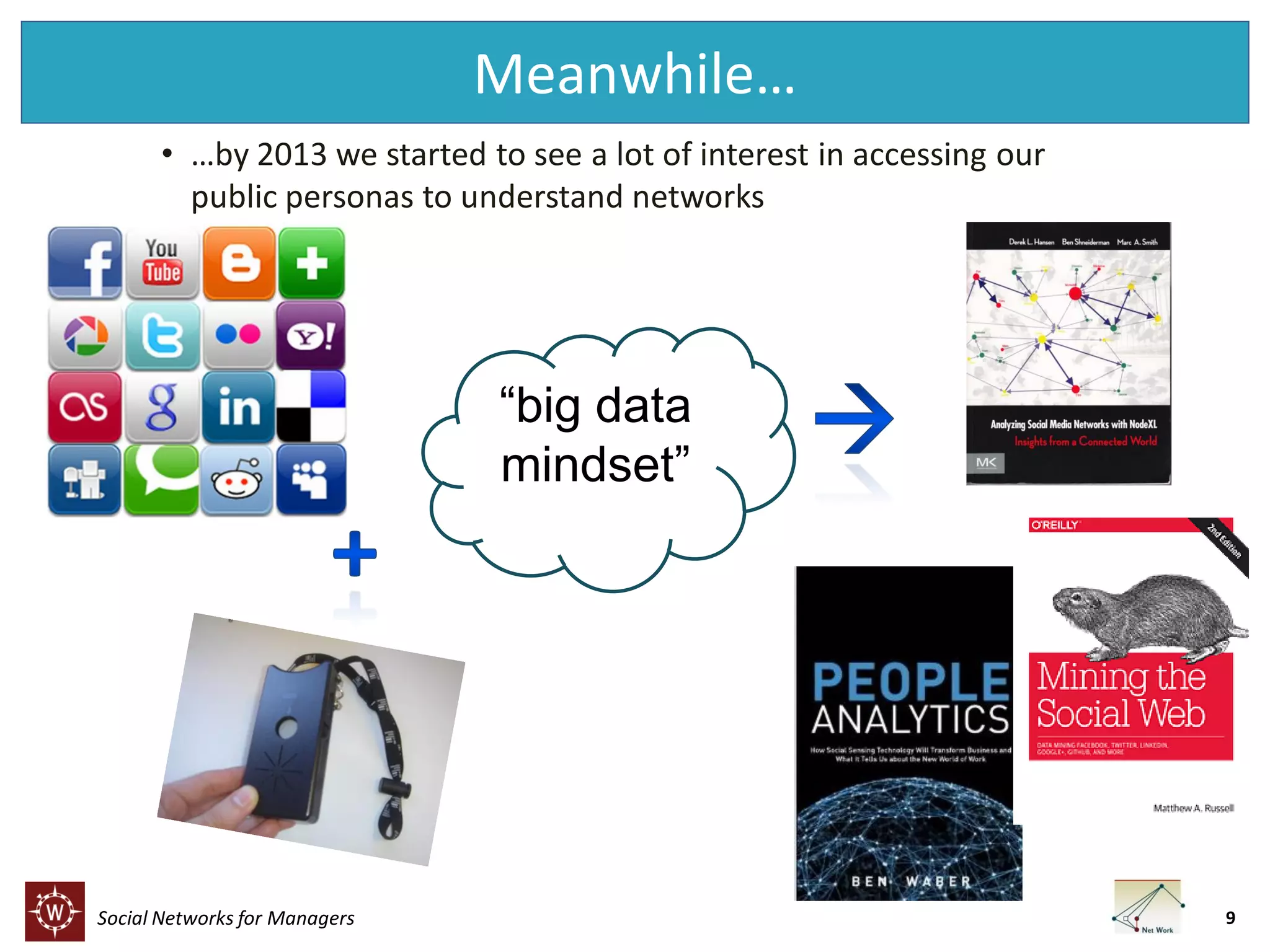
• …by 2013 we started to see a lot of interest in accessing our
public personas to understand networks

“big data
mindset”

Social Networks for Managers

9
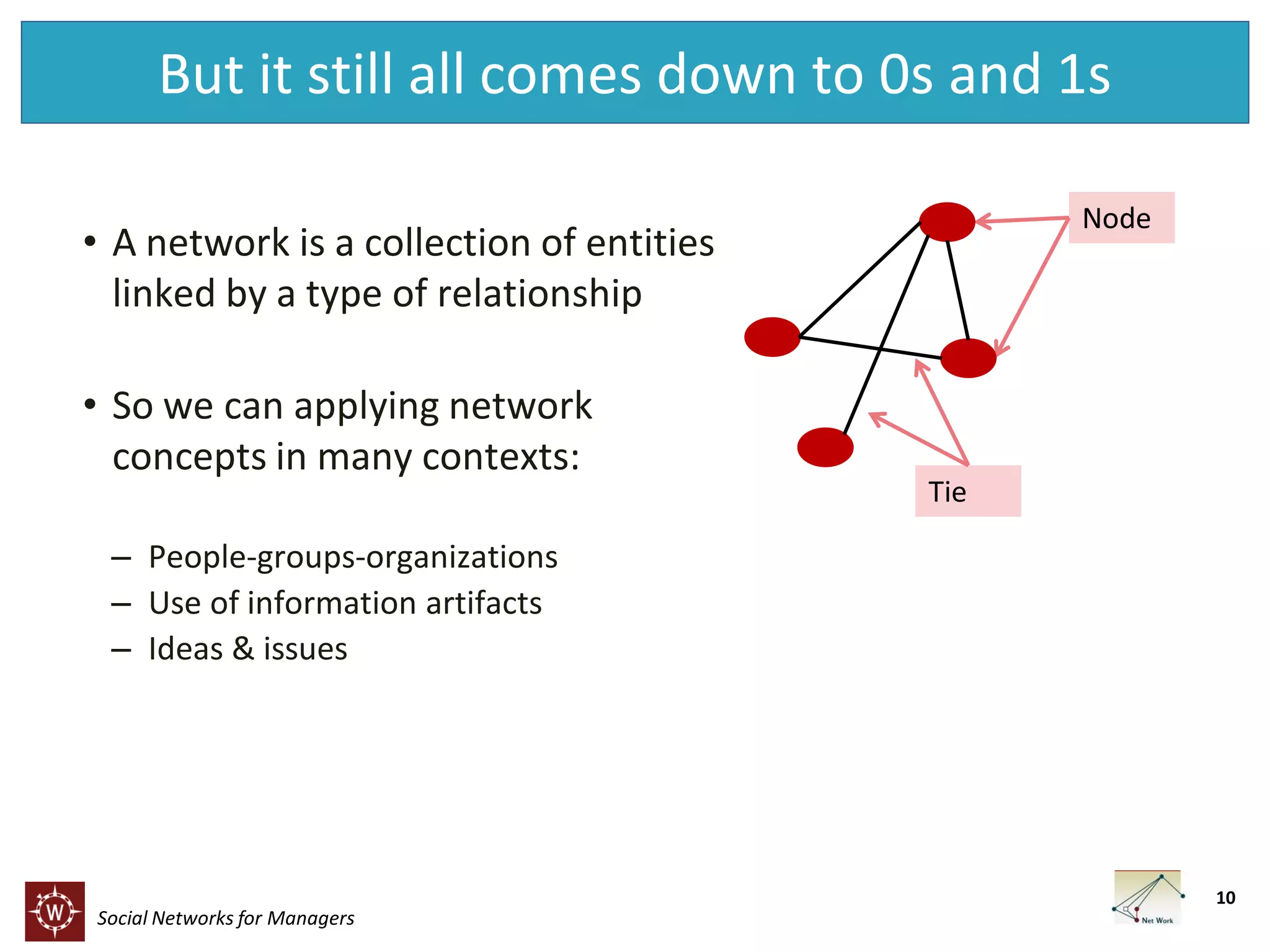
But it still all comes down to 0s and 1s
Node

• A network is a collection of entities
linked by a type of relationship
• So we can applying network
concepts in many contexts:

Tie

– People-groups-organizations
– Use of information artifacts
– Ideas & issues

10

Social Networks for Managers
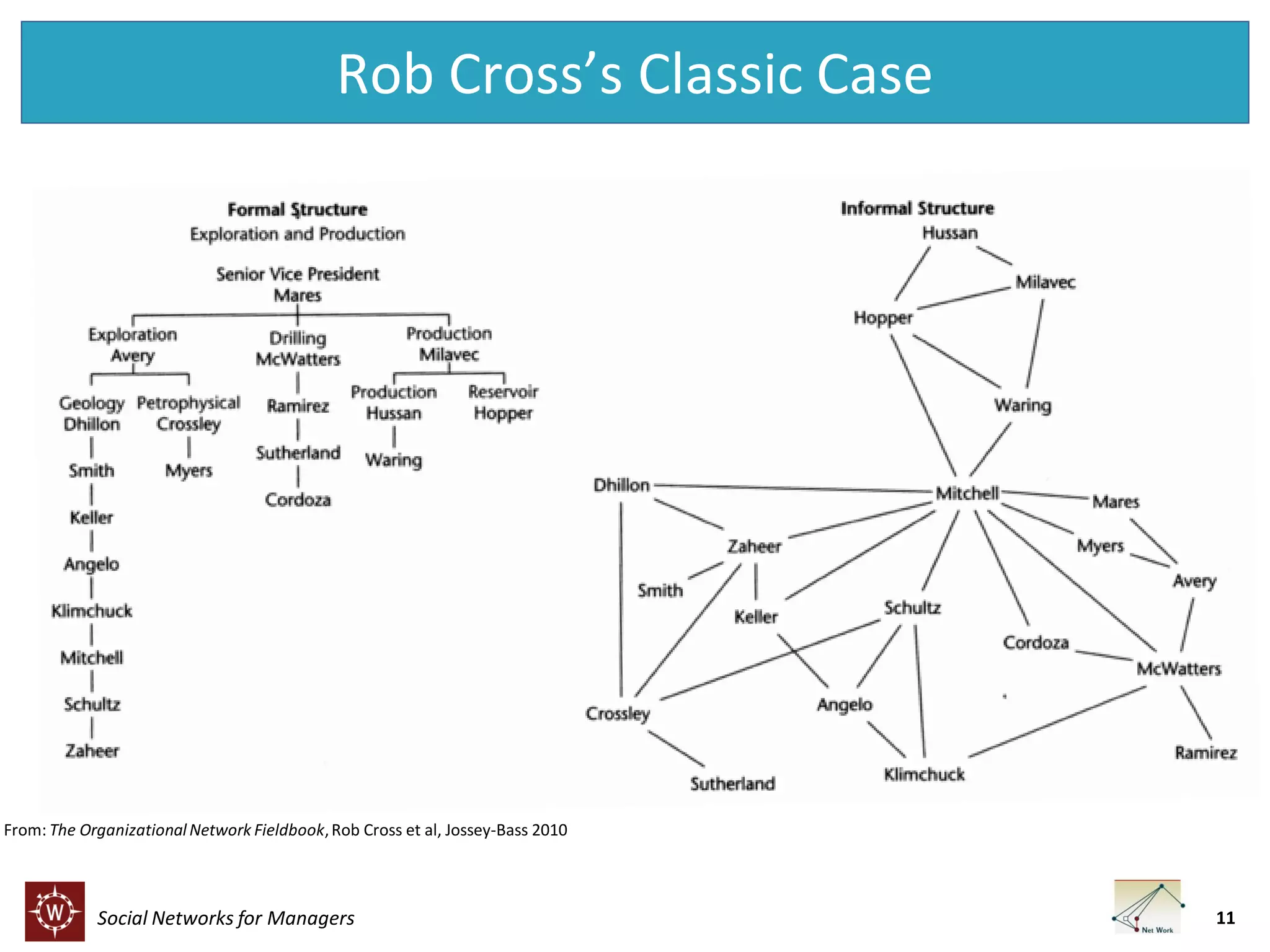
Rob Cross’s Classic Case

From: The Organizational Network Fieldbook, Rob Cross et al, Jossey-Bass 2010

Social Networks for Managers

11
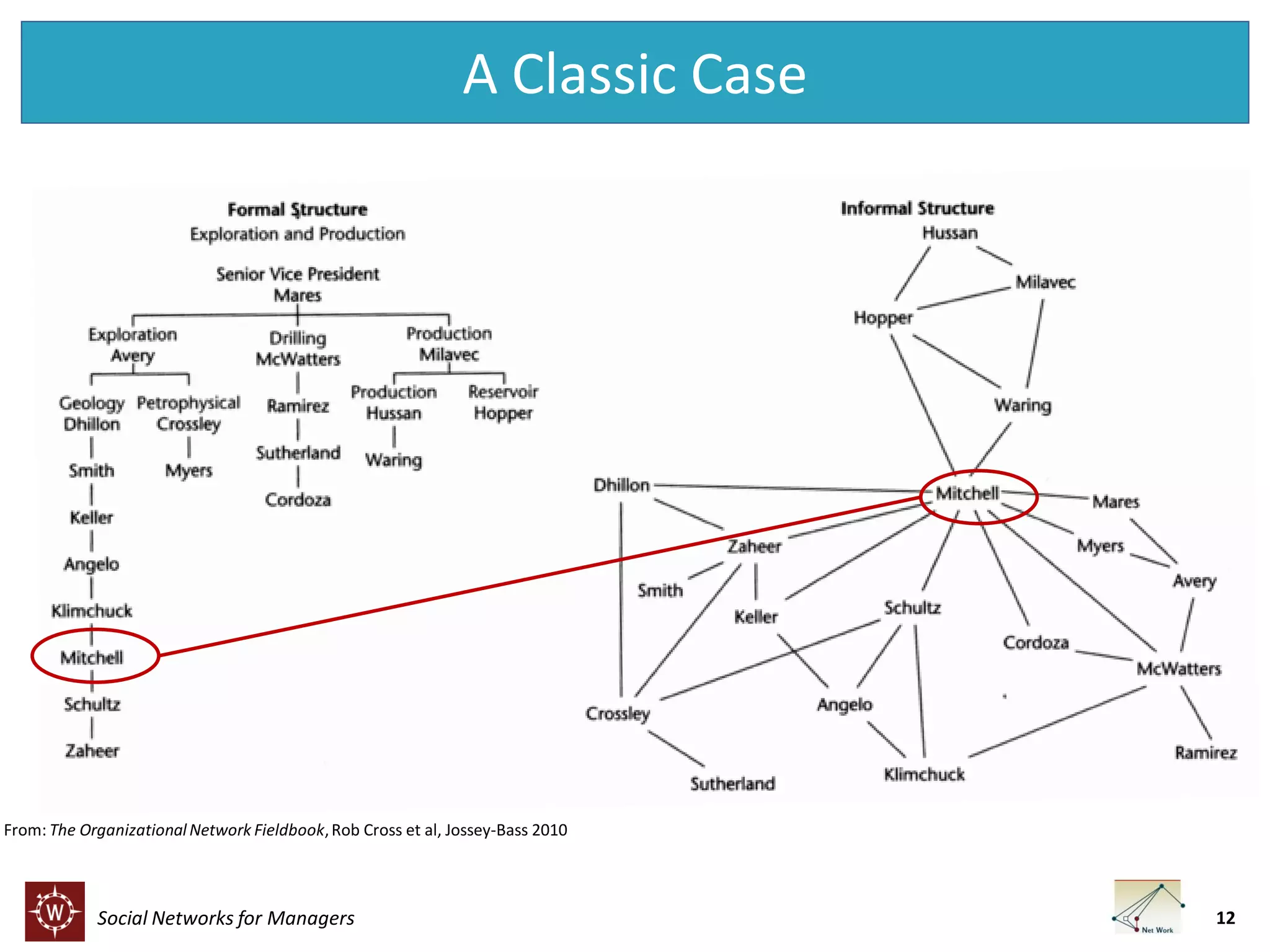
A Classic Case

From: The Organizational Network Fieldbook, Rob Cross et al, Jossey-Bass 2010

Social Networks for Managers

12
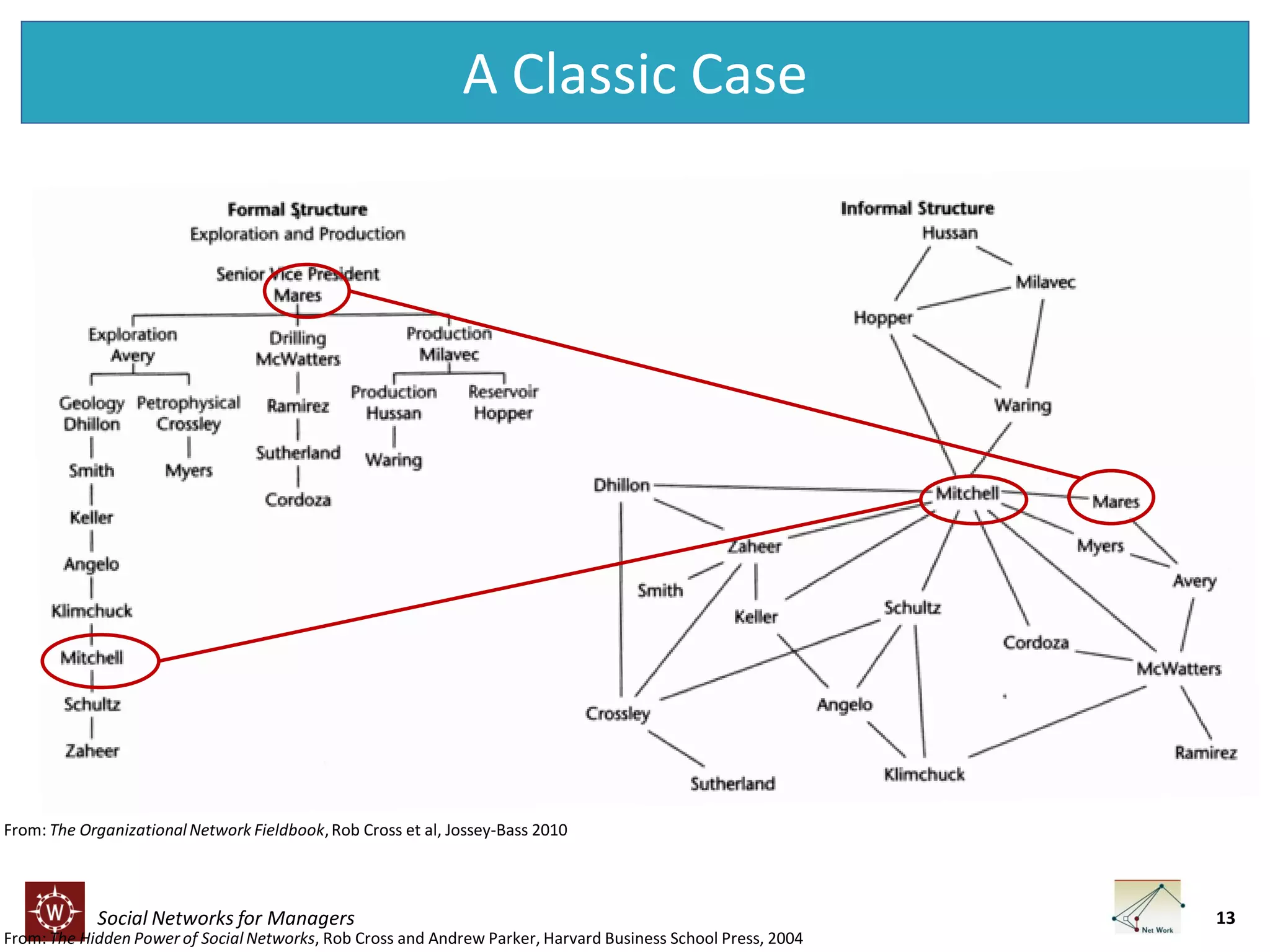
A Classic Case

From: The Organizational Network Fieldbook, Rob Cross et al, Jossey-Bass 2010

Social Networks for Managers
From: The Hidden Power of Social Networks, Rob Cross and Andrew Parker, Harvard Business School Press, 2004

13
A Classic Case

From: The Organizational Network Fieldbook, Rob Cross et al, Jossey-Bass 2010

Social Networks for Managers

14
A Classic Case

From: The Organizational Network Fieldbook, Rob Cross et al, Jossey-Bass 2010

Social Networks for Managers

15
It’s all about Questions

Patterns provide
insights that provoke
good questions.
Full stop.

Social Networks for Managers

16
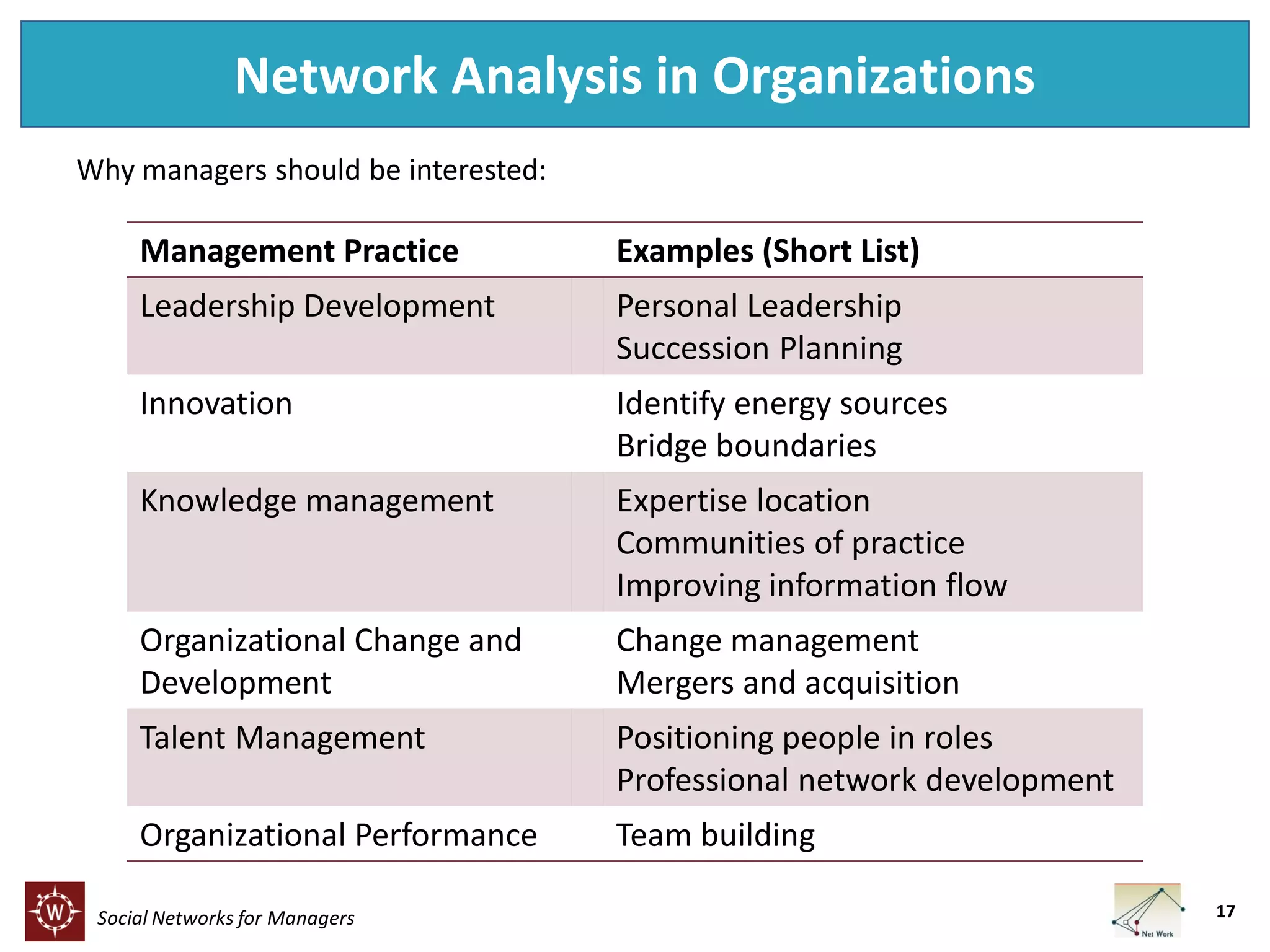
Network Analysis in Organizations
Why managers should be interested:

Management Practice

Examples (Short List)

Leadership Development

Personal Leadership
Succession Planning

Innovation

Identify energy sources
Bridge boundaries

Knowledge management

Expertise location
Communities of practice
Improving information flow

Organizational Change and
Development

Change management
Mergers and acquisition

Talent Management

Positioning people in roles
Professional network development

Organizational Performance

Team building

Social Networks for Managers

17
The Crux of the Analysis: The Questions
Problem (Examples)

Relationships of Interest

• Improve collaboration
• Finding connectors and
influencers in organizations and
communities
• Leadership development
• Performance benchmarking
• Integration of units following
merger/acquisition

•
•
•
•
•
•
•

Access to expertise
Innovative capacity
Collaborative capacity
Ease of knowledge flow
Decision-making and task flow
Innovation potential
Energy

Shares new ideas with
Works closely with

Social Networks for Managers

Knows expertise of
Seeks help for problem-solving
The Unit of Analysis: The Relationship

19

Social Networks for Managers
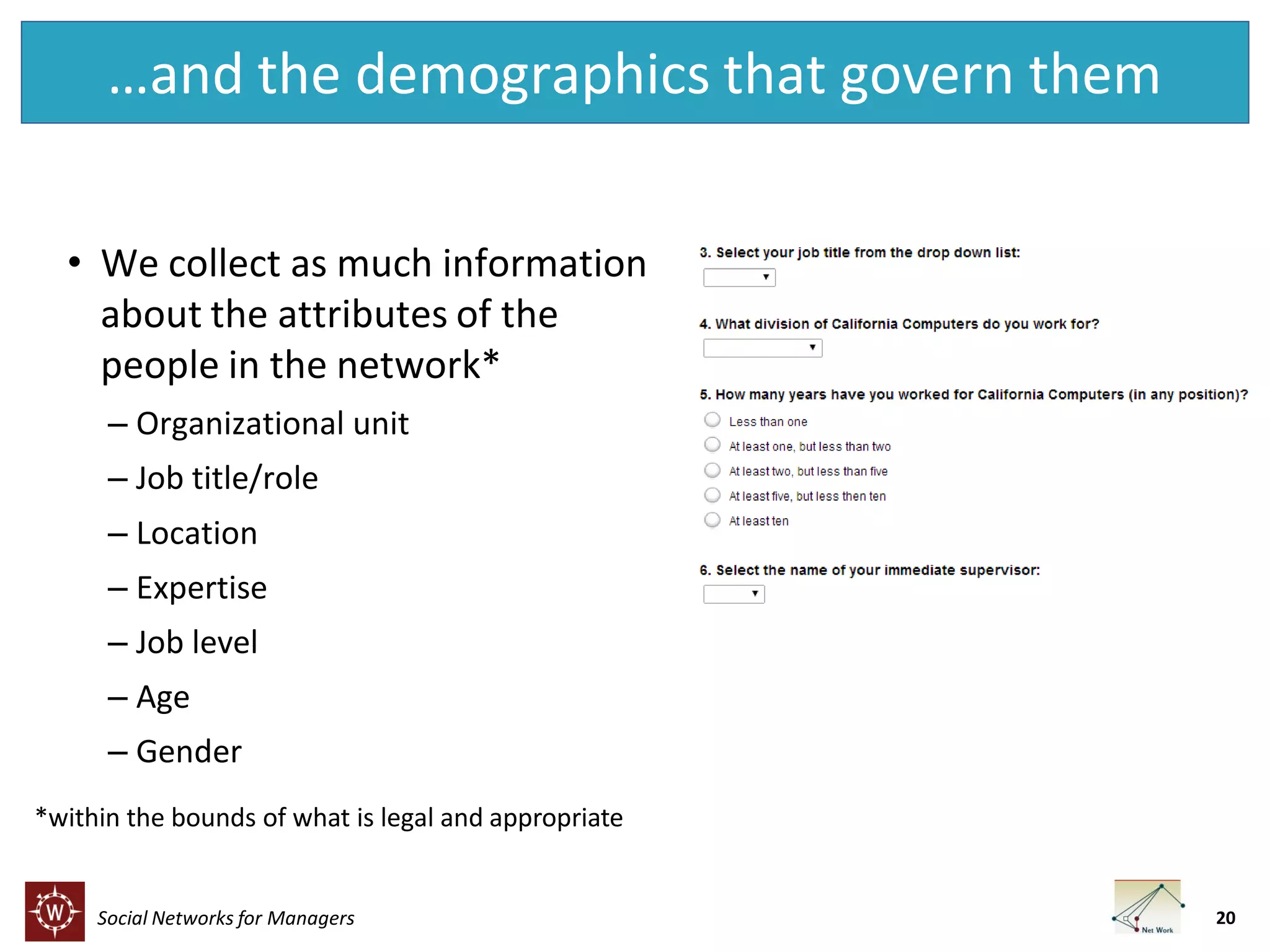
…and the demographics that govern them
• We collect as much information
about the attributes of the
people in the network*
– Organizational unit
– Job title/role

– Location
– Expertise
– Job level

– Age
– Gender
*within the bounds of what is legal and appropriate

Social Networks for Managers

20
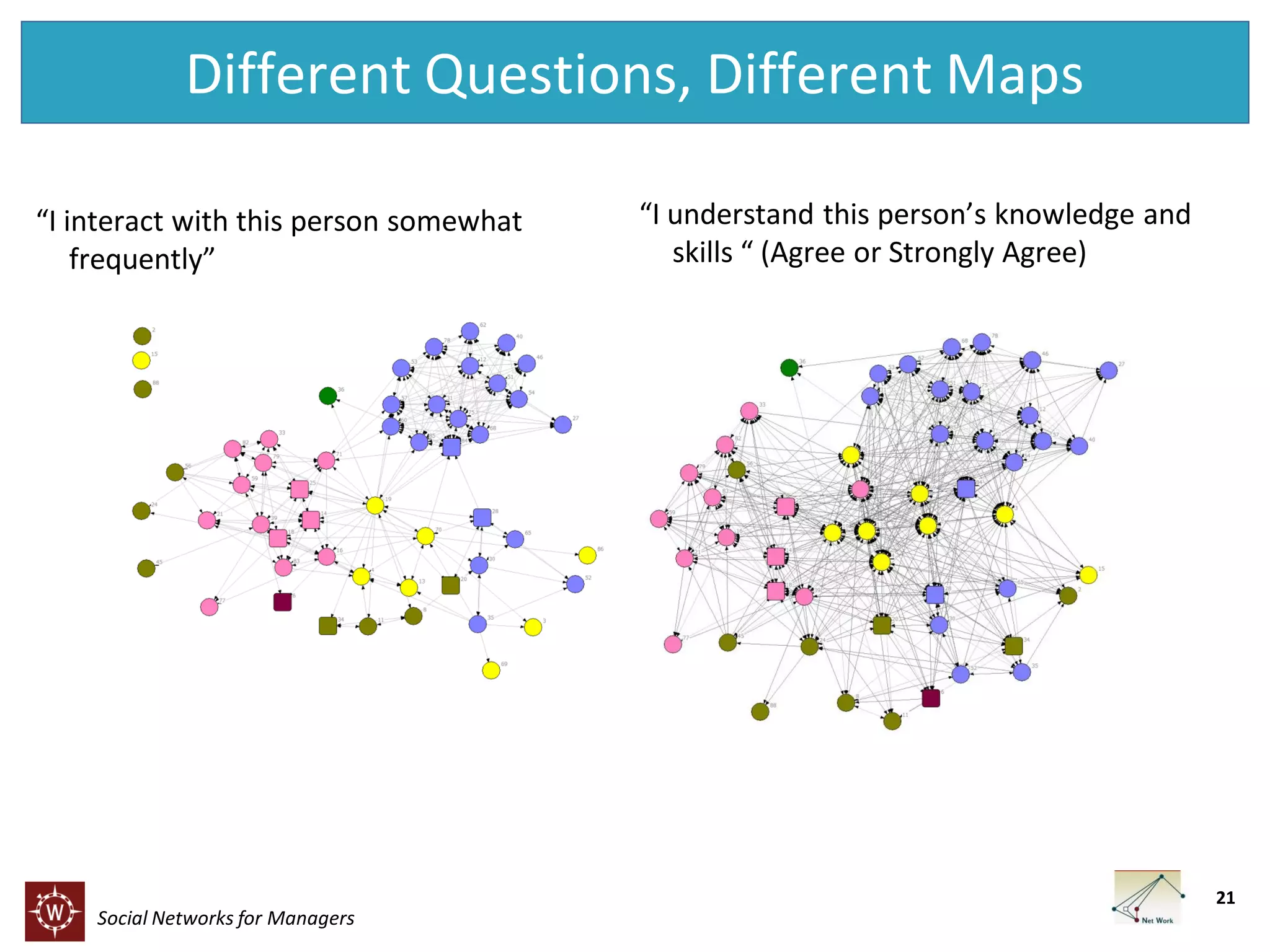
Different Questions, Different Maps
“I interact with this person somewhat
frequently”

“I understand this person’s knowledge and
skills “ (Agree or Strongly Agree)

21

Social Networks for Managers
More Terminology
• Direction
– If ties are directed, it matters which
way they go.

Directed ties

– If it doesn’t matter, they are undirected

– When ties are directed, sometimes
reciprocity matters

• Degree
– The number of ties each node has is its
degree

Undirected ties

– If ties are directed, then the node will
have an in-degree and an out-degree
– If ties are undirected, then the node
has simply a degree
Social Networks for Managers

22
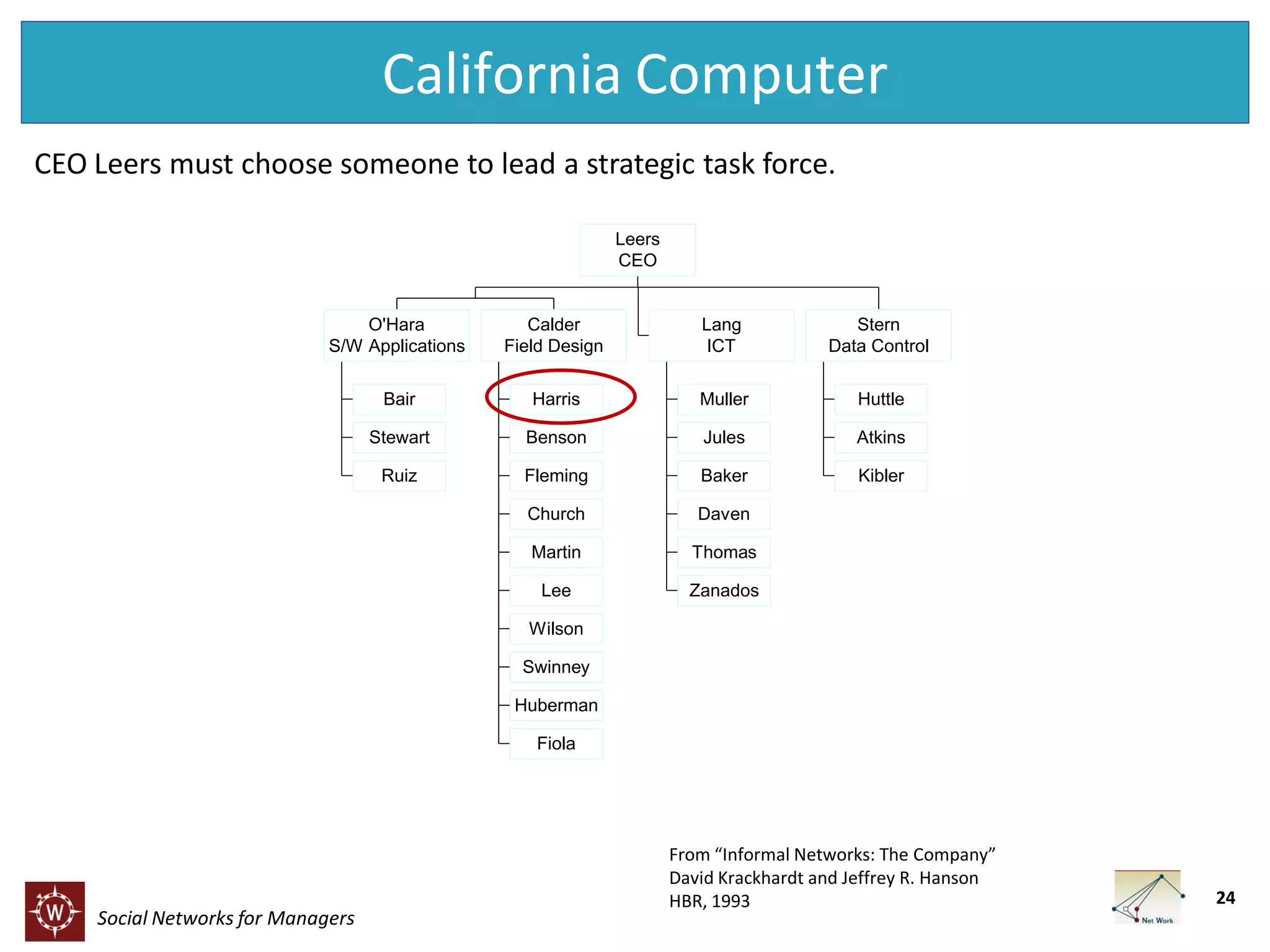
California Computer
CEO Leers must choose someone to lead a strategic task force.
Leers
CEO

O'Hara
S/W Applications

Calder
Field Design

Lang
ICT

Stern
Data Control

Bair

Harris

Muller

Huttle

Stewart

Benson

Jules

Atkins

Ruiz

Fleming

Baker

Kibler

Church

Daven

Martin

Thomas

Lee

Zanados

Wilson

Swinney
Huberman
Fiola

Social Networks for Managers

From “Informal Networks: The Company”
David Krackhardt and Jeffrey R. Hanson
HBR, 1993

23
California Computer
CEO Leers must choose someone to lead a strategic task force.
Leers
CEO

O'Hara
S/W Applications

Calder
Field Design

Lang
ICT

Stern
Data Control

Bair

Harris

Muller

Huttle

Stewart

Benson

Jules

Atkins

Ruiz

Fleming

Baker

Kibler

Church

Daven

Martin

Thomas

Lee

Zanados

Wilson

Swinney
Huberman
Fiola

Social Networks for Managers

From “Informal Networks: The Company”
David Krackhardt and Jeffrey R. Hanson
HBR, 1993

24
Was Harris a Good Choice?
Whom do you
go to for help
or advice?

CEO
Software Applications
Field Design
ICT
Data Control Systems
25

Social Networks for Managers
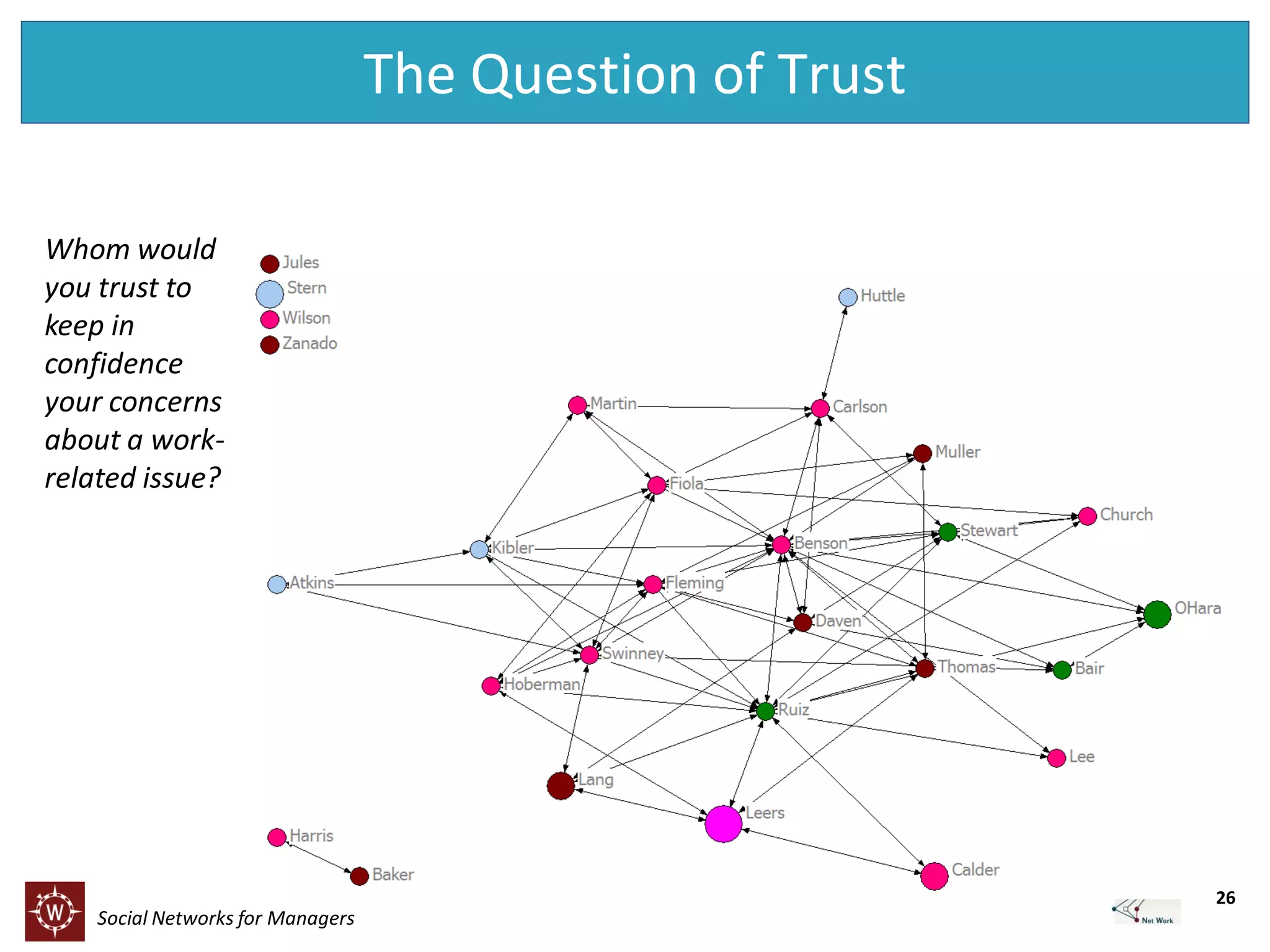
The Question of Trust
Whom would
you trust to
keep in
confidence
your concerns
about a workrelated issue?

26

Social Networks for Managers
The Question of Trust
Whom would
you trust to
keep in
confidence
your concerns
about a workrelated issue?

27

Social Networks for Managers
Network Analysis Also Provides Metrics

Structural Metrics
• Look at the whole network
and its components

Centrality Metrics
• Look at positions of
individuals in the network

28

Social Networks for Managers
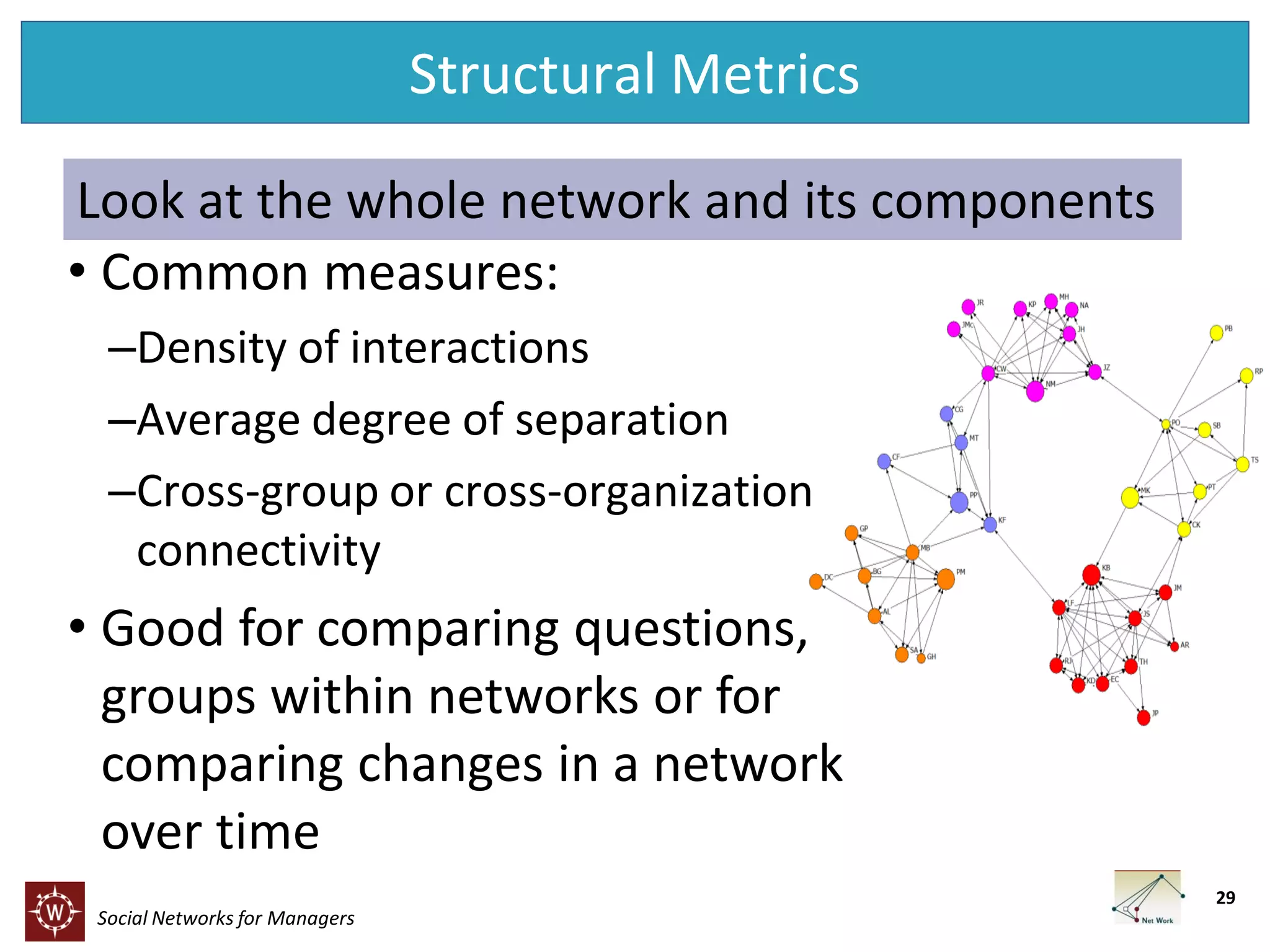
Structural Metrics
Look at the whole network and its components
• Common measures:
–Density of interactions
–Average degree of separation
–Cross-group or cross-organization
connectivity

• Good for comparing questions,
groups within networks or for
comparing changes in a network
over time
29

Social Networks for Managers
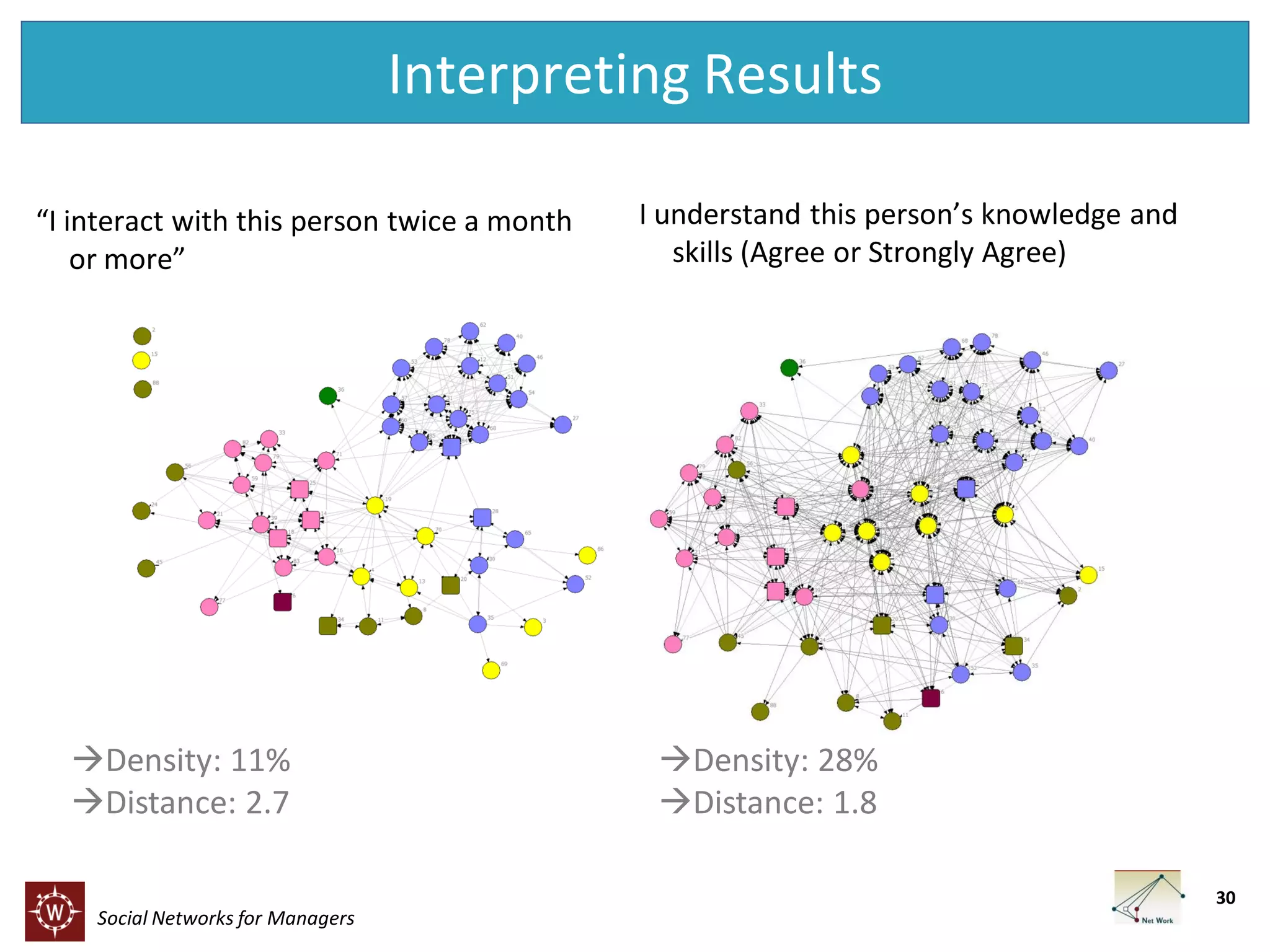
Interpreting Results
“I interact with this person twice a month
or more”

Density: 11%
Distance: 2.7

I understand this person’s knowledge and
skills (Agree or Strongly Agree)

Density: 28%
Distance: 1.8
30

Social Networks for Managers
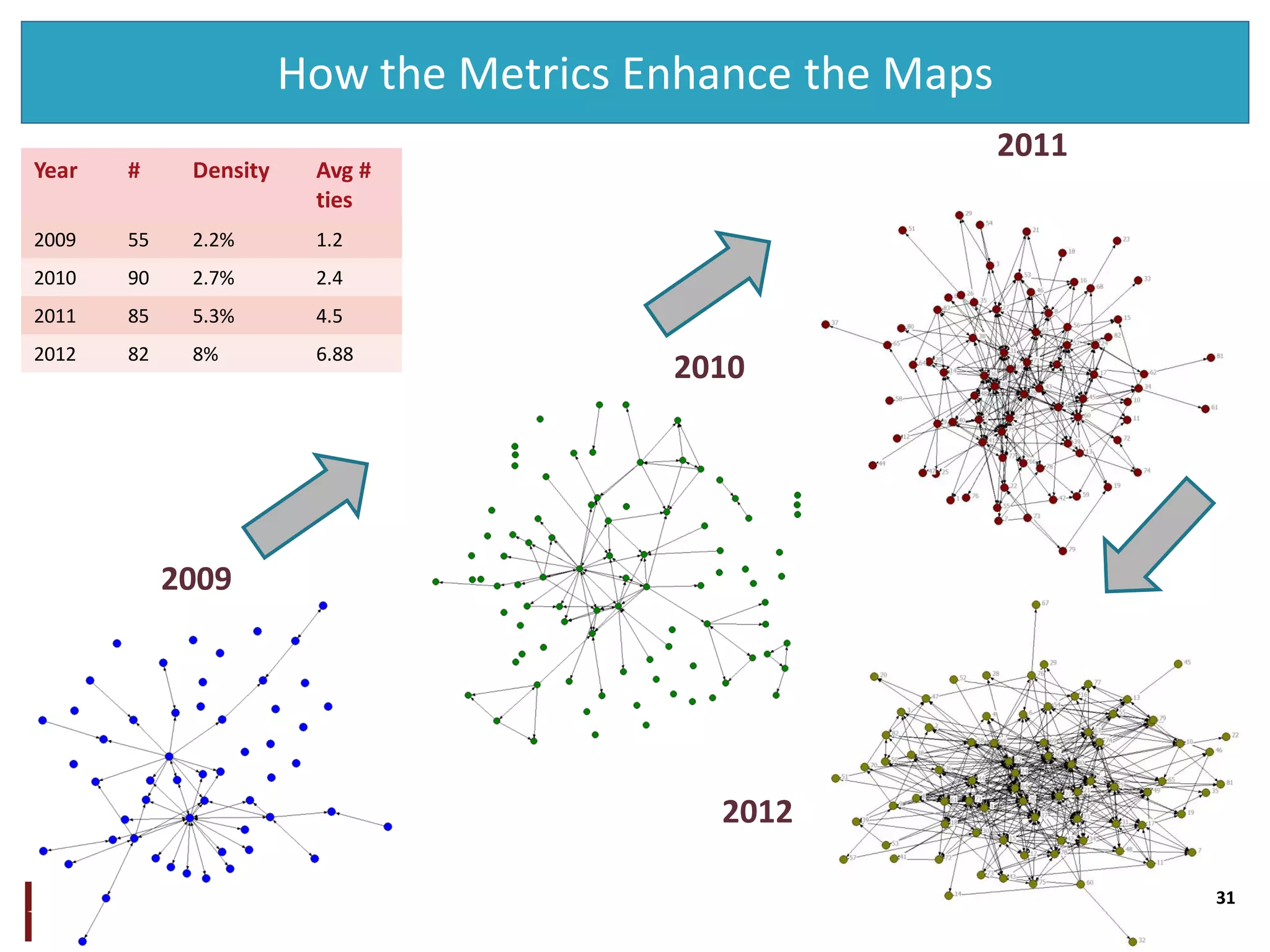
How the Metrics Enhance the Maps
Year

#

Density

2009

55

2.2%

1.2

2010

90

2.7%

2.4

2011

85

5.3%

4.5

2012

82

8%

6.88

2011

Avg #
ties

2010

2009

2012
31

Social Networks for Managers
Centrality Metrics
Look at positions of individuals in the network
• Common measures:
– Number of connections (degrees)

– Frequency of occurrence on paths between others
– Diversity of connections

– Quality of connections
• Good for identifying people who are well positioned to influence
the network or to move information around

 The people with the most connections are not necessarily the most influential!
32

Social Networks for Managers
Identifying Key People
Who are the people who are best positioned to move information through the network?
In-degree: 11
Betweenness: 469

In-degree: 16
Betweenness: 1125
In-degree: 5
Betweenness: 586

In-degree: 9
Betweenness: 415
Social Networks for Managers

33
Which Technology Scout is Most Successful?

Social Networks for Managers

It's Whom You Know Not What You Know: A Social Network Analysis Approach to
Talent Management, Eoin Whelan, SSRN: http://ssrn.com/abstract=1694453

34
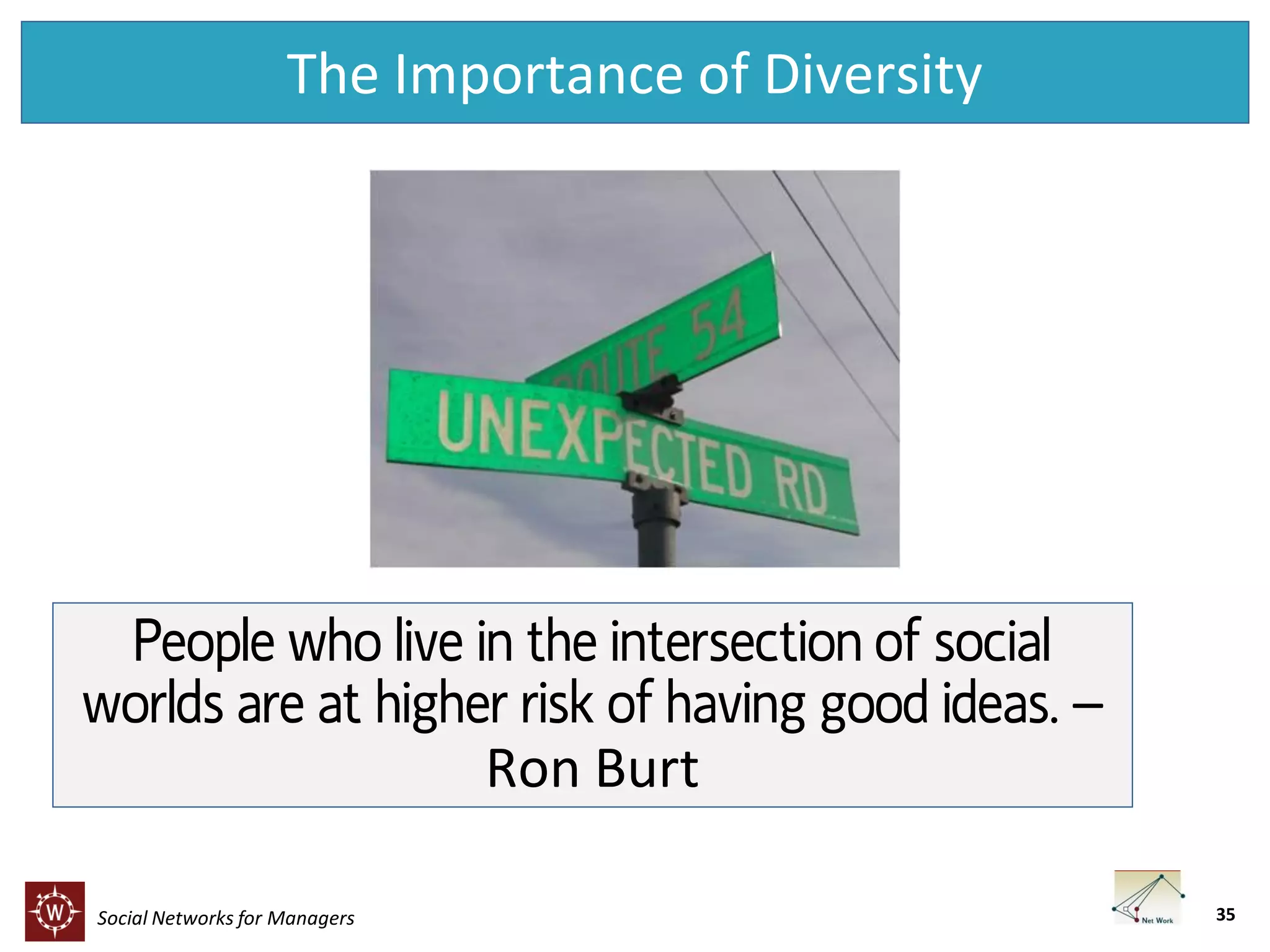
The Importance of Diversity

People who live in the intersection of social
worlds are at higher risk of having good ideas. –
Ron Burt
Social Networks for Managers

35
Detecting Diversity
• Who is more likely to have
access to new ideas?
– Tom

– Marion

• Why?

Social Networks for Managers

36
Organizational Interventions
Ways to change patterns in
networks

Practices from the KM Repertoire

Create more connections

Make introductions through meetings and webinars, face-to-face events
(like knowledge fairs); implement social software or social network
referral software; social network stimulation

Increase the flow of knowledge

Establish collaborative workspaces, install instant messaging systems,
make existing knowledge bases more accessible and usable

Discover connections

Implement expertise location and/or; discovery systems; social
software; social networking applications

Decentralize

Social software; blogs, wikis; shift knowledge to the edge

Connect disconnected clusters

Establish knowledge brokering roles; expand communication channels

Create more trusted relationships

Assign people to work on projects together

Alter the behavior of individual nodes

Create awareness of the impact of an individual’s place in a network;
educate employees on personal knowledge networking

Increase diversity

Add nodes; connect and create networks; encourage people to bring
knowledge in from their networks in the world

Social Networks for Managers

37
Organizational Networks Summary
• The science of networks has brought insights into the structure
of organizational networks
• Organizational network analysis lets us map relationships that
reveal the informal networks through which work gets done

• Developing and sharing these maps helps organizations
improve collaborative capacity, overcome obstacles to
effective sharing, and redesign their work relationships
• Results are a guide to asking good questions and should never
be interpreted as an “answer”

38

Social Networks for Managers
http://quilting.about.com/od/picturesofquilts/ig/Alzheimer-s-Quilts/The-Ties-that-Bind.htm

Overview of Tools and Technologies
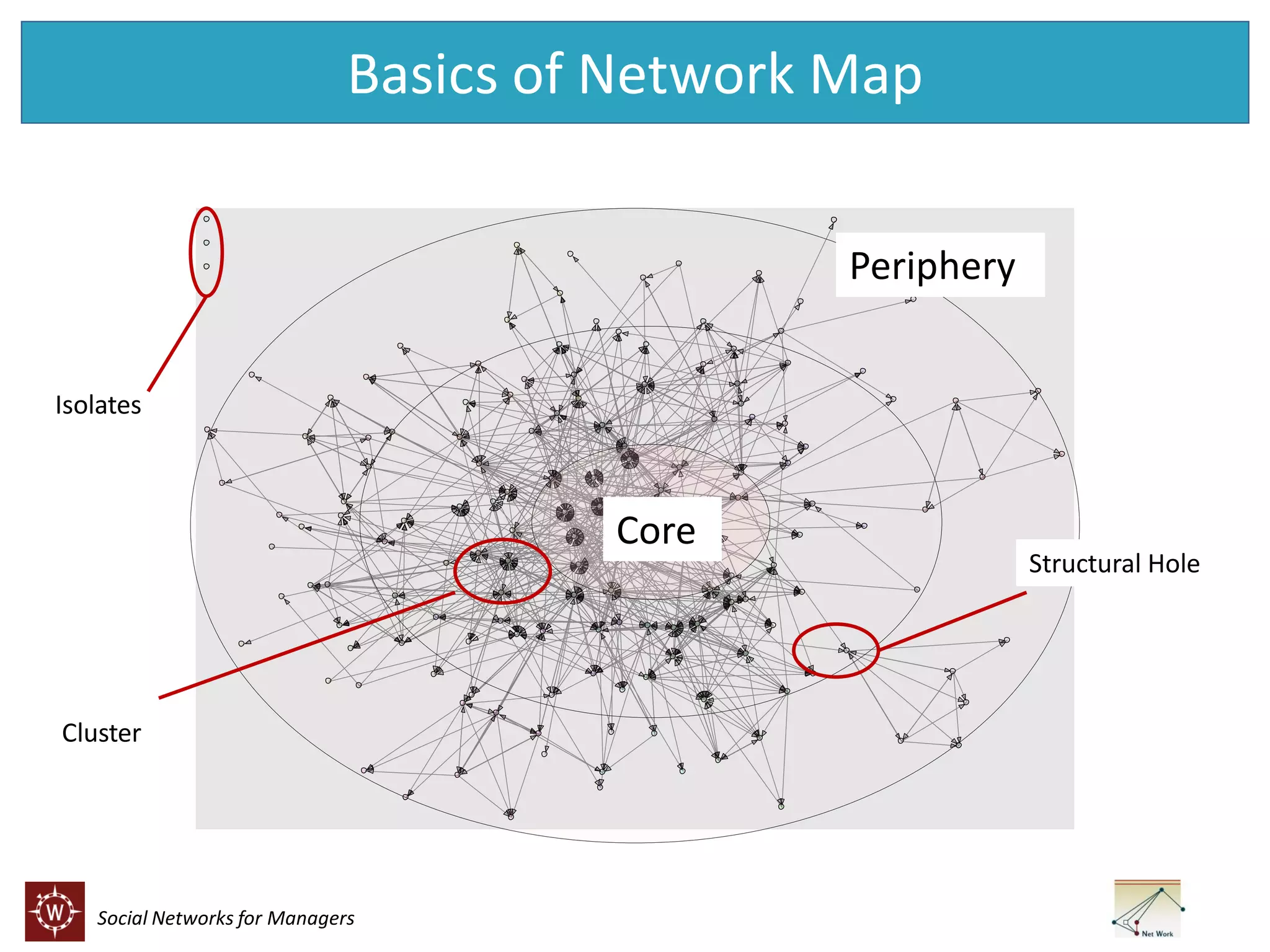
Basics of Network Map
Periphery
Isolates

Core

Cluster

Social Networks for Managers

Structural Hole
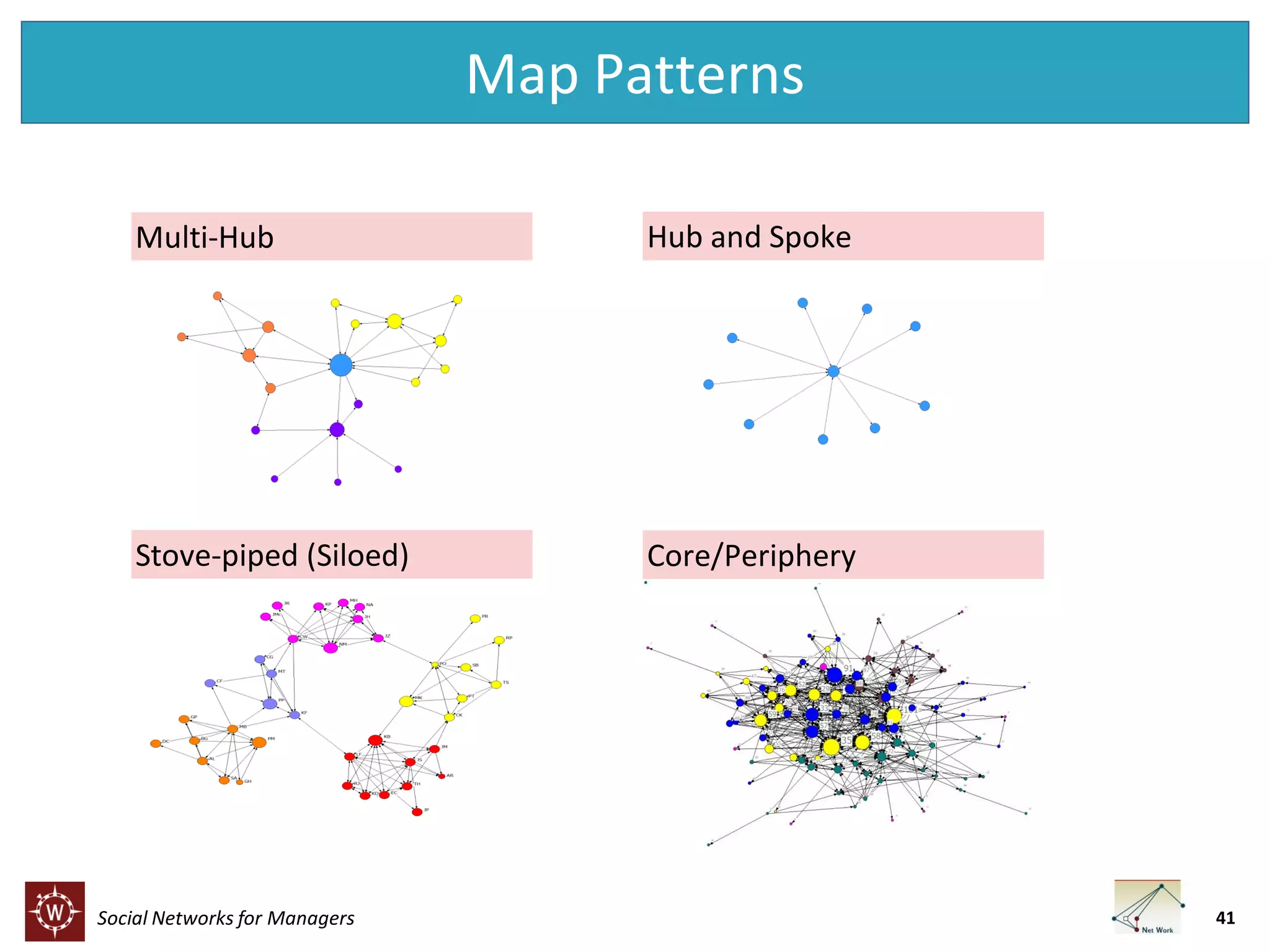
Map Patterns
Multi-Hub

Hub and Spoke

Stove-piped (Siloed)

Core/Periphery

Social Networks for Managers

41
What Sorts of Tools Are There?

Hands-on Tools

• Range in complexity of
function & cost

Social Media
Graph apps

• Let you access and map
your own network

Enterprise Analytics

• High-end measurement &
dashboards

Specialized assessment
instruments

• PNA (personal network
assessment) tool offers
individualized results

Social Networks for Managers

42
Mapping and Analysis Tools

Social Networks for Managers
Tool Basics – the Dataset (0s and 1s)
Information about the nodes (vertices) and the ties (edges)

44

Social Networks for Managers
Load and Draw…1

45

Social Networks for Managers
Load and Draw…2

46

Social Networks for Managers
Load and Draw…3

47

Social Networks for Managers
Short List of Resources for SNA/ONA Tools
http://tinyurl.com/SNA-ONA-Tools

48

Social Networks for Managers
On the Internet, What’s in a Tie?
• Social network platforms:
– A Facebook Friend
– A LinkedIn Connection

– A Twitter Following

• Social media content platforms:
– Likes, posts, replies, shares,
and uploads
– Mentions or “retweet”
#hashtags

Social Networks for Managers

49
Networks in Social Media
Analyzing Twitter networks with NodeXL: Broadcast Networks
1.

Krugman tweets a
link to an article

2.

There are a
number of
Tweeters who
publish links to
the article but
these are not
connected to
other Tweeters

3.

There are two
densely
interconnected
groups of people
who share the
link and discuss it
http://www.pewinternet.org/2014/02/20/mapping-twitter-topic-networks-from-polarized-crowds-to-community-clusters/

Social Networks for Managers

50
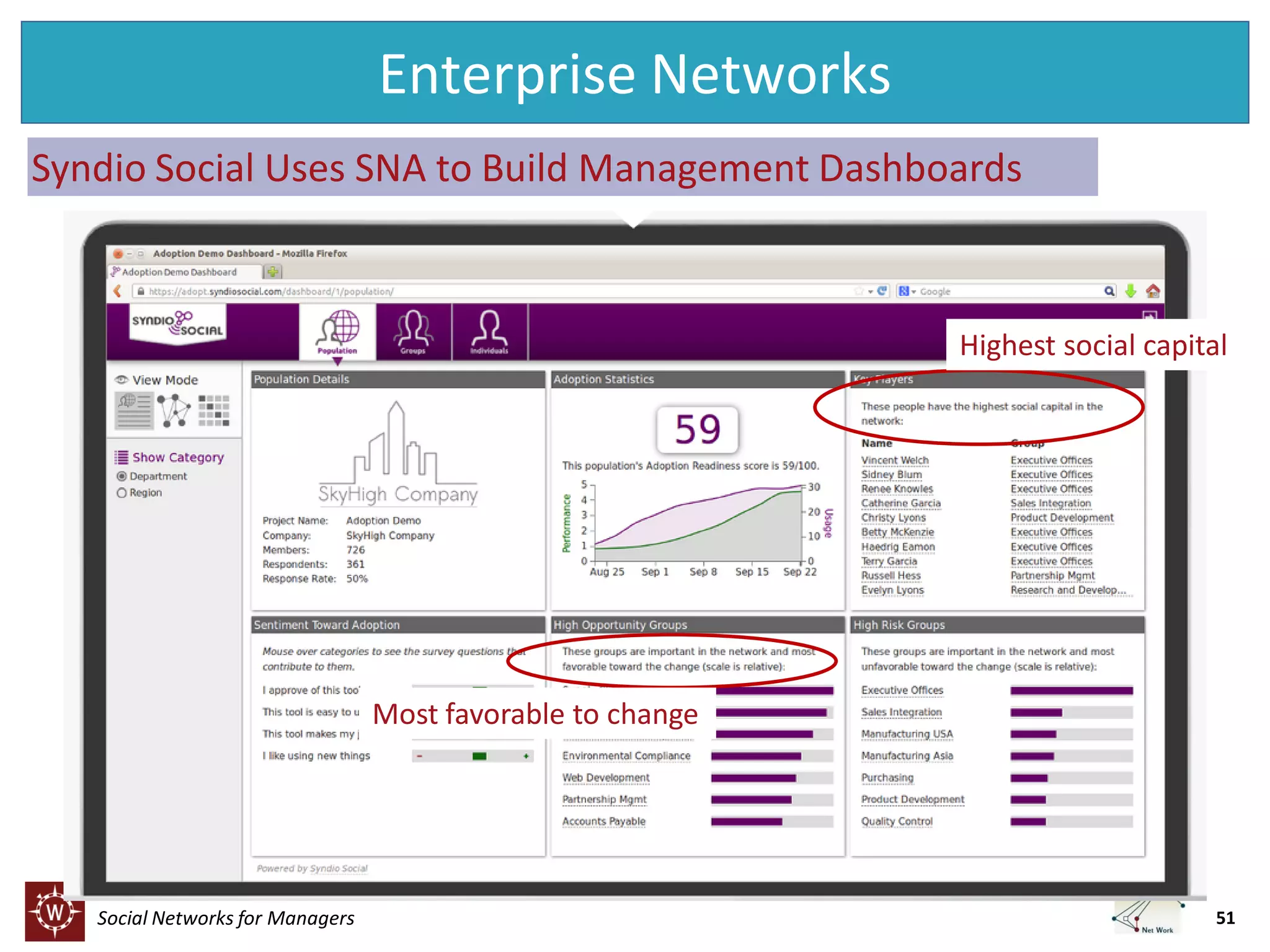
Enterprise Networks
Syndio Social Uses SNA to Build Management Dashboards

Highest social capital

Most favorable to change

Social Networks for Managers

51
Our Personal Networks
http://inmaps.linkedinlabs.com/

Social Networks for Managers

52
Understanding Your Personal Network
Focus

Purpose

How to Develop

Operational

Getting work done
efficiently

Identify people who can
block or support a
project

Personal

Develop and maintain
professional skills and
reputation

Participate in
professional
associations, clubs, and
physical and online
communities

Strategic

Figure out and obtain
support for future
priorities and challenges

Identify lateral and
vertical relationships
outside your immediate
control

Source: “How Leaders Create and Use Networks,” Herminia Ibarra and Mark Hunter, Harvard Business Review January 2007

Social Networks for Managers

53
Who’s Connected into Different Parts of My Network?

Social Networks for Managers

54
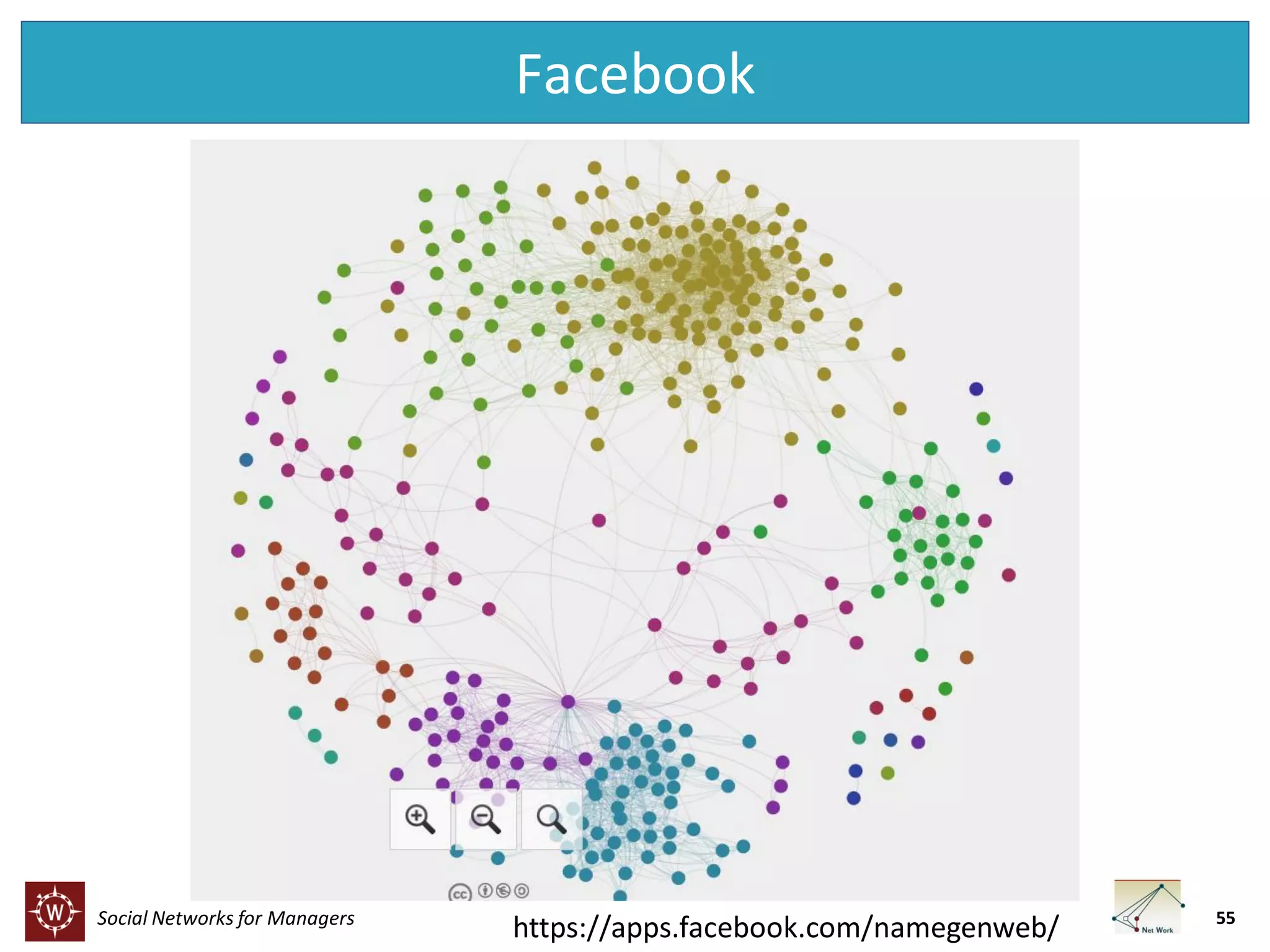
Facebook

Social Networks for Managers

https://apps.facebook.com/namegenweb/

55
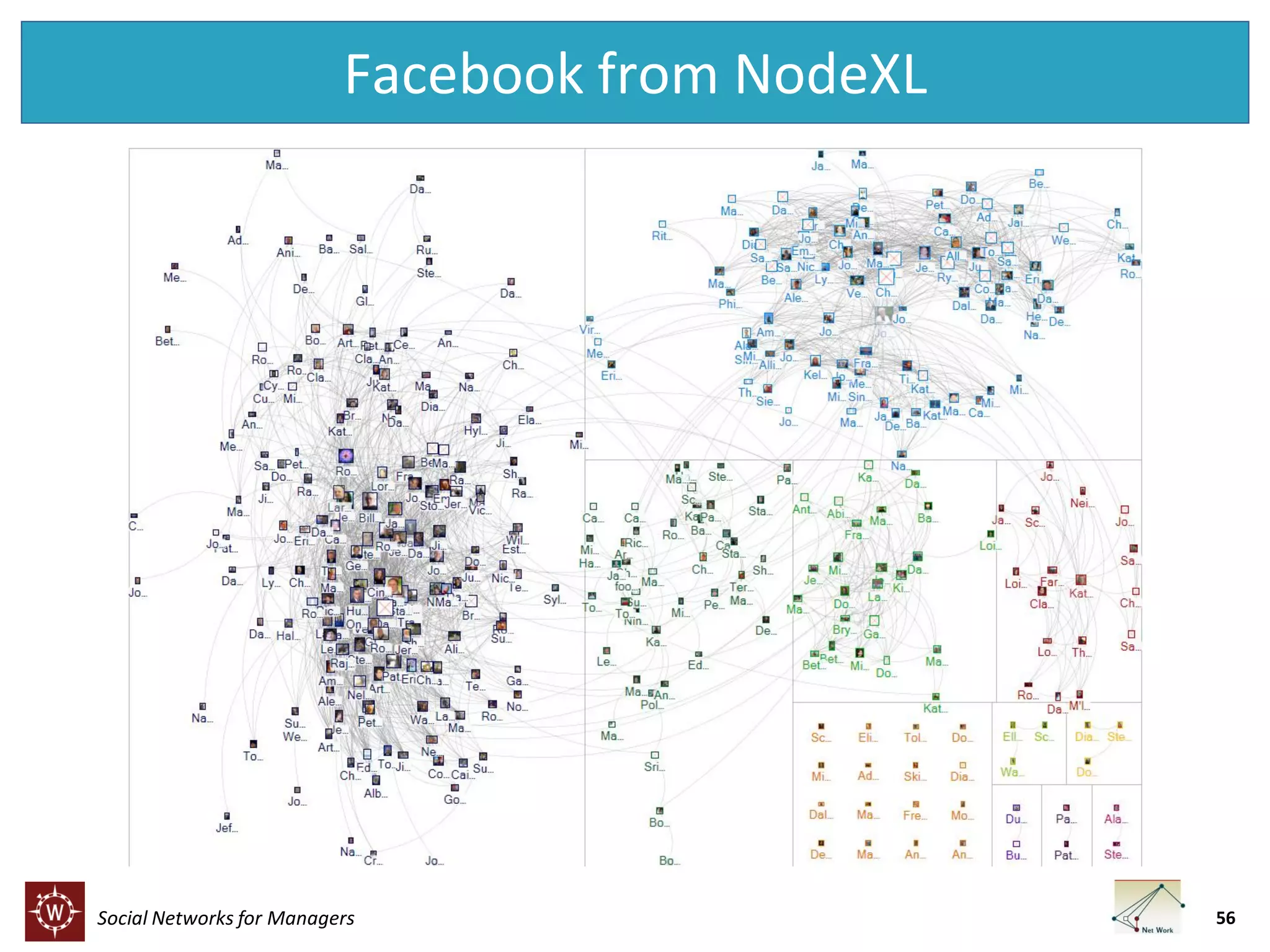
Facebook from NodeXL

Social Networks for Managers

56
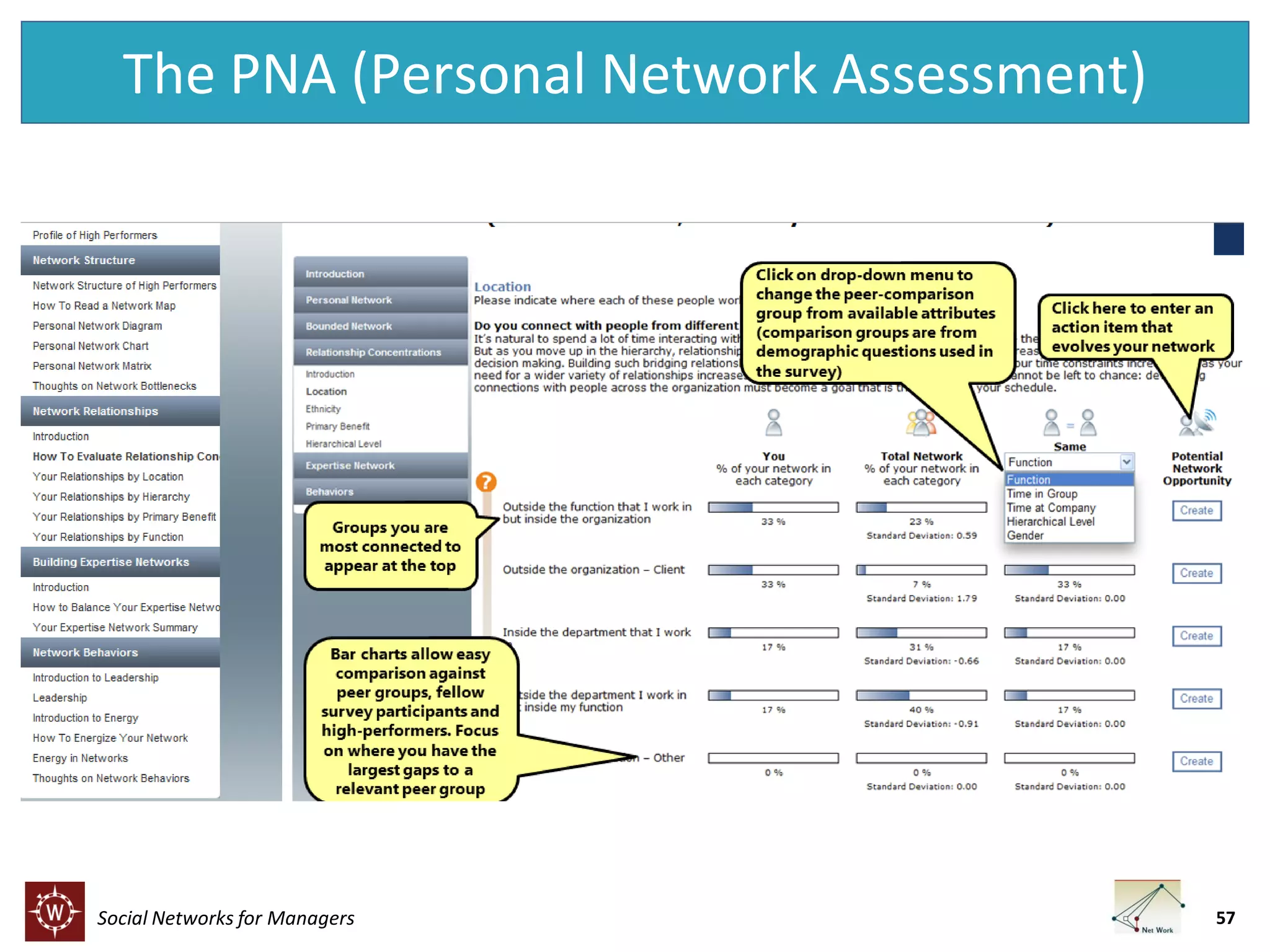
The PNA (Personal Network Assessment)

Social Networks for Managers

57
Summary
• Social network analysis tools and methods are available to map
organizational, Internet, enterprise, and an individual’s personal network

• The tools matter less than the network mindset – and the understanding
that the structure of a network matters

Social Networks for Managers

58
• patti@pattianklam.com

•http://www.pattianklam.com

Thank you.
Question
59

Social networks for managers

  • 1.
    Social Networks forManagers Patti Anklam Willamette University March 4, 2014
  • 2.
    I’ve become convincedthat understanding how networks work is an essential 21st century literacy. Howard Rheingold
  • 3.
    Agenda Social Network Analysis ―Thelanguage of networks ―Networks in organizations Overview of Tools and Technologies Social Networks for Managers 3
  • 4.
  • 5.
    Networks Matter • Welive in networks all the time: communities, organizations, teams • The complexity of work in today’s world is such that no one can understand – let alone complete – a task alone – Individual-individual – Team-team – Company-company – Eco-system to eco-system • Strong networks are correlated with health: – People with stronger personal networks are more productive, happier, and better performers – Companies who know how to manage alliances are more flexible, adaptive and resilient – Our personal health and well-being is often tied to our social networks Social Networks for Managers 5
  • 6.
    Structure Matters • Thereis science to support the understanding of network structure • The structure of a network provides insights into how the network “works” • Once you understand the structure, you can make decisions about how to manage the network’s context • Network analysis tools help you understand the structure 6 Social Networks for Managers
  • 7.
    The Importance ofUnderstanding Networks “Teaching executives to see social capital” http://faculty.chicagobooth.edu/ronald.burt/research/files/TESSC.pdf (2006) Social Networks for Managers 7
  • 8.
    The new scienceof networks • Beginning in the 1990’s computer science made it possible to map and analyze large social networks. • Insights became accessible to the public. 2009 2004 2003 2009 2002 2002 2005 2002 Social Networks for Managers • By 2009, network science and analysis are accepted practice in science and management 2004 8
  • 9.
    Meanwhile… • …by 2013we started to see a lot of interest in accessing our public personas to understand networks “big data mindset” Social Networks for Managers 9
  • 10.
    But it stillall comes down to 0s and 1s Node • A network is a collection of entities linked by a type of relationship • So we can applying network concepts in many contexts: Tie – People-groups-organizations – Use of information artifacts – Ideas & issues 10 Social Networks for Managers
  • 11.
    Rob Cross’s ClassicCase From: The Organizational Network Fieldbook, Rob Cross et al, Jossey-Bass 2010 Social Networks for Managers 11
  • 12.
    A Classic Case From:The Organizational Network Fieldbook, Rob Cross et al, Jossey-Bass 2010 Social Networks for Managers 12
  • 13.
    A Classic Case From:The Organizational Network Fieldbook, Rob Cross et al, Jossey-Bass 2010 Social Networks for Managers From: The Hidden Power of Social Networks, Rob Cross and Andrew Parker, Harvard Business School Press, 2004 13
  • 14.
    A Classic Case From:The Organizational Network Fieldbook, Rob Cross et al, Jossey-Bass 2010 Social Networks for Managers 14
  • 15.
    A Classic Case From:The Organizational Network Fieldbook, Rob Cross et al, Jossey-Bass 2010 Social Networks for Managers 15
  • 16.
    It’s all aboutQuestions Patterns provide insights that provoke good questions. Full stop. Social Networks for Managers 16
  • 17.
    Network Analysis inOrganizations Why managers should be interested: Management Practice Examples (Short List) Leadership Development Personal Leadership Succession Planning Innovation Identify energy sources Bridge boundaries Knowledge management Expertise location Communities of practice Improving information flow Organizational Change and Development Change management Mergers and acquisition Talent Management Positioning people in roles Professional network development Organizational Performance Team building Social Networks for Managers 17
  • 18.
    The Crux ofthe Analysis: The Questions Problem (Examples) Relationships of Interest • Improve collaboration • Finding connectors and influencers in organizations and communities • Leadership development • Performance benchmarking • Integration of units following merger/acquisition • • • • • • • Access to expertise Innovative capacity Collaborative capacity Ease of knowledge flow Decision-making and task flow Innovation potential Energy Shares new ideas with Works closely with Social Networks for Managers Knows expertise of Seeks help for problem-solving
  • 19.
    The Unit ofAnalysis: The Relationship 19 Social Networks for Managers
  • 20.
    …and the demographicsthat govern them • We collect as much information about the attributes of the people in the network* – Organizational unit – Job title/role – Location – Expertise – Job level – Age – Gender *within the bounds of what is legal and appropriate Social Networks for Managers 20
  • 21.
    Different Questions, DifferentMaps “I interact with this person somewhat frequently” “I understand this person’s knowledge and skills “ (Agree or Strongly Agree) 21 Social Networks for Managers
  • 22.
    More Terminology • Direction –If ties are directed, it matters which way they go. Directed ties – If it doesn’t matter, they are undirected – When ties are directed, sometimes reciprocity matters • Degree – The number of ties each node has is its degree Undirected ties – If ties are directed, then the node will have an in-degree and an out-degree – If ties are undirected, then the node has simply a degree Social Networks for Managers 22
  • 23.
    California Computer CEO Leersmust choose someone to lead a strategic task force. Leers CEO O'Hara S/W Applications Calder Field Design Lang ICT Stern Data Control Bair Harris Muller Huttle Stewart Benson Jules Atkins Ruiz Fleming Baker Kibler Church Daven Martin Thomas Lee Zanados Wilson Swinney Huberman Fiola Social Networks for Managers From “Informal Networks: The Company” David Krackhardt and Jeffrey R. Hanson HBR, 1993 23
  • 24.
    California Computer CEO Leersmust choose someone to lead a strategic task force. Leers CEO O'Hara S/W Applications Calder Field Design Lang ICT Stern Data Control Bair Harris Muller Huttle Stewart Benson Jules Atkins Ruiz Fleming Baker Kibler Church Daven Martin Thomas Lee Zanados Wilson Swinney Huberman Fiola Social Networks for Managers From “Informal Networks: The Company” David Krackhardt and Jeffrey R. Hanson HBR, 1993 24
  • 25.
    Was Harris aGood Choice? Whom do you go to for help or advice? CEO Software Applications Field Design ICT Data Control Systems 25 Social Networks for Managers
  • 26.
    The Question ofTrust Whom would you trust to keep in confidence your concerns about a workrelated issue? 26 Social Networks for Managers
  • 27.
    The Question ofTrust Whom would you trust to keep in confidence your concerns about a workrelated issue? 27 Social Networks for Managers
  • 28.
    Network Analysis AlsoProvides Metrics Structural Metrics • Look at the whole network and its components Centrality Metrics • Look at positions of individuals in the network 28 Social Networks for Managers
  • 29.
    Structural Metrics Look atthe whole network and its components • Common measures: –Density of interactions –Average degree of separation –Cross-group or cross-organization connectivity • Good for comparing questions, groups within networks or for comparing changes in a network over time 29 Social Networks for Managers
  • 30.
    Interpreting Results “I interactwith this person twice a month or more” Density: 11% Distance: 2.7 I understand this person’s knowledge and skills (Agree or Strongly Agree) Density: 28% Distance: 1.8 30 Social Networks for Managers
  • 31.
    How the MetricsEnhance the Maps Year # Density 2009 55 2.2% 1.2 2010 90 2.7% 2.4 2011 85 5.3% 4.5 2012 82 8% 6.88 2011 Avg # ties 2010 2009 2012 31 Social Networks for Managers
  • 32.
    Centrality Metrics Look atpositions of individuals in the network • Common measures: – Number of connections (degrees) – Frequency of occurrence on paths between others – Diversity of connections – Quality of connections • Good for identifying people who are well positioned to influence the network or to move information around  The people with the most connections are not necessarily the most influential! 32 Social Networks for Managers
  • 33.
    Identifying Key People Whoare the people who are best positioned to move information through the network? In-degree: 11 Betweenness: 469 In-degree: 16 Betweenness: 1125 In-degree: 5 Betweenness: 586 In-degree: 9 Betweenness: 415 Social Networks for Managers 33
  • 34.
    Which Technology Scoutis Most Successful? Social Networks for Managers It's Whom You Know Not What You Know: A Social Network Analysis Approach to Talent Management, Eoin Whelan, SSRN: http://ssrn.com/abstract=1694453 34
  • 35.
    The Importance ofDiversity People who live in the intersection of social worlds are at higher risk of having good ideas. – Ron Burt Social Networks for Managers 35
  • 36.
    Detecting Diversity • Whois more likely to have access to new ideas? – Tom – Marion • Why? Social Networks for Managers 36
  • 37.
    Organizational Interventions Ways tochange patterns in networks Practices from the KM Repertoire Create more connections Make introductions through meetings and webinars, face-to-face events (like knowledge fairs); implement social software or social network referral software; social network stimulation Increase the flow of knowledge Establish collaborative workspaces, install instant messaging systems, make existing knowledge bases more accessible and usable Discover connections Implement expertise location and/or; discovery systems; social software; social networking applications Decentralize Social software; blogs, wikis; shift knowledge to the edge Connect disconnected clusters Establish knowledge brokering roles; expand communication channels Create more trusted relationships Assign people to work on projects together Alter the behavior of individual nodes Create awareness of the impact of an individual’s place in a network; educate employees on personal knowledge networking Increase diversity Add nodes; connect and create networks; encourage people to bring knowledge in from their networks in the world Social Networks for Managers 37
  • 38.
    Organizational Networks Summary •The science of networks has brought insights into the structure of organizational networks • Organizational network analysis lets us map relationships that reveal the informal networks through which work gets done • Developing and sharing these maps helps organizations improve collaborative capacity, overcome obstacles to effective sharing, and redesign their work relationships • Results are a guide to asking good questions and should never be interpreted as an “answer” 38 Social Networks for Managers
  • 39.
  • 40.
    Basics of NetworkMap Periphery Isolates Core Cluster Social Networks for Managers Structural Hole
  • 41.
    Map Patterns Multi-Hub Hub andSpoke Stove-piped (Siloed) Core/Periphery Social Networks for Managers 41
  • 42.
    What Sorts ofTools Are There? Hands-on Tools • Range in complexity of function & cost Social Media Graph apps • Let you access and map your own network Enterprise Analytics • High-end measurement & dashboards Specialized assessment instruments • PNA (personal network assessment) tool offers individualized results Social Networks for Managers 42
  • 43.
    Mapping and AnalysisTools Social Networks for Managers
  • 44.
    Tool Basics –the Dataset (0s and 1s) Information about the nodes (vertices) and the ties (edges) 44 Social Networks for Managers
  • 45.
    Load and Draw…1 45 SocialNetworks for Managers
  • 46.
    Load and Draw…2 46 SocialNetworks for Managers
  • 47.
    Load and Draw…3 47 SocialNetworks for Managers
  • 48.
    Short List ofResources for SNA/ONA Tools http://tinyurl.com/SNA-ONA-Tools 48 Social Networks for Managers
  • 49.
    On the Internet,What’s in a Tie? • Social network platforms: – A Facebook Friend – A LinkedIn Connection – A Twitter Following • Social media content platforms: – Likes, posts, replies, shares, and uploads – Mentions or “retweet” #hashtags Social Networks for Managers 49
  • 50.
    Networks in SocialMedia Analyzing Twitter networks with NodeXL: Broadcast Networks 1. Krugman tweets a link to an article 2. There are a number of Tweeters who publish links to the article but these are not connected to other Tweeters 3. There are two densely interconnected groups of people who share the link and discuss it http://www.pewinternet.org/2014/02/20/mapping-twitter-topic-networks-from-polarized-crowds-to-community-clusters/ Social Networks for Managers 50
  • 51.
    Enterprise Networks Syndio SocialUses SNA to Build Management Dashboards Highest social capital Most favorable to change Social Networks for Managers 51
  • 52.
  • 53.
    Understanding Your PersonalNetwork Focus Purpose How to Develop Operational Getting work done efficiently Identify people who can block or support a project Personal Develop and maintain professional skills and reputation Participate in professional associations, clubs, and physical and online communities Strategic Figure out and obtain support for future priorities and challenges Identify lateral and vertical relationships outside your immediate control Source: “How Leaders Create and Use Networks,” Herminia Ibarra and Mark Hunter, Harvard Business Review January 2007 Social Networks for Managers 53
  • 54.
    Who’s Connected intoDifferent Parts of My Network? Social Networks for Managers 54
  • 55.
    Facebook Social Networks forManagers https://apps.facebook.com/namegenweb/ 55
  • 56.
    Facebook from NodeXL SocialNetworks for Managers 56
  • 57.
    The PNA (PersonalNetwork Assessment) Social Networks for Managers 57
  • 58.
    Summary • Social networkanalysis tools and methods are available to map organizational, Internet, enterprise, and an individual’s personal network • The tools matter less than the network mindset – and the understanding that the structure of a network matters Social Networks for Managers 58
  • 59.