Network Topologies
The configuration of a communication network
What are network topologies?
 In communication networks, a topology is a usually schematic description of the
arrangement of a network, including its nodes and connecting lines.
Why we use network topologies?
 Network topology is used initially for planning the best way to design your
network to get maximum performance.
Types of Network Topologies
 Mesh Topology
 Star Topology
 Bus Topology
 Ring Topology
 Tree Topology
Mesh Topology
 Computers in mesh topologies are
connected directly to each other
with cables.
Mesh Topology
Advantages
 Data can be transmitted from
different devices simultaneously.
This topology can withstand high
traffic.
 Even if one of the components fails
there is always an alternative
present. So data transfer doesn’t
get affected.
 Expansion and modification in
topology can be done without
disrupting other nodes.
Disadvantages
 Connections not fully utilized.
 Overall cost of this network is way
too high as compared to other
network topologies.
 Set-up and maintenance of this
topology is very difficult. Even
administration of the network is
tough.
Star Topology
 In a star topology all computers are
connected to a central device
known as hub or switch.
 All the computers share data
through the Hub or Switch
Star Topology
Advantages
 A new node can be easily
connected to the existing network
by connecting it with unused port
of hub.
 If there is fault in cable connected
with computer, only the particular
computer get affected.
 Less cables required than Mesh
Topology. That’s why it is
affordable by small organisations
also.
Disadvantages
 If Hub or switch get faulty, all
computer connected to it will be
get affected.
 Traffic increased when computers
are simultaneously sending data to
each other.
Bus Topology
 In bus topology computers are
connected via a single cable known
as a Trunk or Backbone cable.
 Trunk cable was then connected to
the branch cables which were
further connected to the PCs.
Bus Topology
Advantages
 Uses less cables than star or mesh
topology
 Don’t need any special device like
Hub or Switch.
Disadvantages
 Main disadvantage is the difficulty
of troubleshooting it.
 Bus topology is not scalable. New
node attaching to network is not
easy.
 Backbone cable become faulty all
computer connected to it get
affected.
Ring Topology
 In ring topology all the nodes are
connected to each-other in such a way
that they make a closed loop.
 Data travels around the network, in one
direction. Sending and receiving of data
takes place by the help of TOKEN.
 Token Passing: Token contains a piece of
information which along with data is sent
by the source computer. This token then
passes to next node, which checks if the
signal is intended to it. If yes, it receives
it and passes the empty to into the
network, otherwise passes token along
with the data to next node. This process
continues until the signal reaches its
intended destination.
Ring Topology
Advantages
 Each node gets to send the data when it
receives an empty token. This helps to
reduces chances of collision.
 All the traffics flows in one direction only
at a very high speed.
 No need for network server to control the
connectivity between workstations.
 Each computer has equal access to
resources.
 Receiver and repeater boost the signal
and send it to the next node along with
the token and data.
Disadvantages
 Each packet of data must pass
through all the computers between
source and destination. This makes it
slower.
 If one workstation or port goes down,
the entire network gets affected
 Difficult to add and remove devices
once the network has been set up.
 Data sharing accomplished through
one direction only. It takes more
time to send or receive data.
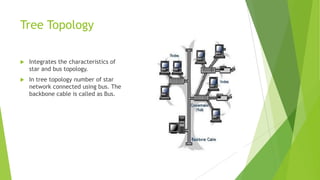
Tree Topology
 Integrates the characteristics of
star and bus topology.
 In tree topology number of star
network connected using bus. The
backbone cable is called as Bus.
Tree Topology
Advantages
 Expansion of Network is possible and
easy.
 Networks divided into segments, that
can be easily maintained.
 Error detection and correction is
easy.
 Each segment is provided with
dedicated point-to-point wiring to
the central hub.
 If one segment is damaged, other
segments are not affected.
Disadvantages
 Relies heavily on the main bus
cable, if it breaks whole network is
crippled.
 As more and more nodes and
segments are added, the
maintenance becomes difficult.
 Heavy traffic cause the network
and make it slow.

Network topologies

  • 1.
    Network Topologies The configurationof a communication network
  • 2.
    What are networktopologies?  In communication networks, a topology is a usually schematic description of the arrangement of a network, including its nodes and connecting lines.
  • 3.
    Why we usenetwork topologies?  Network topology is used initially for planning the best way to design your network to get maximum performance.
  • 4.
    Types of NetworkTopologies  Mesh Topology  Star Topology  Bus Topology  Ring Topology  Tree Topology
  • 5.
    Mesh Topology  Computersin mesh topologies are connected directly to each other with cables.
  • 6.
    Mesh Topology Advantages  Datacan be transmitted from different devices simultaneously. This topology can withstand high traffic.  Even if one of the components fails there is always an alternative present. So data transfer doesn’t get affected.  Expansion and modification in topology can be done without disrupting other nodes. Disadvantages  Connections not fully utilized.  Overall cost of this network is way too high as compared to other network topologies.  Set-up and maintenance of this topology is very difficult. Even administration of the network is tough.
  • 7.
    Star Topology  Ina star topology all computers are connected to a central device known as hub or switch.  All the computers share data through the Hub or Switch
  • 8.
    Star Topology Advantages  Anew node can be easily connected to the existing network by connecting it with unused port of hub.  If there is fault in cable connected with computer, only the particular computer get affected.  Less cables required than Mesh Topology. That’s why it is affordable by small organisations also. Disadvantages  If Hub or switch get faulty, all computer connected to it will be get affected.  Traffic increased when computers are simultaneously sending data to each other.
  • 9.
    Bus Topology  Inbus topology computers are connected via a single cable known as a Trunk or Backbone cable.  Trunk cable was then connected to the branch cables which were further connected to the PCs.
  • 10.
    Bus Topology Advantages  Usesless cables than star or mesh topology  Don’t need any special device like Hub or Switch. Disadvantages  Main disadvantage is the difficulty of troubleshooting it.  Bus topology is not scalable. New node attaching to network is not easy.  Backbone cable become faulty all computer connected to it get affected.
  • 11.
    Ring Topology  Inring topology all the nodes are connected to each-other in such a way that they make a closed loop.  Data travels around the network, in one direction. Sending and receiving of data takes place by the help of TOKEN.  Token Passing: Token contains a piece of information which along with data is sent by the source computer. This token then passes to next node, which checks if the signal is intended to it. If yes, it receives it and passes the empty to into the network, otherwise passes token along with the data to next node. This process continues until the signal reaches its intended destination.
  • 12.
    Ring Topology Advantages  Eachnode gets to send the data when it receives an empty token. This helps to reduces chances of collision.  All the traffics flows in one direction only at a very high speed.  No need for network server to control the connectivity between workstations.  Each computer has equal access to resources.  Receiver and repeater boost the signal and send it to the next node along with the token and data. Disadvantages  Each packet of data must pass through all the computers between source and destination. This makes it slower.  If one workstation or port goes down, the entire network gets affected  Difficult to add and remove devices once the network has been set up.  Data sharing accomplished through one direction only. It takes more time to send or receive data.
  • 13.
    Tree Topology  Integratesthe characteristics of star and bus topology.  In tree topology number of star network connected using bus. The backbone cable is called as Bus.
  • 14.
    Tree Topology Advantages  Expansionof Network is possible and easy.  Networks divided into segments, that can be easily maintained.  Error detection and correction is easy.  Each segment is provided with dedicated point-to-point wiring to the central hub.  If one segment is damaged, other segments are not affected. Disadvantages  Relies heavily on the main bus cable, if it breaks whole network is crippled.  As more and more nodes and segments are added, the maintenance becomes difficult.  Heavy traffic cause the network and make it slow.

Editor's Notes

  • #4 If we have a organisation and we have 8-10 computers to work on. We need to share the data etc. etc.