


Network-on-Chip
(NoC) Technology
Department of Electronics Engineering
By
Karthikesan R
17304014
12/9/2020
CONTENTS
• Defintion,Significance & Evolution
• Why We Need NOCs?
• Bus vs Networks-on-Chip (NoCs)
• Characteristics
• Network On-chip Interconnection
• NoC layers
• Routing algorithms
• Advantages With NOCs
• Commercial providers
• References
22/9/2020
DEFINITION
According to Arteris
Network-on-chip (NoC) interconnect technology
is often called “a front-end solution to a back-end
problem.
Network on Chip (NoC) is a new paradigm to
make the interconnections inside a System on
Chip (SoC) system
32/9/2020
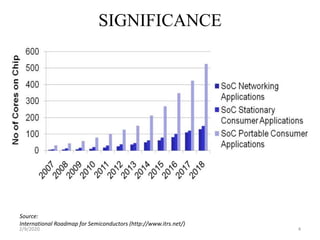
SIGNIFICANCE
Source:
International Roadmap for Semiconductors (http://www.itrs.net/)
42/9/2020
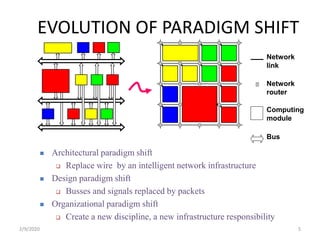
EVOLUTION OF PARADIGM SHIFT
Computing
module
Network
router
Network
link
 Architectural paradigm shift
 Replace wire by an intelligent network infrastructure
 Design paradigm shift
 Busses and signals replaced by packets
 Organizational paradigm shift
 Create a new discipline, a new infrastructure responsibility
Bus
52/9/2020
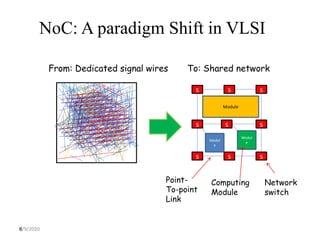
NoC: A paradigm Shift in VLSI
6
s
s
s
s
s s
s
s
Module
Modul
e
s
Modul
e
From: Dedicated signal wires To: Shared network
Point-
To-point
Link
Network
switch
Computing
Module
2/9/2020
Why We Need NOCs?
• Traditionally, ICs have been designed with dedicated point-to-
point connections, with one wire dedicated to each signal.
• For large designs, in particular, this has several limitations
from a physical design viewpoint.
• The wires occupy much of the area of the chip, and in
nanometer CMOS technology, interconnects dominate both
performance and dynamic power dissipation, as signal
propagation in wires across the chip requires multiple clock
cycles. (According to Rent's rule of wiring requirements for
point-to-point connections)
72/9/2020
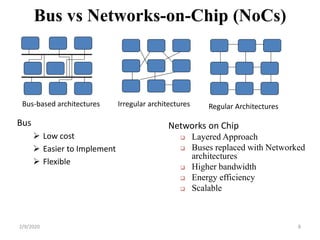
Bus vs Networks-on-Chip (NoCs)
Bus
 Low cost
 Easier to Implement
 Flexible
Networks on Chip
 Layered Approach
 Buses replaced with Networked
architectures
 Higher bandwidth
 Energy efficiency
 Scalable
Irregular architectures Regular ArchitecturesBus-based architectures
82/9/2020
CHARACTERISTICS
IP
 In electronic design a semiconductor intellectual property core,
IP core, or IP block is a reusable unit of logic,
cell, or integrated circuit (commonly called a "chip") layout
design that is the intellectual property of one party.
 IP cores may be licensed to another party or can be owned and
used by a single party alone
 Today, the most widely licensed IP cores are from ARM
Holdings (43.2% market share), Synopsys Inc. (13.9% market
share ), Imagination Technologies (9% market share )
and Cadence Design Systems (5.1% market share )
92/9/2020
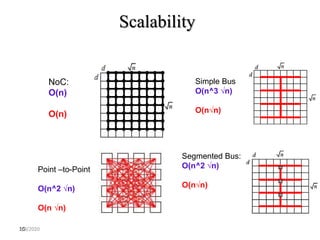
Scalability
10
NoC:
O(n)
O(n)
Point –to-Point
O(n^2 √n)
O(n √n)
Simple Bus
O(n^3 √n)
O(n√n)
Segmented Bus:
O(n^2 √n)
O(n√n)
2/9/2020
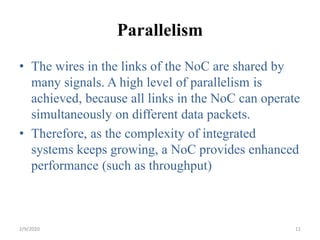
Parallelism
• The wires in the links of the NoC are shared by
many signals. A high level of parallelism is
achieved, because all links in the NoC can operate
simultaneously on different data packets.
• Therefore, as the complexity of integrated
systems keeps growing, a NoC provides enhanced
performance (such as throughput)
112/9/2020
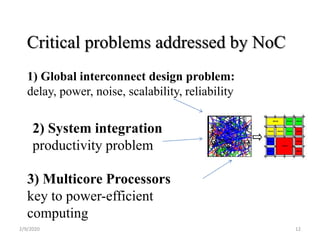
Critical problems addressed by NoC
1) Global interconnect design problem:
delay, power, noise, scalability, reliability
2) System integration
productivity problem
3) Multicore Processors
key to power-efficient
computing
2/9/2020 12
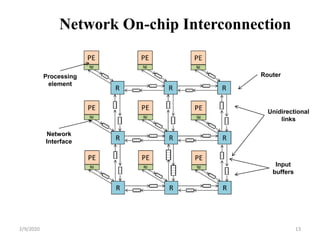
Processing
element
Network
Interface
Router
Input
buffers
Unidirectional
links
Network On-chip Interconnection
132/9/2020
NoC layers
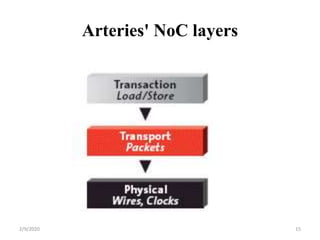
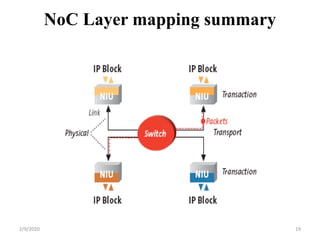
IP blocks communicate over the NoC using a
three layered communication referred to as the
1. Transaction
2. Transport and
3. Physical layers
142/9/2020
Arteries' NoC layers
152/9/2020
Physical Layer
• The Physical layer defines how packets are physically
transmitted over an interface.
• In addition, Arteris has defined a special physical
interface that allows independent hardening of
physical cores, and then connection of those cores
together, regardless of each core clock speed and
physical distance within the cores (within reasonable
limits guaranteeing signal integrity). This enables true
hierarchical physical design practices.
162/9/2020
Transport Layer
• The Transport layer defines rules that apply as
packets are routed through the switch fabric.
• The packet format is very flexible and easily
accommodates changes at transaction level without
impacting transport level.
• The Transport Layer may be optimized to application
needs.
172/9/2020
Transaction Layer
• The Transaction layer defines the communication
primitives available to interconnected IP blocks.
• Special NoC Interface Units (NIUs), located at
the NoC periphery, provide transaction-layer
services to IP blocks with which they are paired.
• The transaction layer defines how information is
exchanged between NIUs to implement a
particular transaction
182/9/2020
NoC Layer mapping summary
192/9/2020
2/9/2020 20
ROUTING ALGORITHMS
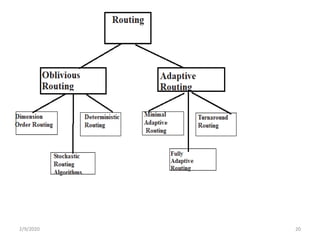
Oblivious routing algorithms
 It have no information about conditions of the
network, like traffic amounts or congestions.
 A router makes routing decisions on the grounds of
some algorithm or for example randomly.
 The simplest oblivious routing algorithm is a minimal
turn routing. It routes packets using as few turns as
possible.
Example: Dimension Order Routing
212/9/2020
Dimension Order Routing
• Dimension order routing (DOR) is a typical
minimal turn algorithm.
• The algorithm determines to what direction
packets are routed during every stage of the
routing
Example: XY routing
222/9/2020
XY routing
• XY routing is a dimension order routing which
routes packets first in x- or horizontal direction
to the correct column and then in y- or vertical
direction to the receiver.
• XY routing suits well on a network using mesh
or torus topology. Addresses of the routers are
their xy-coordinates
232/9/2020
Adaptive Routing Algorithms
Fully Adaptive Routing
• Fully adaptive routing algorithm uses always a
route which is not congested.
• The algorithm does not care although the route is
not the shortest path between sender and receiver.
• Typically an adaptive routing algorithm sets
alternative congestion free routes to order of
superiority
242/9/2020
Minimal Adaptive Routing
• Minimal adaptive routing algorithm always
routes packets along the shortest path.
• The algorithm is effective when more than one
minimal, or as short as possible,
routes between sender and receiver exist.
• The algorithm uses route which is least
congested
252/9/2020
Turnaround Routing
• Turnaround routing is a routing algorithm for butterfly and fat-
tree networks.
• Senders and receivers of packets are all on the same side of the
network.
• Packets are first routed from sender to some random
intermediate node on the other side of the network.
• In this node the packets are turned around and then routed to
the destination on the same side of the network, where the
whole routing started.
• The routing from the intermediate node to the definite receiver
is done with the destination-tag routing
262/9/2020
ADVANTAGES WITH NOCs
 It is possible to take packet switched networks in the field of
communication theory and computer networks, adapting those concepts to
the particular constraints of on chip interconnection.
 It is possible to achieve a very high grade of flexibility, using
Modularity (extensive use of parameterized independent functional blocks)
Reconfigurability (functional blocks can be mutually connected in different
manners in order to create the particular topology needed for a given
application).
 It is possible to easily integrate IP cores developed by different people or
companies, provided that this modules share a common interface for
communication with the external environment
272/9/2020
COMMERCIAL PROVIDERS
• Net Speed Systems
(http://www.netspeedsystems.com/
• Arteris (http://www.arteris.com/)
• Sonics (http://sonicsinc.com/)
• Aims Technology Inc
(http://aimstechnologyinc.com/)
282/9/2020
REFERENCES
1) NoCS (http://nocsymposium.org/) website
2) On-Chip Networks Bibliography
(http://www.cl.cam.ac.uk/)
3) “Network on Chip Routing Algorithms “, Ville
Rantala ,Teijo Lehtonen ,Juha Plosila,
University of Turku, Department of Information
Technology Joukahaisenkatu 3-5 B, 20520
Turku, Finland
292/9/2020
302/9/2020

Network on Chip

  • 1.
    Network-on-Chip (NoC) Technology Department ofElectronics Engineering By Karthikesan R 17304014 12/9/2020
  • 2.
    CONTENTS • Defintion,Significance &Evolution • Why We Need NOCs? • Bus vs Networks-on-Chip (NoCs) • Characteristics • Network On-chip Interconnection • NoC layers • Routing algorithms • Advantages With NOCs • Commercial providers • References 22/9/2020
  • 3.
    DEFINITION According to Arteris Network-on-chip(NoC) interconnect technology is often called “a front-end solution to a back-end problem. Network on Chip (NoC) is a new paradigm to make the interconnections inside a System on Chip (SoC) system 32/9/2020
  • 4.
    SIGNIFICANCE Source: International Roadmap forSemiconductors (http://www.itrs.net/) 42/9/2020
  • 5.
    EVOLUTION OF PARADIGMSHIFT Computing module Network router Network link  Architectural paradigm shift  Replace wire by an intelligent network infrastructure  Design paradigm shift  Busses and signals replaced by packets  Organizational paradigm shift  Create a new discipline, a new infrastructure responsibility Bus 52/9/2020
  • 6.
    NoC: A paradigmShift in VLSI 6 s s s s s s s s Module Modul e s Modul e From: Dedicated signal wires To: Shared network Point- To-point Link Network switch Computing Module 2/9/2020
  • 7.
    Why We NeedNOCs? • Traditionally, ICs have been designed with dedicated point-to- point connections, with one wire dedicated to each signal. • For large designs, in particular, this has several limitations from a physical design viewpoint. • The wires occupy much of the area of the chip, and in nanometer CMOS technology, interconnects dominate both performance and dynamic power dissipation, as signal propagation in wires across the chip requires multiple clock cycles. (According to Rent's rule of wiring requirements for point-to-point connections) 72/9/2020
  • 8.
    Bus vs Networks-on-Chip(NoCs) Bus  Low cost  Easier to Implement  Flexible Networks on Chip  Layered Approach  Buses replaced with Networked architectures  Higher bandwidth  Energy efficiency  Scalable Irregular architectures Regular ArchitecturesBus-based architectures 82/9/2020
  • 9.
    CHARACTERISTICS IP  In electronicdesign a semiconductor intellectual property core, IP core, or IP block is a reusable unit of logic, cell, or integrated circuit (commonly called a "chip") layout design that is the intellectual property of one party.  IP cores may be licensed to another party or can be owned and used by a single party alone  Today, the most widely licensed IP cores are from ARM Holdings (43.2% market share), Synopsys Inc. (13.9% market share ), Imagination Technologies (9% market share ) and Cadence Design Systems (5.1% market share ) 92/9/2020
  • 10.
    Scalability 10 NoC: O(n) O(n) Point –to-Point O(n^2 √n) O(n√n) Simple Bus O(n^3 √n) O(n√n) Segmented Bus: O(n^2 √n) O(n√n) 2/9/2020
  • 11.
    Parallelism • The wiresin the links of the NoC are shared by many signals. A high level of parallelism is achieved, because all links in the NoC can operate simultaneously on different data packets. • Therefore, as the complexity of integrated systems keeps growing, a NoC provides enhanced performance (such as throughput) 112/9/2020
  • 12.
    Critical problems addressedby NoC 1) Global interconnect design problem: delay, power, noise, scalability, reliability 2) System integration productivity problem 3) Multicore Processors key to power-efficient computing 2/9/2020 12
  • 13.
  • 14.
    NoC layers IP blockscommunicate over the NoC using a three layered communication referred to as the 1. Transaction 2. Transport and 3. Physical layers 142/9/2020
  • 15.
  • 16.
    Physical Layer • ThePhysical layer defines how packets are physically transmitted over an interface. • In addition, Arteris has defined a special physical interface that allows independent hardening of physical cores, and then connection of those cores together, regardless of each core clock speed and physical distance within the cores (within reasonable limits guaranteeing signal integrity). This enables true hierarchical physical design practices. 162/9/2020
  • 17.
    Transport Layer • TheTransport layer defines rules that apply as packets are routed through the switch fabric. • The packet format is very flexible and easily accommodates changes at transaction level without impacting transport level. • The Transport Layer may be optimized to application needs. 172/9/2020
  • 18.
    Transaction Layer • TheTransaction layer defines the communication primitives available to interconnected IP blocks. • Special NoC Interface Units (NIUs), located at the NoC periphery, provide transaction-layer services to IP blocks with which they are paired. • The transaction layer defines how information is exchanged between NIUs to implement a particular transaction 182/9/2020
  • 19.
    NoC Layer mappingsummary 192/9/2020
  • 20.
  • 21.
    ROUTING ALGORITHMS Oblivious routingalgorithms  It have no information about conditions of the network, like traffic amounts or congestions.  A router makes routing decisions on the grounds of some algorithm or for example randomly.  The simplest oblivious routing algorithm is a minimal turn routing. It routes packets using as few turns as possible. Example: Dimension Order Routing 212/9/2020
  • 22.
    Dimension Order Routing •Dimension order routing (DOR) is a typical minimal turn algorithm. • The algorithm determines to what direction packets are routed during every stage of the routing Example: XY routing 222/9/2020
  • 23.
    XY routing • XYrouting is a dimension order routing which routes packets first in x- or horizontal direction to the correct column and then in y- or vertical direction to the receiver. • XY routing suits well on a network using mesh or torus topology. Addresses of the routers are their xy-coordinates 232/9/2020
  • 24.
    Adaptive Routing Algorithms FullyAdaptive Routing • Fully adaptive routing algorithm uses always a route which is not congested. • The algorithm does not care although the route is not the shortest path between sender and receiver. • Typically an adaptive routing algorithm sets alternative congestion free routes to order of superiority 242/9/2020
  • 25.
    Minimal Adaptive Routing •Minimal adaptive routing algorithm always routes packets along the shortest path. • The algorithm is effective when more than one minimal, or as short as possible, routes between sender and receiver exist. • The algorithm uses route which is least congested 252/9/2020
  • 26.
    Turnaround Routing • Turnaroundrouting is a routing algorithm for butterfly and fat- tree networks. • Senders and receivers of packets are all on the same side of the network. • Packets are first routed from sender to some random intermediate node on the other side of the network. • In this node the packets are turned around and then routed to the destination on the same side of the network, where the whole routing started. • The routing from the intermediate node to the definite receiver is done with the destination-tag routing 262/9/2020
  • 27.
    ADVANTAGES WITH NOCs It is possible to take packet switched networks in the field of communication theory and computer networks, adapting those concepts to the particular constraints of on chip interconnection.  It is possible to achieve a very high grade of flexibility, using Modularity (extensive use of parameterized independent functional blocks) Reconfigurability (functional blocks can be mutually connected in different manners in order to create the particular topology needed for a given application).  It is possible to easily integrate IP cores developed by different people or companies, provided that this modules share a common interface for communication with the external environment 272/9/2020
  • 28.
    COMMERCIAL PROVIDERS • NetSpeed Systems (http://www.netspeedsystems.com/ • Arteris (http://www.arteris.com/) • Sonics (http://sonicsinc.com/) • Aims Technology Inc (http://aimstechnologyinc.com/) 282/9/2020
  • 29.
    REFERENCES 1) NoCS (http://nocsymposium.org/)website 2) On-Chip Networks Bibliography (http://www.cl.cam.ac.uk/) 3) “Network on Chip Routing Algorithms “, Ville Rantala ,Teijo Lehtonen ,Juha Plosila, University of Turku, Department of Information Technology Joukahaisenkatu 3-5 B, 20520 Turku, Finland 292/9/2020
  • 30.