1
HELLO!
GOOD AFTERNOON
This presentation is
presented by
NABAJIT KUMAR BARMAN
17304018
2
CONTENT
▸INTRODUCTION
▸DESCRIPTION
▸PROBLEM STATEMENT
▸ANALYSIS
▸CORRECTIVE ACTION
▸CONCLUSION
▸REFERENCES
3
INTRODUCTION
4
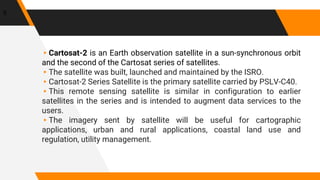
▸Cartosat-2 is an Earth observation satellite in a sun-synchronous orbit
and the second of the Cartosat series of satellites.
▸The satellite was built, launched and maintained by the ISRO.
▸Cartosat-2 Series Satellite is the primary satellite carried by PSLV-C40.
▸This remote sensing satellite is similar in configuration to earlier
satellites in the series and is intended to augment data services to the
users.
▸The imagery sent by satellite will be useful for cartographic
applications, urban and rural applications, coastal land use and
regulation, utility management.
5
DESCRIPTION
6
▸Cartosat-2 series spacecraft carries four high resolution payloads
▸Panchromatic camera, Multispectral camera, Event monitoring
camera-1&2.
▸The spacecraft altitude is 505 km.
▸The overall mass of the satellite is around 725 kg.
▸Spacecraft DC power generation capability is around 986 watts.
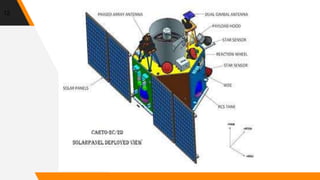
▸It has solar array for power generation which consists of 4 deployable
solar panels as shown in Figure.
▸There are two identical raw buses Bus-A and Bus-B each of 30 – 42V
range.
7
▸Each bus is formed with 9 numbers of strings out of which two strings
are operated in duty cycle mode based on the Pulse Width Modulation
(PWM) with frequency of 15 KHz Âą 1.5 KHz.
▸Two Li-ion batteries of 36 AH capacity are used to support.
▸It is achieved by PWM based Taper Charge Regulator (TCR)
▸Two power control electronics package PW-11 & PW-21 which controls
the bus regulation.
▸OBC is used to carry out functions such as Telemetry, Tele-command,
Attitude and Orbit Control functions and Thermal management.
▸EED interfaces and Relay supplies.
8
▸Provides serial Tele-command and Telemetry interface.
▸TT&C-RF system of spacecraft is used for communicating to
spacecraft from ground stations.
▸It consists of two chains of S-Band transponders connected to a
common antenna system.
▸TTC-Main and Null Filling Antennas are used for providing 360⁰
coverage.
▸X-band data transmission system is used.
▸It consists of two X-band data transmitters and PAA & DGA for
transmitting the payload data.
▸This spacecraft mission is configured with two deployment events
such as solar panel and DGA antenna.
9
▸Solar panel deployment is made with Pyro squib whereas DGA
deployment is designed using SMA based pin puller.
▸SMA pin puller is a current based deployment device which requires
2.0 Amps of current which is derived directly from the string-2 of bus-A
and bus-B.
10
11
12
PROBLEM
STATEMENT
13
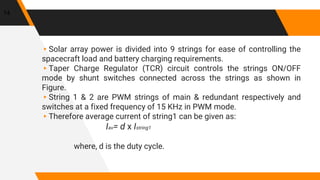
▸Solar array power is divided into 9 strings for ease of controlling the
spacecraft load and battery charging requirements.
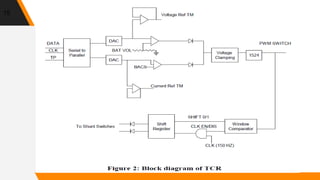
▸Taper Charge Regulator (TCR) circuit controls the strings ON/OFF
mode by shunt switches connected across the strings as shown in
Figure.
▸String 1 & 2 are PWM strings of main & redundant respectively and
switches at a fixed frequency of 15 KHz in PWM mode.
▸Therefore average current of string1 can be given as:
Iav= d x Istring1
where, d is the duty cycle.
14
15
▸OBC provides data command interface in the form of three signal lines
Data, Clock and Transfer Pulse (TP) to set the Vref and Iref.
▸it was observed that, a few TCR commands of Bus-A were not
executed.
▸These commands were tested and found normal in the earlier phases
of testing.
▸in assembled mode IST, these commands were executed if the
spacecraft is powered through battery simulator but not responded when
the spacecraft is powered through solar array.
▸TCR commands were issued again and it was found that commands
were executed and registered in OBC command counter.
▸The required action was not happened in TCR control circuit and
corresponding telemetry was not changed.
16
ANALYSIS
17
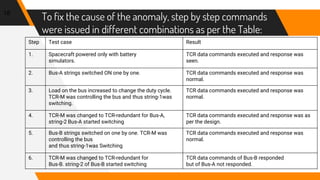
To fix the cause of the anomaly, step by step commands
were issued in different combinations as per the Table:
18
Step Test case Result
1. Spacecraft powered only with battery
simulators.
TCR data commands executed and response was
seen.
2. Bus-A strings switched ON one by one. TCR data commands executed and response was
normal.
3. Load on the bus increased to change the duty cycle.
TCR-M was controlling the bus and thus string-1was
switching.
TCR data commands executed and response was
normal.
4. TCR-M was changed to TCR-redundant for Bus-A,
string-2 Bus-A started switching
TCR data commands executed and response was as
per the design.
5. Bus-B strings switched on one by one. TCR-M was
controlling the bus
and thus string-1was Switching
TCR data commands executed and response was
normal.
6. TCR-M was changed to TCR-redundant for
Bus-B. string-2 of Bus-B started switching
TCR data commands of Bus-B responded
but of Bus-A not responded.
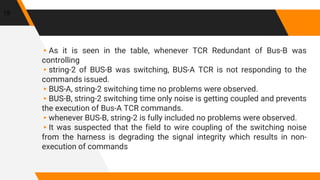
▸As it is seen in the table, whenever TCR Redundant of Bus-B was
controlling
▸string-2 of BUS-B was switching, BUS-A TCR is not responding to the
commands issued.
▸BUS-A, string-2 switching time no problems were observed.
▸BUS-B, string-2 switching time only noise is getting coupled and prevents
the execution of Bus-A TCR commands.
▸whenever BUS-B, string-2 is fully included no problems were observed.
▸It was suspected that the field to wire coupling of the switching noise
from the harness is degrading the signal integrity which results in non-
execution of commands
19
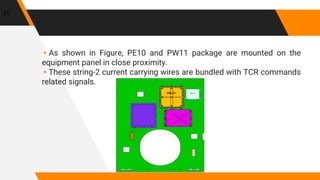
▸As shown in Figure, PE10 and PW11 package are mounted on the
equipment panel in close proximity.
▸These string-2 current carrying wires are bundled with TCR commands
related signals.
20
▸to confirm that, harness routing path for string-2 for both BUS-A & BUS-
B was studied
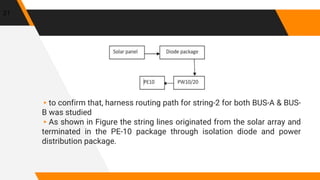
▸As shown in Figure the string lines originated from the solar array and
terminated in the PE-10 package through isolation diode and power
distribution package.
21
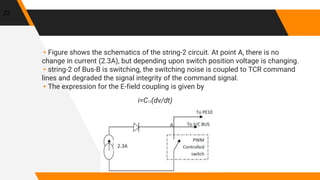
▸Figure shows the schematics of the string-2 circuit. At point A, there is no
change in current (2.3A), but depending upon switch position voltage is changing.
▸string-2 of Bus-B is switching, the switching noise is coupled to TCR command
lines and degraded the signal integrity of the command signal.
▸The expression for the E-field coupling is given by
i=C12(dv/dt)
22
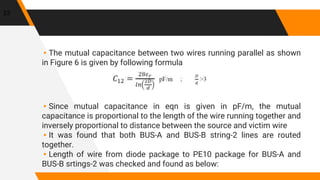
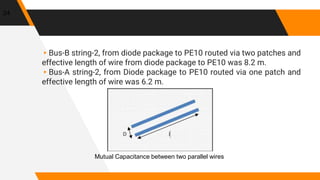
▸The mutual capacitance between two wires running parallel as shown
in Figure 6 is given by following formula
▸Since mutual capacitance in eqn is given in pF/m, the mutual
capacitance is proportional to the length of the wire running together and
inversely proportional to distance between the source and victim wire
▸It was found that both BUS-A and BUS-B string-2 lines are routed
together.
▸Length of wire from diode package to PE10 package for BUS-A and
BUS-B srtings-2 was checked and found as below:
23
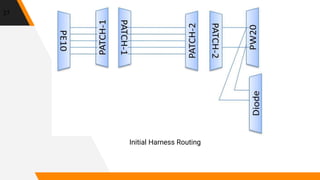
▸Bus-B string-2, from diode package to PE10 routed via two patches and
effective length of wire from diode package to PE10 was 8.2 m.
▸Bus-A string-2, from Diode package to PE10 routed via one patch and
effective length of wire was 6.2 m.
24
Mutual Capacitance between two parallel wires
CORRECTIVE ACTION
25
26
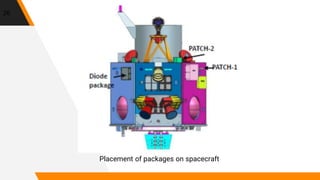
Placement of packages on spacecraft
27
Initial Harness Routing
28
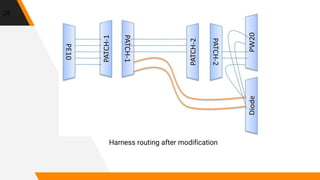
Harness routing after modification
▸Since both patches and diode package are placed outside following scheme for
harness changes were carried out:
▸Wire between patch-1 to patch-2 was removed and a new wire added directly
from diode package to patch-2 as shown in Figure
▸Thus diode package to PE10 effective length of wire became 4.2 m.
▸With this changed harness routing harness length was reduced by 4 m, without
opening the panels. Modified harness routing plan is shown in Figure
▸After reduction in harness length, test was repeated and no problem was
observed
▸With BUS-B, string-2 switching TCR data was changed
▸Finally, the spacecraft was launched and the On-orbit performance is as per the
mission specifications.
29
CONCLUSION
30
▸Anomaly encountered during Cartosat-2C spacecraft realisation is
studied.
▸The anomaly was successfully solved without affecting the realisation
schedule
▸Even though switching strings wires were shielded wires and proper
separation of wire was taken care during routing, the length of the wire
played a major role and caused the anomaly
▸In future missions in Cartosat 2 series, the diode package is modified
and placed behind the solar panels which results in reduced harness
length of all strings.
31
REFERENCES
32
Research Paper:
▸Mishra Priyanka, Muniraja S. M., V. Neelima, S. Vidya, B. Karthikeyan, Jeyanthi
Rajesh, and V. K. Hariharan “Minimizing Solar Array Switching Noise in Cartosat-2
Series Spacecraft”, Electrical Integration Division-1, Systems Integration Group
ISRO Satellite Centre, Old Airport Road, Bangalore
Document:
▸Cartosat-2 spacecraft executive summary document. ISRO-ISACCARTOSAT- 2C-
RR-1002
▸AIT PDR Document of Cartosat-2 Series.
Online website:
▸https://www.morningstarcorp.com/wp-content/uploads/2014/02/8.-Why-
PWM1.pdf
▸http://www.mpoweruk.com/chargers.htm
▸https://www.isro.gov.in/Spacecraft/cartosat-2-series-satellite-2
33
34
THANKS!
Any questions?

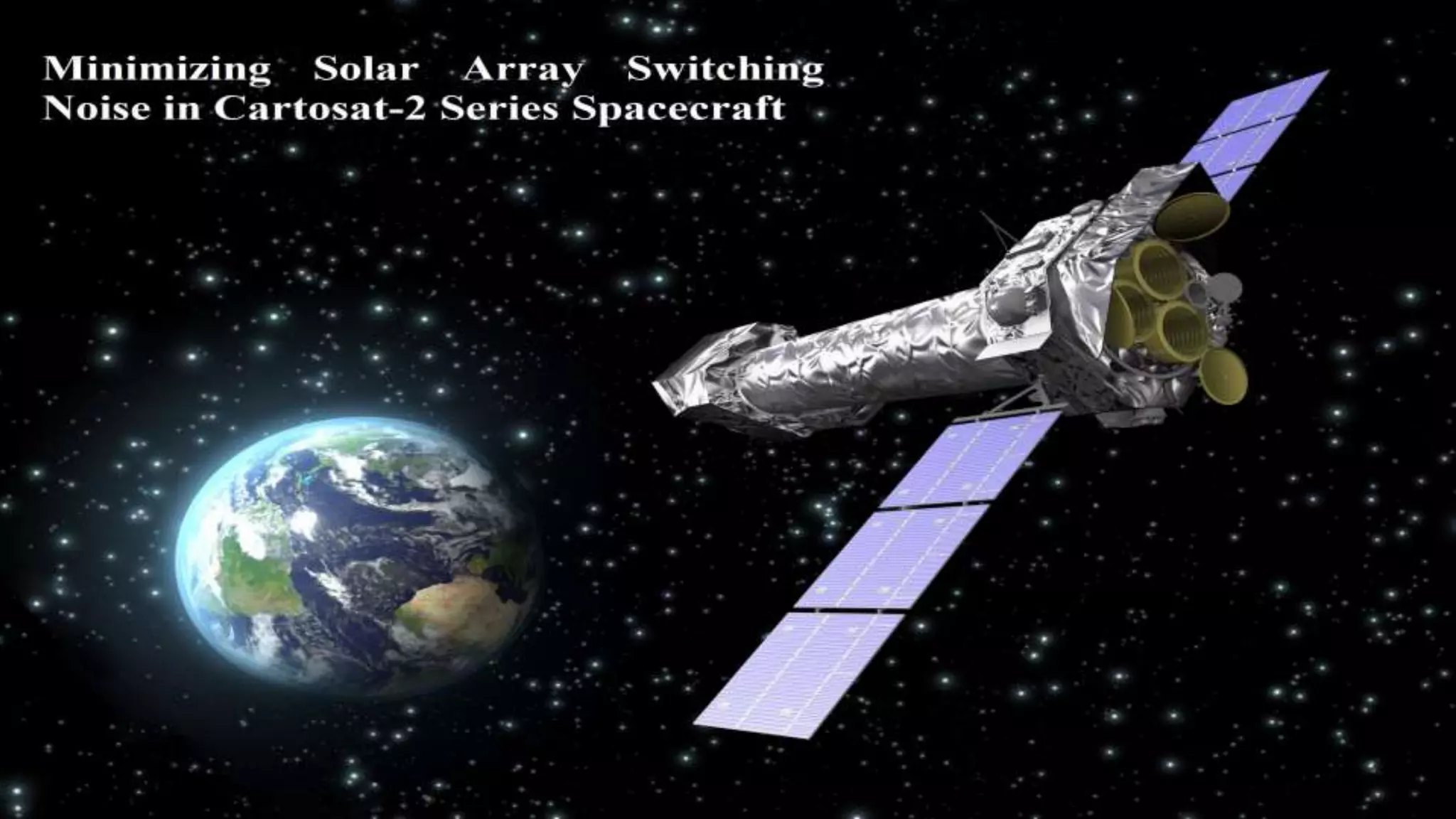
minimize solar array switching

  • 1.
  • 2.
    HELLO! GOOD AFTERNOON This presentationis presented by NABAJIT KUMAR BARMAN 17304018 2
  • 3.
  • 4.
  • 5.
    ▸Cartosat-2 is anEarth observation satellite in a sun-synchronous orbit and the second of the Cartosat series of satellites. ▸The satellite was built, launched and maintained by the ISRO. ▸Cartosat-2 Series Satellite is the primary satellite carried by PSLV-C40. ▸This remote sensing satellite is similar in configuration to earlier satellites in the series and is intended to augment data services to the users. ▸The imagery sent by satellite will be useful for cartographic applications, urban and rural applications, coastal land use and regulation, utility management. 5
  • 6.
  • 7.
    ▸Cartosat-2 series spacecraftcarries four high resolution payloads ▸Panchromatic camera, Multispectral camera, Event monitoring camera-1&2. ▸The spacecraft altitude is 505 km. ▸The overall mass of the satellite is around 725 kg. ▸Spacecraft DC power generation capability is around 986 watts. ▸It has solar array for power generation which consists of 4 deployable solar panels as shown in Figure. ▸There are two identical raw buses Bus-A and Bus-B each of 30 – 42V range. 7
  • 8.
    ▸Each bus isformed with 9 numbers of strings out of which two strings are operated in duty cycle mode based on the Pulse Width Modulation (PWM) with frequency of 15 KHz ± 1.5 KHz. ▸Two Li-ion batteries of 36 AH capacity are used to support. ▸It is achieved by PWM based Taper Charge Regulator (TCR) ▸Two power control electronics package PW-11 & PW-21 which controls the bus regulation. ▸OBC is used to carry out functions such as Telemetry, Tele-command, Attitude and Orbit Control functions and Thermal management. ▸EED interfaces and Relay supplies. 8
  • 9.
    ▸Provides serial Tele-commandand Telemetry interface. ▸TT&C-RF system of spacecraft is used for communicating to spacecraft from ground stations. ▸It consists of two chains of S-Band transponders connected to a common antenna system. ▸TTC-Main and Null Filling Antennas are used for providing 360⁰ coverage. ▸X-band data transmission system is used. ▸It consists of two X-band data transmitters and PAA & DGA for transmitting the payload data. ▸This spacecraft mission is configured with two deployment events such as solar panel and DGA antenna. 9
  • 10.
    ▸Solar panel deploymentis made with Pyro squib whereas DGA deployment is designed using SMA based pin puller. ▸SMA pin puller is a current based deployment device which requires 2.0 Amps of current which is derived directly from the string-2 of bus-A and bus-B. 10
  • 11.
  • 12.
  • 13.
  • 14.
    ▸Solar array poweris divided into 9 strings for ease of controlling the spacecraft load and battery charging requirements. ▸Taper Charge Regulator (TCR) circuit controls the strings ON/OFF mode by shunt switches connected across the strings as shown in Figure. ▸String 1 & 2 are PWM strings of main & redundant respectively and switches at a fixed frequency of 15 KHz in PWM mode. ▸Therefore average current of string1 can be given as: Iav= d x Istring1 where, d is the duty cycle. 14
  • 15.
  • 16.
    ▸OBC provides datacommand interface in the form of three signal lines Data, Clock and Transfer Pulse (TP) to set the Vref and Iref. ▸it was observed that, a few TCR commands of Bus-A were not executed. ▸These commands were tested and found normal in the earlier phases of testing. ▸in assembled mode IST, these commands were executed if the spacecraft is powered through battery simulator but not responded when the spacecraft is powered through solar array. ▸TCR commands were issued again and it was found that commands were executed and registered in OBC command counter. ▸The required action was not happened in TCR control circuit and corresponding telemetry was not changed. 16
  • 17.
  • 18.
    To fix thecause of the anomaly, step by step commands were issued in different combinations as per the Table: 18 Step Test case Result 1. Spacecraft powered only with battery simulators. TCR data commands executed and response was seen. 2. Bus-A strings switched ON one by one. TCR data commands executed and response was normal. 3. Load on the bus increased to change the duty cycle. TCR-M was controlling the bus and thus string-1was switching. TCR data commands executed and response was normal. 4. TCR-M was changed to TCR-redundant for Bus-A, string-2 Bus-A started switching TCR data commands executed and response was as per the design. 5. Bus-B strings switched on one by one. TCR-M was controlling the bus and thus string-1was Switching TCR data commands executed and response was normal. 6. TCR-M was changed to TCR-redundant for Bus-B. string-2 of Bus-B started switching TCR data commands of Bus-B responded but of Bus-A not responded.
  • 19.
    ▸As it isseen in the table, whenever TCR Redundant of Bus-B was controlling ▸string-2 of BUS-B was switching, BUS-A TCR is not responding to the commands issued. ▸BUS-A, string-2 switching time no problems were observed. ▸BUS-B, string-2 switching time only noise is getting coupled and prevents the execution of Bus-A TCR commands. ▸whenever BUS-B, string-2 is fully included no problems were observed. ▸It was suspected that the field to wire coupling of the switching noise from the harness is degrading the signal integrity which results in non- execution of commands 19
  • 20.
    ▸As shown inFigure, PE10 and PW11 package are mounted on the equipment panel in close proximity. ▸These string-2 current carrying wires are bundled with TCR commands related signals. 20
  • 21.
    ▸to confirm that,harness routing path for string-2 for both BUS-A & BUS- B was studied ▸As shown in Figure the string lines originated from the solar array and terminated in the PE-10 package through isolation diode and power distribution package. 21
  • 22.
    ▸Figure shows theschematics of the string-2 circuit. At point A, there is no change in current (2.3A), but depending upon switch position voltage is changing. ▸string-2 of Bus-B is switching, the switching noise is coupled to TCR command lines and degraded the signal integrity of the command signal. ▸The expression for the E-field coupling is given by i=C12(dv/dt) 22
  • 23.
    ▸The mutual capacitancebetween two wires running parallel as shown in Figure 6 is given by following formula ▸Since mutual capacitance in eqn is given in pF/m, the mutual capacitance is proportional to the length of the wire running together and inversely proportional to distance between the source and victim wire ▸It was found that both BUS-A and BUS-B string-2 lines are routed together. ▸Length of wire from diode package to PE10 package for BUS-A and BUS-B srtings-2 was checked and found as below: 23
  • 24.
    ▸Bus-B string-2, fromdiode package to PE10 routed via two patches and effective length of wire from diode package to PE10 was 8.2 m. ▸Bus-A string-2, from Diode package to PE10 routed via one patch and effective length of wire was 6.2 m. 24 Mutual Capacitance between two parallel wires
  • 25.
  • 26.
  • 27.
  • 28.
  • 29.
    ▸Since both patchesand diode package are placed outside following scheme for harness changes were carried out: ▸Wire between patch-1 to patch-2 was removed and a new wire added directly from diode package to patch-2 as shown in Figure ▸Thus diode package to PE10 effective length of wire became 4.2 m. ▸With this changed harness routing harness length was reduced by 4 m, without opening the panels. Modified harness routing plan is shown in Figure ▸After reduction in harness length, test was repeated and no problem was observed ▸With BUS-B, string-2 switching TCR data was changed ▸Finally, the spacecraft was launched and the On-orbit performance is as per the mission specifications. 29
  • 30.
  • 31.
    ▸Anomaly encountered duringCartosat-2C spacecraft realisation is studied. ▸The anomaly was successfully solved without affecting the realisation schedule ▸Even though switching strings wires were shielded wires and proper separation of wire was taken care during routing, the length of the wire played a major role and caused the anomaly ▸In future missions in Cartosat 2 series, the diode package is modified and placed behind the solar panels which results in reduced harness length of all strings. 31
  • 32.
  • 33.
    Research Paper: ▸Mishra Priyanka,Muniraja S. M., V. Neelima, S. Vidya, B. Karthikeyan, Jeyanthi Rajesh, and V. K. Hariharan “Minimizing Solar Array Switching Noise in Cartosat-2 Series Spacecraft”, Electrical Integration Division-1, Systems Integration Group ISRO Satellite Centre, Old Airport Road, Bangalore Document: ▸Cartosat-2 spacecraft executive summary document. ISRO-ISACCARTOSAT- 2C- RR-1002 ▸AIT PDR Document of Cartosat-2 Series. Online website: ▸https://www.morningstarcorp.com/wp-content/uploads/2014/02/8.-Why- PWM1.pdf ▸http://www.mpoweruk.com/chargers.htm ▸https://www.isro.gov.in/Spacecraft/cartosat-2-series-satellite-2 33
  • 34.