SPINTRONICS
Submitted by
DHIVYA DHARSHINI .K
(17304007)
1
CONTENT
• INTRODUCTION
• EVOLUTION
• GMR
• TYPES OF GMR
o MULTILAYER
o GRANULAR
o SPIN VALUE
• TMR
• MRAM
• ADVANTAGES
• LIMITATIONS
• REFERENCE
2
INTRODUCTION
• Spintronics (" SPIN TRansport electrONICS "), also known
as magneto electronics is an emerging technology that makes
use of the intrinsic spin of the electron and its associated
magnetic moment, in addition to its fundamental electronic
charge.
• In conventional electronic devices, charge of electron used to
achieve functionalities and also semi conducting materials for
logical operation and magnetic materials for storage
• But Spintronics influences the electron spin and resulting
magnetic moment, to achieve improved functionalities and
also magnetic materials that are used for processing and
storage
3
EVOLUTION
• In 1965, Gordon Moore, Intel's co-founder, predicted that the
number of transistors on an integrated circuit would double
every 18 months which known as Moore’s Law
• The moment when transistors reach as small as atoms, it
cannot shrunk any further
• For this reason and also to enhance the multifunctionality of
devices spin property of the electron has been exploited. Spin
is a purely quantum phenomenon
4
GAINT MAGNETO RESISTANCE
• Magneto resistance is the property of a material to change the
value of its electrical resistance when an external magnetic
field is applied to it
• It was unable to lower the electrical resistance of anything by
more than 5%. This effect was later termed Anisotropic
Magneto Resistance (AMR)
• And later Giant Magneto Resistance (GMR) was introduced in
in 1988 which was considered as the birth of Spintronics.
• GMR is 200 times stronger than ordinary Magneto
Resistance.
5
• Giant magneto resistance is a quantum mechanical magneto
resistance effect observed in thin film structures composed of
alternating ferromagnetic and non magnetic layers.
• It was discovered that the application of a magnetic field to
magnetic metallic multilayers (such as Fe/Cr and Co/Cu) in
which ferromagnetic layers are separated by nonmagnetic
spacer layers of a few nm thick, results in a significant
reduction of the electrical resistance of the multilayer
6
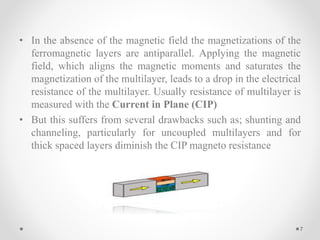
• In the absence of the magnetic field the magnetizations of the
ferromagnetic layers are antiparallel. Applying the magnetic
field, which aligns the magnetic moments and saturates the
magnetization of the multilayer, leads to a drop in the electrical
resistance of the multilayer. Usually resistance of multilayer is
measured with the Current in Plane (CIP)
• But this suffers from several drawbacks such as; shunting and
channeling, particularly for uncoupled multilayers and for
thick spaced layers diminish the CIP magneto resistance
7
• To overcome these problems we measure with Current
Perpendicular to the Plane (CPP), mainly because electrons
cross all magnetic layers, but a practical difficulty is
encountered the perpendicular resistance of ultra thin
multilayers is too small to be measured by ordinary techniques
8
TYPES OF GMR
1. Multilayer GMR
2. Granular GMR
3. Spinvalue GMR
• MULTILAYER GMR
Two or more ferromagnetic layers are separated by a very thin
(about 1 nm) non-ferromagnetic spacer (e.g. Fe/Cr/Fe).
The strength of electrical current between the layers can change
by upto 10%.
The GMR effect was first observed in multilayer stacks of 10
or more layers
9
• Granular GMR
Granular GMR is an effect found in copper containing
grains of cobalt
It is not possible to control the strength of granular GMR
in the same manner as multilayer GMR
• Spin value GMR
In spin value GMR, two magnetic layers are separated by
a thin non magnetic (insulating) layer.
Materials used in spin values are copper and an alloy of
nickel and iron
Spin value GMR is the most useful sort for hard drives
and is tested carefully to meet industry standards
10
TUNNEL MAGNETO RESISTANCE
• The Tunnel magneto resistance (TMR) is a magneto resistive
effect that occurs in magnetic tunnel junctions (MTJs)
• This is a component consisting of two ferromagnets separated
by a thin insulator. If the insulating layer is thin enough
(typically a few nanometers), electrons can tunnel from one
ferromagnet into the other
• The direction of the two magnetizations of the ferromagnetic
films can be switched individually by an external magnetic
field. If the magnetizations are in a parallel orientation it is
more likely that electrons will tunnel through the insulating
film than if they are in the oppositional (antiparallel)
orientation
11
MRAM
• The read-heads of modern hard disk drives work on the basis
of magnetic tunnel junctions (i.e), TMR is also the basis of
MRAM, a new type of non-volatile memory
• Magnetoresistive Random Access Memory (MRAM) is a non-
volatile computer memory (NVRAM) technology, it uses
magnetism rather than electrical power to store data.
• Unlike conventional RAM chip technologies, in MRAM data
is not stored as electric charge or current flows, but by
magnetic storage elements
12
WORKING OF MRAM
• MRAM (Magnetoresistive Random Access Memory) uses
electron spin to store data. Memory cells are integrated on an
integrated circuit chip, and the function of the resulting device
is like a semiconductor static RAM (SRAM) chip, with
potentially higher density and the added feature that the data
are nonvolatile, that is data are retained with power off
• Data are written by small electrical currents in the write lines
that create a magnetic fields, which flip electron spins in the
spin-dependent tunnel junction storage layer, thus changing the
junction’s resistance. Data is read by the tunneling current or
resistance through the tunnel junction.
13
ADVANTAGES
1. Non-Volatile memory
2. Low power Consumption
3. Spintronics does not require unique and specialised
semiconductors
4. spintronic RAM chips will:
• increase storage densities
• have faster operation
14
LIMITATIONS
1. Controlling spin for long distances.
2. Difficult to INJECT and MEASURE spin.
3. Interference with nearest field.
4. Control of spin in Silicon is difficult
15
CONCLUTION
The spin of the electron has attracted renewed interest
because it promises a wide variety of new devices that combine
logic, storage and sensor applications. And these “spintronic”
devices might lead to quantum computers and quantum
communication based on electronic solid-state devices, thus
changing the perspective of information technology in the 21st
century.
16
REFERENCE
• Electronic measurement and control of spin transport
• en.Wikipedia.org/org/wiki/ spintronics
• http://www.slideshare.net
• http:/www.seminarproject.com
• www.physic.uni-Regensburg.de/..../ spintronics
17
Thank y☺u
18

Spintronics

  • 1.
  • 2.
    CONTENT • INTRODUCTION • EVOLUTION •GMR • TYPES OF GMR o MULTILAYER o GRANULAR o SPIN VALUE • TMR • MRAM • ADVANTAGES • LIMITATIONS • REFERENCE 2
  • 3.
    INTRODUCTION • Spintronics ("SPIN TRansport electrONICS "), also known as magneto electronics is an emerging technology that makes use of the intrinsic spin of the electron and its associated magnetic moment, in addition to its fundamental electronic charge. • In conventional electronic devices, charge of electron used to achieve functionalities and also semi conducting materials for logical operation and magnetic materials for storage • But Spintronics influences the electron spin and resulting magnetic moment, to achieve improved functionalities and also magnetic materials that are used for processing and storage 3
  • 4.
    EVOLUTION • In 1965,Gordon Moore, Intel's co-founder, predicted that the number of transistors on an integrated circuit would double every 18 months which known as Moore’s Law • The moment when transistors reach as small as atoms, it cannot shrunk any further • For this reason and also to enhance the multifunctionality of devices spin property of the electron has been exploited. Spin is a purely quantum phenomenon 4
  • 5.
    GAINT MAGNETO RESISTANCE •Magneto resistance is the property of a material to change the value of its electrical resistance when an external magnetic field is applied to it • It was unable to lower the electrical resistance of anything by more than 5%. This effect was later termed Anisotropic Magneto Resistance (AMR) • And later Giant Magneto Resistance (GMR) was introduced in in 1988 which was considered as the birth of Spintronics. • GMR is 200 times stronger than ordinary Magneto Resistance. 5
  • 6.
    • Giant magnetoresistance is a quantum mechanical magneto resistance effect observed in thin film structures composed of alternating ferromagnetic and non magnetic layers. • It was discovered that the application of a magnetic field to magnetic metallic multilayers (such as Fe/Cr and Co/Cu) in which ferromagnetic layers are separated by nonmagnetic spacer layers of a few nm thick, results in a significant reduction of the electrical resistance of the multilayer 6
  • 7.
    • In theabsence of the magnetic field the magnetizations of the ferromagnetic layers are antiparallel. Applying the magnetic field, which aligns the magnetic moments and saturates the magnetization of the multilayer, leads to a drop in the electrical resistance of the multilayer. Usually resistance of multilayer is measured with the Current in Plane (CIP) • But this suffers from several drawbacks such as; shunting and channeling, particularly for uncoupled multilayers and for thick spaced layers diminish the CIP magneto resistance 7
  • 8.
    • To overcomethese problems we measure with Current Perpendicular to the Plane (CPP), mainly because electrons cross all magnetic layers, but a practical difficulty is encountered the perpendicular resistance of ultra thin multilayers is too small to be measured by ordinary techniques 8
  • 9.
    TYPES OF GMR 1.Multilayer GMR 2. Granular GMR 3. Spinvalue GMR • MULTILAYER GMR Two or more ferromagnetic layers are separated by a very thin (about 1 nm) non-ferromagnetic spacer (e.g. Fe/Cr/Fe). The strength of electrical current between the layers can change by upto 10%. The GMR effect was first observed in multilayer stacks of 10 or more layers 9
  • 10.
    • Granular GMR GranularGMR is an effect found in copper containing grains of cobalt It is not possible to control the strength of granular GMR in the same manner as multilayer GMR • Spin value GMR In spin value GMR, two magnetic layers are separated by a thin non magnetic (insulating) layer. Materials used in spin values are copper and an alloy of nickel and iron Spin value GMR is the most useful sort for hard drives and is tested carefully to meet industry standards 10
  • 11.
    TUNNEL MAGNETO RESISTANCE •The Tunnel magneto resistance (TMR) is a magneto resistive effect that occurs in magnetic tunnel junctions (MTJs) • This is a component consisting of two ferromagnets separated by a thin insulator. If the insulating layer is thin enough (typically a few nanometers), electrons can tunnel from one ferromagnet into the other • The direction of the two magnetizations of the ferromagnetic films can be switched individually by an external magnetic field. If the magnetizations are in a parallel orientation it is more likely that electrons will tunnel through the insulating film than if they are in the oppositional (antiparallel) orientation 11
  • 12.
    MRAM • The read-headsof modern hard disk drives work on the basis of magnetic tunnel junctions (i.e), TMR is also the basis of MRAM, a new type of non-volatile memory • Magnetoresistive Random Access Memory (MRAM) is a non- volatile computer memory (NVRAM) technology, it uses magnetism rather than electrical power to store data. • Unlike conventional RAM chip technologies, in MRAM data is not stored as electric charge or current flows, but by magnetic storage elements 12
  • 13.
    WORKING OF MRAM •MRAM (Magnetoresistive Random Access Memory) uses electron spin to store data. Memory cells are integrated on an integrated circuit chip, and the function of the resulting device is like a semiconductor static RAM (SRAM) chip, with potentially higher density and the added feature that the data are nonvolatile, that is data are retained with power off • Data are written by small electrical currents in the write lines that create a magnetic fields, which flip electron spins in the spin-dependent tunnel junction storage layer, thus changing the junction’s resistance. Data is read by the tunneling current or resistance through the tunnel junction. 13
  • 14.
    ADVANTAGES 1. Non-Volatile memory 2.Low power Consumption 3. Spintronics does not require unique and specialised semiconductors 4. spintronic RAM chips will: • increase storage densities • have faster operation 14
  • 15.
    LIMITATIONS 1. Controlling spinfor long distances. 2. Difficult to INJECT and MEASURE spin. 3. Interference with nearest field. 4. Control of spin in Silicon is difficult 15
  • 16.
    CONCLUTION The spin ofthe electron has attracted renewed interest because it promises a wide variety of new devices that combine logic, storage and sensor applications. And these “spintronic” devices might lead to quantum computers and quantum communication based on electronic solid-state devices, thus changing the perspective of information technology in the 21st century. 16
  • 17.
    REFERENCE • Electronic measurementand control of spin transport • en.Wikipedia.org/org/wiki/ spintronics • http://www.slideshare.net • http:/www.seminarproject.com • www.physic.uni-Regensburg.de/..../ spintronics 17
  • 18.