ISTE Technology Standards for
Teachers
Introduction to EDUU 551
Educational Applications of Computers
I. Facilitate and Inspire Student
Learning and Creativity
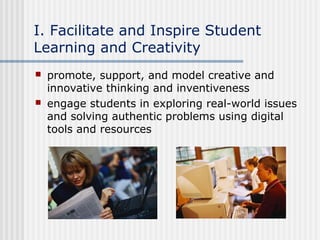
 promote, support, and model creative and
innovative thinking and inventiveness
 engage students in exploring real-world issues
and solving authentic problems using digital
tools and resources
I. Facilitate and Inspire Student
Learning and Creativity
 promote student reflection using collaborative
tools to reveal and clarify students’ conceptual
understanding and thinking, planning, and
creative processes
 model collaborative knowledge construction by
engaging in learning with students, colleagues,
and others in face-to-face and virtual
environments
Design and Develop Digital-Age
Learning Experiences and Assessments
 design or adapt relevant learning experiences
that incorporate digital tools and resources to
promote student learning and creativity
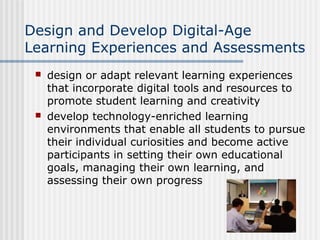
 develop technology-enriched learning
environments that enable all students to pursue
their individual curiosities and become active
participants in setting their own educational
goals, managing their own learning, and
assessing their own progress
Design and Develop Digital-Age
Learning Experiences and Assessments
 customize and personalize learning activities to
address students’ diverse learning styles,
working strategies, and abilities using digital
tools and resources
 provide students with multiple and varied
formative and summative assessments aligned
with content and technology standards and use
resulting data to inform learning and teaching
Model Digital-Age Work and Learning
 demonstrate fluency in technology systems and
the transfer of current knowledge to new
technologies and situations
 collaborate with students, peers, parents, and
community members using digital tools and
resources to support student success and
innovation
Model Digital-Age Work and
Learning
 communicate relevant information and ideas
effectively to students, parents, and peers
using a variety of digital-age media and
formats
 model and facilitate effective use of current
and emerging digital tools to locate, analyze,
evaluate, and use information resources to
support research and learning
Promote and Model Digital Citizenship
and Responsibility
 advocate, model, and teach safe, legal, and
ethical use of digital information and technology,
including respect for copyright, intellectual
property, and the appropriate documentation of
sources
 address the diverse needs of all learners by
using learner-centered strategies and providing
equitable access to appropriate digital tools and
resources
Promote and Model Digital Citizenship
and Responsibility
 promote and model digital etiquette and
responsible social interactions related to the use
of technology and information
 develop and model cultural understanding and
global awareness by engaging with colleagues
and students of other cultures using digital-age
communication and collaboration tools
Engage in Professional Growth
and Leadership
 participate in local and global learning
communities to explore creative applications of
technology to improve student learning
 exhibit leadership by demonstrating a vision of
technology infusion, participating in shared
decision making and community building, and
developing the leadership and technology skills
of others
Engage in Professional Growth
and Leadership
 evaluate and reflect on current research and
professional practice on a regular basis to make
effective use of existing and emerging digital
tools and resources in support of student
learning
 contribute to the effectiveness, vitality, and self-
renewal of the teaching profession and of their
school and community
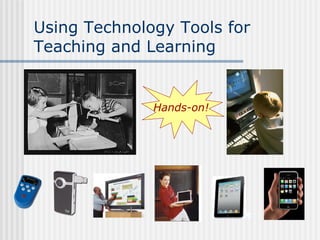
Hands-on!
Using Technology Tools for
Teaching and Learning
ISTE Technology Standards
for Teachers
 Web –
http://www.iste.org/standards/stand
ards/standards-for-teachers
 PDF -
https://www.iste.org/docs/pdfs/20-
14_ISTE_Standards-T_PDF.pdf

ISTE Technology Standards for Teachers

  • 1.
    ISTE Technology Standardsfor Teachers Introduction to EDUU 551 Educational Applications of Computers
  • 2.
    I. Facilitate andInspire Student Learning and Creativity  promote, support, and model creative and innovative thinking and inventiveness  engage students in exploring real-world issues and solving authentic problems using digital tools and resources
  • 3.
    I. Facilitate andInspire Student Learning and Creativity  promote student reflection using collaborative tools to reveal and clarify students’ conceptual understanding and thinking, planning, and creative processes  model collaborative knowledge construction by engaging in learning with students, colleagues, and others in face-to-face and virtual environments
  • 4.
    Design and DevelopDigital-Age Learning Experiences and Assessments  design or adapt relevant learning experiences that incorporate digital tools and resources to promote student learning and creativity  develop technology-enriched learning environments that enable all students to pursue their individual curiosities and become active participants in setting their own educational goals, managing their own learning, and assessing their own progress
  • 5.
    Design and DevelopDigital-Age Learning Experiences and Assessments  customize and personalize learning activities to address students’ diverse learning styles, working strategies, and abilities using digital tools and resources  provide students with multiple and varied formative and summative assessments aligned with content and technology standards and use resulting data to inform learning and teaching
  • 6.
    Model Digital-Age Workand Learning  demonstrate fluency in technology systems and the transfer of current knowledge to new technologies and situations  collaborate with students, peers, parents, and community members using digital tools and resources to support student success and innovation
  • 7.
    Model Digital-Age Workand Learning  communicate relevant information and ideas effectively to students, parents, and peers using a variety of digital-age media and formats  model and facilitate effective use of current and emerging digital tools to locate, analyze, evaluate, and use information resources to support research and learning
  • 8.
    Promote and ModelDigital Citizenship and Responsibility  advocate, model, and teach safe, legal, and ethical use of digital information and technology, including respect for copyright, intellectual property, and the appropriate documentation of sources  address the diverse needs of all learners by using learner-centered strategies and providing equitable access to appropriate digital tools and resources
  • 9.
    Promote and ModelDigital Citizenship and Responsibility  promote and model digital etiquette and responsible social interactions related to the use of technology and information  develop and model cultural understanding and global awareness by engaging with colleagues and students of other cultures using digital-age communication and collaboration tools
  • 10.
    Engage in ProfessionalGrowth and Leadership  participate in local and global learning communities to explore creative applications of technology to improve student learning  exhibit leadership by demonstrating a vision of technology infusion, participating in shared decision making and community building, and developing the leadership and technology skills of others
  • 11.
    Engage in ProfessionalGrowth and Leadership  evaluate and reflect on current research and professional practice on a regular basis to make effective use of existing and emerging digital tools and resources in support of student learning  contribute to the effectiveness, vitality, and self- renewal of the teaching profession and of their school and community
  • 12.
    Hands-on! Using Technology Toolsfor Teaching and Learning
  • 13.
    ISTE Technology Standards forTeachers  Web – http://www.iste.org/standards/stand ards/standards-for-teachers  PDF - https://www.iste.org/docs/pdfs/20- 14_ISTE_Standards-T_PDF.pdf