HISTORY OF  EDUCATIONAL TECHNOLOGY Where Are We Going & Where Have We Been Prepared & Modified by FOR-IAN V. SANDOVAL
Educational Technology Objectives: To identify events and devices of the past that contributed to the technological revolution. To examine the organizations and their viewpoints that have shaped technology use in the classroom today. To prepare for the future in educational technology by analyzing current trends and advances.
Educational Technology “ Technology is commonly thought of in terms of gadgets, instruments, machines and devices … most (educators) will defer to technology as computers.”  (Muffoletto, 1994) TEA
Educational Technology The history of “Educational technology … can be traced back to the time when tribal priests systemized bodies of knowledge, and early cultures invented pictographs or sign writing to record and transmit information.” (Paul Saettler, 1990)
Educational Technology In ancient Greece, the Elder Sophist used the term “techne” to refer the process of applying knowledge systematically to the practical art of instruction. They formulated cognitive rules, systematically analyzed subject matter designed instructional technologies and devised effective instructional materials.
Educational Technology During the Middle Age Advent of Scholastic Philosophy, Pierre Abelard introduced a technology of instruction which was really a new method of structuring and presenting materials that helped set the style of scholastic education.
Educational Technology Comenius, Pestalozzi, Froebel, Herbart and Montessori contributed their own concept on educational technology improving educative process . John Amos Comenius  was recognized as the pioneer of modern instructional technology by reason of his book Orbis Pictus (The World in Picture) which was illustrated textbooks for children studying Latin & Sciences.
Educational Technology Edward Thorndike and John Dewey formulated scientific theory of learning and the scientific method, respectively. Thorndike gave emphasis to the use of empirical investigation as a basis for an organized process of learning. On his part, Dewey introduced a method of instruction in terms scientific method in broad terms
The 19 th  century paved in the advent of effective technological development including the production of textbooks, use of blackboards and improvements in writing implements like pen and ink. Photography was invented, giving a way to a movement called “ Visual Instruction ”. Educational Technology
By 1920, visual media became widely accepted. Then came the publication of audio-visual media texts.  In 1926, educational films were used as instructional media. In 1927, Pressey wrote on programmed learning through a machine which tested and confirmi a learning task. Educational Technology
By 1920, visual media became widely accepted. Then came the publication of audio-visual media texts.  In 1926, educational films were used as instructional media. In 1927, Pressey wrote on programmed learning through a machine which tested and confirmed a learning task. Educational Technology
In 1932, the first instructional television program was aired at the State  University of Iowa. About the same time, the 16 mm sound motion picture was developed and this served as the educational workhorse during the audio-visual movement of the time. Educational Technology
During World War II, the U.S. government encouraged the implementation of technology of instruction for military training programs. This gave impetus to a system approach to instruction to include: micro-teaching, individualized instruction, Language laboratories, behavioral laboratories, behavioral objectives, computer assisted instruction and among others Educational Technology
History of “Computers” Abacus---Approximately 3000 BC Calculators---1600s Punched Card Devices---1800s First Electronic Computers---1940s Mainframes---1950s Minicomputers---1960s Microcomputers---1970s Microcomputer Systems---1980s Internet---1990s
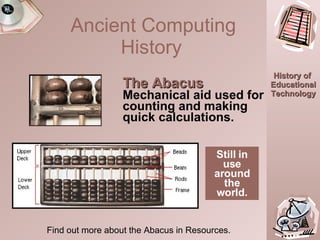
Ancient Computing History   The Abacus Mechanical aid used for counting and making quick calculations. Still in use around the world. Find out more about the Abacus in Resources.
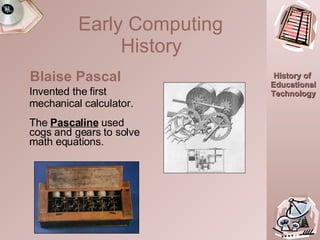
Early Computing  History   Invented the first mechanical calculator. The  Pascaline   used cogs and gears to solve math equations. Blaise Pascal
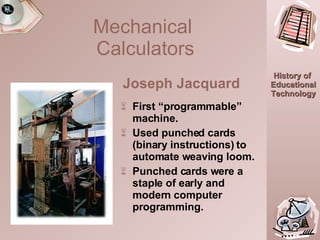
First “programmable”   machine. Used punched cards (binary instructions) to automate weaving loom. Punched cards were a staple of early and modern computer programming. Mechanical  Calculators Joseph Jacquard
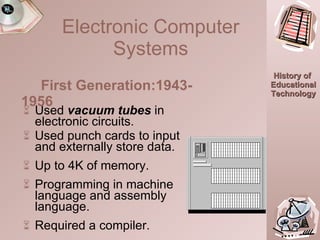
Electronic Computer Systems Used  vacuum tubes  in electronic circuits. Used punch cards to input and externally store data. Up to 4K of memory. Programming in machine language and assembly language. Required a compiler. First Generation:1943-1956
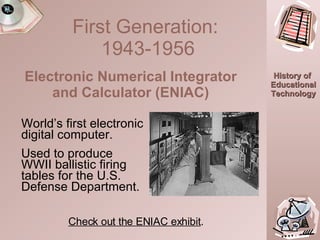
First Generation:  1943-1956 World’s first electronic digital computer. Used to produce WWII ballistic firing tables for the U.S. Defense Department. Electronic Numerical Integrator and Calculator (ENIAC) Check out the ENIAC exhibit .
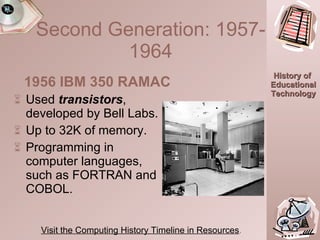
Used  transistors , developed by Bell Labs. Up to 32K of memory. Programming in computer languages, such as FORTRAN and COBOL. 1956 IBM 350 RAMAC Second Generation: 1957-1964 Visit the Computing History Timeline in Resources .
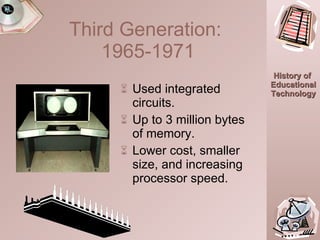
Used integrated circuits. Up to 3 million bytes of memory. Lower cost, smaller size, and increasing processor speed. Third Generation:  1965-1971
1971, Intel develops 4004, the first  microprocessor chip . Altair sold in 1975, the first personal computer. It is a kit that must be assembled. Apple Computer is formed in 1976 and sells 50 Apple I. Advances increase memory size, storage space, and processing speeds. Fourth Generation:  1972-Now Microcomputer Revolution Begins.
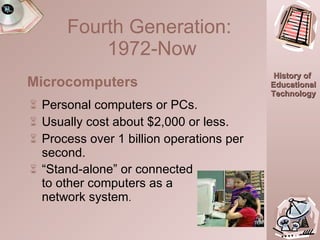
Personal computers or PCs. Usually cost about $2,000 or less. Process over 1 billion operations per second. “ Stand-alone” or connected  to other computers as a  network system . Fourth Generation:  1972-Now Microcomputers  TEA
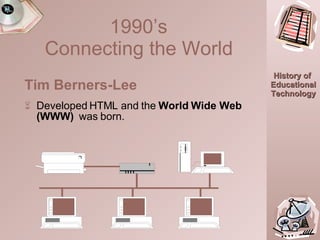
Tim Berners-Lee Developed HTML and the  World Wide Web (WWW)   was born.  1990’s  Connecting the World
Marc Andreessen An original developer of  Mosaic , the first browser software able to read HTML.  Co-founder of Netscape Communications. 1990’s  Connecting the World
Technologies of the Future Advanced robotics commonplace Smart houses Wearable computers Holodeck virtual reality Truly individualized education The 21st Century Check out Dave Moursund’s view of education in the year 2015, one of the Resources.
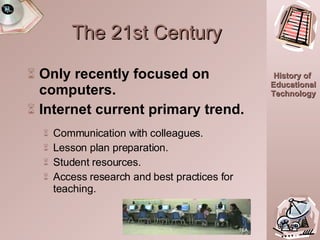
The 21st Century Only recently focused on computers. Internet current primary trend. Communication with colleagues. Lesson plan preparation. Student resources. Access research and best practices for teaching. 05:34.0 TEA
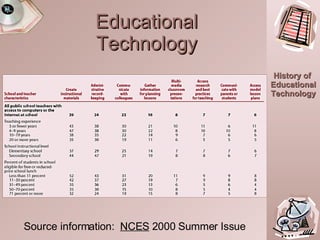
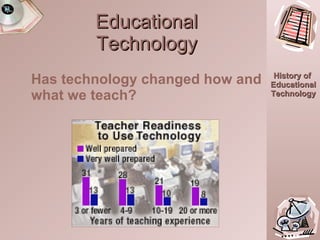
Educational Technology Source information:  NCES  2000 Summer Issue
Educational Technology Our Definition: “ A combination of the processes and tools involved in addressing educational needs and problems, with an emphasis on applying the most current tools: computers and their related technologies.”  (M. D. Roblyer, 2000)
Educational Technology Has technology changed how and what we teach?
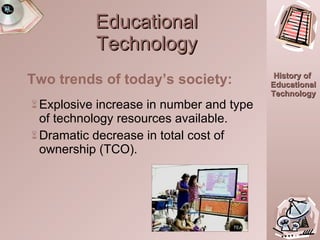
Educational Technology Two trends of today’s society: Explosive increase in number and type of technology resources available. Dramatic decrease in total cost of ownership (TCO). TEA
Educational Technology CPU: Intel 4.77 MHz 8088 Memory: 64K Storage: Single-sided, 160K 5” floppy disk drive Display: 12 inch monochrome Price: $2880.00 IBM unveils first PC in 1981. Read about IBM Through the Years   in Resources.
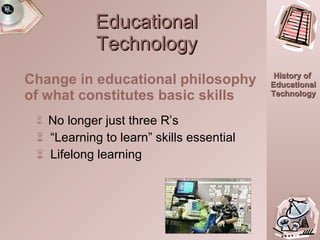
Educational Technology Change in educational philosophy of what constitutes basic skills No longer just three R’s “ Learning to learn” skills essential Lifelong learning TEA
Four Different Views Association for Educational Communications & Technology (AECT) International Society for Performance Improvement (ISPI) International Technology Education Association (ITEA) International Society for Technology in Education (ISTE)
Four Different Views Audiovisual Media Communications. Begun in 1923. Initially centered on radio. Quickly extended focus to include instructional film strips and educational television. Today, it includes global satellite broadcasting, two-way audio, and visual communications. AECT
Four Different Views “ Branch of educational theory and practice concerned primarily with the design and use of messages which control the learning process.” (Saettler, 1990, p. 9) Publications:   TechTrends Handbook of Research for Educational Communications and Technology Visit the AECT web site from Resources. AECT
Four Different Views ISPI Instructional systems approach based on Behaviorist theories “ Systematic approach to designing, developing, and delivering instruction matched to carefully identified needs.”   (Heinich, Molenda, Russell, & Smaldino, 1997)
Four Different Views Publications: Performance Improvement Journal Performance Improvement Quarterly Explore ISPI resources at the ISPI web site. ISPI
Four Different Views ITEA Industry trainers and vocational teachers. Schools should prepare students for work force Learning about technology as used in the “real world” is essential.
Four Different Views ITEA Includes robotics, manufacturing systems, computer-assisted design (CAD). Publications: The Technology Teacher Technology and Children The Journal of Technology Education   Find out more at the ITEA web site.
Four Different Views ISTE Primary focus encompassed both instructional and support applications of computers. Begun by trainers and educators who predicted that computers would revolutionize education. Influenced by technical personnel, such as programmers and systems analysts .
Four Different Views ISTE  National Educational Technology Standards for Students and Teachers (NETS) Publications: Learning and Leading with Technology (formerly The Computing Teacher) Journal of Research on Computing in Education ISTE’s website is one of the Resources.
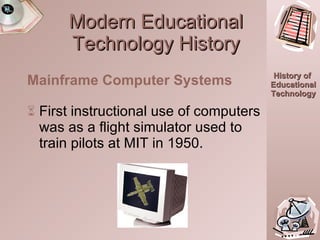
Modern Educational Technology History First instructional use of computers was as a flight simulator used to train pilots at MIT in 1950.  Mainframe Computer Systems
Modern Educational Technology History First use in public schools taught New York elementary students binary arithmetic in 1959.  Mainframe Computer Systems
Modern Educational Technology History Federal funds supported many large-scale projects in mainframe computer-assisted instruction (CAI) in schools, colleges, and universities through the middle of 1970’s.   Mainframe Computer Systems
Stanford University – first multimedia learning station, Course writer Programmed Logic for Automatic Teaching Operations (PLATO) BYU – Time-shared Interactive Computer-Controlled Information Television (TICCIT) Mainframe Computer Systems Modern Educational Technology History
Designed to support personalized mastery learning Individually Prescribed Instruction (IPI) - University of Pittsburgh Program for Learning in Accordance with Needs (PLAN) - American Institutes of Research Mainframe Computer Systems Modern Educational Technology History
National Education Computing Conference (NECC) Created by mainframe programming enthusiasts from universities nationwide. First conference held in1979. Today is the largest educational technology conference in U.S. with attendance of 10,000+ people.  Modern Educational Technology History
Introduced in late 1970’s. Adopted by public school systems during 1980’s. Apple II Commodore PET Radio Shack TRS - 80 Microcomputers in Education Modern Educational Technology History
Early courseware developed for mainframes were provided by: Large hardware manufacturers Software systems companies University development projects New microcomputer software market driven primarily by educators. Software Modern Educational Technology History
Minnesota Educational Computing Consortium (MECC) Initially largest provider of educational software. Funded by National Science Foundation. MicroSift, EPIE  Provided courseware evaluations. Software Modern Educational Technology History
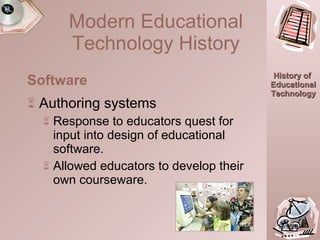
15:05.0 Authoring systems Response to educators quest for input into design of educational software. Allowed educators to develop their own courseware. Software TEA Modern Educational Technology History
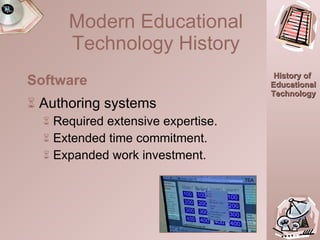
Authoring systems Required extensive expertise. Extended time commitment. Expanded work investment. Software Modern Educational Technology History TEA
Computer Literacy  Originally defined as programming skills and tools such as word processing. Today’s world can only agree that the term refers to skills that are constantly changing. 15:45.0 Modern Educational Technology History
Seymour Papert Educational theorist mentored by Jean Piaget. Developed programming language for young children based on constructivist theory of education. Raised national consciousness about potential of technology to change the educational system. 16:25.0 Modern Educational Technology History
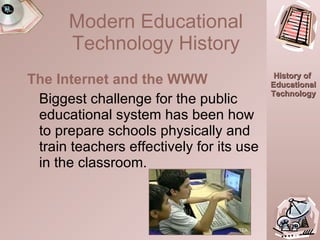
The Internet and the WWW Biggest challenge for the public educational system has been how to prepare schools physically and train teachers effectively for its use in the classroom.  16:50.0 TEA Modern Educational Technology History
What We’ve Learned Computer literacy or knowledge of computer applications is a moving target. Teaching students technical skills for today is valuable. More important are “learning to learn” tools for tomorrow and years to come. 17:20.0
What We’ve Learned Computer-based materials are just one component of resources available to educational system. Integration of technology as a tool to advance learning in the content areas adds to the effectiveness of  other resources and teacher created activities. 18:00.0
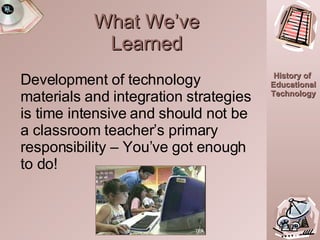
What We’ve Learned Development of technology materials and integration strategies is time intensive and should not be a classroom teacher’s primary responsibility – You’ve got enough to do! 18:20.0 TEA
What We’ve Learned Educators must keep pace with technological advances. But often times technology changes faster than the educational environment. Business and Industry must do it’s part in providing economical technology solutions. 18:40.0
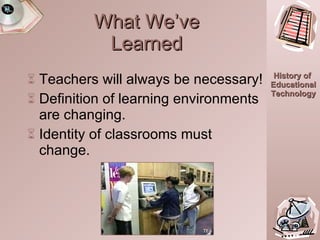
What We’ve Learned Teachers will always be necessary! Definition of learning environments are changing. Identity of classrooms must change. 19:03.0 TEA
Our models of effective instruction must change too! Educators must be more than:  Sage on the Stage Guide on the Side What We’ve Learned 19:40.0
What We’ve Learned Vet in the Net Today’s teacher must be willing to be:  A participating learner in the classroom. One who will take the same risks and not always have the right answer. A veteran learner in a network of learners called the classroom. 20:10.0
Enrichment Activity 2 E-mail your answer to  [email_address] Create a graphic organizer showing the historical development of educational technology. Discuss educational programs on television: how effective are these in enriching the educational process in Philippine schools? What are their flaws ad limitations. 20:10.0
Reference “ EDUCATIONAL TECHNOLOGY” by Dr. Paz I. Lucido & Dr.  Milagros L. Borabo 20:10.0 Web Link http://www.tcet.unt.edu/weblibrary2/overview/?id=33&PHPSESSID=1f41402407f2621f9827509fa7a8d6e8

History Of Educational Technology

  • 1.
    HISTORY OF EDUCATIONAL TECHNOLOGY Where Are We Going & Where Have We Been Prepared & Modified by FOR-IAN V. SANDOVAL
  • 2.
    Educational Technology Objectives:To identify events and devices of the past that contributed to the technological revolution. To examine the organizations and their viewpoints that have shaped technology use in the classroom today. To prepare for the future in educational technology by analyzing current trends and advances.
  • 3.
    Educational Technology “Technology is commonly thought of in terms of gadgets, instruments, machines and devices … most (educators) will defer to technology as computers.” (Muffoletto, 1994) TEA
  • 4.
    Educational Technology Thehistory of “Educational technology … can be traced back to the time when tribal priests systemized bodies of knowledge, and early cultures invented pictographs or sign writing to record and transmit information.” (Paul Saettler, 1990)
  • 5.
    Educational Technology Inancient Greece, the Elder Sophist used the term “techne” to refer the process of applying knowledge systematically to the practical art of instruction. They formulated cognitive rules, systematically analyzed subject matter designed instructional technologies and devised effective instructional materials.
  • 6.
    Educational Technology Duringthe Middle Age Advent of Scholastic Philosophy, Pierre Abelard introduced a technology of instruction which was really a new method of structuring and presenting materials that helped set the style of scholastic education.
  • 7.
    Educational Technology Comenius,Pestalozzi, Froebel, Herbart and Montessori contributed their own concept on educational technology improving educative process . John Amos Comenius was recognized as the pioneer of modern instructional technology by reason of his book Orbis Pictus (The World in Picture) which was illustrated textbooks for children studying Latin & Sciences.
  • 8.
    Educational Technology EdwardThorndike and John Dewey formulated scientific theory of learning and the scientific method, respectively. Thorndike gave emphasis to the use of empirical investigation as a basis for an organized process of learning. On his part, Dewey introduced a method of instruction in terms scientific method in broad terms
  • 9.
    The 19 th century paved in the advent of effective technological development including the production of textbooks, use of blackboards and improvements in writing implements like pen and ink. Photography was invented, giving a way to a movement called “ Visual Instruction ”. Educational Technology
  • 10.
    By 1920, visualmedia became widely accepted. Then came the publication of audio-visual media texts. In 1926, educational films were used as instructional media. In 1927, Pressey wrote on programmed learning through a machine which tested and confirmi a learning task. Educational Technology
  • 11.
    By 1920, visualmedia became widely accepted. Then came the publication of audio-visual media texts. In 1926, educational films were used as instructional media. In 1927, Pressey wrote on programmed learning through a machine which tested and confirmed a learning task. Educational Technology
  • 12.
    In 1932, thefirst instructional television program was aired at the State University of Iowa. About the same time, the 16 mm sound motion picture was developed and this served as the educational workhorse during the audio-visual movement of the time. Educational Technology
  • 13.
    During World WarII, the U.S. government encouraged the implementation of technology of instruction for military training programs. This gave impetus to a system approach to instruction to include: micro-teaching, individualized instruction, Language laboratories, behavioral laboratories, behavioral objectives, computer assisted instruction and among others Educational Technology
  • 14.
    History of “Computers”Abacus---Approximately 3000 BC Calculators---1600s Punched Card Devices---1800s First Electronic Computers---1940s Mainframes---1950s Minicomputers---1960s Microcomputers---1970s Microcomputer Systems---1980s Internet---1990s
  • 15.
    Ancient Computing History The Abacus Mechanical aid used for counting and making quick calculations. Still in use around the world. Find out more about the Abacus in Resources.
  • 16.
    Early Computing History Invented the first mechanical calculator. The Pascaline used cogs and gears to solve math equations. Blaise Pascal
  • 17.
    First “programmable” machine. Used punched cards (binary instructions) to automate weaving loom. Punched cards were a staple of early and modern computer programming. Mechanical Calculators Joseph Jacquard
  • 18.
    Electronic Computer SystemsUsed vacuum tubes in electronic circuits. Used punch cards to input and externally store data. Up to 4K of memory. Programming in machine language and assembly language. Required a compiler. First Generation:1943-1956
  • 19.
    First Generation: 1943-1956 World’s first electronic digital computer. Used to produce WWII ballistic firing tables for the U.S. Defense Department. Electronic Numerical Integrator and Calculator (ENIAC) Check out the ENIAC exhibit .
  • 20.
    Used transistors, developed by Bell Labs. Up to 32K of memory. Programming in computer languages, such as FORTRAN and COBOL. 1956 IBM 350 RAMAC Second Generation: 1957-1964 Visit the Computing History Timeline in Resources .
  • 21.
    Used integrated circuits.Up to 3 million bytes of memory. Lower cost, smaller size, and increasing processor speed. Third Generation: 1965-1971
  • 22.
    1971, Intel develops4004, the first microprocessor chip . Altair sold in 1975, the first personal computer. It is a kit that must be assembled. Apple Computer is formed in 1976 and sells 50 Apple I. Advances increase memory size, storage space, and processing speeds. Fourth Generation: 1972-Now Microcomputer Revolution Begins.
  • 23.
    Personal computers orPCs. Usually cost about $2,000 or less. Process over 1 billion operations per second. “ Stand-alone” or connected to other computers as a network system . Fourth Generation: 1972-Now Microcomputers TEA
  • 24.
    Tim Berners-Lee DevelopedHTML and the World Wide Web (WWW) was born. 1990’s Connecting the World
  • 25.
    Marc Andreessen Anoriginal developer of Mosaic , the first browser software able to read HTML. Co-founder of Netscape Communications. 1990’s Connecting the World
  • 26.
    Technologies of theFuture Advanced robotics commonplace Smart houses Wearable computers Holodeck virtual reality Truly individualized education The 21st Century Check out Dave Moursund’s view of education in the year 2015, one of the Resources.
  • 27.
    The 21st CenturyOnly recently focused on computers. Internet current primary trend. Communication with colleagues. Lesson plan preparation. Student resources. Access research and best practices for teaching. 05:34.0 TEA
  • 28.
    Educational Technology Sourceinformation: NCES 2000 Summer Issue
  • 29.
    Educational Technology OurDefinition: “ A combination of the processes and tools involved in addressing educational needs and problems, with an emphasis on applying the most current tools: computers and their related technologies.” (M. D. Roblyer, 2000)
  • 30.
    Educational Technology Hastechnology changed how and what we teach?
  • 31.
    Educational Technology Twotrends of today’s society: Explosive increase in number and type of technology resources available. Dramatic decrease in total cost of ownership (TCO). TEA
  • 32.
    Educational Technology CPU:Intel 4.77 MHz 8088 Memory: 64K Storage: Single-sided, 160K 5” floppy disk drive Display: 12 inch monochrome Price: $2880.00 IBM unveils first PC in 1981. Read about IBM Through the Years in Resources.
  • 33.
    Educational Technology Changein educational philosophy of what constitutes basic skills No longer just three R’s “ Learning to learn” skills essential Lifelong learning TEA
  • 34.
    Four Different ViewsAssociation for Educational Communications & Technology (AECT) International Society for Performance Improvement (ISPI) International Technology Education Association (ITEA) International Society for Technology in Education (ISTE)
  • 35.
    Four Different ViewsAudiovisual Media Communications. Begun in 1923. Initially centered on radio. Quickly extended focus to include instructional film strips and educational television. Today, it includes global satellite broadcasting, two-way audio, and visual communications. AECT
  • 36.
    Four Different Views“ Branch of educational theory and practice concerned primarily with the design and use of messages which control the learning process.” (Saettler, 1990, p. 9) Publications: TechTrends Handbook of Research for Educational Communications and Technology Visit the AECT web site from Resources. AECT
  • 37.
    Four Different ViewsISPI Instructional systems approach based on Behaviorist theories “ Systematic approach to designing, developing, and delivering instruction matched to carefully identified needs.” (Heinich, Molenda, Russell, & Smaldino, 1997)
  • 38.
    Four Different ViewsPublications: Performance Improvement Journal Performance Improvement Quarterly Explore ISPI resources at the ISPI web site. ISPI
  • 39.
    Four Different ViewsITEA Industry trainers and vocational teachers. Schools should prepare students for work force Learning about technology as used in the “real world” is essential.
  • 40.
    Four Different ViewsITEA Includes robotics, manufacturing systems, computer-assisted design (CAD). Publications: The Technology Teacher Technology and Children The Journal of Technology Education Find out more at the ITEA web site.
  • 41.
    Four Different ViewsISTE Primary focus encompassed both instructional and support applications of computers. Begun by trainers and educators who predicted that computers would revolutionize education. Influenced by technical personnel, such as programmers and systems analysts .
  • 42.
    Four Different ViewsISTE National Educational Technology Standards for Students and Teachers (NETS) Publications: Learning and Leading with Technology (formerly The Computing Teacher) Journal of Research on Computing in Education ISTE’s website is one of the Resources.
  • 43.
    Modern Educational TechnologyHistory First instructional use of computers was as a flight simulator used to train pilots at MIT in 1950. Mainframe Computer Systems
  • 44.
    Modern Educational TechnologyHistory First use in public schools taught New York elementary students binary arithmetic in 1959. Mainframe Computer Systems
  • 45.
    Modern Educational TechnologyHistory Federal funds supported many large-scale projects in mainframe computer-assisted instruction (CAI) in schools, colleges, and universities through the middle of 1970’s. Mainframe Computer Systems
  • 46.
    Stanford University –first multimedia learning station, Course writer Programmed Logic for Automatic Teaching Operations (PLATO) BYU – Time-shared Interactive Computer-Controlled Information Television (TICCIT) Mainframe Computer Systems Modern Educational Technology History
  • 47.
    Designed to supportpersonalized mastery learning Individually Prescribed Instruction (IPI) - University of Pittsburgh Program for Learning in Accordance with Needs (PLAN) - American Institutes of Research Mainframe Computer Systems Modern Educational Technology History
  • 48.
    National Education ComputingConference (NECC) Created by mainframe programming enthusiasts from universities nationwide. First conference held in1979. Today is the largest educational technology conference in U.S. with attendance of 10,000+ people. Modern Educational Technology History
  • 49.
    Introduced in late1970’s. Adopted by public school systems during 1980’s. Apple II Commodore PET Radio Shack TRS - 80 Microcomputers in Education Modern Educational Technology History
  • 50.
    Early courseware developedfor mainframes were provided by: Large hardware manufacturers Software systems companies University development projects New microcomputer software market driven primarily by educators. Software Modern Educational Technology History
  • 51.
    Minnesota Educational ComputingConsortium (MECC) Initially largest provider of educational software. Funded by National Science Foundation. MicroSift, EPIE Provided courseware evaluations. Software Modern Educational Technology History
  • 52.
    15:05.0 Authoring systemsResponse to educators quest for input into design of educational software. Allowed educators to develop their own courseware. Software TEA Modern Educational Technology History
  • 53.
    Authoring systems Requiredextensive expertise. Extended time commitment. Expanded work investment. Software Modern Educational Technology History TEA
  • 54.
    Computer Literacy Originally defined as programming skills and tools such as word processing. Today’s world can only agree that the term refers to skills that are constantly changing. 15:45.0 Modern Educational Technology History
  • 55.
    Seymour Papert Educationaltheorist mentored by Jean Piaget. Developed programming language for young children based on constructivist theory of education. Raised national consciousness about potential of technology to change the educational system. 16:25.0 Modern Educational Technology History
  • 56.
    The Internet andthe WWW Biggest challenge for the public educational system has been how to prepare schools physically and train teachers effectively for its use in the classroom. 16:50.0 TEA Modern Educational Technology History
  • 57.
    What We’ve LearnedComputer literacy or knowledge of computer applications is a moving target. Teaching students technical skills for today is valuable. More important are “learning to learn” tools for tomorrow and years to come. 17:20.0
  • 58.
    What We’ve LearnedComputer-based materials are just one component of resources available to educational system. Integration of technology as a tool to advance learning in the content areas adds to the effectiveness of other resources and teacher created activities. 18:00.0
  • 59.
    What We’ve LearnedDevelopment of technology materials and integration strategies is time intensive and should not be a classroom teacher’s primary responsibility – You’ve got enough to do! 18:20.0 TEA
  • 60.
    What We’ve LearnedEducators must keep pace with technological advances. But often times technology changes faster than the educational environment. Business and Industry must do it’s part in providing economical technology solutions. 18:40.0

  • 61.
    What We’ve LearnedTeachers will always be necessary! Definition of learning environments are changing. Identity of classrooms must change. 19:03.0 TEA
  • 62.
    Our models ofeffective instruction must change too! Educators must be more than: Sage on the Stage Guide on the Side What We’ve Learned 19:40.0
  • 63.
    What We’ve LearnedVet in the Net Today’s teacher must be willing to be: A participating learner in the classroom. One who will take the same risks and not always have the right answer. A veteran learner in a network of learners called the classroom. 20:10.0
  • 64.
    Enrichment Activity 2E-mail your answer to [email_address] Create a graphic organizer showing the historical development of educational technology. Discuss educational programs on television: how effective are these in enriching the educational process in Philippine schools? What are their flaws ad limitations. 20:10.0
  • 65.
    Reference “ EDUCATIONALTECHNOLOGY” by Dr. Paz I. Lucido & Dr. Milagros L. Borabo 20:10.0 Web Link http://www.tcet.unt.edu/weblibrary2/overview/?id=33&PHPSESSID=1f41402407f2621f9827509fa7a8d6e8