The ISTE National Education Technology Standards and Performance Indicators for Students
It is change, continuing change, inevitable change, that is the dominant factor in society today. No sensible decision can be made any longer without taking into account not only the world as it is, but the world as it will be.”  -Isaac Asimov
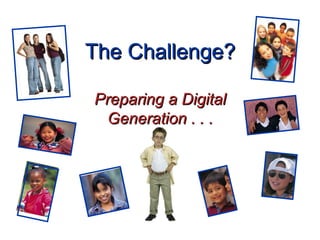
The Challenge? Preparing a Digital Generation . . .
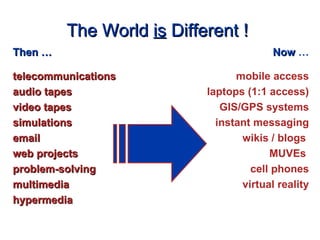
The World  is  Different ! Then … Now  … telecommunications  audio tapes video tapes simulations  email web projects problem-solving  multimedia  hypermedia mobile access laptops (1:1 access) GIS/GPS systems instant messaging wikis / blogs  MUVEs  cell phones virtual reality
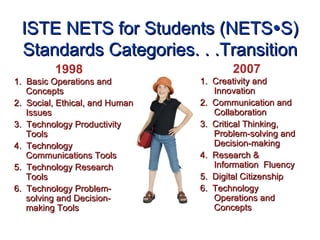
ISTE NETS for Students (NETS  S) Standards Categories. . .Transition 1.  Basic Operations and Concepts 2.  Social, Ethical, and Human Issues 3.  Technology Productivity Tools 4.  Technology Communications Tools 5.  Technology Research Tools 6.  Technology Problem-solving and Decision- making Tools 1.  Creativity and Innovation  2.  Communication and Collaboration  3.  Critical Thinking, Problem-solving and Decision-making 4.  Research & Information  Fluency  5.  Digital Citizenship 6.  Technology Operations and Concepts 1998 2007
Creativity & Innovation
 
Communication  & Collaboration
 
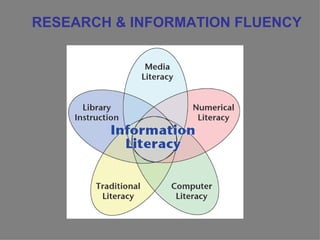
RESEARCH & INFORMATION FLUENCY
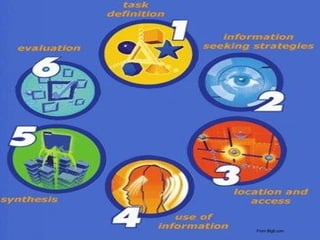
From Big6.com
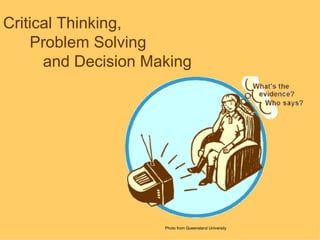
Photo from Queensland University Critical Thinking, Problem Solving and Decision Making
 
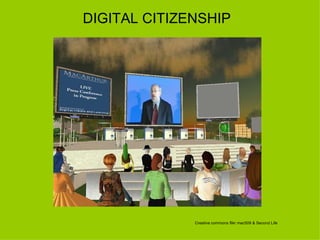
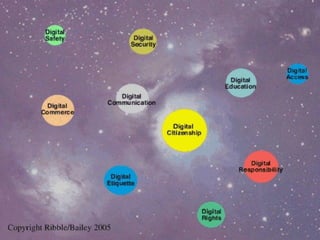
Creative commons flikr mac509 & Second Life DIGITAL CITIZENSHIP
 
TECHNOLOGY OPERATIONS & CONCEPTS
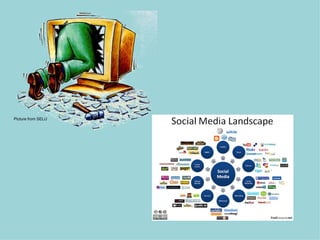
Picture from SELU
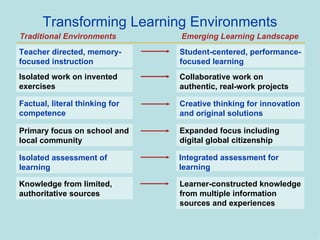
Teacher directed, memory-focused instruction Student-centered, performance-focused learning Isolated work on invented exercises Collaborative work on authentic, real-work projects Factual, literal thinking for competence Creative thinking for innovation and original solutions Primary focus on school and local community Expanded focus including digital global citizenship Isolated assessment of  learning Integrated assessment for learning Transforming Learning Environments Traditional Environments Emerging Learning Landscape Knowledge from limited, authoritative sources Learner-constructed knowledge from multiple information sources and experiences
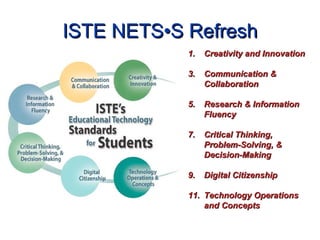
ISTE NETS•S Refresh Creativity and Innovation Communication & Collaboration Research & Information Fluency Critical Thinking, Problem-Solving, & Decision-Making Digital Citizenship Technology Operations and Concepts
"Teachers must become comfortable as co-learners with their students and with colleagues around the world. Today it is less about  staying ahead  and more about  moving ahead  as members of dynamic learning communities. The digital-age teaching professional must demonstrate a vision of technology infusion and develop the technology skills of others.  “ Don Knezek, ISTE CEO, 2008

Iste Studentstandards New

  • 1.
    The ISTE NationalEducation Technology Standards and Performance Indicators for Students
  • 2.
    It is change,continuing change, inevitable change, that is the dominant factor in society today. No sensible decision can be made any longer without taking into account not only the world as it is, but the world as it will be.” -Isaac Asimov
  • 3.
    The Challenge? Preparinga Digital Generation . . .
  • 4.
    The World is Different ! Then … Now … telecommunications audio tapes video tapes simulations email web projects problem-solving multimedia hypermedia mobile access laptops (1:1 access) GIS/GPS systems instant messaging wikis / blogs MUVEs cell phones virtual reality
  • 5.
    ISTE NETS forStudents (NETS  S) Standards Categories. . .Transition 1. Basic Operations and Concepts 2. Social, Ethical, and Human Issues 3. Technology Productivity Tools 4. Technology Communications Tools 5. Technology Research Tools 6. Technology Problem-solving and Decision- making Tools 1. Creativity and Innovation 2. Communication and Collaboration 3. Critical Thinking, Problem-solving and Decision-making 4. Research & Information Fluency 5. Digital Citizenship 6. Technology Operations and Concepts 1998 2007
  • 6.
  • 7.
  • 8.
    Communication &Collaboration
  • 9.
  • 10.
  • 11.
  • 12.
    Photo from QueenslandUniversity Critical Thinking, Problem Solving and Decision Making
  • 13.
  • 14.
    Creative commons flikrmac509 & Second Life DIGITAL CITIZENSHIP
  • 15.
  • 16.
  • 17.
  • 18.
    Teacher directed, memory-focusedinstruction Student-centered, performance-focused learning Isolated work on invented exercises Collaborative work on authentic, real-work projects Factual, literal thinking for competence Creative thinking for innovation and original solutions Primary focus on school and local community Expanded focus including digital global citizenship Isolated assessment of learning Integrated assessment for learning Transforming Learning Environments Traditional Environments Emerging Learning Landscape Knowledge from limited, authoritative sources Learner-constructed knowledge from multiple information sources and experiences
  • 19.
    ISTE NETS•S RefreshCreativity and Innovation Communication & Collaboration Research & Information Fluency Critical Thinking, Problem-Solving, & Decision-Making Digital Citizenship Technology Operations and Concepts
  • 20.
    "Teachers must becomecomfortable as co-learners with their students and with colleagues around the world. Today it is less about staying ahead and more about moving ahead as members of dynamic learning communities. The digital-age teaching professional must demonstrate a vision of technology infusion and develop the technology skills of others.  “ Don Knezek, ISTE CEO, 2008

Editor's Notes

  • #2 What students should know and be able to do to learn effectively and live productively in an increasingly digital world…