b. The Principle of
Appropriateness of
Assessment
Evaluation procedures and techniques
should be selected in terms of the
clearly stated objectives
(Gronlund, 1991 )
The clearer the objectives are in
teacher’s mind, the greater the
chance of making a wise decision to
choose appropriate assessment
procedures and techniques in
assessing students’ learning.
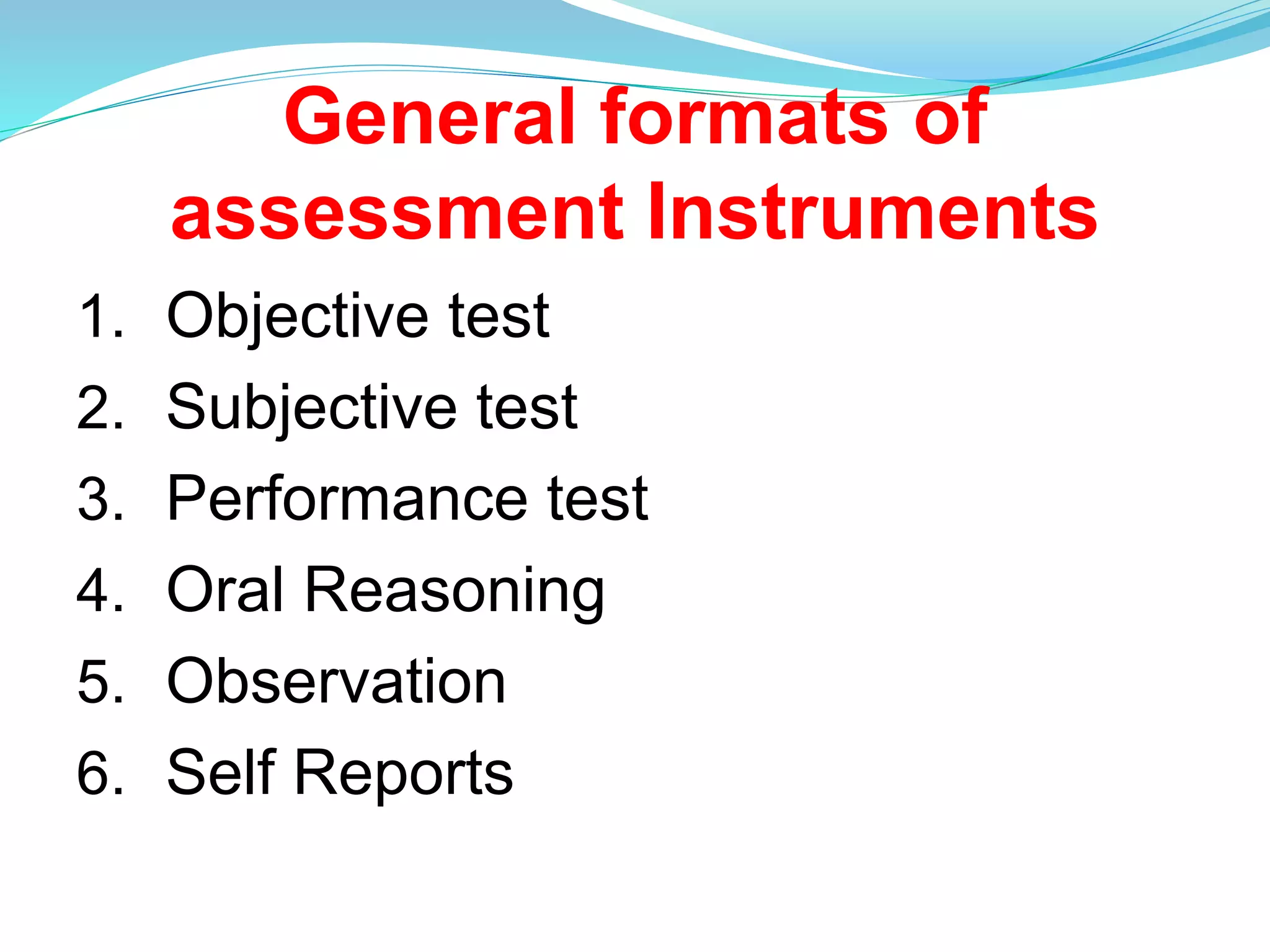
General formats of
assessment Instruments
1. Objective test
2. Subjective test
3. Performance test
4. Oral Reasoning
5. Observation
6. Self Reports
Objective test
are those that require one and
only one correct answer and no
other possible answers.
Reganit, et al. (2004)
is made up of items for which
correct responses maybe set up in
advance
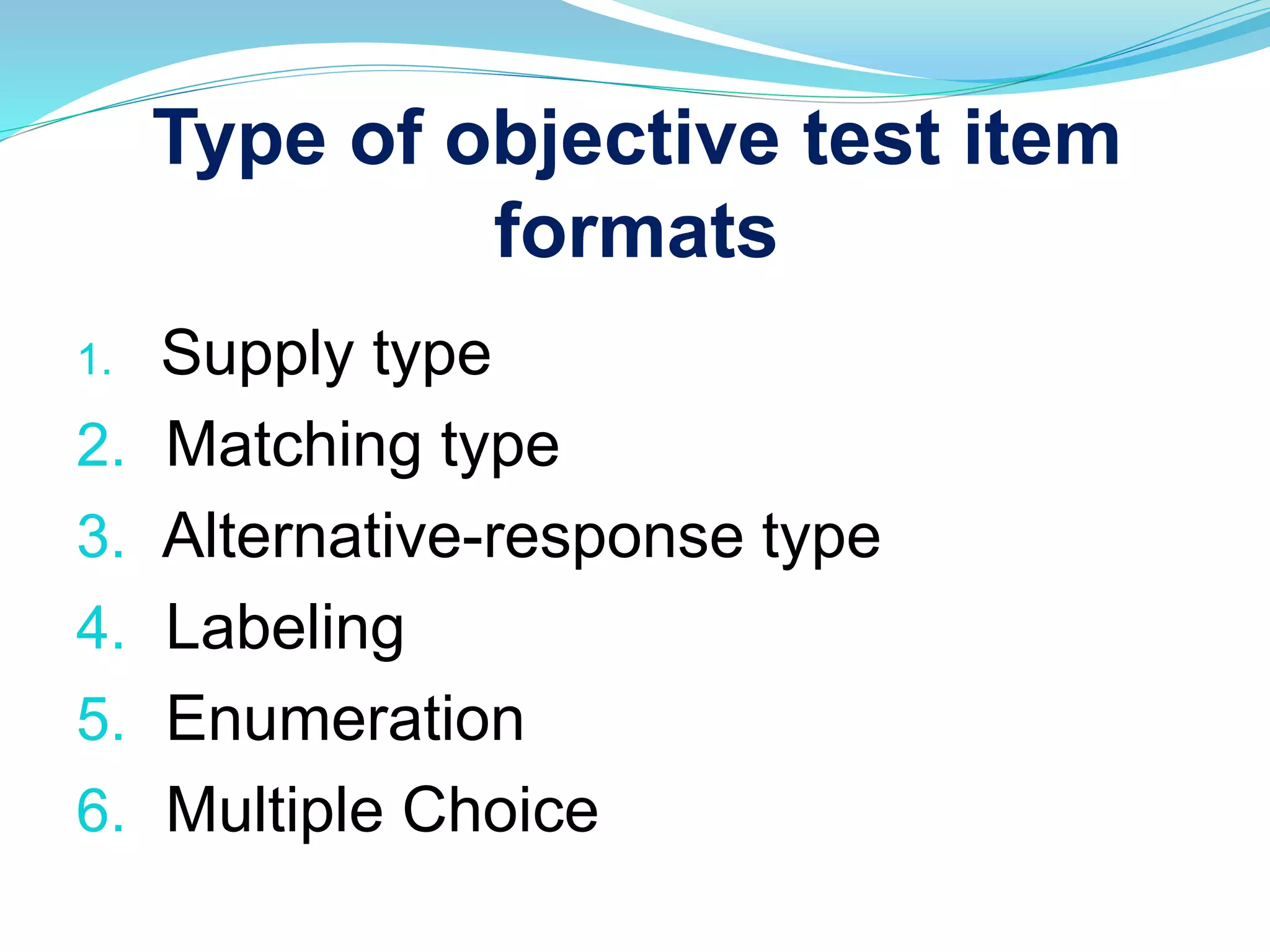
Type of objective test item
formats
1. Supply type
2. Matching type
3. Alternative-response type
4. Labeling
5. Enumeration
6. Multiple Choice
Subjective test
are evaluated by giving an opinion
about the issue, concept, ideas and
the like.
Example:rubrics
Test reliability
u
s
e
Performance test
this test is used when the objective
of the lesson requires that at the end
of the lesson the students are
required to perform in an activity.
Determine whether students have
acquired the necessary skills to do the
tasks in the learning activity.
Oral Reasoning
when the instructional objectives
states that “at the end the lesson,
pupils orally defend their stand on the
issue.
Determine students’ critical
thinking and other meta-cognitive
processes and oral presentation
Observation
Reed and Bergemann (2001)
is one of effective means of
learning...... how students respond to
the learning environment.
this can be done by teacher, co-
students or even by parents.
Example:
Observation checklist or Rating scales
Determine students’ performance,
behaviour, skills, values, and
achievement.
these are considered as non-test
assessment instrument
U
s
e
Self-Reports
students may be required to write
personal opinions, journals and
reflections about the learning activity.
evaluate whether or not these students
have learned the concepts though in the
classroom.
u
s
e
it also contain personal account of
students’ participation and involvement in
the teaching and learning processes.
the teachers practice this method,
comply with the requirement that
“evaluation should allow students to
evaluate themselves”
(ipsative assessment)
Thank you for
listening!!!!!!

The Principle of Appropriateness of Assessment

  • 1.
    b. The Principleof Appropriateness of Assessment
  • 2.
    Evaluation procedures andtechniques should be selected in terms of the clearly stated objectives (Gronlund, 1991 )
  • 3.
    The clearer theobjectives are in teacher’s mind, the greater the chance of making a wise decision to choose appropriate assessment procedures and techniques in assessing students’ learning.
  • 4.
    General formats of assessmentInstruments 1. Objective test 2. Subjective test 3. Performance test 4. Oral Reasoning 5. Observation 6. Self Reports
  • 5.
    Objective test are thosethat require one and only one correct answer and no other possible answers. Reganit, et al. (2004) is made up of items for which correct responses maybe set up in advance
  • 6.
    Type of objectivetest item formats 1. Supply type 2. Matching type 3. Alternative-response type 4. Labeling 5. Enumeration 6. Multiple Choice
  • 7.
    Subjective test are evaluatedby giving an opinion about the issue, concept, ideas and the like. Example:rubrics Test reliability u s e
  • 8.
    Performance test this testis used when the objective of the lesson requires that at the end of the lesson the students are required to perform in an activity. Determine whether students have acquired the necessary skills to do the tasks in the learning activity.
  • 9.
    Oral Reasoning when theinstructional objectives states that “at the end the lesson, pupils orally defend their stand on the issue. Determine students’ critical thinking and other meta-cognitive processes and oral presentation
  • 10.
    Observation Reed and Bergemann(2001) is one of effective means of learning...... how students respond to the learning environment. this can be done by teacher, co- students or even by parents.
  • 11.
    Example: Observation checklist orRating scales Determine students’ performance, behaviour, skills, values, and achievement. these are considered as non-test assessment instrument U s e
  • 12.
    Self-Reports students may berequired to write personal opinions, journals and reflections about the learning activity. evaluate whether or not these students have learned the concepts though in the classroom. u s e
  • 13.
    it also containpersonal account of students’ participation and involvement in the teaching and learning processes. the teachers practice this method, comply with the requirement that “evaluation should allow students to evaluate themselves” (ipsative assessment)
  • 14.