Preparedby: Sheldine Abuhan
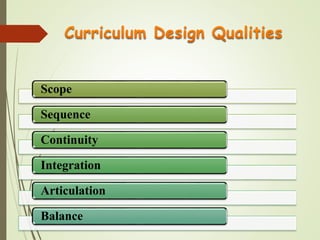
Scope
Sequence
Continuity
Integration
Articulation
Balance
All the content, topics, learning
experiences, and organizing threads
comprising the educational plan.
(Ralph Tyler)
Refers to the curriculum's horizontal
dimension. (John Goodlad & Zhisin Su)
Scope of the Curriculum is usually
structured in units and units are
divided into lesson plans
Order of topics overtime
Also called vertical dimension
Jean Piaget provided a framework
for sequencing content
Based on Piaget's Theory of
Cognitive Development
Simple to complex learning –
content & experiences are
organized from simple to complex,
easy to difficult.
Prerequisite Learning- bits of
information must be grasped
before other bits can be
comprehended.
(Smith, Stanby and Shore, 1973)
Whole to Part Learning -
overview before the specific
content or topics.
Chronological learning – refers to
content whose sequence reflects
the time of real world occurrence.
Example is history, political
science and world events.
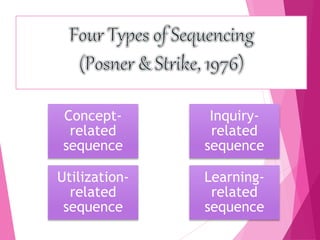
Concept-
related
sequence
Inquiry-
related
sequence
Learning-
related
sequence
Utilization-
related
sequence
Concept-related method
It focuses on concept's
interrelatedness
Inquiry-related model
It reflect the steps of
scholarly investigation
Learning-Related Sequence
Where individuals learn
through experiencing
content and activities
Focuses on how people who use
knowledge or engage in a particular
activity
Utilization- Related Learning
Refers to the smoothness or
absence of disruption in the
curriculum over time
3. Continuity
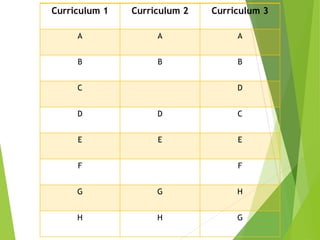
Curriculum 1 Curriculum 2 Curriculum 3
A A A
B B B
C D
D D C
E E E
F F
G G H
H H G
Sequence without continuity is
possible but continuity without
sequence is not
Continuity is mostly manifested in
Jerome Bruner's notion of the
spiral curriculum
4. Integration
Linking all types of knowledge
and experiences within the
curriculum plan
4. Articulation
 Refers to the smooth flow of the
curriculum on both vertical and
horizontal dimensions.
 In vertical articulation, suggest
sequencing of content from one grade
level to another.
 Horizontal articulation - association
among simultaneous elements
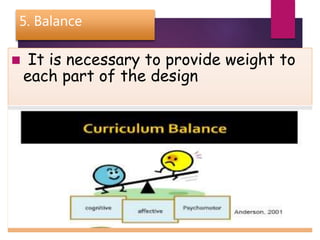
5. Balance
 It is necessary to provide weight to
each part of the design
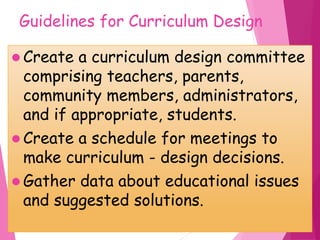
Guidelines for Curriculum Design
 Create a curriculum design committee
comprising teachers, parents,
community members, administrators,
and if appropriate, students.
 Create a schedule for meetings to
make curriculum - design decisions.
 Gather data about educational issues
and suggested solutions.
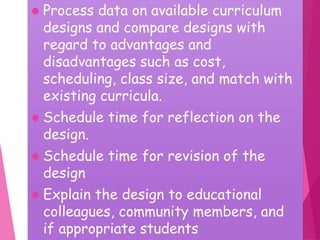
 Process data on available curriculum
designs and compare designs with
regard to advantages and
disadvantages such as cost,
scheduling, class size, and match with
existing curricula.
 Schedule time for reflection on the
design.
 Schedule time for revision of the
design
 Explain the design to educational
colleagues, community members, and
if appropriate students
Curriculum design qualities

Curriculum design qualities

  • 1.
  • 2.
  • 3.
    All the content,topics, learning experiences, and organizing threads comprising the educational plan. (Ralph Tyler) Refers to the curriculum's horizontal dimension. (John Goodlad & Zhisin Su)
  • 4.
    Scope of theCurriculum is usually structured in units and units are divided into lesson plans
  • 6.
    Order of topicsovertime Also called vertical dimension Jean Piaget provided a framework for sequencing content Based on Piaget's Theory of Cognitive Development
  • 7.
    Simple to complexlearning – content & experiences are organized from simple to complex, easy to difficult. Prerequisite Learning- bits of information must be grasped before other bits can be comprehended. (Smith, Stanby and Shore, 1973)
  • 8.
    Whole to PartLearning - overview before the specific content or topics. Chronological learning – refers to content whose sequence reflects the time of real world occurrence. Example is history, political science and world events.
  • 9.
  • 10.
    Concept-related method It focuseson concept's interrelatedness
  • 11.
    Inquiry-related model It reflectthe steps of scholarly investigation
  • 12.
    Learning-Related Sequence Where individualslearn through experiencing content and activities
  • 13.
    Focuses on howpeople who use knowledge or engage in a particular activity Utilization- Related Learning
  • 14.
    Refers to thesmoothness or absence of disruption in the curriculum over time 3. Continuity
  • 15.
    Curriculum 1 Curriculum2 Curriculum 3 A A A B B B C D D D C E E E F F G G H H H G
  • 16.
    Sequence without continuityis possible but continuity without sequence is not Continuity is mostly manifested in Jerome Bruner's notion of the spiral curriculum
  • 17.
    4. Integration Linking alltypes of knowledge and experiences within the curriculum plan
  • 18.
    4. Articulation  Refersto the smooth flow of the curriculum on both vertical and horizontal dimensions.  In vertical articulation, suggest sequencing of content from one grade level to another.  Horizontal articulation - association among simultaneous elements
  • 19.
    5. Balance  Itis necessary to provide weight to each part of the design
  • 20.
    Guidelines for CurriculumDesign  Create a curriculum design committee comprising teachers, parents, community members, administrators, and if appropriate, students.  Create a schedule for meetings to make curriculum - design decisions.  Gather data about educational issues and suggested solutions.
  • 21.
     Process dataon available curriculum designs and compare designs with regard to advantages and disadvantages such as cost, scheduling, class size, and match with existing curricula.  Schedule time for reflection on the design.  Schedule time for revision of the design  Explain the design to educational colleagues, community members, and if appropriate students