Jose Quinones BadilloTEED 4007May 18,2010The ISTENational Educational Technology Standards (NETS•T)and Performance Indicators for Teachers
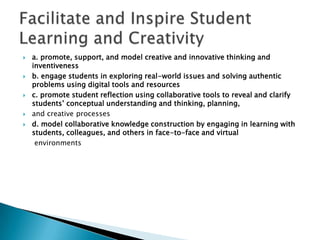
a. promote, support, and model creative and innovative thinking and inventivenessb. engage students in exploring real-world issues and solving authentic problems using digital tools and resourcesc. promote student reflection using collaborative tools to reveal and clarify students’ conceptual understanding and thinking, planning,and creative processesd. model collaborative knowledge construction by engaging in learning with students, colleagues, and others in face-to-face and virtual     environmentsFacilitate and Inspire Student Learning and Creativity
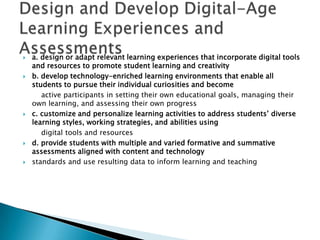
a. design or adapt relevant learning experiences that incorporate digital tools and resources to promote student learning and creativityb. develop technology-enriched learning environments that enable all students to pursue their individual curiosities and become        active participants in setting their own educational goals, managing their own learning, and assessing their own progressc. customize and personalize learning activities to address students’ diverse learning styles, working strategies, and abilities using        digital tools and resourcesd. provide students with multiple and varied formative and summative assessments aligned with content and technologystandards and use resulting data to inform learning and teachingDesign and Develop Digital-Age Learning Experiences and Assessments
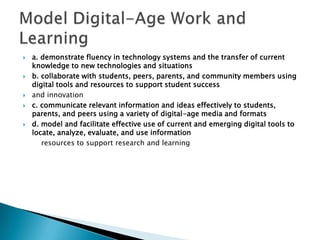
a. demonstrate fluency in technology systems and the transfer of current knowledge to new technologies and situationsb. collaborate with students, peers, parents, and community members using digital tools and resources to support student successand innovationc. communicate relevant information and ideas effectively to students, parents, and peers using a variety of digital-age media and formatsd. model and facilitate effective use of current and emerging digital tools to locate, analyze, evaluate, and use information        resources to support research and learningModel Digital-Age Work and Learning
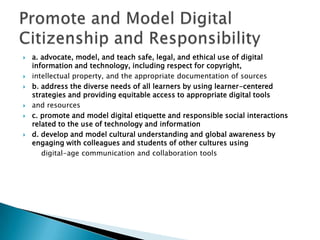
a. advocate, model, and teach safe, legal, and ethical use of digital information and technology, including respect for copyright,intellectual property, and the appropriate documentation of sourcesb. address the diverse needs of all learners by using learner-centered strategies and providing equitable access to appropriate digital toolsand resourcesc. promote and model digital etiquette and responsible social interactions related to the use of technology and informationd. develop and model cultural understanding and global awareness by engaging with colleagues and students of other cultures usingdigital-age communication and collaboration toolsPromote and Model Digital Citizenship and Responsibility
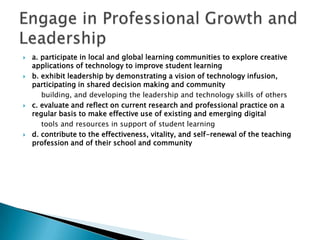
a. participate in local and global learning communities to explore creative applications of technology to improve student learningb. exhibit leadership by demonstrating a vision of technology infusion, participating in shared decision making and community        building, and developing the leadership and technology skills of othersc. evaluate and reflect on current research and professional practice on a regular basis to make effective use of existing and emerging digitaltools and resources in support of student learningd. contribute to the effectiveness, vitality, and self-renewal of the teaching profession and of their school and communityEngage in Professional Growth and Leadership
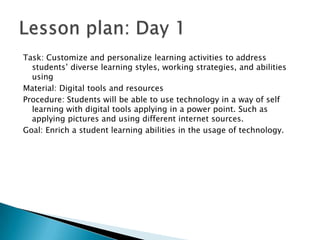
Task: Customize and personalize learning activities to address students’ diverse learning styles, working strategies, and abilities usingMaterial: Digital tools and resourcesProcedure: Students will be able to use technology in a way of self learning with digital tools applying in a power point. Such as applying pictures and using different internet sources.Goal: Enrich a student learning abilities in the usage of technology.Lesson plan: Day 1
Task: Customize and personalize learning activities to address students’ diverse learning styles, working strategies, and abilities usingMaterial: Digital tools and resourcesProcedure: Students will be able to use technology in a way of self learning with digital tools applying in a class room with clip board.Goal: students will be able to use their working strategies in a classroom area with clip board and make use of it. Lesson plan: Day 2
Task: Customize and personalize learning activities to address students’ diverse learning styles, working strategies, and abilities usingMaterial: Digital tools and resourcesProcedure: Students will be able to use technology in a way of self learning with digital tools applying in a poem with their learning styles of tgy.Goal: apply their learning style of life with technology and apply a poem of diverse methods to succeed.Lesson plan: day 3

final proyect

  • 1.
    Jose Quinones BadilloTEED4007May 18,2010The ISTENational Educational Technology Standards (NETS•T)and Performance Indicators for Teachers
  • 2.
    a. promote, support,and model creative and innovative thinking and inventivenessb. engage students in exploring real-world issues and solving authentic problems using digital tools and resourcesc. promote student reflection using collaborative tools to reveal and clarify students’ conceptual understanding and thinking, planning,and creative processesd. model collaborative knowledge construction by engaging in learning with students, colleagues, and others in face-to-face and virtual environmentsFacilitate and Inspire Student Learning and Creativity
  • 3.
    a. design oradapt relevant learning experiences that incorporate digital tools and resources to promote student learning and creativityb. develop technology-enriched learning environments that enable all students to pursue their individual curiosities and become active participants in setting their own educational goals, managing their own learning, and assessing their own progressc. customize and personalize learning activities to address students’ diverse learning styles, working strategies, and abilities using digital tools and resourcesd. provide students with multiple and varied formative and summative assessments aligned with content and technologystandards and use resulting data to inform learning and teachingDesign and Develop Digital-Age Learning Experiences and Assessments
  • 4.
    a. demonstrate fluencyin technology systems and the transfer of current knowledge to new technologies and situationsb. collaborate with students, peers, parents, and community members using digital tools and resources to support student successand innovationc. communicate relevant information and ideas effectively to students, parents, and peers using a variety of digital-age media and formatsd. model and facilitate effective use of current and emerging digital tools to locate, analyze, evaluate, and use information resources to support research and learningModel Digital-Age Work and Learning
  • 5.
    a. advocate, model,and teach safe, legal, and ethical use of digital information and technology, including respect for copyright,intellectual property, and the appropriate documentation of sourcesb. address the diverse needs of all learners by using learner-centered strategies and providing equitable access to appropriate digital toolsand resourcesc. promote and model digital etiquette and responsible social interactions related to the use of technology and informationd. develop and model cultural understanding and global awareness by engaging with colleagues and students of other cultures usingdigital-age communication and collaboration toolsPromote and Model Digital Citizenship and Responsibility
  • 6.
    a. participate inlocal and global learning communities to explore creative applications of technology to improve student learningb. exhibit leadership by demonstrating a vision of technology infusion, participating in shared decision making and community building, and developing the leadership and technology skills of othersc. evaluate and reflect on current research and professional practice on a regular basis to make effective use of existing and emerging digitaltools and resources in support of student learningd. contribute to the effectiveness, vitality, and self-renewal of the teaching profession and of their school and communityEngage in Professional Growth and Leadership
  • 7.
    Task: Customize andpersonalize learning activities to address students’ diverse learning styles, working strategies, and abilities usingMaterial: Digital tools and resourcesProcedure: Students will be able to use technology in a way of self learning with digital tools applying in a power point. Such as applying pictures and using different internet sources.Goal: Enrich a student learning abilities in the usage of technology.Lesson plan: Day 1
  • 8.
    Task: Customize andpersonalize learning activities to address students’ diverse learning styles, working strategies, and abilities usingMaterial: Digital tools and resourcesProcedure: Students will be able to use technology in a way of self learning with digital tools applying in a class room with clip board.Goal: students will be able to use their working strategies in a classroom area with clip board and make use of it. Lesson plan: Day 2
  • 9.
    Task: Customize andpersonalize learning activities to address students’ diverse learning styles, working strategies, and abilities usingMaterial: Digital tools and resourcesProcedure: Students will be able to use technology in a way of self learning with digital tools applying in a poem with their learning styles of tgy.Goal: apply their learning style of life with technology and apply a poem of diverse methods to succeed.Lesson plan: day 3