FOUNDATIONS OF
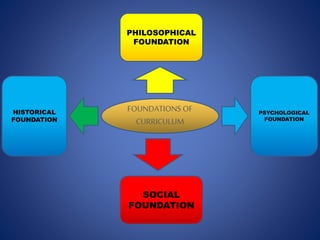
CURRICULUM
PHILOSOPHICAL
FOUNDATION
SOCIAL
FOUNDATION
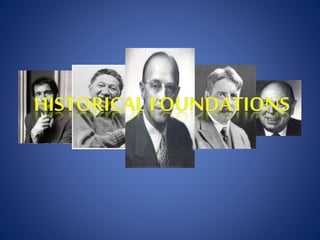
HISTORICAL
FOUNDATION
PSYCHOLOGICAL
FOUNDATION
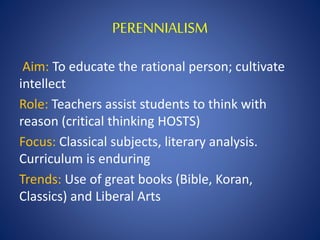
PERENNIALISM
Aim: To educate the rational person; cultivate
intellect
Role: Teachers assist students to think with
reason (critical thinking HOSTS)
Focus: Classical subjects, literary analysis.
Curriculum is enduring
Trends: Use of great books (Bible, Koran,
Classics) and Liberal Arts
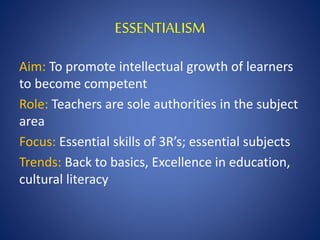
ESSENTIALISM
Aim: To promote intellectual growth of learners
to become competent
Role: Teachers are sole authorities in the subject
area
Focus: Essential skills of 3R’s; essential subjects
Trends: Back to basics, Excellence in education,
cultural literacy
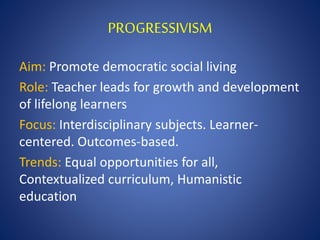
PROGRESSIVISM
Aim: Promote democratic social living
Role: Teacher leads for growth and development
of lifelong learners
Focus: Interdisciplinary subjects. Learner-
centered. Outcomes-based.
Trends: Equal opportunities for all,
Contextualized curriculum, Humanistic
education
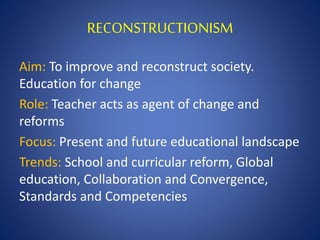
RECONSTRUCTIONISM
Aim: To improve and reconstruct society.
Education for change
Role: Teacher acts as agent of change and
reforms
Focus: Present and future educational landscape
Trends: School and curricular reform, Global
education, Collaboration and Convergence,
Standards and Competencies
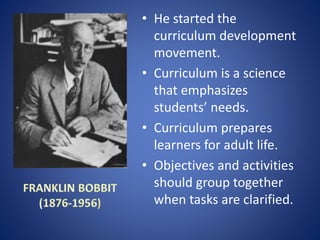
• He started the
curriculum development
movement.
• Curriculum is a science
that emphasizes
students’ needs.
• Curriculum prepares
learners for adult life.
• Objectives and activities
should group together
when tasks are clarified.
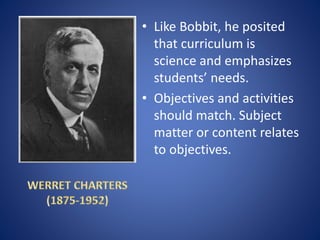
• Like Bobbit, he posited
that curriculum is
science and emphasizes
students’ needs.
• Objectives and activities
should match. Subject
matter or content relates
to objectives.
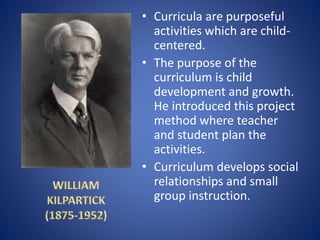
• Curricula are purposeful
activities which are child-
centered.
• The purpose of the
curriculum is child
development and growth.
He introduced this project
method where teacher
and student plan the
activities.
• Curriculum develops social
relationships and small
group instruction.
• Curriculum should
develop the whole child.
It is child-centered.
• With the statement of
objectives and related
learning activities,
curriculum should
produce outcomes.
• Emphasized social
studies and suggested
that the teacher plans
curriculum in advance.
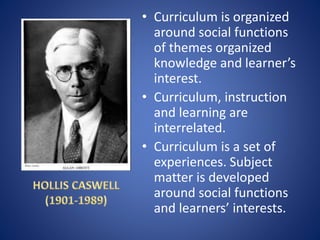
• Curriculum is organized
around social functions
of themes organized
knowledge and learner’s
interest.
• Curriculum, instruction
and learning are
interrelated.
• Curriculum is a set of
experiences. Subject
matter is developed
around social functions
and learners’ interests.
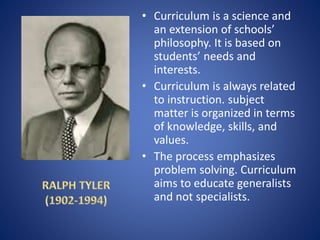
• Curriculum is a science and
an extension of schools’
philosophy. It is based on
students’ needs and
interests.
• Curriculum is always related
to instruction. subject
matter is organized in terms
of knowledge, skills, and
values.
• The process emphasizes
problem solving. Curriculum
aims to educate generalists
and not specialists.
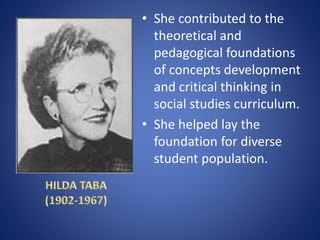
• She contributed to the
theoretical and
pedagogical foundations
of concepts development
and critical thinking in
social studies curriculum.
• She helped lay the
foundation for diverse
student population.
• He described how
curriculum change is a
cooperative endeavor.
• Teacchers and
curriculum specialist
constitute the
professional core of
planners.
• Significant improvement
is achieved through
group activity.
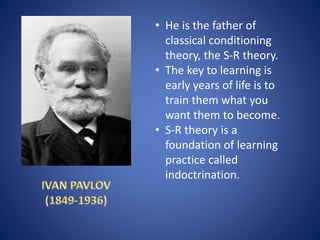
• He is the father of
classical conditioning
theory, the S-R theory.
• The key to learning is
early years of life is to
train them what you
want them to become.
• S-R theory is a
foundation of learning
practice called
indoctrination.
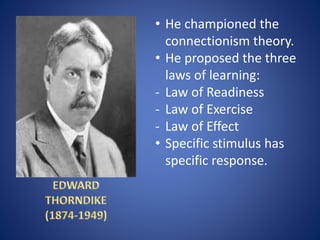
• He championed the
connectionism theory.
• He proposed the three
laws of learning:
- Law of Readiness
- Law of Exercise
- Law of Effect
• Specific stimulus has
specific response.
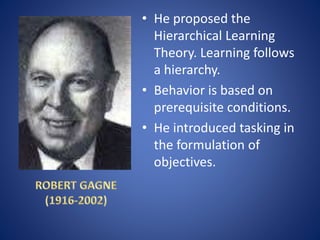
• He proposed the
Hierarchical Learning
Theory. Learning follows
a hierarchy.
• Behavior is based on
prerequisite conditions.
• He introduced tasking in
the formulation of
objectives.
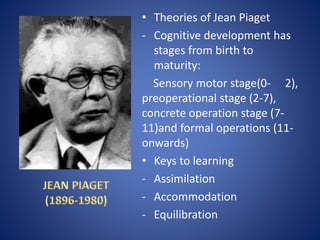
• Theories of Jean Piaget
- Cognitive development has
stages from birth to
maturity:
Sensory motor stage(0- 2),
preoperational stage (2-7),
concrete operation stage (7-
11)and formal operations (11-
onwards)
• Keys to learning
- Assimilation
- Accommodation
- Equilibration
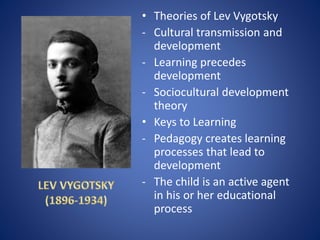
• Theories of Lev Vygotsky
- Cultural transmission and
development
- Learning precedes
development
- Sociocultural development
theory
• Keys to Learning
- Pedagogy creates learning
processes that lead to
development
- The child is an active agent
in his or her educational
process
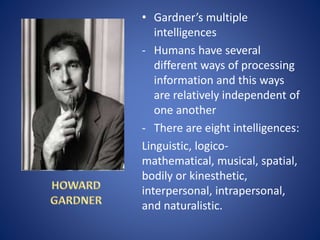
• Gardner’s multiple
intelligences
- Humans have several
different ways of processing
information and this ways
are relatively independent of
one another
- There are eight intelligences:
Linguistic, logico-
mathematical, musical, spatial,
bodily or kinesthetic,
interpersonal, intrapersonal,
and naturalistic.
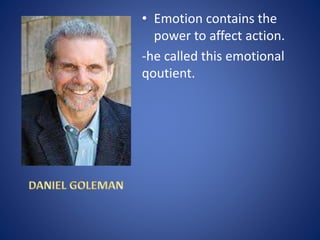
• Emotion contains the
power to affect action.
-he called this emotional
qoutient.
• Gestalt Theory
- Learning is explained in terms of
“wholeness” of the problem
- Human beings do not respond to
isolated stimuli but to an
organization or pattern of stimuli.
• Keys to Learning
- Learning is complex and abstract
- Learners analyze the problem,
discriminate between essential
and nonessential data, and
perceive relationships.
- Learners will perceive something
in relation to the whole. What or
how they perceive is related to
their previous experiences.
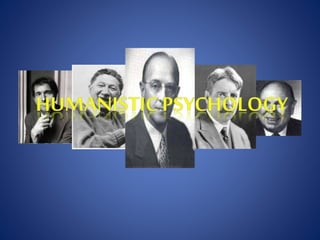
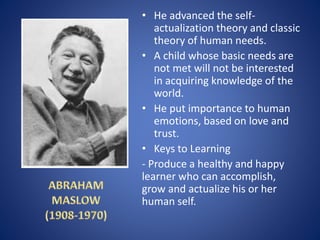
• He advanced the self-
actualization theory and classic
theory of human needs.
• A child whose basic needs are
not met will not be interested
in acquiring knowledge of the
world.
• He put importance to human
emotions, based on love and
trust.
• Keys to Learning
- Produce a healthy and happy
learner who can accomplish,
grow and actualize his or her
human self.
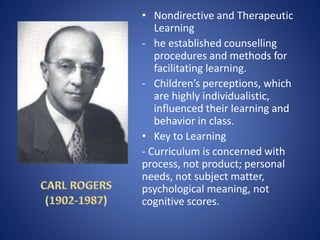
• Nondirective and Therapeutic
Learning
- he established counselling
procedures and methods for
facilitating learning.
- Children’s perceptions, which
are highly individualistic,
influenced their learning and
behavior in class.
• Key to Learning
- Curriculum is concerned with
process, not product; personal
needs, not subject matter,
psychological meaning, not
cognitive scores.
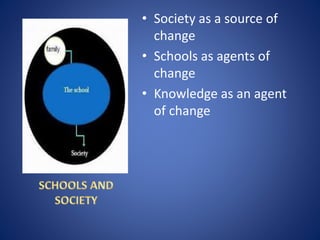
• Society as a source of
change
• Schools as agents of
change
• Knowledge as an agent
of change
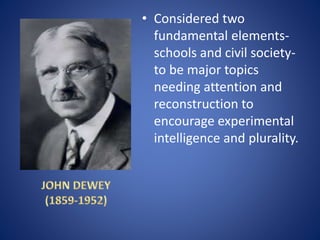
• Considered two
fundamental elements-
schools and civil society-
to be major topics
needing attention and
reconstruction to
encourage experimental
intelligence and plurality.
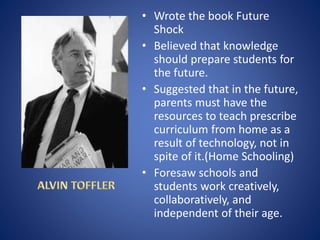
• Wrote the book Future
Shock
• Believed that knowledge
should prepare students for
the future.
• Suggested that in the future,
parents must have the
resources to teach prescribe
curriculum from home as a
result of technology, not in
spite of it.(Home Schooling)
• Foresaw schools and
students work creatively,
collaboratively, and
independent of their age.
Foundations of a curriculum

Foundations of a curriculum

  • 2.
  • 5.
    PERENNIALISM Aim: To educatethe rational person; cultivate intellect Role: Teachers assist students to think with reason (critical thinking HOSTS) Focus: Classical subjects, literary analysis. Curriculum is enduring Trends: Use of great books (Bible, Koran, Classics) and Liberal Arts
  • 6.
    ESSENTIALISM Aim: To promoteintellectual growth of learners to become competent Role: Teachers are sole authorities in the subject area Focus: Essential skills of 3R’s; essential subjects Trends: Back to basics, Excellence in education, cultural literacy
  • 7.
    PROGRESSIVISM Aim: Promote democraticsocial living Role: Teacher leads for growth and development of lifelong learners Focus: Interdisciplinary subjects. Learner- centered. Outcomes-based. Trends: Equal opportunities for all, Contextualized curriculum, Humanistic education
  • 8.
    RECONSTRUCTIONISM Aim: To improveand reconstruct society. Education for change Role: Teacher acts as agent of change and reforms Focus: Present and future educational landscape Trends: School and curricular reform, Global education, Collaboration and Convergence, Standards and Competencies
  • 10.
    • He startedthe curriculum development movement. • Curriculum is a science that emphasizes students’ needs. • Curriculum prepares learners for adult life. • Objectives and activities should group together when tasks are clarified.
  • 11.
    • Like Bobbit,he posited that curriculum is science and emphasizes students’ needs. • Objectives and activities should match. Subject matter or content relates to objectives.
  • 12.
    • Curricula arepurposeful activities which are child- centered. • The purpose of the curriculum is child development and growth. He introduced this project method where teacher and student plan the activities. • Curriculum develops social relationships and small group instruction.
  • 13.
    • Curriculum should developthe whole child. It is child-centered. • With the statement of objectives and related learning activities, curriculum should produce outcomes. • Emphasized social studies and suggested that the teacher plans curriculum in advance.
  • 14.
    • Curriculum isorganized around social functions of themes organized knowledge and learner’s interest. • Curriculum, instruction and learning are interrelated. • Curriculum is a set of experiences. Subject matter is developed around social functions and learners’ interests.
  • 15.
    • Curriculum isa science and an extension of schools’ philosophy. It is based on students’ needs and interests. • Curriculum is always related to instruction. subject matter is organized in terms of knowledge, skills, and values. • The process emphasizes problem solving. Curriculum aims to educate generalists and not specialists.
  • 16.
    • She contributedto the theoretical and pedagogical foundations of concepts development and critical thinking in social studies curriculum. • She helped lay the foundation for diverse student population.
  • 17.
    • He describedhow curriculum change is a cooperative endeavor. • Teacchers and curriculum specialist constitute the professional core of planners. • Significant improvement is achieved through group activity.
  • 19.
    • He isthe father of classical conditioning theory, the S-R theory. • The key to learning is early years of life is to train them what you want them to become. • S-R theory is a foundation of learning practice called indoctrination.
  • 20.
    • He championedthe connectionism theory. • He proposed the three laws of learning: - Law of Readiness - Law of Exercise - Law of Effect • Specific stimulus has specific response.
  • 21.
    • He proposedthe Hierarchical Learning Theory. Learning follows a hierarchy. • Behavior is based on prerequisite conditions. • He introduced tasking in the formulation of objectives.
  • 22.
    • Theories ofJean Piaget - Cognitive development has stages from birth to maturity: Sensory motor stage(0- 2), preoperational stage (2-7), concrete operation stage (7- 11)and formal operations (11- onwards) • Keys to learning - Assimilation - Accommodation - Equilibration
  • 23.
    • Theories ofLev Vygotsky - Cultural transmission and development - Learning precedes development - Sociocultural development theory • Keys to Learning - Pedagogy creates learning processes that lead to development - The child is an active agent in his or her educational process
  • 24.
    • Gardner’s multiple intelligences -Humans have several different ways of processing information and this ways are relatively independent of one another - There are eight intelligences: Linguistic, logico- mathematical, musical, spatial, bodily or kinesthetic, interpersonal, intrapersonal, and naturalistic.
  • 25.
    • Emotion containsthe power to affect action. -he called this emotional qoutient.
  • 27.
    • Gestalt Theory -Learning is explained in terms of “wholeness” of the problem - Human beings do not respond to isolated stimuli but to an organization or pattern of stimuli. • Keys to Learning - Learning is complex and abstract - Learners analyze the problem, discriminate between essential and nonessential data, and perceive relationships. - Learners will perceive something in relation to the whole. What or how they perceive is related to their previous experiences.
  • 28.
    • He advancedthe self- actualization theory and classic theory of human needs. • A child whose basic needs are not met will not be interested in acquiring knowledge of the world. • He put importance to human emotions, based on love and trust. • Keys to Learning - Produce a healthy and happy learner who can accomplish, grow and actualize his or her human self.
  • 29.
    • Nondirective andTherapeutic Learning - he established counselling procedures and methods for facilitating learning. - Children’s perceptions, which are highly individualistic, influenced their learning and behavior in class. • Key to Learning - Curriculum is concerned with process, not product; personal needs, not subject matter, psychological meaning, not cognitive scores.
  • 31.
    • Society asa source of change • Schools as agents of change • Knowledge as an agent of change
  • 32.
    • Considered two fundamentalelements- schools and civil society- to be major topics needing attention and reconstruction to encourage experimental intelligence and plurality.
  • 33.
    • Wrote thebook Future Shock • Believed that knowledge should prepare students for the future. • Suggested that in the future, parents must have the resources to teach prescribe curriculum from home as a result of technology, not in spite of it.(Home Schooling) • Foresaw schools and students work creatively, collaboratively, and independent of their age.