CRYPTOGRAPHY
Terminology :
• Encryption :
• Decryption :
PLAINTEXT CIPHERTEXT
PLAINTEXTCIPHERTEXT
Vernam Cipher
H O W A R E Y O U
7 14 22 0 17 4 24 14 20
Plain text
One time pad N C B T Z Q A R X
13 2 1 19 25 16 0 17 23
Total 20 16 23 19 42 20 24 31 43
20 16 23 19 16 20 24 5 17Subtract
U Q X T Q U Y F RCipher text
Private-key Cryptography :
• Same key is used to encrypt and decrypt the message
• Sender and the recipient(receiver) of the message must agree
on a common key
• It is symmetric Cryptography, parties are equal
• Hence does not protect sender from receiver forging a
message & claiming is sent by sender
Message: hey alice  Message: hey alice 
Alice’s key
Public-key Cryptography :
• Public-key cryptography involves the use of two keys:
• A Public-key, which may be known by anybody, and can
be used to encrypt messages, and verify signatures
• A Private-key, known only to the recipient(receiver), used
to decrypt messages, and sign(create) signatures
HelloAlice!
6EB69570
08E03CE4
Encrypt
HelloAlice! Decrypt
Public key
Private key
Bob
Alice
RSA Algorithm :
• RSA stands for Ron Rivest , Adi Shamir and Leonard Adleman,
who first publicly described it in 1977
• It allows anyone in the communication network to encrypt and
send message
• N=pq, where p & q are two distinct primes
• Random positive integer ‘e’ called enciphering exponent must
satisfying gcd(e, Ø(n))=1
• Pair (n,e) are made public
Prerequisites :
• Prime number
• Prime factorization
• Fermat’s little theorem
• Euler’s phi function
• Euler’s totient theorem
In 1970 british mathematician and
scientist Clifford Cocks came out with a
one way fuction called as
“The Trapdoor”
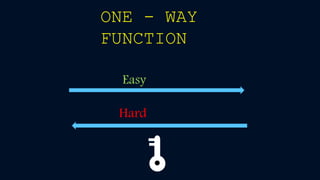
ONE - WAY
FUNCTION
Easy
Hard
For this Clifford Cocks took help of Modular Exponentiation
46 Mod 12 = 10
1
2
3
4
5
6
7
8
910
11
12
13
14
15
16
17
3 mod 17 =
12543
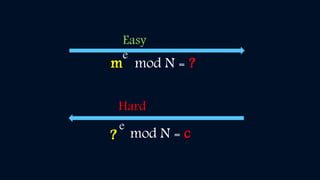
m
e
mod N = ?
Easy
Hard
e
mod N = c?
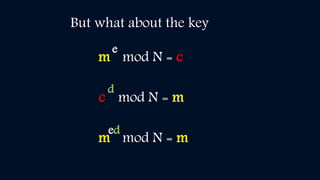
But what about the key
m mod N = c
e
c mod N = m
d
m mod N = m
ed
Prime factorization
9874563210123654789302145987698745632101236547893021459876987456321012365478930214598769874563210123654789302145987698745632101236547893021459876
9874563210123654789302145987698745632101236547893021459876987456321012365478930214598769874563210123654789302145987698745632101236547893021459876
P1=
P2=
9874563210123654789302145987698745632101236547893021459876987456321012365478930214598769874563210123654789302145987698745632101236547893021459876
9874563210123654789302145987698745632101236547893021459876987456321012365478930214598769874563210123654789302145987698745632101236547893021459876
N=
N=P1×P2
Eulers φ function
Φ(8)=
1
2
3
4
5
6
7
8
=4
Φ(A)= A-1
Eg. Φ(7)=6
Where A is a prime number
Φ(A×B) = (A-1)×(B-1)
Eg. Φ(7×11) = (7-1)×(11-1)= 60
But the problem is
how to connect
Modular Exponentiation with
Eulers Φ Function
Eulers
Theorem
m = 1 mod n
Φ(n)
Lets make some modifications in the Eulers theorem
m = 1 mod n
Φ(n)
1 =1
k
m = 1 mod n
k×Φ(n)
1×m=m m×m = m mod n
k×Φ(n)
m = m mod n
k×Φ(n)+1
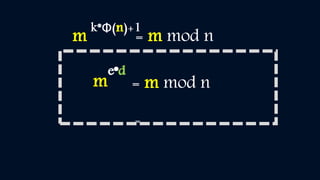
m = m mod n
k*Φ(n)+1
m = m mod n
e*d
k*Φ(n)+1
e*d
=
T H
U

Cryptography and RSA algorithm