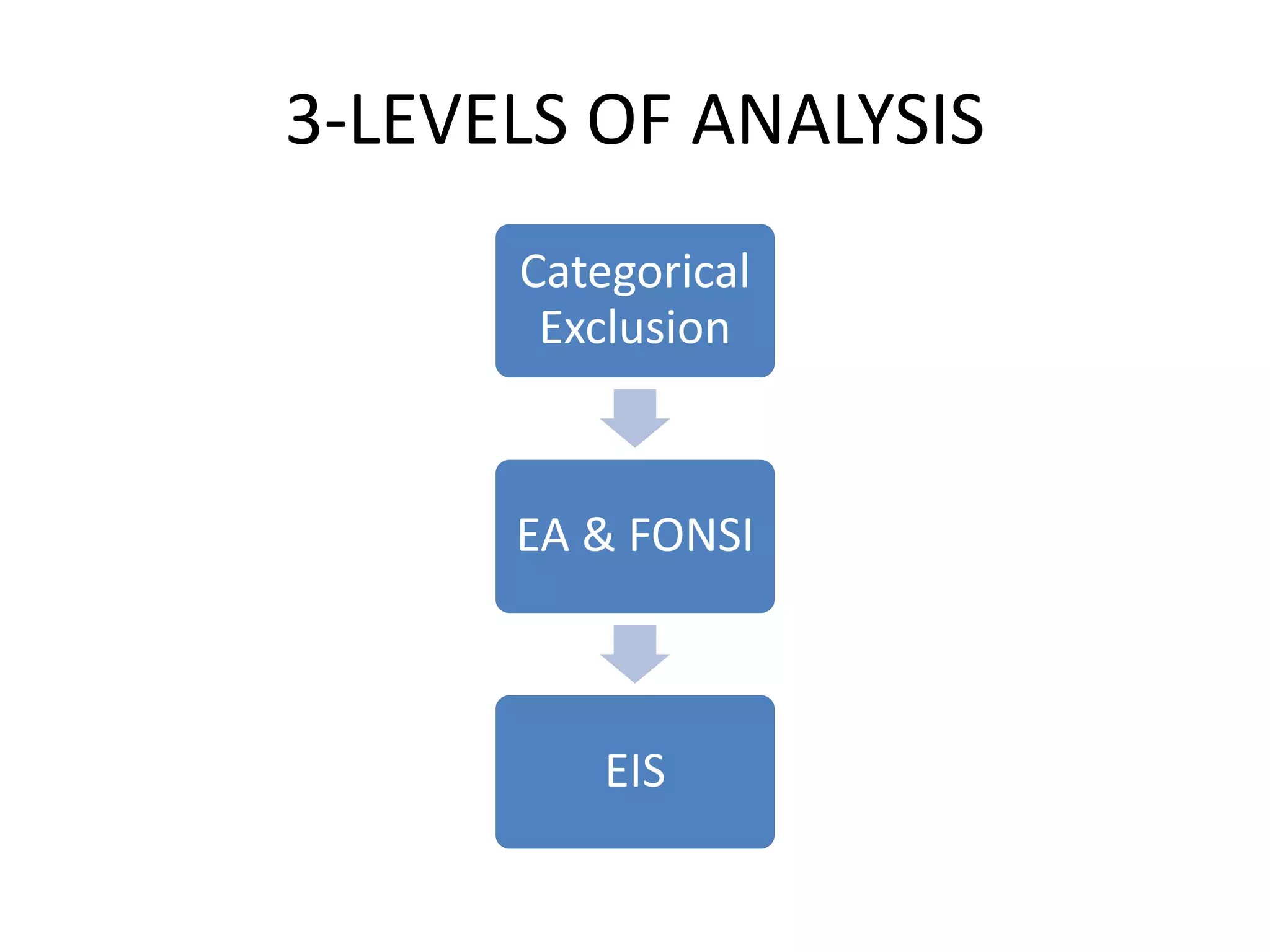
3-LEVELS OF ANALYSIS
Categorical
Exclusion
EA & FONSI
EIS
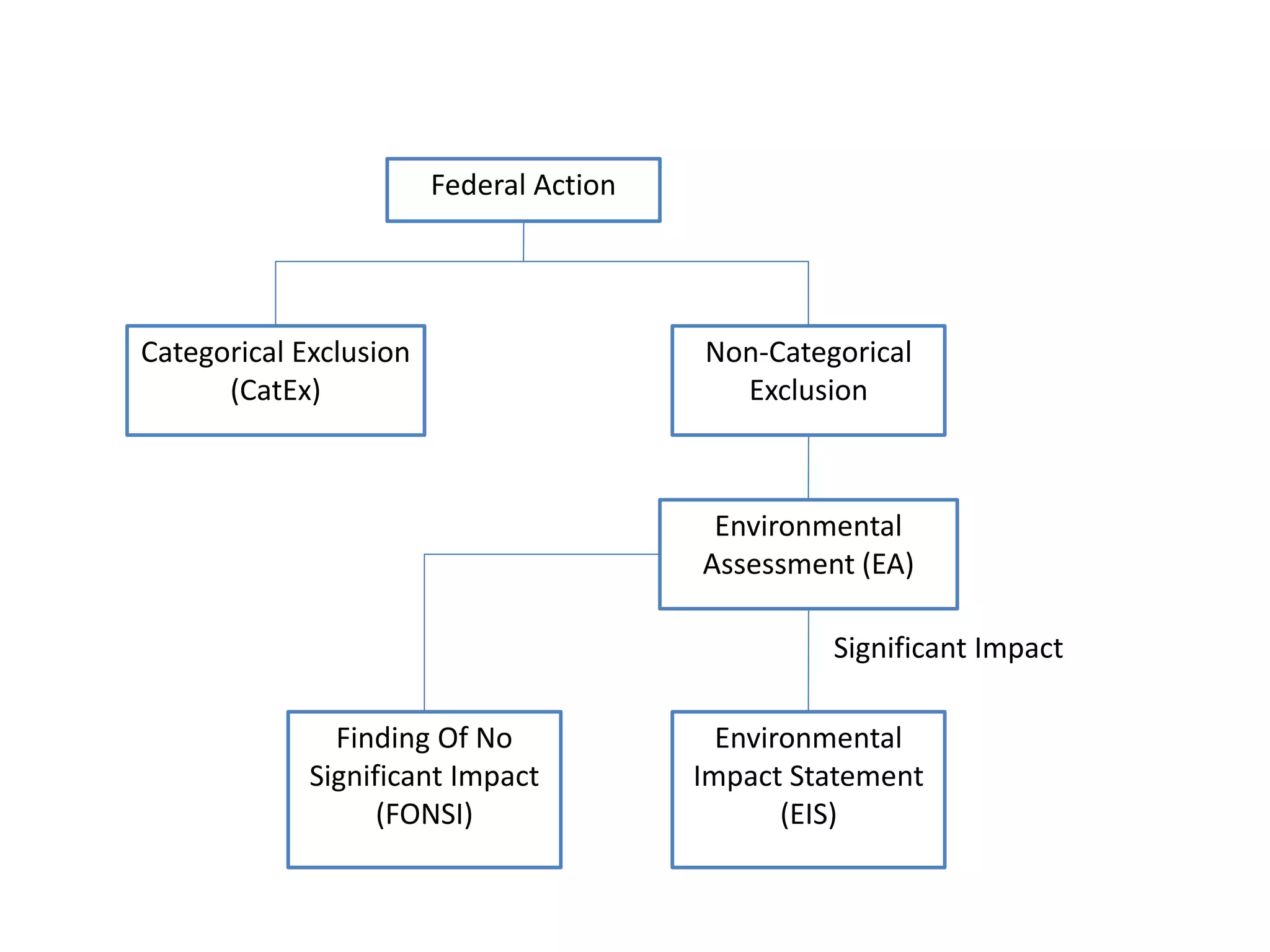
Federal Action
Categorical Exclusion
(CatEx)
Non-Categorical
Exclusion
Environmental
Assessment (EA)
Finding Of No
Significant Impact
(FONSI)
Environmental
Impact Statement
(EIS)
Significant Impact
Federal Action
 Adoption of:-
o Policy
o Plan
o Programs
o Projects
Categorical Exclusion
 List of actions
 Do not significantly affect the quality of human
environment individually or cumulatively
Proposed Action
CatEx List
Prepare EANo EA
(Federal Agency should make sure
proposed action does not affect
environment)
Yes No
EA & FONSI
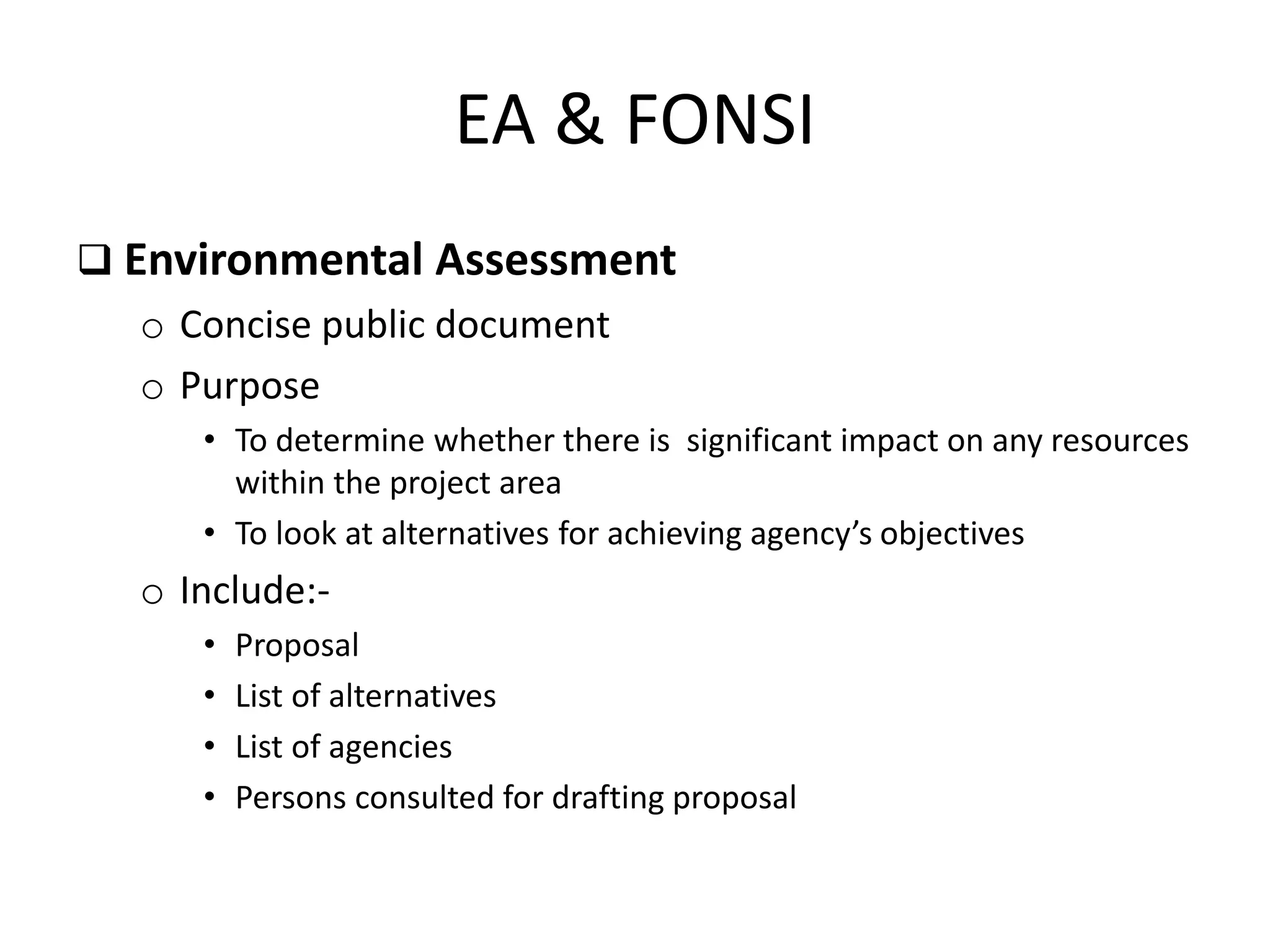
 Environmental Assessment
o Concise public document
o Purpose
• To determine whether there is significant impact on any resources
within the project area
• To look at alternatives for achieving agency’s objectives
o Include:-
• Proposal
• List of alternatives
• List of agencies
• Persons consulted for drafting proposal
 EA Contd...
o Provide evidence & analysis for determining whether to
prepare EIS
o Facilitate preparing an EIS
o Can be completed in short period than EIS
o Less cost & public participation compared to EIS
 Finding of No Significant Impact (FONSI)
o Document issued by Federal Agency
o After EA, if no substantial effect on environment are found,
FONSI is produced
o Should explain why the action will not have a significant
impact
o Mitigated FONSI – FONSI with mitigation measure to
reduce any significant impact, if any
Environmental Impact Statement (EIS)
 Detailed written statement
 Prepared, if proposed action doesn’t fall in CatEx &
not qualified for FONSI
 Provide full & fair discussion of significant impacts
o Environmental impacts of proposed action
o Any adverse impact that cannot be avoided
o Why should the proposal be implemented
o Reasonable alternatives
o Possibility of maintenance & enhancement of environment
o Irreversible and irretrievable impacts of resources
 Prepare draft EIS for public to comment on findings
 Final EIS is prepared incorporating public comments
& is published again before making a decision
 Decision maker will also review final EIS
 Record of Decision (ROD): Issued as a record of
agency’s final decision
 EIS v/s EA
o Costly
o Long period of time for completion
 EA cannot be substituted for EIS
EIS – Conceptual Framework
 Project Description & Need (PDN)
o Type of project, how it functions, location, period, need etc.
 Pertinent Institutional Information (PII)
o Environmental laws, policies, regulations, orders etc.
 Identification of Potential Impacts (IPI)
 Description of Affected Environment (DAE)
 Impact Prediction (IP)
o Mathematical models, lab studies
 Impact Assessment (IA)
 Impact Mitigation
o Avoiding, minimizing, compensating impact
 Selecting Proposed Actions (SPA)
 Public Written Documentation (PWD)
o Preliminary report, EA or EIS
 Environmental Monitoring (EM)
EIS Preparation
 Preliminary Activities
o Identify basic issues
• Need of action
• Technical, geographic, administrative alternatives
o Identify authorizations for action
 Scoping
o Develop notification list
• Federal agencies
• State agencies
• Local authorities
• Citizen & environmental group
• Private parties with major stakes in outcome
o Prepare information package
• Describe proposed action & alternatives
• Describe potential environmental concerns
• Describe proposed scope of Draft EIS
o Notify interested parties & invite comment
o Obtain & consider comments
o Develop EIS preparation strategy
• Integration of federal and state laws
• Participation of federal and state agencies
• Plan to manage public communications & respond to public
concerns
 Draft EIS Preparation
o Prepare EIS implementation plan
• Work breakdown structure
• Budget and schedule
• Responsibilities for preparation
o Prepare preliminary Draft EIS
o Comply with internal agency procedures
o Finalize Draft EIS
o Publish notice & invite comments
• List, availability of public place, scheduling of meeting
o Obtain Comments
o Respond to comments
• Make changes, improve EIS scope, negotiate & adopt mitigation
measures, record of responses
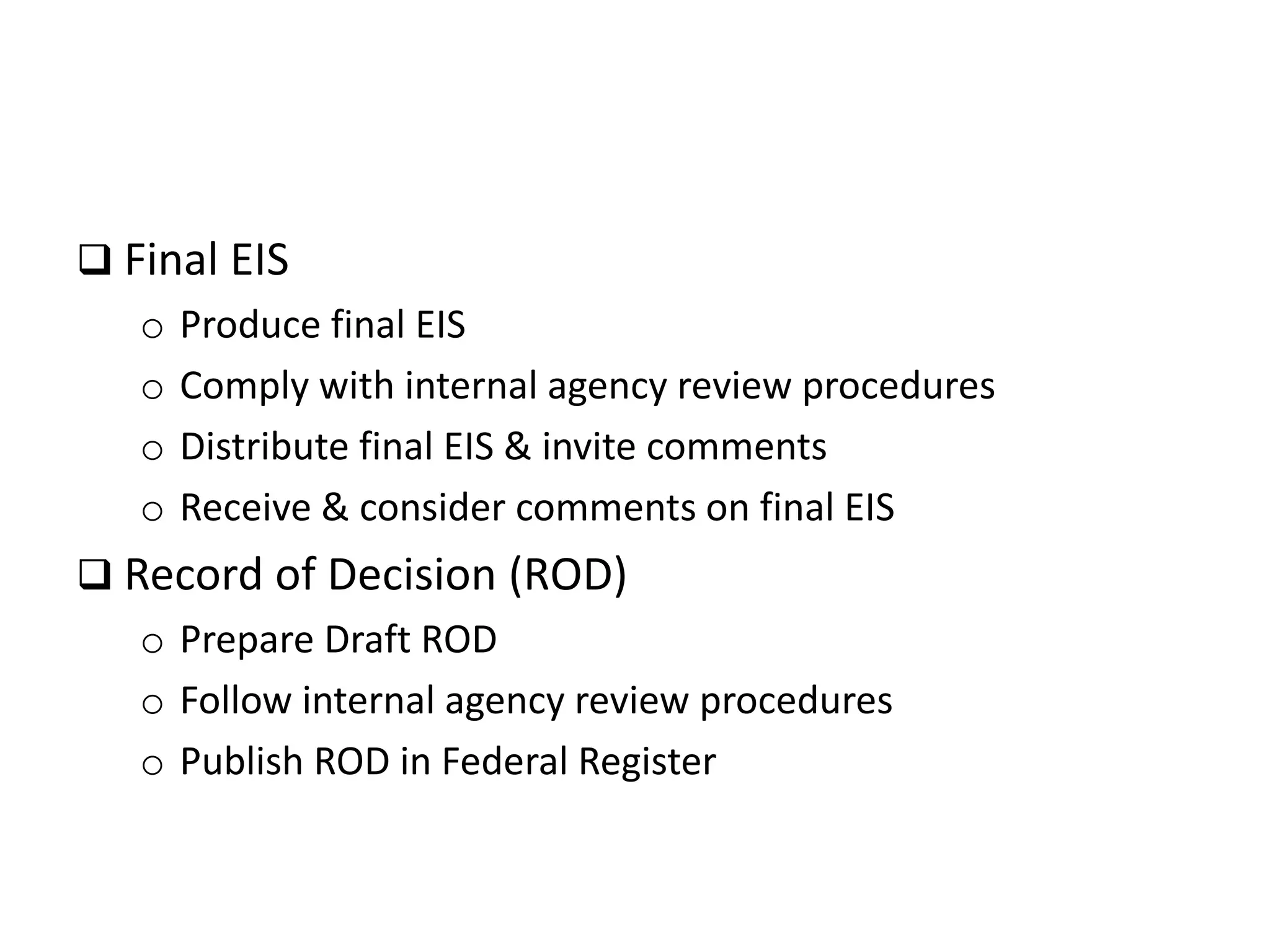
 Final EIS
o Produce final EIS
o Comply with internal agency review procedures
o Distribute final EIS & invite comments
o Receive & consider comments on final EIS
 Record of Decision (ROD)
o Prepare Draft ROD
o Follow internal agency review procedures
o Publish ROD in Federal Register

NEPA Processes

  • 2.
  • 3.
    Federal Action Categorical Exclusion (CatEx) Non-Categorical Exclusion Environmental Assessment(EA) Finding Of No Significant Impact (FONSI) Environmental Impact Statement (EIS) Significant Impact
  • 4.
    Federal Action  Adoptionof:- o Policy o Plan o Programs o Projects
  • 5.
    Categorical Exclusion  Listof actions  Do not significantly affect the quality of human environment individually or cumulatively Proposed Action CatEx List Prepare EANo EA (Federal Agency should make sure proposed action does not affect environment) Yes No
  • 6.
    EA & FONSI Environmental Assessment o Concise public document o Purpose • To determine whether there is significant impact on any resources within the project area • To look at alternatives for achieving agency’s objectives o Include:- • Proposal • List of alternatives • List of agencies • Persons consulted for drafting proposal
  • 7.
     EA Contd... oProvide evidence & analysis for determining whether to prepare EIS o Facilitate preparing an EIS o Can be completed in short period than EIS o Less cost & public participation compared to EIS
  • 8.
     Finding ofNo Significant Impact (FONSI) o Document issued by Federal Agency o After EA, if no substantial effect on environment are found, FONSI is produced o Should explain why the action will not have a significant impact o Mitigated FONSI – FONSI with mitigation measure to reduce any significant impact, if any
  • 9.
    Environmental Impact Statement(EIS)  Detailed written statement  Prepared, if proposed action doesn’t fall in CatEx & not qualified for FONSI  Provide full & fair discussion of significant impacts o Environmental impacts of proposed action o Any adverse impact that cannot be avoided o Why should the proposal be implemented o Reasonable alternatives o Possibility of maintenance & enhancement of environment o Irreversible and irretrievable impacts of resources
  • 10.
     Prepare draftEIS for public to comment on findings  Final EIS is prepared incorporating public comments & is published again before making a decision  Decision maker will also review final EIS  Record of Decision (ROD): Issued as a record of agency’s final decision
  • 11.
     EIS v/sEA o Costly o Long period of time for completion  EA cannot be substituted for EIS
  • 12.
    EIS – ConceptualFramework  Project Description & Need (PDN) o Type of project, how it functions, location, period, need etc.  Pertinent Institutional Information (PII) o Environmental laws, policies, regulations, orders etc.  Identification of Potential Impacts (IPI)  Description of Affected Environment (DAE)  Impact Prediction (IP) o Mathematical models, lab studies  Impact Assessment (IA)
  • 13.
     Impact Mitigation oAvoiding, minimizing, compensating impact  Selecting Proposed Actions (SPA)  Public Written Documentation (PWD) o Preliminary report, EA or EIS  Environmental Monitoring (EM)
  • 14.
    EIS Preparation  PreliminaryActivities o Identify basic issues • Need of action • Technical, geographic, administrative alternatives o Identify authorizations for action  Scoping o Develop notification list • Federal agencies • State agencies • Local authorities • Citizen & environmental group • Private parties with major stakes in outcome
  • 15.
    o Prepare informationpackage • Describe proposed action & alternatives • Describe potential environmental concerns • Describe proposed scope of Draft EIS o Notify interested parties & invite comment o Obtain & consider comments o Develop EIS preparation strategy • Integration of federal and state laws • Participation of federal and state agencies • Plan to manage public communications & respond to public concerns
  • 16.
     Draft EISPreparation o Prepare EIS implementation plan • Work breakdown structure • Budget and schedule • Responsibilities for preparation o Prepare preliminary Draft EIS o Comply with internal agency procedures
  • 17.
    o Finalize DraftEIS o Publish notice & invite comments • List, availability of public place, scheduling of meeting o Obtain Comments o Respond to comments • Make changes, improve EIS scope, negotiate & adopt mitigation measures, record of responses
  • 18.
     Final EIS oProduce final EIS o Comply with internal agency review procedures o Distribute final EIS & invite comments o Receive & consider comments on final EIS  Record of Decision (ROD) o Prepare Draft ROD o Follow internal agency review procedures o Publish ROD in Federal Register

Editor's Notes

  • #13 IPI – Qualitative IP – Quantitative IA – Technical analysis and judgment – public participation
  • #14 SPA – from alternatives