Name: Joy Bhattacharjee
Stamford University Bangladesh
Prepared By: Joy Bhattacharjee

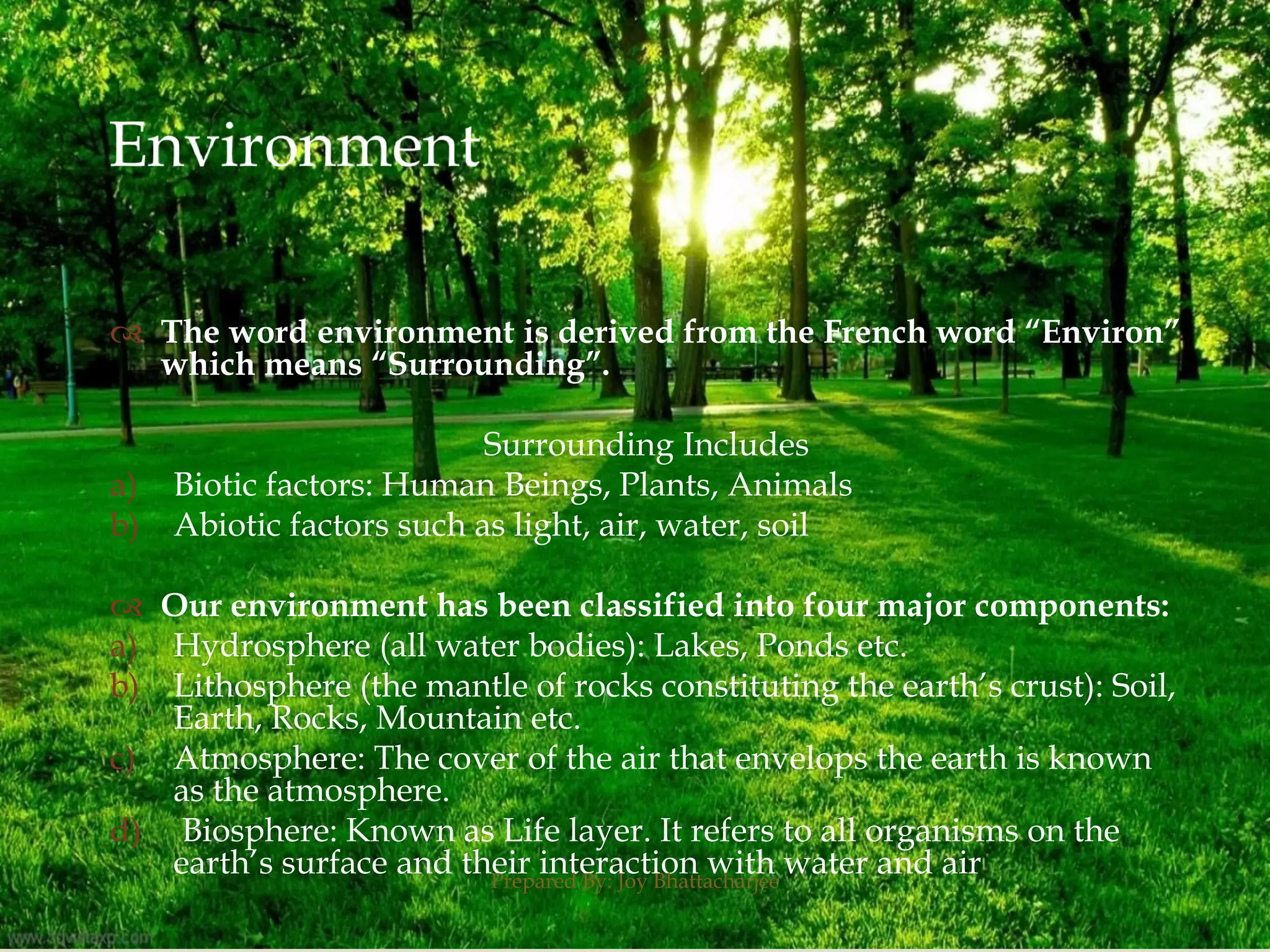
 The word environment is derived from the French word “Environ”
which means “Surrounding”.
Surrounding Includes
a) Biotic factors: Human Beings, Plants, Animals
b) Abiotic factors such as light, air, water, soil
 Our environment has been classified into four major components:
a) Hydrosphere (all water bodies): Lakes, Ponds etc.
b) Lithosphere (the mantle of rocks constituting the earth’s crust): Soil,
Earth, Rocks, Mountain etc.
c) Atmosphere: The cover of the air that envelops the earth is known
as the atmosphere.
d) Biosphere: Known as Life layer. It refers to all organisms on the
earth’s surface and their interaction with water and air.Prepared By: Joy Bhattacharjee

 So , Environment is a complex of many variables,
which surrounds man as well as the living
organisms.
 In a word, Environment is everything that is around
us. It can be living or non living things.
Bird's Eye View of
Environment
Prepared By: Joy Bhattacharjee

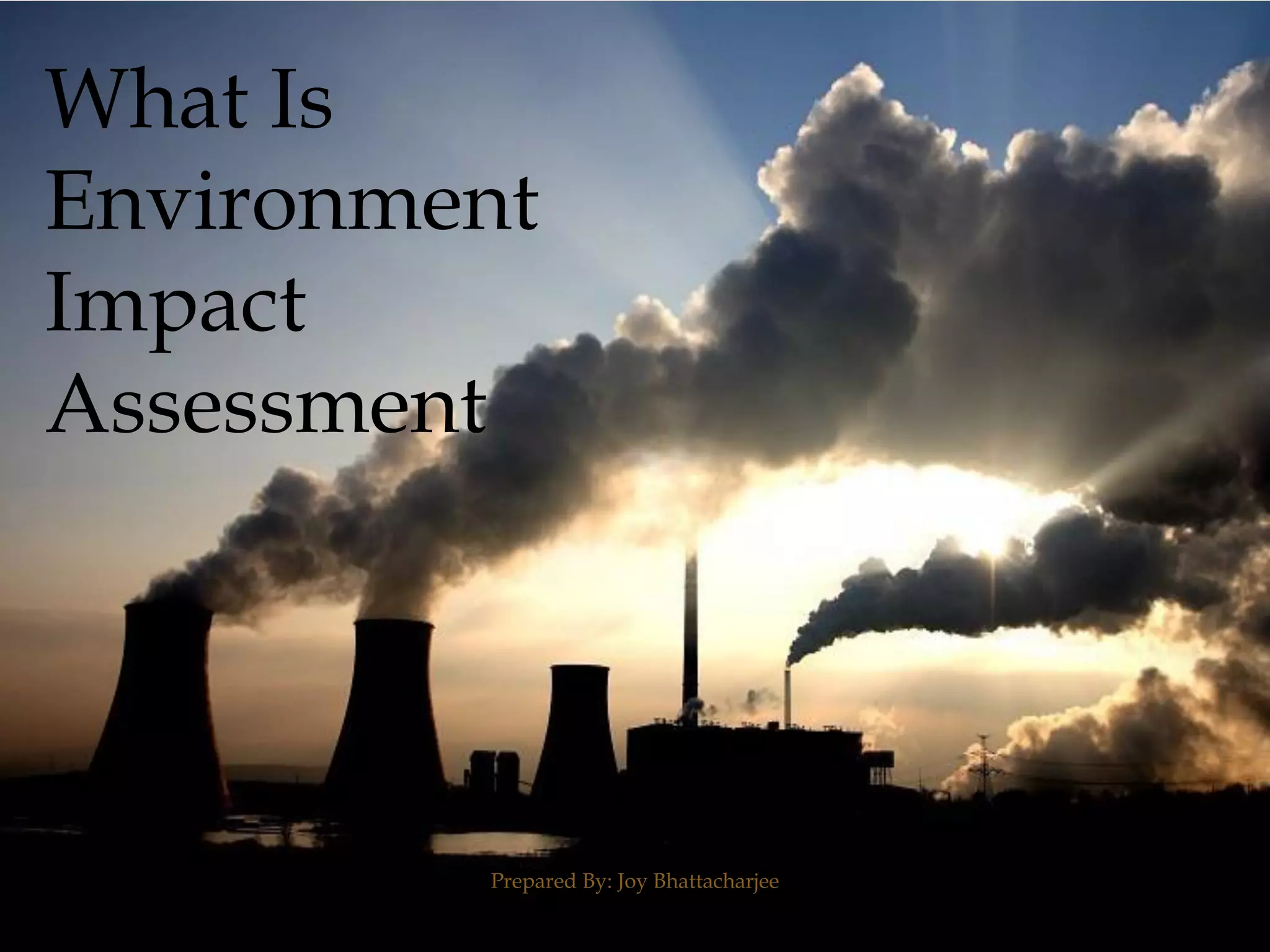
What Is
Environment
Impact
Assessment
Prepared By: Joy Bhattacharjee

 EIA is a Systematic process of identifying future
consequences of a current or proposed action.
 UNEP (United Nations Environment Programme) Defines
Environmental Impact assessment as a tool used to identify
the environmental, social and economic impacts of a project
prior to decision-making.
Environmental Impact
Assessment (EIA)
Prepared By: Joy Bhattacharjee

 Before Discuss the significance of EIA I want to
disclose the biotic and abiotic components of
Environment.
Why EIA?
Prepared By: Joy Bhattacharjee

 It aims to:
a. predict environment at an early stage in project planning and
design,
b. find ways and means to reduce adverse impacts,
c. Shape projects to suit the local environment
d. and present the predictions & options to decision makers.
We know that, Environment is composed of Biotic & Abiotic
components. There is a dynamic equilibrium between these components.
When a project is undertaken it tends to disturb these components. To
maintain the quality of environment it is essential that the perspective
impacts of the project on natural environment are studied on time and
remedial measures be taken so as to promote sustainable and holistic
development of the project. This is done through EIA
Why EIA?
Prepared By: Joy Bhattacharjee

Steps In
Environmental
Impact
Assessment
(EIA)
Prepared By: Joy Bhattacharjee

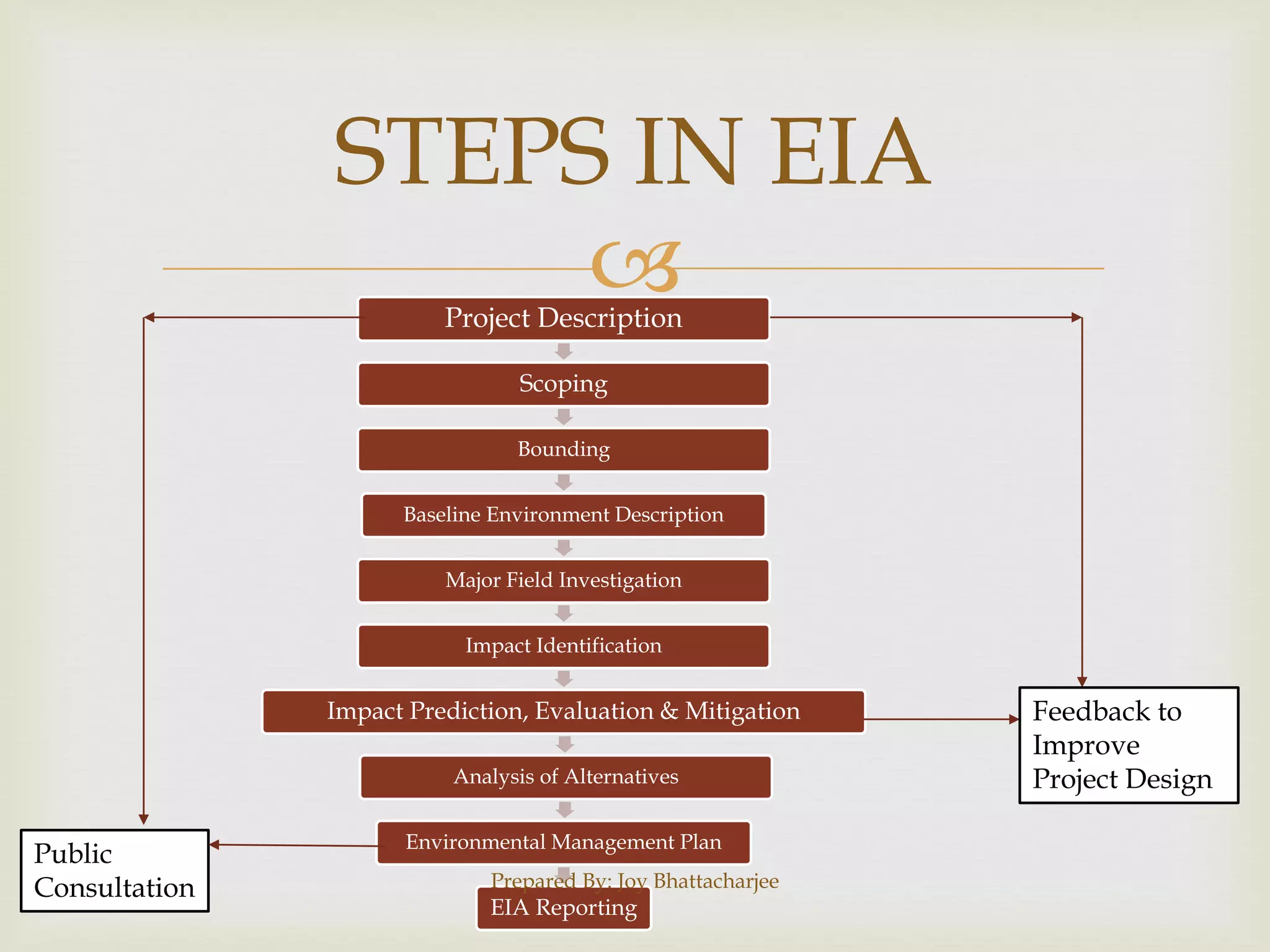
STEPS IN EIA
Project Description
Scoping
Bounding
Baseline Environment Description
Major Field Investigation
Impact Identification
Impact Prediction, Evaluation & Mitigation
Analysis of Alternatives
Environmental Management Plan
EIA Reporting
Feedback to
Improve
Project Design
Public
Consultation Prepared By: Joy Bhattacharjee

 Project descriptions provide the following details to
the applicants:
a) the problem the project will address,
b) a set of goals for the project,
c) the overall objectives for the project,
d) a project plan that describes the activities the
members will undertake.
Step – 1
Project Description
Prepared By: Joy Bhattacharjee
 Scoping is a process by which the project “areas of influence”is
identified.
 The elements of scoping include
a) geographical boundary,
b) affected groups, institutions, agencies and
c) significant environmental issues to be investigated. Such as: physical and ecological resources,
human and economic development values, and quality of life values.
In a nutshell, it is what needs to be achieved and the work that must be done to deliver a project.
Scoping is important for two reasons.
First, problems can be pinpointed early allowing mitigating design changes to be made before expensive
detailed work is carried out.
Second, to ensure that detailed prediction work is only carried out for important issues.
Step -2
Scoping
Prepared By: Joy Bhattacharjee

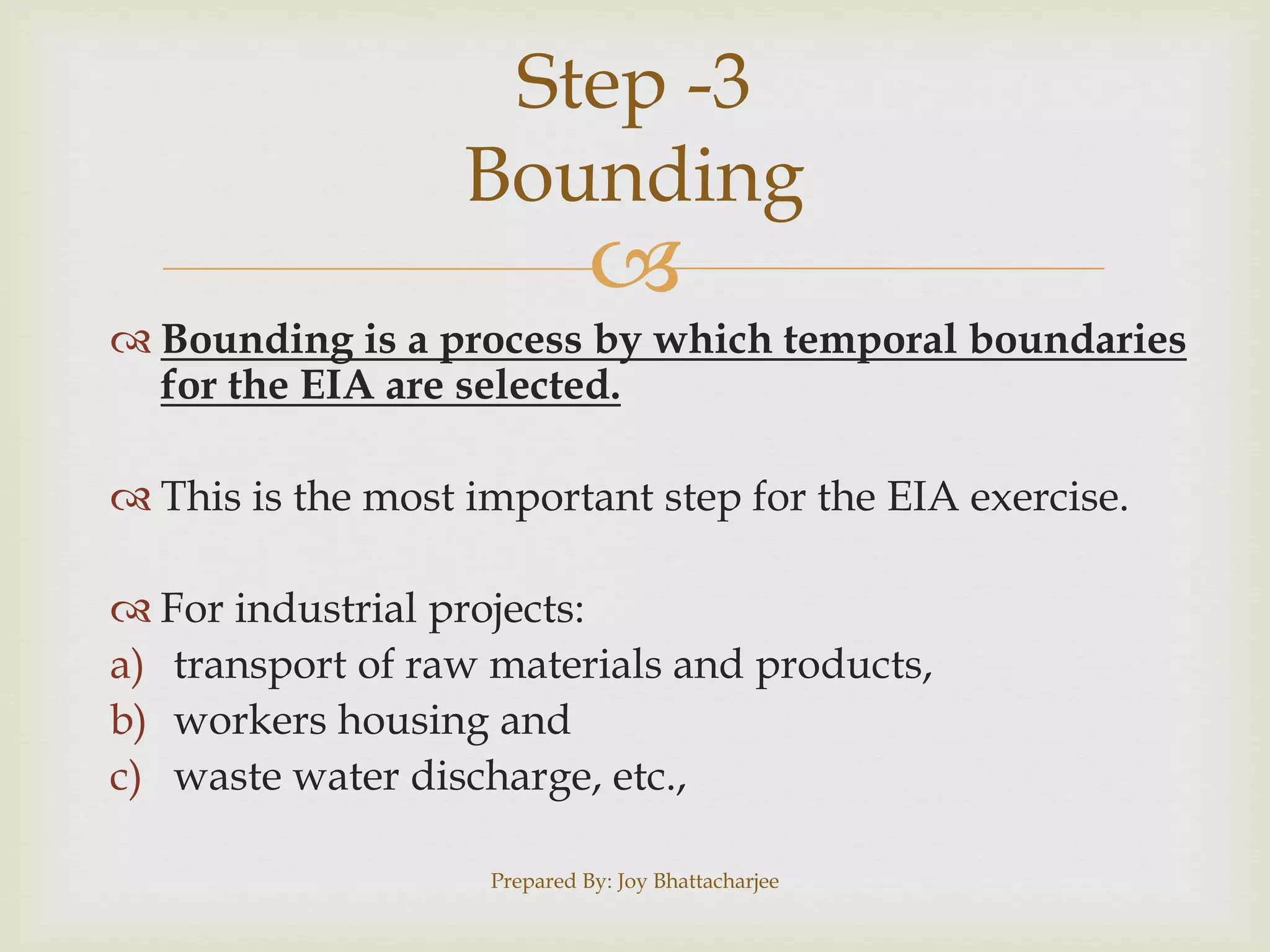
 Bounding is a process by which temporal boundaries
for the EIA are selected.
 This is the most important step for the EIA exercise.
 For industrial projects:
a) transport of raw materials and products,
b) workers housing and
c) waste water discharge, etc.,
Step -3
Bounding
Prepared By: Joy Bhattacharjee

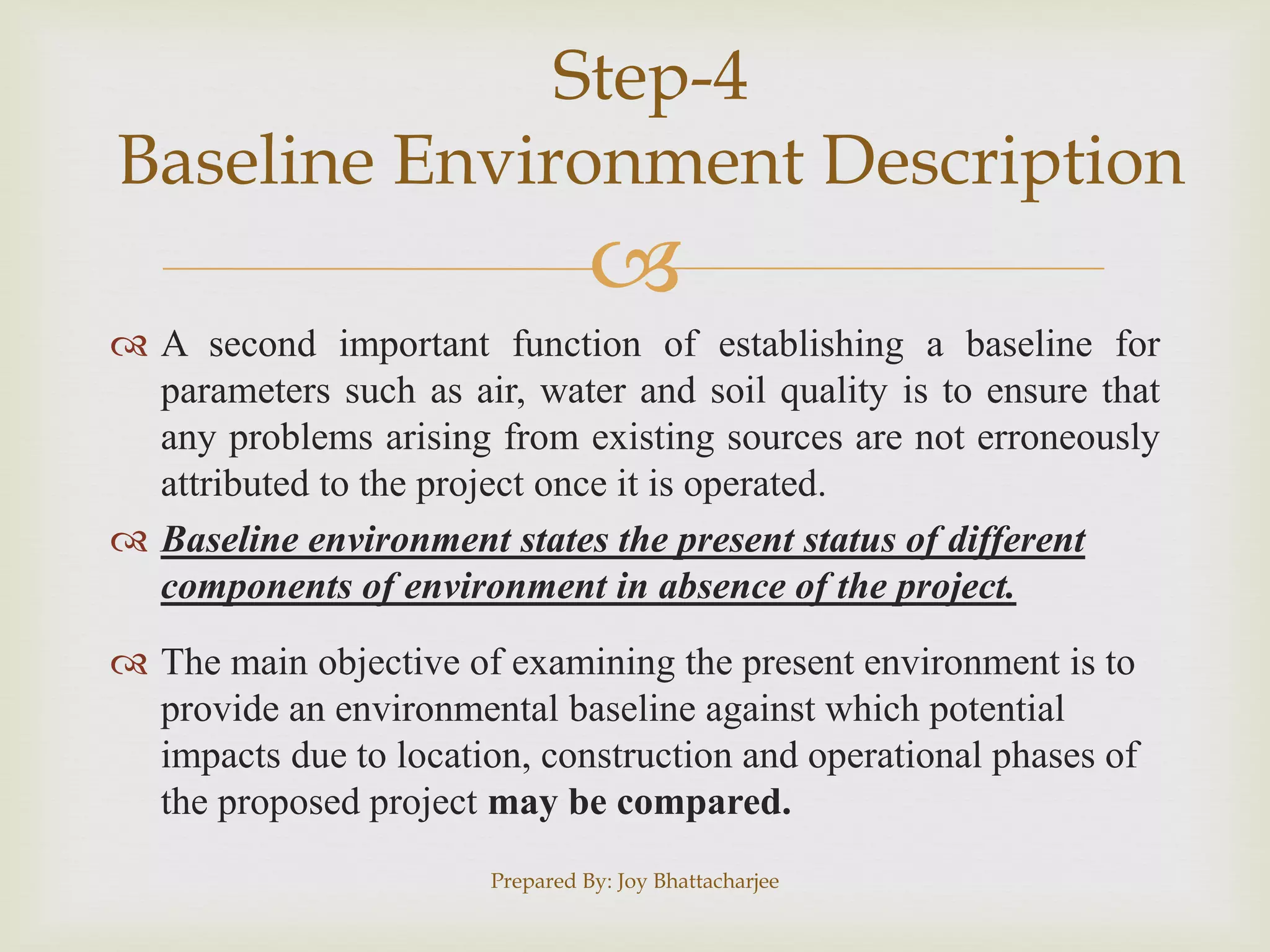
 A second important function of establishing a baseline for
parameters such as air, water and soil quality is to ensure that
any problems arising from existing sources are not erroneously
attributed to the project once it is operated.
 Baseline environment states the present status of different
components of environment in absence of the project.
 The main objective of examining the present environment is to
provide an environmental baseline against which potential
impacts due to location, construction and operational phases of
the proposed project may be compared.
Step-4
Baseline Environment Description
Prepared By: Joy Bhattacharjee

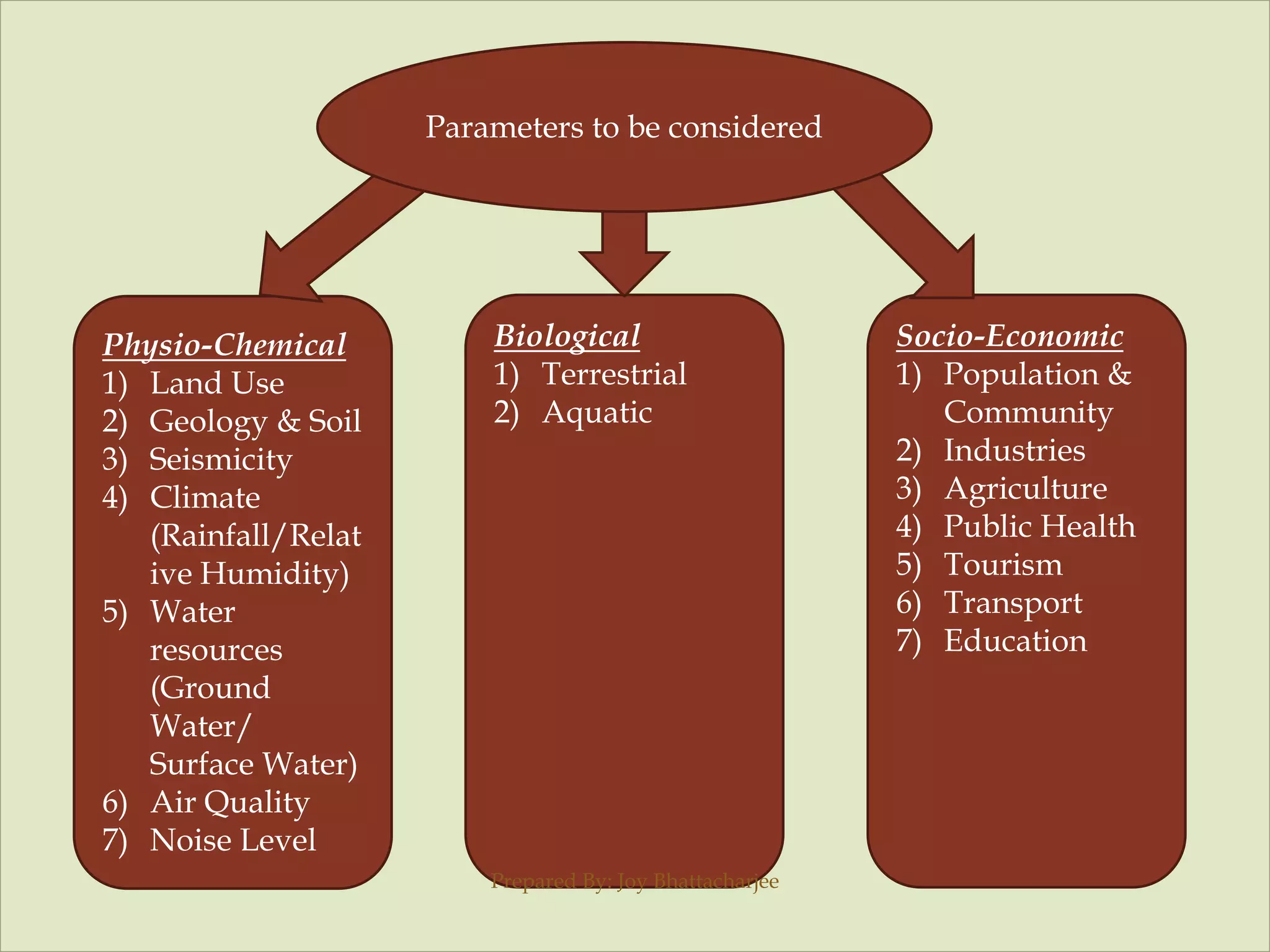
Parameters to be considered in
Baseline Environment Description
Prepared By: Joy Bhattacharjee

Physio-Chemical
1) Land Use
2) Geology & Soil
3) Seismicity
4) Climate
(Rainfall/Relat
ive Humidity)
5) Water
resources
(Ground
Water/
Surface Water)
6) Air Quality
7) Noise Level
Biological
1) Terrestrial
2) Aquatic
Socio-Economic
1) Population &
Community
2) Industries
3) Agriculture
4) Public Health
5) Tourism
6) Transport
7) Education
Parameters to be considered
Prepared By: Joy Bhattacharjee

 "Field investigation" means the study of the traces of
human culture at any site by means of
a) surveying,
b) sampling,
c) excavating, or
d) removing surface or subsurface material,
e) or going on a site with that intent.
Step -5
Major Field Investigation
Prepared By: Joy Bhattacharjee

Prepared By: Joy Bhattacharjee

 Impact identification attempts to answer the question, “What
will happen when a project enters its operational Stage?”
 A list of Important impacts such as:
a) Changes in air quality
b) Changes in water and soil qualities
c) Noise levels
d) Wildlife habitats
e) Spices diversity
f) Social and cultural systems
g) Employment levels etc. may be prepared
Step – 6
Impact Identification
Prepared By: Joy Bhattacharjee

 Several methodologies have been developed for
identifying the impacts of development activities on
the environment. These are as follows:
i. Ad-hoc,
ii. Checklists,
iii. Matrices,
iv. Networks and
v. Overlays
Methods of Impact
Identification
Prepared By: Joy Bhattacharjee

 It is useful when time constraints and lack of
information require that the EIA must rely Exclusively
on Expert opinion.
 But when more scientific methods are available, it is
not recommended.
 Types of Ad-hoc Method:
a) Opinion polls
b) Expert opinion
c) Delphi Methods etc
Ad-hoc Method
Prepared By: Joy Bhattacharjee

 Checklist means a listing of potential environment impacts.
 The method is done to assess the nature of the impacts. Such as:
a) Adverse/ Beneficial
b) Short term/ Long term
c) No effect/ Significant impact
d) Reversible/ Irreversible etc.
Types of checklist method:
a) Simple lists
b) Descriptive checklists
c) Scaling checklists
d) Questionnaire Checklists etc.
Checklists Method
Prepared By: Joy Bhattacharjee

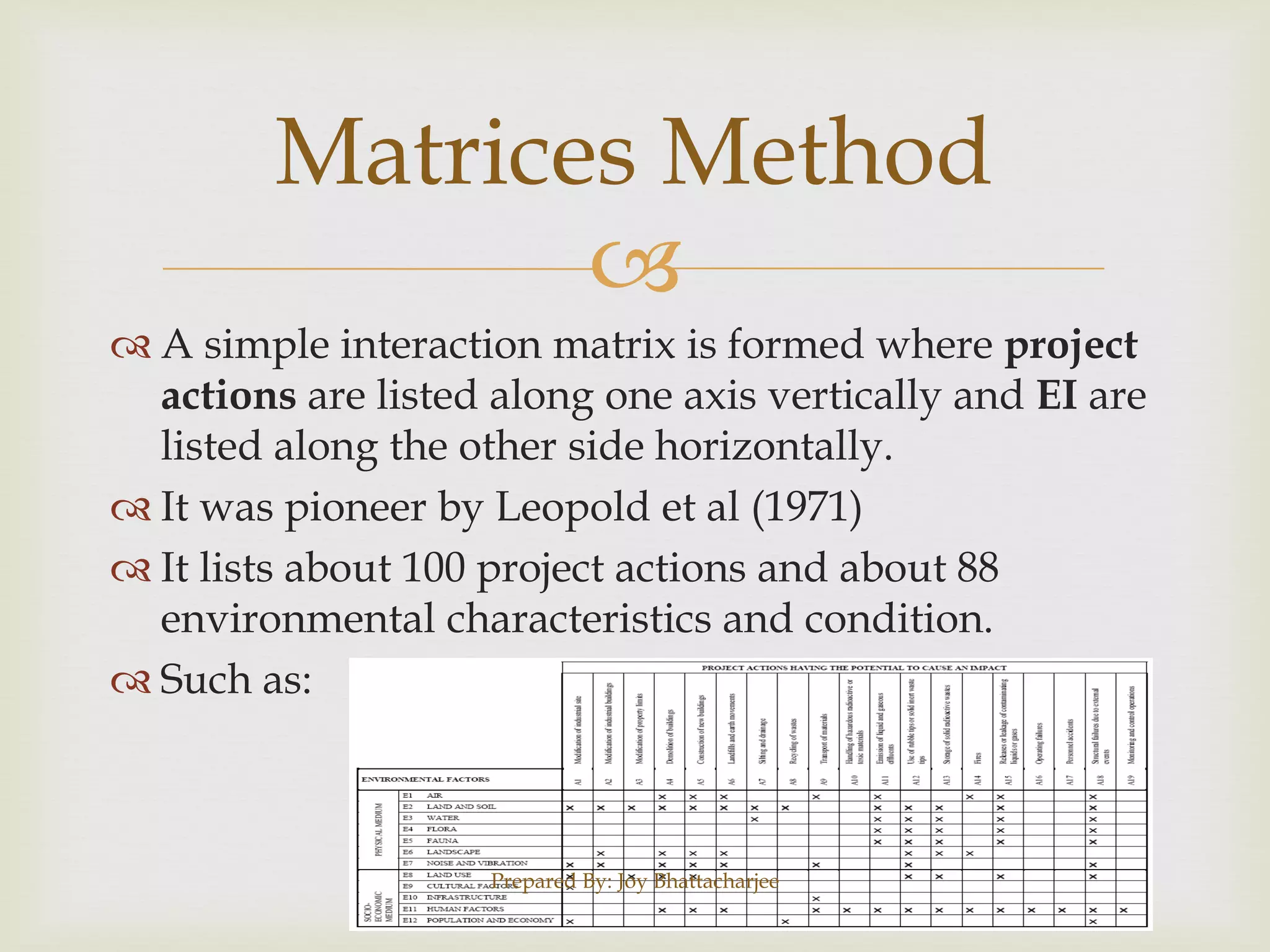
 A simple interaction matrix is formed where project
actions are listed along one axis vertically and EI are
listed along the other side horizontally.
 It was pioneer by Leopold et al (1971)
 It lists about 100 project actions and about 88
environmental characteristics and condition.
 Such as:
Matrices Method
Prepared By: Joy Bhattacharjee

 Used to identify cause-effect linkage
 Visual description of linkage
 Shown in the form of tree called as relevance. Impact
tree/ sequence diagram.
 Example of a network analysis:
Network Method
Prepared By: Joy Bhattacharjee

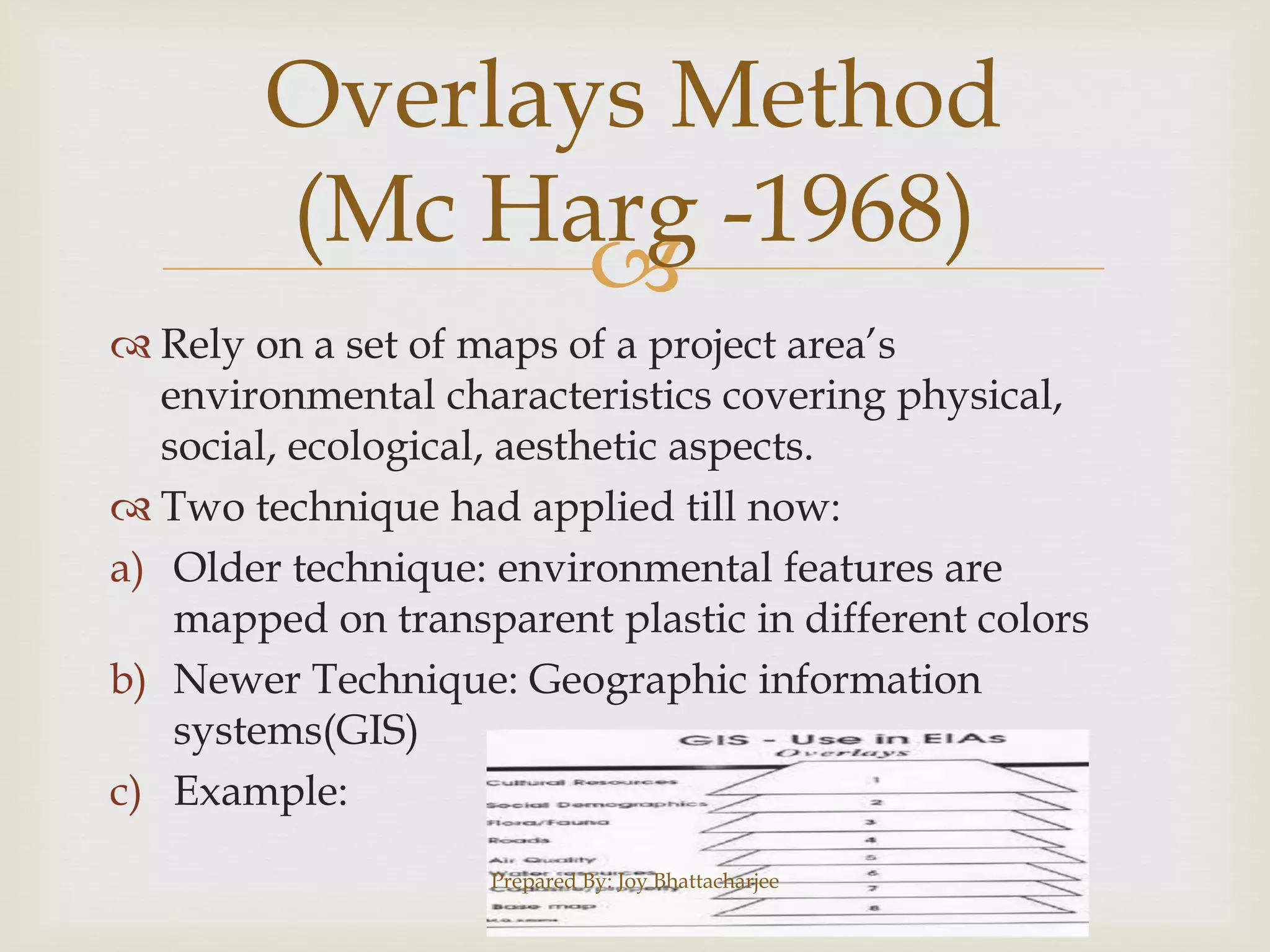
 Rely on a set of maps of a project area’s
environmental characteristics covering physical,
social, ecological, aesthetic aspects.
 Two technique had applied till now:
a) Older technique: environmental features are
mapped on transparent plastic in different colors
b) Newer Technique: Geographic information
systems(GIS)
c) Example:
Overlays Method
(Mc Harg -1968)
Prepared By: Joy Bhattacharjee

 The purpose of Impact prediction exercise is:
a) To estimate the extent of changes and
b) To quantify them as far as practicable
Prediction follows an impact due to a project activity and
investigates its subsequent effects on the environmental
components and aspects such as
a) strain on available infrastructure
b) adverse impacts on crops, forests, fishes, economic
effects etc.
Step – 7
Impact Prediction,
Evaluation
& Mitigation/ Enhancement
Impact Prediction
Prepared By: Joy Bhattacharjee

 Prediction provides idea of extent of changes in the
environment, in quantitative or qualitative terms.
 But one must see if these changes matter at all then this
exercise is called EVALUATION.
 This judgement of significance is based on one or more of
the following consideration:
a) Comparison with laws, regulations or accepted
standards
b) Consistency with government policy objectives
c) Risk (Probability of serious environmental effects)
d) Importance (local, regional or national) etc.
Impact Evaluation
Prepared By: Joy Bhattacharjee

Objective:
a) To offset the adverse impacts of the project, as far as
practicable
b) Suggest project modification, if necessary
Elements of Mitigation Measures:
a) Buffer zones
b) Resource substitutions
c) Resource minimization,
d) Process modifications,
e) Temperature control etc.
Impact Mitigation or
Enhancement
Prepared By: Joy Bhattacharjee

 It provides opportunities to compare various
development options which aims to achieve the
same objectives:
 One alternative is the ‘no action’ option
 Identification and selection of alternatives can be
based on:
a) Alternative location
b) Alternative scale
c) Alternative technology
d) Alternative mitigation
Step - 8
Analysis of Alternatives
Prepared By: Joy Bhattacharjee

 An environmental management plan is an
implementation plan for mitigation, protection and
enhancement measures which are recommended in
the EIA.
 The EMP presents in detail
a) how these measures should be operated,
b) How the resources required and
c) What will be the schedule for implementation.
Step – 9
Environmental Management Plan
Prepared By: Joy Bhattacharjee

Steps in EMP
Prepared By: Joy Bhattacharjee

If local people are to support a particular project or program,
then must be involved in project planning from the earliest
phases.
To achieve effective public participation, it is necessary to
communicate with as many people as possible, as early as
possible. Some of the techniques which could be adopted are:
a) Radio & Television
b) News Releases
c) Advertisement
d) Sample Polls
e) Workshops
f) Meetings etc.
Public Consultation
Prepared By: Joy Bhattacharjee

Thanks a lot
Prepared By: Joy Bhattacharjee

Environmental Impact Assessment (EIA) in Project Management

  • 1.
    Name: Joy Bhattacharjee StamfordUniversity Bangladesh Prepared By: Joy Bhattacharjee
  • 2.
      The wordenvironment is derived from the French word “Environ” which means “Surrounding”. Surrounding Includes a) Biotic factors: Human Beings, Plants, Animals b) Abiotic factors such as light, air, water, soil  Our environment has been classified into four major components: a) Hydrosphere (all water bodies): Lakes, Ponds etc. b) Lithosphere (the mantle of rocks constituting the earth’s crust): Soil, Earth, Rocks, Mountain etc. c) Atmosphere: The cover of the air that envelops the earth is known as the atmosphere. d) Biosphere: Known as Life layer. It refers to all organisms on the earth’s surface and their interaction with water and air.Prepared By: Joy Bhattacharjee
  • 3.
      So ,Environment is a complex of many variables, which surrounds man as well as the living organisms.  In a word, Environment is everything that is around us. It can be living or non living things. Bird's Eye View of Environment Prepared By: Joy Bhattacharjee
  • 4.
  • 5.
      EIA isa Systematic process of identifying future consequences of a current or proposed action.  UNEP (United Nations Environment Programme) Defines Environmental Impact assessment as a tool used to identify the environmental, social and economic impacts of a project prior to decision-making. Environmental Impact Assessment (EIA) Prepared By: Joy Bhattacharjee
  • 6.
      Before Discussthe significance of EIA I want to disclose the biotic and abiotic components of Environment. Why EIA? Prepared By: Joy Bhattacharjee
  • 7.
      It aimsto: a. predict environment at an early stage in project planning and design, b. find ways and means to reduce adverse impacts, c. Shape projects to suit the local environment d. and present the predictions & options to decision makers. We know that, Environment is composed of Biotic & Abiotic components. There is a dynamic equilibrium between these components. When a project is undertaken it tends to disturb these components. To maintain the quality of environment it is essential that the perspective impacts of the project on natural environment are studied on time and remedial measures be taken so as to promote sustainable and holistic development of the project. This is done through EIA Why EIA? Prepared By: Joy Bhattacharjee
  • 8.
  • 9.
     STEPS IN EIA ProjectDescription Scoping Bounding Baseline Environment Description Major Field Investigation Impact Identification Impact Prediction, Evaluation & Mitigation Analysis of Alternatives Environmental Management Plan EIA Reporting Feedback to Improve Project Design Public Consultation Prepared By: Joy Bhattacharjee
  • 10.
      Project descriptionsprovide the following details to the applicants: a) the problem the project will address, b) a set of goals for the project, c) the overall objectives for the project, d) a project plan that describes the activities the members will undertake. Step – 1 Project Description Prepared By: Joy Bhattacharjee
  • 11.
     Scoping isa process by which the project “areas of influence”is identified.  The elements of scoping include a) geographical boundary, b) affected groups, institutions, agencies and c) significant environmental issues to be investigated. Such as: physical and ecological resources, human and economic development values, and quality of life values. In a nutshell, it is what needs to be achieved and the work that must be done to deliver a project. Scoping is important for two reasons. First, problems can be pinpointed early allowing mitigating design changes to be made before expensive detailed work is carried out. Second, to ensure that detailed prediction work is only carried out for important issues. Step -2 Scoping Prepared By: Joy Bhattacharjee
  • 12.
      Bounding isa process by which temporal boundaries for the EIA are selected.  This is the most important step for the EIA exercise.  For industrial projects: a) transport of raw materials and products, b) workers housing and c) waste water discharge, etc., Step -3 Bounding Prepared By: Joy Bhattacharjee
  • 13.
      A secondimportant function of establishing a baseline for parameters such as air, water and soil quality is to ensure that any problems arising from existing sources are not erroneously attributed to the project once it is operated.  Baseline environment states the present status of different components of environment in absence of the project.  The main objective of examining the present environment is to provide an environmental baseline against which potential impacts due to location, construction and operational phases of the proposed project may be compared. Step-4 Baseline Environment Description Prepared By: Joy Bhattacharjee
  • 14.
     Parameters to beconsidered in Baseline Environment Description Prepared By: Joy Bhattacharjee
  • 15.
     Physio-Chemical 1) Land Use 2)Geology & Soil 3) Seismicity 4) Climate (Rainfall/Relat ive Humidity) 5) Water resources (Ground Water/ Surface Water) 6) Air Quality 7) Noise Level Biological 1) Terrestrial 2) Aquatic Socio-Economic 1) Population & Community 2) Industries 3) Agriculture 4) Public Health 5) Tourism 6) Transport 7) Education Parameters to be considered Prepared By: Joy Bhattacharjee
  • 16.
      "Field investigation"means the study of the traces of human culture at any site by means of a) surveying, b) sampling, c) excavating, or d) removing surface or subsurface material, e) or going on a site with that intent. Step -5 Major Field Investigation Prepared By: Joy Bhattacharjee
  • 17.
     Prepared By: JoyBhattacharjee
  • 18.
      Impact identificationattempts to answer the question, “What will happen when a project enters its operational Stage?”  A list of Important impacts such as: a) Changes in air quality b) Changes in water and soil qualities c) Noise levels d) Wildlife habitats e) Spices diversity f) Social and cultural systems g) Employment levels etc. may be prepared Step – 6 Impact Identification Prepared By: Joy Bhattacharjee
  • 19.
      Several methodologieshave been developed for identifying the impacts of development activities on the environment. These are as follows: i. Ad-hoc, ii. Checklists, iii. Matrices, iv. Networks and v. Overlays Methods of Impact Identification Prepared By: Joy Bhattacharjee
  • 20.
      It isuseful when time constraints and lack of information require that the EIA must rely Exclusively on Expert opinion.  But when more scientific methods are available, it is not recommended.  Types of Ad-hoc Method: a) Opinion polls b) Expert opinion c) Delphi Methods etc Ad-hoc Method Prepared By: Joy Bhattacharjee
  • 21.
      Checklist meansa listing of potential environment impacts.  The method is done to assess the nature of the impacts. Such as: a) Adverse/ Beneficial b) Short term/ Long term c) No effect/ Significant impact d) Reversible/ Irreversible etc. Types of checklist method: a) Simple lists b) Descriptive checklists c) Scaling checklists d) Questionnaire Checklists etc. Checklists Method Prepared By: Joy Bhattacharjee
  • 22.
      A simpleinteraction matrix is formed where project actions are listed along one axis vertically and EI are listed along the other side horizontally.  It was pioneer by Leopold et al (1971)  It lists about 100 project actions and about 88 environmental characteristics and condition.  Such as: Matrices Method Prepared By: Joy Bhattacharjee
  • 23.
      Used toidentify cause-effect linkage  Visual description of linkage  Shown in the form of tree called as relevance. Impact tree/ sequence diagram.  Example of a network analysis: Network Method Prepared By: Joy Bhattacharjee
  • 24.
      Rely ona set of maps of a project area’s environmental characteristics covering physical, social, ecological, aesthetic aspects.  Two technique had applied till now: a) Older technique: environmental features are mapped on transparent plastic in different colors b) Newer Technique: Geographic information systems(GIS) c) Example: Overlays Method (Mc Harg -1968) Prepared By: Joy Bhattacharjee
  • 25.
      The purposeof Impact prediction exercise is: a) To estimate the extent of changes and b) To quantify them as far as practicable Prediction follows an impact due to a project activity and investigates its subsequent effects on the environmental components and aspects such as a) strain on available infrastructure b) adverse impacts on crops, forests, fishes, economic effects etc. Step – 7 Impact Prediction, Evaluation & Mitigation/ Enhancement Impact Prediction Prepared By: Joy Bhattacharjee
  • 26.
      Prediction providesidea of extent of changes in the environment, in quantitative or qualitative terms.  But one must see if these changes matter at all then this exercise is called EVALUATION.  This judgement of significance is based on one or more of the following consideration: a) Comparison with laws, regulations or accepted standards b) Consistency with government policy objectives c) Risk (Probability of serious environmental effects) d) Importance (local, regional or national) etc. Impact Evaluation Prepared By: Joy Bhattacharjee
  • 27.
     Objective: a) To offsetthe adverse impacts of the project, as far as practicable b) Suggest project modification, if necessary Elements of Mitigation Measures: a) Buffer zones b) Resource substitutions c) Resource minimization, d) Process modifications, e) Temperature control etc. Impact Mitigation or Enhancement Prepared By: Joy Bhattacharjee
  • 28.
      It providesopportunities to compare various development options which aims to achieve the same objectives:  One alternative is the ‘no action’ option  Identification and selection of alternatives can be based on: a) Alternative location b) Alternative scale c) Alternative technology d) Alternative mitigation Step - 8 Analysis of Alternatives Prepared By: Joy Bhattacharjee
  • 29.
      An environmentalmanagement plan is an implementation plan for mitigation, protection and enhancement measures which are recommended in the EIA.  The EMP presents in detail a) how these measures should be operated, b) How the resources required and c) What will be the schedule for implementation. Step – 9 Environmental Management Plan Prepared By: Joy Bhattacharjee
  • 30.
     Steps in EMP PreparedBy: Joy Bhattacharjee
  • 31.
     If local peopleare to support a particular project or program, then must be involved in project planning from the earliest phases. To achieve effective public participation, it is necessary to communicate with as many people as possible, as early as possible. Some of the techniques which could be adopted are: a) Radio & Television b) News Releases c) Advertisement d) Sample Polls e) Workshops f) Meetings etc. Public Consultation Prepared By: Joy Bhattacharjee
  • 32.
     Thanks a lot PreparedBy: Joy Bhattacharjee