VIJAI KRISHNANV
M.Tech Student
Rajiv Gandhi Institute ofTechnology,
Kottayam, Kerala
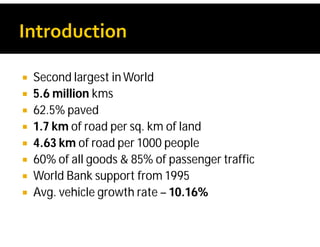
 Second largest in World
 5.6 million kms
 62.5% paved
 1.7 km of road per sq. km of land
 4.63 km of road per 1000 people
 60% of all goods & 85% of passenger traffic
 World Bank support from 1995
 Avg. vehicle growth rate – 10.16%
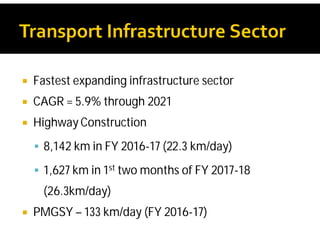
 Fastest expanding infrastructure sector
 CAGR = 5.9% through 2021
 Highway Construction
 8,142 km in FY 2016-17 (22.3 km/day)
 1,627 km in 1st two months of FY 2017-18
(26.3km/day)
 PMGSY – 133 km/day (FY 2016-17)
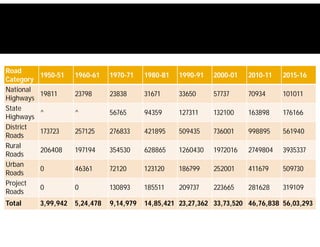
Road
Category
1950-51 1960-61 1970-71 1980-81 1990-91 2000-01 2010-11 2015-16
National
Highways
19811 23798 23838 31671 33650 57737 70934 101011
State
Highways
^ ^ 56765 94359 127311 132100 163898 176166
District
Roads
173723 257125 276833 421895 509435 736001 998895 561940
Rural
Roads
206408 197194 354530 628865 1260430 1972016 2749804 3935337
Urban
Roads
0 46361 72120 123120 186799 252001 411679 509730
Project
Roads
0 0 130893 185511 209737 223665 281628 319109
Total 3,99,942 5,24,478 9,14,979 14,85,421 23,27,362 33,73,520 46,76,838 56,03,293
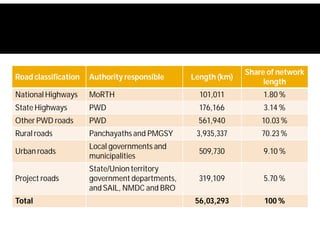
Road classification Authority responsible Length (km)
Share of network
length
National Highways MoRTH 101,011 1.80 %
State Highways PWD 176,166 3.14 %
Other PWD roads PWD 561,940 10.03 %
Rural roads Panchayaths and PMGSY 3,935,337 70.23 %
Urban roads
Local governments and
municipalities
509,730 9.10 %
Project roads
State/Union territory
government departments,
and SAIL, NMDC and BRO
319,109 5.70 %
Total 56,03,293 100 %
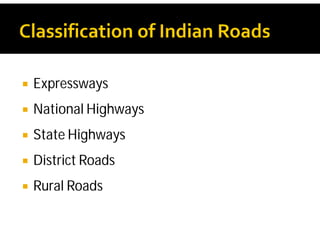
 Expressways
 National Highways
 State Highways
 District Roads
 Rural Roads
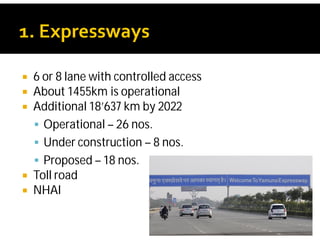
 6 or 8 lane with controlled access
 About 1455km is operational
 Additional 18’637 km by 2022
 Operational – 26 nos.
 Under construction – 8 nos.
 Proposed – 18 nos.
 Toll road
 NHAI
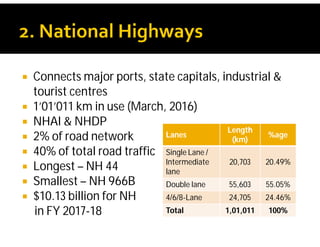
 Connects major ports, state capitals, industrial &
tourist centres
 1’01’011 km in use (March, 2016)
 NHAI & NHDP
 2% of road network
 40% of total road traffic
 Longest – NH 44
 Smallest – NH 966B
 $10.13 billion for NH
in FY 2017-18
Lanes
Length
(km)
%age
Single Lane /
Intermediate
lane
20,703 20.49%
Double lane 55,603 55.05%
4/6/8-Lane 24,705 24.46%
Total 1,01,011 100%
 New numbering system:
 All North-South oriented highways will have even
numbers increasing from the East toWest
 All East-West oriented highways will have odd numbers
increasing from the North to South
 All major highways will be single digit or double digit
number
 Three digit numbered highways are secondary routes or
branches of a main highway, prefixed to the number of the
main highway
 SuffixesA, B, C, D etc. are added to the three digit sub
highways to indicate very small stretches of sub-highways
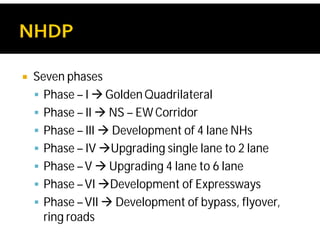
 Seven phases
 Phase – I  Golden Quadrilateral
 Phase – II  NS – EW Corridor
 Phase – III  Development of 4 lane NHs
 Phase – IV Upgrading single lane to 2 lane
 Phase –V  Upgrading 4 lane to 6 lane
 Phase –VI Development of Expressways
 Phase –VII  Development of bypass, flyover,
ring roads
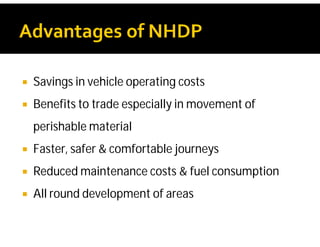
 Savings in vehicle operating costs
 Benefits to trade especially in movement of
perishable material
 Faster, safer & comfortable journeys
 Reduced maintenance costs & fuel consumption
 All round development of areas
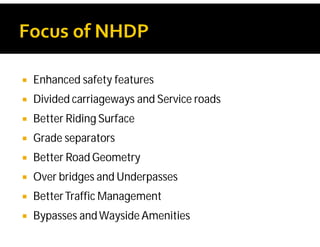
 Enhanced safety features
 Divided carriageways and Service roads
 Better Riding Surface
 Grade separators
 Better Road Geometry
 Over bridges and Underpasses
 BetterTraffic Management
 Bypasses andWayside Amenities
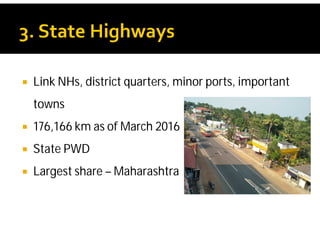
 Link NHs, district quarters, minor ports, important
towns
 176,166 km as of March 2016
 State PWD
 Largest share – Maharashtra
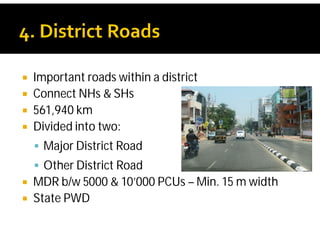
 Important roads within a district
 Connect NHs & SHs
 561,940 km
 Divided into two:
 Major District Road
 Other District Road
 MDR b/w 5000 & 10’000 PCUs – Min. 15 m width
 State PWD
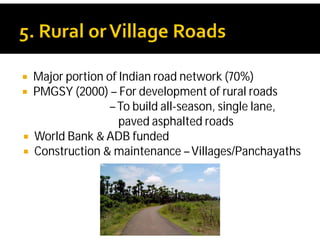
 Major portion of Indian road network (70%)
 PMGSY (2000) – For development of rural roads
–To build all-season, single lane,
paved asphalted roads
 World Bank & ADB funded
 Construction & maintenance –Villages/Panchayaths
 Road accidents & fatalities
 Rapid increase in number of vehicles
 Congestion in Urban areas
 Increase in pollution and vehicle operation
cost
 Less average speed
 Poor quality of village roads
 Bharatmala
 Setu Bharatam
 National Highways and Infrastructure Development
Corporation (NHIDCL)
 NHDP
 Special Accelerated Road Development Programme
in North East (SARDP-NE)
 NHAI to target 2’00’000 km
 PMGSY
 Logistic Efficiency Enhancement Programme
(LEEP)
 Second highest highway project after NHDP
 Seven phases
 Target – 30km/day
 Raise 40% freight to 80% freight on NH
 Multi-source funding
 24,800 km of highways in first phase
 Highlights:
 Development of Border and International connectivity
roads
 Improving efficiency of existing corridors
 Improving connectivity in the North East
 Enhancing use of technology & scientific planning
 50 new corridors
 Connect 550 districts through NH linkages
 Categories:
 Economic Corridor – 9000 km
 Feeder Route or Inter Corridor – 6000 km
 National Corridor Efficiency Improvement – 5000 km
 Border Road and International Connectivity – 2000 km
 Port Connectivity and Coastal Road – 2000 km
 Green Field Expressway
 Balance NHDPWorks - 10,000km
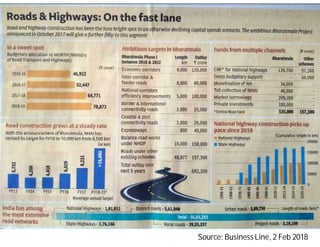
Source: Business Line, 2 Feb 2018
 https://www.ibef.org/industry/roads-india.aspx
 www.nhai.gov.in
 https://www.india.gov.in/spotlight/bharatmala-pariyojana-stepping-
stone-towards-new-india
 http://www.makeinindia.com/article/-/v/connecting-the-country-road-
infrastructure
 http://nhidcl.com/welcome-to-nhidcl/#
 http://www.worldbank.org/en/country/india/brief/highways
 http://www.mospi.gov.in/statistical-year-book-india/2017/190
Indian Road Network Statistics

Indian Road Network Statistics

  • 1.
    VIJAI KRISHNANV M.Tech Student RajivGandhi Institute ofTechnology, Kottayam, Kerala
  • 2.
     Second largestin World  5.6 million kms  62.5% paved  1.7 km of road per sq. km of land  4.63 km of road per 1000 people  60% of all goods & 85% of passenger traffic  World Bank support from 1995  Avg. vehicle growth rate – 10.16%
  • 3.
     Fastest expandinginfrastructure sector  CAGR = 5.9% through 2021  Highway Construction  8,142 km in FY 2016-17 (22.3 km/day)  1,627 km in 1st two months of FY 2017-18 (26.3km/day)  PMGSY – 133 km/day (FY 2016-17)
  • 4.
    Road Category 1950-51 1960-61 1970-711980-81 1990-91 2000-01 2010-11 2015-16 National Highways 19811 23798 23838 31671 33650 57737 70934 101011 State Highways ^ ^ 56765 94359 127311 132100 163898 176166 District Roads 173723 257125 276833 421895 509435 736001 998895 561940 Rural Roads 206408 197194 354530 628865 1260430 1972016 2749804 3935337 Urban Roads 0 46361 72120 123120 186799 252001 411679 509730 Project Roads 0 0 130893 185511 209737 223665 281628 319109 Total 3,99,942 5,24,478 9,14,979 14,85,421 23,27,362 33,73,520 46,76,838 56,03,293
  • 5.
    Road classification Authorityresponsible Length (km) Share of network length National Highways MoRTH 101,011 1.80 % State Highways PWD 176,166 3.14 % Other PWD roads PWD 561,940 10.03 % Rural roads Panchayaths and PMGSY 3,935,337 70.23 % Urban roads Local governments and municipalities 509,730 9.10 % Project roads State/Union territory government departments, and SAIL, NMDC and BRO 319,109 5.70 % Total 56,03,293 100 %
  • 6.
     Expressways  NationalHighways  State Highways  District Roads  Rural Roads
  • 7.
     6 or8 lane with controlled access  About 1455km is operational  Additional 18’637 km by 2022  Operational – 26 nos.  Under construction – 8 nos.  Proposed – 18 nos.  Toll road  NHAI
  • 8.
     Connects majorports, state capitals, industrial & tourist centres  1’01’011 km in use (March, 2016)  NHAI & NHDP  2% of road network  40% of total road traffic  Longest – NH 44  Smallest – NH 966B  $10.13 billion for NH in FY 2017-18 Lanes Length (km) %age Single Lane / Intermediate lane 20,703 20.49% Double lane 55,603 55.05% 4/6/8-Lane 24,705 24.46% Total 1,01,011 100%
  • 9.
     New numberingsystem:  All North-South oriented highways will have even numbers increasing from the East toWest  All East-West oriented highways will have odd numbers increasing from the North to South  All major highways will be single digit or double digit number  Three digit numbered highways are secondary routes or branches of a main highway, prefixed to the number of the main highway  SuffixesA, B, C, D etc. are added to the three digit sub highways to indicate very small stretches of sub-highways
  • 10.
     Seven phases Phase – I  Golden Quadrilateral  Phase – II  NS – EW Corridor  Phase – III  Development of 4 lane NHs  Phase – IV Upgrading single lane to 2 lane  Phase –V  Upgrading 4 lane to 6 lane  Phase –VI Development of Expressways  Phase –VII  Development of bypass, flyover, ring roads
  • 11.
     Savings invehicle operating costs  Benefits to trade especially in movement of perishable material  Faster, safer & comfortable journeys  Reduced maintenance costs & fuel consumption  All round development of areas
  • 12.
     Enhanced safetyfeatures  Divided carriageways and Service roads  Better Riding Surface  Grade separators  Better Road Geometry  Over bridges and Underpasses  BetterTraffic Management  Bypasses andWayside Amenities
  • 13.
     Link NHs,district quarters, minor ports, important towns  176,166 km as of March 2016  State PWD  Largest share – Maharashtra
  • 14.
     Important roadswithin a district  Connect NHs & SHs  561,940 km  Divided into two:  Major District Road  Other District Road  MDR b/w 5000 & 10’000 PCUs – Min. 15 m width  State PWD
  • 15.
     Major portionof Indian road network (70%)  PMGSY (2000) – For development of rural roads –To build all-season, single lane, paved asphalted roads  World Bank & ADB funded  Construction & maintenance –Villages/Panchayaths
  • 16.
     Road accidents& fatalities  Rapid increase in number of vehicles  Congestion in Urban areas  Increase in pollution and vehicle operation cost  Less average speed  Poor quality of village roads
  • 17.
     Bharatmala  SetuBharatam  National Highways and Infrastructure Development Corporation (NHIDCL)  NHDP  Special Accelerated Road Development Programme in North East (SARDP-NE)  NHAI to target 2’00’000 km  PMGSY  Logistic Efficiency Enhancement Programme (LEEP)
  • 18.
     Second highesthighway project after NHDP  Seven phases  Target – 30km/day  Raise 40% freight to 80% freight on NH  Multi-source funding  24,800 km of highways in first phase
  • 19.
     Highlights:  Developmentof Border and International connectivity roads  Improving efficiency of existing corridors  Improving connectivity in the North East  Enhancing use of technology & scientific planning  50 new corridors  Connect 550 districts through NH linkages
  • 20.
     Categories:  EconomicCorridor – 9000 km  Feeder Route or Inter Corridor – 6000 km  National Corridor Efficiency Improvement – 5000 km  Border Road and International Connectivity – 2000 km  Port Connectivity and Coastal Road – 2000 km  Green Field Expressway  Balance NHDPWorks - 10,000km
  • 21.
  • 22.
     https://www.ibef.org/industry/roads-india.aspx  www.nhai.gov.in https://www.india.gov.in/spotlight/bharatmala-pariyojana-stepping- stone-towards-new-india  http://www.makeinindia.com/article/-/v/connecting-the-country-road- infrastructure  http://nhidcl.com/welcome-to-nhidcl/#  http://www.worldbank.org/en/country/india/brief/highways  http://www.mospi.gov.in/statistical-year-book-india/2017/190