Presented by,
VIJAI KRISHNAN V
M.Tech Student
Transportation Engg.
Guided by,
Dr. BINO I KOSHY
Professor
Dept. of Civil Engineering
RIT, Kottayam
Contents
 Introduction
 Weigh-in-Motion Technology
 Types of WIM Systems
 Sensors
 Data Acquisition & Storage
 Implementation
 Case Studies
 Uses & Limitations
 WIM Systems in India
 Conclusion
29-May-18 Weigh-in-Motion Systems 2
Introduction
 Overloading of vehicle
 Damage & degradation of road infrastructure
 Higher accident risks
 Affect road traffic
 Affect truck stability, maneuverability etc.
 Pollution, noise, vibration & fuel consumption
29-May-18 Weigh-in-Motion Systems 3
 Static Weighing Systems
 Accurate
 Rarely used for enforcement
 Limitations
 Trucks are stopped
 Congestion
 Reduce efficiency of freight
transport
 Require large area
29-May-18 Weigh-in-Motion Systems 4
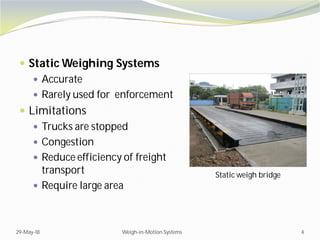
Static weigh bridge
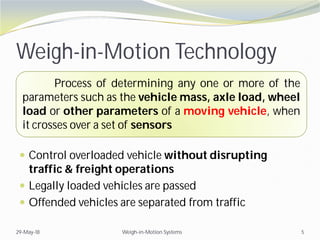
 Control overloaded vehicle without disrupting
traffic & freight operations
 Legally loaded vehicles are passed
 Offended vehicles are separated from traffic
29-May-18 Weigh-in-Motion Systems 5
Weigh-in-Motion Technology
Process of determining any one or more of the
parameters such as the vehicle mass, axle load, wheel
load or other parameters of a moving vehicle, when
it crosses over a set of sensors
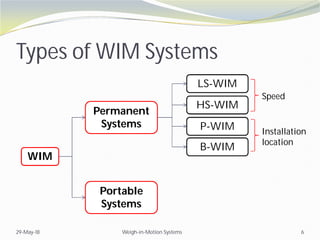
Types of WIM Systems
29-May-18 Weigh-in-Motion Systems 6
Permanent
Systems
Portable
Systems
LS-WIM
HS-WIM
B-WIM
P-WIM
WIM
Speed
Installation
location
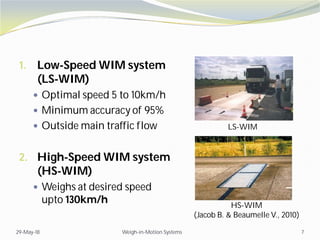
1. Low-Speed WIM system
(LS-WIM)
 Optimal speed 5 to 10km/h
 Minimum accuracy of 95%
 Outside main traffic flow
2. High-Speed WIM system
(HS-WIM)
 Weighs at desired speed
upto 130km/h
29-May-18 Weigh-in-Motion Systems 7
LS-WIM
HS-WIM
(Jacob B. & Beaumelle V., 2010)
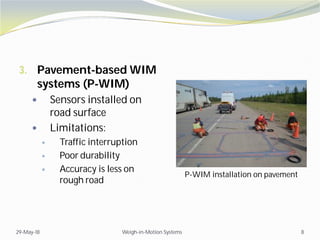
3. Pavement-based WIM
systems (P-WIM)
 Sensors installed on
road surface
 Limitations:
 Traffic interruption
 Poor durability
 Accuracy is less on
rough road
29-May-18 Weigh-in-Motion Systems 8
P-WIM installation on pavement
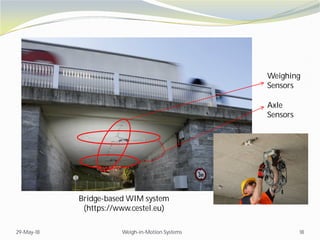
4. Bridge-based WIM system (B-WIM)
 Measure deformation of bridge
 Strain sensors installed on bridge soffit
 Advantages over P-WIM
 No traffic interruption for installation
 Bridge health monitoring & assessment
 Non-destructive implementation
 More durable
 Multiple heavy vehicles simultaneously on bridge, result
in biased data
 SiWIM – a commercial B-WIM system
29-May-18 Weigh-in-Motion Systems 9
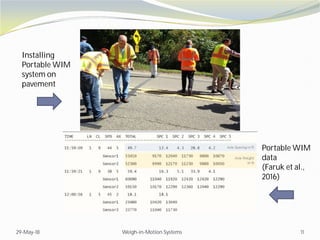
5. Portable WIM systems
 Sensors affixed to pavement surface by tapes
 2 sensors at 2.5 m distance
 Advantages:
 Convenient & cost effective
 No traffic closure or trench required
 Limitations:
 Require in-situ calibration at each site
 Loss accuracy & sensitivity over time
 Recommended for 7 days only
29-May-18 Weigh-in-Motion Systems 10
29-May-18 Weigh-in-Motion Systems 11
Installing
Portable WIM
system on
pavement
Portable WIM
data
(Faruk et al.,
2016)
Sensors
 Measure axle load & spacing
 Convert load to electric signals
1. Based on width of sensor
1. Plate Sensors
2. Strip Sensors
2. Based on purpose
1. Weighing sensors
2. Axle detecting sensors
29-May-18 Weigh-in-Motion Systems 12
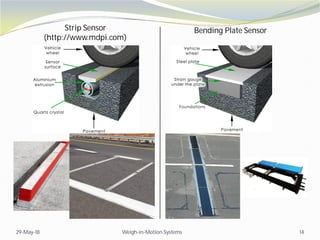
1. Plate sensors
 Use strain gauges
 High strength, rectangular steel plates
 More accurate, but costly
 Difficult to install
2. Strip Sensors
 Width is only few centimetres
 Less expensive & easy to install
 Highly accurate on smooth road surface, but less
accurate on deteriorated surfaces
29-May-18 Weigh-in-Motion Systems 13
29-May-18 Weigh-in-Motion Systems 14
Strip Sensor
(http://www.mdpi.com)
Bending Plate Sensor
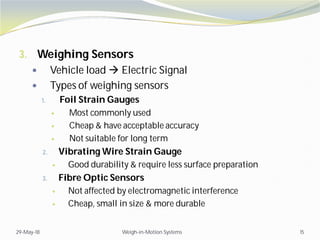
3. Weighing Sensors
 Vehicle load  Electric Signal
 Types of weighing sensors
1. Foil Strain Gauges
 Most commonly used
 Cheap & have acceptable accuracy
 Not suitable for long term
2. Vibrating Wire Strain Gauge
 Good durability & require less surface preparation
3. Fibre Optic Sensors
 Not affected by electromagnetic interference
 Cheap, small in size & more durable
29-May-18 Weigh-in-Motion Systems 15
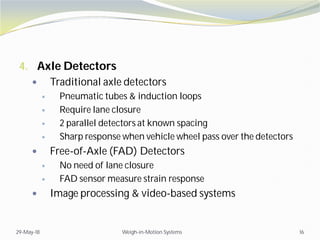
4. Axle Detectors
 Traditional axle detectors
 Pneumatic tubes & induction loops
 Require lane closure
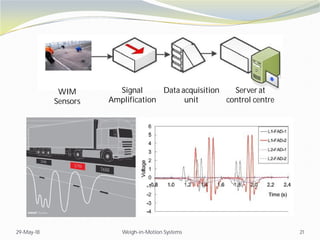
 2 parallel detectors at known spacing
 Sharp response when vehicle wheel pass over the detectors
 Free-of-Axle (FAD) Detectors
 No need of lane closure
 FAD sensor measure strain response
 Image processing & video-based systems
29-May-18 Weigh-in-Motion Systems 16
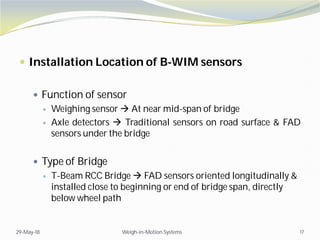
 Installation Location of B-WIM sensors
 Function of sensor
 Weighing sensor  At near mid-span of bridge
 Axle detectors  Traditional sensors on road surface & FAD
sensors under the bridge
 Type of Bridge
 T-Beam RCC Bridge  FAD sensors oriented longitudinally &
installed close to beginning or end of bridge span, directly
below wheel path
29-May-18 Weigh-in-Motion Systems 17
29-May-18 Weigh-in-Motion Systems 18
Bridge-based WIM system
(https://www.cestel.eu)
Weighing
Sensors
Axle
Sensors
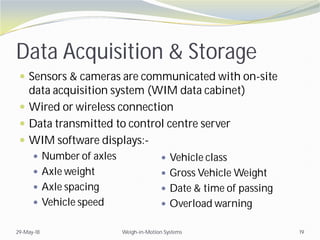
Data Acquisition & Storage
 Sensors & cameras are communicated with on-site
data acquisition system (WIM data cabinet)
 Wired or wireless connection
 Data transmitted to control centre server
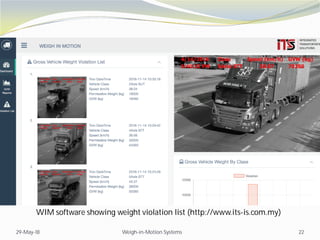
 WIM software displays:-
 Number of axles
 Axle weight
 Axle spacing
 Vehicle speed
29-May-18 Weigh-in-Motion Systems 19
 Vehicle class
 Gross Vehicle Weight
 Date & time of passing
 Overload warning
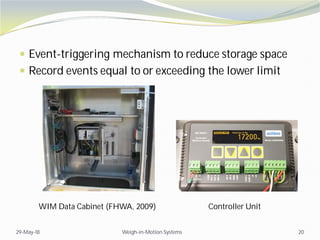
 Event-triggering mechanism to reduce storage space
 Record events equal to or exceeding the lower limit
29-May-18 Weigh-in-Motion Systems 20
WIM Data Cabinet (FHWA, 2009) Controller Unit
29-May-18 Weigh-in-Motion Systems 21
WIM
Sensors
Signal
Amplification
Data acquisition
unit
Server at
control centre
29-May-18 Weigh-in-Motion Systems 22
WIM software showing weight violation list (http://www.its-is.com.my)
Implementation
 Details to be considered :-
 Average daily heavy vehicle traffic
 Structure of heavy vehicle
 Number of overloaded vehicles
 Source & destination of heavy vehicles
 Type & condition of road
 Horizontal & vertical alignment of road
 Geometric road location
 Pilot implementation is done first as WIM is costly
29-May-18 Weigh-in-Motion Systems 23
 Effectiveness is then measured based on:
 Change of vehicle travel time
 Traffic in central areas of the city
 Change in distance covered
 Change in impact on environment
 New traffic conditions (change in time lost, queue
length, number of stops etc...)
29-May-18 Weigh-in-Motion Systems 24
Case Studies
1. City of Gdynia, Poland
 To reduce heavy & overloaded vehicles from Port of
Gdynia entering into city central areas
 Measurement done at urban entry points
 Significant reduction in heavy vehicle on access roads
to city & no heavy vehicle traffic on entries into city
centre
 Shifting to smaller vehicle
29-May-18 Weigh-in-Motion Systems 25
2. Netherlands & France
 WIM + video surveillance or license plate number
recognition cameras (ANPR)
 Companies classified by severity level
3. USA
 To assess road infrastructure damage & impose weight
enforcement
 Portable WIM units deployed in Texas to collect traffic
details
4. Taiwan
 HS-WIM system for direct enforcement in 1998 & 2010
29-May-18 Weigh-in-Motion Systems 26
Uses of WIM
 Reduce overloaded vehicles
 Control access to busy parts of city
 Reduce road deterioration & repairs
 Road safety
 Bridge assessment
 Minimize environmental impacts
 Economical benefit
 Road infrastructure planning, design & maintenance
29-May-18 Weigh-in-Motion Systems 27
Limitations
 Accuracy of sensor decrease over time
 Malfunctioning of sensors affect data quality
 More time & cost for calibration & installation
 Lifetime of P-WIM is short
 Increase risk & traffic on secondary roads
 Laws & legislations
29-May-18 Weigh-in-Motion Systems 28
WIM Systems in India
 Overloaded vehicle – 13% of total accidents claiming
about 22,000 lives
 NHAI Recommendations
 Locations – entries to highways, toll plazas & locations
where heavy loads are likely to be carried (industries)
 Camera – to capture image of offending vehicle & its
registration number
 Alert messages via mobile apps to enforcement or
highway patrol agencies
29-May-18 Weigh-in-Motion Systems 29
 Accuracy – 98%
 Minimum axle weight of 40 tonnes at speed  5km/h
 Should work satisfactorily under:
 Wet road conditions
 Temperature range of -20C to +55C
 Relative humidity upto 95%
 Standby battery
 System shall be duly calibrated, tested & approved
29-May-18 Weigh-in-Motion Systems 30
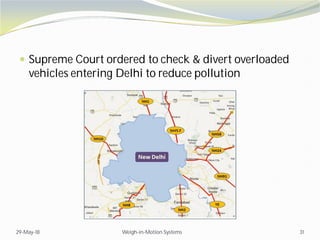
 Supreme Court ordered to check & divert overloaded
vehicles entering Delhi to reduce pollution
29-May-18 Weigh-in-Motion Systems 31
Conclusion
 Effective in overweight enforcement
 Optimize life expectancy of road & bridges
 Increase mobility & safety
 Collect traffic & vehicle weight data
 Costly & sophisticated but accurate & efficient
 Assist in planning, design & management
 In-depth analysis is necessary since a hasty change
may deteriorate the traffic
29-May-18 Weigh-in-Motion Systems 32
References
1. Oskarbski, J., and Kaszubowski, D., Implementation of Weigh-in-Motion
system in freight traffic management in urban areas, 2nd International
Conference “Green Cities – Green Logistics for Greener Cities”, Poland,
Transportation Research Procedia,Vol: 16, 2016, 449-463.
2. Haugen, T., Levy, J. R., Aarke, E., and Tello, M. E. P., Weigh-in-Motion
equipment – experiences and challenges, 6th Transport Research Arena,
Transportation Research Procedia, Vol: 14, 2016, 1423-1432.
3. Faruk, A. N.M., Liu, W., Lee, S. I., Naik, B., Chen, D. H. and Walubita, L. F.,
Traffic volume and load data measurement using portable weigh in motion
system: A case study, International Journal of Pavement Research and
Technology, Vol: 9, 2016, 202-213.
4. Jacob, B. and Cottineau, L. M., Weigh-in-motion for direct enforcement of
overloaded commercial vehicles, 6th Transport Research Arena,
Transportation Research Procedia, Vol: 14, 2016, 1413-1422.
5. Jacob, B., and Beaumelle, V. F. L., Improving truck safety: Potential of weigh-
in-motion technology, IATSS Research, Vol: 34, 2010, 9-15.
6. Yu, Y., Cai, C.S., and Deng, L., State-of-the-art review on bridge weigh-in-
motion technology, Advances in Structural Engineering, 2016, 1-17.
7. Burnos, P. and Gajda, J., Vehicle’s Weigh-in-Motion system for enforcement
in Poland, 11th ITS European Congress, Glasgow, Scotland, 2016, 1-11.
29-May-18 Weigh-in-Motion Systems 33
8. Karim, M. R., Ibrahim, N. I., Saifizul, A. A. and Yamanaka, H., Effectiveness
of vehicle weight enforcement in a developing country using weigh-in-
motion sorting system considering vehicle by-pass and enforcement
capability, IATSS Research, Vol: 37, 2014, 124-129.
9. Stanczyk, D. and Klein, E., Heavy traffic data collection and detection of
overloaded HGV, Transport Research Arena – Europe, Procedia – Social and
Behavioral Sciences, Vol: 48, 2012, 133-143.
10. Lydon, M., Taylor, S. E., Robinson D., Mufti A., and Brien E. J. O., Recent
developments in bridge weigh in motion (B-WIM), Journal of Civil Structural
Health Monitoring, Vol: 6, No: 1,2016, 69-81.
11. Batenko, A., Grakovski, A., Kabashkin, I., Petersons, E. and Sikerzhicki, Y.,
Weight-in-motion (WIM) measurements by fiber optic sensor: Problems and
solutions, Transport and Telecommunication, Vol: 12, No: 4, 2011, 27-33.
12. NHAI, Advanced Traffic Management System (ATMS) on NHs – Functional
and Technical Specifications, Highway Automation and Management
Division, 2016, 60-62.
13. FHWA, LTBP Program’s Literature Review on Weigh-in-Motion Systems, US
Department of Transportation, 2016.
14. FHWA, Deploying Weigh-In-Motion Installations on Asphalt Concrete
Pavements, US Department of Transportation, 2008.
15. EPCA for Delhi, Installation of weigh-in-motion bridges at all entry points,
MoRTH, 2016.
29-May-18 Weigh-in-Motion Systems 34
Weigh-in-Motion (WIM) Systems

Weigh-in-Motion (WIM) Systems

  • 1.
    Presented by, VIJAI KRISHNANV M.Tech Student Transportation Engg. Guided by, Dr. BINO I KOSHY Professor Dept. of Civil Engineering RIT, Kottayam
  • 2.
    Contents  Introduction  Weigh-in-MotionTechnology  Types of WIM Systems  Sensors  Data Acquisition & Storage  Implementation  Case Studies  Uses & Limitations  WIM Systems in India  Conclusion 29-May-18 Weigh-in-Motion Systems 2
  • 3.
    Introduction  Overloading ofvehicle  Damage & degradation of road infrastructure  Higher accident risks  Affect road traffic  Affect truck stability, maneuverability etc.  Pollution, noise, vibration & fuel consumption 29-May-18 Weigh-in-Motion Systems 3
  • 4.
     Static WeighingSystems  Accurate  Rarely used for enforcement  Limitations  Trucks are stopped  Congestion  Reduce efficiency of freight transport  Require large area 29-May-18 Weigh-in-Motion Systems 4 Static weigh bridge
  • 5.
     Control overloadedvehicle without disrupting traffic & freight operations  Legally loaded vehicles are passed  Offended vehicles are separated from traffic 29-May-18 Weigh-in-Motion Systems 5 Weigh-in-Motion Technology Process of determining any one or more of the parameters such as the vehicle mass, axle load, wheel load or other parameters of a moving vehicle, when it crosses over a set of sensors
  • 6.
    Types of WIMSystems 29-May-18 Weigh-in-Motion Systems 6 Permanent Systems Portable Systems LS-WIM HS-WIM B-WIM P-WIM WIM Speed Installation location
  • 7.
    1. Low-Speed WIMsystem (LS-WIM)  Optimal speed 5 to 10km/h  Minimum accuracy of 95%  Outside main traffic flow 2. High-Speed WIM system (HS-WIM)  Weighs at desired speed upto 130km/h 29-May-18 Weigh-in-Motion Systems 7 LS-WIM HS-WIM (Jacob B. & Beaumelle V., 2010)
  • 8.
    3. Pavement-based WIM systems(P-WIM)  Sensors installed on road surface  Limitations:  Traffic interruption  Poor durability  Accuracy is less on rough road 29-May-18 Weigh-in-Motion Systems 8 P-WIM installation on pavement
  • 9.
    4. Bridge-based WIMsystem (B-WIM)  Measure deformation of bridge  Strain sensors installed on bridge soffit  Advantages over P-WIM  No traffic interruption for installation  Bridge health monitoring & assessment  Non-destructive implementation  More durable  Multiple heavy vehicles simultaneously on bridge, result in biased data  SiWIM – a commercial B-WIM system 29-May-18 Weigh-in-Motion Systems 9
  • 10.
    5. Portable WIMsystems  Sensors affixed to pavement surface by tapes  2 sensors at 2.5 m distance  Advantages:  Convenient & cost effective  No traffic closure or trench required  Limitations:  Require in-situ calibration at each site  Loss accuracy & sensitivity over time  Recommended for 7 days only 29-May-18 Weigh-in-Motion Systems 10
  • 11.
    29-May-18 Weigh-in-Motion Systems11 Installing Portable WIM system on pavement Portable WIM data (Faruk et al., 2016)
  • 12.
    Sensors  Measure axleload & spacing  Convert load to electric signals 1. Based on width of sensor 1. Plate Sensors 2. Strip Sensors 2. Based on purpose 1. Weighing sensors 2. Axle detecting sensors 29-May-18 Weigh-in-Motion Systems 12
  • 13.
    1. Plate sensors Use strain gauges  High strength, rectangular steel plates  More accurate, but costly  Difficult to install 2. Strip Sensors  Width is only few centimetres  Less expensive & easy to install  Highly accurate on smooth road surface, but less accurate on deteriorated surfaces 29-May-18 Weigh-in-Motion Systems 13
  • 14.
    29-May-18 Weigh-in-Motion Systems14 Strip Sensor (http://www.mdpi.com) Bending Plate Sensor
  • 15.
    3. Weighing Sensors Vehicle load  Electric Signal  Types of weighing sensors 1. Foil Strain Gauges  Most commonly used  Cheap & have acceptable accuracy  Not suitable for long term 2. Vibrating Wire Strain Gauge  Good durability & require less surface preparation 3. Fibre Optic Sensors  Not affected by electromagnetic interference  Cheap, small in size & more durable 29-May-18 Weigh-in-Motion Systems 15
  • 16.
    4. Axle Detectors Traditional axle detectors  Pneumatic tubes & induction loops  Require lane closure  2 parallel detectors at known spacing  Sharp response when vehicle wheel pass over the detectors  Free-of-Axle (FAD) Detectors  No need of lane closure  FAD sensor measure strain response  Image processing & video-based systems 29-May-18 Weigh-in-Motion Systems 16
  • 17.
     Installation Locationof B-WIM sensors  Function of sensor  Weighing sensor  At near mid-span of bridge  Axle detectors  Traditional sensors on road surface & FAD sensors under the bridge  Type of Bridge  T-Beam RCC Bridge  FAD sensors oriented longitudinally & installed close to beginning or end of bridge span, directly below wheel path 29-May-18 Weigh-in-Motion Systems 17
  • 18.
    29-May-18 Weigh-in-Motion Systems18 Bridge-based WIM system (https://www.cestel.eu) Weighing Sensors Axle Sensors
  • 19.
    Data Acquisition &Storage  Sensors & cameras are communicated with on-site data acquisition system (WIM data cabinet)  Wired or wireless connection  Data transmitted to control centre server  WIM software displays:-  Number of axles  Axle weight  Axle spacing  Vehicle speed 29-May-18 Weigh-in-Motion Systems 19  Vehicle class  Gross Vehicle Weight  Date & time of passing  Overload warning
  • 20.
     Event-triggering mechanismto reduce storage space  Record events equal to or exceeding the lower limit 29-May-18 Weigh-in-Motion Systems 20 WIM Data Cabinet (FHWA, 2009) Controller Unit
  • 21.
    29-May-18 Weigh-in-Motion Systems21 WIM Sensors Signal Amplification Data acquisition unit Server at control centre
  • 22.
    29-May-18 Weigh-in-Motion Systems22 WIM software showing weight violation list (http://www.its-is.com.my)
  • 23.
    Implementation  Details tobe considered :-  Average daily heavy vehicle traffic  Structure of heavy vehicle  Number of overloaded vehicles  Source & destination of heavy vehicles  Type & condition of road  Horizontal & vertical alignment of road  Geometric road location  Pilot implementation is done first as WIM is costly 29-May-18 Weigh-in-Motion Systems 23
  • 24.
     Effectiveness isthen measured based on:  Change of vehicle travel time  Traffic in central areas of the city  Change in distance covered  Change in impact on environment  New traffic conditions (change in time lost, queue length, number of stops etc...) 29-May-18 Weigh-in-Motion Systems 24
  • 25.
    Case Studies 1. Cityof Gdynia, Poland  To reduce heavy & overloaded vehicles from Port of Gdynia entering into city central areas  Measurement done at urban entry points  Significant reduction in heavy vehicle on access roads to city & no heavy vehicle traffic on entries into city centre  Shifting to smaller vehicle 29-May-18 Weigh-in-Motion Systems 25
  • 26.
    2. Netherlands &France  WIM + video surveillance or license plate number recognition cameras (ANPR)  Companies classified by severity level 3. USA  To assess road infrastructure damage & impose weight enforcement  Portable WIM units deployed in Texas to collect traffic details 4. Taiwan  HS-WIM system for direct enforcement in 1998 & 2010 29-May-18 Weigh-in-Motion Systems 26
  • 27.
    Uses of WIM Reduce overloaded vehicles  Control access to busy parts of city  Reduce road deterioration & repairs  Road safety  Bridge assessment  Minimize environmental impacts  Economical benefit  Road infrastructure planning, design & maintenance 29-May-18 Weigh-in-Motion Systems 27
  • 28.
    Limitations  Accuracy ofsensor decrease over time  Malfunctioning of sensors affect data quality  More time & cost for calibration & installation  Lifetime of P-WIM is short  Increase risk & traffic on secondary roads  Laws & legislations 29-May-18 Weigh-in-Motion Systems 28
  • 29.
    WIM Systems inIndia  Overloaded vehicle – 13% of total accidents claiming about 22,000 lives  NHAI Recommendations  Locations – entries to highways, toll plazas & locations where heavy loads are likely to be carried (industries)  Camera – to capture image of offending vehicle & its registration number  Alert messages via mobile apps to enforcement or highway patrol agencies 29-May-18 Weigh-in-Motion Systems 29
  • 30.
     Accuracy –98%  Minimum axle weight of 40 tonnes at speed  5km/h  Should work satisfactorily under:  Wet road conditions  Temperature range of -20C to +55C  Relative humidity upto 95%  Standby battery  System shall be duly calibrated, tested & approved 29-May-18 Weigh-in-Motion Systems 30
  • 31.
     Supreme Courtordered to check & divert overloaded vehicles entering Delhi to reduce pollution 29-May-18 Weigh-in-Motion Systems 31
  • 32.
    Conclusion  Effective inoverweight enforcement  Optimize life expectancy of road & bridges  Increase mobility & safety  Collect traffic & vehicle weight data  Costly & sophisticated but accurate & efficient  Assist in planning, design & management  In-depth analysis is necessary since a hasty change may deteriorate the traffic 29-May-18 Weigh-in-Motion Systems 32
  • 33.
    References 1. Oskarbski, J.,and Kaszubowski, D., Implementation of Weigh-in-Motion system in freight traffic management in urban areas, 2nd International Conference “Green Cities – Green Logistics for Greener Cities”, Poland, Transportation Research Procedia,Vol: 16, 2016, 449-463. 2. Haugen, T., Levy, J. R., Aarke, E., and Tello, M. E. P., Weigh-in-Motion equipment – experiences and challenges, 6th Transport Research Arena, Transportation Research Procedia, Vol: 14, 2016, 1423-1432. 3. Faruk, A. N.M., Liu, W., Lee, S. I., Naik, B., Chen, D. H. and Walubita, L. F., Traffic volume and load data measurement using portable weigh in motion system: A case study, International Journal of Pavement Research and Technology, Vol: 9, 2016, 202-213. 4. Jacob, B. and Cottineau, L. M., Weigh-in-motion for direct enforcement of overloaded commercial vehicles, 6th Transport Research Arena, Transportation Research Procedia, Vol: 14, 2016, 1413-1422. 5. Jacob, B., and Beaumelle, V. F. L., Improving truck safety: Potential of weigh- in-motion technology, IATSS Research, Vol: 34, 2010, 9-15. 6. Yu, Y., Cai, C.S., and Deng, L., State-of-the-art review on bridge weigh-in- motion technology, Advances in Structural Engineering, 2016, 1-17. 7. Burnos, P. and Gajda, J., Vehicle’s Weigh-in-Motion system for enforcement in Poland, 11th ITS European Congress, Glasgow, Scotland, 2016, 1-11. 29-May-18 Weigh-in-Motion Systems 33
  • 34.
    8. Karim, M.R., Ibrahim, N. I., Saifizul, A. A. and Yamanaka, H., Effectiveness of vehicle weight enforcement in a developing country using weigh-in- motion sorting system considering vehicle by-pass and enforcement capability, IATSS Research, Vol: 37, 2014, 124-129. 9. Stanczyk, D. and Klein, E., Heavy traffic data collection and detection of overloaded HGV, Transport Research Arena – Europe, Procedia – Social and Behavioral Sciences, Vol: 48, 2012, 133-143. 10. Lydon, M., Taylor, S. E., Robinson D., Mufti A., and Brien E. J. O., Recent developments in bridge weigh in motion (B-WIM), Journal of Civil Structural Health Monitoring, Vol: 6, No: 1,2016, 69-81. 11. Batenko, A., Grakovski, A., Kabashkin, I., Petersons, E. and Sikerzhicki, Y., Weight-in-motion (WIM) measurements by fiber optic sensor: Problems and solutions, Transport and Telecommunication, Vol: 12, No: 4, 2011, 27-33. 12. NHAI, Advanced Traffic Management System (ATMS) on NHs – Functional and Technical Specifications, Highway Automation and Management Division, 2016, 60-62. 13. FHWA, LTBP Program’s Literature Review on Weigh-in-Motion Systems, US Department of Transportation, 2016. 14. FHWA, Deploying Weigh-In-Motion Installations on Asphalt Concrete Pavements, US Department of Transportation, 2008. 15. EPCA for Delhi, Installation of weigh-in-motion bridges at all entry points, MoRTH, 2016. 29-May-18 Weigh-in-Motion Systems 34