Prepared by NIBEDITA MUKHERJEE
Visiting Faculty at BCET
M.SC IN BOTANY & GATE
 EIA is one of the tools available with the
planners to achieve the goal of harmonising
development activities with the
environmental concerns. EIA integrates the
environmental concerns in the
developmental activites right at the time of
initiating for preparing the feasibility report.
EIA can often prevent future liabilities or
expensive alterations in project desgin.
 The objective of EIA is to foresee the
potential environmental problems that would
arise out of the proposed development and
address them in the projects planning and
desgin stage. It should assist planners and
government authorities in the decision
making process by identifying the key
impacts and formulating the mitigation
measures.
 Ministry of Environment & Forest /( MoE&F)
has taken several policy initiatives and
enacted environmental and pollution control
legislations to prevent indiscriminate
exploitation of natural resources and to
promote integration of environmental
concerns in developmental projects. One
such initiative is the notification on
Environmental Impact Assessment (EIA) of
developmental projects 1994 under the
provisions of Environment Protection Act,
1986 .
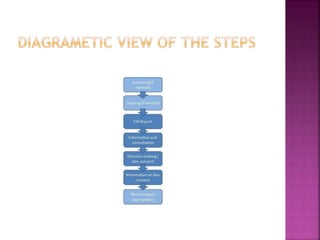
 The EIA process in INDIA is made up of the
following phases:
1. Screening
2. Scoping
3. Impact Assessment & Mitigation
4. The EIA Report
5. Public hearing
6. Decision making
7. Monitoring the clearance condition .
 Screening is done to see whether a project requires
environmental clearance as per the statutory notification.
 Screening criteria is based on:
 Scales of investment.
 Types of development; &
 Location of development.
 A project requires statutory environmental clearance only
if the provisions of EIA notification and one or more
statutory notification under Environment ( Protection ) Act
1986 cover it.
 A project will have several ramifications biophysical or
environmental, economic and social. Hence, it requires
some degree of public participation. The law for EIA varies
from country to country. If screening shows that a project
necessitates EIA, it moves to the next stage.
 Scoping is the procedure of identifying the key environmental
issues and is possibly the most important step in an EIA. Scoping
means the scope or range of the EIA report.
 It undertakes the project’s effect on the air, water, soil, noise
level, air quality and physical impact.
 It identifies issues and concerns, decides the assessment
methods, identifies affected parties and invites public
participation for agreement on debatable issues. In which public
participation involves interactions of all stakeholders including
project beneficiaries, local people, private sectors, NGOs,
scientists and other.
 It is on-going process and is likely to continue in the planning and
design phases of the project.
 Scoping is important because it is possible to bring changes in the
project in the early stages of the cycle of the project and it
ensures the study of all possible important issues.
 In this stage there is an option for cancelling or revising the
project. After crossing this stage, there is little opportunity for
major changes to the project.
 Impact Prediction is a way of ‘mapping’ the environmental consequences
of the significant aspects of the project and its alternatives.
 There are two steps in impact analysis:
 (i) Identification:
 Identification of the impacts would have been initiated in the scoping
stage itself. These initial identifications may be confirmed and new ones
are added as and when the investigations reveal.
 (ii) Prediction of Impacts:
 Predication of impacts is both qualitative and quantitative. The scale and
severity of an impact is determined by whether it is reversible or
irreversible. If the impact is reversible, then it may be taken as low
impact. If the adverse impact cannot be reversed then the impact is said
to be high.
 Duration of the impact is equally important to understand. The
chronological aspects of impacts, arising at different stages must be
taken into account.
 Thus, it may be categorized into:
 (i) Short-term (3-9 years)
 (ii) Medium-term (10-20 years)
 (iii) Long-term (beyond 20 years)
Mitigation:
 This stage includes recommended actions
that can offset the adverse impacts of the
project. This is done with the idea of
lessening the negative effects and improving
the scope for project benefits.
 Mitigating measures may be:
 (i) Preventive: public awareness programmes
 (ii) Compensatory: to reduce potential
reactions
 (iii) Corrective: putting into place devices
and installations
 . Reporting To Decision-Making Body:
 The project authorities have to furnish the following documents for environmental appraisal of a development project.
 (i) Detailed project report (DPR)
 (ii) Filled in questionnaire
 (iii) Environmental impact statement (EIS): EIS should provide the possible impact (positive and negative) of the project.
 Some of the issues to be included are:
 1. Impact on soil, water (hydrologic regime, ground water and surface water) and air quality
 2. Impact on land use, forests, agriculture, fisheries, tourism, recreation etc.
 3. Socio-economic impact including short and long-term impact on population
 4. Impact on health
 5. Impact on flora, fauna and wildlife, particularly endemic and endangered species, and
 6. Cost benefits analysis including the measures for environmental protection.
 (iv) Environmental Management Plan (EMP):
 It covers the following aspects:
 1. Safeguards and control measures proposed to prevent or mitigate the adverse environmental impact
 2. Plans for habitation of project outers
 3. Contingency plans for dealing with accidents and disasters
 4. Monitoring add feedback mechanisms on implementation of necessary safeguards.
 (v) Human Exposure Assessment Location (HEAL):
 The concept of Human Exposure Assessment Location (HEAL) was developed as a part of the health-related monitoring programme by WHO in
cooperation with UNEP, and the project has three components, viz., air quality monitoring, water quality monitoring and food contamination
monitoring on a global basis.
 In our country, Chembur and central Bombay city have been identified for such study of human exposure with reference to pollutants such as
chlorinated pesticides (DDT and BHC), heavy metals (lead, cadmium) and air pollutants (nitrogen oxides).
Public Hearing:
 After the completion of EIA report the law requires that
the public must be informed and consulted on a proposed
development after the completion of EIA report.
 Any one likely to be affected by the proposed project is
entitled to have access to the executive summary of the
EIA.
 The affected person may include:
 (i) Bonafide local residents;
 (ii) Local associations;
 (iii) Environmental groups active in the area
 (iv) Any other person located at the project site/ sites of
displacement
 They are to be given an opportunity to make oral/written
suggestions to the State Pollution Control Board as per
Schedule IV of the act.
 (EIA Report):
 Once the final report is prepared, it may be
reviewed based on the comments and inputs
of stakeholders.
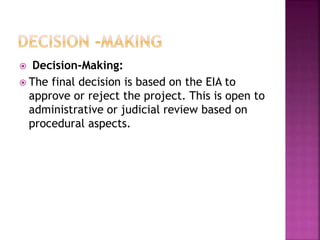
 Decision-Making:
 The final decision is based on the EIA to
approve or reject the project. This is open to
administrative or judicial review based on
procedural aspects.
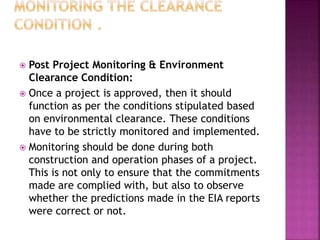
 Post Project Monitoring & Environment
Clearance Condition:
 Once a project is approved, then it should
function as per the conditions stipulated based
on environmental clearance. These conditions
have to be strictly monitored and implemented.
 Monitoring should be done during both
construction and operation phases of a project.
This is not only to ensure that the commitments
made are complied with, but also to observe
whether the predictions made in the EIA reports
were correct or not.
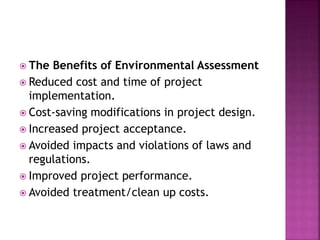
 The Benefits of Environmental Assessment
 Reduced cost and time of project
implementation.
 Cost-saving modifications in project design.
 Increased project acceptance.
 Avoided impacts and violations of laws and
regulations.
 Improved project performance.
 Avoided treatment/clean up costs.
 PROJECT NAME-
 LOCATION –
 AREA IN DETAILS
 CONSTRUCTION DETAILS-
 REAGION CONDITION BEFORE & AFTER THE
PROJECT-
 PROJECT’S EFFECT ON ENVIRONMENT-
 REPORT ABOUT GREENY SURROUNDINGS-
 PROJECT COST –
 SOCIAL IMPACTS FOR THIS PROJECT-
 ECONOMICAL IMPACTS FOR THIS PROJECT-
 NOTE FROM SYLLABUS
THANK YOU

ENVIRONMENTAL IMPACT ASSESSMENT (EIA)2.pptx

  • 1.
    Prepared by NIBEDITAMUKHERJEE Visiting Faculty at BCET M.SC IN BOTANY & GATE
  • 2.
     EIA isone of the tools available with the planners to achieve the goal of harmonising development activities with the environmental concerns. EIA integrates the environmental concerns in the developmental activites right at the time of initiating for preparing the feasibility report. EIA can often prevent future liabilities or expensive alterations in project desgin.
  • 3.
     The objectiveof EIA is to foresee the potential environmental problems that would arise out of the proposed development and address them in the projects planning and desgin stage. It should assist planners and government authorities in the decision making process by identifying the key impacts and formulating the mitigation measures.
  • 4.
     Ministry ofEnvironment & Forest /( MoE&F) has taken several policy initiatives and enacted environmental and pollution control legislations to prevent indiscriminate exploitation of natural resources and to promote integration of environmental concerns in developmental projects. One such initiative is the notification on Environmental Impact Assessment (EIA) of developmental projects 1994 under the provisions of Environment Protection Act, 1986 .
  • 5.
     The EIAprocess in INDIA is made up of the following phases: 1. Screening 2. Scoping 3. Impact Assessment & Mitigation 4. The EIA Report 5. Public hearing 6. Decision making 7. Monitoring the clearance condition .
  • 6.
     Screening isdone to see whether a project requires environmental clearance as per the statutory notification.  Screening criteria is based on:  Scales of investment.  Types of development; &  Location of development.  A project requires statutory environmental clearance only if the provisions of EIA notification and one or more statutory notification under Environment ( Protection ) Act 1986 cover it.  A project will have several ramifications biophysical or environmental, economic and social. Hence, it requires some degree of public participation. The law for EIA varies from country to country. If screening shows that a project necessitates EIA, it moves to the next stage.
  • 7.
     Scoping isthe procedure of identifying the key environmental issues and is possibly the most important step in an EIA. Scoping means the scope or range of the EIA report.  It undertakes the project’s effect on the air, water, soil, noise level, air quality and physical impact.  It identifies issues and concerns, decides the assessment methods, identifies affected parties and invites public participation for agreement on debatable issues. In which public participation involves interactions of all stakeholders including project beneficiaries, local people, private sectors, NGOs, scientists and other.  It is on-going process and is likely to continue in the planning and design phases of the project.  Scoping is important because it is possible to bring changes in the project in the early stages of the cycle of the project and it ensures the study of all possible important issues.  In this stage there is an option for cancelling or revising the project. After crossing this stage, there is little opportunity for major changes to the project.
  • 8.
     Impact Predictionis a way of ‘mapping’ the environmental consequences of the significant aspects of the project and its alternatives.  There are two steps in impact analysis:  (i) Identification:  Identification of the impacts would have been initiated in the scoping stage itself. These initial identifications may be confirmed and new ones are added as and when the investigations reveal.  (ii) Prediction of Impacts:  Predication of impacts is both qualitative and quantitative. The scale and severity of an impact is determined by whether it is reversible or irreversible. If the impact is reversible, then it may be taken as low impact. If the adverse impact cannot be reversed then the impact is said to be high.  Duration of the impact is equally important to understand. The chronological aspects of impacts, arising at different stages must be taken into account.  Thus, it may be categorized into:  (i) Short-term (3-9 years)  (ii) Medium-term (10-20 years)  (iii) Long-term (beyond 20 years)
  • 9.
    Mitigation:  This stageincludes recommended actions that can offset the adverse impacts of the project. This is done with the idea of lessening the negative effects and improving the scope for project benefits.  Mitigating measures may be:  (i) Preventive: public awareness programmes  (ii) Compensatory: to reduce potential reactions  (iii) Corrective: putting into place devices and installations
  • 10.
     . ReportingTo Decision-Making Body:  The project authorities have to furnish the following documents for environmental appraisal of a development project.  (i) Detailed project report (DPR)  (ii) Filled in questionnaire  (iii) Environmental impact statement (EIS): EIS should provide the possible impact (positive and negative) of the project.  Some of the issues to be included are:  1. Impact on soil, water (hydrologic regime, ground water and surface water) and air quality  2. Impact on land use, forests, agriculture, fisheries, tourism, recreation etc.  3. Socio-economic impact including short and long-term impact on population  4. Impact on health  5. Impact on flora, fauna and wildlife, particularly endemic and endangered species, and  6. Cost benefits analysis including the measures for environmental protection.  (iv) Environmental Management Plan (EMP):  It covers the following aspects:  1. Safeguards and control measures proposed to prevent or mitigate the adverse environmental impact  2. Plans for habitation of project outers  3. Contingency plans for dealing with accidents and disasters  4. Monitoring add feedback mechanisms on implementation of necessary safeguards.  (v) Human Exposure Assessment Location (HEAL):  The concept of Human Exposure Assessment Location (HEAL) was developed as a part of the health-related monitoring programme by WHO in cooperation with UNEP, and the project has three components, viz., air quality monitoring, water quality monitoring and food contamination monitoring on a global basis.  In our country, Chembur and central Bombay city have been identified for such study of human exposure with reference to pollutants such as chlorinated pesticides (DDT and BHC), heavy metals (lead, cadmium) and air pollutants (nitrogen oxides).
  • 11.
    Public Hearing:  Afterthe completion of EIA report the law requires that the public must be informed and consulted on a proposed development after the completion of EIA report.  Any one likely to be affected by the proposed project is entitled to have access to the executive summary of the EIA.  The affected person may include:  (i) Bonafide local residents;  (ii) Local associations;  (iii) Environmental groups active in the area  (iv) Any other person located at the project site/ sites of displacement  They are to be given an opportunity to make oral/written suggestions to the State Pollution Control Board as per Schedule IV of the act.
  • 12.
     (EIA Report): Once the final report is prepared, it may be reviewed based on the comments and inputs of stakeholders.
  • 13.
     Decision-Making:  Thefinal decision is based on the EIA to approve or reject the project. This is open to administrative or judicial review based on procedural aspects.
  • 14.
     Post ProjectMonitoring & Environment Clearance Condition:  Once a project is approved, then it should function as per the conditions stipulated based on environmental clearance. These conditions have to be strictly monitored and implemented.  Monitoring should be done during both construction and operation phases of a project. This is not only to ensure that the commitments made are complied with, but also to observe whether the predictions made in the EIA reports were correct or not.
  • 16.
     The Benefitsof Environmental Assessment  Reduced cost and time of project implementation.  Cost-saving modifications in project design.  Increased project acceptance.  Avoided impacts and violations of laws and regulations.  Improved project performance.  Avoided treatment/clean up costs.
  • 17.
     PROJECT NAME- LOCATION –  AREA IN DETAILS  CONSTRUCTION DETAILS-  REAGION CONDITION BEFORE & AFTER THE PROJECT-  PROJECT’S EFFECT ON ENVIRONMENT-  REPORT ABOUT GREENY SURROUNDINGS-  PROJECT COST –  SOCIAL IMPACTS FOR THIS PROJECT-  ECONOMICAL IMPACTS FOR THIS PROJECT-
  • 19.
     NOTE FROMSYLLABUS
  • 20.