Application of SEA in
Infrastructure Planning
STRATEGIC ENVIRONMENTAL ASSESSMENT CONFERENCE,
Jakarta, 4 – 5 DECEMBER 2017
By:
Bambang Tri Sasongko Adi (PT HATFIELD INDONESIA)
Images are downloaded from https://www.competeprosper.ca/
Outlines
• Introduction
• Infrastructure development plan (2015-2019)
• Infrastructure sector and SDGs
• Characteristics of infrastructure development
• Is AMDAL only sufficient?
• SEA for infrastructure program
• SEA Typology
• Why require SEA?
• International practices
• SEA for infrastructure sector
Introduction
• Infrastructure is the main driver of growth in Indonesian
economy;
• Infrastructure investment commitments could raise
Indonesia’s GDP by 0.3 percent, out of 0.9 percent additional
growth from all of implemented commitments by 2018 (tax,
SMEs, business licenses, manpower, market, etc.)1
• Strategic infrastructure projects are usually complex and
beyond the capacity of AMDAL to address environmental and
social issues
12017 Growth Strategy – Indonesia (G20 Germany 2017)
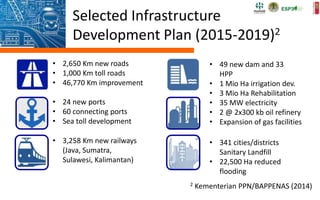
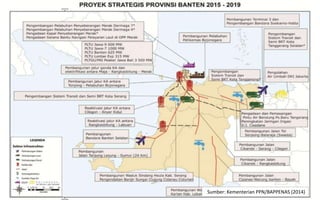
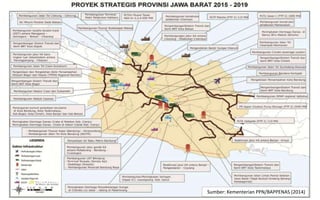
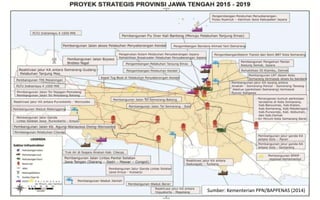
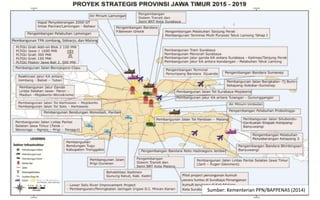
Selected Infrastructure
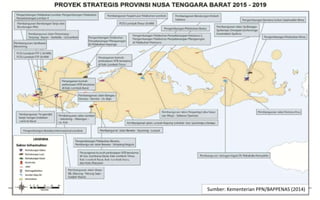
Development Plan (2015-2019)2
2 Kementerian PPN/BAPPENAS (2014)
• 49 new dam and 33
HPP
• 1 Mio Ha irrigation dev.
• 3 Mio Ha Rehabilitation
• 341 cities/districts
Sanitary Landfill
• 22,500 Ha reduced
flooding
• 35 MW electricity
• 2 @ 2x300 kb oil refinery
• Expansion of gas facilities
• 2,650 Km new roads
• 1,000 Km toll roads
• 46,770 Km improvement
• 24 new ports
• 60 connecting ports
• Sea toll development
• 3,258 Km new railways
(Java, Sumatra,
Sulawesi, Kalimantan)
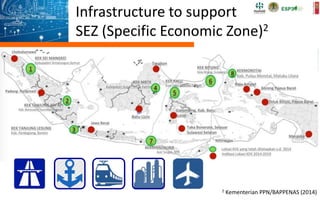
Infrastructure to support
SEZ (Specific Economic Zone)2
2 Kementerian PPN/BAPPENAS (2014)
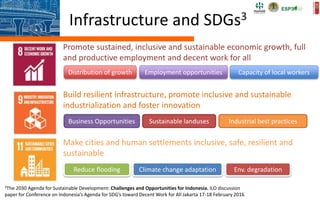
Infrastructure and SDGs3
Promote sustained, inclusive and sustainable economic growth, full
and productive employment and decent work for all
3The 2030 Agenda for Sustainable Development: Challenges and Opportunities for Indonesia. ILO discussion
paper for Conference on Indonesia’s Agenda for SDG’s toward Decent Work for All Jakarta 17-18 February 2016
Build resilient infrastructure, promote inclusive and sustainable
industrialization and foster innovation
Make cities and human settlements inclusive, safe, resilient and
sustainable
Distribution of growth Employment opportunities Capacity of local workers
Business Opportunities Sustainable landuses Industrial best practices
Reduce flooding Climate change adaptation Env. degradation
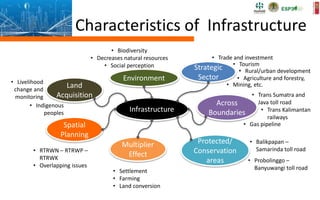
Characteristics of Infrastructure
Infrastructure
Protected/
Conservation
areas
• Balikpapan –
Samarinda toll road
• Probolinggo –
Banyuwangi toll road
Across
Boundaries
• Trans Sumatra and
Java toll road
• Gas pipeline
• Trans Kalimantan
railways
Strategic
Sector
• Trade and investment
• Tourism
• Mining, etc.
• Rural/urban development
• Agriculture and forestry,
Multiplier
Effect
• Settlement
• Farming
• Land conversion
Spatial
Planning
• RTRWN – RTRWP –
RTRWK
• Overlapping issues
Land
Acquisition
• Livelihood
change and
monitoring
• Indigenous
peoples
Environment
• Biodiversity
• Decreases natural resources
• Social perception
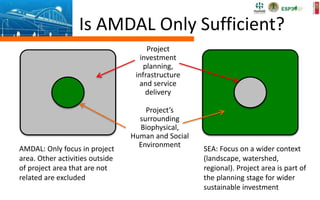
Is AMDAL Only Sufficient?
Project
investment
planning,
infrastructure
and service
delivery
Project’s
surrounding
Biophysical,
Human and Social
Environment
AMDAL: Only focus in project
area. Other activities outside
of project area that are not
related are excluded
SEA: Focus on a wider context
(landscape, watershed,
regional). Project area is part of
the planning stage for wider
sustainable investment
Sumber: Kementerian PPN/BAPPENAS (2014)
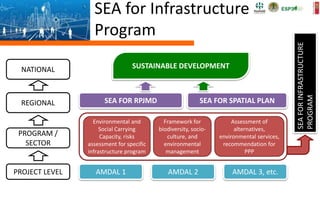
SEA for Infrastructure
Program
AMDAL 3, etc.AMDAL 1 AMDAL 2PROJECT LEVEL
PROGRAM /
SECTOR
REGIONAL SEA FOR RPJMD
Environmental and
Social Carrying
Capacity, risks
assessment for specific
infrastructure program
Framework for
biodiversity, socio-
culture, and
environmental
management
Assessment of
alternatives,
environmental services,
recommendation for
PPP
NATIONAL
SEA FOR SPATIAL PLAN
SEAFORINFRASTRUCTURE
PROGRAM
SUSTAINABLE DEVELOPMENT
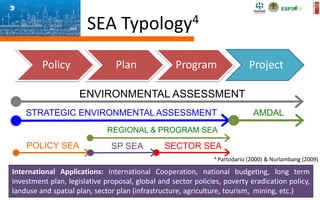
SEA Typology4
Policy Plan Program Project
ENVIRONMENTAL ASSESSMENT
STRATEGIC ENVIRONMENTAL ASSESSMENT AMDAL
REGIONAL & PROGRAM SEA
POLICY SEA SECTOR SEA
International Applications: International Cooperation, national budgeting, long term
investment plan, legislative proposal, global and sector policies, poverty eradication policy,
landuse and spatial plan, sector plan (infrastructure, agriculture, tourism, mining, etc.)
4 Partodario (2000) & Nurlambang (2009)
SP SEA
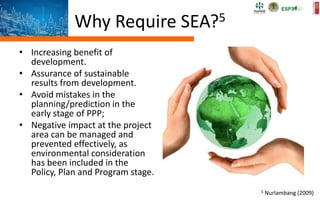
Why Require SEA?5
• Increasing benefit of
development.
• Assurance of sustainable
results from development.
• Avoid mistakes in the
planning/prediction in the
early stage of PPP;
• Negative impact at the project
area can be managed and
prevented effectively, as
environmental consideration
has been included in the
Policy, Plan and Program stage.
5 Nurlambang (2009)
International practices
• Strategic Environmental
Assessment in the Transport Sector:
An Overview of Legislation and
Practice in EU Member States. EC-
DG Environment, October 2000
• Report on Strategic Environmental
Assessment for the Energy Sector
Development of the Rep. of Serbia
by 2025 with projection until 2030
(2013)
• Strategic Environmental
Assessment for Wind Power and
Solar PV in South Africa (2015)
• SEA for Fundy Tidal Energy, Nova
Scotia Department of Energy (2008)
• Strategic Environmental
Assessment for Future Leasing for
Offshore Wind Farms and Licensing
for Offshore Oil & Gas and Gas
Storage (2009)
• Integrating SEA into Power
Planning. ADB (2015)
• Strategic Environmental
Assessment for Transport in Four
Nordic Countries (November 1999)
• Strategic Environmental
Assessment to Improve
Infrastructure Impact Assessments
in Brazil (2013)
SEA for Infrastructure Sector
• Regulation on SEA: Law
32/2009 and PP
46/2016;
– Plan, Policy and Program
that has the potential
causing impacts and/or
environmental risks
– Public request for PPP to
have a SEA
THANK YOU
For further information, please contact:
Bambang Tri Sasongko Adi
PT Hatfield Indonesia
bambangtsa@hatfieldgroup.com

Strategic Environmental Assessment for Infrastructure Sector

  • 1.
    Application of SEAin Infrastructure Planning STRATEGIC ENVIRONMENTAL ASSESSMENT CONFERENCE, Jakarta, 4 – 5 DECEMBER 2017 By: Bambang Tri Sasongko Adi (PT HATFIELD INDONESIA) Images are downloaded from https://www.competeprosper.ca/
  • 2.
    Outlines • Introduction • Infrastructuredevelopment plan (2015-2019) • Infrastructure sector and SDGs • Characteristics of infrastructure development • Is AMDAL only sufficient? • SEA for infrastructure program • SEA Typology • Why require SEA? • International practices • SEA for infrastructure sector
  • 3.
    Introduction • Infrastructure isthe main driver of growth in Indonesian economy; • Infrastructure investment commitments could raise Indonesia’s GDP by 0.3 percent, out of 0.9 percent additional growth from all of implemented commitments by 2018 (tax, SMEs, business licenses, manpower, market, etc.)1 • Strategic infrastructure projects are usually complex and beyond the capacity of AMDAL to address environmental and social issues 12017 Growth Strategy – Indonesia (G20 Germany 2017)
  • 4.
    Selected Infrastructure Development Plan(2015-2019)2 2 Kementerian PPN/BAPPENAS (2014) • 49 new dam and 33 HPP • 1 Mio Ha irrigation dev. • 3 Mio Ha Rehabilitation • 341 cities/districts Sanitary Landfill • 22,500 Ha reduced flooding • 35 MW electricity • 2 @ 2x300 kb oil refinery • Expansion of gas facilities • 2,650 Km new roads • 1,000 Km toll roads • 46,770 Km improvement • 24 new ports • 60 connecting ports • Sea toll development • 3,258 Km new railways (Java, Sumatra, Sulawesi, Kalimantan)
  • 5.
    Infrastructure to support SEZ(Specific Economic Zone)2 2 Kementerian PPN/BAPPENAS (2014)
  • 6.
    Infrastructure and SDGs3 Promotesustained, inclusive and sustainable economic growth, full and productive employment and decent work for all 3The 2030 Agenda for Sustainable Development: Challenges and Opportunities for Indonesia. ILO discussion paper for Conference on Indonesia’s Agenda for SDG’s toward Decent Work for All Jakarta 17-18 February 2016 Build resilient infrastructure, promote inclusive and sustainable industrialization and foster innovation Make cities and human settlements inclusive, safe, resilient and sustainable Distribution of growth Employment opportunities Capacity of local workers Business Opportunities Sustainable landuses Industrial best practices Reduce flooding Climate change adaptation Env. degradation
  • 7.
    Characteristics of Infrastructure Infrastructure Protected/ Conservation areas •Balikpapan – Samarinda toll road • Probolinggo – Banyuwangi toll road Across Boundaries • Trans Sumatra and Java toll road • Gas pipeline • Trans Kalimantan railways Strategic Sector • Trade and investment • Tourism • Mining, etc. • Rural/urban development • Agriculture and forestry, Multiplier Effect • Settlement • Farming • Land conversion Spatial Planning • RTRWN – RTRWP – RTRWK • Overlapping issues Land Acquisition • Livelihood change and monitoring • Indigenous peoples Environment • Biodiversity • Decreases natural resources • Social perception
  • 8.
    Is AMDAL OnlySufficient? Project investment planning, infrastructure and service delivery Project’s surrounding Biophysical, Human and Social Environment AMDAL: Only focus in project area. Other activities outside of project area that are not related are excluded SEA: Focus on a wider context (landscape, watershed, regional). Project area is part of the planning stage for wider sustainable investment
  • 9.
  • 10.
  • 11.
  • 12.
  • 13.
  • 14.
    SEA for Infrastructure Program AMDAL3, etc.AMDAL 1 AMDAL 2PROJECT LEVEL PROGRAM / SECTOR REGIONAL SEA FOR RPJMD Environmental and Social Carrying Capacity, risks assessment for specific infrastructure program Framework for biodiversity, socio- culture, and environmental management Assessment of alternatives, environmental services, recommendation for PPP NATIONAL SEA FOR SPATIAL PLAN SEAFORINFRASTRUCTURE PROGRAM SUSTAINABLE DEVELOPMENT
  • 15.
    SEA Typology4 Policy PlanProgram Project ENVIRONMENTAL ASSESSMENT STRATEGIC ENVIRONMENTAL ASSESSMENT AMDAL REGIONAL & PROGRAM SEA POLICY SEA SECTOR SEA International Applications: International Cooperation, national budgeting, long term investment plan, legislative proposal, global and sector policies, poverty eradication policy, landuse and spatial plan, sector plan (infrastructure, agriculture, tourism, mining, etc.) 4 Partodario (2000) & Nurlambang (2009) SP SEA
  • 16.
    Why Require SEA?5 •Increasing benefit of development. • Assurance of sustainable results from development. • Avoid mistakes in the planning/prediction in the early stage of PPP; • Negative impact at the project area can be managed and prevented effectively, as environmental consideration has been included in the Policy, Plan and Program stage. 5 Nurlambang (2009)
  • 17.
    International practices • StrategicEnvironmental Assessment in the Transport Sector: An Overview of Legislation and Practice in EU Member States. EC- DG Environment, October 2000 • Report on Strategic Environmental Assessment for the Energy Sector Development of the Rep. of Serbia by 2025 with projection until 2030 (2013) • Strategic Environmental Assessment for Wind Power and Solar PV in South Africa (2015) • SEA for Fundy Tidal Energy, Nova Scotia Department of Energy (2008) • Strategic Environmental Assessment for Future Leasing for Offshore Wind Farms and Licensing for Offshore Oil & Gas and Gas Storage (2009) • Integrating SEA into Power Planning. ADB (2015) • Strategic Environmental Assessment for Transport in Four Nordic Countries (November 1999) • Strategic Environmental Assessment to Improve Infrastructure Impact Assessments in Brazil (2013)
  • 18.
    SEA for InfrastructureSector • Regulation on SEA: Law 32/2009 and PP 46/2016; – Plan, Policy and Program that has the potential causing impacts and/or environmental risks – Public request for PPP to have a SEA
  • 19.
    THANK YOU For furtherinformation, please contact: Bambang Tri Sasongko Adi PT Hatfield Indonesia bambangtsa@hatfieldgroup.com