PREPARED BY:
Manoj Sharma
Msc.Ag (Agri- Economics)
Agriculture and Forestry
Univesity
EIA and IT’S PROCESS
1
AFU
What is EIA ?
 A study of the effects of a proposed project, plan or
program on the environment
 Sadler, B. 1996.
“ Environmental impact assessment is a process of
identifying, predicting, evaluating, and
mitigating the biophysical, social, and other
relevant effects of proposed projects and physical
activities prior to major decisions and
commitments being made ”
2
AFU
History of EIA
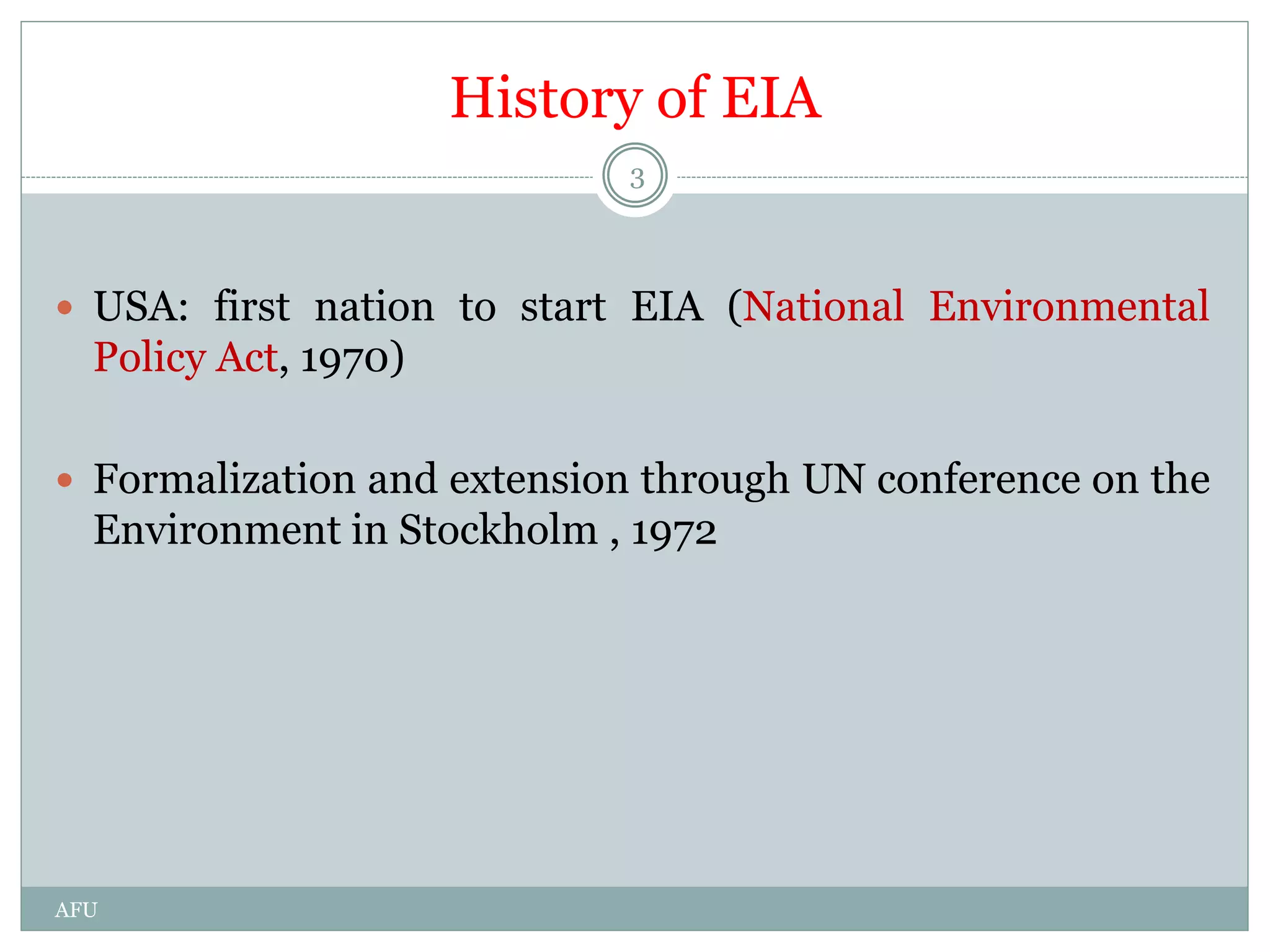
 USA: first nation to start EIA (National Environmental
Policy Act, 1970)
 Formalization and extension through UN conference on the
Environment in Stockholm , 1972
3
AFU
EIA in Nepal
 Sixth Five Year Plan (1980-1985) - first mentioned the need
for EIA for major infrastructure projects
 Eighth Five Year Plan (1991-1995) – need of EIA at the
stage of feasibility study
 National EIA Guideline, September 1992 and gazette in
July 1993
4
AFU
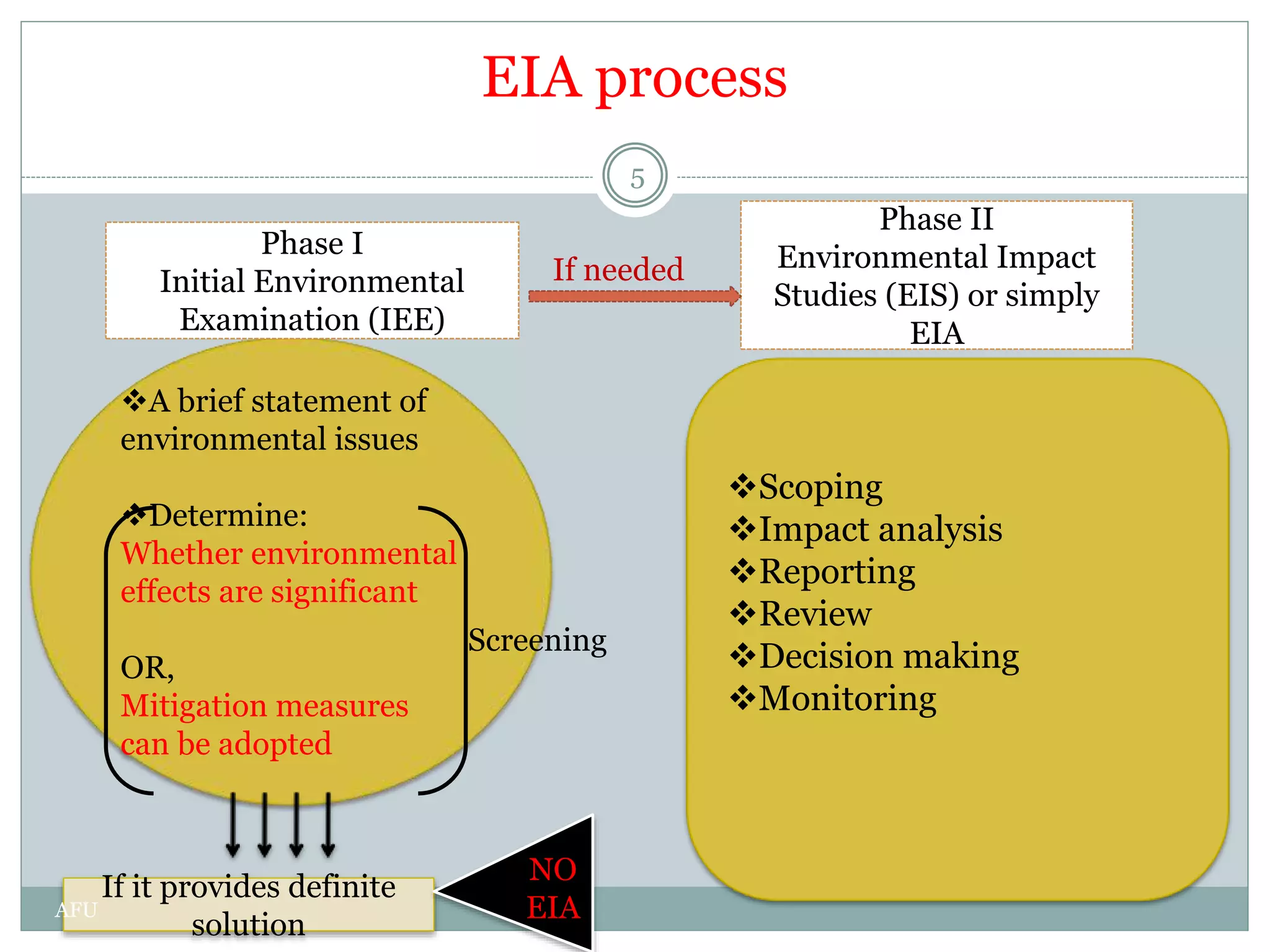
EIA process
Scoping
Impact analysis
Reporting
Review
Decision making
Monitoring
A brief statement of
environmental issues
Determine:
Whether environmental
effects are significant
OR,
Mitigation measures
can be adopted
Phase I
Initial Environmental
Examination (IEE)
Phase II
Environmental Impact
Studies (EIS) or simply
EIA
If it provides definite
solution
NO
EIA
If needed
Screening
5
AFU
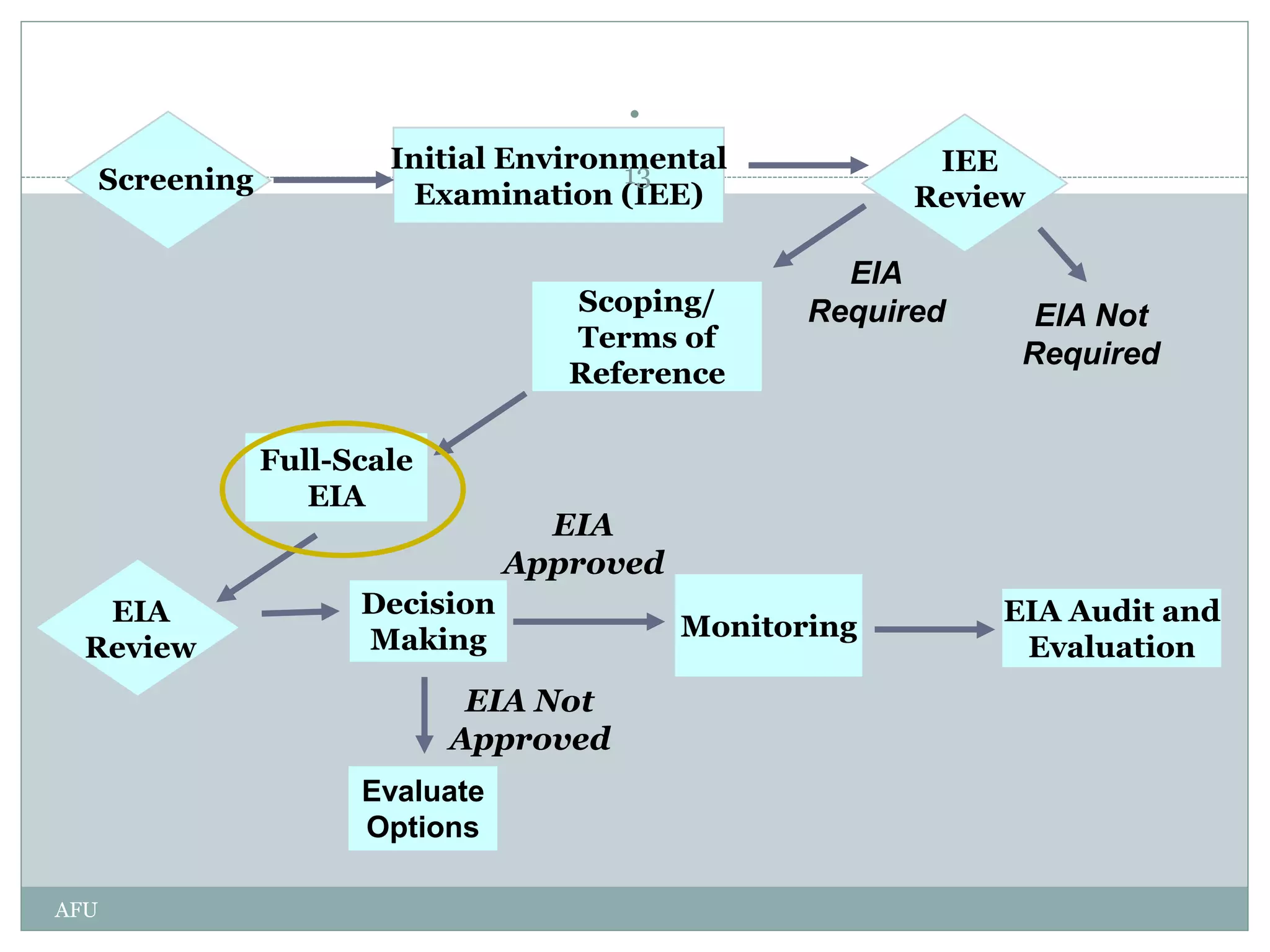
Screening
Initial Environmental
Examination (IEE)
EIA Not
Required
EIA
Required
Monitoring
EIA Audit and
Evaluation
IEE
Review
Scoping/
Terms of
Reference
Full-Scale
EIA
Evaluate
Options
EIA Not
Approved
EIA
Review
Decision
Making
EIA
Approved
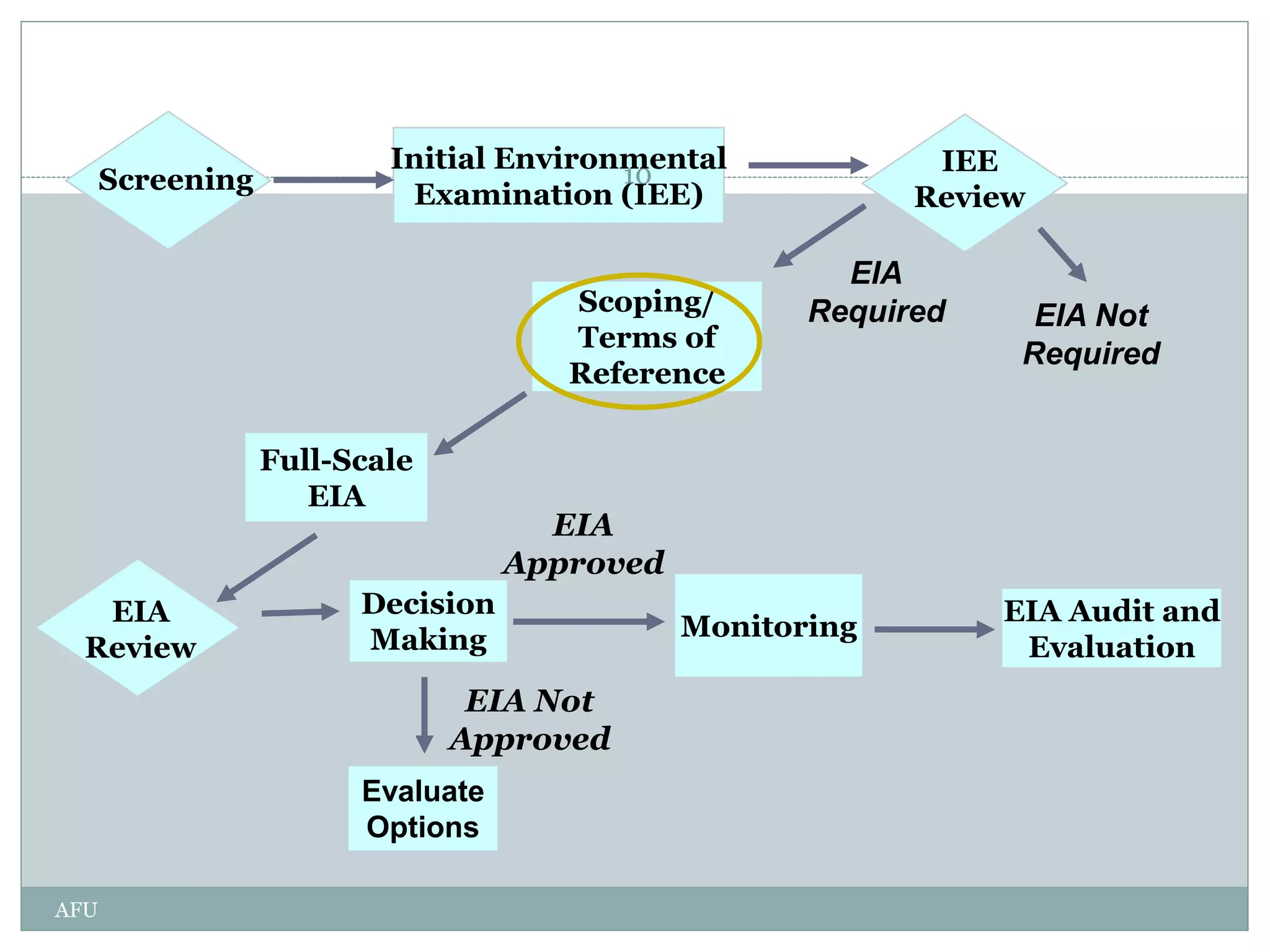
A flowchart of EIA Process
6
AFU
Screening
 No all development projects require an EIA, as some
projects may not pose an environmental threat
 Screening is the process used to determine
o Whether an proposed project or activity requires an EIA
and,
o If so, what level of environmental review is necessary
Phase I
7
AFU
IEE
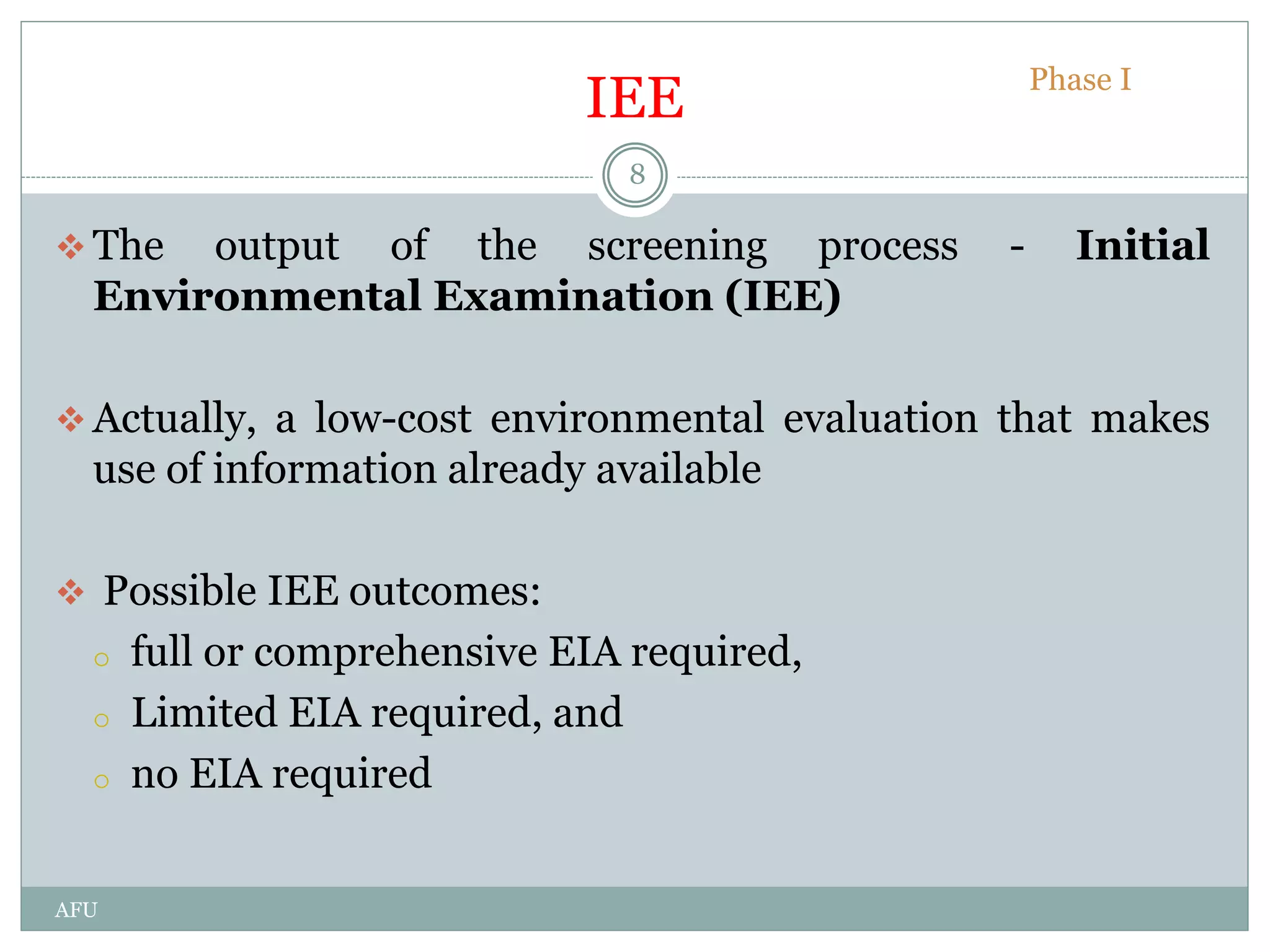
 The output of the screening process - Initial
Environmental Examination (IEE)
 Actually, a low-cost environmental evaluation that makes
use of information already available
 Possible IEE outcomes:
o full or comprehensive EIA required,
o Limited EIA required, and
o no EIA required
Phase I
8
AFU
IEE Flow chart…….
1. Identify Potential
Significant Environmental
Issues
2. Obtain Information
3. Effects Classification/
Identification of Significant
Environmental Issues (SEIs)
4. Resolve SEIs Where
Possible (Review
Alternatives/Develop
Environmental Management
Plans and Protection
Measures)
The IEE makes
recommendations
for further study:
Full-Scale EIA
IEE is the final
EIA Report
5. Are all SEIs
resolved?
YES NO
9
AFU
Screening
Initial Environmental
Examination (IEE)
EIA Not
Required
EIA
Required
Monitoring
EIA Audit and
Evaluation
IEE
Review
Scoping/
Terms of
Reference
Full-Scale
EIA
Evaluate
Options
EIA Not
Approved
EIA
Review
Decision
Making
EIA
Approved
10
AFU
Scoping
A process of interaction between government agencies
and project proponents
A stage for members of the public or NGOs to learn about
a proposed project and to voice their opinions
Identifies the key issues and impacts to be considered
Lays the foundation of an effective process, saves time
and money, and reduces conflict
Establish terms of reference (TOR) for EIA study
Phase II
11
AFU
Terms of Reference contents:
o Project Description (i.e., type, magnitude, location,
alternatives and constraints)
o Environmental Setting (i.e., delineation of study area,
listing of environmental resources and sensitive or special
value areas)
o Background Reports (e.g., aspects of the environmental
setting, previous projects with relevant impacts or
resources)
12
AFU
.
Screening
Initial Environmental
Examination (IEE)
EIA Not
Required
EIA
Required
Monitoring
EIA Audit and
Evaluation
IEE
Review
Scoping/
Terms of
Reference
Full-Scale
EIA
Evaluate
Options
EIA Not
Approved
EIA
Review
Decision
Making
EIA
Approved
13
AFU
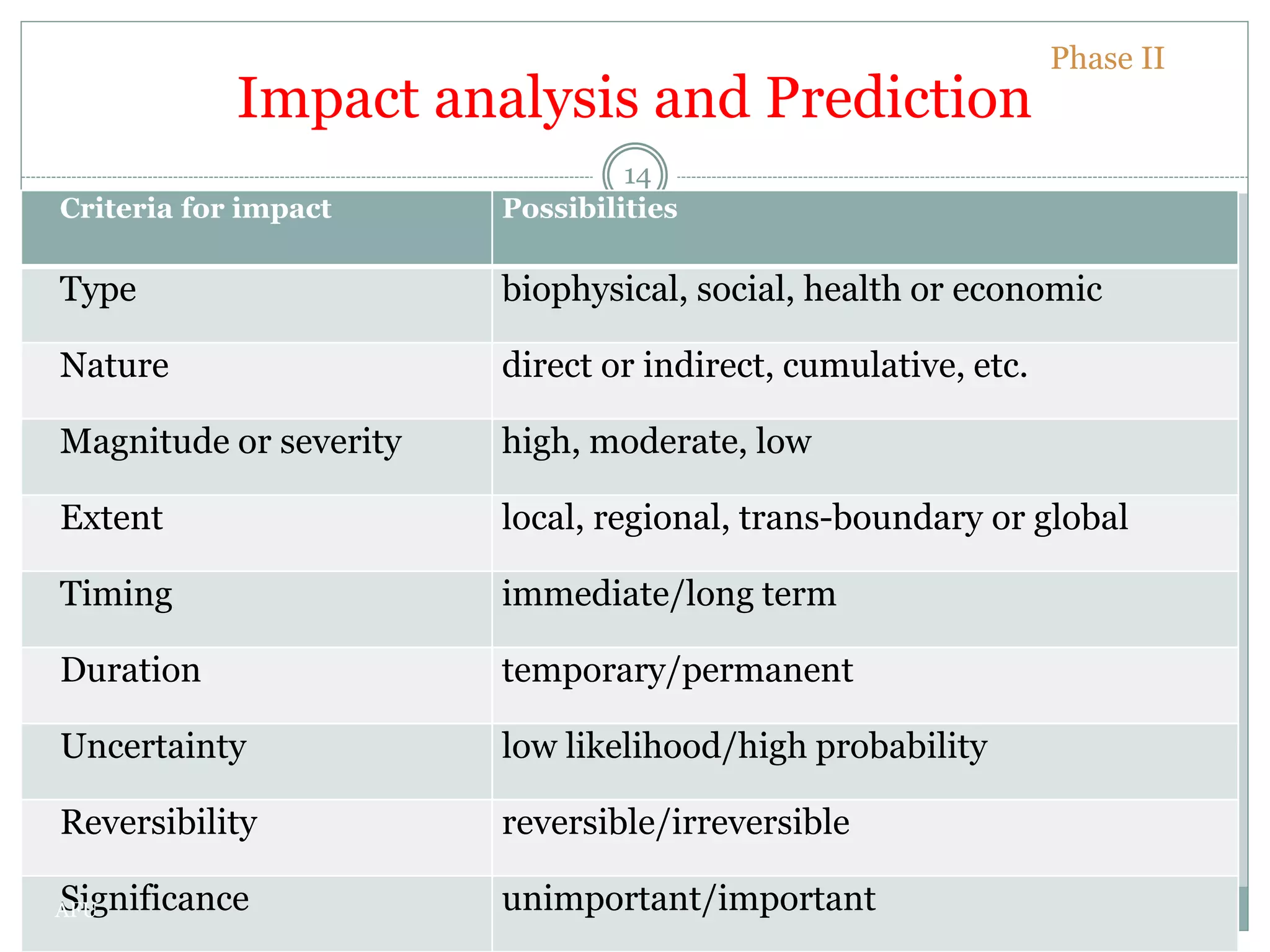
Impact analysis and Prediction
Criteria for impact Possibilities
Type biophysical, social, health or economic
Nature direct or indirect, cumulative, etc.
Magnitude or severity high, moderate, low
Extent local, regional, trans-boundary or global
Timing immediate/long term
Duration temporary/permanent
Uncertainty low likelihood/high probability
Reversibility reversible/irreversible
Significance unimportant/important
Phase II
14
AFU
Cont…
Tools used for impact analysis
o Checklists
o Matrices
o Networks
o Overlays and geographical information systems (GIS)
o Expert systems
o Professional judgment
15
AFU
Mitigation and impact management
 To avoid, minimize or offset predicted adverse impacts
 Different approaches for Impact management:
•Avoid
•Replace
•Reduce
•Restore
•Compensate
Phase II
16
AFU
Reporting
 Different Names for Report:
o Environmental Impact Assessment Report (EIA
Report,
o Environmental Impact Statement (EIS)
o Environmental Statement (ES)
Phase II
17
AFU
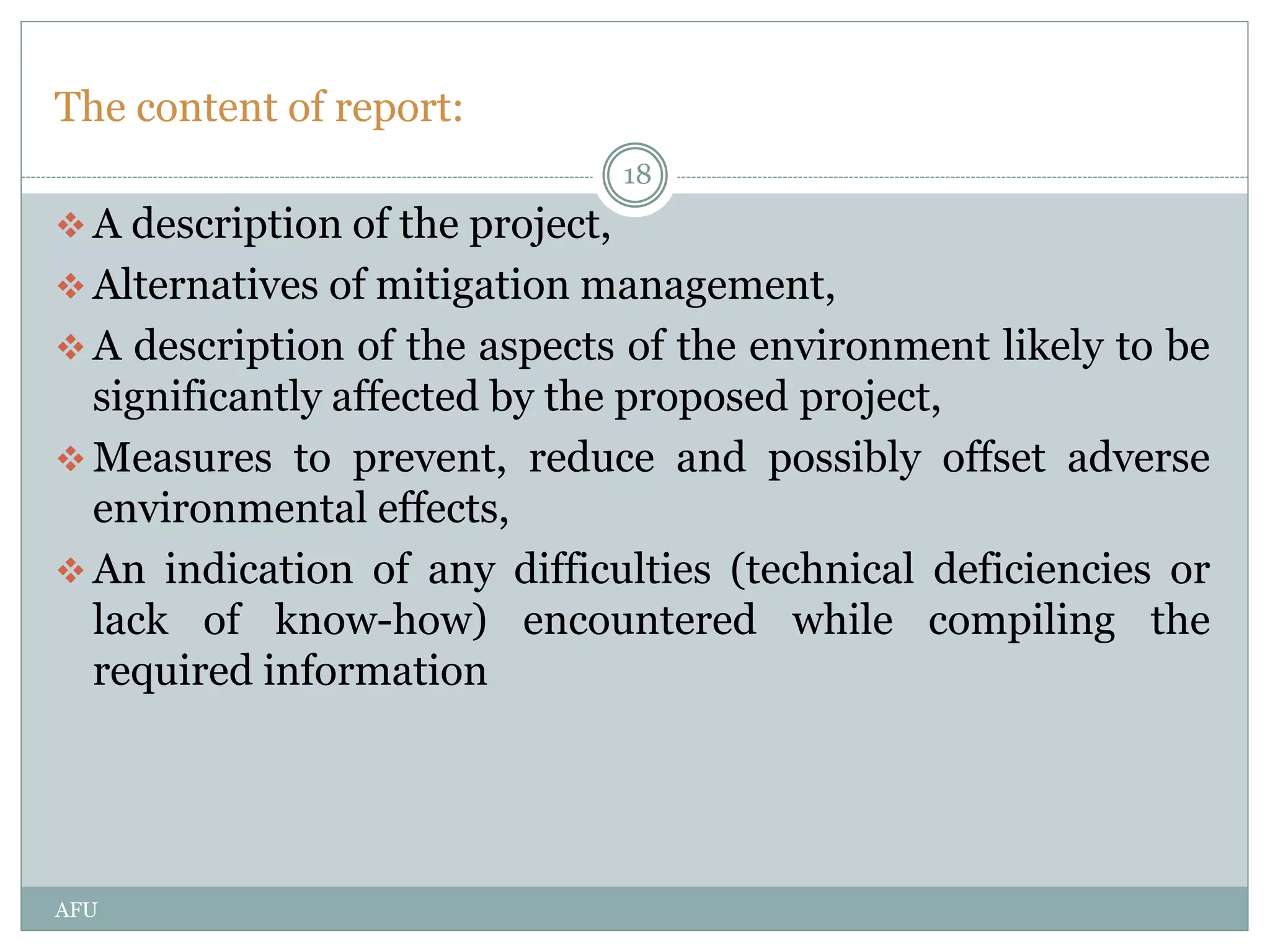
The content of report:
 A description of the project,
 Alternatives of mitigation management,
 A description of the aspects of the environment likely to be
significantly affected by the proposed project,
 Measures to prevent, reduce and possibly offset adverse
environmental effects,
 An indication of any difficulties (technical deficiencies or
lack of know-how) encountered while compiling the
required information
18
AFU
Screening
Initial Environmental
Examination (IEE)
EIA Not
Required
EIA
Required
Monitoring
EIA Audit and
Evaluation
IEE
Review
Scoping/
Terms of
Reference
Full-Scale
EIA
Evaluate
Options
EIA Not
Approved
EIA
Review
Decision
Making
EIA
Approved
19
AFU
Review
 To establish if the information in an EIA report is sufficient
for decision-making
 EIA review methods involves
o general checklists,
o project specific checklists,
o review packages,
o expert and accredited reviewers,
o public hearings,
o extended review frameworks etc.
Phase II
20
AFU
Decision making
 A decision to approve or reject a proposed project
 Possible decision outcome;
o Approval
o Approval with conditions
o Approval subject to ongoing investigation
o Further investigation required
o Request for a supplementary, or new, EIA report
o Rejection
 Ministry of Forest and Environment: Report approval of
EIA and environmental auditing
21
AFU
Screening
Initial Environmental
Examination (IEE)
EIA Not
Required
EIA
Required
Monitoring
EIA Audit and
Evaluation
IEE
Review
Scoping/
Terms of
Reference
Full-Scale
EIA
Evaluate
Options
EIA Not
Approved
EIA
Review
Decision
Making
EIA
Approved
22
AFU
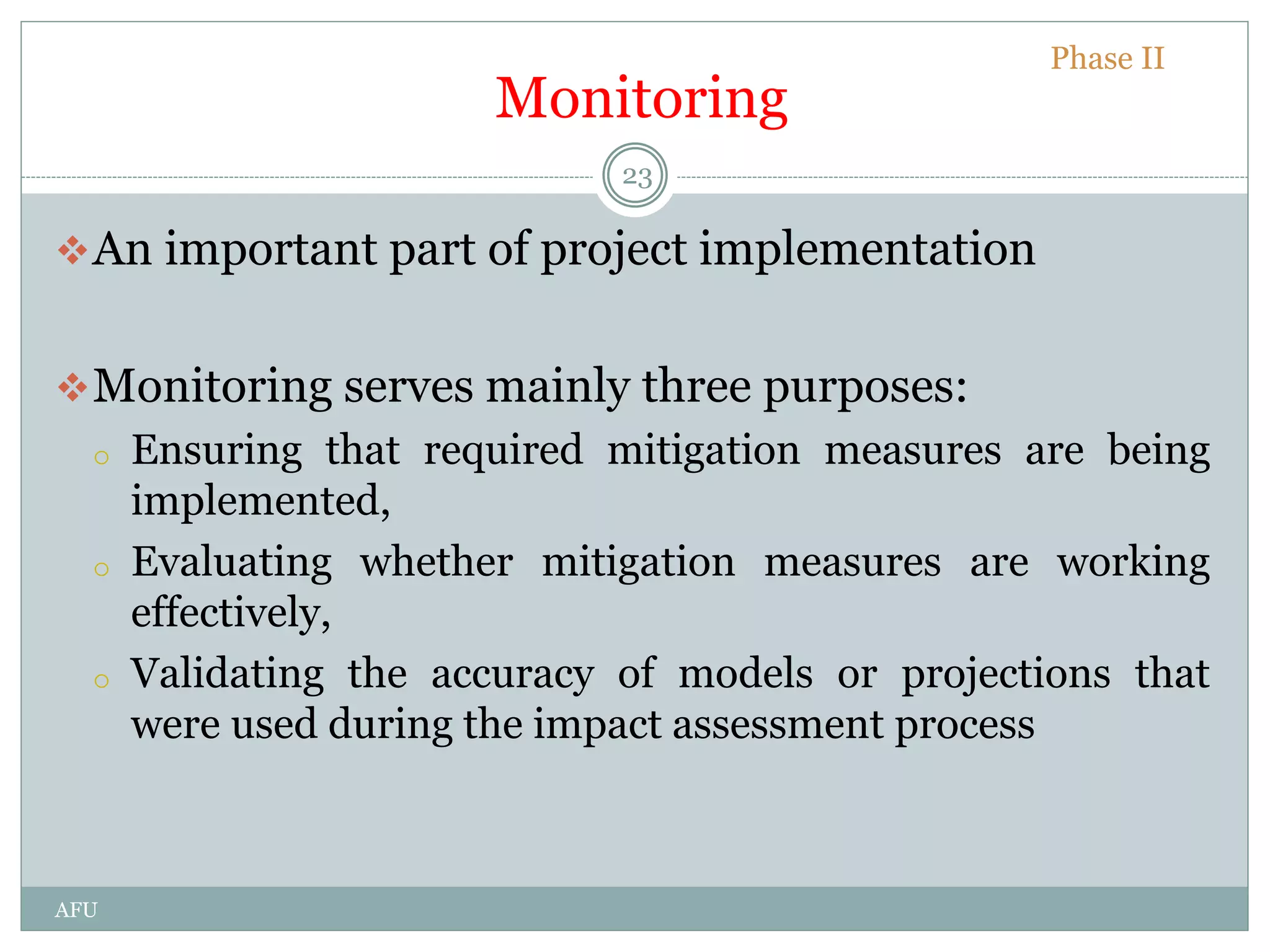
Monitoring
An important part of project implementation
Monitoring serves mainly three purposes:
o Ensuring that required mitigation measures are being
implemented,
o Evaluating whether mitigation measures are working
effectively,
o Validating the accuracy of models or projections that
were used during the impact assessment process
Phase II
23
AFU
Screening
Initial Environmental
Examination (IEE)
EIA Not
Required
EIA
Required
Monitoring
EIA Audit and
Evaluation
IEE
Review
Scoping/
Terms of
Reference
Full-Scale
EIA
Evaluate
Options
EIA Not
Approved
EIA
Review
Decision
Making
EIA
Approved
24
AFU
EIA Audit
 Determine impacts
 Check that conditions arising from EIA are being met
 Test accuracy of EIA predictions
 Identify areas where EIA could have been improved
 Compile lessons learned for future EIAs
Phase II
25
AFU
CONCLUDING THOUGHTS
 The integration of environment into development planning
is the most important tool in achieving sustainable
development.
 Thinks to be remember:
o The EIA process should be adaptive.
o The EIA process needs to be inclusive and transparent.
o The process should not be seen as an administrative task.
26
AFU
27
AFU

Eia and its process

  • 1.
    PREPARED BY: Manoj Sharma Msc.Ag(Agri- Economics) Agriculture and Forestry Univesity EIA and IT’S PROCESS 1 AFU
  • 2.
    What is EIA?  A study of the effects of a proposed project, plan or program on the environment  Sadler, B. 1996. “ Environmental impact assessment is a process of identifying, predicting, evaluating, and mitigating the biophysical, social, and other relevant effects of proposed projects and physical activities prior to major decisions and commitments being made ” 2 AFU
  • 3.
    History of EIA USA: first nation to start EIA (National Environmental Policy Act, 1970)  Formalization and extension through UN conference on the Environment in Stockholm , 1972 3 AFU
  • 4.
    EIA in Nepal Sixth Five Year Plan (1980-1985) - first mentioned the need for EIA for major infrastructure projects  Eighth Five Year Plan (1991-1995) – need of EIA at the stage of feasibility study  National EIA Guideline, September 1992 and gazette in July 1993 4 AFU
  • 5.
    EIA process Scoping Impact analysis Reporting Review Decisionmaking Monitoring A brief statement of environmental issues Determine: Whether environmental effects are significant OR, Mitigation measures can be adopted Phase I Initial Environmental Examination (IEE) Phase II Environmental Impact Studies (EIS) or simply EIA If it provides definite solution NO EIA If needed Screening 5 AFU
  • 6.
    Screening Initial Environmental Examination (IEE) EIANot Required EIA Required Monitoring EIA Audit and Evaluation IEE Review Scoping/ Terms of Reference Full-Scale EIA Evaluate Options EIA Not Approved EIA Review Decision Making EIA Approved A flowchart of EIA Process 6 AFU
  • 7.
    Screening  No alldevelopment projects require an EIA, as some projects may not pose an environmental threat  Screening is the process used to determine o Whether an proposed project or activity requires an EIA and, o If so, what level of environmental review is necessary Phase I 7 AFU
  • 8.
    IEE  The outputof the screening process - Initial Environmental Examination (IEE)  Actually, a low-cost environmental evaluation that makes use of information already available  Possible IEE outcomes: o full or comprehensive EIA required, o Limited EIA required, and o no EIA required Phase I 8 AFU
  • 9.
    IEE Flow chart……. 1.Identify Potential Significant Environmental Issues 2. Obtain Information 3. Effects Classification/ Identification of Significant Environmental Issues (SEIs) 4. Resolve SEIs Where Possible (Review Alternatives/Develop Environmental Management Plans and Protection Measures) The IEE makes recommendations for further study: Full-Scale EIA IEE is the final EIA Report 5. Are all SEIs resolved? YES NO 9 AFU
  • 10.
    Screening Initial Environmental Examination (IEE) EIANot Required EIA Required Monitoring EIA Audit and Evaluation IEE Review Scoping/ Terms of Reference Full-Scale EIA Evaluate Options EIA Not Approved EIA Review Decision Making EIA Approved 10 AFU
  • 11.
    Scoping A process ofinteraction between government agencies and project proponents A stage for members of the public or NGOs to learn about a proposed project and to voice their opinions Identifies the key issues and impacts to be considered Lays the foundation of an effective process, saves time and money, and reduces conflict Establish terms of reference (TOR) for EIA study Phase II 11 AFU
  • 12.
    Terms of Referencecontents: o Project Description (i.e., type, magnitude, location, alternatives and constraints) o Environmental Setting (i.e., delineation of study area, listing of environmental resources and sensitive or special value areas) o Background Reports (e.g., aspects of the environmental setting, previous projects with relevant impacts or resources) 12 AFU
  • 13.
    . Screening Initial Environmental Examination (IEE) EIANot Required EIA Required Monitoring EIA Audit and Evaluation IEE Review Scoping/ Terms of Reference Full-Scale EIA Evaluate Options EIA Not Approved EIA Review Decision Making EIA Approved 13 AFU
  • 14.
    Impact analysis andPrediction Criteria for impact Possibilities Type biophysical, social, health or economic Nature direct or indirect, cumulative, etc. Magnitude or severity high, moderate, low Extent local, regional, trans-boundary or global Timing immediate/long term Duration temporary/permanent Uncertainty low likelihood/high probability Reversibility reversible/irreversible Significance unimportant/important Phase II 14 AFU
  • 15.
    Cont… Tools used forimpact analysis o Checklists o Matrices o Networks o Overlays and geographical information systems (GIS) o Expert systems o Professional judgment 15 AFU
  • 16.
    Mitigation and impactmanagement  To avoid, minimize or offset predicted adverse impacts  Different approaches for Impact management: •Avoid •Replace •Reduce •Restore •Compensate Phase II 16 AFU
  • 17.
    Reporting  Different Namesfor Report: o Environmental Impact Assessment Report (EIA Report, o Environmental Impact Statement (EIS) o Environmental Statement (ES) Phase II 17 AFU
  • 18.
    The content ofreport:  A description of the project,  Alternatives of mitigation management,  A description of the aspects of the environment likely to be significantly affected by the proposed project,  Measures to prevent, reduce and possibly offset adverse environmental effects,  An indication of any difficulties (technical deficiencies or lack of know-how) encountered while compiling the required information 18 AFU
  • 19.
    Screening Initial Environmental Examination (IEE) EIANot Required EIA Required Monitoring EIA Audit and Evaluation IEE Review Scoping/ Terms of Reference Full-Scale EIA Evaluate Options EIA Not Approved EIA Review Decision Making EIA Approved 19 AFU
  • 20.
    Review  To establishif the information in an EIA report is sufficient for decision-making  EIA review methods involves o general checklists, o project specific checklists, o review packages, o expert and accredited reviewers, o public hearings, o extended review frameworks etc. Phase II 20 AFU
  • 21.
    Decision making  Adecision to approve or reject a proposed project  Possible decision outcome; o Approval o Approval with conditions o Approval subject to ongoing investigation o Further investigation required o Request for a supplementary, or new, EIA report o Rejection  Ministry of Forest and Environment: Report approval of EIA and environmental auditing 21 AFU
  • 22.
    Screening Initial Environmental Examination (IEE) EIANot Required EIA Required Monitoring EIA Audit and Evaluation IEE Review Scoping/ Terms of Reference Full-Scale EIA Evaluate Options EIA Not Approved EIA Review Decision Making EIA Approved 22 AFU
  • 23.
    Monitoring An important partof project implementation Monitoring serves mainly three purposes: o Ensuring that required mitigation measures are being implemented, o Evaluating whether mitigation measures are working effectively, o Validating the accuracy of models or projections that were used during the impact assessment process Phase II 23 AFU
  • 24.
    Screening Initial Environmental Examination (IEE) EIANot Required EIA Required Monitoring EIA Audit and Evaluation IEE Review Scoping/ Terms of Reference Full-Scale EIA Evaluate Options EIA Not Approved EIA Review Decision Making EIA Approved 24 AFU
  • 25.
    EIA Audit  Determineimpacts  Check that conditions arising from EIA are being met  Test accuracy of EIA predictions  Identify areas where EIA could have been improved  Compile lessons learned for future EIAs Phase II 25 AFU
  • 26.
    CONCLUDING THOUGHTS  Theintegration of environment into development planning is the most important tool in achieving sustainable development.  Thinks to be remember: o The EIA process should be adaptive. o The EIA process needs to be inclusive and transparent. o The process should not be seen as an administrative task. 26 AFU
  • 27.

Editor's Notes

  • #22 MOFE has authority to approve the EIA and env auditing.