Environmental Impact
Assessment and meaningful
citizen participation

            From an ongoing work of PAC


Mrs. Prarthana Rao
Programme Officer,
Public Affairs Centre, Bangalore
Outline of the presentation
   Introduction to EIA
   Environmental Legislations in India
   Process of EIA
   Public participation in EIA
   Concerns/gaps
   CLEIA – An initiative of PAC


                                          2
Introduction to EIA
 EIA is a formal process used to predict the
  environmental consequences of any
  development project.
 EIA is a relatively new planning and
  decision making tool in India
 Helps in identifying, environmental, social
  and economic impacts of a project prior to
  decision making
 Aids the process of selection of “optimal”
  alternative - maximise beneficial effects &
  mitigates adverse effects on environment
                                                3
Environmental legislations in
India
 Concern for Environment – 1972 – UN
  conference on human environment at
  Stockholm
 Tiwari committee – Department of
  Environment and Forest in 1980 (environmental
    impact studies and administrative responsibility for pollution
    monitoring and control)
 Umbrella Legislation – Environment
  Protection Act in 1986 gave statutory backing
  for MoEF
 EPA enactment – one of the outcomes was
  EIA becoming statutory – first notification in
  1994; latest notification in 2006
                                                                     4
EIA process in India
   Screening
   Scoping
   Impact prediction & Assessment of
    alternatives
   PUBLIC HEARING
   Environmental Management Plan
   Appraisal
   Monitoring the clearance conditions


                                          5
Screening
 The notification categorizes projects into
  two categories, A and B based on the
  spatial extent of the impacts, effects on
  human health and the effects on the
  environment.
 Category A projects are looked into by the
  Central Government and Category B
  Projects go to the State Government.
 Category B projects are further sub divided
  into Category B1 and Category B2, the
  former which do require an EIA and public
  consultation and the latter which don‟t
                                                6
Scoping
 Process of determining detailed and
  comprehensive Terms of Reference (ToR)
  for an Environment Impact Assessment
  (EIA) Report
 ToR to be conveyed within 60 days from
  receipt of Form 1by the appraisal committee
  else the ToR proposed by the proponent
  deemed fit
 ToR to be made public on website of the
  MoEF

                                                7
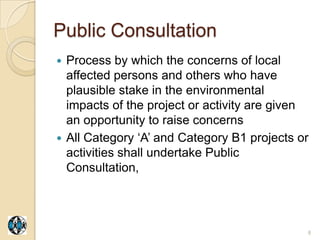
Public Consultation
 Process by which the concerns of local
  affected persons and others who have
  plausible stake in the environmental
  impacts of the project or activity are given
  an opportunity to raise concerns
 All Category „A‟ and Category B1 projects or
  activities shall undertake Public
  Consultation,


                                             8
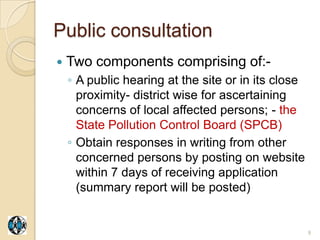
Public consultation
   Two components comprising of:-
    ◦ A public hearing at the site or in its close
      proximity- district wise for ascertaining
      concerns of local affected persons; - the
      State Pollution Control Board (SPCB)
    ◦ Obtain responses in writing from other
      concerned persons by posting on website
      within 7 days of receiving application
      (summary report will be posted)


                                                     9
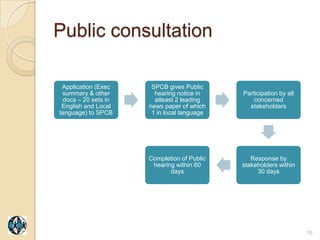
Public consultation

 Application (Exec     SPCB gives Public
 summary & other        hearing notice in    Participation by all
  docs – 20 sets in     atleast 2 leading        concerned
 English and Local    news paper of which      stakeholders
language) to SPCB      1 in local language


                      Completion of Public      Response by
                       hearing within 60     stakeholders within
                             days                 30 days


                                                                    10
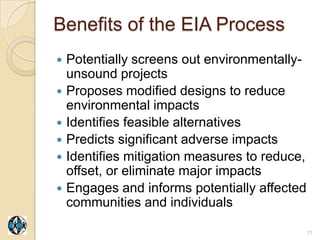
Benefits of the EIA Process
   Potentially screens out environmentally-
    unsound projects
   Proposes modified designs to reduce
    environmental impacts
   Identifies feasible alternatives
   Predicts significant adverse impacts
   Identifies mitigation measures to reduce,
    offset, or eliminate major impacts
   Engages and informs potentially affected
    communities and individuals

                                                11
Gaps ……
 The legislation prioritizes the needs of
  the industry over the environment.
 Categorization of projects results in
  diluting the responsibility of the
  Central Government – May result in
  timely clearances but room for misuse
  of powers at the State level


                                             12
Gaps …..
 Construction activities and SEZ‟s do
  not require a public hearing before
  going ahead with the project.
 Activities like tourism, which has a
  severe impact on the environment,
  does not require a clearance
 Allows only “CONCERNED” people to
  be part of the public consultation …….
  Big blow
                                       13
Gaps….
 Often timelines and procedures laid in
  the notification are not adhered to
 Misuse of clause which allows the
  cancellation of a public hearing if the
  local conditions are not conducive for
  hearing the views of the people.
 NO penalties on proponents for
  violating the terms and conditions of
  the clearance
                                            14
Community Led EIA (CLEIA)
– A PAC initiative
   To identify key areas to
    introduce/enhance public participation in
    the EIA paradigm
    To develop a toolkit that facilitates
    citizen participation at all stages of the
    EIA procedure
   To empower the local communities to
    engage with stakeholders in participatory
    environmental governance

                                                 15
THANK YOU


            16

Environmental Impact Assessment and Meaningful Citizen Participation

  • 1.
    Environmental Impact Assessment andmeaningful citizen participation From an ongoing work of PAC Mrs. Prarthana Rao Programme Officer, Public Affairs Centre, Bangalore
  • 2.
    Outline of thepresentation  Introduction to EIA  Environmental Legislations in India  Process of EIA  Public participation in EIA  Concerns/gaps  CLEIA – An initiative of PAC 2
  • 3.
    Introduction to EIA EIA is a formal process used to predict the environmental consequences of any development project.  EIA is a relatively new planning and decision making tool in India  Helps in identifying, environmental, social and economic impacts of a project prior to decision making  Aids the process of selection of “optimal” alternative - maximise beneficial effects & mitigates adverse effects on environment 3
  • 4.
    Environmental legislations in India Concern for Environment – 1972 – UN conference on human environment at Stockholm  Tiwari committee – Department of Environment and Forest in 1980 (environmental impact studies and administrative responsibility for pollution monitoring and control)  Umbrella Legislation – Environment Protection Act in 1986 gave statutory backing for MoEF  EPA enactment – one of the outcomes was EIA becoming statutory – first notification in 1994; latest notification in 2006 4
  • 5.
    EIA process inIndia  Screening  Scoping  Impact prediction & Assessment of alternatives  PUBLIC HEARING  Environmental Management Plan  Appraisal  Monitoring the clearance conditions 5
  • 6.
    Screening  The notificationcategorizes projects into two categories, A and B based on the spatial extent of the impacts, effects on human health and the effects on the environment.  Category A projects are looked into by the Central Government and Category B Projects go to the State Government.  Category B projects are further sub divided into Category B1 and Category B2, the former which do require an EIA and public consultation and the latter which don‟t 6
  • 7.
    Scoping  Process ofdetermining detailed and comprehensive Terms of Reference (ToR) for an Environment Impact Assessment (EIA) Report  ToR to be conveyed within 60 days from receipt of Form 1by the appraisal committee else the ToR proposed by the proponent deemed fit  ToR to be made public on website of the MoEF 7
  • 8.
    Public Consultation  Processby which the concerns of local affected persons and others who have plausible stake in the environmental impacts of the project or activity are given an opportunity to raise concerns  All Category „A‟ and Category B1 projects or activities shall undertake Public Consultation, 8
  • 9.
    Public consultation  Two components comprising of:- ◦ A public hearing at the site or in its close proximity- district wise for ascertaining concerns of local affected persons; - the State Pollution Control Board (SPCB) ◦ Obtain responses in writing from other concerned persons by posting on website within 7 days of receiving application (summary report will be posted) 9
  • 10.
    Public consultation Application(Exec SPCB gives Public summary & other hearing notice in Participation by all docs – 20 sets in atleast 2 leading concerned English and Local news paper of which stakeholders language) to SPCB 1 in local language Completion of Public Response by hearing within 60 stakeholders within days 30 days 10
  • 11.
    Benefits of theEIA Process  Potentially screens out environmentally- unsound projects  Proposes modified designs to reduce environmental impacts  Identifies feasible alternatives  Predicts significant adverse impacts  Identifies mitigation measures to reduce, offset, or eliminate major impacts  Engages and informs potentially affected communities and individuals 11
  • 12.
    Gaps ……  Thelegislation prioritizes the needs of the industry over the environment.  Categorization of projects results in diluting the responsibility of the Central Government – May result in timely clearances but room for misuse of powers at the State level 12
  • 13.
    Gaps …..  Constructionactivities and SEZ‟s do not require a public hearing before going ahead with the project.  Activities like tourism, which has a severe impact on the environment, does not require a clearance  Allows only “CONCERNED” people to be part of the public consultation ……. Big blow 13
  • 14.
    Gaps….  Often timelinesand procedures laid in the notification are not adhered to  Misuse of clause which allows the cancellation of a public hearing if the local conditions are not conducive for hearing the views of the people.  NO penalties on proponents for violating the terms and conditions of the clearance 14
  • 15.
    Community Led EIA(CLEIA) – A PAC initiative  To identify key areas to introduce/enhance public participation in the EIA paradigm  To develop a toolkit that facilitates citizen participation at all stages of the EIA procedure  To empower the local communities to engage with stakeholders in participatory environmental governance 15
  • 16.